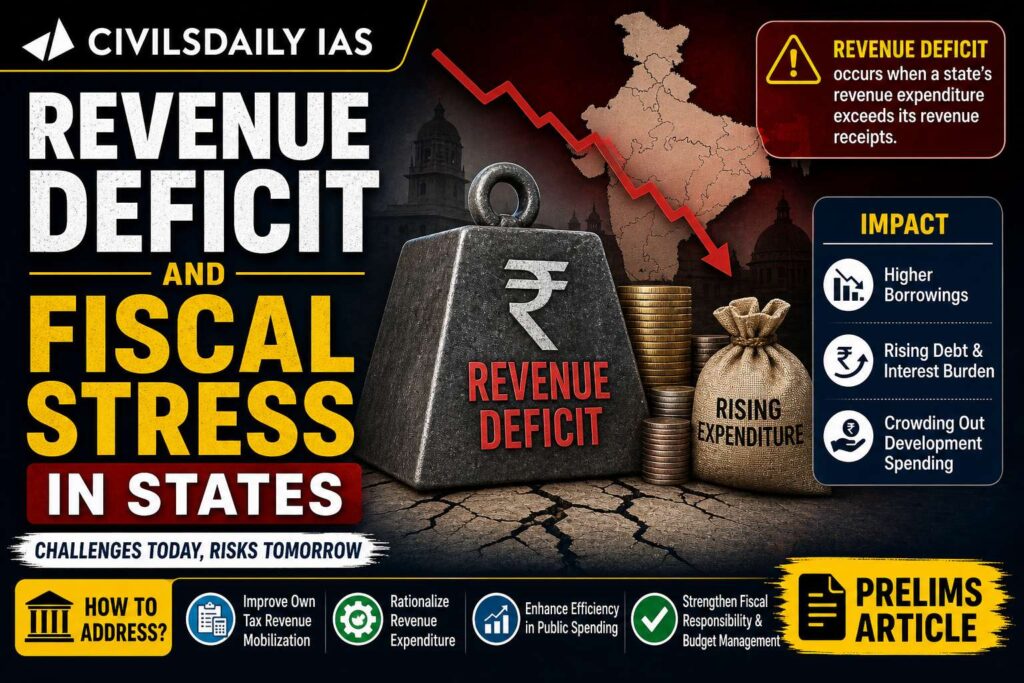
Why in the News
The Ministry of Finance in its Monthly Economic Review (April 2026) has warned that several Indian States with revenue deficits and high debt burdens may face fiscal stress, especially during economic shocks.
What is Revenue Deficit
- Occurs when revenue expenditure exceeds revenue receipts
- Revenue expenditure includes:
- Salaries
- Pensions
- Subsidies
- Interest payments
- Revenue receipts include:
- Taxes
- Fees
- Non tax revenues
Key Findings
- Out of 18 major States analysed:
- 9 States projected to have revenue deficit
- 7 States projected to have revenue surplus
- 1 State in revenue balance
States with Revenue Deficit (Important)
- Himachal Pradesh, Punjab, Kerala, Andhra Pradesh, Rajasthan, Haryana, Karnataka, Maharashtra, and Chhattisgarh.
- Punjab has highest interest burden (22.8 percent of revenue receipts)
States with Revenue Surplus
- Odisha, Jharkhand, Uttar Pradesh, Goa, Gujarat, Uttarakhand, Telangana, and Bihar
Key Concept
- Golden Rule of Fiscal Policy
- Governments should borrow only for capital expenditure
- Revenue deficit should ideally be zero
Fiscal Concerns
- High interest payments reduce fiscal flexibility
- Revenue deficit States may:
- Cut productive expenditure (capital spending)
- Seek higher central transfers
- Limited ability to respond to economic shocks
| [2025] Suppose the revenue expenditure is ₹ 80,000 crores and the revenue receipts of the Government are ₹ 60,000 crores. The Government budget also shows borrowings of ₹ 10,000 crores and interest payments of ₹ 6,000 crores. Which of the following statements are correct? I. Revenue deficit is ₹ 20,000 crores. II. Fiscal deficit is ₹ 10,000 crores. III. Primary deficit is ₹ 4,000 crores. Select the correct answer using the code given below. [A] I and II only [B] II and III only [C] I and III only [D] I, II and III |
