Why in News?
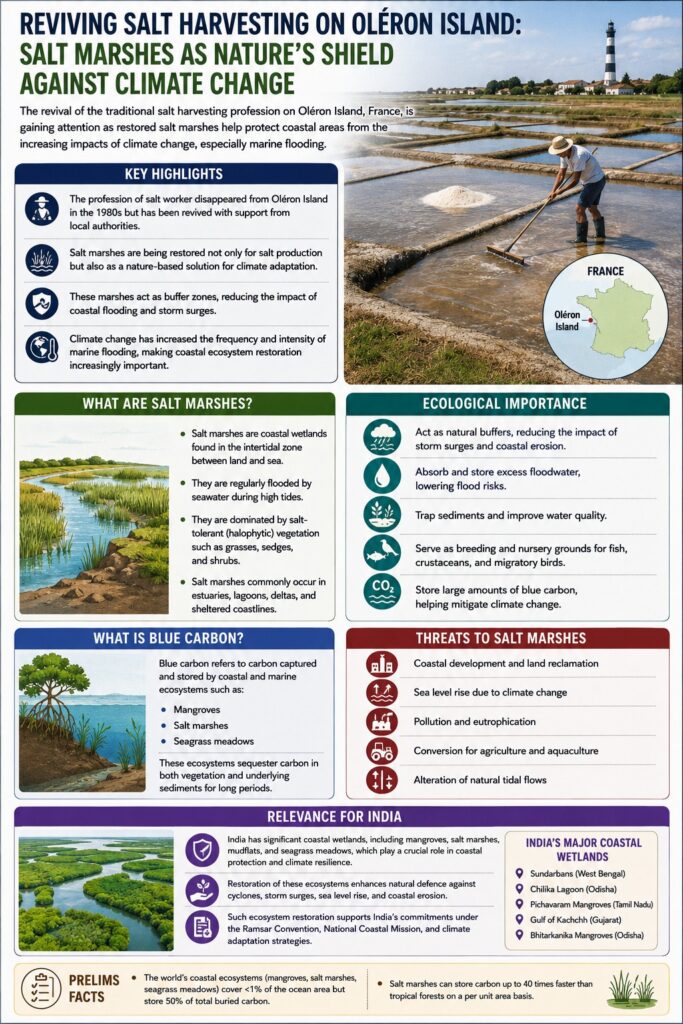
The revival of the traditional salt harvesting profession on Oléron Island, France, is gaining attention as restored salt marshes help protect coastal areas from the increasing impacts of climate change, especially marine flooding.
Key Highlights
- The profession of salt worker disappeared from Oléron Island in the 1980s but has been revived with support from local authorities.
- Salt marshes are being restored not only for salt production but also as a nature-based solution for climate adaptation.
- These marshes act as buffer zones, reducing the impact of coastal flooding and storm surges.
- Climate change has increased the frequency and intensity of marine flooding, making coastal ecosystem restoration increasingly important.
What are Salt Marshes?
- Salt marshes are coastal wetlands found in the intertidal zone between land and sea.
- They are regularly flooded by seawater during high tides.
- They are dominated by salt-tolerant (halophytic) vegetation such as grasses, sedges, and shrubs.
- Salt marshes commonly occur in estuaries, lagoons, deltas, and sheltered coastlines.
Ecological Importance
- Act as natural buffers, reducing the impact of storm surges and coastal erosion.
- Absorb and store excess floodwater, lowering flood risks.
- Trap sediments and improve water quality.
- Serve as breeding and nursery grounds for fish, crustaceans, and migratory birds.
- Store large amounts of blue carbon, helping mitigate climate change.
What is Blue Carbon?
- Blue carbon refers to carbon captured and stored by coastal and marine ecosystems such as: Mangroves, Salt marshes, and Seagrass meadows
- These ecosystems sequester carbon in both vegetation and underlying sediments for long periods.
Threats to Salt Marshes
- Coastal development and land reclamation.
- Sea level rise due to climate change.
- Pollution and eutrophication.
- Conversion for agriculture and aquaculture.
- Alteration of natural tidal flows.
Relevance for India
- India has significant coastal wetlands, including mangroves, salt marshes, mudflats, and seagrass meadows, which play a crucial role in coastal protection and climate resilience.
- Restoration of these ecosystems supports India’s commitments under the Ramsar Convention, National Coastal Mission, and climate adaptation strategies.
[2021] What is blue carbon?
[A] Carbon captured by oceans and coastal ecosystems
[B] Carbon sequestered in forest biomass and agricultural soils
[C] Carbon contained in petroleum and natural gas
[D] Carbon present in atmosphere
