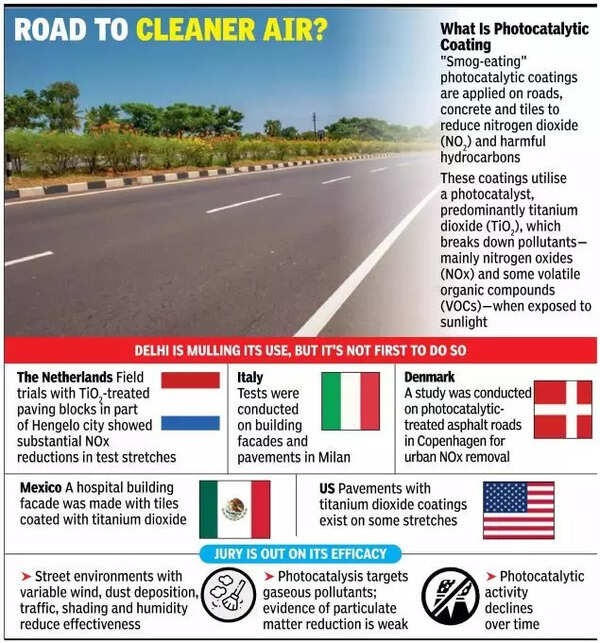
Why in the News
- The Delhi Government and IIT Madras are collaborating to study smog eating photocatalytic coatings on roads to reduce urban air pollution.
What is Smog-Eating Photocatalytic Coating
- A special coating applied on roads and buildings
- Designed to neutralize harmful pollutants in the air
- Targets:
- Nitrogen dioxide (NO₂)
- Volatile hydrocarbons
- Other toxic gases
Compound Used
Titanium Dioxide (TiO₂)
- Most commonly used material
- Advantages:
- Low cost
- Chemically stable
- Durable
- Compatible with construction materials
Working Mechanism
Photocatalysis Process
- Sunlight activates Titanium dioxide
- Chemical reactions break down pollutants
- Converts harmful gases into:
- Less toxic substances
- Harmless compounds
Result:
- Cleaner air
- Reduced smog levels
- Environmental cleaning
Applications
- Roads, Buildings, Pavements, Flyovers, and Public infrastructure
Benefits
- Reduces urban air pollution
- Passive pollution control
- Low maintenance
- Cost effective
- Sustainable technology
| [2013] Photochemical smog is a resultant of the reaction among: (a) NO 2 , O 3 and peroxyacetyl nitrate (PAN) in the presence of sunlight (b) CO 2 , O 2 , and peroxyacetyl nitrate in the presence of sunlight (c) CO, CO 2 , and NO 2 at low temperature (d) high concentration of NO 2 , O 3 and CO in the evening |

