Why in the news?
Scientists from the Physical Research Laboratory (PRL) used data from Chandrayaan-2’s Dual Frequency Synthetic Aperture Radar (DFSAR) to discover strong evidence of subsurface water-ice near the Moon’s South Pole.
Key Findings
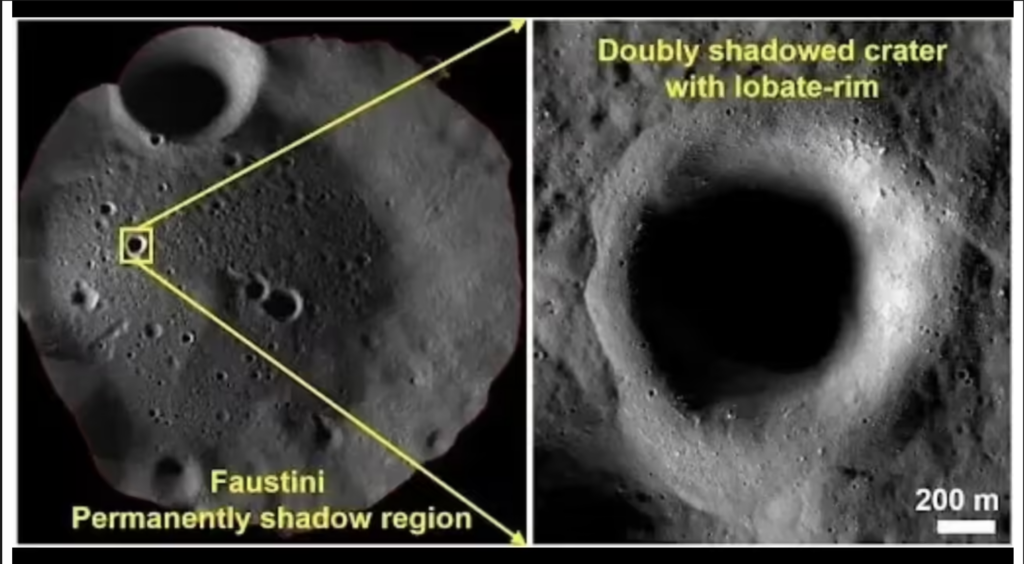
- Target Location: Four “doubly shadowed craters” located inside Permanently Shadowed Regions (PSRs) at the lunar south pole.
- Extreme Thermal Environment: These locations are permanently shielded from solar radiation, maintaining temperatures around 25 Kelvin (-248°C), acting as ideal cold traps to preserve volatiles.
- The Prime Candidate: A 1.1 km diameter micro-crater located within the larger Faustini Crater showed the highest probability of containing clean subsurface ice.
Geomorphological Evidence
- Lobate-Rim Morphology: The highly-evident 1.1 km crater exhibits flow-like, lobed patterns along its rim.
- Geological Meaning: This indicates that the initial meteoroid impact likely penetrated a layer of subsurface ice, melting it briefly to create a slurry-like, fluid ejecta pattern before re-freezing.
About Chandrayaan-2 & DFSAR
- Mission Context: Launched in July 2019; while its Vikram lander failed to make a soft landing, the orbiter remains fully functional in lunar orbit.
- DFSAR Instrument: Dual Frequency Synthetic Aperture Radar.
- Capabilities: It is the first fully polarimetric radar sent to the Moon, operating across L-band and S-band microwave frequencies to penetrate deep into the lunar regolith.
Significance
- In-Situ Resource Utilization (ISRU): Essential for future crewed bases (such as Artemis or India’s planned lunar base) to harvest local water for life support and rocket fuel production.
- Strategic Mapping: Provides high-fidelity targeting data for future landing and excavation missions, including India’s upcoming Chandrayaan missions.
Challenges
- Accessing Cold Traps: Operating mechanical equipment in permanent darkness at 25 Kelvin presents immense engineering challenges.
- Regolith Depth Overburden: The ice is subsurface, requiring specialized drilling and extraction systems rather than surface scraping.
[2017] The terms ‘Event Horizon’, ‘Singularity’, ‘String Theory’ and ‘Standard Model’ are sometimes seen in the news in the context of
[A] Observation and understanding of the Universe
[B] Study of the solar and the lunar eclipses
[C] Placing satellites in the orbit of the Earth
[D] Origin and evolution of living organisms on the earth
