Why in the News?
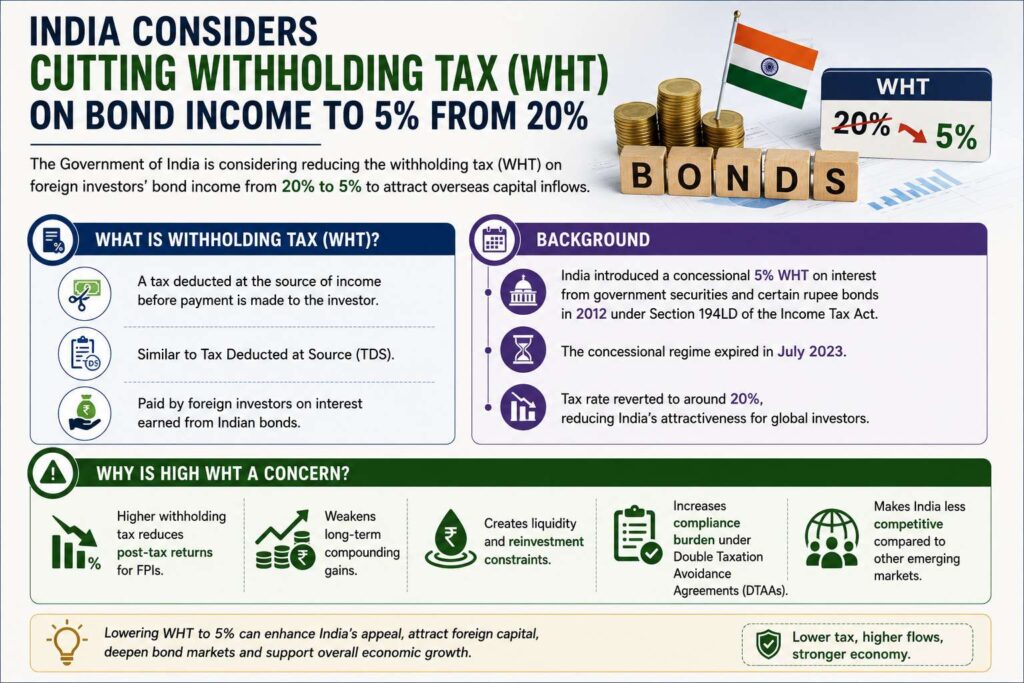
The Government of India is considering reducing the withholding tax (WHT) on foreign investors’ bond income from 20% to 5% to attract overseas capital inflows.
What is Withholding Tax (WHT)?
- A tax deducted at the source of income before payment is made to the investor.
- Similar to Tax Deducted at Source (TDS).
- Paid by foreign investors on interest earned from Indian bonds.
Background
- India introduced a concessional 5% WHT on interest from government securities and certain rupee bonds in 2012 under Section 194LD of the Income Tax Act.
- The concessional regime expired in July 2023.
- Tax rate reverted to around 20%, reducing India’s attractiveness for global investors.
Why is High WHT a Concern?
Higher withholding tax:
- Reduces post-tax returns for FPIs.
- Weakens long-term compounding gains.
- Creates liquidity and reinvestment constraints.
- Increases compliance burden under Double Taxation Avoidance Agreements (DTAAs).
How Will Tax Reduction Help FPIs?
- Improve effective yields on Indian bonds.
- Increase attractiveness of Indian debt markets.
- Encourage foreign capital inflows.
- Support forex reserves and external stability.
Global Comparison
- Countries imposing WHT on foreign investors:
- United States: 30%
- Germany: 26.4%
- France: 25%
- China: 10%
- No WHT: Hong Kong and Singapore
FPIs in India’s Debt Market
- FPIs hold a limited share of India’s government debt market.
- Investments increased after inclusion in global bond indices such as:
- JPMorgan Government Bond Index-Emerging Market
- RBI cap on FPI investment in government securities:
- 6% of outstanding stock
| [2019] Which of the following is issued by registered foreign portfolio investors to overseas investors who want to be part of the Indian stock market without registering themselves directly? (a) Certificate of Deposit (b) Commercial Paper (c) Promissory Note (d) Participatory Note |
