Why in the News
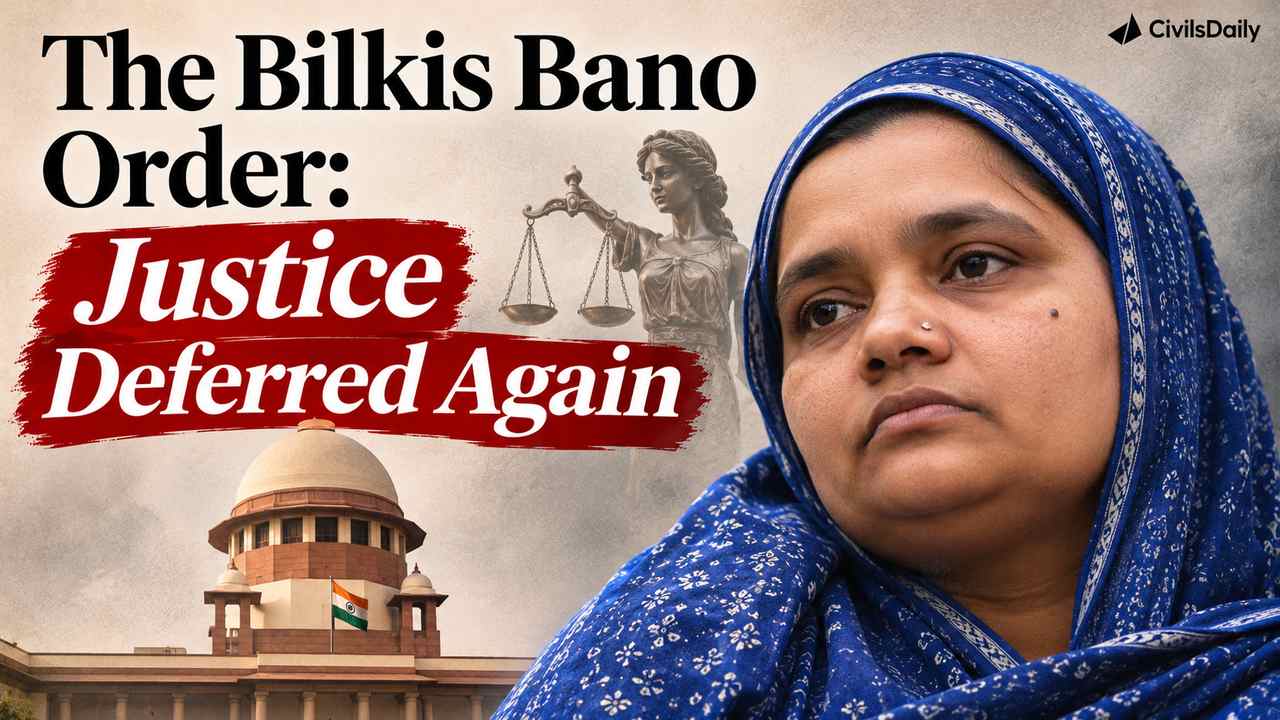
A two judge Supreme Court Bench has suspended the life sentences of two of the 11 men convicted of gang-raping Bilkis Bano during the 2002 Gujarat riots, granting them bail pending appeal. She was not heard before the order, so a criminal justice system that calls itself victim-centric left the survivor out.
What is suspension of sentence pending appeal?
- What it is: Suspension of sentence lets an appeal court pause a convict’s sentence and release them on bail until the appeal is decided. In effect it is bail by another name.
- Legal home: The power sat in Section 389 of the Code of Criminal Procedure, 1973 (CrPC). It now sits in Section 430 of the Bharatiya Nagarik Suraksha Sanhita, 2023 (BNSS).
- Why it exists: It spares a convict whose appeal may take years from serving a sentence a higher court might set aside. Settled law treats it as an exception, demanding clear and compelling reasons that weigh the crime’s seriousness and the appeal’s chances.
- Prosecutor’s safeguard: For offences punishable with death, life imprisonment or at least 10 years, the Public Prosecutor must be allowed to show cause in writing against release. The provision names the prosecutor, not the victim.
- The takeaway: The provision protects the convict’s liberty and gives the state a voice, but leaves the survivor without one.
Why is this no routine bail case?
- The crime: In March 2002 a mob attacked Ms. Bano’s group near Chapparwad village in Dahod district. She was gang-raped while pregnant, and seven family members were killed.
- Stalled prosecution: After the inquiry was closed, the Supreme Court and the Central Bureau of Investigation (CBI) had it reopened. The trial moved to Maharashtra, and a Mumbai special court convicted the 11 men in 2008.
- Remission quashed: Gujarat granted remission, an early release from a sentence, to all the convicts in August 2022. In Bilkis Yakub Rasool v. Union of India (2024), the Court quashed it, because Gujarat was not the competent government.
What did the Bench decide, and why is it contested?
- Grounds for relief: The Bench noted that both men had spent over 17 years in jail, one has a severe disability, and their appeals raise questions of fact and law.
- Not an acquittal: The convictions, upheld by the Bombay High Court in 2017, stand, and the appeals are still to be decided.
- Survivor not heard: The Additional Solicitor General opposed the pleas, but Ms. Bano was neither informed nor heard. The convicts’ counsel says she was not a party.
- Similar relief: On November 23 the same Bench released Siraj Pada, a convict in the Sabarmati Express coach fire case, on similar grounds.
Which rights and laws collide in this order?
- Speedy appeal: Since Hussainara Khatoon vs State of Bihar (1979), the Court has read a right to speedy trial into Article 21, later extended to a reasonably prompt appeal.
- Dignity and equality: Article 21 also protects the survivor’s dignity. Article 14 bars the state from treating one side of a case with more care than the other.
- Victim in law: In 2009 Parliament defined “victim” in Section 2(wa) of the CrPC. It also gave victims a right of appeal under the proviso to Section 372.
- Right to be heard: Mallikarjun Kodagali vs State of Karnataka (2018) read that appeal right broadly, in the victim’s favour. Jagjeet Singh vs Ashish Mishra (2022) held that a victim must be heard at every stage, bail included.
Challenges
- Silent statute: The suspension provision requires only the prosecutor to be heard, so a survivor’s voice depends on a court’s discretion.
- Appellate delay: Appeals pending for years make long custody itself a ground for release, shifting the cost of delay onto the survivor.
- Mass violence cases: Routine bail standards applied to grave communal crimes erode survivors’ trust in courts.
Way Forward
- BNSS amendment: Parliament should require notice to the victim before a sentence is suspended for offences carrying life imprisonment.
- Time-bound appeals: High Courts and the Supreme Court should list long-pending appeals in grave offences for time-bound hearing.
- Recorded reasons: Courts should record why a victim was or was not heard in every suspension order.
Conclusion
The order sets a convict’s right to a prompt appeal against a survivor’s right to be heard, and the law as written protects only the first. Whether Parliament or the Court writes the victim into the suspension provision will decide if victim-centric justice is real.
Matching Previous Year Question
“[2026, GS2, 10 marks] Right to privacy relating to self-identity is very dear to every human being and well protected under Article 21 of the Constitution. In this context, examine the effect of the amendment in 2026, to the Transgender Persons (Protection of Rights) Act, 2019.”
