Why in the News
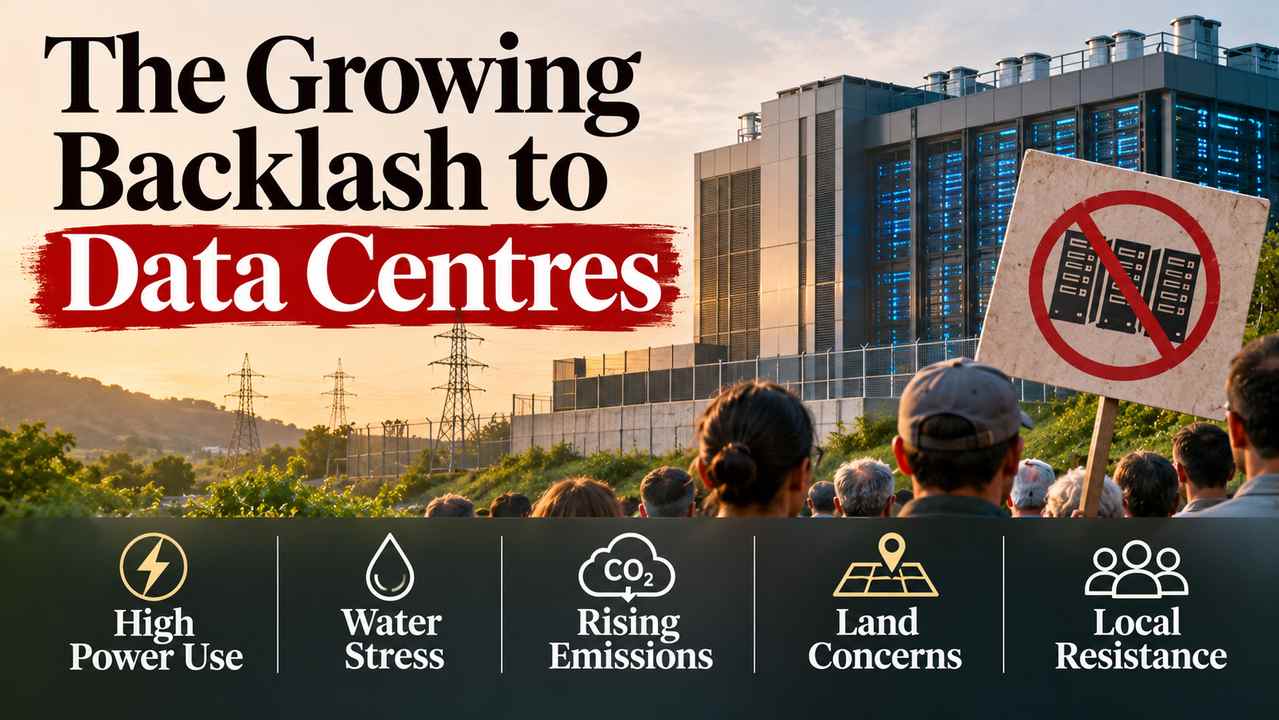
Data centres, sold as engines of growth and jobs, now face local resistance over water, power, land and the few lasting jobs they create. In India, court pleas challenge the environmental clearance and land allocation for the $15 billion artificial intelligence (AI) data centre campus that Adani Enterprises and Google plan in Visakhapatnam, Andhra Pradesh. Similar opposition has surfaced from Finland to Kenya.
What is an AI data centre, and why is it different?
- What it is: A data centre houses the servers, storage and cooling systems that store, process and manage data. It works like a warehouse for the internet.
- Why location matters: Data centres must sit near users to avoid latency, the delay signals suffer over long distances.
- AI changes the scale: AI data centres run on graphics processing units (GPUs), chips built for complex calculations, so they are larger and use far more power. Their size is measured in megawatts (MW).
- Power appetite: The International Energy Agency (IEA) says a typical AI data centre uses as much electricity as 100,000 households, and the largest under construction will use 20 times as much.
- The takeaway: AI has turned data centres into heavy users of land, water and power, which is why communities contest them.
Why do governments want more of them?
- Data sovereignty: The host country’s laws decide a data centre’s security and who can access it, which matters for health data. The United States (US) hosts nearly half of all data centres.
- India’s hosting gap: India generates nearly a fifth of the world’s data but hosts only about 3% of global data centres, says the Economic Survey 2025-26.
- Promised gains: The Adani-Google release promises digital inclusion, tens of thousands of jobs and an energy project to strengthen the grid.
- “Double-edged swords”: The Survey calls data centres this, citing an estimate that one AI data centre uses a rocket launch’s energy daily.
Why are communities opposed?
- Resource and cost burden: Communities see data centres as guzzlers of water and electricity with little local benefit:
- evaporative cooling removes server heat by evaporating water, so residents fear for their drinking water;
- newer direct-to-chip cooling instead circulates coolant through cold plates on the processors;
- firms buying renewable power may still draw on fossil-heavy grids, passing extra load to other consumers;
- construction employs thousands for about a year, but only just over 100 permanent jobs remain.
- US midterm signal: The Republican Party’s midterm losses partly reflected voter rejection of data centre expansion. Tech and AI stocks lost $2.5 trillion as investors expected Democrats to be less pro-AI.
- Visakhapatnam objections: The Human Rights Forum says the green clearance lacked informed public debate, and flags the site’s link to a reservoir catchment and a wildlife sanctuary.
- Local costs, distant benefits: Benefits go to distant users, but costs stay with the host locality, which fuels NIMBY (“not in my backyard”) opposition.
How are data centres regulated?
- No national policy: India has no national data centre policy. Uttar Pradesh, Maharashtra, Andhra Pradesh, Karnataka and Telangana have State policies aimed mainly at attracting investment.
- Race to the bottom: Without national rules, States may compete to offer companies the least demanding terms.
- Survey’s alternative: AI infrastructure competes with households and industry, so the Survey backs “smaller, task-specific (AI) models” on limited hardware and decentralised compute.
Challenges
- Investment-first State policies: Policies built to woo investors carry few environmental or community safeguards.
- Grid strain: Large AI loads push utilities towards fossil power and raise other consumers’ tariffs.
- Weak consultation: Clearances without informed public debate invite litigation and delay.
Way Forward
- National data centre policy: The Ministry of Electronics and Information Technology (MeitY) should frame national norms on siting, water and energy use.
- Efficiency mandates: Require water-light cooling and disclosure of water and power use.
- Dedicated clean power: Tie approvals to dedicated renewable supply so grid costs do not shift to others.
- Informed public hearings: Make informed public consultation part of the clearance process for large facilities.
Conclusion
India needs more data centres, but AI-scale facilities impose real local costs that are unevenly shared. A national policy with common rules on water, power and consultation will decide if expansion earns local consent.
Key numbers
- Shell of a frontier-scale facility (Harvard Business School estimate): $2 billion to $4 billion for a 150 MW facility.
- Servers and hardware: $3 billion or more to fill that shell, plus recurring billions.
- City-wise capacity (MeitY): Mumbai and Navi Mumbai 790 MW; Chennai 305 MW.
Matching Previous Year Question
“[2018] Consider the following pairs : Terms sometimes seen in news Context /Topic Belle II experiment Artificial Intelligence Blockchain technology Digital/ Cryptocurrency CRISPR — Cas9 Particle Physics Which of the pairs given above is/are correctly matched? (a) 1 and 3 only (b) 2 only (c) 2 and 3 only (d) 1, 2 and 3 ANSWER: (a)”