Why in the News
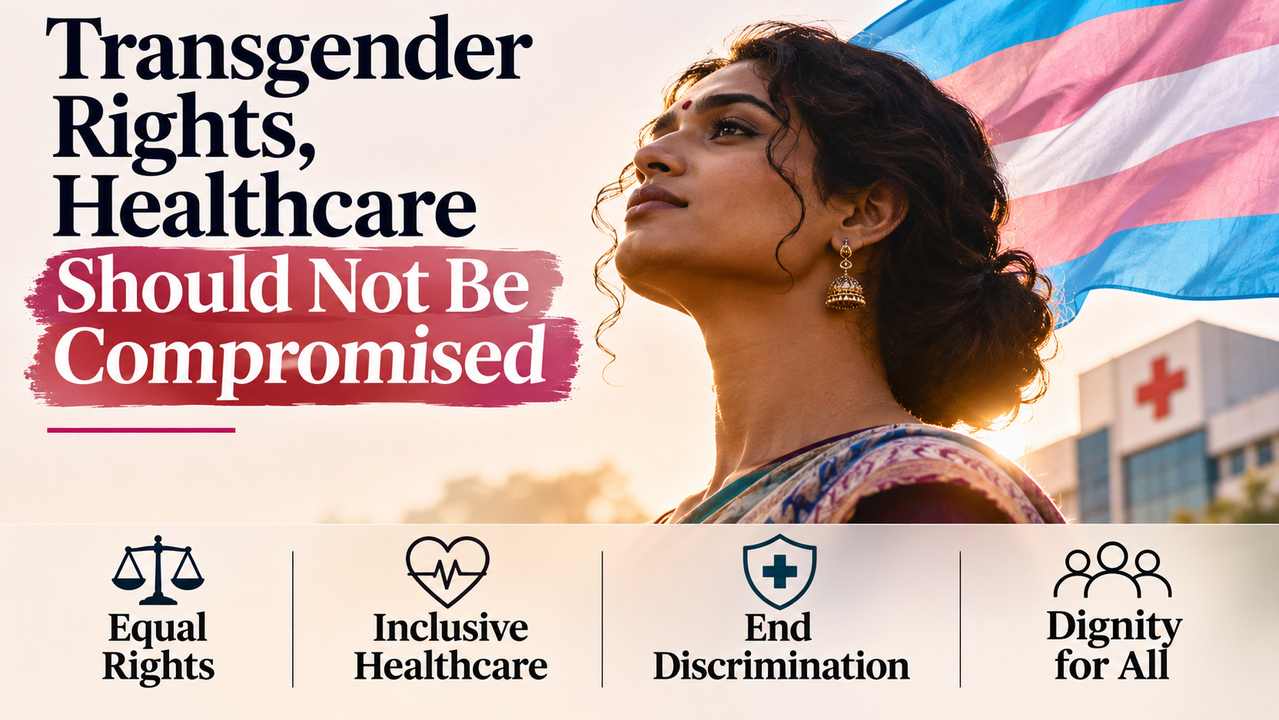
Legal recognition of transgender persons in India has shifted from self-identification to medical assessment. Parliament passed the Transgender Persons (Protection of Rights) Amendment Act, 2026 earlier this year, amending the Transgender Persons (Protection of Rights) Act, 2019. The shift clashes with the Supreme Court’s National Legal Services Authority (NALSA) v Union of India (2014) judgment and is already pushing transgender persons away from formal healthcare.
What does the 2026 amendment change?
- Earlier position: Under the 2019 Act, recognition rested largely on self-identification, with a certificate from the District Magistrate (DM). It worked like a self-declaration the state records rather than tests.
- New procedure: The 2026 Act requires a medical board’s recommendation, selection from prescribed categories and certification by the DM. Recognition now depends on medical and administrative approval.
- Narrower definition: The Act drops trans men, trans women and genderqueer persons (those outside the male and female binary) from the definition. It keeps only certain socio-cultural identities and specified variations in sex characteristics.
- Who loses cover: Even cultural identities such as kinner, hijra, aravani and jogta now need medical certification. A medical board cannot judge membership of a community.
- The takeaway: The state, not the person, now decides who counts as transgender, and that decision controls every right the law grants.
Is the Act protecting transgender persons or deciding who qualifies?
- NALSA’s holding: In NALSA v Union of India (2014), a two judge Bench of the Supreme Court held that gender identity is part of personal autonomy and dignity under Article 21. It rejected making gender identity depend on medical intervention.
- Medical standards: The definition contradicts the World Health Organization’s International Classification of Diseases (ICD-11) and the World Professional Association for Transgender Health (WPATH) Standards of Care Version 8. It revives the discredited psychiatric model of certifying identity.
- Two questions conflated: The Act treats a person’s legal gender and their welfare eligibility as one question, so a medical authority decides both.
- No route to challenge: The Act provides no effective appeal or independent review, so a refused certificate shuts a person out of statutory rights.
- Against the NHRC: The National Human Rights Commission (NHRC) 2026 advisory urged self-identification, independent grievance redress and fewer documents. The Act runs against all three.
What are the health consequences?
- Barriers to care: The certificate blocks access to gender-affirming care (hormones and surgery that align the body with gender identity), documents, jobs, education, insurance and mental health services.
- Providers pulling back: Legal uncertainty has led some providers to delay, suspend or withdraw such care.
- Grey market: Patients turn to unqualified providers for hormones and surgery, so self-medication, infections and post-operative complications rise.
- Cost and delay: Bureaucratic steps add out-of-pocket spending and delay care.
- Rising distress: Helplines report more distress calls since the amendment, including suicidal ideation, depression, sleep disturbance and anxiety.
Challenges
- Persistent discrimination: The NHRC advisory records continuing discrimination in education, healthcare, property and inheritance, employment, documentation, policing and grievance redressal.
- Hospital avoidance: Many transgender persons avoid hospitals after past experiences, fearing judgement, loss of privacy and cost.
- Untrained staff: The Madras High Court’s Sushma (2021) verdict mandates training in transgender health, but the National Medical Commission (NMC) has not added it to the medical curriculum.
- Unenforced safeguards: Most hospitals have not designated the Complaints Officer that the 2019 Act requires in every establishment.
Way Forward
- Mainstream care: Make transgender healthcare part of general care, so a patient with diabetes need not find a dedicated transgender clinic.
- Training for all staff: Train doctors, nurses, front desk and security staff and administrators in basic transgender health.
- Inclusive records: Let hospital forms record a patient’s preferred name and gender identity alongside clinically relevant information.
Conclusion
India’s transgender law now grants protection only after the state certifies identity, reversing the autonomy principle NALSA set. Whether self-identification is restored, and whether general hospitals become safe for transgender patients, will decide if rights and healthcare survive the shift.
Government Initiatives for Transgender Persons
- National Council for Transgender Persons: Set up in 2020 under the 2019 Act to advise the Centre. Members resigned in protest against the 2026 amendment.
- SMILE scheme: The Support for Marginalised Individuals for Livelihood and Enterprise (SMILE) scheme of the Ministry of Social Justice and Empowerment funds welfare for transgender persons. Eg. Garima Greh shelter homes.
- Ayushman Bharat TG Plus: Health insurance for transgender persons under Ayushman Bharat. Like other welfare, it is keyed to the certificate, so a narrower definition narrows access.
Matching Previous Year Question
“[2026, GS2, 10 marks] Right to privacy relating to self-identity is very dear to every human being and well protected under Article 21 of the Constitution. In this context, examine the effect of the amendment in 2026, to the Transgender Persons (Protection of Rights) Act, 2019.”
