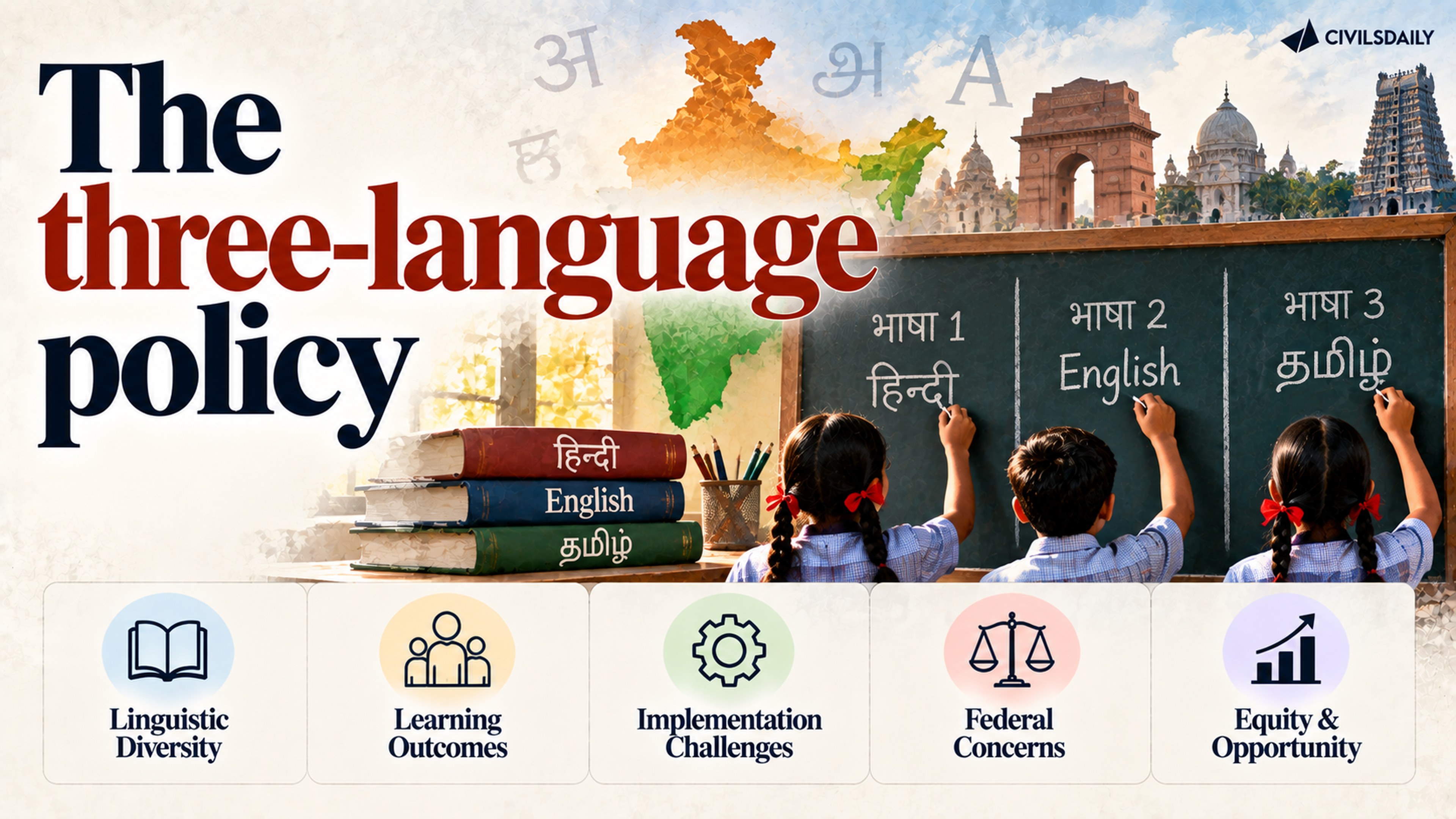
Why in the News
The Central Board of Secondary Education (CBSE) designed its three-language policy to end in a Board examination in the third language, but the Supreme Court keeps cutting it back. Its latest ruling extends to current Class 6 students the relief given to Classes 7 to 9: their final Class 10 test in the third language will only be an internal assessment. In practice, the policy is pushing foreign languages out of CBSE schools.
What is the three-language policy, and why has the Court stepped in?
- What it is: The policy requires CBSE students to study three languages, two of them Indian, with the third examined at Class 10. It is like adding a compulsory subject midway through a course.
- Why it was introduced: The National Education Policy (NEP) 2020 advocates two Indian languages. The Court has found merit in learning more Indian languages to strengthen the federal structure.
- What went wrong: Students who had not studied a second “Indian” language until Class 8 would suddenly have to learn one in Class 9, which the Court called too disruptive.
- Court’s interventions: The Court asked whether the policy could start from 2027 rather than 2026, to lessen the load until schools are fully prepared. The CBSE has resisted compromise.
- The takeaway: The Court is easing the policy’s burden on students before its final ruling, which shows the design did not plan for students already midway through school.
Why does the status of English matter?
- Categorisation question: The Court has suggested treating English as an indigenous language instead of classifying it as foreign.
- De facto Indian language: English has been used in India for at least 300 years. It leads in education, courts and professions and serves as a link language for many.
- Employment edge: English has given Indians an advantage in global industries such as information technology, which the government’s jobs strategy relies on.
- NEP on foreign languages: NEP 2020 also stresses learning foreign languages to support the global mobility of Indians seeking jobs.
What is the policy doing in practice, and does it serve its aim?
- English as the sole foreign language: Two of the three languages must be Indian, and English is needed as the medium of instruction in other subjects. So English takes the only remaining slot, leaving no room for another foreign language.
- Default choices: Many schools will keep Hindi first and Sanskrit as the second Indian language up to Class 10. Southern schools will continue with a regional language such as Tamil or Kannada.
- Foreign languages squeezed out: The practical result is the removal of Spanish, French and other foreign languages from schools.
- Weak cross-regional learning: The stated aim of learning another region’s language goes largely unserved. A demanding extra Indian language adds little practical value for students.
Challenges
- Unprepared schools: Schools lack teachers and time to introduce a new language midway, so students carry the adjustment cost.
- Narrower global options: Losing foreign languages weakens students’ preparation for jobs and study abroad.
- Perceived imposition: Default Hindi and Sanskrit choices feed resistance in non-Hindi States. Eg. Tamil Nadu’s long-standing two-language policy.
- Policy by litigation: Repeated court-ordered changes leave students and schools unsure what each cohort must study.
Way Forward
- Two-language core: The CBSE should make English and the mother tongue the compulsory pair.
- Internal assessment: Test any third language of the student’s choice through internal assessment, not a Board examination.
- Cohort-wise start: Apply new language requirements only to cohorts that can begin them in early grades.
- Foreign language slot: Keep foreign languages as a permitted choice for the third language.
Conclusion
The dispute is whether school language policy should serve cultural integration or practical mobility, and the current design gives up the second without securing the first. The Court’s final judgment, and whether the CBSE accepts a third language assessed internally, will decide what CBSE students learn.
Back2Basics: Three-language formula
- Origin: Recommended by the Kothari Commission (1964-66) and adopted in the National Policy on Education, 1968.
- Original design: Hindi-speaking States teach Hindi, English and another modern Indian language. Non-Hindi States teach the regional language, Hindi and English.
- NEP 2020 version: Retains the formula with flexibility, requiring at least two of the three languages to be native to India and imposing no language on any State.
[2026, GS2, 15 marks] Should education be treated primarily as a welfare obligation of the state or as a strategic investment for building a globally competitive, knowledge-driven nation? Critically evaluate.”
