Why in News?
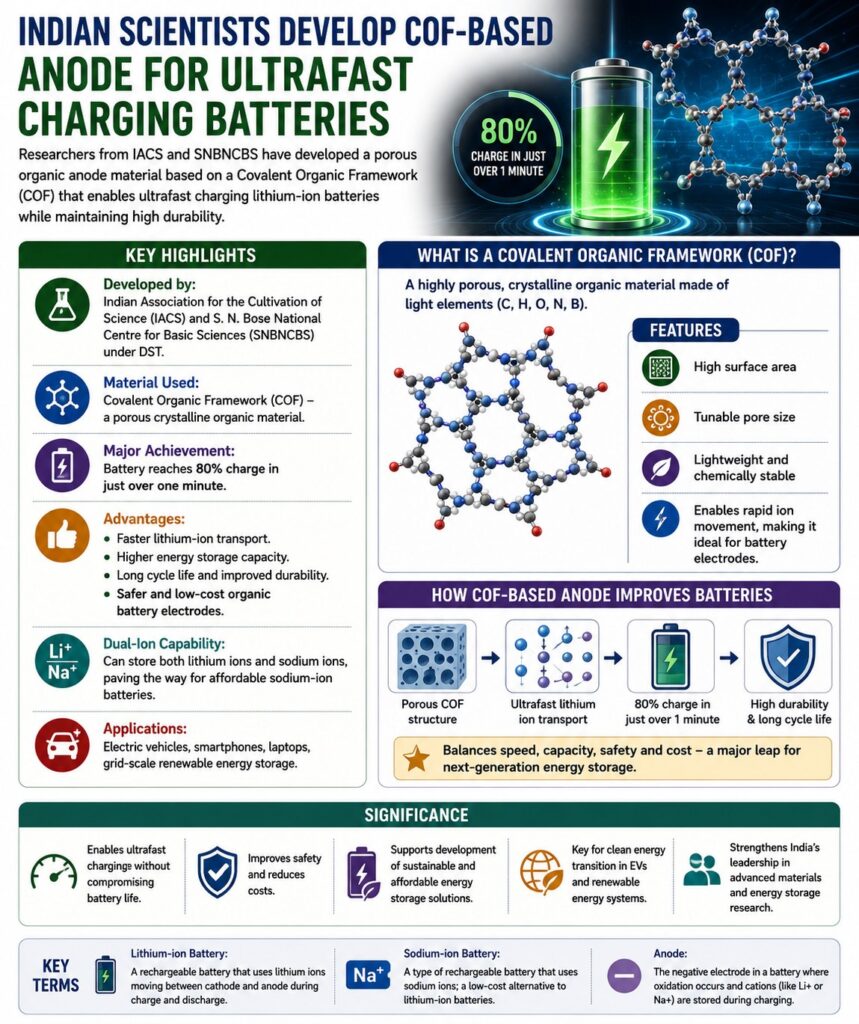
Researchers from IACS and SNBNCBS have developed a porous organic anode material based on a Covalent Organic Framework (COF) that enables ultrafast charging lithium-ion batteries while maintaining high durability.
Key Highlights
- Developed by: Indian Association for the Cultivation of Science (IACS) and S. N. Bose National Centre for Basic Sciences (SNBNCBS) under DST.
- Material Used: Covalent Organic Framework (COF) – a porous crystalline organic material.
- Major Achievement: Battery reaches 80% charge in just over one minute.
- Advantages:
- Faster lithium-ion transport.
- Higher energy storage capacity.
- Long cycle life and improved durability.
- Safer and low-cost organic battery electrodes.
- Dual-Ion Capability: Can store both lithium ions and sodium ions, paving the way for affordable sodium-ion batteries.
- Applications: Electric vehicles, smartphones, laptops, grid-scale renewable energy storage.
What is a Covalent Organic Framework (COF)?
- A highly porous, crystalline organic material made of light elements (C, H, O, N, B).
- Features: High surface area. Tunable pore size. Lightweight and chemically stable. Enables rapid ion movement, making it ideal for battery electrodes.
[2025] In the context of electric vehicle batteries, consider the following elements:
I. Cobalt
II. Graphite
III. Lithium
IV. Nickel
How many of the above usually make up battery cathodes?
[A] Only one
[B] Only two
[C] Only three
[D] All the four
