Why in the News?
- Female participation in India’s workforce is rising, but representation in leadership roles remains low, raising concerns for inclusive growth.
Key Trends
Rising Female Labour Force Participation (LFPR)
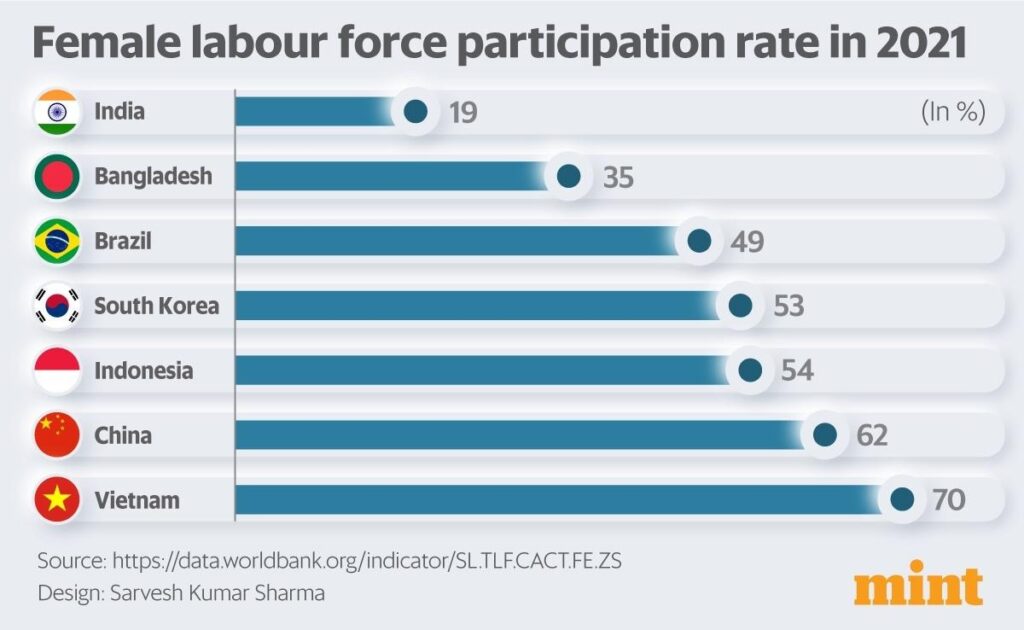
- Female LFPR:
- 2022: 33.9%
- 2025: 40%
- Still below:
- Global average: 49%
- Brazil: 53%
- Vietnam: 69%
Why Female Participation Matters
- According to the World Bank: India needs ~8% growth to become developed by 2047
- Low female participation: Major constraint to growth
Economic Impact
- Study (2018): Constituencies with women legislators: +1.8% higher economic performance
Women in Leadership (Major Concern)
1. Academia
- IITs: Female faculty ~14%
- IIMs: Range: 19% to 31%
- Professors (India overall): ~29.5%
2. Business & Corporate Sector
- Female-owned establishments: ~27%
- Women in leadership roles: Only 13 women per 100 men
3. Corporate Boards
- Many firms: Only 1–2 women directors
- Women board chairpersons:
- BSE 200: ~7%
- NSE 500: ~5%
- Indicates token representation
Note:
- The BSE 200 is a stock market index on the Bombay Stock Exchange (BSE) in India, comprising 200 of the largest, most liquid, and highly traded companies across various sectors.
- The Nifty 500 is a broad-based stock market index representing the top 500 companies listed on the National Stock Exchange of India (NSE) based on market capitalization and average daily turnover.
| [2024] Consider the following statements regarding ‘Nari Shakti Vandan Adhiniyam’ : 1. Provisions will come into effect from 18th Lok Sabha. 2. This will be in force for 15 years after becoming an Act. 3. There are provisions for the reservation of seats for Scheduled Castes Women within the quota reserved for the Scheduled Castes. Which of the statements given above are correct? [A] 1, 2 and 3 [B] 1 and 2 only [C] 2 and 3 only [D] 1 and 3 only |
