💥UPSC 2026, 2027, 2028 UAP Mentorship (March Batch) + Access XFactor Notes & Microthemes PDF

Search results for: “”

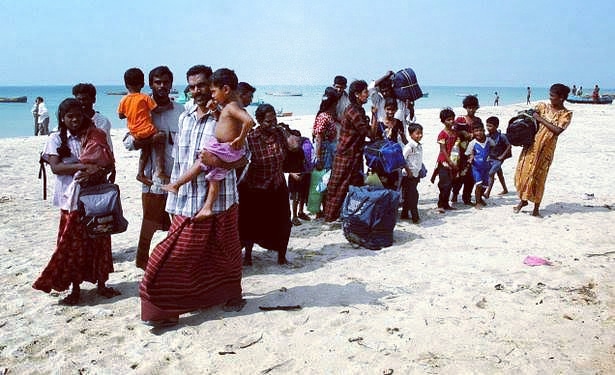
  • Case of Citizenship to Stateless Indian origin Tamils

    CitizenshipContext

    • The Supreme Court of India has now posted the 232 petitions challenging the Citizenship (Amendment) Act (CAA) to be heard on December 6, 2022. However, there is another issue linked to the subject, i.e., the unresolved status of Indian origin Tamils who repatriated from Sri Lanka.

    Present status of Sri Lankan refugees in India

    • For over four decades, Indian origin Tamils have been classified as stateless persons, based on technicalities. Nations High Commission for Refugees, “Comprehensive Solutions Strategy for Sri Lankan Refugees”, there are around 29,500 Indian origin Tamils currently living in India.
    CitizenshipHistorical background of citizenship to Indian origin Tamils

    • As Indentured plantation workers: Indian origin Tamils were brought in as indentured labourers to work in plantations. They remained mostly legally undocumented and socially isolated from the native Sri Lankan Tamil and Sinhalese communities due to the policies of the British.
    • Denied citizenship led to stateless population: After 1947, Sri Lanka witnessed rising Sinhalese nationalism, leaving no room for their political and civil participation. They were denied citizenship rights and existed as a ‘stateless’ population, numbering close to 10 lakhs by 1960.
    • Bilateral pacts granted citizenship: As an ethnolinguistic minority without voting rights, this resulted in a double disadvantage till the two national governments addressed this issue. Subsequently, under the bilateral Sirimavo-Shastri Pact (1964) and the Sirimavo-Gandhi Pact (1974), six lakh people along with their natural increase would be granted Indian citizenship upon their repatriation.
    • Civil wars forcing to seek asylum in India: The Sri Lankan civil war resulted in a spike in Sri Lankan Tamils and Indian origin Tamils together seeking asylum in India. This resulted in a Union Ministry of Home Affairs directive to stop the grant of citizenship to those who arrived in India after July 1983.
    • Focus on Refugee welfare and rehabilitation: The focus of the Indian and Tamil Nadu governments shifted to refugee welfare and rehabilitation. The legal destiny of Indian origin Tamils has been largely intertwined with that of Sri Lankan Tamil refugees, and both cohorts have been relegated to ‘refugee’ status.
    • Classified as Illegal migrants as per the CAA 2003: Indian origin Tamils who arrived after 1983 came through unauthorized channels or without proper documentation and came to be classified as ‘illegal migrants’ as per the CAA 2003. This classification has resulted in their statelessness and blocking of potential legal pathways to citizenship.

    How to overcome the problem of statelessness?

    • While constitutional courts have not had an occasion to deal with the question of statelessness, there have been two recent judgments (Madurai Bench of the Madras High Court, Justice G.R. Swaminathan), taking these issues head on.
    • Judgment on P. Ulaganathan vs Government of India (2019): The status of citizenship of Indian origin Tamils at the Kottapattu and Mandapam camps came up for consideration. The court recognized the distinction between Indian origin Tamils and Sri Lankan Tamils and held that a continuous period of statelessness of Indian origin Tamils offends their fundamental right under Article 21 of the Constitution of India. The court further held that the Union Government has implied powers to grant relaxation in conferring citizenship and prescribed that a humanitarian approach, shorn of the rigors of law, should be adopted.
    • Abirami S. vs The Union of India 2022: Statelessness is something to be avoided. The court further held that the principles of the CAA, 2019, which relaxes the conditions for citizenship for Hindus from Afghanistan, Pakistan and Bangladesh, would also apply to Sri Lankan Tamil refugees. As such, these judgments have provided categorial judicial guidance to the Union of India on how to utilize an expanded and liberal interpretation of the CAA, 2019 to overcome statelessness.
    • Supreme Court (Committee for C.R. of C.A.P. and Ors. vs State of Arunachal Pradesh 2015): An undertaking made by the Government of India with respect to grant of citizenship inheres a right in the stateless or refugee population. As such, India has made repeated undertakings, through the 1964 and 1974 pacts, which have created a legitimate expectation among the Indian origin Tamils and would entitle them to be granted citizenship.
    • Obligatory International customary law: The situation of statelessness of Indian origin Tamils is ‘de jure’, created from the failure in implementing the 1964 and 1974 pacts. De jure statelessness is recognized in international customary law. Therefore, India has an obligation to remedy the situation.

    How other nations deals with statelessness situation?

    • United States: Remedying statelessness is not a novel process in law. While dealing with a similar situation, in 1994, the United States enacted the Immigration and the Nationality Technical Corrections Act to retroactively grant citizenship to all children born to an alien father and citizen mother.
    • Brazil: Through the Constitutional Amendment No. 54 of 2007 retroactively, Brazil granted citizenship to children under jus sanguinis, which was earlier stripped by an earlier amendment, i.e., Constitutional Amendment No. 3 of 1994.
    Citizenship

    What India can do?

    • Any corrective legislative action by the Government of India to eliminate statelessness should necessarily include retroactive citizenship for Indian origin Tamils.

    Conclusion

    • India has provided the one of largest refuge to people in the world including Tibetan, Sri Lankan, Pakistani, and Bangladeshi. Despite not being a signatory to UN refugee convention. any decision of granting citizenship has to be based on national interest rather than emotional connect.

    Mains Question

    Q. What are rules for granting the citizenship to foreigner in India? What are the hurdles in Tamil Sri Lankan getting their citizenship? How can Sri Lankan Tamil get citizenship by applying the rule of intelligible differentia under article 14?

    Click and Get your FREE copy of Current Affairs Micro notes

  • 1st Nov| Daily Answer Writing Enhancement

    Topics for Today’s questions:

    GS-1          Salient features of Indian Society, Diversity of India.

    GS-2         Functioning of the Executive and the Judiciary

    GS-3         Science and Technology- developments and their applications and effects in everyday life.

    GS-4        Attitude: content, structure, function; its influence and relation with thought and behaviour; moral and political attitudes; social influence and persuasion.

    Question 1)

    Q.1 Fully unlocking the value of India’s diversity will depend on the ability to manage contradictions and conflicts arising out of cultural differences. Discuss. (15 Marks)

    Question 2)

    Q.2 With the help of relevant Supreme Court judgements, analyse whether death penalty as a method of delivering justice should remain or go. (15 Marks)

    Question 3)

    Q.3 Although the adoption of genetically modified (GM) food crops is in our broader national interest, there are some concerns associated with it. Discuss. (10 Marks)

    Question 4)  

    Q.4 Social media has played a key role in influencing political opinions and social attitudes in India. Comment. (10 Marks)

    HOW TO ATTEMPT ANSWERS IN DAILY ANSWER WRITING ENHANCEMENT(AWE)?

    1. Daily 4 questions from General studies 1, 2, 3, and 4 will be provided to you.

    2. A Mentor’s Comment will be available for all answers. This can be used as a guidance tool but we encourage you to write original answers.

    3. You can write your answer on an A4 sheet and scan/click pictures of the same.

    4.  Upload the scanned answer in the comment section of the same question.

    5. Along with the scanned answer, please share your Razor payment ID, so that paid members are given priority.

    6. If you upload the answer on the same day like the answer of 11th  February is uploaded on 11th February then your answer will be checked within 72 hours. Also, reviews will be in the order of submission- First come first serve basis

    7. If you are writing answers late, for example, 11th February is uploaded on 13th February , then these answers will be evaluated as per the mentor’s schedule.

    8. We encourage you to write answers on the same day. However, if you are uploading an answer late then tag the mentor like @Staff so that the mentor is notified about your answer.

    *In case your answer is not reviewed, reply to your answer saying *NOT CHECKED*. 

    1. For the philosophy of AWE and payment: 

  • The Amendments To The IT Rules, 2021

    IT rulesContext

    • The Ministry of Electronics and IT (MeitY) has notified amendments to the Information Technology (Intermediary Guidelines and Digital Media Ethics Code) Rules, 2021 (IT Rules, 2021) on October 28. In June 2022, MeitY had put out a draft of the amendments and solicited feedback from the relevant stakeholders. The draft generated considerable discussion and comment on the regulation of social media in India.

    What are the IT rules 2021?

    • Regulating SMI’s: World over, governments are grappling with the issue of regulating social media intermediaries (SMIs).
    • Addressing the issues of SMI controlling the free speech: Given the multitudinous nature of the problem the centrality of SMIs in shaping public discourse, the impact of their governance on the right to freedom of speech and expression, the magnitude of information they host and the constant technological innovations that impact their governance it is important for governments to update their regulatory framework to face emergent challenges.
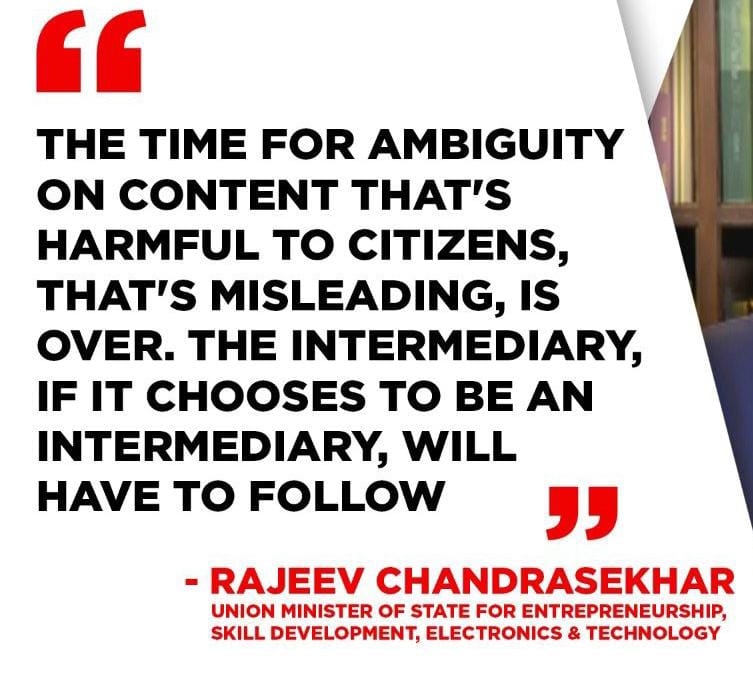
    • Placing obligations on SMI: In a bid to keep up with these issues, India in 2021, replaced its decade old regulations on SMIs with the IT Rules, 2021 that were primarily aimed at placing obligations on SMIs to ensure an open, safe and trusted internet.

    IT rules What are the proposed amendments?

    • Draft amendments in June 2022, the stated objectives of the amendments were threefold.
    1. Protecting the constitutional rights: there was a need to ensure that the interests and constitutional rights of netizens are not being contravened by big tech platforms,
    2. Grievance redressal: to strengthen the grievance redressal framework in the Rules,
    3. To avoid the dominance: that compliance with these should not impact early-stage Indian start-ups.
    • This translated into a set of proposed amendments that can be broadly classified into two categories.
    1. Additional obligation on SMI: The first category involved placing additional obligations on the SMIs to ensure better protection of user interests.
    2. Appellate mechanism: The second category involved the institution of an appellate mechanism for grievance redressal.

    IT rules

    What are the additional obligations placed on social media intermediaries?

    • Users need to comply with rules of platforms(intermediaries): The original IT Rules, 2021 obligated the SMIs to merely inform its users of the “rules and regulations, privacy policy and user agreement” that governed its platforms along with the categories of content that users are prohibited from hosting, displaying, sharing etc. on the platform. This obligation on the SMIs has now been extended to ensuring that its users are in compliance with the relevant rules of the platform.
    • Prevent the prohibited content: Further, SMIs are required to “make reasonable” efforts to prevent prohibited content being hosted on its platform by the users.
    • SMIs have to respects rights under constitution: Second, a similar concern arises with the other newly introduced obligation on SMIs to “respect all the rights accorded to the citizens under the Constitution, including in the articles 14, 19 and 21”. Given the importance of SMIs in public discourse and the implications of their actions on the fundamental rights of citizens, the horizontal application of fundamental rights is laudable.
    • Remove the content within 72 hours: SMIs are now obligated to remove information or a communication link in relation to the six prohibited categories of content as and when a complaint arises. They have to remove such information within 72 hours of the complaint being made. Given the virality with which content spreads, this is an important step to contain the spread of the content.
    • Ensuring the accessibility of services: SMIs have been obligated to “take all reasonable measures to ensure accessibility of its services to users along with reasonable expectation of due diligence, privacy and transparency”.
    • Provide content in all scheduled language: In this context, the amendments also mandate that “rules and regulations, privacy policy and user agreement” of the platform should be made available in all languages listed in the eighth schedule of the Constitution.

    IT rulesWhat is the grievance appellate committee (GAC)?

    • Composition of GAC: The government has instituted Grievance Appellate Committees (GAC). The committee is styled as a three-member council out of which one member will be a government officer (holding the post ex officio) while the other two members will be independent representatives.
    • Complaint within 30 days: Users can file a complaint against the order of the grievance officer within 30 days.
    • Online dispute resolution: The GAC is required to adopt an online dispute resolution mechanism which will make it more accessible to the users.

    What are the concerns associated with GAC?

    • Confusion over GAC and High courts: It is unclear whether this is a compulsory tier of appeal or not, that is will the user have to approach the grievance appellate committee before approaching the court. The confusion arises from the fact that the press notes expressly stated that the institution of the GAC would not bar the user from approaching the court directly against the order of the grievance officer. However, the final amendments provide no such indication.
    • Apprehensions about appointment by central government: While this makes the inhouse grievance redressal more accountable and appellate mechanism more accessible to users, appointments being made by the central government could lead to apprehensions of bias in content moderation.
    • GAC doesn’t have enforcement power: Further, the IT Rules, 2021 do not provide any explicit power to the GAC to enforce its orders.
    • Overlapping jurisdiction of courts and appellate: if users can approach both the courts and the GAC parallelly, it could lead to conflicting decisions often undermining the impartiality and merit of one institution or the other.

    Conclusion

    • Across the world, social media regulation is need of an hour. Fake news, protests, riots are fuelled by social media outrage on petty things. However, government should not usurp the unaccountable power of in the name social regulation. Power of government should also be scrutinized by parliamentary committee.

    Mains Question

    Q. How social media can disrupt the law-and-order situation? Social media intermediaries have become the master regulators of free speech. Explain. critically analyze the new draft recommendations of IT rules 2021.

    Click and Get your FREE copy of Current Affairs Micro notes


  • Green Signal to GM Mustard

    MustardContext

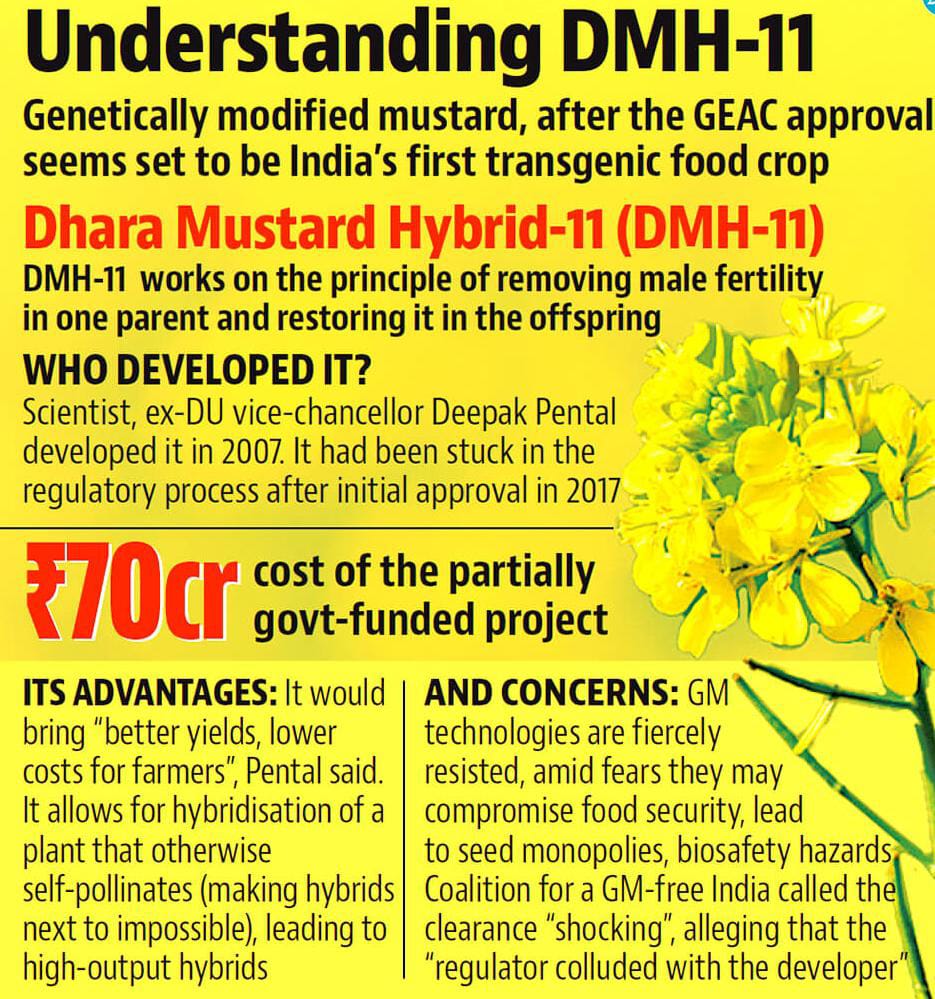
    • The recent clearance by the government for the release of GM Mustard Hybrid DMH 11 based on the recommendations of GEAC under the Ministry of Environment, Forests and Climate Change is a bold decision in the best interest of our farmers and the nation.

    What are Genetically modified organisms (GMO)

    • Changes in genetic material: GMOs can be defined as organisms (i.e., plants, animals or microorganisms) in which the genetic material (DNA) has been altered in a way that does not occur naturally by mating and/or natural recombination
    • Transfers of genes: It allows selected individual genes to be transferred from one organism into another, also between nonrelated species.
    • GM foods: Foods produced from or using GM organisms are often referred to as GM foods
    • GM Mustard: GM mustard crop was introduced, which was later withdrawn. There is a raging debate going on advantages and disadvantages of GMOs. For a long time, further study was requested by farmers, environmentalist on GMO crops.

    MustardAdvantages of GM mustard?

    • Benefits to producers and consumers: GM foods are developed and marketed because there is some perceived advantage either to the producer or consumer of these foods. This is meant to translate into a product with a lower price, greater benefit (in terms of durability or nutritional value) or both. Initially GM seed developers wanted their products to be accepted by producers and have concentrated on innovations that bring direct benefit to farmers (and food industry generally)
    • Improves crop protection: One of the objectives for developing plants based on GM organisms is to improve crop protection.
    • Insect Resistance: Some GMO foods have been modified to make them more resistant to insects and other pests. This means the amount of pesticide chemicals used on the plants are reduced, so their exposure to dangerous pesticides is also reduced
    • Develops stronger Crop: Another benefit that GM technology is believed to bring about is that crops can be engineered to withstand weather extremes and fluctuations, this means that there will be good quality and sufficient yields even under a poor or severe weather condition
    • Provides Environment Protection: GM crops often requires less time, tools and chemicals, and may help with reducing greenhouse gas emissions, soil erosion and environmental pollution
    • More Nutritious Foods: According to the UN Food and Agricultural Organization (FAO), some GM foods have been engineered to become more nutritious in terms of vitamin or mineral content.
    • More economic benefits: Larger production leading to increased farm income, reduced poverty, low food prices and thus reduced hunger and malnutrition. Besides new food products are also included, diversifying food varieties

    What is the risk associated with GMO?

    • Contamination of genes: GMOs contaminate forever. GMOs cross pollinate and their seeds can travel far and wide.
    • Irreversible changes in gene pool: It is impossible to fully clean up our contaminated gene pool.
    • More herbicides in our food: Genetic engineering allows plants to survive high doses of weed killers, resulting in higher herbicide residues in our food.
    • Super weeds and super bugs: GMO crops are creating ‘super weeds’ and ‘super bugs,’ which can only be killed with more toxic poisons.

    MustardWhy there was necessity to grant approval for GM Mustard?
    • To meet our current challenges: Over-exploitation of natural resources (soil, water, biodiversity), declining factor productivity, urgency to achieve sustainable development goals, especially ending poverty and hunger, and addressing timely the adverse effects of climate change the best option is scientific innovations and their scaling.
    • The adoption of GM food crops is in our broader national interest: Genetically modified maize, soybean, cotton, tomato and canola are grown across the world and the area currently under GM crops is about 200 m ha. Besides India, these have been grown for many years in the US, Brazil, Argentina, Canada, Australia, Philippines, Pakistan, Bangladesh, and China.
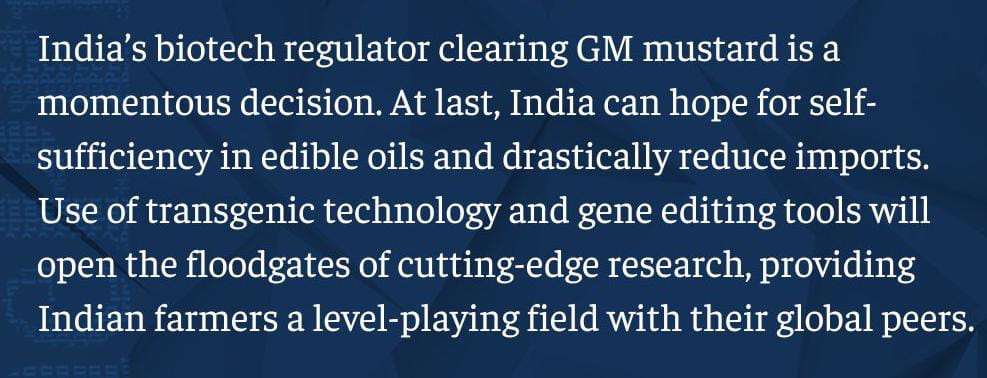
    • To meet the existing deficit in edible oils: India is currently importing around 13 million tonnes at a cost of Rs 1.17 lakh crore to the exchequer. Interestingly, of this, 2.0-2.5 mt soybean oil and 1.0-1.5 mt canola oil is already GM. Hence, we are consuming GM oil already, besides, the 1.5 mt of GM cotton oil produced domestically.
    • Associated health benefits: It is scientifically proven that the consumption of refined oil does not allow any protein to enter the human system. Thus, the consumption of GM oil is completely safe from a health point of view.
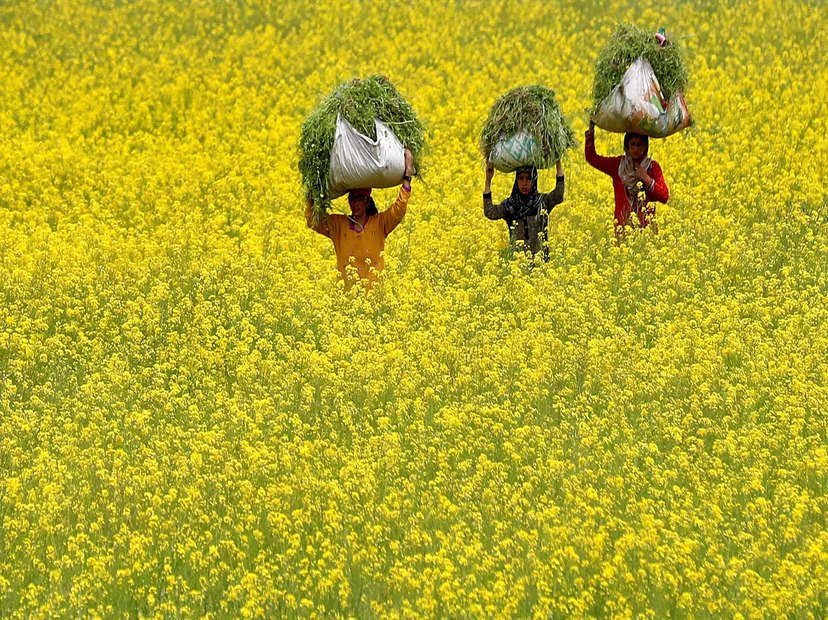
    • High yields to farmers: A major concern of our farmers is that yields of mustard are low and have stagnated for a long time at around 1,260 kg/ha, much lower than the global average of 2,000 kg/ha. Yields of canola in Canada, China and Australia are almost three times higher than in India since they use GM hybrid technology. Mustard is a very important oilseed crop, grown in 6.0 -7.0 million hectares, mostly in Rajasthan, Haryana, Punjab and Madhya Pradesh. Thus, the government’s decision to allow the production of GM Mustard hybrids will go a long way in increasing our yields, while reducing the use of pesticides.

    MustardWhat else needs to be done?

    • Providing enabling environment: The Department of Agriculture (DoA) and ICAR need to move forward fast and provide an enabling environment to test the available seed of Hybrid DMH 11 in the current rabi season.
    • Encourage public-private partnership: This needs to happen on several farmers’ fields in the mustard belt. It must also encourage public-private partnerships to produce quality seeds to cover more area next year.
    • Encouraging further innovation: Also, scientists at ICAR institutes must be encouraged to develop new GM Mustard hybrids on a mission mode. Allowing the production of GM Soybean and GM Maize going forward will also be a positive step, increasing both the productivity and profitability of these crops and doubling farmers’ income.

    Conclusion

    • The decision to remove the unscientific ban on GM crops reflects the determination of the government to move towards Atmanirbhar Bharat. It also meets the aspirations of our scientific community and farmers can derive the benefits of innovative technology.

    Mains Question

    Q. How GM mustard crop are different from conventional crops? What are the benefits and risks of adopting the GM mustard crop?

    Click and Get your FREE copy of Current Affairs Micro notes


  • SC admits plea challenging first amendment to Constitution

    The Supreme Court has agreed to examine a PIL challenging changes made to the right to freedom of speech and expression by the first amendment to the Constitution in 1951.

    Why in news?

    • The fresh petition argues that the 1st Constitutional Amendment damages the basic structure doctrine.

    What was the first amendment?

    • The Constitution (First Amendment) Act, 1951 made several changes to the Fundamental Rights provisions of the Indian constitution.
    • It provided means to:
    1. Restrict freedom of speech and expression,
    2. Validation of zamindari abolition laws, and
    3. Clarified that the right to equality does not bar the enactment of laws which provide “special consideration” for weaker sections of society
    • This Amendment set the precedent of amending the Constitution to overcome judicial judgements impeding fulfilment of the government’s perceived responsibilities.

    Why in news now?

    • In his plea, the petitioner said Section 3(1) of the 1951 Amending Act substituted original Clause (2) of Article 19.
    • This clause 19(2) deals with reasonable restrictions on the freedom of speech and expression guaranteed under Article 19(1)(a).

    (a) Objectionable insertions

    • It which contained two objectionable insertions allowing restrictions also:
    1. In the interest of public order and
    2. In relation to incitement to an offence

    (b) Crucial omissions

    • The new Clause (2) also omitted the expression “tends to overthrow the State” as appearing in the original Clause (2).
    • Section 3 (2) of the amending Act effected validation of certain laws even if they took away or abridged the right to freedom of speech and expression, the petitioner said.

    Issues created by Clause (2) of Article 19

    Ans. It protects certain arbitrary sections of IPC from constitutionality check

    • The petition contended that these two insertions protect certain IPC sections such as from the vice of unconstitutionality –
    1. Sections 124A: Sedition
    2. Section 153A: Promoting enmity between different groups on grounds of religion, race, place of birth, residence, language, etc. prejudicial to maintenance of harmony
    3. Section 295A: Deliberate and malicious acts, intended to outrage religious feelings of any class by insulting its religion or religious beliefs and
    4. Section 505: Statements conducing to public mischief
    • The questionable expressions inserted unduly abridge the fundamental right under Article 19 (1)(a) { freedom of speech and expression}.

    How it sought to trivialize national security?

    • The amendment also neglects national security by dropping the expression ‘tends to overthrow the State’.
    • The omission of this expression raises grave concern in the context of the dangers posed to the concept of secular democratic republic by radicalism, terrorism and religious fundamentalism.
    • This could either be radicalism or right-wing extremism.

    How did the petition invoke basic structure doctrine here?

    • The petition argued that undue abridgement does not advance or sub serve any constitutional objectives.
    • They appear more to damages inter alia democracy and republicanism and supremacy of the Constitution.


    Click and Get your FREE copy of Current Affairs Micro notes

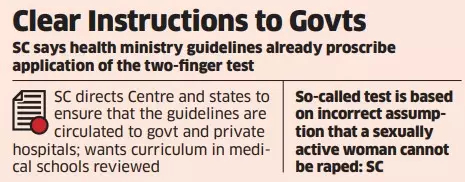
  • Why the SC slammed the two-finger test on rape and sexual assault victims?

    finger

    The Supreme Court has declared that any person conducting the invasive ‘two-finger’ or ‘three-finger’ vaginal test on rape or sexual assault survivors will be found guilty of misconduct.

    What is the two-finger test?

    • The test is conducted to check whether the victim has had recent sexual intercourse.
    • It includes an inspection of the hymen.
    • The hymen is inspected as it can be torn only if the woman has had any sexual intercourse.
    • This test was performed on rape or sexual assault survivors.

    What did the Verma Committee say on the two-finger test?

    • The committee under former Chief Justice JS Verma, formed soon after the 2012 Nirbhaya Gangrape case had recommended tougher laws for such cases and ban of the two-finger test.
    • This test has no bearing on a case of sexual assault.
    • On the basis of this test observations/ conclusions such as ‘habituated to sexual intercourse’ should not be made and this is forbidden by law.
    • Yet, the test continues to be conducted in India and other countries despite rape test kits are being provided by the government to all medical institutions after the committee recommendations.

    Is the two-finger test scientifically accepted?

    • Of course NOT.
    • According to medical experts, science has proved that the hymen is not a reliable source of proving vaginal penetration.
    • The hymen, which is a thin membrane in the vagina, can rupture not just during sexual activity but also during day-to-day work or any physical activity, including playing sports.

    What has the Supreme Court said previously?

    • Violation of privacy: In May 2013, the Supreme Court banned the two-finger test on rape victims on the grounds that it violated their right to privacy.
    • Alternative procedures: The court asked the government to provide better medical procedures in order to confirm sexual assault.
    • Painful for women: The test is medically unnecessary, often times painful, humiliating and a traumatic practice that must end.

    Way ahead

    • Workshops should be held for health providers to prevent the test from being conducted on rape survivors.
    • The curriculum in medical schools should be revised.
    • The court ordered copies of the judgment to be handed over to the Health Ministry, which should be circulated to the health and home departments of the States.
    • The home departments should circulate the judgment to the Director Generals of Police in the States.


    Click and Get your FREE copy of Current Affairs Micro notes

  • Decentralise MGNREGS for better implementation: Govt. Study

    An internal study commissioned by the Ministry of Rural Development has argued for decentralization of the Mahatma Gandhi National Rural Employment Guarantee Scheme (MGNREGS), allowing for more “flexibility” at the ground level.

    Key recommendations to revamp MGNREGS

    • Work diversification: There should be a greater diversification of permissible works instead of listing the types of permissible works.
    • Broad categories of works may be listed out.
    • Flexibility should be given at ground level to select the type of works as per broad categories.

    What is MGNREGS?

    • The MGNREGA stands for Mahatma Gandhi National Rural Employment Guarantee Act of 2005.
    • This is labour law and social security measure that aims to guarantee the Right to Work’.
    • The act was first proposed in 1991 by P.V. Narasimha Rao.

    What is so unique about it?

    • MGNREGA is unique in not only ensuring at least 100 days of employment to the willing unskilled workers, but also in ensuring an enforceable commitment on the implementing machinery i.e., the State Governments, and providing a bargaining power to the labourers.
    • The failure of provision for employment within 15 days of the receipt of job application from a prospective household will result in the payment of unemployment allowance to the job seekers.
    • Any Indian citizen above the age of 18 years who resides in rural India can apply for the NREGA scheme. The applicant should have volunteered to do unskilled work.
    • Employment is to be provided within 5 km of an applicant’s residence, and minimum wages are to be paid.
    • Thus, employment under MGNREGA is a legal entitlement.

    Why imbibe some changes?

    (1) Empowering Gram Sabhas

    • The fund management has been centralised instead of paying the Gram Sabhas.
    • The Gram Sabhas could better decide the work they want to undertake.
    • The Sabhas can take into account the local conditions and the community’s requirement instead of chasing a target set for them.

    (2) Prevent delays in fund disbursal

    • The internal study also flagged the frequent delay in fund disbursal, and to deal with it suggested a revolving fund that can be utilised whenever there is a delay in the Central funds.
    • The survey quoted various instances to underline this chronic problem.

    (3) Prevent delay in wages

    • In Himachal Pradesh and Gujarat, the delay in wages was by three or four months and the material component by six months.
    • The study also noted that the MGNREGS wages were far below the market rate in many States, defeating the purpose of acting as a safety net.

    Answer this PYQ in the comment box:

    Q.Among the following who are eligible to benefit from the “Mahatma Gandhi national rural employment guarantee act”?

    (a) Adult members of only the scheduled caste and scheduled tribe households.

    (b) Adult members of below poverty line (BPL) households.

    (c) Adult members of households of all backward communities.

    (d) Adult members of any household.

    Post your answers here.


    Click and Get your FREE copy of Current Affairs Micro notes

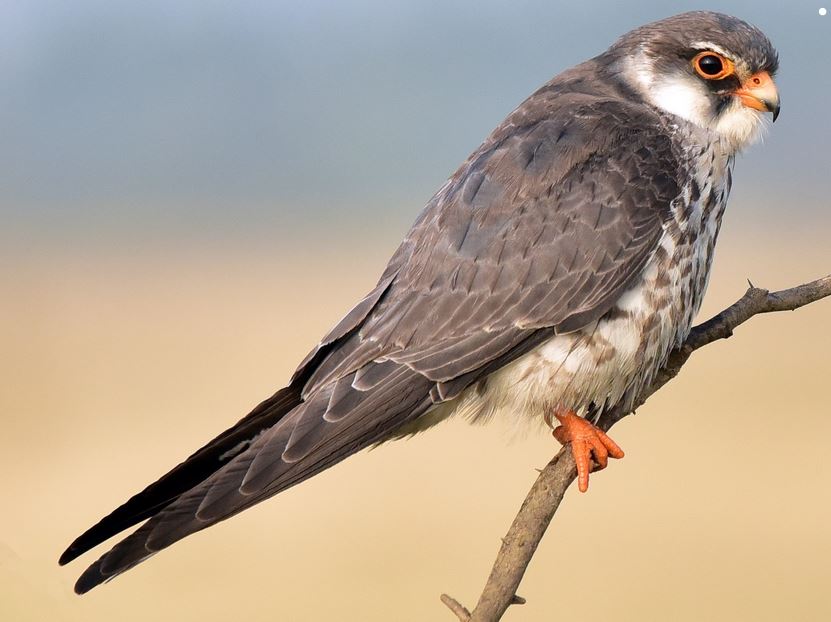
  • Species in news: Amur Falcon

    falcon

    The Amur falcons have begun to arrive in Manipur after travelling over 20,000 km.

    Amur Falcon

    • The Amur falcon (Falco amurensis) is a small raptor of the falcon family.
    • It breeds in south-eastern Siberia and Northern China before migrating in large flocks across India and over the Arabian Sea to winter in Southern and East Africa.

    How it migrates?

    • Locally known as Akhuipuina, the bird arrives mainly in Manipur and Nagaland on its southbound migration from breeding grounds in North China, Eastern Mongolia and far-east Russia.
    • They travel to Manipur en-route to its wintering grounds in South Africa.
    • The one-way journey via India is about 20,000 km long and the birds do this twice a year.
    • They spend three-four weeks in many parts of Manipur to build fat reserves by preying on termites that emerge around this time.

    Conservation status

    • It is protected under the Wildlife Protection Act 1972 and included under its Schedule IV.
    • It is listed in the IUCN Red list as Least Concern.
    • Hunting of the birds or possessing its meat is punishable with imprisonment up to three years or a fine up to Rs 5,000.
    • In 2018, the forest department started a conservation programme by radio-tagging the birds to study their migratory route.

    Click and get your FREE copy of Current Affairs micro notes

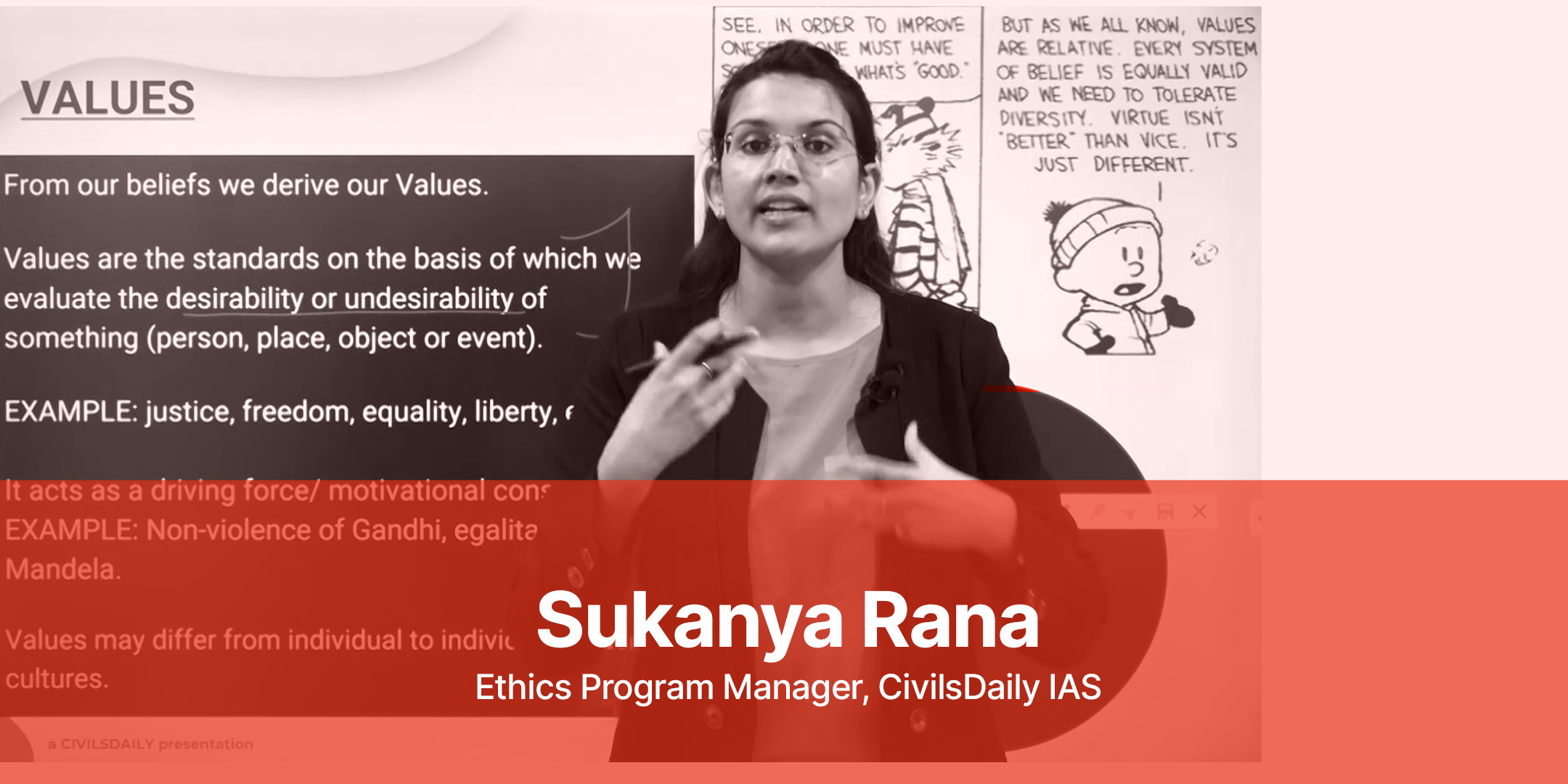
  • Ethics Masterclass 2023 Offline-Online Batches launched | Lectures, tests 1-1 mentorship by Sukanya ma’am. Details inside

    Ethics Masterclass 2023 Offline-Online Batches launched | Lectures, tests 1-1 mentorship by Sukanya ma’am. Details inside

    Now is the perfect time for you to start Ethics.

    Why? First is the time factor. From Jan 2023 you will get engrossed in prelims prep. And you need at least 1.5 – 2 months for GS Paper 4 – Ethics with answer writing practice. The second factor is weightage – 250 marks. You don’t want to ignore it and leave it for your post-prelims plan.

    CivilsDaily is launching Ethics Masterclass 2023 under Sukanya ma’am

    Click here for more details – Ethics Masterclass 2023

    Table of Content


    What is Ethics Masterclass?

    Ethics Masterclass is a Sukanya ma’am-led mentor-driven holistic course for GS Paper 4, i.e. Ethics, Integrity, and Aptitude, by Civilsdaily.

    Program details

    • We will cover the whole GS 4 syllabus and Case studies
    • Weekly Mini tests for revisions
    • Civilsdaily Handholding with 1 on 1 mentorship 
    • Emphasis on application-based studies as derived from Previous year questions
    • Notes – Full Topic wise notes are available on every chapter as PDF.
    • Lectures ppt will also be available
    • Online lectures will be available on the portal till Mains 2023
    • Webinar on doubt clearance till mains 2023 based on demand.

    Ethics Masterclass Details

    Start Date: 7th November

    Duration- 16 Lectures

    Course fee: Rs 8000 + GST 

    Mode: This program is available both Offline and Online

    Offline classes will be held at CivilsDaily’s Delhi Center in Karol Bagh

    LOCATION: 1 LGF, Apsara Arcade, Next to Karol Bagh Metro Stn. (Gate #7), Delhi 110060

    Paper 4 aka Ethics is the most dynamic General studies paper out of the lot. There is no “ONE WAY approach” in ethics. Scoring well in an ethics paper is essential for shortlisting and getting the desired services. Like an essay paper, this paper gives maximum returns. One can get good marks with significantly less effort. Thorough preparation of this paper helps to add a moral dimension to GS Papers – 1, 2, 3 Papers and Essay Paper Answers. It helps to come across as a person with desired qualities of a government employee in the personality test.

    This is an offline effort to combine the cohort based learning with classsroom lectures to provide a complete learning experience. A focused, personalized, and Mentor guided approach will ensure a disciplined and holistic preparation.

    VIDEO LECTURES

    Structured video lectures of Paper 4 for a concrete understanding of the syllabus. Our novel methodology accompanied by an in-depth explanation ensures comprehensive coverage of every topic in the syllabus. Added to this, we have made sure to add that extra element of fun.

    Sukanya Rana Ethics Civilsdaily IAS 2021 upsc 2021

    DOUBT AND DISCUSSION SESSION

    A schedule is created where dedicated days are kept to discuss your doubts regarding each lecture. So, cover the part of the lecture video for the day and clear your doubts the same day. In addition to that, It also provides an opportunity to carry out advanced discussion sessions focused on video lectures. This is additional to the basic level discussion on the Ethics group.

    MINI-TESTS

    A mini-test on the weekend will help to bring together the ideas and concepts learned throughout the week. This is the perfect icing on the cake! Get personalized reviews on your answers by Sukanya ma’am to understand how you can improve and score better.

    CASE STUDIES DISCUSSION

    Scoring in case studies translates into a good score in paper 4. Learn the tips and tricks to master Section B of the ethics paper with discussions and practice questions.

    CIVILSDAILY’S HANDHOLDING

    You’ll be given membership to an exclusive group on Civilsdaily’s Habitat. The group will be headed by Sukanya ma’am herself. From doubt resolution, discussion, and personalized review of the mini-test copies will be done by Sukanya ma’am only. Here you can directly connect with ma’am.

    Below – Ethics discussion on Habitat


    ethics for upsc 2020 2021 ias civilsadaily sukanya rana

    Should you encounter any issues in this process or you have a query, reach out to us at 7303316700 or hello@civilsdaily.com

  • Are there anti-superstition laws in India?

    superstition

    Context

    • The brutal murders of two women as part of “ritualistic human sacrifices” in the Pathanamthitta district of Kerala have left the country in shock. Chilling details of the killings have sparked a debate about the prevalence of superstitious beliefs, black magic and sorcery in Kerala. In the absence of a comprehensive law to counter such acts, the call for a strict anti-superstition law has grown louder.

    superstition

    What is Superstition?

    • Superstition is an irrational belief usually founded on ignorance or fear and characterized by obsessive reverence for omens, charms etc. It is a notion, act or ritual that derives from such belief.

    What is Witchcraft?

    • Black magic is also known as Witchcraft is usage of supernatural power for evil and selfish purposes and to perform malicious practices to destroy someone physically or mentally or financially.
    • Black magic makes humans victims of baseless fears, reverses fortunes and confusions.

    superstition

    What is the status of such killings in India?

    • As per the 2021 report of the National Crime Records Bureau (NCRB), six deaths were linked to human sacrifices, while witchcraft was the motive for 68 killings.
    • In 2020, India saw 88 deaths due to witchcraft and 11 died as part of human sacrifices.
    • The maximum number of witchcraft cases were reported from Chhattisgarh (20), followed by Madhya Pradesh (18) and Telangana (11). Kerala saw two cases of human sacrifice, the NCRB report states.

    What are the laws over superstition in India?

    • No central law: In India, there is no central law that exclusively deals with crimes related to witchcraft, superstition, or occult-inspired activities. In the absence of a nationwide legislation, a few States have enacted laws to counter witchcraft and protect women from deadly ‘witch-hunting’.

    superstition

    Anti-superstition Laws enacted by the states

    • Bihar: Bihar was the first State to enact a law to prevent witchcraft, identification of a woman as a witch and “eliminate torture, humiliation and killing of women.” The Prevention of Witch (Daain) Practices Act came into force in October 1999. Anyone who identifies a person as a “witch” and acts to aid this identification can face a jail term of up to three months, or a fine of ₹1,000, or both.
    • Jharkhand: A similar law was passed in Jharkhand in 2001 the Prevention of Witch (Daain) Practices Act.
    • Chhattisgarh: Even though Chhattisgarh is one of the worst-affected States in terms of witchcraft-related crimes, the State enacted the Chhattisgarh Tonahi (witch) Pratadna Nivaran Act only in 2005. As per the law, a person convicted for identifying someone as a witch can be sentenced to up to three years of rigorous imprisonment with a fine
    • Odisha: Following the directions of the Odisha High Court to frame a law to deal with rising cases of witch-hunting in the State, the Odisha Prevention of Witch-Hunting Bill was passed by the Assembly in 2013. The bill provides penalties for a witch doctor, or a person claiming to be a black magician
    • Maharashtra: In Maharashtra, the Maharashtra Prevention and Eradication of Human Sacrifice and other Inhuman, Evil and Aghori Practices and Black Magic Act, 2013 was passed after the murder of anti-superstition activist Dr. Narendra Dabholkar.
    • Rajasthan: The state of Rajasthan enacted the Rajasthan Prevention of Witch-Hunting Act in 2015 to “provide for effective measures to tackle the menace of witch-hunting and prevent the practice of witchcraft.
    • Assam: The Assam Witch Hunting (Prohibition, Prevention and Protection) Act, 2015, which received the President’s assent in 2018, prohibits witch hunting completely. The law states, no person shall identify, call, stigmatize, defame or accuse any other person as witch by words, or by signs or indications or by conducts or actions or any other manner or instigate, aid or abet such an act or commit witch hunting.
    • Karnataka: The latest law was passed in Karnataka where the Karnataka Prevention and Eradication of Inhuman Evil Practices and Black Magic Act, 2017 came into effect in January 2020. The law bans several practices related to black magic and superstition, like forcing a person to walk on fire at religious festivals and the practice of piercing rods from one side of the jaw to the other.

    Conclusion

    • States governments are doing their best to criminalize the rituals of human sacrifices by enacting stringent laws. There is need to have a concrete nationwide anti-superstition law and as a society every individual should be made a stakeholder in awareness against human sacrifices based on witchcraft and rituals.

    Mains Question

    Q. What is Superstition? Are there any anti-superstition laws in India that criminalizes the rituals such as human sacrifices and witch-hunting? Discuss.

    Click and Get your FREE copy of Current Affairs Micro notes

More posts