💥UPSC 2026, 2027, 2028 UAP Mentorship (March Batch) + Access XFactor Notes & Microthemes PDF

Search results for: “”

  • Parliamentary Committee opposes Mediation Bill

    The Parliamentary Standing Committee on Law and Justice has recommended substantial changes to the Mediation Bill.

    Mediation Bill, 2021

    • Mediation is a voluntary dispute resolution process.
    • It is an informal, confidential, flexible, and non-binding process in which an impartial person called a “mediator” helps the parties to understand the interests of everyone involved, and their practical and legal choices.
    • The Bill requires persons to try to settle civil or commercial disputes through mediation before approaching any court or tribunal.
    • Agreements resulting from mediation will be binding and enforceable in the same manner as court judgments.

    Key features of the Bill

    (1) Pre-litigation mediation

    • Parties must attempt to settle civil or commercial disputes by mediation before approaching any court or certain tribunals.
    • Even if they fail to reach a settlement through pre-litigation mediation, the court or tribunal may at any stage refer the parties to mediation if they request for the same.

    (2) Disputes not fit for mediation

    • The Bill contains a list of disputes which are not fit for mediation.
    • These include disputes: (i) relating to claims against minors or persons of unsound mind, (ii) involving criminal prosecution, and (iii) affecting the rights of third parties.
    • The central government may amend this list.
    • It will apply to mediations conducted in India: (i) involving only domestic parties, (ii) involving at least one foreign party and relating to a commercial dispute (i.e., international mediation).

     (3) Mediation process

    • Mediation proceedings will be confidential, and must be completed within 180 days (may be extended by 180 days by the parties).
    • A party may withdraw from mediation after two sessions.
    • Court annexed mediation must be conducted as per the rules framed by the Supreme Court or High Courts.

    (4) Mediators

    • Mediators may be appointed by: (i) the parties by agreement, or (ii) a mediation service provider (an institution administering mediation).
    • They must disclose any conflict of interest that may raise doubts on their independence.
    • Parties may then choose to replace the mediator.

    (5) Mediation Council of India

    • The central government will establish the Mediation Council of India.
    • The Council will consist of a chairperson, two full-time members (with experience in mediation or ADR), three ex-officio members (including the Law Secretary, and the Expenditure Secretary), and a part-time member from an industry body.
    • Functions of the Council include: (i) registration of mediators, and (ii) recognising mediation service providers and mediation institutes (which train, educate, and certify mediators).

    (6) Mediated settlement agreement

    • Agreements resulting from mediation (other than community mediation) will be final, binding, and enforceable in the same manner as court judgments.
    • They may be challenged on grounds of: (i) fraud, (ii) corruption, (iii) impersonation, or (iv) relating to disputes not fit for mediation.

    (7) Community mediation

    • This may be attempted to resolve disputes likely to affect the peace and harmony amongst residents of a locality.
    • It will be conducted by a panel of three mediators (may include persons of standing in the community, and representatives of resident welfare associations).

    Issues highlighted by the Parliamentary Committee

    • Compulsion: The panel cautioned against making compulsory pre-litigation mediation.
    • Scope for Delay: Making pre-litigation mediation mandatory may actually result in delaying of cases.
    • Judicial intervention: The provision to give higher courts the power to frame rules for mediation was also questioned.
    • Narrower scope: The members questioned the non-applicability of the provisions to non-commercial disputes involving the Government and its agencies.
    • No bar of experienced professionals: The MCI, established to regulate the profession of mediators, may not have representation of practising mediators with adequate experience.
    • Prior approval from centre: The MCI requires prior approval from the central government before issuing regulations related to its essential functions.  It is not clear why such prior approval is required.
    • Domestic conduct of mediation: The Bill applies to international mediations only if they are conducted in India and not outside.

    Why need a law on Mediation?

    • Fast: Because the amount of time necessary for the parties and therefore the Mediator to organize for the mediation is significantly way less as that needed for trial or arbitration, a mediation of dispute can occur relatively early.
    • Flexible: There exists no set formula for mediation. Different Mediators employ different styles. Procedures are often modified to satisfy the requirements of a specific case.
    • Cost Efficient: Because mediation generally requires less preparation, is very less formal than trial or arbitration, and may occur at an early stage of the dispute.
    • Brings Parties Together: Parties can save and sometimes rebuild their relationship like during a family dispute or commercial dispute.
    • Convenient: The parties can control the time, location, and duration of the proceedings to large extent. Scheduling isn’t subject to the convenience of courts.
    • Creative: Resolutions that aren’t possible through arbitration or judicial determination could also be achieved.
    • Confidential: What’s said during mediation are often kept confidential. Parties wishing to avoid the glare of publicity can use mediation to stay their disputes low-key and personal
    • Control: The parties control the result of the mediation and either party has the advantage of terminating the mediation, if it’s felt that it’s not within the interest of the said party.


    UPSC 2023 countdown has begun! Get your personal guidance plan now! (Click here)

  • In news: Pardoning Power of the President

    The Supreme Court has held that the Centre was “bound to advise” the President to remit the life sentence of gangster Abu Salem in the 1993 Mumbai blasts case on his completion of 25 years of his jail term.

    What did the SC say?

    • On the appellant completing 25 years of his sentence, the Central government is bound to advise the President for the exercise of his powers under Article 72 of the Constitution.
    • The Centre could itself consider remission on the completion of 25 years’ sentence in terms of Sections 432 and 433 of the Code of Criminal Procedure.

    What is Pardon?

    • A pardon is a government/executive decision to allow a person to be absolved of guilt for an alleged crime or other legal offense as if the act never occurred.

    Why need Pardon?

    • Pardons can be granted when individuals are deemed to have demonstrated that they have “paid their debt to society”, or are otherwise considered to be deserving of them.
    • Pardons are sometimes offered to persons who were either wrongfully convicted or who claim that they were wrongfully convicted.
    • Pardons are sometimes seen as a mechanism for combating corruption, allowing a particular authority to circumvent a flawed judicial process to free someone that is seen as wrongly convicted.

    What is the Article 72?

    • Article 72 says that the president shall have the power to grant pardons, reprieves, respites or remissions of punishment or to suspend, remit or commute the sentence of any person convicted of any offense.
    • There are five different types of pardoning:
    1. Pardon: means completely absolving the person of the crime and letting him go free. The pardoned criminal will be like a normal citizen.
    2. Commutation: means changing the type of punishment given to the guilty into a less harsh one, for example, a death penalty commuted to a life sentence.
    3. Reprieve: means a delay allowed in the execution of a sentence, usually a death sentence, for a guilty person to allow him some time to apply for Presidential Pardon or some other legal remedy to prove his innocence or successful rehabilitation.
    4. Respite: means reducing the quantum or degree of the punishment to a criminal in view of some special circumstances, like pregnancy, mental condition etc.
    5. Remission: means changing the quantum of the punishment without changing its nature, for example reducing twenty year rigorous imprisonment to ten years.

    Cases as specified by art. 72

    In all cases where the punishment or sentence:

    • is by a court-martial
    • is for an offence against any law relating to a matter to which the executive power of the Union extends
    • is a sentence of death

    Nature of the Pardoning Power

    • The pardoning power of the president is not absolute. It is governed by the advice of the Council of Ministers.
    • This has not been discussed by the constitution but is the practical truth.
    • Further, the constitution does not provide for any mechanism to question the legality of decisions of presidents or governors exercising mercy jurisdiction.
    • But the SC in Epuru Sudhakar Case has given a small window for judicial review of the pardon powers of President and governors for the purpose of ruling out any arbitrariness.
    • The court has earlier held that court has retained the power of judicial review even on a matter which has been vested by the Constitution solely in the Executive.

    Some traditions

    • It is important to note that India has a unitary legal system and there is no separate body of state law.
    • All crimes are crimes against the Union of India.
    • Therefore, a convention has developed that the governor’s powers are exercised for only minor offenses.
    • While requests for pardons and reprieves for major offenses and offenses committed in the UTs are deferred to the President.

    Try this PYQ:

    Who/Which of the following is the custodian of the Constitution of India?

    (a) The President of India

    (b) The Prime Minister of India

    (c) The Lok Sabha Secretariat

    (d) The Supreme Court of India


    Post your answers here.


    UPSC 2023 countdown has begun! Get your personal guidance plan now! (Click here)
  • United Nations’ World Population Prospects (WPP)

    The 2022 edition of the United Nations’ World Population Prospects (WPP) was released.

    Why in news?

    • India is projected to surpass China as the world’s most populous country in 2023.

    What is the World Population Prospects?

    • The Population Division of the UN has been publishing the WPP in a biennial cycle since 1951.
    • Each revision of the WPP provides a historical time series of population indicators starting in 1950.
    • It does so by taking into account newly released national data to revise estimates of past trends in fertility, mortality or international migration.

    Main takeaways for the global population

    (1) Slow pace of growth

    • The world’s population continues to grow, but the pace of growth is slowing down.
    • The global population is expected to grow to around 8.5 billion in 2030, 9.7 billion in 2050 and 10.4 billion in 2100.
    • In 2020, the global growth rate fell under 1% per year for the first time since 1950.

    (2) Region-wise differential

    • Rates of population growth vary significantly across countries and regions.
    • More than half of the projected increase in global population up to 2050 will be concentrated in just eight countries- Congo, Egypt, Ethiopia, India, Nigeria, Pakistan, the Philippines and Tanzania.
    • Disparate growth rates among the world’s largest countries will re-order their ranking by size.

    (3) Ageing population

    • The population of older persons is increasing both in numbers and as a share of the total.
    • The share of the global population aged 65 years or above is projected to rise from 10% in 2022 to 16% in 2050.
    • The report suggests measures for ageing population by improving the sustainability of social security and pension systems and by establishing universal health care and long-term care systems.

    (4) Decline in fertility rate

    • A sustained drop in fertility has led to an increased concentration of the population at working ages (between 25 and 64 years), creating an opportunity for accelerated economic growth per capita.
    • This shift in the age distribution provides a time-bound opportunity for accelerated economic growth known as the “demographic dividend”.

    (5) International migration

    • This is having important impacts on population trends for some countries.
    • For high-income countries between 2000 and 2020, the contribution of international migration to population growth (net inflow of 80.5 million) exceeded the balance of births over deaths (66.2 million).
    • Over the next few decades, migration will be the sole driver of population growth in high-income countries.
    • In many of these countries, the outflows were due to temporary labour movements, such as for Pakistan (net flow of -16.5 million), India (-3.5 million), Bangladesh (-2.9 million), Nepal (-1.6 million) etc.

    How reliable is the UN projection, and how do they compare with India’s Census?

    • In India, of course, the Registrar General comes out with a population projection based on the Census.
    • The last such projection was released in 2019 and it was based on Census 2011.
    • The Census projection is slightly lower than the UN projection.
    • Still UN projection is widely acknowledged across the world

    What is the significance of India overtaking China?

    • That India would overtake China has been known for a while.
    • Moreover, in the past, when the world population was still at 5-billion or 6-billion levels, there was a concern about overcrowding.
    • Those concerns no longer exist because the global population is already 8 billion and several countries (including India) have achieved a replacement rate of fertility.
    • The concern now is not about the absolute numbers — India’s population is already 1.4 billion and may go up to 1.6 billion before declining.


    UPSC 2023 countdown has begun! Get your personal guidance plan now! (Click here)

  • What is the Nord Stream 1 Gas Link?

    The Nord Stream 1, Germany’s main source of gas from Russia, was recently shut down for scheduled maintenance work.

    Why in news?

    • There are growing concerns in European countries that Russia would shut down its gas supplies in retaliation against the current sanctions against Moscow.

    What is Nord Stream 1?

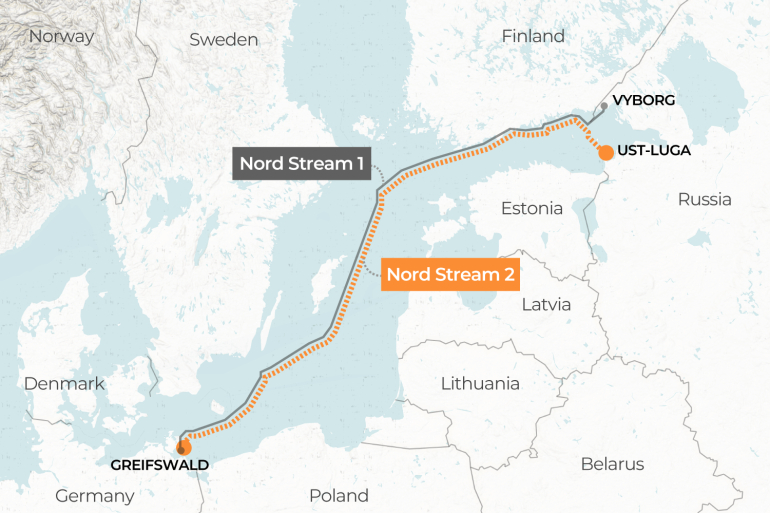
    • It is a system of offshore natural gas pipelines running under the Baltic Sea from Russia to Germany.
    • Nord Stream 1 is a 1,224 km underwater gas pipeline that runs from Vyborg in northwest Russia to Lubmin in northeastern Germany via the Baltic Sea.
    • Two further pipelines under construction running from Ust-Luga to Lubmin termed Nord Stream 2.
    • Majority owned by the Russian energy giant Gazprom, the pipeline is the primary route through which its gas enters Germany.

    Worry for Europe

    • There have been growing concerns that there could be further restrictions to European gas supplies.
    • European countries rely on Russian energy for their cold winters.
    • But now they believe that Russia could weaponized their dependency as a response to their sanction due to the conflict in Ukraine.

    What are Europe’s alternative sources of energy?

    • As an alternative source for energy, European countries have increasingly turned towards the US, from whom they purchase liquified natural gas (LNG) that comes via ships.
    • Since ship-delivered gas ends up being far more expensive, there are also attempts to get non-Russian pipeline gas from Norway and Azerbaijan.
    • While EU countries were earlier seeking to phase out fossil fuels and emphasize renewable forms of energy, many are now returning to coal to deal with the energy crisis.


    UPSC 2023 countdown has begun! Get your personal guidance plan now! (Click here)

  • LINK INSIDE || Join the Pioneers of the most Successful Mentorship Program live on YouTube with Sajal and Sudhanshu Sir || Session at 3:00 PM Today

    LINK INSIDE || Join the Pioneers of the most Successful Mentorship Program live on YouTube with Sajal and Sudhanshu Sir || Session at 3:00 PM Today

    The Session will start at 3:00 pm Today on our Official YouTube channel. Link will be shared at 2:00 pm today. CLICK TO JOIN


    Dear Aspirants,

      We are delighted to invite you to our Live Session on You Tube with Sajal Sir who scored the highest marks in GS in 2017 mains with Sudhanshu sir who has made Current Affairs along with the Answer Writing like a cake walk that even toppers feel writing mains is like writing Civilsdaily Test Series.

    Click here to join

    Harbingers for Toppers

    Sajal sir is not just the topper of the 2017 GS but also since the inception of our mentorship program he has helped many aspirants to secure a good rank. Many aspirants who were stuck in their mains exam were able to crack the exam because of his guidance.

    The Hindu recognizes our efforts too

    The Hindu is the most popular news paper among the UPSC aspirants. Even the Hindu has recognized our efforts and praised for our successful mentorship.

    Free package worth 5000/- along with a Bumper Surprise

    Registered members will get the free Civilsdaily package worth 5000/- The package will be made available for those who will join the live session at 3:00 pm today. This is not just it but a surprise is also waiting that will be revealed tomorrow during the live session.

    One Year Long Plan

    The hurdle with and aspirant is to plan the whole preparation. Only 10% aspirants can do it successfully. Out of these 10% only 1% can follow the timetable and achieve the mini goals they have set. And these are the aspirants who are actually in the race.
    During the webinar mentors will provide you tips on how to balance your current affairs, general Studies and Optional throughout the year along with how to maintain the consistency. They will help you in different segments such as-

    1. How Toppers’ notes are different from normal or just qualified aspirants.
    2. How toppers allocate their time to Optional, GS and Current Affairs.
    3. When and how they do the answer writing.
    4. When do they start the Prelims preparation.

    Ask Anything from during the live session.

    Each aspirant has his/her own issues where he/she finds himself/herself clueless. You can ask your specific queries during the session.

    Session Timing

    The Session will start at 3:00 pm sharp.
    The session will be on our official YouTube channel. Click to subscribe
    Link for the session will be shared at 2:00 PM.
    JOIN HERE

    Still you want to talk to a mentor personally?

    No worries you can fill the form and we will connect with you a mentor who can help you regarding your specific queries. Click here to fill the form.

  • [Burning Issue] Enforcement Directorate (ED): Dreaded nightmare of Indian Politicians & Businessmen

    UPSC 2023 countdown has begun! Get your personal guidance plan now! (Click here)

    Context

    • The Enforcement Directorate (ED) is in the news now and often for summoning a range of personalities from politicians to celebrities as well as NGOs.
    • Many states often accuse the agency of being a tool used by the Centre to coercively engage politicians for vested interests.
    • The timing of the ED cases is making politicians see red. Opposition parties usually allege that raids by Central agencies like the ED and the CBI pick up the pace before crucial polls.

    Is the ED a tool to investigate financial skulduggery or a stick to browbeat opposition leaders? Let’s check.

    What is Enforcement Directorate (ED)?

    • ED was formed in 1957 to look into cases of foreign exchange-related violations, a civil provision.
    • It goes back to May 1, 1956, when an ‘Enforcement Unit’ was formed in the Department of Economic Affairs.
    • Now, the ED falls under the finance ministry’s Department of Revenue.
    • But in 2002, after the introduction of the PMLA, it started taking up cases of financial fraud and money laundering, which were of criminal nature.
    • It was then tasked for handling Exchange Control Laws violations under the Foreign Exchange Regulation Act (FERA).
    • Today, it is a multi-dimensional organisation investigating economic offences under the:
    1. Prevention of Money Laundering Act (PMLA)
    2. Fugitive Economic Offenders Act
    3. Foreign Exchange Management Act
    4. Foreign Exchange Regulation Act (FERA)

    Its establishment

    • When proceeds of crime (property/money) are generated, the best way to save that money is by parking it somewhere, so one is not answerable to anyone in the country.
    • Therefore, there was a need to control and prevent the laundering of money.
    • The PMLA was brought in for this exact reason in 2002, but was enacted only in 2005.
    • The objective was to prevent parking of the money outside India and to trace out the layering and the trail of money.
    • So as per the Act, the ED got its power to investigate under Sections 48 (authorities under act) and 49 (appointment and powers of authorities and other officers).

    At what stage does the ED step in when a crime is committed?

    • Whenever any offence is registered by a local police station, which has generated proceeds of crime over and above ₹1 crore, the investigating police officer forwards the details to the ED.
    • Alternately, if the offence comes under the knowledge of the Central agency, they can then call for the First Information Report (FIR) or the chargesheet if it has been filed directly by police officials.
    • This will be done to find out if any laundering has taken place.

    What differentiates the probe between the local police and officers of the ED?

    Case study:

    • If a theft has been committed in a nationalised bank, the local police station will first investigate the crime.
    • If it is learnt that the founder of the bank took all the money and kept it in his house, without being spent or used, then the crime is only theft and the ED won’t interfere because the amount has already been seized.
    • But if the amount which has been stolen is used after four years to purchase some properties, then the ill-gotten money is brought back in the market.
    • Or if the money is given to someone else to buy properties in different parts of the country, then there is ‘laundering’ of money.
    • Hence the ED will need to step in and look into the layering and attachment of properties to recover the money.
    • If jewellery costing ₹1 crore is stolen, police officers will investigate the theft. The ED, however, will attach assets of the accused to recover the amount of ₹1 crore.

    Roles and functions of the ED

    • Summon, Search and seizure: The ED carries out search (property) and seizure (money/documents) after it has decided that the money has been laundered, under Section 16 (power of survey) and Section 17 (search and seizure) of the PMLA.
    • Arrest and detentions: On the basis of that, the authorities will decide if an arrest is needed as per Section 19 (power of arrest).
    • Attachment of property: Under Section 50, the ED can also directly carry out search and seizure without calling the person for questioning. It is not necessary to summon the person first and then start with the search and seizure.
    • Filing of chargesheet: If the person is arrested, the ED gets 60 days to file the prosecution complaint (chargesheet) as the punishment under PMLA doesn’t go beyond seven years.

    Centrestage of our debate: Over-reach by Investigation Agencies

    Why is ED comes to picture frequently?

    Ans. Money laundering

    • Money laundering is the process of making significant amounts of money obtained through criminal activities, such as drug trafficking or terrorist funding, appear to have come from a legitimate source.
    • As a result, it provides an incentive for money launderers to “legitimize” their ill-gotten gains through money laundering.
    • The money generated is referred to as ‘dirty money,’ and money laundering is the act of converting ‘dirty money’ into ‘legitimate’ money.
    Prevention of Money Laundering Act (PMLA)

    PMLA, 2002 is an Act of the Parliament of India enacted by the NDA government to prevent money laundering and to provide for the confiscation of property derived from money laundering.
    It was enacted in response to India’s global commitment (including the Vienna Convention) to combat the menace of money laundering.
    PMLA and the Rules notified there under came into force with effect from July 1, 2005.
    The act was amended in the year 2005, 2009 and 2012.

    Why ED mostly grips Politicians?

    • Exposing rampant corruption: It is not always ironic to say that most politicians are never corrupt. We have a very inglorious past of political corruption.
    • Selective witch-hunt: The ED has often been attacked for initiating investigations, raiding and questioning leaders of opposition parties, be it under the current regime or under past governments.

    Issues with PMLA

    • Misuse of central agencies: PMLA is being pulled into the investigation of even ordinary crimes by the Enforcement Directorate.
    • Seizing of assets: Assets of genuine victims have been attached. The ED could just walk into anybody’s house.
    • Politically motivated raids: In all this, the fundamental purpose of PMLA to investigate the conversion of “illegitimate money into legitimate money” was lost.
    • Opacity of charges: Petitioners pointed out that even the Enforcement Case Information Report (ECIR) – an equivalent of the FIR – is considered an “internal document” and not given to the accused.
    • Vagueness over evidence: The accused is called upon to make statements that are treated as admissible in evidence.
    • Harassment: The ED begins to summon accused persons and seeks details of all their financial transactions and of their family members.
    • Against individual liberty: The initiation of an investigation by the ED has consequences that have the potential of curtailing the liberty of an individual.

    Allegations against ED

    • Huge discretions: The ED is the only Central agency in the country that does not require permission from the government to summon or prosecute politicians or government functionaries for committing economic offences like money laundering.
    • Used for petty crimes: PMLA is pulled into the investigation of even “ordinary” crimes and assets of genuine victims have been attached.
    • Actual purpose denigrated: PMLA was a comprehensive penal statute to counter the threat of money laundering, specifically stemming from the trade in narcotics.
    • Violations of Rights: PMLA was enacted in response to India’s global commitment to combat the menace of money laundering. Instead, rights have been “cribbed, cabined and confined”.
    • Functional opacity: There is also a lack of clarity about ED’s selection of cases to investigate. We often see ED raiding houses of opposition parties suddenly.
    • Poor rate of conviction: We have hardly read the conclusion of cases by ED. Meantime media-trial tears off the accused person’s credibility which is the most desired intent.
    • Under-trials and slower prosecution: ED has been focusing on keeping the accused in custody rather than actually proving the charges against them.

    Challenges to ED

    • ED being dragged to court: The petitions against the ED had the effect of slowing down the investigations, as officers have to defend themselves in court.
    • Foul crying politicians: There are attempts to cover up unexplained, high-value transactions that fall within the PMLA’s ambit
    • Investigation of foreign transactions: Getting information on accounts and money stashed abroad to establish a trail is the biggest challenge they face.

    Way forward

    • The fight against corruption is intimately linked with the reform of the investigations.
    • Therefore the adjudicating authorities must work in cooperation and ensure the highest standards of transparency and fairness.
    • ED has been walking a tightrope to safeguard its integrity by speeding up investigations and court procedures.
    • The need of the hour could be systemic fixes—and not shrill calls to throw the baby out with the bathwater.
    • It is unlikely that corruption can be substantially reduced without modifying the way government agencies operate.

    Conclusion

    • What the ED is caught in is really an image crisis.
    • The trust in premier investigating institutions, and their credibility, is at stake.
  • The West has a chance to wean India off Russian weaponry

    Context

    Perturbed by India’s reluctance to condemn the Russian invasion of Ukraine and keen to bind the country closer in confronting China, Western governments have launched a fresh push to wean India, the world’s biggest importer of arms, off its long dependence on Russian weaponry.

    India’s concerns after Ukraine war

    • India has grown increasingly alarmed about China, following deadly border clashes in 2020.
    • Since the war in Ukraine began, it has also worried about Russia’s reliability as an arms supplier and about the quality of some of its weapons.
    • Diversification away from Russia: India, though insistent that it has every right to choose its own suppliers, is already diversifying away from Russia. 
    • The share of weapons it imports from Russia has fallen sharply, to around 50% between 2016 and 2021, down from 70% during the previous five-year period.
    • Western help for diversification: It has welcomed Western help in fulfilling its ambition to make more of its own weapons.

    Joint arms production plan

    • As the West cannot compete with Russia on price and remain reluctant to share their most cutting-edge technology, they are counting on joint arms production.
    • Western leaders have been vocal about their willingness to help India arm itself.
    • At a ministerial meeting in Washington in April, American officials discussed helping India to make advanced weapons, including reconnaissance aircraft and a system for combating aerial drones.
    • On visits to Delhi that month, Boris Johnson, Britain’s prime minister, and Ursula von der Leyen, the European Commission’s president, also proposed joint arms ventures.
    • Despite avowed interest from both sides, such a shift faces many challenges.

    Challenges

    • Dominance of PSUs: India’s arms industry, technically open to private investment since 2001, has long been hampered by the dominance of a small number of state-owned giants such as Hindustan Aeronautics Limited (HAL).
    • Inefficiencies: State-owned arms-makers remain notoriously inefficient.
    • They also retain long-running tie-ups with Russia, making Western governments wary of accepting India’s demands for the transfer of more advanced technology.
    • Low presence of private sector: The share of defence production in the hands of the private sector, which is a more natural partner for big Western defence manufacturers, is about a fifth—scarcely higher than it was five years ago.
    • Lack of industrial capacity and skill: Both the state and private sector still lack the industrial capacity and skilled workers to produce highly specialised defence technology at scale—especially military aircraft.
    • Trust issue: While Western companies worry about inadvertent technology transfers to Russia, India worries about the reliability of its Western partners.
    • Past record: Many see America, which in the past has imposed sanctions on India for its nuclear-weapons programme, as a fickle supplier.
    • More recently America refused to sell India its Patriot missile system, prompting India to fall back on a Russian alternative and thereby put itself at risk of American sanctions once more.

    Way forward

    • Liberalisation of defence sector: As a step to liberalise the industry as part of his push towards self-reliance, in 2020 India raised the limit on foreign ownership of defence firms from 49% to 74%.
    • Ordinance Factory Board was dissolved into small units to corporatize the entity.
    • Lockheed Martin, a big American defence manufacturer, last year approved the manufacture of wings for the f-16 fighter jet by its joint venture with Tata.
    • The company has also pledged to produce a more advanced fighter, the f-21, in India, provided it wins a multi-billion-dollar contract to supply 114 fighter jets.
    • Big deals like those would provide incentives for foreign governments to approve more technology transfer and for Western manufacturers to make the investments needed to spur India’s indigenisation drive.

    Conclusion

    Russia’s war and China’s muscle-flexing have opened a door for India and the West to walk through, but crossing the threshold will require some resolve on both sides.

    UPSC 2023 countdown has begun! Get your personal guidance plan now! (Click here)

  • As GST compensation ends, state governments need to be provided certainty of revenues

    Context

    The five-year transition period after the adoption of the Goods and Services Tax (GST) on July 1, 2017, came to an end on June 30, 2022. With this, the era of GST compensation that the state governments were entitled to has ended.

    High estimated loan issuance

    • Many state governments have asked for the compensation period to be extended by a few years.
    • To tangibly assess the near-term outlook for state finances, we have to rely on the states’ own estimates for their market borrowing requirements for the second quarter of 2022-23.
    • The indicative calendar of market borrowings by 23 state governments and two Union territories for the second quarter has pegged their total state development loan issuance — the primary source of financing state government deficits — at Rs 2.1 trillion.
    •  This projected issuance is 29 per cent higher than the same period last year, and at an eight-quarter high.
    • This high level of issuance projected by states reflects concerns that some of them might rightfully have regarding the uncertainty of their cash flows in the post-GST compensation era.
    • High dependence on GST compensation: Of these 23 states, Tamil Nadu, Andhra Pradesh, Haryana, Punjab and Gujarat have indicated large increases in borrowings.
    • Most of these states have an above-average dependence on GST compensation.

    Implications of discontinuation of GST compensation

    • Alter the revenue compensation: The discontinuation of the GST compensation flows would alter the revenue composition of some states adversely, particularly those with a relatively larger share of such receipts in their overall revenue streams.
    • Increase in debt level: To offset a portion of the associated revenue loss, such states are likely to enhance their borrowings and/or to undertake some expenditure adjustments in the quarters ahead.

    Adjustment of borrowing limit of the States by the Centre

    • At the time of communicating to states their annual borrowing limits for the ongoing year, we understand that the Centre had informed state governments that their off-budget borrowings for the past two years (2020-21 and 2021-22) would be adjusted from their borrowing ceiling this year.
    • Data on off-budget borrowing: It appears that the calculation of the adjusted borrowing limit required the submission of detailed data by the state governments related to their off-budget borrowings for the last two fiscal years, followed by a thorough assessment of the same by the Centre.

    Need for early step up in tax-devolution

    • On the whole, though, states appear to have entered the year with a comfortable cash flow position.
    • This follows from the back-ended release of the tax devolution to states for 2021-22 — nearly half of the full-year amount was released in the fourth quarter.
    • Additionally, the total amount was also well above the revised estimate, providing an unexpected gain to states.
    • This may have allowed them to temporarily withstand the changes related to their borrowing permission.
    • Subsequently, the release of the GST compensation grant of Rs 869 billion for several months in May is likely to have further eased their cash flows.
    • If the government does decide to step-up tax devolution to the states in the near term, instead of back-ending it as was done in the last year, it may reduce the size of state borrowings in the second quarter.
    • But more significantly, such revenue certainty, despite the end of the GST compensation era, may embolden states to ringfence their capital spending, providing a positive impulse to the economy.

    Conclusion

    The discontinuation of the GST compensation flows would alter the revenue composition of some states adversely, tax devolution to the states in the near term could cushion the blow of the discontinuation.

    UPSC 2023 countdown has begun! Get your personal guidance plan now! (Click here)


    Back2Basics: Compensation under GST regime

    • The adoption of the GST was made possible by the States ceding almost all their powers to impose local-level indirect taxes and agreeing to let the prevailing multiplicity of imposts be subsumed under the GST.
    • While the States would receive the SGST (State GST) component of the GST, and a share of the IGST (Integrated GST), it was agreed that revenue shortfalls arising from the transition to the new indirect taxes regime would be made good from a pooled GST Compensation Fund for a period of five years that is set to end in 2022.
    • This corpus in turn is funded through a compensation cess that is levied on so-called ‘demerit’ goods.
    • This GST Compensation Cess or GST Cess is levied on five products considered to be ‘sin’ or luxury as mentioned in the GST (Compensation to States) Act, 2017 and includes items such as- Pan Masala, Tobacco, and Automobiles etc.

More posts