Political factions in Bihar has planned to organise the birth anniversary of the 1857 uprising hero Veer Kunwar Singh on April 23 at Jagdishpur in Bhojpur.
Veer Kunwar Singh
Kunwar Singh also known as Babu Kunwar Singh was a leader during the uprising of 1857.
He belonged to a family of the Ujjainiya clan of the Parmar Rajputs of Jagdispur, currently a part of Bhojpur district, Bihar.
At the age of 80, he led a selected band of armed soldiers against the troops under the command of the British East India Company.
He was the chief organiser of the fight against the British in Bihar.
He is popularly known as Veer Kunwar Singh or Veer Babu Kunwar Singh.
Role in 1857 Uprising
Singh led the Indian Rebellion of 1857 in Bihar. He was nearly eighty and in failing health when he was called upon to take up arms.
He was assisted by both his brother, Babu Amar Singh and his commander-in-chief, Hare Krishna Singh.
He gave a good fight and harried British forces for nearly a year and remained invincible until the end.
He was an expert in the art of guerrilla warfare.
In popular culture
To honour his contribution to India’s freedom movement, the Centre issued a commemorative stamp on 23 April 1966.
The Government of Bihar established the Veer Kunwar Singh University, Arrah, in 1992.
Recently, the Finance Minister has stressed upon the need to increase capital expenditure by both public sector as well as private sector.
This is in order to improve the economic growth and invigorate demand in the country.
Why increase CAPEX?
As per the various studies, capital expenditure has a multiplier effect of 2.45 in the short term and 4.8 in the long term.
This means that a single rupee spent on capital expenditure has the potential to add Rs 2.45 in the short term and Rs 4.8 in the long term to the overall economy.
What is multiplier effect in economy?
The multiplier effect is an economic term, referring to the proportional amount of increase, or decrease, in final income that results from an injection, or withdrawal, of capital.
In effect, it measures the impact that a change in economic activity—like investment or spending—will have on the total economic output of something.
Amount of Capital Expenditure in this year Budget
The budget for 2022-23 has proposed a hike of 24.47% in capital expenditure, amounting to almost Rs 7.5 Lakh Crore.
If grants in aid for the creation of capital assets (including MGNREGA assets) are included in the capital expenditure, the effective capital expenditure increases to Rs 10.68 Lakh Crore.
This is 27% more than the capital expenditure of Rs 8.4 Lakh Crore in 2021-22.
Similar Provisions in the Budget
Due to COVID-induced economic slowdown, the Union government has relaxed various provisions related to expenditure.
For e.g. the Borrowing limit for the states has been enhanced to 4% of the Gross State Domestic Product (GSDP).
The government has allowed Rs 2 Lakh Crore for States and Autonomous bodies for capital expenditure.
Need for Increase in Capital Expenditure
Pandemic: As mentioned above, COVID-induced lockdown has resulted in closure of industries for an extended period of time.
Crowding-in private investment: There is a need to crowd-in private investment through direct investment and signalling through favorable policy interventions by the government in the Economy.
Shortfall in Tax Revenues: The pandemic has led to a decrease in the realization of tax revenues due to a fall in demand as well as temporary closure of industries. This can be countered by sustained investment by the government, providing the necessary boost to animal spirits within the Economy.
Benefits of Capital Expenditure: Capital Expenditure has various effects on the Economy of a country including creating capacity and increasing supply, increasing employment generation and rise in wages, in turn, stimulating demand for the goods and services and attracting FDI.
Supplementary fundings: The increased allocations would be available for investment in PM Gati Shakti Plan and its associated initiatives. The funds can also be used for supplementary funding in projects like PM Gram Sadak Yojana.
Scheme for Special Assistance to States for Capital Expenditure: These funds under will also be used to encourage the government to undertake reforms for increasing the development in the States. The associated sectors include digitization of the Economy, including digital payments, and reform in areas like town planning, transit oriented development, building bylaws and transferable development rights.
Conclusion
Overall, this budget aims to create a long-term multiplier effect by focusing its resources and capital in the right direction.
In future years, the government will need to stay the course set today, as the impact of these initiatives will be seen in the long term.
Our Hall of Fame boasts of nearly 150 aspirants who have cleared the exam as working professionals. This year, our Civilsdaily students — Vaibhav Rawat (AIR 25) and Ravi Kumar (AIR 84) worked really hard in their respective jobs and studied before they tasted success. This busts the myth that only full-time aspirants can clear the exam.
Cracking UPSC is an art of excellence & can be achieved even by improving 1% a day. All it wants are will and effort, methodical practice and ultimate guidance.
Our step-by-step 5-hour learning strategy enabled them to justifynot only ‘how to avoid errors in prelims’ but also ‘how to introduce and conclude the answer in mains’ and to develop templates for answers that you can recall at a short notice .
Attend the free live webinar conducted by Civilsdaily’s toppers’ mentor & Mains Program Head Sukanya Rana Ma’am to understand what are the processes that every aspirant must care for.
Webinar Details
Never miss the chance to get value added guidance to secure a rank under 100 with your answer writing in a holistic manner! This webinar is absolutely free. All aspirants are warmly welcome to attend.
Tips to Learn in This Free Live Webinar by Sukanya Rana!
1. The UPSC preparation process is divided into Four stages. What should you focus on during each phase?
2. Our step-by-step 5-hour learning plan. Other toppers’ time-management skills are also discussed.
3. Avoiding errors that cost you a chance. How do you get your preparation off to a good start?
4. The advantages of being a UPSC aspirant while working. What distinguishes you from the competition?
5. Studying judiciously. How can you save time by using the Civilsdaily App to acquire aggregated information?
About Sukanya Rana Ma’am
Our Civilsdaily Mains Program Head Mrs. Sukanya Rana has been mentoring students across multiple stages from prelims to mains to interview. She herself was a working professional as a PO in CANARA BANK during her first UPSC Interview in 2016.
Attend the webinar to gain insights from her personal experience of working and preparing for UPSC.
Communal clashes broke out during Ram Navami processions in several parts of the country including at Khargone in Madhya Pradesh. Subsequently, the Madhya Pradesh government bulldozed the houses of those who were allegedly involved in rioting.
Right to housing
Fundamental right under Article 21: The right to housing is not only a fundamental right recognised under Article 21 of the Indian Constitution, it is also a well-documented right under the international human rights law framework, which is binding on India.
Article 25 of the Universal Declaration of Human Rights (UDHR) states that “everyone has the right to a standard of living adequate for the health and well-being of himself and of his family, including food, clothing, housing and medical care.
Likewise, Article 11.1 of the International Covenant on Economic, Social and Cultural Rights (ICESCR) recognises “the right of everyone to an adequate standard of living for himself and his family, including adequate food, clothing and housing, and to the continuous improvement of living condition.
The rights recognised under ICESCR, according to Article 4, can be restricted by States only if the limitations are determined by law in a manner compatible with the nature of these rights and solely to promote society’s general welfare.
Besides, international law also prohibits arbitrary interference in an individual’s right to property.
For instance, Article 12 of the UDHR states that “no one shall be subjected to arbitrary interference with his privacy, family, home or correspondence, nor to attacks upon his honour and reputation”.
Article 12 also stipulates that “everyone has the right to the protection of the law against such interference or attacks”.
This same right is also provided under Article 17 of the International Covenant on Civil and Political Rights (ICCPR).
Protection against Forced eviction
According to the UN Human Rights Office, an integral element of the right to adequate housing is ‘protection against forced evictions’.
The UN Human Rights Office defines ‘forced evictions’ as ‘permanent or temporary removal against the will of individuals, families and/or communities from the homes and/or land which they occupy, without the provision of, and access to, appropriate forms of legal or other protection’.
Way forward
The apex court in cases like Bachan Singh vs State of Punjab, Vishaka vs State of Rajasthan, and recently in the famous Puttaswamy vs Union of India has laid down the principle that the fundamental rights guaranteed under the Constitution must be read and interpreted in a manner which would enhance their conformity with international human rights law.
It is high time that the judiciary acted and imposed necessary checks on the unbridled exercise of power by the executive.
Conclusion
The bulldozing of the houses of the alleged rioters amounts to forced eviction and arbitrary interference with an individual’s home.
There isn’t a more opportune time to invest your rapt attention in UPSC preparation if you have a couple of years in hand. Preparing for the UPSC exam is not awhimsical fancy. Many toppers even started their UPSC preparation in their penultimate year in school. Because winners start early.
It will be a game changer if any undergraduate, with only 2 to 3 years in hand, inculcates the brainchild formulas of toppers’ mentors to crack UPSC.
When time is short and way is long, every step must be more on-target.
So, why tax your brain! Let’s know those formulas right away.
When the destination is IAS or IPS, UPSC syllabus and previous year question papers go hand in hand. So, don’t wander off, you may lose the track.
Bring the syllabus on your finger tip. Because you have to complete the syllabus and not books.
Hook at least 5 years previous years MCQs (Prelims + Mains + Optional)
According to mentor heads, there are 2 types of syllabus pattern
Raw static syllabus
Dynamic syllabus
In the incipient stage, finish static syllabus at least once. Because static parts boost aspirants’ confidence, besides, it’s the very foundation of grip on current affairs. To finish the static parts, an aspirant may need around 6 months and not more than that.
Now, start investing time in the dynamic syllabus.
Take PYQs, revise chapters accordingly
Learn Current affairs and tangle with static questions.
It’s worth remembering that balancing study is the key to excellence for either the MCQs or writing for mains.
Another key point to be noted here is ‘Evaluation of preparation’. It’s also an indirect and inseparable part of your UPSC syllabus.
Civilsdaily’s centralized mentorship is recommended here.
https://youtu.be/DSwO38weHAA
Time Management
Minimum 2 years and maximum 3 years will run short unless and until you become sincere about time management.
Have you heard the traditional proverb “An apple a day keeps the doctor away”?
Similarly, keep in mind ‘A chapter a day unblocks UPSC doorway’.
Learn from mentors and act on how to divide time for newspaper reading, answer writing, practicing MCQs, etc. each and everyday.
Running free webinars, mentorship programs in community managed platforms of Civilsdaily, will help you immensely to learn how to utilize maximum time.
If there is a guide on the unknown path, even the crooked path becomes simpler. When you have 2-3 years in your hand, and want to make a gigantic syllabus familiar at firsthand, taking a risk may be proven as a fool’s errand. Let’s understand the difference.
SELF STUDY
MENTOR’S GUIDE
Self-study, though isn’t an empty vessel always, is very time and energy consuming. Following self-study, almost 75% of aspirants look for a needle in a haystack.
Mentors’ guide means saving time and energy not to get baffled.
Most of the time, the daily target dies.
Daily target lives because of guidance.
Self study lacks self assessment.
Assessment of leaders
So, how would you like to react to mentors’ guidance now? Let’s know.
Nothing is more important than the limit of time. From circling OMR sheet to answer writing and optional to interview, all these won’t be tediously threatening if done under proper guidance especially when there is a bound on time.
It’s the aspirants’ choice whether they embrace the very 1st attempt or love to get into a labyrinth of futile attempts.
Progress in settling border disputes, removal of AFSPA herald positive changes in the region.
Significant development for restoring normalcy in the region
Efforts to address the issues of the Northeast have been moving according to a strategic plan which is premised on three objectives —
1] Ending all disputes.
2] Ushering in economic progress and taking the region’s contribution to GDP back to its pre-Independence levels,
3] making efforts to maintain and preserve the region’s languages, dialects, dance, music, food, and culture and make it attractive for the whole country.
In this regard, two recent developments are significant:
On March 29, the Assam and Meghalaya chief ministers signed an agreement to resolve the five-decade-old border dispute.
The Union home ministry (MHA) decided to reduce the disturbed areas under the Armed Forces (Special Powers) Act (AFSPA) in Assam, Nagaland and Manipur after decades.
Progress on the border disputes
As part of the strategy, existing issues of both interstate border disputes and insurgency have been closely studied and negotiated and a few agreements have been signed.
Assam, with the maximum border disputes in the region, got into a proactive border dialogue.
The dialogues on the state’s border disputes with Meghalaya, Arunachal Pradesh, Nagaland and Mizoram are continuing at a steady pace.
After the violent flare-ups witnessed last year at the Assam-Mizoram border, today there are regular engagements to maintain peace and work out a permanent solution.
The model of Assam’s engagement with Meghalaya, is a good one to emulate — the two chief ministers, after two rounds of talks in August last year, constituted three committees each under cabinet ministers in their states to go into the complex boundary issues.
Significance of notification on AFSPA
Peace has been witnessed in most places across Assam, and even in Nagaland and Manipur talks with various groups for a permanent solution had resulted in a cessation of violence.
The NLFT Tripura Agreement (August 2019), the Bru Agreement (January 2020), the Bodo Peace Accord (January 2020) and the Karbi Anglong Agreement (September 2021) have actually resulted in about 7,000 militants surrendering their arms.
Removal of DAN: So the demand for the removal of the disturbed areas notification (DAN) was very much justified.
DAN has been in force in the whole of Assam since 1990, in all of Manipur (except the Imphal Municipality area) since 2004 and in the whole of Nagaland since 1995.
With the removal of the DAN tag, AFSPA has been removed with effect from April 1 this year completely from 23 districts and partially from one district of Assam, from 15 police station areas of six districts of Manipur and from 15 police station areas in seven districts in Nagaland.
DAN is currently applicable in only three districts and in two police station areas in one other district of Arunachal Pradesh.
AFSPA was completely removed from Tripura in 2015 and Meghalaya in 2018, respectively.
Conclusion
The efforts by the Union government to make the northeastern region the main pillar of the Act East policy have been useful in bringing a sense of political stability that is very crucial for optimal economic development and capacity enhancement in the region.
Book your slot for UPSC Mock interviews (paneled by ex UPSC members) and get a dedicated mentor, on-call DAF analysis, DAF-based personalized questionnaire, and Situational questionnaire (FREE)
India could end up facing a Sri Lanka-type economic crisis if it doesn’t stop the “culture of freebies” and subsidies in sectors like agriculture, NITI Aayog member Ramesh Chand has warned.
What is a Freebie?
The term Freebies is not new; rather it is a prevalent culture in Indian politics (in the name of socialism).
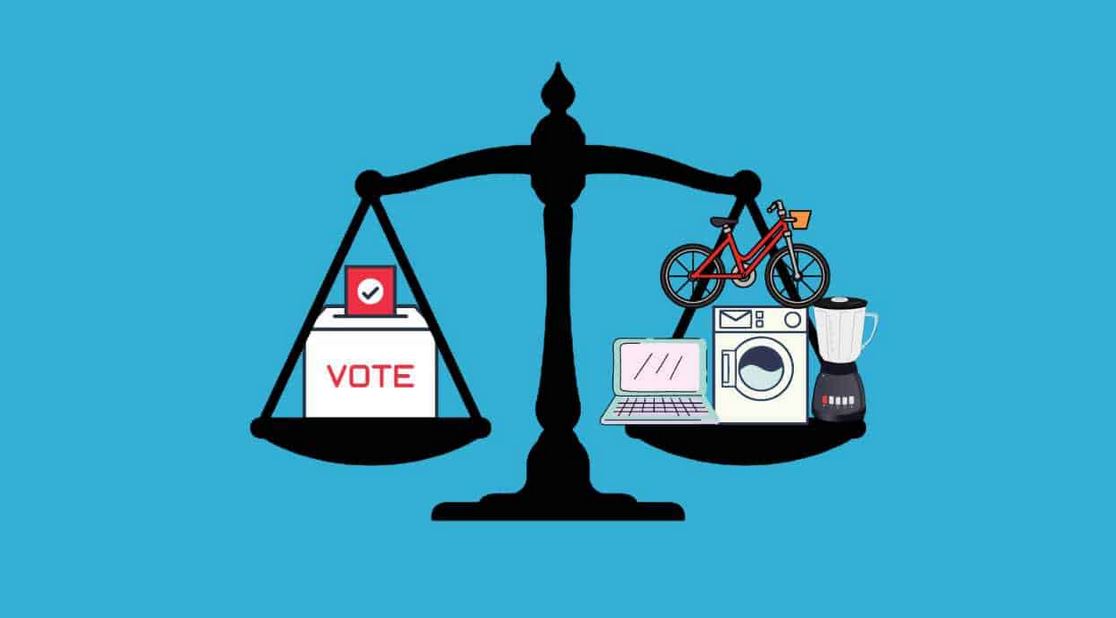
The political parties are always trying to outdo each other in luring the Indian voters with assorted freebies.
From free water to free smartphones the Indian politicians promise everything to attract prospective voters in favour.
This trend has gained more momentum in the recent times with the political parties being innovative in their offerings as the ‘traditional free water and electricity’ is no longer sufficient as election goodies.
Examples of freebies
Promise of Rs 15 lakh in our bank accounts
Free TV, Laptops
Free electricity
Loan waivers
Offering free public transport ride to all women in Delhi
Why are such policies popular among the public?
Failure of economic policies: The answer lies in the utter failure of our economic policies to create decent livelihood for a vast majority of Indians.
Quest for decent livelihood: The already low income had to be reoriented towards spending a disproportionately higher amount on education and health, from which, the state increasingly withdrew.
Prevailing unemployment: Employment surveys have shown that employment growth initially slowed down from the 1990s, and then has turned negative over the past few years.
Increased cost of living: Real income growth of the marginal sections has actually slowed down since 1991 reforms.
Increased consumerism: The poor today also spend on things which appear to be luxuries; cellphones and data-packs are two such examples which are shown as signs of India’s increased affluence.
Necessity: For migrant workers, the mobile phone helps them keep in touch with their families back home, or do a quick video-call to see how their infant is learning to sit up or crawl.
Can Freebies be compared with Welfare Politics?
These freebies are not bad. It is a part of social welfare.
Using freebies to lure voters is not good.
Voter’s greediness may lead to a problem in choosing a good leader.
When we don’t have a good leader then democracy will be a mockery.
Impact of such policies
Never ending trail: The continuity of freebies is another major disadvantage as parties keep on coming up with lucrative offers to lure more number of votes to minimize the risk of losing in the elections.
Burden on exchequer: People forget that such benefits are been given at the cost of exchequer and from the tax paid.
Ultimate loss of poors: The politicians and middlemen wipe away the benefits and the poor have to suffer as they are deprived from their share of benefits which was to be achieved out of the money.
Inflationary practice: Such distribution freebie commodity largely disrupts demand-supply dynamics.
Lethargy in population: Freebies actually have the tendency to turn the nation’s population into: Lethargy and devoid of entrepreneurship.
Money becomes only remedy: Everyone at the slightest sign of distress starts demanding some kind of freebies from the Govt.
Popular politics: This is psychology driving sections of the population expecting and the government promptly responds with immediate monetary relief or compensation.
Food Security through fair price shops ( under National Food Security Act)
Prime Minister Kisan Samman Yojana (PM-KISAN)
Arguments in favour
Social investment: Aid to the poor is seen as a wasteful expenditure. But low interest rates for corporates to get cheap loans or the ‘sop’ of cutting corporate taxes are never criticized.
Socialistic policy: This attitude comes from decades of operating within the dominant discourse of market capitalism.
Election manifesto: Proponents of such policies would argue that poll promises are essential for voters to know what the party would do if it comes to power and have the chance to weigh options.
Welfare: Economists opine that as long as any State has the capacity and ability to finance freebies then its fine; if not then freebies are the burden on economy.
Other wasteful expenditure: When the Centre gives incentives like free land to big companies and announce multi-year tax holidays, questions are not asked as to where the money will come from.
A rational analysis of freebies
Winning election and good governance are two different things. The role of freebies to avail good governance is definitely questionable.
The social, political and economic consequences of freebies are very short-lived in nature.
There are many freebies and subsidies schemes available in many States but we still find starvation deaths, lack of electricity, poor education and health service.
Hence the sorrow of the masses of India cannot be solved by freebies or by incentives.
So are not freebies meant only to attract voters and swing voters by concentrating on a preferential group or community?
Way forward
It can be agreed that a democracy requires popular support for its rule to continue. The sops and freebies to the poor buy it the requisite votes.
But the democratic process of election and election promises should be clear. It should not control voters thought.
What some people term as ‘populism’ actually constitutes what real economics should be.
If you deprive people of what they really need, you will have to throw allurements at them.
This can only be stopped if political masters try to follow what economist EA Schumacher had conveyed through his seminal work Small is beautiful – “Treat economics as if people matter.”
Conclusion
There is nothing wrong in having a policy-led elaborate social security programme that seeks to help the poor get out of poverty.
But such a programme needs well thought out preparation and cannot be conjured up just before an election.