💥UPSC 2026, 2027, 2028 UAP Mentorship (March Batch) + Access XFactor Notes & Microthemes PDF

Search results for: “”

  • Tariff problem of renewable energy

    Context

    We need to shift to a two-part tariff for solar and wind to incentivise private investments.

    Background of power generation tariff in India

    • The two-part tariff has been in vogue since 1992.
    • It applies to thermal and hydro generation.
    • 1] Fixed component: The first part is a fixed component – the cost that a generator incurs.
    • This is not linked to the amount of power generated.
    • 2] Variable component: The second part varies with the quantum of generation.
    • It does not apply to renewable generation — solar, wind, and also nuclear.
    • Under the two-part formula, the variable cost is calculated on the basis prescribed by the regulatory commissions.
    • This is based on the cost of fuel — coal or gas or lignite — as the case may be.
    • The fixed cost is also determined by regulatory commissions and it has a graded payment system depending on the extent to which the plant would be in a position to generate.
    • The point here is that when a generator is in a position to generate, it gets to recover the fixed cost (or some part of it), irrespective of whether it actually generates power.

    Single-part tariff for nuclear, wind and solar

    • In contrast, solar and wind generation and also nuclear are still governed by a single-part tariff.
    • The single-part tariff applies to nuclear power stations for various reasons including the fact that given the technology, a nuclear generator does not usually increase/decrease the generation at a quick tempo, but maintains a steady stream.
    • In any case, nuclear power accounts for only about two per cent of the entire generation, so let’s leave it aside.
    • On the other hand, solar and wind generation account for about 10 per cent of the generation today and going by the statement delivered during COP26 in Glasgow, we want to ramp it up to 50 per cent by 2030.

    Issues with single-part tariff for wind

    • Must run status: The renewable sector has been given a “must run” status.
    • This means that any generation from renewables needs to be dispatched first.
    • The problem is that “must run” runs counter to the basic economic theory that in order to minimise total cost, dispatch should commence from the source offering the cheapest variable cost and then move upwards.
    • With a single-part tariff, whenever the renewable generator is asked to back down for maintaining grid balance, it is paid nothing.
    • With a single part tariff for renewable generation, the entire cost is variable and at Rs 2.5 per unit for solar generation, it is not the cheapest source.
    • There are several NTPC coal-fired pit head plants whose variable costs are far lower, for example, Simhadri (Rs 1.36), Korba (Rs 1.36), Sipat (Rs 1.43).
    • For the older solar plants, the tariff could be well above Rs 3 per unit and for wind-based generation, it is even higher, averaging around Rs 4.5 per unit.
    • Therefore, the SLDCs often flout the principle of “must run”, since the distribution companies would save money by asking the renewable generator to back down while keeping the tap on for a coal-based generation.

    Solution

    • Two-part tariff for solar: The solution to this problem is to apply a two-part tariff for solar and wind generators as we do for hydro plants today.
    • Lowest variable cost: The overriding principle is that the percentage allocated as variable cost should ensure that renewable generation has the lowest variable cost so that there is no violation of the “must-run” principle.
    • At the same time, the fixed cost component should not be kept so high that it hurts the consumers. 
    • A fine balance between the proportion of the fixed and variable costs will have to be maintained.
    • It would also ensure a certain minimum return to developers even if they are not generating during certain hours, as in the case of coal and hydro plants.
    • Proper environment: If we are serious about having a renewable generating capacity of 450-500 GW by 2030, we need to create a proper environment and ensure adequate returns to invite fresh investments into renewable generation.

    Conclusion

    The switch from a single to a two-part tariff structure for renewables has to be made right now as we are at the cusp of ramping up our renewable generation and it takes time for matters to get streamlined as we have seen in the past.

    UPSC 2022 countdown has begun! Get your personal guidance plan now! (Click here)

  • It’s time to repeal AFSPA

    Context

    The Centre on Thursday significantly reduced the footprint of the Armed Forces Special Powers Act (AFSPA), 1958 in the Northeast, withdrawing it entirely from 23 districts in Assam; and partially from seven districts in Nagaland, six districts in Manipur, and one district in Assam.

    Background of AFSPA

    • AFSPA was adopted in 1958 during the early days of the Naga uprising to apply to what was then the state of Assam and the union territory of Manipur.
    • The counterinsurgency campaigns against the Nagas were counterproductive.
    • In the following decades, as new states were formed in Northeast India, AFSPA was amended to accommodate the names of those states.

    Provision under AFSPA, 1958

    • AFSPA allows civilian authorities to call on the armed forces to come to the assistance of civil powers.
    • Sweeping powers to armed forces: Once a state — or a part of a state — is declared “disturbed” under this law, the armed forces can make preventive arrests, search premises without warrants, and even shoot and kill civilians.
    • Approval of central government for legal action: Legal action against those abusing these powers requires the prior approval of the central government — a feature that functions as de facto immunity from prosecution.

    Issues with AFSPA

    • Critics charge that it effectively suspends fundamental freedoms and creates a de facto emergency regime.
    • In 2012, a petition was filed in the Supreme Court to investigate as many as 1,528 cases of fake encounters that allegedly occurred in the state between 1979 and 2012.
    • Supreme Court appointed a three-member commission to inquire into the first six of the 1,528 cases in the petition.
    • Its interim judgment of July 2016 said that “there is some truth in the allegations, calling for a deeper probe”.
    • In the court’s view, AFSPA clearly provided the context for these killings.

    Demand for changes and repeal

    • When the Supreme Court pronounced AFSPA constitutional in 1997, it also recommended some changes.
    • Among them was the stipulation that a “disturbed area” designation be subjected to review every six months.
    • In some parts of Northeast India, AFSPA is now routinely extended every six months. But there is little evidence that any meaningful review occurs at those times.
    • In 2004, the then central government set up a five-member committee under former Supreme Court Justice Jeevan Reddy, which submitted its report in 2005 recommending the repeal of AFSPA, calling it “highly undesirable”, and saying it had become a symbol of oppression.
    • Subsequently, the Second Administrative Reforms Commission, headed by Veeerapa Moily, endorsed these recommendations.

    Conclusion

    One must welcome the government’s announcement to reduce the number of such areas. But not to consider the repeal of this law, which is now almost as old as the Republic, is a missed opportunity to reflect on why this law has or has not been successful, and to learn from this history and strengthen the foundation of our democracy.

    UPSC 2022 countdown has begun! Get your personal guidance plan now! (Click here)

  • India-Australia sign Economic Cooperation and Trade Agreement (ECTA)

    India and Australia signed an Economic Cooperation and Trade Agreement (ECTA) in the presence of PM Narendra Modi and his counterpart in Canberra Scott Morrison.

    India-Australia ECTA

    • It is the first trade agreement of India with a developed country after more than a decade.
    • The Agreement encompasses cooperation across the entire gamut of bilateral economic and commercial relations between the two friendly countries.
    • It covers areas like Trade in Goods, Rules of Origin, Trade in Services, Technical Barriers to Trade (TBT), Sanitary and Phytosanitary (SPS) measures, Dispute Settlement, Movement of Natural Persons, Telecom, Customs Procedures, Pharmaceutical products, and Cooperation in other Areas.
    • Eight subject specific side letters covering various aspects of bilateral economic cooperation were also concluded as part of the Agreement.

    Background of the ECTA

    • The negotiations for India-Australia ECTA were formally re-launched on 30 September 2021 and concluded on a fast-track basis by the end of March 2022.
    • India and Australia enjoy excellent bilateral relations that have undergone transformative evolution in recent years, developing along a positive track, into a friendly partnership.
    • Growing India-Australia economic and commercial relations contribute to the stability and strength of a
    • Australia is the 17th largest trading partner of India and India is Australia’s 9th largest trading partner.

    Features of the agreement

    • The ECTA between India and Australia covers almost all the tariff lines dealt in by India and Australia respectively.
    • India will benefit from preferential market access provided by Australia on 100% of its tariff lines.
    • This includes all the labour-intensive sectors of export interest to India such as Gems and Jewellery, Textiles, leather, footwear, furniture, food, and agricultural products, engineering products, medical devices, and Automobiles.
    • India will be offering preferential access to Australia on over 70% of its tariff lines, including lines of export interest to Australia which are primarily raw materials and intermediaries such as coal, mineral ores and wines etc.
    • As regards trade in services, Australia has offered wide ranging commitments in around 135 sub sectors and Most Favoured Nation (MFN) in 120 sub sectors which cover key areas of India’s interest like IT, ITES, Business services, Health, Education, and Audio visual.
    • Both sides have also agreed to a separate Annex on Pharmaceutical products under this agreement, which will enable fast track approval for patented, generic and biosimilar medicines.

    Way ahead

    • The India-Australia ECTA will further cement the already deep, close and strategic relations between the two countries.
    • It will significantly enhance bilateral trade in goods and services, create new employment opportunities, raise living standards, and improve the general welfare of the peoples of the two countries.


    UPSC 2022 countdown has begun! Get your personal guidance plan now! (Click here)

  • Explained: The ‘Chandigarh Question’

    The newly elected Punjab Legislative Assembly passed a resolution, moved by the Chief Minister himself, on April 1 in a special session seeking the transfer of Chandigarh to Punjab.

    With this, the ‘Chandigarh question’ has resurfaced, but this time it occupies the national spotlight.

    Establishment of Chandigarh

    • Chandigarh is described as a ‘planned city’ emblematic of ‘Nehruvian modernity’.
    • It is a greenfield city, which was commissioned by the government in independent India to replace Lahore, which went to Pakistan after Partition, as the capital of Punjab.
    • Designed by Le Corbusier in association with Pierre Jeanneret, it is located on the foothills of the Shivalik Himalayas on village land acquired from what was then the Kharar tehsil of Ambala district.
    • It was the capital of undivided Punjab from its inauguration in 1953 till 1966.

    Bifurcation of Punjab and Common Capital

    • Under the Punjab Reorganisation Act, 1966 following the Punjabi Suba movement, Haryana was carved out of the Hindi-speaking regions as a separate State.
    • The hill regions of Punjab were merged with what was then the Union Territory (UT) of Himachal Pradesh.
    • Chandigarh was made a UT and has remained the joint capital of Haryana and Punjab with State assets divided between Punjab and Haryana in a ratio of 60:40.

    What is the Chandigarh issue?

    • Since 1966, the lack of full rights to its capital has remained a vexed issue in Punjab politics.
    • All the governments and most political parties of Punjab have regularly raised the demand for Chandigarh.
    • It has featured in all major developments, whether it is the 1973 Anandpur Sahib resolution, Dharam Yudh Morcha (then separatist movement) and the 1985 Rajiv-Longowal Accord.
    • Since 1966, the Punjab Assembly has passed at least six such resolutions with the last being in 2014 under the Shiromani Akali Dal-Bharatiya Janata Party (SAD-BJP) government.
    • The Centres’ opposition to the latest Assembly resolution is the first time a political party has taken a contrarian stand.

    What is different this time?

    • The immediate provocation this time has been two recent decisions of the Central government: breaking allies with erstwhile govt and withdrawal of farm laws.
    • The Centre also amended the rules governing the functioning of the Bhakra Beas Management Board (BBMB), constituted under the 1966 Act.
    • It changed the eligibility criteria for the two full-time members of the Board which have, though technically open to all Indian officials, by convention gone to officials from Punjab and Haryana.
    • These moves are widely interpreted as a continuation of the Centre’s contentious relationship with the other political parties.
    • It gives an affront blow to Punjab’s claim over Chandigarh.

    What has been the position of the Union government on the city?

    • At the time of the 1966 Act, the Union government with Indira Gandhi as Prime Minister indicated that the UT status to Chandigarh was temporary and that it would be transferred to Punjab.
    • This decision was formalised in 1970 with Mrs Gandhi promising Haryana funds for building its own capital.
    • According to the 1985 Rajiv-Longowal Accord, Chandigarh was to be handed over to Punjab on January 26, 1986 but this never fructified after the assassination of Longowal and the long period of militancy.
    • The recent developments could thus indicate a shift in the Central government’s position.

    What about Haryana?

    • As in Punjab, all parties in Haryana present a common position asserting its claim to the city.
    • It has objected to any move which associates Chandigarh solely with Punjab.

    Is there a distinctive Chandigarh position?

    • Employees and unions of the Chandigarh administration have mostly welcomed the change in service rules since the Central provisions carry more benefits and perks.
    • After decades of existence as a UT, Chandigarh has developed a distinctive cultural character.
    • Given its geographical location it has the presence of many educational institutions, medical establishments and the Army and Air Force.
    • It has developed a unique cosmopolitanism and become a magnet for the youth across the north western region.
    • They city residents thus favour the status quo.

    Way forward

    • While this time the issue has attracted more attention than usual.
    • Its Punjab mandate indicates massive expectations from the electorate including better service conditions from government employees but it has inherited a debt-ridden government.
    • The new govt will have to balance these contending claims in deciding further action.


    UPSC 2022 countdown has begun! Get your personal guidance plan now! (Click here)
  • State of Emergency in Sri Lanka

    A day after angry mob converged in front of President Gotabaya Rajapaksa’s Colombo residence, demanding he step down immediately, he declared a state of Emergency in Sri Lanka.

    Sri Lankan Crisis: A backgrounder

    • Sri Lanka’s economic crisis can be traced to two key developments— the Easter Sunday bombings of 2019 that deterred tourists, and the pandemic since early 2020.
    • These events stalled recovery and further drained the economy.
    • As it grappled with an unprecedented challenge, the Rajapaksa regime made policy choices that are now proving to be costly.
    • It cut the government’s tax revenue substantially and rushed into an ‘organic only’ agricultural policy that will likely slash this year’s harvest by half.
    • The weak and debt-ridden economy with the lingering strain of the pandemic, and ill-advised policies accelerated the downward spiral.

    What were the economic indicators?

    • COVID-19 hit Sri Lanka’s key foreign revenue earning sectors hard.
    • Earnings from tourism, exports, and worker remittances fell sharply in the last two years.
    • But the country could not stop importing essentials, and its dollar account began dwindling.
    • Fast draining foreign reserves, a glaring trade deficit, and a related Balance of Payments problem came as crucial signals.
    • Colombo’s huge foreign loan obligations and the drop in domestic production compounded the economic strain.

    When did things begin to worsen?

    • The long-simmering crisis made its first big announcement during last August’s food emergency, when supplies were badly affected.
    • It was soon followed by fears of a sovereign default in late 2021, which Sri Lanka averted.
    • But without enough dollars to pay for the country’s high import bill, the island continued facing severe shortage of essentials — from fuel, cooking gas, and staple foodgrains to medicines.

    How did the crisis manifest itself on the ground?

    • Consumers could not find the most basic things such as petrol, LPG cylinders, kerosene, or milk in the market.
    • They spent hours waiting in long queues outside fuel stations or shops.
    • Supermarket shelves were either empty or had products with high price tags that most could not afford.
    • For instance, the price of one kg of milk powder, a staple item in dairy-deficient Sri Lanka, suddenly shot up to nearly LKR 2000 in March.
    • Be it cooking gas, oils, rice, pulses, vegetables, fish, meat, consumers found themselves paying substantially more, or simply had to forego the item.
    • The fuel shortage has led to long blackouts — up to 13 hours — across the island.

    What is the situation now?

    • The value of the Sri Lankan rupee has dropped to 300 against a U.S. dollar (and even more than 400 in the black market), putting importers in a difficult spot.
    • The government is unable to pay for its import shipments, forcing consignments to leave the Colombo port.
    • For the average citizen contending with COVID-induced salary cuts and job losses, the soaring living costs have brought more agony.

    How did India help mitigate the crisis?

    • India has extended $2.4 billion this year.
    • China, that is considering a fresh request from Colombo for $2.5 billion assistance, in addition to the $2.8 billion it has extended since the pandemic broke out.
    • The government has decided to negotiate an International Monetary Fund programme, while seeking support from other multilateral and bilateral sources.
    • But even with all this help, Sri Lanka can barely manage.

    How has it affected the people?

    • Sri Lankans are seething with anger, going by public demonstrations and protests.
    • They want the President to step down immediately and the ruling clan to leave the country’s helm.
    • They have been agitating in different parts of the country, including near the President’s home.
    • Former military man Gotabaya Rajapaksa, who came to power on a huge mandate in 2019, is Sri Lanka’s most unpopular leader today.
    • Following the protests near his home, Mr. Rajapaksa said “extremists” were plotting an ‘Arab Spring’ and hence he declared a state of Emergency.

    Back2Basics: Financial Emergency in India

    • The President of India can declare the Financial Emergency on the aid and advise of the Council of Ministers.
    • She/ He has to be satisfied that a situation has arisen due to which the financial stability or credit of India or any part of its territory is threatened.
    • Article 360 gives authority to the President of India to declare a financial emergency.
    • However, the 44th Constitutional Amendment Act of 1978 says that the President’s ‘satisfaction’ is not beyond judicial review.
    • It means the Supreme Court can review the declaration of a Financial Emergency.

    Parliamentary Approval and Duration

    • A proclamation of financial emergency must be approved by both the Houses of Parliament within two months from the date of its issue.
    • A resolution approving the proclamation of financial emergency can be passed by either House of Parliament (Lok Sabha or Rajya Sabha) only by a simple majority.
    • Once approved by both the Houses of Parliament, the Financial Emergency continues indefinitely till it is revoked.
    • It may be revoked by the President anytime without any Parliamentary approval (but with the usual aid and advice).

    Effects of Financial Emergency

    • During the financial emergency, the executive authority of the Center expands and it can give financial orders to any state according to its own.
    • All money bills or other financial bills, that come up for the President’s consideration after being passed by the state legislature, can be reserved.
    • Salaries and allowances of all or any class of persons serving in the state can be reduced.
    • The President may issue directions for the reduction of salaries and allowances of: (i) All or any class of persons serving the Union and the judges of the Supreme Court and the High Court.

    Try this PYQ:

    Q. With reference to the Constitution of India, prohibitions or limitations or provisions contained in ordinary laws cannot act as prohibitions or limitations on the constitutional powers under Article 142. It could mean which one of the following?


    (a) The decisions taken by the Election Commission of India while discharging its duties cannot be challenged in any court of law.

    (b) The Supreme Court of India is not constrained in the exercise of its powers by laws made by the Parliament.

    (c) In the event of grave financial crisis in the country, the President of India can declare Financial Emergency without the counsel from the Cabinet.

    (d) State Legislatures cannot make laws on certain matters without the concurrence of the Union Legislature.


    Post your answers here.


    UPSC 2022 countdown has begun! Get your personal guidance plan now! (Click here)
  • Near Field Communication (NFC) technology for instant payments

    Google Pay has recently launched a new feature in India, ‘Tap to pay for UPI’, in collaboration with Pine Labs. The feature makes use of Near Field Communication (NFC) technology.

    What is Near Field Communication (NFC)?

    • NFC is a short-range wireless connectivity technology that allows NFC-enabled devices to communicate with each other and transfer information quickly and easily with a single touch.
    • It makes possible to pay bills, exchange business cards, download coupons, or share a document.

    How does it work?

    • NFC transmits data through electromagnetic radio fields, to enable communication between two devices. Both devices must contain NFC chips, as transactions take place within a very short distance.
    • NFC-enabled devices must be either physically touching or within a few centimetres from each other for data transfer to occur.

    When did NFC tech start?

    • In 2004, consumer electronics companies, Nokia, Philips and Sony together formed the NFC Forum, which outlined the architecture for NFC technology to create powerful new consumer-driven products.
    • Nokia released the first NFC-enabled phone in 2007.

    How will this technology work with the recently launched feature, ‘Tap to pay for UPI’?

    • Google Pay has been the first among UPI apps to bring the Tap to Pay feature working on POS terminals.
    • It will allow users with UPI accounts configured on Google Pay to make payments just by tapping their NFC-enabled Android smartphones on any Pine Labs Android POS terminal.
    • Once users tap their phones on the POS terminal, it will automatically open the Google pay app with the payment amount pre-filled.
    • Users can then verify the amount and merchant name and authenticate the payment, using their UPI PIN.
    • The process is much faster compared to scanning a QR code or entering the UPI-linked mobile number which has been the conventional way till now.

    What are the other applications of NFC technology?

    • NFC tech has a wide range of applications besides driving payment services.
    • It is used in contactless banking cards to perform money transactions or to generate contact-less tickets for public transport.
    • Contactless cards and readers use NFC in several applications from securing networks and buildings to monitoring inventory and sales, preventing auto theft, keeping tabs on library books,
    • NFC is behind the cards that we wave over card readers in subway turnstiles and on buses to check tickets.
    • It is present in speakers, household appliances, and other electronic devices that we monitor and control through our smartphones.
    • With just a touch, NFC can also set up WiFi and Bluetooth devices in our homes, investopedia noted.
    • It also has an application in healthcare, to monitor patient stats through NFC-enabled wristbands.
    • NFC is used in wireless charging too.

    How safe is this technology?

    • NFC technology is designed for an operation between devices within a few centimetres from each other.
    • This makes it difficult for attackers to record the communication between the devices compared to other wireless technologies which have a working distance of several metres, according to the NFC forum, a non-profit industry association.
    • The user of the NFC-enabled device determines by the touch gesture which entity the NFC communication should take place with, making it more difficult for the attacker to get connected.
    • The security level of the NFC communication is by default higher compared to other wireless communication protocols.

    Where does it stand in comparison to other wireless technologies?

    • There are other wireless technologies available which are replacing cable-based connections.
    • The IrDa technology is a short range (a few metres) connection based on the exchange of data over infrared light where the two communication devices must be positioned within a line of sight.
    • Today, this technology is mainly used for remote control devices. For larger data communication with computer devices this technology was replaced by Bluetooth or WiFi connections.
    • However, for these technologies’ receiver devices need their own power supply due to the larger working distance.
    • Therefore, the receiving device cannot be powered by the radiofrequency (RF) field like in NFC, the NFC forum highlighted.
    • Another consequence of the larger working distance is the need for the user to configure their device and to pair them together for communication.


    UPSC 2022 countdown has begun! Get your personal guidance plan now! (Click here)

  • India to export Wheat

    Russia and Ukraine account for about 25% of the world’s wheat exports. However, Russia’s invasion of Ukraine and the subsequent Western sanctions against Moscow have curtailed wheat supplies drastically.

    India eyeing the global wheat basket

    • As a result of War, many countries which were sourcing wheat mainly from these two nations are now in a dire need of alternatives.
    • India, the largest wheat producer after China, is reported to be eyeing the void.
    • The government plans to allow increased exports to cash in on the higher price of wheat in the international market.
    • With harvesting season (March to May) coinciding with the supply crunch, a bumper crop is also expected again this year.

    Global wheat scenario

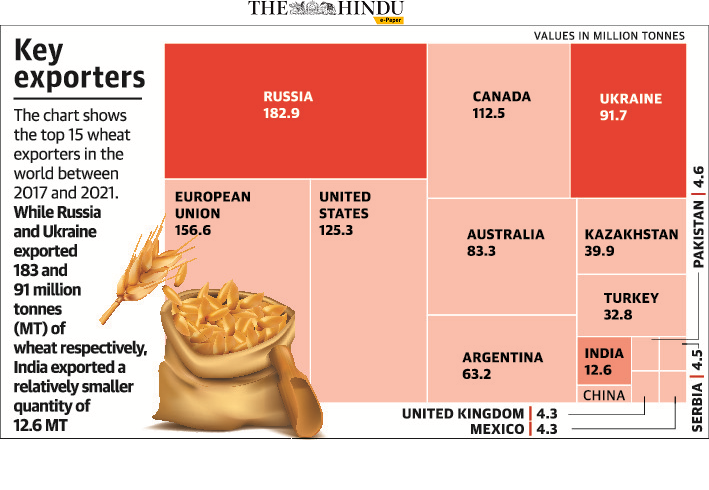
    • While Russia and Ukraine exported 183 million tonnes (MT) and 91 MT of wheat, respectively, between 2017 and 2021, India exported just a fraction of its output, or just 12.6 MT, in the period.
    • Five other countries accounted for the bulk of wheat exports in this period, including the European Union (157 MT), the U.S. (125 MT), Canada (112 MT) and Australia (83 MT).
    • India, which had the second-highest wheat supply (including production, existing stocks and imports) in this period at 613 million tonnes, exported only 2% of this, with about 80% used for domestic consumption, and the rest stored.

    Impact of the war

    • Many countries in Africa, West Asia and Southeast Asia rely heavily on Russian and Ukrainian wheat.
    • Egypt, the biggest importer of wheat, sources 93% of its needs from the East European neighbors. Indonesia, the second-largest importer, has a 30% dependence on these two nations.
    • African nations such as Sudan (60% reliance), Tanzania (64%), Libya (53%), Tunisia (52%), and West Asian countries including Lebanon (77% dependency), Yemen (50%) and the UAE (42%) are also highly dependent on supplies from the two neighbors now at war.

    India’s focus markets

    • India is now focussing on exporting wheat to many nations such as Egypt, Turkey, Nigeria, Algeria, West Asia, Indonesia, Vietnam, Sri Lanka, Bangladesh, Thailand, the Philippines, Morocco and Tanzania.
    • To give impetus to the export promotion of wheat as well as to bring focus on the challenges and bottlenecks faced in production and export, APEDA has created a task group.

    Legal hurdles over Wheat Exports

    • If India decides to export wheat from its stocks, some developed nations may raise objections at the World Trade Organisation.
    • Already, in March, India was accused of exporting rice from its stocks.
    • India had replied that its rice exports were not from stocks set aside under the public stockholding programs.

    India’s consideration

    • The Supreme Court in the Right to Food case, observed that the peace clause adopted in WTO’s Bali Ministerial in 2014 does not prevent India from exporting foodgrains.
    • With the buffer stocks at hand, India should increase its wheat exports in order to stabilise global prices to the extent that it can.
    • It is also important because the countries that were dependent on Russia and Ukraine for their wheat are looking for an alternative source.

    Way ahead

    • There is a need to prioritise local prices and ensure adequate supplies for domestic consumption before deciding on the quantum of exports.
    • Ensuring the stability of prices in India and availability of grain for internal consumption should be of utmost priority to the Indian government
    • The government should plan this move in such a way that it does not impact local consumption.
    • A bumper crop of wheat is expected, so the government can procure enough for its distribution and buffer needs.
    • Further, as of now, there are no export restrictions, so farmers can also get the advantage of higher prices by selling the surplus to private traders for exports.


    Try this PYQ from CSP 2019:

    Q. Among the agricultural commodities imported by India, which one of the following accounts for the highest imports in terms of value in the last five years?

    (a) Spices

    (b) Fresh fruits

    (c) Pulses

    (d) Vegetable oils


    Answer is subjective to the year. But still you can give it a try.


    UPSC 2022 countdown has begun! Get your personal guidance plan now! (Click here)

  • Raja Ravi Varma and his Arts

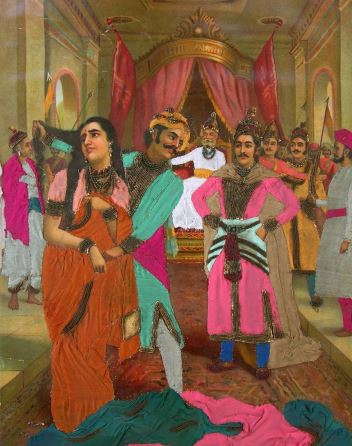
    Raja Rai Varma’s Draupadi Vastraharan is expected to fetch between Rs 15 and Rs 20 crore at an auction.

    Who was Raja Ravi Varma?

    • Raja Ravi Varma was born in April 1848 in Kilimanoor, Kerala, to a family which was very close to the royals of Travancore.
    • Often referred to as the father of modern Indian art, he is widely known for his realistic portrayal of Indian gods and goddesses.
    • While he majorly painted for the royalty, he is also credited for taking art to the masses with his prints and oleographs.
    • At a young age, he would draw animals and everyday scenes on the walls in indigenous colours made from natural materials such as leaves, flowers and soil.
    • His uncle, Raja Raja Varma, noticed this and encouraged his talent.
    • Patronised by Ayilyam Thirunal, the then ruler of Travancore, he learnt watercolour painting from the royal painter Ramaswamy Naidu, and later trained in oil painting from Dutch artist Theodore Jensen.

    How he became an artist of the royals?

    • Varma became a much sought-after artist for the aristocrats and was commissioned several portraits in late 19th century.
    • Arguably, at one point, he became so popular that the Kilimanoor Palace in Kerala opened a post office due to the sheer number of painting requests that would come in for him.
    • He travelled across India extensively, for work and inspiration.

    Fame as a notable painter

    • Following a portrait of Maharaja Sayajirao of Baroda, he was commissioned 14 Puranic paintings for the Durbar Hall of the new Lakshmi Vilas Palace at Baroda.
    • Depicting Indian culture, Varma borrowed from episodes of Mahabharata and Ramayana for the same.
    • He also received patronage from numerous other rulers, including the Maharaja of Mysore and Maharaja of Udaipur.
    • As his popularity soared, the artist won an award for an exhibition of his paintings at Vienna in 1873.
    • He was also awarded three gold medals at the World’s Columbian Exposition in Chicago in 1893.

    Nature of his artforms

    • Much of his celebrated art also borrows heavily from Indian mythology.
    • In fact, he is often credited with defining the images of Indian gods and goddesses through his relatable and more realistic portrayals often painted with humans as models.
    • The depictions include Lakshmi as the goddess of wealth, Saraswati as the goddess of knowledge and wisdom, and Lord Vishnu with his consorts, Maya and Lakshmi.

    How he took Indian art to the masses?

    • Raja Ravi Varma aspired to take his art to the masses and the intent led him to open a Lithographic Press in Bombay in 1894.
    • The idea, reportedly, came from Sir T Madhava Rao, former Dewan of Travancore and later Baroda, in a letter where he pointed out to Varma that since it was impossible for him to meet the large demand for his work, it would be ideal for him to send some of his select works to Europe and have them produced as oleographs.
    • Varma, instead, chose to establish a printing press of his own.
    • The first picture printed at Varma’s press was reportedly The Birth of Shakuntala, followed by numerous mythological figures and saints such as Adi Shankaracharya.

    Try this PYQ:

    Q. There are only two known examples of cave paintings of the Gupta period in ancient India. One of these is paintings of Ajanta caves. Where is the other surviving example of Gupta paintings?


    (a) Bagh caves

    (b) Ellora caves

    (c) Lomas Rishi cave

    (d) Nasik caves


    Post your answers here.


    UPSC 2022 countdown has begun! Get your personal guidance plan now! (Click here)

More posts