💥UPSC 2026, 2027, 2028 UAP Mentorship (March Batch) + Access XFactor Notes & Microthemes PDF

Search results for: “”

  • A constant legal tussle over the state’s “unique constitutional status”

    Why in the News?

    Over the past decade, the Aam Aadmi Party’s government in Delhi has been in a constant legal battle with the Centre over the city’s special constitutional status and how it should be governed.

    What is the Constitutional status of Delhi? 

    • Union Territory with Special Status – Delhi is a Union Territory (UT) but has a legislative assembly and council of ministers, unlike most other UTs. It is governed under Article 239 and Article 239AA of the Indian Constitution.
    • Limited Legislative Powers – The Delhi Legislative Assembly can make laws on subjects in the State List and Concurrent List, except for police, public order, and land, which remain under the control of the Central Government (Article 239AA(3)(a)).
      • Three Power Centers – Governance in Delhi is divided among:
      • Chief Minister and Council of Ministers (elected government)
      • Lieutenant Governor (L-G) (appointed by the President)
      • Union Home Ministry (exercises control over law, order, and services).
    • L-G’s Role and Discretionary Powers – While the L-G is bound by the aid and advice of the Council of Ministers, they can refer matters to the President in case of disagreements, giving the Centre overriding authority (Article 239AA(4)).
    • Sui Generis (Unique) Model – The Supreme Court has ruled that Delhi’s governance model is neither like a full-fledged state nor like a regular Union Territory, making it a special case within India’s federal structure.

    How does Delhi differ from other Union Territories and States?

    Feature Delhi (NCT) Full-Fledged State Other Union Territories (UTs)
    Legislative Assembly Yes (since 1991) Yes No (except J&K, Puducherry)
    Elected Government Yes Yes No (except J&K, Puducherry)
    Control Over Public Order   No Yes No
    Control Over Land No Yes No
    Lieutenant Governor (L-G) Yes, has special powers No (Governor acts as ceremonial head) Yes (UTs are directly administered by L-G/Administrator)
    Power Over Services (Bureaucracy) Limited (Disputed between Delhi Govt. & Centre) Yes (State Govt. controls) No (Centre controls)
    Special Constitutional Provisions Yes (Article 239AA) No (Governed under normal state rules) No (UTs are governed under Article 239)

    What are the legal battles between Delhi and the central Government? 

    • Control Over Bureaucracy (Services Department Dispute): The Centre transferred control of Delhi’s bureaucracy (services) to the Lieutenant Governor (L-G) through a 2015 notification. The Supreme Court (2023) ruled in favor of the Delhi government, giving it power over services except police, land, and public order. However, the Centre later amended the GNCTD Act (2023) to override this decision, restoring L-G’s power over services.
      • Example: The Delhi government’s attempt to appoint bureaucrats without L-G’s approval was blocked.
    • Lieutenant Governor’s Special Powers (Interpretation of Article 239AA): The Centre argued that the L-G has overriding authority over all governance matters, while the Delhi government maintained that L-G must act on the aid and advice of the elected government. In 2018, the Supreme Court ruled that the L-G must follow the advice of the Delhi government, except in matters explicitly under the Centre’s control.
      • Example: The L-G blocked multiple decisions of the Delhi Cabinet, including the ‘Doorstep Ration Delivery’ scheme, citing procedural issues.
    • Control Over Law and Order (Police and Land Disputes): Delhi’s elected government has no control over law and order (including Delhi Police and land administration), leading to governance challenges. The Supreme Court has repeatedly upheld Centre’s control over these subjects as per Article 239AA.
      • Example: The Delhi government sought control over Delhi Police after riots in 2020, but the Centre refused, citing law and order as a central subject.

    What are the implications due to Governance Crisis and Political Fallout?

    • Administrative Paralysis and Policy Delays: Frequent clashes between the Delhi government and the L-G have stalled decision-making, leading to delays in key projects and governance paralysis.
      • Example: The Mohalla Clinics initiative for public healthcare faced repeated delays due to bureaucratic approvals and interference by the L-G’s office.
    • Reduced Accountability and Bureaucratic Resistance: With dual control over administration, bureaucrats often face conflicting orders from the elected government and the Centre, leading to inefficiency.
      • Example: The Delhi Jal Board’s water supply projects were disrupted as officers refused to follow the Delhi government’s directives, citing L-G’s authority.
    • Political Tensions and Electoral Ramifications: The governance crisis has deepened political rivalries, with the Delhi government accusing the Centre of undermining democracy, while the Centre claims Delhi needs central oversight due to its national capital status.
      • Example: The arrest of CM Arvind Kejriwal and Deputy CM Manish Sisodia in the excise policy case led to political instability and weakened AAP’s governance.

    What could happen after the election result in future?  

    • Stronger Central Control and Policy Alignment: With the BJP in power in both the Centre and Delhi, governance could become more streamlined as there would be no friction over administrative control.
      • Example: The L-G’s role in decision-making would likely diminish in practice, as seen in BJP-ruled Puducherry, where Centre-state coordination improved after a BJP-backed government took over.
    • Reversal of AAP’s Key Policies: The BJP might roll back or modify key AAP policies, such as free electricity, water subsidies, and education reforms, aligning governance with its national agenda.
      • Example: Similar to how the BJP government in Madhya Pradesh altered welfare schemes after replacing the Congress government, a BJP-led Delhi might review or discontinue AAP’s flagship initiatives.

    Way forward: 

    • Clearer Division of Powers – Amendments to Article 239AA or a judicial clarification can establish a more balanced framework, ensuring smooth governance without frequent conflicts between the Centre and the Delhi government.
    • Strengthening Cooperative Federalism – A structured dialogue mechanism between the Centre, L-G, and the elected government can improve coordination.

    Mains PYQ:

    Q Discuss the essentials of the 69th Constitutional Amendment Act and anomalies, if any that have led to recent reported conflicts between the elected representatives and the institution of the Lieutenant Governor in the administration of Delhi. Do you think that this will give rise to a new trend in the functioning of the Indian federal politics? (UPSC IAS/2016)

  • Sailing Towards Self-Reliance: Is India Ready for Atmanirbharta in the Maritime Sector?

    NOTE4STUDENTS:

    This article covers India’s journey toward maritime self-reliance, focusing on indigenous naval production and strategic initiatives. UPSC tends to ask questions that connect current affairs with static knowledge. Many struggle with connecting current events to static concepts. It’s not just about knowing the facts but understanding their broader implications in the context of India’s defense strategy. Another common mistake is not giving enough attention to details of indigenous systems or the technical aspects involved in defense production, which are key to understanding India’s maritime self-reliance. This article breaks down complex topics into simple, digestible pieces. It covers both current news and static knowledge, making it easy to understand how one ties into the other. It also connects real-world events (like the commissioning of warships) with defense policy and technological advancements, helping to bridge gaps in understanding.

    PYQ ANCHORING & MICROTHEMES

    1. GS 2: Sea is an important Component of the Cosmos’. Discuss in the light of the above statement the role of the IMO(International Maritime Organisation) in protecting environment and enhancing maritime safety and security.  [2023]
    2. GS 3 : What are the maritime security challenges in India ? Discuss the organisational, technical and procedural initiatives taken to improve the maritime security. [2022]

    Microtheme: Maritime Security challenges

    On January 15, 2024, Prime Minister Narendra Modi presided over the commissioning of three naval platforms—INS Surat (destroyer), INS Nilgiri (frigate), and INS Vagsheer (submarine)—built at Mazagon Docks, marking a historic milestone in India’s quest for maritime self-reliance (Atmanirbharta). 

    The Indian Navy’s Swavlamban initiative reflects a commitment to Atmanirbhar Bharat (self-reliance), emphasizing innovation and indigenization in defense manufacturing. This aligns with India’s broader aspirations of reducing dependency on imports while leveraging domestic capabilities to add value and boost exports. 

    PRESENT STATUS OF MARINE ATMANIRBHARTA

    AspectDetails
    Present Force LevelApproximately 150 ships and submarines, with 60 large Navy ships valued at Rs 1.5 trillion currently under construction.
    Indigenous Warship and Submarine ProductionWarships: 60 warships/vessels under construction at MDL, GRSE, and GSL, including:
    – INS Vikrant (India’s first indigenous aircraft carrier, commissioned 2022)
    – Project 15B (Visakhapatnam-class destroyers, advanced stealth destroyers)
    – Project 17A (Nilgiri-class frigates, guided missile frigates)
    Submarines:
    – Advanced Technology Vessel (ATV) Project, including Arihant-class nuclear submarines.
    – INS Arihant and Arighat (indigenous nuclear-powered submarines).
    – Kalvari-class submarines (Scorpene, six inducted/planned under Project 75 at MDL).
    Indigenous Weapons Systems– BrahMos Missiles (jointly with Russia, domestically produced)
    – Varunastra Torpedo (indigenous heavyweight torpedo for anti-submarine warfare).
    – DRDO Missiles & Systems (Barak-8, underwater surveillance systems).
    Indigenous Sensors and Electronics– Development of Combat Management Systems (CMS), radar systems (Rohini and Revathi), and Sonars (HUMSA-NG for ships and submarines).
    Aircraft and UAVs– Naval Tejas (Indigenous Light Combat Aircraft for carrier-based operations under development).
    – Dornier 228 Aircraft (locally produced multi-role aircraft for maritime patrol).
    – Rustom UAV (Indigenous unmanned aerial vehicle for surveillance).

    The Indian Navy’s present force level comprises about 150 ships and submarines with 60 large Navy ships, valued around Rs 1.5 trillion, are under construction. India’s naval force has made significant strides in domestic production, showcasing a growing reliance on indigenous capabilities.

    KEY STEPS TOWARDS MARITIME ATMNIRBHARTA

    1. Strategic Vision and Initiatives: SAGAR (Security and Growth for All in the Region) framework emphasizes an open, secure, and inclusive Indo-Pacific, with India as a first responder in the Indian Ocean.

    2. Evolution of Self-Reliance:

    • Make-in-India (2014) aimed at attracting foreign manufacturers to set up operations in India for job creation, skill development, and technology transfer.
    • Atmanirbhar Bharat expands this vision to foster domestic manufacturing (indigenization) and ensure India’s capacity to add value to necessary imports.

    3. Navy’s Success in Indigenization:

    Since the 1960s, the Navy has indigenously designed 19 warship models and built 121 ships and submarines.

    It has developed advanced systems like propulsion mechanisms, sonar, electronic warfare suites, fire control systems, and more, many of which are exported as “world-class” products.

    4. Focus on Technology & MSMEs:

    The Navy’s 15-year Science and Technology Roadmap emphasizes cutting-edge areas like AI, robotics, hypersonic missiles, and bio-technical weapons. E.g. DPSUs and MSMEs Collaboration.

    MSMEs and start-ups play a crucial role in creating disruptive technologies and supporting special operations. E.g. Green Channel Policy.

    5. Collaborations & Innovation Structures:

    The Navy has established the Naval Indigenisation and Innovation Organisation (NIIO), the Naval Technology Acceleration Council (N-TAC), and vendor-development programs to facilitate partnerships with academia, industry, and global players.

    Initiatives like IN STEP engage students to work on naval problem statements.

    NEEDS OF MARITIME ATMNIRBHARTA

    AreaBenefitExample
    National Security and Strategic AutonomyReduces dependence on foreign suppliers, ensuring independence during conflicts.Development of the INS Arihant.
    Economic Growth and Cost-EffectivenessReduces reliance on imports, strengthens local industries, creates jobs, fosters innovation.Construction of INS Kamorta (anti-submarine warfare corvette) in Kolkata.
    Maritime Domain AwarenessEnhances ability to monitor coastlines, EEZ, and IOR with tailored surveillance systems.PierSight’s Varuna.
    Global Influence and Soft PowerBuilds credibility and strengthens international partnerships via defense exports.Export of Offshore Patrol Vessels (OPVs).
    Aligning with Atmanirbhar Bharat VisionSupports India’s goal of self-reliance, reduces import dependency in defense.Construction of the INS Vikrant under Make in India and Defence Acquisition Procedure (DAP) 2020.
    Preparedness for Non-Traditional ThreatsFacilitates quick, tailored responses to maritime threats like piracy and terrorism.Information Fusion Centre-Indian Ocean Region (IFC-IOR).
    Technology and Innovation AdvancementPromotes local technological development benefiting both defense and civilian sectors.Varunastra torpedo.

    CHALLENGES WITH INDIA’S MARITIME ATMNIRBHARTA

    1. Global and Regional Context:
    • The Indian Navy is well-regarded, but still behind major powers like the US and China.
    • True Value Rating (TrV): India ranks 7th globally with 103 major naval units and a TrV of 100.5, while the US and China have much larger fleets with TrVs of 323.9 and 319.8, respectively.
    • Defense Spending: India’s defense budget for 2023 was $84 billion, while the US spent $916 billion and China spent $330 billion.
    1. Challenges in Indigenisation:
    • Shipbuilding Delays: India’s shipbuilding is slow. For example, the INS Surat took 31 months to build, while China built a similar ship in just 4.5 months.
    • Dependence on Imports: A lot of the equipment needed for warships is still bought from other countries. There are few local successes, like the BrahMos missile.
    • R&D Challenges: Progress in developing military technology has been slow, affecting India’s ability to become truly self-reliant in defense.
    1. Technological and Innovation Gaps: India still relies on foreign technology for important systems, like advanced turbines, nuclear propulsion, and anti-submarine weapons. The slow adaptation to new technology makes it harder to keep up with global competition.
    2. Infrastructure and Skilled Workforce Deficits: Shipyards in India, like MDL and GRSE, are overloaded, causing delays in production. There is also a shortage of skilled professionals in areas like submarine design and weapon development.
    3. Bureaucratic and Budgetary Challenges: The process of buying new defense technology is slow and complicated, often leading to delays and cost overruns. This is seen in projects like the Arihant-class nuclear submarines.
    4. Security Vulnerabilities: The increasing use of digital systems, such as those on INS Vikramaditya, exposes the navy to cyber threats. Stronger security measures are needed to protect sensitive technology.
    5. Global Competition and Limited Export: Indian defense products face tough competition from countries like the US and China in the global market. Challenges in scaling up production and selling technology like the INS Kalvari limit India’s export opportunities.

    WAY FORWARD

    1. Defense R&D: Prioritize local development of naval technologies like the INS Vikrant, India’s first indigenous aircraft carrier.
    2. Empowerment: Support local industries like Mazagon Dock Shipbuilders Limited (MDL) in manufacturing naval assets through public-private partnerships.
    3. Strategic Partnerships: Strengthen ties with countries like France for the Scorpene submarine project, which was a joint venture for building nuclear-capable submarines.
    4. Infrastructure Development: Modernize Goa Shipyard to ramp up the construction speed of ships, reducing delays in building vital naval vessels.
    5. Naval Doctrine: Develop strategies for countering hybrid warfare, like India’s policy on anti-submarine warfare and cyber defense strategies to prevent naval vulnerabilities.
    6. Acquisition Reforms: Streamline naval procurement processes as seen with the quick induction of the INS Kalvari, a Scorpene-class submarine.
    7. Visionary Leadership: Provide political direction like in the Make in India campaign, driving India’s commitment to indigenous defense production, such as the BrahMos missile program.
    8. Youth Engagement: Encourage youth in STEM through programs like the Indian Navy’s National level internship scheme, where students work directly on naval technologies.

    #BACK2BASICS: DOMESTIC PRODUCTION FOR INDIA’S NAVY 

    1. Indigenous Warship and Submarine Production:

    a. Warships: 60 warships and vessels are currently under construction in Indian shipyards, including the Mazagon Dock Shipbuilders Limited (MDL), Garden Reach Shipbuilders and Engineers (GRSE), and Goa Shipyard Limited (GSL). Notable projects are:

    INS Vikrant: India’s first indigenous aircraft carrier, commissioned in 2022.

    Project 15B (Visakhapatnam-class destroyers): Advanced stealth destroyers being built domestically.

    Project 17A (Nilgiri-class frigates): Guided missile frigates equipped with state-of-the-art systems.

    b. Submarines:

    Advanced Technology Vessel (ATV) Project: Launched in the 1980s and marked India’s place in designing and building nuclear-powered submarines, leading to the creation of the Arihant-class submarines.

    INS Arihant and Arighat: India’s indigenous nuclear-powered submarine.

    Kalvari-class submarines (Scorpene): Built under Project 75 at MDL in collaboration with France, with six submarines inducted/planned.

    2. Indigenous Weapons Systems:

    BrahMos Missiles: Jointly developed with Russia and domestically produced; equipped on many Indian Navy ships.

    Varunastra Torpedo: Indigenously developed heavyweight torpedo used in anti-submarine warfare.

    DRDO-developed missiles and systems: Advanced missile systems like Barak-8 and underwater surveillance systems.

    3. Indigenous Sensors and Electronics:

    Development of Combat Management Systems (CMS) and radar systems such as the Rohini radar and Revathi radar, enhancing the Navy’s self-reliance.

    Sonars: Indigenous sonars like HUMSA-NG are deployed on Indian Navy ships and submarines.

    4. Aircraft and UAVs:

    Naval Tejas: Efforts are ongoing to operationalize an indigenous Light Combat Aircraft (LCA) for carrier-based operations.

    Dornier 228 Aircraft: Locally produced multi-role aircraft for maritime patrol.

    Rustom UAV: Indigenous unmanned aerial vehicles are under development for surveillance purposes.

  • PARAS-2 Spectrograph

    Why in the News?

    Scientists at PRL, Ahmedabad, discovered the exoplanet TOI-6038A b, a dense sub-Saturn-sized planet with a mass of 78.5 Earth masses and a radius of 6.41 Earth radii, using the PARAS-2 spectrograph at Mount Abu Observatory.

    About TOI-6038A b

    • TOI-6038A b is a dense sub-Saturn-sized planet with a mass of 78.5 Earth masses and a radius of 6.41 Earth radii, orbiting a bright, metal-rich F-type star every 5.83 days in a circular orbit.
    • This is the 2nd exoplanet discovery using the PARAS-2 spectrograph.
    • It is also the 5th exoplanet detection combining efforts of PARAS-1 and PARAS-2, showcasing India’s growing expertise in astronomical instrumentation.

    About PARAS-2 Spectrograph:

    • PARAS-2 (PRL Advanced Radial-velocity All-sky Search-2) is a state-of-the-art high-resolution spectrograph designed for exoplanet detection.
    • The development of PARAS-2 began in mid-2018 and was successfully installed at the telescope site in mid-2022.
    • It is the highest-resolution stabilized radial velocity (RV) spectrograph in Asia, operating at a precision level of 30 cm/s.
    • It is installed at PRL’s 2.5-meter telescope at the Mount Abu Observatory, benefiting from high-altitude, clear sky conditions.
    • Key Features of PARAS-2:
      • Operates in the 380-690 nm waveband, making it suitable for studying a wide range of celestial objects.
      • Resolution of ~107,000, the highest in Asia, enabling ultra-precise exoplanetary studies.
      • Ultra-stable temperature and pressure environment: Maintained at 24 ± 0.001 °C and 0.005 ± 0.0005 mbar, ensuring minimal instrumental drift.
      • Uses a Uranium Argon Hollow Cathode Lamp (UAr HCL) for calibration, achieving a velocity precision of better than 2 m/s.
      • Advanced optical fiber system for capturing stellar light and spectral calibration data simultaneously.
    • It uses the radial velocity method, which detects tiny wobbles in a star’s motion caused by the gravitational pull of an orbiting planet.
    • These wobbles cause shifts in the star’s light spectrum, allowing scientists to determine a planet’s presence, mass, and orbital period.
    • It can detect minute stellar movements, making it ideal for finding low-mass exoplanets like super-Earths.

    PYQ:

    [2015] The term ‘Goldilocks Zone’ is often seen in the news in the context of:

    (a) the limits of habitable zone above the surface of the Earth
    (b) regions inside the Earth where shale gas is available
    (c) search for the Earth-like planets in outer space
    (d) search for meteorites containing precious metals


  • New Fishing Grounds discovered in Arabian Sea 

    Why in the News?

    A deep-sea fishing expedition conducted by the Fishery Survey of India (FSI) has uncovered several highly productive and previously unexplored fishing grounds in the Arabian Sea.

    Key Findings of the Deep-Sea Survey:

    • Fishing was conducted at depths between 300-540 meters using deep-sea trawlers.
    • The survey was funded under the Pradhan Mantri Matsya Sampada Yojana (PMMSY).
    • It mapped potential deep-sea fishing zones 100-120 nautical miles off India’s western coast, stretching from Kollam in Kerala to Goa.

    About Fishery Survey of India (FSI)

    • FSI was established in 1983, under the Ministry of Fisheries, Animal Husbandry & Dairying.
    • It conducts fisheries research, resource surveys, and sustainable fishing assessments.
    • It operates annual Fishery Resource Surveys to guide:
      • Traditional fishermen
      • Small and medium boat operators
      • Deep-sea longlining tuna fleet
    • History of FSI:
      • Originated from the “Deep Sea Fishing Station” project (1946).
      • Renamed “Exploratory Fisheries Project” (1974) and later “Fishery Survey of India” (1983).
      • In 2005, Marine Engineering Division was integrated into FSI.
      • In 2017, PM Narendra Modi launched the Deep-Sea Fishing Project to promote sustainable fishing practices.
    • Capabilities of FSI:
      • Operates 11 ocean survey vessels across six major Indian ports.
      • Employs 752 personnel, conducting deep-sea research and data collection.

    India’s Marine Fishing Industry

    • India ranks second in global fish production after China.
    • Contributes 9.58 million tonnes of total fish production, with:
      • 70% from the west coast
      • 30% from the east coast
    • Major fish-producing states: Andhra Pradesh (20%), West Bengal (15%), Gujarat (8%), Kerala (7%), Maharashtra (6%), Tamil Nadu (6%).
    • Exports and Global Trade:
      • India exports 1.05 million tonnes of marine fish, generating ₹334.4 billion ($5.57 billion) in revenue.
      • Major export markets: USA (26%), ASEAN nations (26%), EU (20%), Japan (9%), Middle East (6%), China (4%).


    PYQ:

    [2018] Defining blue revolution, explain the problems and strategies for pisciculture development in India.

    [2022] What is Integrated Farming System? How is it helpful to small and marginal farmers in India?


  • In news: Arab League

    Why in the News?

    The Arab League has strongly rejected US President Donald Trump’s proposal for Gaza relocation, calling it unacceptable.

    arab league

    About the Arab League

    • The Arab League was founded on March 22, 1945, in Cairo, Egypt.
    • Its founding members included Egypt, Iraq, Jordan, Lebanon, Saudi Arabia, and Syria.
    • The primary goals of the Arab League include:
      • Promoting economic, cultural, political, and military cooperation among Arab states.
      • Safeguarding the independence and sovereignty of its members.
      • Addressing regional conflicts through diplomatic engagement and coordination.
    • The League operates on consensus-based decision-making, meaning all member states must agree on major resolutions.
    • It holds regular summits and meetings where Arab leaders discuss and formulate policies.
    • Specialized councils and committees focus on key areas like economic affairs, defense, social welfare, and education.
    • Organisation Structure:
      • Today, it has 22 member states and several observer nations.
      • Members: Egypt, Iraq, Jordan, Lebanon, Saudi Arabia, Syria, Libya, Tunisia, Algeria, Bahrain, Comoros, Djibouti, Kuwait, Mauritania, Morocco, Oman, Palestine, Qatar, Somalia, Sudan, UAE, and Yemen.
      • Observer Nations: Several non-Arab nations, including Brazil, Eritrea, India, and Venezuela, hold observer status but do not have voting rights.

    Key Achievements of the Arab League:

    • Arab Peace Initiative (2002): Proposed a two-state solution to resolve the Israeli-Palestinian conflict.
    • Military Coordination: Facilitated joint military efforts in various regional conflicts.
    • Economic Integration: Established the Arab Free Trade Area to promote intra-regional trade.
    • Cultural and Educational Exchange Programs: Strengthened cooperation in education, research, and cultural preservation.


    PYQ:

    [2023] Consider the following statements :

    Statement-I: Israel has established diplomatic relations with some Arab States.
    Statement-II: The ‘Arab Peace Initiative’ mediated by Saudi Arabia was signed by Israel and Arab League.

    Which one of the following is correct in respect of the above statements?

    (a) Both Statement-I and Statement-II are correct and Statement-II is the correct explanation for Statement-I

    (b) Both Statement-I and Statement-II are correct and Statement-II is not the correct explanation for Statement-I

    (c) Statement-I is correct but Statement-II is incorrect

    (d) Statement-I is incorrect but Statement-II is correct


  • Brahmagiri Wildlife Sanctuary

    Why in the News?

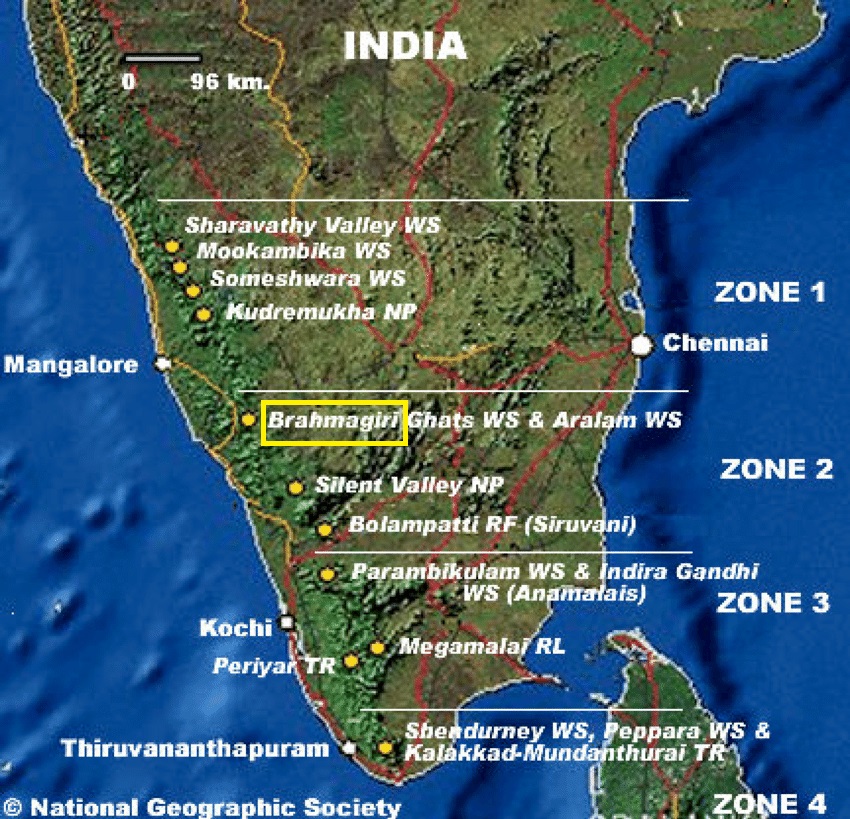
    The Karnataka government’s move to build a tribal village in Brahmagiri Wildlife Sanctuary’s buffer zone has sparked debates on environmental conservation, tribal rights, and human-wildlife conflict.

    Brahmagiri Wildlife Sanctuary

    About Brahmagiri Wildlife Sanctuary:

    • The Brahmagiri WLS is located in Kodagu District, Karnataka, within the Western Ghats.
    • It serves as a crucial ecological corridor, facilitating wildlife movement between Nagarhole National Park and Wayanad Wildlife Sanctuary.
    • Geographical Location and Features
      • It is situated approximately 250 km from Bengaluru and derives its name from the Brahmagiri Peak, the highest point in the region.
      • The sanctuary was declared a protected area on June 5, 1974, to conserve its unique flora and fauna.
      • The terrain consists of evergreen and semi-evergreen forests, grasslands, and shola forests, which provide a habitat for various species.
    • Flora:
      • Bamboo species are widely spread across the region, providing food for herbivores like elephants and deer.
      • The diverse vegetation supports a wide range of faunal species by offering food, shelter, and nesting sites.
    • Fauna:
      • Carnivores: Tigers, jungle cats, leopard cats, wild dogs, and sloth bears.
      • Herbivores: Indian elephants, gaurs, sambars, spotted deer, barking deer, mouse deer, and wild pigs.
      • Primates: Lion-tailed macaques, Nilgiri langurs, slender loris, bonnet macaques, and common langurs.
      • Small Mammals & Rodents: Malabar giant squirrels, giant flying squirrels, Nilgiri martens, common otters, brown mongooses, civets, porcupines, and pangolins.
      • Reptiles: King cobras, Indian cobras, pythons, Malabar pit vipers.
      • Birds: Emerald doves, square-tailed bulbuls, and Malabar trogons.

    PYQ:

    [2020] Which one of the following protected areas is well-known for the conservation of a sub-species of the Indian swamp deer (Barasingha) that thrives well on hard ground and is exclusively graminivorous?

    (a) Kanha National Park

    (b) Manas National Park

    (c) Mudumalai Wildlife Sanctuary

    (d) Tal Chhapar Wildlife Sanctuary


  • [13th February 2025] The Hindu Op-ed: Nuclear energy — dangerous concessions on liability

    PYQ Relevance:

    Q) Give an account of the growth and development of nuclear science and technology in India. What is the advantage of a fast breeder reactor programme in India? (UPSC CSE 2017)


    Mentor’s Comment: UPSC mains have always focused on nuclear science and technology (2017), and atomic energy (2013).

    In the Union Budget speech on February 1, Finance Minister Nirmala Sitharaman announced plans to amend the Atomic Energy Act and the Civil Liability for Nuclear Damage (CLND) Act. This move is likely to be welcomed by the U.S., where past governments have opposed India’s law because it holds nuclear manufacturers partly responsible for accidents. However, in India, removing supplier liability could be a major concern, as it might weaken nuclear safety measures.


    Today’s editorial talks about the Atomic Energy Act and the Civil Liability for Nuclear Damage (CLND) Act. This content will help in GS papers 2 and 3 in mains answer writing.

    _

    Let’s learn!

    Why in the News?

    The mention of plans to amend the Civil Liability for Nuclear Damage Act in the Union Budget is a serious issue that needs attention.

    What is the Atomic Energy Act?

    • The Atomic Energy Act, 1962 is an Indian law that regulates the development, production, and use of nuclear energy for peaceful purposes while ensuring national security. It gives the government exclusive control over nuclear materials, plants, and research and allows the establishment of nuclear power projects. The Act also covers radiation safety, uranium mining, reactor operations, and waste disposal to prevent misuse and ensure public safety.

    What is the Civil Liability for Nuclear Damage Act? 

    • The Civil Liability for Nuclear Damage (CLND) Act, 2010 is an Indian law that defines liability in case of a nuclear accident. It ensures compensation for victims while holding nuclear plant operators accountable.

    Key Features:

    • Operator Liability: The primary financial responsibility for any nuclear accident rests with the plant operator (NPCIL in India), not the supplier.
    • Right of Recourse: Unlike many other countries, India allows operators to seek compensation from suppliers if defective equipment or services cause an accident (Section 17).
    • Liability Cap: Operator liability is capped at ₹1,500 crore (~$180 million), with the government covering additional costs if needed.
    • Exclusion from Global Regimes: India has not joined international nuclear liability agreements like the Convention on Supplementary Compensation (CSC), meaning financial responsibility remains domestic.

    What are the safety and liability concerns related to nuclear energy?

    • Risk of Catastrophic Accidents: Nuclear plant failures can lead to massive radiation leaks, environmental destruction, and long-term health impacts.Example: The Fukushima Daiichi disaster (2011, Japan) resulted from a tsunami, causing multiple reactor meltdowns and widespread radioactive contamination.
    • Design Flaws and Negligence: Suppliers may overlook or downplay safety risks in reactor designs, leading to vulnerabilities. Example: The Three Mile Island accident (1979, USA) occurred due to a known reactor design flaw that the supplier failed to address.
    • Limited Liability for Suppliers: In many countries, nuclear suppliers are indemnified, placing financial liability entirely on plant operators and governments.Example: General Electric (GE), which designed the Fukushima reactors, faced no financial consequences due to Japan’s liability laws.
    • Insufficient Compensation for Victims: Liability caps limit compensation for victims, despite the high costs of nuclear disasters. Example: India’s Civil Liability for Nuclear Damage (CLND) Act caps liability at ₹1,500 crore, whereas Fukushima’s cleanup costs are estimated at ₹20-46 lakh crore.
    • Radioactive Waste and Long-Term Risks: Safe disposal of nuclear waste remains a major challenge, with risks of leaks and contamination lasting thousands of years.Example: The Chernobyl disaster (1986, USSR) left a radioactive exclusion zone that remains uninhabitable nearly 40 years later.

    How does India’s approach to nuclear liability differ from global standards?

    • Operator Liability with Limited Supplier Responsibility: India’s Civil Liability for Nuclear Damage (CLND) Act, 2010, places primary liability on the operator (NPCIL), but allows it to seek compensation from suppliers in case of defective equipment or services (Right of Recourse, Section 17).
      • Global Standard: Most countries fully indemnify suppliers, meaning they bear no financial responsibility after supplying reactors.
      • Example: In Japan, General Electric (GE) faced no liability for the Fukushima disaster (2011), while in India, foreign suppliers fear financial risks if an accident occurs.
    • Liability Cap vs. Unlimited Liability in Some Countries: India caps operator liability at ₹1,500 crore (~$180 million), with additional compensation coming from the government if needed.
      • Global Standard: Some countries, like Germany, impose unlimited liability on operators to ensure full compensation. The U.S. Price-Anderson Act establishes a large industry-backed fund for damages beyond a certain limit.
      • Example: After the Chernobyl disaster (1986, USSR), the Soviet government bore the entire cost (~$235 billion), whereas an Indian accident beyond ₹1,500 crore would shift the financial burden to taxpayers.
    • India is Not Part of Global Nuclear Liability Regimes: India has not signed the Convention on Supplementary Compensation for Nuclear Damage (CSC), which standardizes liability norms and creates an international compensation pool.
      • Global Standard: Most nuclear-powered nations, including the U.S. and Japan, are CSC members, ensuring global financial support for nuclear accidents.
      • Example: If a nuclear accident occurs in France, CSC members contribute to compensation, but in India, all financial burdens remain domestic.

    What are the reasons behind the government’s plan to amend the Atomic Energy Act and the Civil Liability for Nuclear Damage (CLND) Act?

    • Attracting Foreign Investment and Suppliers – The existing CLND Act allows India’s nuclear operator (NPCIL) to seek compensation from foreign suppliers in case of faulty equipment, discouraging companies from supplying reactors. Amendments could limit supplier liability, making India a more attractive market for nuclear investments from countries like the U.S., France, and Russia.
    • Expanding Nuclear Energy Capacity – India aims to increase its nuclear power generation to meet rising energy demands and climate goals. Simplifying liability laws could accelerate agreements with international partners and facilitate the construction of new nuclear plants under deals such as the India-U.S. Civil Nuclear Agreement.

    What are the other implications of increasing nuclear energy reliance?

    • High Economic Costs and Project Delays: Nuclear power plants require massive upfront investments, long construction periods, and frequent cost overruns.
      • Example: The AP1000 reactors in Georgia, USA, were initially estimated at $14 billion but were completed at $36.8 billion—a 250% cost overrun. Similarly, India’s Kudankulam Nuclear Power Plant faced significant delays and cost escalations.
    • Nuclear Waste Management and Environmental Risks: Nuclear energy produces radioactive waste that remains hazardous for thousands of years, requiring secure disposal and long-term monitoring.
      • Example: The Fukushima disaster (2011) led to the release of radioactive material, contaminating land and water, with cleanup costs estimated between ¥35-80 trillion (~₹20-46 lakh crore). India lacks permanent storage facilities for high-level nuclear waste.
    • Geopolitical and Security Concerns: Expanding nuclear energy means higher dependence on foreign suppliers, leading to strategic vulnerabilities and potential external influence.
      • Example: India’s civil nuclear deal with the U.S. (2008) opened doors for technology transfer, but suppliers now demand liability protection before delivering reactors, creating diplomatic pressure.

    Way forward:

    • Strengthen Liability and Safety Frameworks: The government should Amend the Civil Liability for Nuclear Damage (CLND) Act to ensure fair risk-sharing between operators and suppliers.
      • Need to invest in advanced reactor safety technologies (e.g., Small Modular Reactors – SMRs) and strengthen independent regulatory oversight.
    • Develop Robust Waste Management and Indigenous Capabilities: The government should establish permanent disposal sites for high-level nuclear waste with stringent monitoring.
      • Need to enhance domestic nuclear technology (e.g., Thorium-based reactors) to reduce reliance on foreign suppliers and improve energy security.
  • Should convicted persons contest elections?

    Why in the News?

    The Supreme Court is reviewing petitions by Ashwin Upadhyay and others, asking for a lifetime ban on convicted people from contesting elections.

    What does the RPA, 1951 stipulate with respect to electoral candidates convicted of criminal offences? 

    • Section 8(3): Disqualifies a person convicted of a criminal offence and sentenced to at least two years of imprisonment. The disqualification extends for six years after their release.
    • Section 8(1): Provides for automatic disqualification for convictions under specific laws (e.g., IPC for heinous crimes like rape, Prevention of Corruption Act, UAPA) regardless of sentence length, plus six years after release.
    • Section 8(4) (Struck Down in 2013): Previously allowed sitting legislators to continue in office despite conviction if they appealed—declared unconstitutional in Lily Thomas (2013).
    • Section 11: Empowers the Election Commission (EC) to remove or reduce the period of disqualification. Used controversially in 2019 to allow Prem Singh Tamang to contest elections.

    What are the various judgments of the SC which favour the decriminalisation of politics? 

    • Association for Democratic Reforms (ADR) case (2002): Mandated the disclosure of criminal records by all candidates.
    • CEC vs. Jan Chaukidar case (2013): Upheld that individuals in jail cease to be ‘electors’ and are therefore not qualified to contest elections. However, this was overturned by a parliamentary amendment in 2013, allowing under-trial prisoners to contest elections.
    • Lily Thomas (2013): Struck down Section 8(4) of the RP Act, 1951, thereby disqualifying sitting legislators immediately upon conviction.

    What is the case for a lifetime ban on convicted individuals standing for office?

    • Upholding Integrity & Public Trust: Lawmakers must adhere to the highest ethical standards as they create and enforce laws.
      • Example: The Lily Thomas (2013) judgment disqualified convicted legislators immediately, reinforcing the need for clean governance.
    • Parity with Government Jobs: A convicted person is ineligible for even a junior government job, yet they can contest elections after six years.Example: A person convicted under the Prevention of Corruption Act cannot work in government but can become an MP/MLA.
    • Curbing Criminalisation of Politics: 46% of MPs in 2024 have criminal cases, and 31% face serious charges like rape, murder, and kidnapping. Example: Mohammad Shahabuddin, a former MP from Bihar, had multiple murder cases but was elected to office multiple times.
    • Judicial & Expert Recommendations: The Supreme Court, Law Commission (1999, 2014), and Election Commission have all recommended stricter disqualification norms. Example: The Law Commission recommended barring individuals from contesting elections once charges are framed for serious offences.
    • Strengthening Democracy & Rule of Law: A lifetime ban for heinous crimes and corruption would prevent criminals from misusing political power.Example: Lalu Prasad Yadav was convicted in the fodder scam but continued to influence politics despite being disqualified.

    Should convicted persons be allowed to contest elections?

    Arguments in Favour:

    • Rehabilitation & Second Chance: A convict who has served their sentence should not be permanently barred from participating in democracy. Example: Nelson Mandela was convicted and imprisoned for 27 years but later became South Africa’s President, leading the country to democracy.
    • Potential for Political Misuse: Opponents may misuse legal provisions by filing false cases to prevent strong candidates from contesting elections. Example: Political leaders in India, like Arvind Kejriwal, have faced multiple cases, some of which were later dismissed as politically motivated.
    • Disproportionate Punishment: Not all convictions involve moral turpitude or crimes against society. A blanket ban would be excessive in certain cases. Example: A person convicted for protesting against an unjust law (civil disobedience) should not be equated with someone convicted of corruption or murder.

    Arguments Against: 

    • Ensuring Clean Politics: Public representatives should maintain high ethical standards, and allowing convicts to contest elections erodes trust in governance. Example: Mohammad Shahabuddin, a convicted criminal, was elected multiple times despite serious charges, highlighting flaws in the system.
    • Parity with Government Jobs: If convicted individuals are ineligible for government employment, they should also be barred from lawmaking positions. Example: A person convicted under the Prevention of Corruption Act cannot hold a bureaucratic post but can become an MP or MLA, which is inconsistent.
    • Threat to Democratic Institutions: Criminally convicted politicians can misuse their power to influence investigations, intimidate witnesses, and weaken democratic institutions. Example: Politicians with serious criminal cases often manipulate legal loopholes and delay proceedings to continue contesting elections.

    Way forward: 

    • Stricter Disqualification Norms: Implement a lifetime ban on candidates convicted of heinous crimes (murder, rape, corruption) while allowing judicial review for politically motivated cases. Strengthen laws to bar individuals from contesting elections once charges are framed for serious offences, as recommended by the Law Commission.
    • Electoral & Judicial Reforms: Fast-track trials of politicians facing criminal cases through special courts, ensuring timely justice. Strengthen the Election Commission’s authority to scrutinize candidates and enforce stricter disclosure norms on criminal records.

    Mains PYQ:

    Q There is a need for simplification of procedure for disqualification of persons found guilty of corrupt practices under the Representation of Peoples Act”. Comment. (UPSC IAS/2020)

  • No fundamental right to reservation, but State can’t deny it without valid reasoning: SC

    Why in the News?

    Recently, the Supreme Court stated that reservation is not a fundamental right. Articles 16(4) and 16(4-A) of the Constitution allow the government to provide reservations, but they do not make it mandatory. However, if the government decides not to give reservations, it must have valid reasons and supporting data to justify its decision.

    What is the legal status of reservation in India?

    Constitutional provisions: 

    • Article 15(4) allows the state to make special provisions for the advancement of socially and educationally backward classes, Scheduled Castes (SCs), and Scheduled Tribes (STs).
    • Article 16(4) enables the State and Central Governments to reserve seats in government services for SCs and STs.
      • Article 16(4A), introduced via the 77th Constitutional Amendment in 1995, empowers the government to provide reservations in promotions for SCs and STs if they are not adequately represented in public services. This was later modified by the 85th Amendment in 2001 to include consequential seniority.
    • Article 338B gives constitutional status to the National Commission for Backward Classes (NCBC).
    • Article 342A empowers the President to notify the list of Socially and Educationally Backward Classes (SEBC) for any state or union territory, which can only be amended by Parliament.
    • Article 46 states that the State shall promote the educational and economic interests of the weaker sections, particularly SCs and STs, and protect them from social injustice and exploitation.

    Judicial precedence: 

    • Champakam Dorairajan vs. State of Madras (1951): The Supreme Court ruled against communal reservations, leading to the First Constitutional Amendment, which introduced Article 15(4).
    • Indra Sawhney vs. Union of India (1992): The Supreme Court capped caste-based reservations at 50%, ruling that reservations should not destroy the concept of equality. It also mandated the exclusion of the “creamy layer” among Other Backward Classes (OBCs) from reservation benefits and stated that there should not be reservation in promotions.
    • M. Nagaraj v. Union of India (2006): The Supreme Court upheld the constitutional validity of Article 16(4A) but stated that any reservation policy must ensure the SC/ST community is socially and educationally backward, not adequately represented in public employment, and that such policy shall not affect the overall efficiency in the administration.
    • Janhit Abhiyan vs Union Of India (2022): The Supreme Court upheld the 103rd Constitutional Amendment, which introduced 10% reservation for Economically Weaker Sections (EWS) from unreserved classes, even if it exceeds the 50% limit on total reservations.

    Under what conditions can the state deny or grant reservations?

    • Based on Quantifiable Data: The State must collect quantifiable data to assess the underrepresentation of backward classes before granting reservations. Example: M. Nagaraj v. Union of India (2006) required the government to prove inadequate representation before providing reservations in promotions.
    • No Arbitrary Decisions: Reservations cannot be granted or denied arbitrarily and they must be backed by valid reasoning and legal justification. Example: The Supreme Court ruled in State of Kerala v. N.M. Thomas (1976) that reservation policies should be rational and not violate the right to equality.
    • Transparency in Public Employment: The government must clearly specify reservation details (total posts, reserved/unreserved categories) in job advertisements. If no reservation is provided, it must be justified. Example: The Supreme Court struck down a 2010 recruitment process in Palamu, Jharkhand for failing to mention reservation details, deeming it non-transparent.

    How does the Supreme Court balance reservation with equality and fairness?

    • Reservations Are Enabling, Not Mandatory: The Court clarifies that Articles 16(4) and 16(4-A) are enabling provisions, meaning the State may grant reservations but is not obligated to do so.
    • Ensuring No Arbitrary Decisions: The State must base its decision on quantifiable data regarding underrepresentation. Arbitrary refusal or granting of reservations is unconstitutional.
    • 50% Ceiling on Reservations: As per the Indra Sawhney judgment (1992), reservations should not exceed 50%, ensuring fair opportunities for all, unless exceptional circumstances justify exceeding the limit.
    • Merit and Social Justice Balance: The Court emphasizes that reservation should uplift disadvantaged groups without compromising meritocracy in public employment and education.
    • Judicial Scrutiny to Prevent Abuse: Courts can strike down reservation policies if they are found to be politically motivated, lacking empirical justification, or violating Articles 14 and 16 (equality in public employment).

    Way forward: 

    • Data-Driven Reservation Policies: The government should ensure periodic empirical assessment of backwardness and representation to justify reservations, preventing misuse and ensuring targeted benefits.
    • Balancing Merit and Affirmative Action: Strengthen skill development, education, and economic empowerment programs to reduce long-term reliance on reservations while ensuring fair representation in public employment and education.

    Mains PYQ:

    Q Why are the tribals in India referred to as ‘the Scheduled Tribes’? Indicate the major provisions enshrined in the Constitution of India for their upliftment.  (UPSC IAS/2016)

  • Nordic-Baltic Eight (NB-8) Countries

    Why in the News?

    Prime Minister Modi met Estonian President Alar Karis at the AI Action Summit in Paris to discuss trade, technology, cybersecurity, and stronger ties between India, Estonia, and the Nordic-Baltic Eight (NB-8).


    Key Highlights of the Recent Visit to Estonia:

    • First Bilateral Meeting: Held at the AI Action Summit in Paris, focusing on trade, digital ties, and cybersecurity.
    • Economic Cooperation: PM Modi invited Estonian businesses to invest in IT and cybersecurity in India.
    • Cybersecurity & Security Issues: Discussed digital governance, cybersecurity collaboration, and the Russia-Ukraine conflict.
    • Multilateral Ties: Emphasized India-Nordic-Baltic (NB-8) cooperation and India’s role in EU & UN diplomacy.
    • Cultural Exchange: PM Modi appreciated Estonia’s interest in yoga and strengthened people-to-people ties.

    Nordic-Baltic Eight (NB-8) Countries

    About Nordic-Baltic Eight (NB-8) Countries

    • The Nordic-Baltic Eight (NB-8) is a regional cooperation platform that includes:
      • Nordic Countries: Denmark, Finland, Iceland, Norway, Sweden
      • Baltic States: Estonia, Latvia, Lithuania
    • NB cooperation dates to the 1990s, following the Baltic states’ independence from Soviet rule.
    • The Nordic Council began engaging with Baltic leaders in 1989, leading to official cooperation in 1991.
    • The NB-8 framework was formally established in 2000 as a regional diplomatic and economic initiative.
    • Structural Mandate:
      • Trade and Economic Growth: Strengthening business and investment partnerships.
      • Technology and Innovation: Collaborating on digital governance, AI, and cybersecurity.
      • Security and Defense:  Enhancing NATO and EU-led security cooperation.
      • Climate and Energy Policy: Advancing sustainability and energy security initiatives.
    • NB-8 Leadership and Coordination:
      • Each year, one NB-8 country assumes the role of coordinator, hosting diplomatic meetings and leading regional initiatives.
      • Denmark will chair NB-8 in 2025, following Sweden in 2024 and Latvia in 2023.

    PYQ:

    [2014] Consider the following countries:

    1. Denmark
    2. Japan
    3. Russian Federation
    4. United Kingdom
    5. United States of America

    Which of the above are the members of the ‘Arctic Council ‘?

    (a) 1, 2 and 3

    (b) 2, 3 and 4

    (c) 1, 4 and 5

    (d) 1, 3 and 5


  • Reimei: World’s 1st Hybrid Quantum Supercomputer goes Online

    Why in the News?

    Japan has officially launched the world’s first hybrid quantum supercomputer, integrating a 20-qubit quantum processor, Reimei, into Fugaku, the world’s sixth-fastest supercomputer.

    About Reimei

    • Reimei is a 20-qubit trapped-ion quantum computer developed by Quantinuum and integrated into Fugaku, the world’s sixth-fastest supercomputer, at Riken, Japan.
    • It is the first fully operational hybrid quantum supercomputer, combining quantum and classical computing for advanced problem-solving.
    • Key Features:
      • Trapped-Ion Qubits: Unlike superconducting qubits, Reimei uses trapped-ion technology, offering higher stability, longer coherence times, and stronger qubit connectivity.
      • Hybrid Integration: Works alongside Fugaku to solve complex calculations faster than classical supercomputers.
      • Ion Shuttling: Enables physical movement of qubits, allowing for more complex quantum algorithms.
      • Error Correction: Uses logical qubits, reducing error rates 800 times lower than standard qubits.
    • Applications:
      • Physics & Chemistry Research: Used for molecular simulations, material science, and high-energy physics.
      • Quantum Cryptography & AI: Enhances cybersecurity and artificial intelligence models.
      • Optimization & Machine Learning:  Solves large-scale optimization problems.
    • Significance:
      • Bridges classical and quantum computing, serving as a transition to fully scalable quantum systems.
      • Paves the way for real-world quantum applications, accelerating scientific and technological advancements.

    PYQ:

    [2022] Which one of the following is the context in which the term “qubit” is mentioned?

    (a) Cloud Services
    (b) Quantum Computing
    (c) Visible Light Communication Technologies
    (d) Wireless Communication Technologies


  • Who was Sant Guru Ravidas?

    Why in the News?

    The birth anniversary of Sant Guru Ravidas, a prominent figure in the Bhakti movement during the 15th and 16th centuries, is celebrated every year on 12th February.

    Sant Guru Ravidas

    Who was Sant Guru Ravidas?

    • Guru Ravidas, also known as Bhagat Ravidas, was a prominent saint, poet, and social reformer of the Bhakti movement in 15th-century India.
    • Born in 1377 CE in Seer Govardhanpur, Uttar Pradesh, he dedicated his life to eradicating social discrimination and promoting equality.
    • Despite facing caste-based oppression, Guru Ravidas rose to prominence through his wisdom, humility, and devotion to God.
    • He was a contemporary of Sant Kabir and is believed to have met Guru Nanak, the founder of Sikh religion.
    • His hymns are included in the Guru Granth Sahib, reflecting his significant influence in Sikhism and Bhakti traditions.

    Key Contributions of Guru Ravidas

    • Equality & Social Justice: Opposed caste discrimination and untouchability.
    • Bhakti Movement: Advocated devotion over rituals for spiritual enlightenment.
    • Begumpura Concept: Envisioned a society free from oppression and sorrow.
    • Literary Contributions: Composed over 40 devotional hymns in Guru Granth Sahib.
    • Spiritual Influence: Guided Meera Bai in her devotion to Lord Krishna.
    • Universal Brotherhood: Taught that God is for all, beyond religion or caste.
    • Impact on Sikhism: Influenced Guru Nanak and Sikh teachings on equality and devotion.

    PYQ:

    [2018] Consider the following Bhakti Saints:

    1. Dadu Dayal

    2. Guru Nanak

    3. Tyagaraja

    Who among the above was/were preaching when the Lodi dynasty fell and Babur took over?

    (a) 1 and 3

    (b) 2 only

    (c) 2 and 3

    (d) 1 and 2


  • Doctrine of Pith and Substance

    Why in the News?

    In a landmark ruling, the Supreme Court has reaffirmed the Doctrine of Pith and Substance, holding that the Centre cannot impose service tax on lottery distributors as the power to tax lotteries falls exclusively within the jurisdiction of state governments.

    Why did the Supreme Court dismiss the Centre’s Plea?

    • Lotteries Are Not a Service but Gambling: The court ruled that the relationship between states and lottery distributors is buyer-seller, not principal-agent, making service tax inapplicable.
    • Exclusive Taxing Power of States: The Constitution grants state legislatures the authority to tax betting and gambling, including lotteries.
      • Parliament cannot override this through residuary powers (Entry 97 – List I) as taxation on lotteries is already covered under Entry 62 – List II.
    • Doctrine of Pith and Substance Applied: The court ruled that the dominant nature of lotteries is gambling, even if marketing and promotion involve service elements.
      • Since the primary focus remains within the State List, the Centre cannot impose service tax on it.
    • Sikkim High Court Ruling Upheld: The SC upheld the 2012 Sikkim HC decision, which declared Section 65(105) of the Finance Act, 1994 (as amended in 2010) unconstitutional, as it attempted to impose service tax on lottery-related activities.

    What is Doctrine of Pith and Substance?

    • The Doctrine of Pith and Substance helps determine whether a law’s dominant purpose falls within the legislative competence of the enacting government.
    • Key Features:
      • Examines the true nature of a law, rather than incidental overlaps.
      • Resolves Centre-State conflicts over legislative powers.
      • Allows minor encroachments if the primary subject falls within the legislature’s authority.
    • Major Supreme Court Cases Applying the Doctrine:
      • State of Bombay v. FN Balsara (1951): Upheld a state alcohol prohibition law, despite minor overlaps with Union subjects.
      • Prafulla Kumar Mukherjee v. Bank of Commerce (1947):  Allowed incidental encroachment as long as the law’s primary focus was within its jurisdiction.
    • Application in Lottery Taxation Case:
      • The Centre’s argument for taxing lotteries under Entry 97 – List I was rejected.
      • The dominant purpose of lottery transactions is gambling, which states exclusively regulate and tax.

    PYQ:

    [2016] The Parliament of India acquires the power to legislate on any item in the State List in the national interest if a resolution to that effect is passed by the:

    (a) Lok Sabha by a simple majority of its total membership

    (b) Lok Sabha by a majority of not less than two-thirds of its total membership

    (c) Rajya Sabha by a simple majority of its total membership

    (d) Rajya Sabha by a majority of not less than two thirds of its members present and voting


  • Hydro Politics: How Will the Neutral Expert’s Decision Impact India-Pakistan Water Disputes?

    NOTE4STUDENTS:

    India-Pakistan’s Indus Water Treaty dispute saw a key development as the Neutral Expert upheld India’s stance. For UPSC aspirants, this topic is crucial for international relations and governance. It highlights how international treaties function, the role of legal mechanisms in dispute resolution, and the broader impact of climate change on shared water resources. Understanding past challenges under the IWT, including Pakistan’s opposition to Indian projects, will provide strong examples for exam answers. The key takeaway is the importance of cooperation, transparency, and dialogue in resolving such disputes. For UPSC preparation, focus on the treaty’s practical aspects, its resolution mechanisms, and environmental challenges to tackle questions on international treaties, conflict resolution, and water governance effectively.

    PYQ ANCHORING & MICROTHEMES:

    GS 2: Project `Mausam’ is considered a unique foreign policy initiative of the Indian Government to improve relationship with its neighbors. Does the project have a strategic dimension? Discuss. [2015]

    Microthemes: Neighbourhood

    Michel Lino, the World Bank-appointed Neutral Expert (NE), declared he is “competent” to decide differences on hydroelectric projects under the Indus Water Treaty (IWT), 1960. India welcomed the decision, emphasizing that all seven technical disputes fall within the NE’s jurisdiction.

    THE CURRENT DISPUTE

    The disagreement between India and Pakistan revolves around two key hydroelectric projects:

    • Kishenganga Project: Located on the Kishenganga River, a tributary of the Jhelum.
    • Ratle Project: Situated on the Chenab River.

    The core issue lies in the differing interpretations of the dispute resolution mechanism under the Indus Water Treaty.

    • India advocates using a Neutral Expert to resolve the dispute, as stipulated in the IWT of 1960.
    • Pakistan insists on seeking adjudication from the Permanent Court of Arbitration (CoA) in The Hague.

    Timeline of Dispute Development:

    1. 2015: Pakistan raised objections to the projects, initially requesting the appointment of a Neutral Expert.
    2. 2016: Pakistan withdrew its Neutral Expert request unilaterally and directly sought adjudication by the CoA, bypassing the treaty’s prescribed sequence in Article IX.
    3. India subsequently requested that the dispute be referred back to a Neutral Expert, adhering to the treaty’s process.

    Parallel Mechanisms and Legal Challenges

    • In 2022, the World Bank facilitated the simultaneous functioning of both a Neutral Expert and a CoA, creating parallel mechanisms.
    • India rejected the CoA as “illegally constituted” and inconsistent with the treaty’s provisions.

    Engagement on Treaty Review

    India and Pakistan are also engaging under Article XII (3) for a review and potential modification of the treaty:

    • January 2023: India formally issued a notice to Pakistan for reviewing and modifying the treaty.
    • August 30, 2024: Another formal notice was sent, but Pakistan has not responded, despite receiving four reminders from India.

    Neutral Expert’s Decision

    The World Bank-appointed Neutral Expert, Michel Lino, upheld India’s stance.

    • Affirmed his jurisdiction under Paragraph 7 of Annexure F of the IWT to address differences.
    • Recognized the Neutral Expert as the competent authority to resolve the seven disputed issues.

    India’s Response

    India welcomed the Neutral Expert’s ruling and criticized the CoA’s legitimacy.

    • Reiterated that the treaty does not allow parallel proceedings on the same matter.
    • The Ministry of External Affairs affirmed that the Neutral Expert was the appropriate body to address the technical disputes, including seven key differences raised concerning the Kishenganga and Ratle projects.

    Next Steps

    The Neutral Expert is now set to:

    1. Evaluate the merits of each of the seven disputes between India and Pakistan.
    2. Deliver a final decision based on the technical and legal considerations.

    This phased resolution process will determine the future trajectory of the Indus Water Treaty and its governance.

    ISSUES WITH THE TREATY & ITS IMPACTS

    IssueDetailsExamplesImpact
    Pakistan’s Frequent OppositionFrequent objections over Indian projects, questioning adherence to treaty specifications.– Opposition to Kishanganga Hydroelectric Project (KHEP) on Jhelum River.
    – Opposition to Ratle Hydroelectric Project on Chenab River.
    Delayed project timelines and increased costs, undermining developmental efforts.
    Limitations of Judicial RecourseIndia seeks resolution via Neutral Expert (spirit of treaty), while Pakistan uses Permanent Court of Arbitration (PCA) (literal interpretation).– July 2023 PCA Verdict: Legally binding decision favoring Pakistan, rejected by India.Lack of consensus undermines trust in the Treaty’s dispute resolution mechanism.
    Strained Bilateral RelationsTreaty’s functioning influenced by geopolitical tensions.– Suspension of biannual talks due to Pakistan’s support for state-sponsored terrorism.Reduced cooperation, increasing risk of Treaty breakdown and potential water conflicts.
    Impact of Climate ChangeAltered precipitation, runoff patterns, and glacial melt affect water availability.– Increased glacial melt in the Himalayas affects Indus Basin flows.
    – Unpredictable monsoons disrupt allocations.
    Treaty fails to account for climate-induced variability, threatening equitable water sharing.
    Third-Party Conflict ResolutionWorld Bank, as guarantor, lacks tools to determine whether changes in flow are illegal interventions or natural variations.– Disputes during low-flow periods often lead to allegations of intentional blockages by India.Misinterpretation of flow changes increases mistrust and unnecessary escalations.
    Inadequate Data SharingLack of regular data sharing limits understanding of river basin dynamics.– Inconsistent hydrological data sharing on Jhelum and Chenab Rivers prevents effective management.Reduces ability to make informed decisions and fuels disagreements.
    Technical Nature of TreatyComplex provisions enable diverse interpretations, leading to frequent disagreements.– Ambiguities in compliance with Annexure D design standards for hydropower projects.Delays developmental projects and creates recurring disputes between the two nations.

    WAY FORWARD

    1. Work Within the Treaty’s Framework: Both countries should make the best use of the treaty’s existing mechanisms to resolve technical issues fairly and effectively.
    2. Be Open and Share Information: By sharing data about water flow and usage, both nations can build trust and solve shared problems.
    3. Team Up to Manage the Basin: With climate change and growing populations putting pressure on the Indus basin, it’s essential for both sides to work together on saving water, controlling floods, and using resources responsibly.
    4. Keep Talking and Stay Committed: Lasting solutions need both governments to stay focused on peaceful dialogue and cooperation rather than getting caught up in conflicts.

    #BACK2BASICS : INDUS WATER TREATY

    Indus Water Treaty: Overview and Key Provisions

    The Indus Water Treaty (IWT), signed in 1960, governs the water-sharing arrangements between India and Pakistan over the Indus River system. The Treaty emerged as a solution to water disputes following the partition of India in 1947, which divided the river system between the two nations.


    Key Provisions of the Indus Water Treaty

    1. Water Sharing Arrangement:
      • The six rivers in the Indus Basin were divided as follows:
        • Western Rivers: Indus, Jhelum, and Chenab were allocated to Pakistan for unrestricted use, except for specified uses by India (e.g., non-consumptive, agricultural, and domestic uses).
        • Eastern Rivers: Ravi, Beas, and Sutlej were allocated to India for unrestricted use.
      • Approximately 80% of the water flow was allocated to Pakistan and 20% to India.
    2. Specific Rights for India on Western Rivers:
      • Annexure C: Grants India rights for limited agricultural usage of waters from the western rivers.
      • Annexure D: Allows India to build ‘run-of-the-river’ hydropower projects (HEPs), which do not involve live water storage.
        • India must adhere to detailed design specifications.
        • Pakistan must be informed about project designs and can raise objections within three months.
    3. Storage Provisions: India is permitted minimal storage on the western rivers for conservation and flood control purposes.
    4. Permanent Indus Commission
      • A Permanent Indus Commission was established under the Treaty, comprising representatives from both nations.
      • Functions: Act as the first step in resolving water-related conflicts and Mandate at least one annual meeting.
    5. Dispute Resolution Mechanism: The IWT outlines a three-step graded dispute resolution mechanism:
      • Permanent Indus Commission/Inter-government Talks: Initial disputes should be resolved through the Commission or inter-government dialogues.
      • Neutral Expert (NE): Unresolved disputes may be referred to the World Bank, which can appoint a Neutral Expert to resolve specific issues.
      • Court of Arbitration (CoA): If disputes involve treaty interpretation or dissatisfaction with the NE’s decision, they may be referred to a Court of Arbitration.
  • [12th February 2025] The Hindu Op-ed: A role for India in South-South climate cooperation

    PYQ Relevance:

    Q) Clean energy is the order of the day.’ Describe briefly India’s changing policy towards climate change in various international fora in the context of geopolitics. (UPSC CSE 2018)


    Mentor’s Comment: UPSC mains have always focused on Climate Change (2017), and COP 26 (2021).

    In the Climate Change Performance Index (CCPI) 2025, India ranks among the top 10 climate performers globally, underscoring its commitment to climate action. India has been recognized for its significant role in South-South climate cooperation, reflecting its leadership in fostering collaboration among developing nations to address climate change. 


    Today’s editorial highlights how South-South cooperation can help achieve climate goals, promote sustainable development, and empower developing countries to meet their climate targets, drawing attention to India’s strategic opportunities and responsibilities in this area. This content would help in substantiation of answers in Mains GS Paper III (Environment and Biodiversity).

    _

    Let’s learn!

    Why in the News?

    India’s potential role in fostering climate cooperation between developing nations through South-South cooperation in the context of the Paris Agreement is needed for the  global solutions to tackle climate change.

    How does Article 6 of the Paris Agreement benefit India in achieving its climate goals?

    • Carbon Markets: Under Article 6.2, countries can trade carbon credits to meet their emissions reduction targets. India can participate in these carbon markets, generating revenue by selling surplus carbon credits earned through emission reductions in sectors like renewable energy, energy efficiency, and afforestation.
        • By engaging in carbon trading, India can attract foreign investments from companies in developed countries looking to offset their emissions. This can provide funding for clean energy projects, supporting India’s transition to a low-carbon economy.
    • Cooperative Approaches: Article 6.4 establishes a global carbon market mechanism, similar to the Clean Development Mechanism (CDM) under the Kyoto Protocol, but with improvements. India could utilize this mechanism to undertake joint projects with other countries that help reduce emissions while fostering sustainable development.
      • Through cooperative approaches, India can access advanced technologies, practices, and expertise from other countries, enabling its industries to adopt cleaner technologies and improve energy efficiency, contributing to its climate and development goals.
    • Non-Market Approaches:
      • Article 6.8 promotes non-market mechanisms, which focus on facilitating actions like capacity-building, finance, and knowledge sharing to address climate change. This can help India strengthen its national capabilities to implement climate policies and adapt to the impacts of climate change, particularly in vulnerable regions.
      • India, being highly vulnerable to the effects of climate change, can benefit from non-market approaches to enhance its adaptive capacities and resilience, addressing critical sectors like agriculture, water resources, and infrastructure.
    • Flexibility in Meeting Targets:
      • The flexibility provided by Article 6 allows India to find the most cost-effective solutions for emission reductions, especially in sectors where technology deployment is expensive or challenging. It provides an opportunity to meet its Nationally Determined Contributions (NDCs) in a way that balances economic growth with environmental sustainability.

    What are the potential challenges India faces in utilizing ITMOs and engaging in international climate finance?

    • Monitoring, Reporting, and Verification (MRV) Systems: India’s current MRV systems for tracking emissions reductions may not meet the rigorous standards required for ITMOs, which are crucial for ensuring transparency and accountability in carbon markets.
      • Inadequate MRV mechanisms could hinder India’s ability to accurately quantify and report emission reductions, limiting its participation in carbon trading and climate finance.
    • Accessing Climate Finance: Despite being a major developing country, India faces challenges in accessing sufficient and predictable climate finance from international sources, as the global financing mechanisms often favor smaller or more vulnerable nations.
      • Limited access to finance can slow down India’s ability to implement large-scale climate projects, especially in sectors like renewable energy, adaptation, and infrastructure development.
    • Ensuring Environmental Integrity: While ITMOs enable carbon trading, there’s a risk of “low-quality” credits or “double counting” (where emissions reductions are claimed by multiple parties), which could undermine the credibility and environmental integrity of the system.
      • If India is not careful in ensuring robust methodologies for generating and trading ITMOs, it might face challenges in maintaining the credibility of its climate commitments, affecting its international reputation.
    • Domestic Policy and Institutional Coordination: India’s domestic policies on climate change may not be fully aligned with the requirements of international climate finance mechanisms or ITMO systems. There is also a need for better coordination among various ministries and stakeholders to implement and track climate action effectively.
      • Misalignment between international climate goals and domestic policies could result in inefficiencies and missed opportunities to access ITMOs and climate finance.

    What are the opportunities for India under South-South cooperation via Article 6.2?

    • Carbon Trading with Fellow Developing Countries: India can collaborate with neighbouring countries like Sri Lanka, Bangladesh, and others in the South Asian region to work together to reduce emissions through renewable energy, afforestation, or energy efficiency programs.
      • India could sell any surplus carbon credits generated through its own emission reduction efforts to other developing countries that need help meeting their own NDCs (Nationally Determined Contributions). This allows India to both achieve its climate goals and potentially generate revenue.
    • Technology and Knowledge Transfer: India has already made significant progress in solar energy and can offer valuable lessons and technologies to fellow developing countries.
      • India can also help other countries develop adaptation strategies for climate change impacts, such as water management techniques, disaster preparedness, and climate-resilient infrastructure.
      • In return, India could receive new technologies, methods, and knowledge to enhance its own climate resilience.
    • Joint Ventures for Clean Energy Projects: India can partner with other developing countries to co-develop large-scale renewable energy projects, such as solar, wind, or hydropower. Joint initiatives could be supported by carbon markets, with emission reductions which could attract investments, expertise, and improve access to clean energy technologies.
      • By collaborating with other developing countries, India can contribute to the development of affordable, scalable solutions that are tailored to the specific needs of developing nations.
      • These solutions could be implemented locally, reducing emissions and improving energy access.
    • Strengthening Capacity and Institutional Frameworks: South-South cooperation can help India and other developing countries to assist in establishing frameworks for monitoring, reporting, and verifying (MRV) emissions reductions, benefiting both India and its partner countries.
      • India can help south countries in refining its strategies and implementing the best practices that suit their own development contexts.
    • Leveraging Climate Finance: India, by engaging in South-South cooperation, could also have access to international financial instruments that make climate action more affordable.
      • This would be particularly beneficial in sectors where India faces challenges in scaling up clean technologies, like electric vehicles, or in regions like rural areas that require adaptation interventions.
  • Struggling with poor cyber security

    Why in the News?

    Kaveri 2.0, a web portal launched in 2023 to make property registrations in Karnataka easier was recently hit by a DDoS attack carried out using AI-powered bots.

    What is a DDoS attack? 

    • A Distributed Denial of Service (DDoS) attack is a type of cyberattack where multiple computers or bots flood a website or online service with excessive traffic, overwhelming its servers and causing it to slow down or crash.

    What are the key issues with Karnataka’s response to cyber attacks, specifically the DDoS attack on Kaveri 2.0?

    • Lack of Proactive Cybersecurity Measures: Despite previous cyber incidents like the 2017 WannaCry ransomware attack and the 2019 e-procurement portal hack, the State failed to implement robust preventive measures. The DDoS attack on Kaveri 2.0 in December 2024 – February 2025 exposed the absence of real-time threat monitoring systems.
    • Poor Coordination Between Departments: The e-Governance Department did not involve the State cyber crime police until February 7, 2025, despite weeks of disruption. Resistance within departments to share cybersecurity concerns with law enforcement delayed incident response, worsening the crisis.
    • Lack of a Dedicated Cybersecurity Infrastructure: Karnataka lacks a Cyber Security Operation Centre like Maharashtra and Odisha. A ₹20 crore cybersecurity centre, proposed in February 2023, was scrapped after the new government took over, leaving critical digital infrastructure vulnerable.
    • Government Response and Security Measures: While the government has initiated a police probe and FIR registration under the Information Technology Act, and the Kaveri 2.0 application has been restored with enhanced security measures,
      • Karnataka launched a cyber security policy in 2024 to combat rising cybercrime, focusing on awareness, skill building, and industry promotion.

    How have past attacks influenced the current state of cyber security?

    • Failure to Implement Robust Cybersecurity Measures: Despite the 2017 WannaCry ransomware attack on the Karnataka State Data Centre and the 2019 e-Procurement portal hack (₹11.5 crore stolen), the state did not establish strong preventive mechanisms.
      • The lack of a dedicated Cyber Security Operation Centre resulted in inadequate monitoring and delayed responses to threats like the recent DDoS attack on Kaveri 2.0 (2024-25).
    • Persistent Coordination Gaps Between Departments: Earlier attacks, such as the 2022 cyber attack on NIMHANS, highlighted poor inter-departmental coordination, yet similar gaps persisted during the Kaveri 2.0 DDoS attack.
      • The e-Governance Department handled the crisis alone without informing the cyber crime police, delaying investigative action until February 7, 2025.
    • Neglect of Cybersecurity Infrastructure Development: A ₹20 crore Cyber Security Operation Centre, proposed in February 2023, was dropped in the May 2023 budget revision after a change in government.
      • Unlike Maharashtra and Odisha, which have dedicated cyber security setups, Karnataka still lacks a real-time threat detection system, leaving it vulnerable to repeated cyber attacks.

    Why has the coordination between the e-Governance Department and the State Police been ineffective during cyber incidents?

    • Lack of a Unified Cybersecurity Framework: Karnataka’s Cyber Security Committee (2023) is led by bureaucrats without police representation, unlike national-level bodies like I4C (Indian Cyber Crime Coordination Centre) and NCIIPC (National Critical Information Infrastructure Protection Centre).
      • This results in fragmented decision-making, where cybersecurity response remains within the e-Governance Department, sidelining law enforcement agencies.
    • Delayed Involvement of the Cyber Crime Police: In the Kaveri 2.0 DDoS attack (2024-25), the e-Governance Department did not inform the State cyber crime police until February 7, 2025—long after the attack began in December 2024.
      • Earlier incidents like the 2019 e-Procurement portal hack and 2022 NIMHANS cyber attack also saw delayed police involvement, allowing attackers more time to operate.
    • Departmental Hesitation to Engage Law Enforcement: Sources indicate a reluctance within the e-Governance Department to involve the police, possibly due to bureaucratic hurdles or fears of administrative scrutiny.
      • This lack of trust and procedural clarity has led to independent firefighting efforts rather than a coordinated response between technical teams and law enforcement.

    Why is it crucial for the state to establish a Cyber Security Operation Centre similar to the national model?

    • Real-Time Threat Detection and Response: The DDoS attack on Kaveri 2.0 (2024-25) went undetected for weeks, causing major disruptions in property registrations. A Cyber Security Operation Centre (CSOC) would enable 24/7 monitoring and early detection of cyber threats.
      • National agencies like I4C (Indian Cyber Crime Coordination Centre) and NCIIPC (National Critical Information Infrastructure Protection Centre) use AI-driven analytics and real-time threat intelligence to mitigate cyber risks, a model Karnataka must adopt.
    • Coordinated and Rapid Incident Response: Karnataka’s e-Governance Department handled the Kaveri 2.0 attack alone, only involving cyber crime police weeks later, delaying mitigation efforts.
      • A CSOC would centralize cybersecurity efforts, ensuring immediate coordination between technical experts, government departments, and law enforcement agencies to prevent prolonged disruptions.

    Way forward: 

    • Establish a Cyber Security Operation Centre (CSOC): Revive the ₹20 crore CSOC proposal with real-time threat monitoring, AI-driven analytics, and centralized coordination between government agencies and law enforcement.
      • Implement automated response mechanisms to detect and neutralize cyber threats before they escalate.
    • Strengthen Inter-Departmental Coordination and Cybersecurity Framework: Mandate immediate police involvement in cyber incidents and integrate law enforcement into cybersecurity governance structures like the Cyber Security Committee.
      • Conduct joint cybersecurity drills between the e-Governance Department, State Police, and IT experts to improve incident response efficiency.

    Mains PYQ:

    Q What are the different elements of cyber security? Keeping in view the challenges in cyber security, examine the extent to which India has successfully developed a comprehensive National Cyber Security Strategy. (UPSC IAS/2022)

  • Unlocking women’s workforce potential in India

    Why in the News?

    Increasing the number of women in the workforce is not just about equality and it is also essential for economic growth.

    What are their challenges in enabling women’s economic participation in India?

    • Unpaid Care Work Burden: Women in India spend 7.2 hours per day on unpaid domestic work, compared to 2.8 hours by men (Time Use in India Report, 2019). This leaves them with less time for paid employment.
      • Example: Many women drop out of the workforce after marriage due to caregiving responsibilities, particularly in rural areas where childcare facilities are scarce.
    • Lack of Formal Part-time Employment: India lacks legally regulated part-time work, unlike OECD countries where part-time work is protected by law and provides benefits.
      • Example: According to the NCAER study (2024), 57% of women prefer part-time jobs for flexibility, but due to the absence of formal options, many take low-wage, informal sector jobs without security.
    • Gender Discrimination and Wage Gap: Women in India earn only 77% of what men earn for the same work (World Economic Forum, Global Gender Gap Report 2023).
      • Example: The STEM sector in India has only 16% female representation, limiting women’s access to high-paying jobs and leadership roles.
    • Limited Access to Safe and Affordable Transport: Lack of safe and reliable transport restricts women’s mobility for work, especially in cities with high crime rates against women.
      • Example: A study by Ola Mobility Institute (2022) found that over 50% of women in Delhi and Mumbai reject job opportunities due to safety concerns while commuting.
    • Low Financial and Digital Literacy: Women in India have lower financial and digital literacy, limiting their participation in modern, high-skilled jobs and entrepreneurship.
      • Example: According to the National Family Health Survey-5 (2019-21), only 33% of Indian women use the Internet, reducing their access to online job markets and digital banking.

    What are the Study and Findings from the LFPR Report?

    • Low Female Labour Force Participation Rate (LFPR) in India: India’s Female LFPR stands at 37%, which is much lower than the global average of 47% and the OECD average of 67%. The primary reasons for this low participation include unpaid care work, lack of formal part-time jobs, gender discrimination, and mobility constraints.
    • Impact of Addressing Barriers on LFPR Growth: The study used the McCall-Mortensen job search model to simulate the effects of policy changes. It found that addressing two major barriers (formalizing part-time work and redistributing unpaid care work) could increase women’s LFPR by 6 percentage points, from 37% to 43%.
    • Projected Increase in LFPR: The study found that addressing these two barriers could raise India’s female LFPR by six percentage points, increasing it from the current 37% to 43%.
    • Formalizing Part-Time Employment: The study highlighted that introducing formally recognized part-time work contracts with pro-rated wages and benefits would offer women the flexibility they need.
    • Redistributing Unpaid Care Work: Achieving gender equality in caregiving responsibilities, through policies like paid parental leave and investment in childcare along with cultural changes, is crucial for enabling women’s participation in the labour force.

    What are the steps taken by the government? 

    • Maternity and Childcare Support – The Maternity Benefit (Amendment) Act, 2017 increased paid maternity leave to 26 weeks, and schemes like PM Matru Vandana Yojana provide financial aid to pregnant women.
    • Skill Development and Entrepreneurship – Programs like PM Kaushal Vikas Yojana (PMKVY) train women in various skills, while Mudra Yojana and Stand-Up India provide financial support for women entrepreneurs.
    • Workplace Safety and Legal Protections – The Sexual Harassment of Women at Workplace Act, 2013 ensures safer workplaces and the Working Women’s Hostels Scheme provides secure housing for working women.

    Way forward: 

    • Policy Reforms for Flexible Work and Social Security: Introduce formal part-time work laws with pro-rated wages and benefits, ensuring job security and flexibility for women. Expand paid parental leave and affordable childcare facilities to reduce the unpaid care work burden.
    • Improving Safety, Mobility, and Digital Inclusion: Strengthen safe public transport infrastructure and women-only commuting options to enhance workplace accessibility. Promote financial and digital literacy programs, ensuring women’s participation in online job markets and entrepreneurship.

    Mains PYQ:

    Q ‘Women’s movement in India has not addressed the issues of women of lower social strata.’ Substantiate your view. (UPSC IAS/2018)

  • [pib] Nationwide Mass Drug Administration (MDA) Campaign for Lymphatic Filariasis (LF) Elimination 

    Why in the News?

    Union Minister for Health and Family Welfare has launched the Annual Nationwide Mass Drug Administration (MDA) Campaign to eliminate Lymphatic Filariasis (LF).

    About Lymphatic Filariasis (LF):

    • Lymphatic Filariasis (LF), or “Hathi Paon”, is a mosquito-borne parasitic disease caused by Wuchereria bancrofti, Brugia malayi, and Brugia timori.
    • It affects the lymphatic system, leading to swelling of limbs (lymphoedema) and scrotal swelling (hydrocele), causing permanent disability.
    • LF spreads through repeated mosquito bites, making it a major public health challenge in tropical regions, including India.
    • India aims to eliminate LF by 2027, ahead of the 2030 Sustainable Development Goal (SDG) target.

    What is Mass Drug Administration (MDA)?

    • MDA is a large-scale public health campaign where anti-filarial medicines are administered to all eligible individuals in endemic areas to stop LF transmission.
    • Medication Regimens:
      • Double Drug Therapy (DA): Diethylcarbamazine Citrate (DEC) + Albendazole
      • Triple Drug Therapy (IDA): Ivermectin + DEC + Albendazole
    • Key Features of MDA
      • Door-to-door supervised drug administration ensures high coverage.
      • Drugs are safe, free, and given twice a year in targeted districts.
      • MDA is crucial for eliminating LF, as it reduces parasite transmission and protects millions from disability.
    • EXCEPTIONS: Children below 2 years, pregnant women, and seriously ill individuals.

    PYQ:

    [2017] Consider the following statements:

    1. In tropical regions, Zika virus disease is transmitted by the same mosquito that transmits dengue.

    2. Sexual transmission of Zika virus disease is possible.

    Which of the statements given above is/are correct?

    (a) 1 only

    (b) 2 only

    (c) Both 1 and 2

    (d) Neither 1 nor 2


  • [pib] Exercise CYCLONE-III

    Why in the News?

    The 3rd edition of Joint Special Forces Exercise CYCLONE commenced at Mahajan Field Firing Ranges in Rajasthan.

    Note: India and the UAE held the ‘Desert Cyclone 2024’ joint military exercise in Rajasthan in January 2024. One must not get confused with this.

    About Exercise CYCLONE-III

    • It is the 3rd edition of the Joint Special Forces Exercise between India and Egypt, aimed at enhancing interoperability, joint tactical operations, and counter-terrorism capabilities.
    • The exercise is conducted at Mahajan Field Firing Ranges in Rajasthan from 10th to 23rd February 2025.
    • CYCLONE is an annual exercise, held alternately in India and Egypt.
      • The previous edition (CYCLONE-II) was conducted in Egypt in January 2024.
    • The exercise focuses on high-intensity special forces training in desert and semi-desert terrains.

    Features and Significance:

    • This exercise involves 25 personnel from each side, focusing on counterterrorism, CQB, hostage rescue, and heliborne operations in desert terrain.
    • The 48-hour final validation exercise tests combat strategies in semi-desert conditions, while an Indian defense technology showcase strengthens military ties.
    • The exercise enhances India-Egypt defense cooperation, improves joint counter-terrorism capabilities, and builds readiness for future operations.
    • It also boosts India’s strategic outreach in the Middle East and North Africa (MENA) region, reinforcing defense collaborations and regional security.
  • Phase 2 of ASPIRE Programme 

    Why in the News?

    The 4th India-UK Energy Dialogue, chaired by the Union Minister of Power and the UK’s Energy Security Secretary, was recently held in New Delhi. The dignitaries launched Phase-2 of the ASPIRE programme to improve power supply, energy efficiency, and renewable energy.

    About the ASPIRE Programme

    • The ASPIRE (Accelerating Smart Power and Renewable Energy in India) program was officially launched in November 2021 during the India-UK Energy for Growth Partnership.
    • It focuses on renewable energy expansion, power distribution reforms, and energy efficiency improvements.
    • The program is implemented in collaboration with India’s Ministry of Power (MoP), Ministry of New and Renewable Energy (MNRE), and the UK Foreign, Commonwealth & Development Office (FCDO).

    Key Features of ASPIRE Phase-2:

    • Round-the-Clock (RTC) Power Supply:  Ensuring uninterrupted electricity with smart grid integration.
    • Renewable Energy Expansion: Scaling up solar, wind, and offshore wind projects with investment support.
    • Industrial Energy Efficiency & Decarbonization:  Reducing carbon emissions in key industries like steel, aluminum, and cement.
    • Power Distribution & Market Reforms:  Enhancing smart metering, grid resilience, and regulatory cooperation between CERC (India) and OFGEM (UK).
    • Offshore Wind Development: Establishing a UK-India Offshore Wind Taskforce to boost supply chains & financing models.
    • Electric Mobility & Green Data Centers: Expanding EV charging infrastructure and sustainable energy solutions.

More posts