A republic is made robust and kept alive by its people. In its current form, the Indian republic marks 73 years of maintaining a dynamic balance.
Directly elected representation
It is to the credit of our people that today we have a pyramidal three-layered elected representative system that governs us.
This system today has over 3 million elected representatives (a million of them women), over 4,000 elected to the state legislatures and over 500 in the Parliament.
This scale of directly elected representation, perhaps, can be seen nowhere else in the world.
Moral and spiritual basis of the Constitution
In Pilgrimage to Freedom, K M Munshi writes, “our Constitution has a moral background — to secure justice for every section of our society; as also a spiritual basis — to preserve and protect all religions in the exercise of their functions”.
The challenges continue in securing justice for every section of our society.
The Backward Classes, the Scheduled Castes and the Scheduled Tribes and the poor across all categories clamour for better opportunities and affordable justice.
What Munshi calls the spiritual basis of our Constitution in having to preserve and protect all religions is also seen under stress.
When the right to practise one’s religion is denied or threatened, the silence of the thinking public or the media weakens that constitutionally embedded protection.
Challenges posed by social media
Through the power of technology and its capacity to broadcast at mass scale, an otherwise useful tool, social media, has become a challenge and sometimes a threat to one or several of the rights enshrined in our Constitution.
Curtailing them to protect the rights of citizens is seen as trampling upon the right to free speech.
Without any action, the damage caused to social harmony by such rampant false news can result in people losing faith in the Constitution itself.
Constitution as a living, dynamic process
Our Constitution is the most amended of all constitutions in the world.
If there are more than 100 amendments made to the Constitution, there are more than 1,500 laws that have been repealed because they have outlived their times.
These deadwood laws, by remaining on paper, occasionally became a weapon in the hands of rent-seekers.
Their removal, as a part of administrative reform, has kept the role of the executive transparent and accountable.
That the Constitution is always evolving is best exemplified by the 101st amendment which rolled out the Goods and Services Tax.
his amendment brought in a unified indirect tax regime by subsuming most of the indirect taxes of the Centre and the states.
Yet to complete five full years, the GST Council has stood the test of challenging times even in its initial years.
It augurs well for cooperative federalism.
Conclusion
Our Constitution has served us well in these seven decades. Several republics in the post-imperial era have rejected their earlier constitutions and tested new ones. It is the people who can keep the republic robust and alive.
This year we are celebrating our 73rd Republic Day. The Constitution has been our guiding force in the journey of the nation as a mature democracy among comity of nations.
Historical background
The Constituent Assembly undertook intensive deliberations over a period of two years, 11 months and 18 days spread over 11 sessions, during which the Constitution of India took shape.
Our Constituent Assembly played a dual role after Independence, given the insurmountable task of nation-building.
Our Constituent Assembly had performed the functions of the provisional Parliament of India in the interval between the time our Constitution was enforced and the day when the new Parliament was formed following the first General Elections (October 25, 1951-February 21, 1952).
The Constituent Assembly of India acted as the first Parliament of independent India.
Role of the Parliament
Representative institutions and democratic traditions have always been an integral part of our rich heritage
Our Parliament has been playing a pivotal role in the all-round development of the nation by adopting many parliamentary devices for ensuring free and fair discussions and dialogue.
We have to ensure that our institutions and governance ensure inclusivity and the participation of our population in our developmental journey, particularly our women, Scheduled Castes, Scheduled Tribes and all other marginalised sections become equal partners in our growth story.
Ensuring the best legislative practices
Repository of the proceedings: To ensure that best legislative practices are shared, a national portal is being planned to serve as a repository of the proceedings of Parliament and all State/Union Territory legislatures in the country.
Research support is being provided to Members to help them participate better and meaningfully in matters brought before Parliament.
Review of the laws to make them relevant: It is also time in the journey of our nation to take stock and review laws that were enacted during the pre-Independence era so as to make them more relevant to our current requirements and future challenges.
Conclusion
Republic Day is an occasion for people’s representatives and all citizens of this proud nation to reaffirm faith in the ideals enshrined in our Constitution.
While many developing countries made net-zero pledges at COP26 in Glasgow, they face enormous developmental challenges in their attempts to grow in a climate-constrained world.
Developmental challenges for India
For India, the national context is shaped by high youth unemployment, millions more entering the workforce each year, and a country hungry for substantial investments in hard infrastructure to industrialise and urbanise.
Growth with low emission footprint: India’s economic growth in the last three decades, led by growth in the services sector, has come at a significantly lower emissions footprint.
But in the coming decades, India will have to move to an investment-led and manufacturing-intensive growth model to create job opportunities and create entirely new cities and infrastructure to accommodate and connect an increasingly urban population.
All of this requires a lot of energy. Can India do all of this with a low emissions footprint?
What could India do to pursue an industrialization pathway that is climate-compatible?
A coherent national transition strategy is important in a global context where industrialised countries are discussing the imposition of carbon border taxes while failing to provide developing countries the necessary carbon space to grow or the finance and technological assistance necessary to decarbonise.
What India needs is an overarching green industrialisation strategy that combines laws, policy instruments, and new or reformed implementing institutions to steer its decentralised economic activities to become climate-friendly and resilient.
Issues with India’s domestic manufacturing of renewable technology components
India’s industrial policy efforts to increase the domestic manufacturing of renewable energy technology components have been affected by policy incoherence, poor management of economic rents, and contradictory policy objectives.
India managed to create just a third of jobs per megawatt that China has managed to in its efforts to promote solar PV and wind technologies.
China has created more jobs in manufacturing solar and wind components for exports than domestic deployment.
India could have retained some of those jobs if it were strategic in promoting these technologies.
Opportunities in decarbonising transport and industry sector
Technologies needed to decarbonise the transport and industry sectors provide a significant opportunity for India.
However, India’s R&D investments in these emerging green technologies are non-existent.
PLI is a step in right direction: The production-linked incentives (PLIs) under ‘Aatmanirbhar Bharat’ are a step in the right direction for localising clean energy manufacturing activities.
Focus on R&D: Aligning existing RD&D investments with the technologies needed for green industrialisation is crucial for realising quantum jumps in economic activities.
Encourage private entrepreneurship: India also needs to nurture private entrepreneurship and experimentation in clean energy technologies.
Besides China, Korea’s green growth strategy provide examples of how India could gain economic and employment rents from green industrialisation without implementing restrictive policies.
Way forward
India should set its pace based on its ability to capitalise on the opportunities to create wealth through green industrialisation.
India should follow a path where it can negotiate carbon space to grow, buying time for the hard-to-abate sectors; push against counterproductive WTO trade litigations on decarbonisation technologies; all while making R&D investments in those technologies to ensure that it can gain economic value in the transition.
Consider the question “What are the challenges India faces as it strives to reach the goal of net-zero emission by 2070. Suggest the strategy India should follow to maximise the developmental gains.”
Conclusion
The government should neither succumb to international pressure to decarbonise soon nor should it postpone its investment in decarbonisation technologies and lose its long-term competitiveness in a global low-carbon economy.
Writing the UPSC-CSE with 50%, 60%, 70% or even 85% syllabus coverage will not guarantee success for you. If you have only read half the syllabus, then there are aspirants against you who have revised 3X times, meaning they have done 300% preparation for the exam.
So, ultimately hardwork alone is the factor that can help you clear UPSC-CSE. However, most of us are not used to studying hard for a competitive exam. The last time we have done so was in the 12th board exam. Switching back to the study mode, presents itself many challenges.
You might have studied for UPSC 16-17 hours for one whole week, only not being able to follow through the next week. You might be experiencing a ‘burn-out’. Burnout is a situation where, you are so overwhelmed with physical and mental exhaustion that you want to give up. For some, it experiences as headaches and backaches and for others it sets in as depression and anxiety.
Your health is your whole life, while UPSC-CSE is just a stage in your life. If you are not able to enjoy the process of working hard for UPSC-CSE, then it’s time to evaluate how you can simplify the process for yourself.
Samanvaya Free 1-on-1 counselling session helps you do a SWOT Analysis With Respect to UPSC-CSE
Knowing yourself is very important to do a year long exam like UPSC-CSE. Why do you want to be an IAS Officer, when you can apply for any other job? Which subjects are your strengths, which are your weaknesses? What part of the syllabus presents as an opportunity to score higher? What are the threats i.e How is your preparation compared to other aspirants?
There are no one-size-fits all answer to these questions. What might be your strength, would be a weakness for another. If not preparing for CSAT is your threat, then the same need not be applicable for another aspirant. UPSC-CSE appears to be a competition against others, but at it’s core its a competition with yourself. It’s pushing yourself to be better than what you used to be before. Also, these are very important questions that one needs an answer to, not once but many times during their preparation. This week in Samanvaya Free 1-on-1 counselling session we will be helping aspirants with the same.
How does Samanvaya, Free 1-on-1 Mentorship help you clear UPSC 2023 in one shot?
Our philosophy behind MENTORSHIP is to get you out of this Snooze cycle. This ensures that you are the BEST VERSION of yourself in this journey. If you are under the impression that mentorship is weekly calls you attend, then you are mistaken, my friend. Trust us, your mentor will be your ‘FRIEND, PHILOSOPHER AND GUIDE’.
TO EACH THEIR OWN – Every aspirant is different. Their strengths and weaknesses are different. Their time availability is also different. Identifying this is important so you don’t end up making unrealistic targets and lose momentum. Your mentor will make sure you start slow but remain consistent to build your confidence. Making your schedule structured based on our experience of working with 2500+ students is our first priority.
TRACK YOUR PROGRESS – When you see yourself grow, it becomes easier to motivate yourself to push boundaries. Tracking your progress can happen in many ways like mentorship calls or chat sessions or by regular tests. The idea is to ensure that you don’t go off track in your preparation, and even if you do, we have your back.
EVOLUTION – A constant guidance is important to bring consistency to your UPSC preparation. Guidance is not about clearing your doubts or asking you to study when you don’t. It is also about the evolution of your preparation. This is where you and your mentor work as a team. A constant effort to PLAN AND BUILD UP YOUR ABILITY to learn in a faster and more efficient way.RECEIVE PERSONAL GUIDANCE FOR UPSC (REGISTER HERE)
TALK IT OUT – The biggest hurdle in achieving your highest level of consistency is the emotional part. Every now and then, you. surround yourself with negative thoughts, you feel scared and depressed. Instead of resolving these emotional issues, you avoid them as it seems like a waste of your precious time. You have to understand that ignoring emotional troubles does not solve them. What your doing is building an emotional time bomb that may burst a week before your mains or prelims! This is where your MENTOR AS A FRIEND comes in. All our mentors have been through this journey. We understand your fears and anxieties. So, TALK IT OUT.
Don’t let inconsistency keep you away from your dreams.
Fill up the SAMANVAYA form given below. Let us know your problems and we will find a solution to it, just like our students say ” TOGETHER WE CAN AND WE WILL”.
How has Civilsdaily Mentorship, helped Aspirants become Toppers?
The most difficult challenge faced by EVERY candidate is inconsistency. Be it inconsistency in studies, answer-writing practice, covering the syllabus, or revision, every candidate finds it difficult to cope with. Buthow do successful candidates manage to FIGHT Inconsistency so consistently?
In UPSC 2020, Civilsdaily helped 80+ students secure ranks in their exams. In the top 100, every 3rd ranker was a Civilsdaily student.
A very recent success story would be Vishwa Shah, student of Civilsdaily Mentor, Sukanya Ma’am. Vishwa has cleared the GPSC exam to become the Deputy Superintendent of Police in Gujarat. He has penned a thank-you note yesterday. Heartiest Congratulations to Vishwa!
One of our other Civilsdaily Student, Shubham Nagargojecleared the exams in 2020 to become an IPS Officer. Shubham was gracious enough to let us know how he felt about Civilsdaily Samanvaya Guidance under Parth sir.
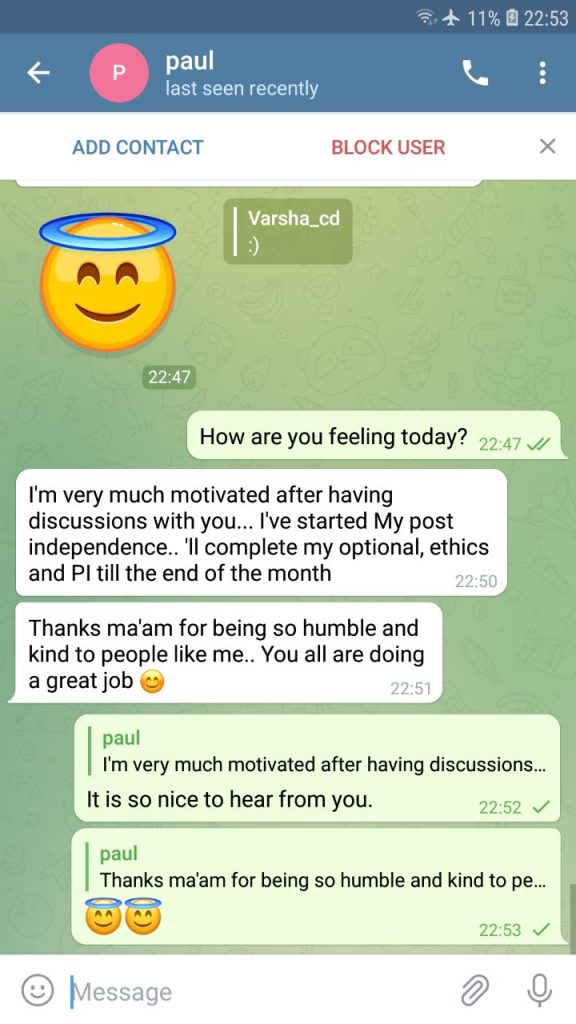
To know how all of them cleared the exam with our mentorship, visit the UnherdPodcast.
Now that results are announced for UPSC 2021 Prelims, out of 15 out of 25 students of Santhosh Gupta sir have been recommended to Mains. One such student, Rahul expresses his gratitude and extends his appreciation.
Most of our Mentors like Sudhanshu sir, Sajal sir, Santhosh sir, Pravin sir, Parth Verma sir and Sukanya Ma’am were UPSC aspirants themselves and have attended UPSC Mains more than five times and UPSC Interview more than twice. Hence their mentorship is always a blend of the best test series, comprehensive notes and current affairs knowledge.
All of them dedicate their time weekly to give 1-on-1 mentorship to every student where they discuss last week’s performance and next week’s approach.
Be it Telegram, Whatsapp or Habitiat channels, they are always available and clear student’s doubts in a turnaround time of 24 Hours.
Why Civilsdaily Mentors are the GPS for Your UPSC-CSE Preparation
Remember there is always light at the end of the tunnel and if you want to get out of the tunnel you have to follow the direction of the light! Our mentors’ give you direction which is divided into daily modules. All you have to do is study and complete them on time.
As every year passes by, we don’t get confident by the previous years’ performance and become laidback. Instead, we become more hungry to convert all our students into toppers.
How are Current Civilsdaily Students Gearing up for UPSC-CSE 2022?
Initially, our Civilsdaily student Smriti wasn’t confident about Prelims when she began her preparation. Though she had joined Civilsdaily in 2020, she started studying for UPSC-CSE back in 2019. At that time, Smriti had enrolled in multiple institutes. Though, most of these institutes had promised a personal mentor, she was unable to get in touch with them on a daily basis. Also those mentors never scheduled test-series on a weekly basis. Hence, despite preparing for a year, Smriti had scored only 35 marks out of 200 in her first test series by Civilsdaily.
She then started writing 20-25 test series over the course of UAP 2021 and in her last test, her scores have drastically improved. She now scores in the range of 130-135 marks in prelims’ and 110+ in mains’ papers.
In Smriti’s own words she describes her Samanvaya Mentorship Experience to be —
“Our parents provide us financial and emotional support, friends provide us moral support and the right mentor gives you logistic and logical support for UPSC. There are days when I felt I won’t be able to compete against lakhs of aspirants. That’s when my mentor, Ravi sir reminded me of my improvement and encouraged me that I can crack it with the same consistency. We need someone, who tells us we are performing well especially when we cannot see that ourselves. The mentorship at Civilsdaily helped me become mentally stronger as a person. In other institutes, mentors are allotted only for doubt resolution. But at Civilsdaily, I am getting end-to-end mentorship via value added notes, classes, test series and detailed evaluation.”
Similarly our another Civilsdaily student, Ashishsums up his Samanvaya experience with Civilsdaily mentor,Pravin Sir, “Because of Pravin sir’s support, I am able to understand a topic in lesser time.”
This is how Pravin sir evaluates Ashish’s Mains Test Series every week. After every test series evaluation, Pravin sir schedules a 1 hour call to discuss how Ashish can improve his marks and the sources he can refer for key topics.
It’s Your Turn Get the Free 40 Min Counselling Session By a CD Mentor
Civilsdaily mentors are so dedicated, consistent and focused for your UPSC goal, that you will eventually become focused into turning your dreams to reality.
At the core of Civilsdaily UPSC mentorship, lies the fact that each one of you will have a unique journey while preparing for the exam. Some will get through on the first attempt without much effort while others will take both more time and more effort.
We want to understand you better to help you optimize your journey so you can focus on the right things and not waste time on the wrong ones. We are asking you to tap into the valuable experiences of mentors who underwent the same grind and realize the pitfalls and understand the shortcuts to make it.
In the first counselling session, we will understand your weaknesses. We then help you to stick to one plan or strategy throughout your preparation. We will then follow up with you on a daily basis to check if you are right on track.
Writing the UPSC-CSE with 50%, 60%, 70% or even 85% syllabus coverage will not guarantee success for you. If you have only read half the syllabus, then there are aspirants against you who have revised 3X times, meaning they have done 300% preparation for the exam.
So, ultimately hardwork alone is the factor that can help you clear UPSC-CSE. However, most of us are not used to studying hard for a competitive exam. The last time we have done so was in the 12th board exam. Switching back to the study mode, presents itself many challenges.
You might have studied for UPSC 16-17 hours for one whole week, only not being able to follow through the next week. You might be experiencing a ‘burn-out’. Burnout is a situation where, you are so overwhelmed with physical and mental exhaustion that you want to give up. For some, it experiences as headaches and backaches and for others it sets in as depression and anxiety.
Your health is your whole life, while UPSC-CSE is just a stage in your life. If you are not able to enjoy the process of working hard for UPSC-CSE, then it’s time to evaluate how you can simplify the process for yourself.
Samanvaya Free 1-on-1 counselling session helps you do a SWOT Analysis With Respect to UPSC-CSE
Knowing yourself is very important to do a year long exam like UPSC-CSE. Why do you want to be an IAS Officer, when you can apply for any other job? Which subjects are your strengths, which are your weaknesses? What part of the syllabus presents as an opportunity to score higher? What are the threats i.e How is your preparation compared to other aspirants?
There are no one-size-fits all answer to these questions. What might be your strength, would be a weakness for another. If not preparing for CSAT is your threat, then the same need not be applicable for another aspirant. UPSC-CSE appears to be a competition against others, but at it’s core its a competition with yourself. It’s pushing yourself to be better than what you used to be before. Also, these are very important questions that one needs an answer to, not once but many times during their preparation. This week in Samanvaya Free 1-on-1 counselling session we will be helping aspirants with the same.
How does Samanvaya, Free 1-on-1 Mentorship help you clear UPSC 2023 in one shot?
Our philosophy behind MENTORSHIP is to get you out of this Snooze cycle. This ensures that you are the BEST VERSION of yourself in this journey. If you are under the impression that mentorship is weekly calls you attend, then you are mistaken, my friend. Trust us, your mentor will be your ‘FRIEND, PHILOSOPHER AND GUIDE’.
TO EACH THEIR OWN – Every aspirant is different. Their strengths and weaknesses are different. Their time availability is also different. Identifying this is important so you don’t end up making unrealistic targets and lose momentum. Your mentor will make sure you start slow but remain consistent to build your confidence. Making your schedule structured based on our experience of working with 2500+ students is our first priority.
TRACK YOUR PROGRESS – When you see yourself grow, it becomes easier to motivate yourself to push boundaries. Tracking your progress can happen in many ways like mentorship calls or chat sessions or by regular tests. The idea is to ensure that you don’t go off track in your preparation, and even if you do, we have your back.
EVOLUTION – A constant guidance is important to bring consistency to your UPSC preparation. Guidance is not about clearing your doubts or asking you to study when you don’t. It is also about the evolution of your preparation. This is where you and your mentor work as a team. A constant effort to PLAN AND BUILD UP YOUR ABILITY to learn in a faster and more efficient way.RECEIVE PERSONAL GUIDANCE FOR UPSC (REGISTER HERE)
TALK IT OUT – The biggest hurdle in achieving your highest level of consistency is the emotional part. Every now and then, you. surround yourself with negative thoughts, you feel scared and depressed. Instead of resolving these emotional issues, you avoid them as it seems like a waste of your precious time. You have to understand that ignoring emotional troubles does not solve them. What your doing is building an emotional time bomb that may burst a week before your mains or prelims! This is where your MENTOR AS A FRIEND comes in. All our mentors have been through this journey. We understand your fears and anxieties. So, TALK IT OUT.
Don’t let inconsistency keep you away from your dreams.
Fill up the SAMANVAYA form given below. Let us know your problems and we will find a solution to it, just like our students say ” TOGETHER WE CAN AND WE WILL”.
How has Civilsdaily Mentorship, helped Aspirants become Toppers?
The most difficult challenge faced by EVERY candidate is inconsistency. Be it inconsistency in studies, answer-writing practice, covering the syllabus, or revision, every candidate finds it difficult to cope with. Buthow do successful candidates manage to FIGHT Inconsistency so consistently?
In UPSC 2020, Civilsdaily helped 80+ students secure ranks in their exams. In the top 100, every 3rd ranker was a Civilsdaily student.
A very recent success story would be Vishwa Shah, student of Civilsdaily Mentor, Sukanya Ma’am. Vishwa has cleared the GPSC exam to become the Deputy Superintendent of Police in Gujarat. He has penned a thank-you note yesterday. Heartiest Congratulations to Vishwa!
One of our other Civilsdaily Student, Shubham Nagargojecleared the exams in 2020 to become an IPS Officer. Shubham was gracious enough to let us know how he felt about Civilsdaily Samanvaya Guidance under Parth sir.
To know how all of them cleared the exam with our mentorship, visit the UnherdPodcast.
Now that results are announced for UPSC 2021 Prelims, out of 15 out of 25 students of Santhosh Gupta sir have been recommended to Mains. One such student, Rahul expresses his gratitude and extends his appreciation.
Most of our Mentors like Sudhanshu sir, Sajal sir, Santhosh sir, Pravin sir, Parth Verma sir and Sukanya Ma’am were UPSC aspirants themselves and have attended UPSC Mains more than five times and UPSC Interview more than twice. Hence their mentorship is always a blend of the best test series, comprehensive notes and current affairs knowledge.
All of them dedicate their time weekly to give 1-on-1 mentorship to every student where they discuss last week’s performance and next week’s approach.
Be it Telegram, Whatsapp or Habitiat channels, they are always available and clear student’s doubts in a turnaround time of 24 Hours.
Why Civilsdaily Mentors are the GPS for Your UPSC-CSE Preparation
Remember there is always light at the end of the tunnel and if you want to get out of the tunnel you have to follow the direction of the light! Our mentors’ give you direction which is divided into daily modules. All you have to do is study and complete them on time.
As every year passes by, we don’t get confident by the previous years’ performance and become laidback. Instead, we become more hungry to convert all our students into toppers.
How are Current Civilsdaily Students Gearing up for UPSC-CSE 2022?
Initially, our Civilsdaily student Smriti wasn’t confident about Prelims when she began her preparation. Though she had joined Civilsdaily in 2020, she started studying for UPSC-CSE back in 2019. At that time, Smriti had enrolled in multiple institutes. Though, most of these institutes had promised a personal mentor, she was unable to get in touch with them on a daily basis. Also those mentors never scheduled test-series on a weekly basis. Hence, despite preparing for a year, Smriti had scored only 35 marks out of 200 in her first test series by Civilsdaily.
She then started writing 20-25 test series over the course of UAP 2021 and in her last test, her scores have drastically improved. She now scores in the range of 130-135 marks in prelims’ and 110+ in mains’ papers.
In Smriti’s own words she describes her Samanvaya Mentorship Experience to be —
“Our parents provide us financial and emotional support, friends provide us moral support and the right mentor gives you logistic and logical support for UPSC. There are days when I felt I won’t be able to compete against lakhs of aspirants. That’s when my mentor, Ravi sir reminded me of my improvement and encouraged me that I can crack it with the same consistency. We need someone, who tells us we are performing well especially when we cannot see that ourselves. The mentorship at Civilsdaily helped me become mentally stronger as a person. In other institutes, mentors are allotted only for doubt resolution. But at Civilsdaily, I am getting end-to-end mentorship via value added notes, classes, test series and detailed evaluation.”
Similarly our another Civilsdaily student, Ashishsums up his Samanvaya experience with Civilsdaily mentor,Pravin Sir, “Because of Pravin sir’s support, I am able to understand a topic in lesser time.”
This is how Pravin sir evaluates Ashish’s Mains Test Series every week. After every test series evaluation, Pravin sir schedules a 1 hour call to discuss how Ashish can improve his marks and the sources he can refer for key topics.
It’s Your Turn Get the Free 40 Min Counselling Session By a CD Mentor
Civilsdaily mentors are so dedicated, consistent and focused for your UPSC goal, that you will eventually become focused into turning your dreams to reality.
At the core of Civilsdaily UPSC mentorship, lies the fact that each one of you will have a unique journey while preparing for the exam. Some will get through on the first attempt without much effort while others will take both more time and more effort.
We want to understand you better to help you optimize your journey so you can focus on the right things and not waste time on the wrong ones. We are asking you to tap into the valuable experiences of mentors who underwent the same grind and realize the pitfalls and understand the shortcuts to make it.
In the first counselling session, we will understand your weaknesses. We then help you to stick to one plan or strategy throughout your preparation. We will then follow up with you on a daily basis to check if you are right on track.
Against the backdrop of possible interest rate hikes by the U.S. Federal Reserve and the taper tantrum, there is pressure on the Reserve Bank of India (RBI) to increase its interest rates to prevent capital outflows.
The monetary policy corridor is still “accommodative” to support the growth recovery.
Globally, central banks have started increasing the interest rates.
Macroeconomic uncertainties
1] Inflationary pressure
In India, the wholesale price index (WPI) inflation rose to a record high of 14.32% in November 2021 as per the data released by the Ministry of Commerce and Industry.
The consumer price index (CPI) inflation now is 5.03%, though that is still within the comfort zone of the inflation targeting framework envisaged in India’s new monetary framework.
The official nominal inflation anchor in India is 4%, with a band of variations of +/- 2.
2] Absorbing excess liquidity
The RBI Financial Stability Report, published on December 29, 2021, revealed a possible worsening of the gross non-performing asset (GNPA) ratio of scheduled commercial banks — from 6.9% in September 2021 to 9.5% by September 2022.
Absorbing the excess liquidity that was injected to stimulate growth as part of the pandemic response is crucial to reversing trends in non performing assets (NPAs).
Absorption of excess liquidity was attempted by increasing the cut-off yield rate of variable rate reverse repo (VRRR) to 3.99%, and curtailing the government securities acquisition programme.
3] Interest rate structure and implications for government borrowing
The call money market rates are below the repo rate.
The bond yields are increasing ahead of the Union Budget 2022-23.
The rise in bond yields will result in higher borrowing costs for the Government.
Way forward for fiscal policy
Maintain accommodative policy stance: Given these macroeconomic uncertainties, maintaining an accommodative fiscal policy stance in the upcoming Union Budget for FY23 is crucial for a sustainable recovery.
Don’t focus on fiscal consolidation: Any attempt at fiscal consolidation at this juncture employing capital expenditure compression rather than a tax buoyancy path can adversely affect economic growth.
Public investment — infrastructure investment in particular — is a major growth driver through “crowding-in” of private corporate investment.
Strengthening investments in the health-care sector is crucial at this juncture as a prolonged lockdown can accentuate the current humanitarian crisis and deepen economic disruptions.
When credit-linked economic stimulus has an uneven impact on growth recovery, the significance of fiscal dominance cannot be undermined.
Address unemployment: Rising unemployment needs to be addressed through an urgent policy response that strengthens job guarantee programmes.
Conclusion
The upcoming Union Budget for 2022-23 should maintain an accommodative fiscal stance in order to support the sustainability of the economic growth process and also for financing human development.
Writing the UPSC-CSE with 50%, 60%, 70% or even 85% syllabus coverage will not guarantee success for you. If you have only read half the syllabus, then there are aspirants against you who have revised 3X times, meaning they have done 300% preparation for the exam.
So, ultimately hardwork alone is the factor that can help you clear UPSC-CSE. However, most of us are not used to studying hard for a competitive exam. The last time we have done so was in the 12th board exam. Switching back to the study mode, presents itself many challenges.
You might have studied for UPSC 16-17 hours for one whole week, only not being able to follow through the next week. You might be experiencing a ‘burn-out’. Burnout is a situation where, you are so overwhelmed with physical and mental exhaustion that you want to give up. For some, it experiences as headaches and backaches and for others it sets in as depression and anxiety.
Your health is your whole life, while UPSC-CSE is just a stage in your life. If you are not able to enjoy the process of working hard for UPSC-CSE, then it’s time to evaluate how you can simplify the process for yourself.
Samanvaya Free 1-on-1 counselling session helps you do a SWOT Analysis With Respect to UPSC-CSE
Knowing yourself is very important to do a year long exam like UPSC-CSE. Why do you want to be an IAS Officer, when you can apply for any other job? Which subjects are your strengths, which are your weaknesses? What part of the syllabus presents as an opportunity to score higher? What are the threats i.e How is your preparation compared to other aspirants?
There are no one-size-fits all answer to these questions. What might be your strength, would be a weakness for another. If not preparing for CSAT is your threat, then the same need not be applicable for another aspirant. UPSC-CSE appears to be a competition against others, but at it’s core its a competition with yourself. It’s pushing yourself to be better than what you used to be before. Also, these are very important questions that one needs an answer to, not once but many times during their preparation. This week in Samanvaya Free 1-on-1 counselling session we will be helping aspirants with the same.
How does Samanvaya, Free 1-on-1 Mentorship help you clear UPSC 2023 in one shot?
Our philosophy behind MENTORSHIP is to get you out of this Snooze cycle. This ensures that you are the BEST VERSION of yourself in this journey. If you are under the impression that mentorship is weekly calls you attend, then you are mistaken, my friend. Trust us, your mentor will be your ‘FRIEND, PHILOSOPHER AND GUIDE’.
TO EACH THEIR OWN – Every aspirant is different. Their strengths and weaknesses are different. Their time availability is also different. Identifying this is important so you don’t end up making unrealistic targets and lose momentum. Your mentor will make sure you start slow but remain consistent to build your confidence. Making your schedule structured based on our experience of working with 2500+ students is our first priority.
TRACK YOUR PROGRESS – When you see yourself grow, it becomes easier to motivate yourself to push boundaries. Tracking your progress can happen in many ways like mentorship calls or chat sessions or by regular tests. The idea is to ensure that you don’t go off track in your preparation, and even if you do, we have your back.
EVOLUTION – A constant guidance is important to bring consistency to your UPSC preparation. Guidance is not about clearing your doubts or asking you to study when you don’t. It is also about the evolution of your preparation. This is where you and your mentor work as a team. A constant effort to PLAN AND BUILD UP YOUR ABILITY to learn in a faster and more efficient way.RECEIVE PERSONAL GUIDANCE FOR UPSC (REGISTER HERE)
TALK IT OUT – The biggest hurdle in achieving your highest level of consistency is the emotional part. Every now and then, you. surround yourself with negative thoughts, you feel scared and depressed. Instead of resolving these emotional issues, you avoid them as it seems like a waste of your precious time. You have to understand that ignoring emotional troubles does not solve them. What your doing is building an emotional time bomb that may burst a week before your mains or prelims! This is where your MENTOR AS A FRIEND comes in. All our mentors have been through this journey. We understand your fears and anxieties. So, TALK IT OUT.
Don’t let inconsistency keep you away from your dreams.
Fill up the SAMANVAYA form given below. Let us know your problems and we will find a solution to it, just like our students say ” TOGETHER WE CAN AND WE WILL”.
How has Civilsdaily Mentorship, helped Aspirants become Toppers?
The most difficult challenge faced by EVERY candidate is inconsistency. Be it inconsistency in studies, answer-writing practice, covering the syllabus, or revision, every candidate finds it difficult to cope with. Buthow do successful candidates manage to FIGHT Inconsistency so consistently?
In UPSC 2020, Civilsdaily helped 80+ students secure ranks in their exams. In the top 100, every 3rd ranker was a Civilsdaily student.
A very recent success story would be Vishwa Shah, student of Civilsdaily Mentor, Sukanya Ma’am. Vishwa has cleared the GPSC exam to become the Deputy Superintendent of Police in Gujarat. He has penned a thank-you note yesterday. Heartiest Congratulations to Vishwa!
One of our other Civilsdaily Student, Shubham Nagargojecleared the exams in 2020 to become an IPS Officer. Shubham was gracious enough to let us know how he felt about Civilsdaily Samanvaya Guidance under Parth sir.
To know how all of them cleared the exam with our mentorship, visit the UnherdPodcast.
Now that results are announced for UPSC 2021 Prelims, out of 15 out of 25 students of Santhosh Gupta sir have been recommended to Mains. One such student, Rahul expresses his gratitude and extends his appreciation.
Most of our Mentors like Sudhanshu sir, Sajal sir, Santhosh sir, Pravin sir, Parth Verma sir and Sukanya Ma’am were UPSC aspirants themselves and have attended UPSC Mains more than five times and UPSC Interview more than twice. Hence their mentorship is always a blend of the best test series, comprehensive notes and current affairs knowledge.
All of them dedicate their time weekly to give 1-on-1 mentorship to every student where they discuss last week’s performance and next week’s approach.
Be it Telegram, Whatsapp or Habitiat channels, they are always available and clear student’s doubts in a turnaround time of 24 Hours.
Why Civilsdaily Mentors are the GPS for Your UPSC-CSE Preparation
Remember there is always light at the end of the tunnel and if you want to get out of the tunnel you have to follow the direction of the light! Our mentors’ give you direction which is divided into daily modules. All you have to do is study and complete them on time.
As every year passes by, we don’t get confident by the previous years’ performance and become laidback. Instead, we become more hungry to convert all our students into toppers.
How are Current Civilsdaily Students Gearing up for UPSC-CSE 2022?
Initially, our Civilsdaily student Smriti wasn’t confident about Prelims when she began her preparation. Though she had joined Civilsdaily in 2020, she started studying for UPSC-CSE back in 2019. At that time, Smriti had enrolled in multiple institutes. Though, most of these institutes had promised a personal mentor, she was unable to get in touch with them on a daily basis. Also those mentors never scheduled test-series on a weekly basis. Hence, despite preparing for a year, Smriti had scored only 35 marks out of 200 in her first test series by Civilsdaily.
She then started writing 20-25 test series over the course of UAP 2021 and in her last test, her scores have drastically improved. She now scores in the range of 130-135 marks in prelims’ and 110+ in mains’ papers.
In Smriti’s own words she describes her Samanvaya Mentorship Experience to be —
“Our parents provide us financial and emotional support, friends provide us moral support and the right mentor gives you logistic and logical support for UPSC. There are days when I felt I won’t be able to compete against lakhs of aspirants. That’s when my mentor, Ravi sir reminded me of my improvement and encouraged me that I can crack it with the same consistency. We need someone, who tells us we are performing well especially when we cannot see that ourselves. The mentorship at Civilsdaily helped me become mentally stronger as a person. In other institutes, mentors are allotted only for doubt resolution. But at Civilsdaily, I am getting end-to-end mentorship via value added notes, classes, test series and detailed evaluation.”
Similarly our another Civilsdaily student, Ashishsums up his Samanvaya experience with Civilsdaily mentor,Pravin Sir, “Because of Pravin sir’s support, I am able to understand a topic in lesser time.”
This is how Pravin sir evaluates Ashish’s Mains Test Series every week. After every test series evaluation, Pravin sir schedules a 1 hour call to discuss how Ashish can improve his marks and the sources he can refer for key topics.
It’s Your Turn Get the Free 40 Min Counselling Session By a CD Mentor
Civilsdaily mentors are so dedicated, consistent and focused for your UPSC goal, that you will eventually become focused into turning your dreams to reality.
At the core of Civilsdaily UPSC mentorship, lies the fact that each one of you will have a unique journey while preparing for the exam. Some will get through on the first attempt without much effort while others will take both more time and more effort.
We want to understand you better to help you optimize your journey so you can focus on the right things and not waste time on the wrong ones. We are asking you to tap into the valuable experiences of mentors who underwent the same grind and realize the pitfalls and understand the shortcuts to make it.
In the first counselling session, we will understand your weaknesses. We then help you to stick to one plan or strategy throughout your preparation. We will then follow up with you on a daily basis to check if you are right on track.
Notwithstanding the unfortunate developments since the Tatmadaw took over, a recalibration exercise for developing a robust relationship with Naypyidaw is the need of the hour.
Need for proactive neighbourhood policy with Myanmar
Security and economic interests: India should implement an unbiased and proactive “Neighbourhood First” strategy that facilitates the Act East policy crucial for India’s long-term security and economic interests.
Myanmar — regardless of who governs its polity — is not only the decisive lynchpin for India’s Act East policy but critical for the economic development and security of India’s Northeast.
China factor: Such a policy should take into account the measures that China has taken to arm the Tatmadaw.
How to support Myanmar?
Critical requirements: India should find ways to support Naypyidaw for its critical requirements of systems and platforms like UAVs, surveillance systems and communication equipment.
Economic engagement: There is a need for dynamic economic engagement with Myanmar, to expedite the completion of the earlier agreement on the operationalisation of the Sittwe port, the establishment of an oil refinery and joint vaccine production facilities at a cost of $6 billion.
People-to-people goodwill: India also needs to proactively employ the existing “people-to-people” goodwill and proximate ties between the two armies.
Engage with military leadership to stop highhandedness: India has the singular advantage of acceptability from both factions in Myanmar and it is, therefore, imperative that it takes the lead in engaging with the ruling military leadership, to stop the highhandedness.
The visit by India’s Foreign Secretary to Myanmar in the last week of December 2021 was significant.
It conveyed the message that India, notwithstanding its commitment to democracy, is amenable to conduct business with the country, regardless of who is in the seat of power.
Conclusion
It is of the utmost importance for India to positively engage Naypyidaw and stave off attempts to exploit Myanmar by countries inimical to India’s growth. Any ambiguity or delay in India’s constructive engagement with Myanmar would only serve the interests of anti-India forces.
For India, an important strategic priority today is to rebalance the Indo-Pacific. Delhi, however, recognises that this expansive challenge can’t be met by any one power, including the US. A larger European role in securing Asia therefore becomes critical.
Importance of Russia in balancing China
Peace with Russia in Europe might be necessary for America to focus on Asia has been the key motivation behind President Joe Biden’s decision to intensify engagement with Vladimir Putin in the last few months.
On the question of Ukraine’s membership of NATO, the US and its European allies have suggested that membership is certainly not imminent; but they are unwilling to say Ukraine will “never” be admitted.
Contradiction in Europe
1] Europe remains geopolitically unstable: None of the three European settlements of the 20th century — in 1919 after the First World War, in 1945 after the Second World War, and in 1991 after the Cold War — has endured.
2] The difficulty of integrating Russia into a European order: Russia was part of the great power system in Europe through the 18th and 19th centuries.
If the 1917 Bolshevik Revolution put Russia and the West at odds with each other, the collapse of the Soviet Union has not resolved the contradiction.
3] Growing tension between the US and Europe: Since the Second World War, Europe has relied on the US for its security.
However, Europe has never stopped resenting the American dominance over its geopolitics.
The EU’s foreign policy chief, Josep Borrell, has repeatedly objected to the US and Russia deciding the future of Ukraine over European heads.
But Russia does not take the EU seriously and is betting on negotiations with the US.
4] Europe still remains a weak security actor: While the EU has become a powerful economic entity (with its $17 trillion GDP), it remains a weak security actor.
Whatever might be the outcome from the gathering conflict over Ukraine, these European contradictions are not going to disappear any time soon.
Why Europe remains a weak security actor?
Dominance of the US and Russia: The ambition to construct a strong geopolitical personality for the EU is hobbled by divisions over the role of Russia and the US in the region.
Mutual suspicions: The historically rooted mutual suspicions among European states also plays role.
Reluctance to spend on defence: This is compounded by the reluctance to spend more on defence and the inability to develop collective defence arrangements outside of NATO led by the US.
Suggestions for India
The contradictions in Europe demand that Delhi discard its tendency to view the region through the “East versus West” binary.
Delhi today could profitably take a leaf out of the book of the Indian national movement.
In the late 18th century, as European powers competed for influence in the subcontinent, many Indian princes sought to take advantage of the contradictions between Britain and France.
Imperial Germany supported the formation of a nationalist government of India in Kabul in 1915 headed by Raja Mahendra Pratap Singh.
Eager to accelerate Indian independence during the Second World War, Netaji turned to Germany and Japan, the world’s newest great power.
The sharpening struggle for Indian independence, and more broadly the liberation of Asia between the two World Wars, inevitably involved exploiting the contradictions between different imperial powers.
This was complicated, however, by rapid realignment among the major powers —friends became adversaries and enemies became allies.
The Indian and Asian national movements were deeply divided in coping with the shifting great power dynamic.
The world enters a similar moment today that could rearrange relations between the US, UK, Europe, Russia, China and Japan.
Consider the question “What are the contradictions in Europe today? How these contradiction can play role in India’s international relations with the European countries?”
Conclusion
Greater engagement with Europe and dealing with its multiple contradictions must necessarily be important elements of India’s international relations today.
HOW TO ATTEMPT ANSWERS IN DAILY ANSWER WRITING ENHANCEMENT(AWE)?
Daily 4 questions from General studies 1, 2, 3, and 4 will be provided to you.
A Mentor’s Comment will be available for all answers. This can be used as a guidance tool but we encourage you to write original answers.
You can write your answer on an A4 sheet and scan/click pictures of the same.
Upload the scanned answer in the comment section of the same question.
Along with the scanned answer, please share your Razor payment ID, so that paid members are given priority.
If you upload the answer on the same day like the answer of 11th October is uploaded on 11th October then your answer will be checked within 72 hours. Also, reviews will be in the order of submission- First come first serve basis
If you are writing answers late, for example, 11th October is uploaded on 13th October, then these answers will be evaluated as per the mentor’s schedule.
We encourage you to write answers on the same day. However, if you are uploading an answer late then tag the mentor like @Staff so that the mentor is notified about your answer.
*In case your answer is not reviewed, reply to your answer saying *NOT CHECKED*.