💥Join UPSC 2027,2028 Mentorship (June Batch) + XFactor Notes & Microthemes PDF

Search results for: “”

  • [23rd June 2026] The Hindu OpED: The challenge of India’s digital sovereignty

    PYQ Relevance[UPSC 2024] Describe the context and salient features of the Digital Personal Data Protection Act, 2023
    Linkage: Data sovereignty is a critical pillar of digital sovereignty, aimed at keeping sensitive information under domestic jurisdiction and protecting it from foreign access. 

    Mentor’s Comment

    Digital sovereignty is no longer limited to data localization; it encompasses control over digital infrastructure, cloud services, semiconductors, AI, software, and defence technologies. For UPSC, link this topic with Atmanirbhar Bharat, Digital Public Infrastructure (UPI, Aadhaar, ONDC), National Security, Semiconductor Mission, AI governance, cyber security, and strategic autonomy. A balanced answer should advocate indigenous innovation, higher R&D spending, private sector participation, and trusted international partnerships rather than complete technological isolation.

    Why in the News?

    Recent incidents, including the compromise of Indian CCTV networks through foreign software, the denial of digital services to Nayara Energy due to EU sanctions, and India’s growing focus on semiconductor manufacturing, indigenous digital platforms, and trusted technology partnerships such as Pax Silica, have renewed the debate on India’s digital sovereignty and technological self reliance.

    What is digital sovereignty? 

    Digital sovereignty is a nation’s ability to control its digital infrastructure, data, technologies, and critical digital services without undue dependence on foreign entities.

    Why is it important for India?

    • Strategic Autonomy: Ensures independent decision making in technology and security. Eg: Indigenous UPI and RuPay payment systems.
    • National Security: Protects critical infrastructure from external interference. Eg: Reducing reliance on foreign cloud platforms for defence data.
    • Data Sovereignty: Keeps sensitive data under domestic jurisdiction. Eg: Government authentication and cloud services hosted on Indian platforms.
    • Economic Competitiveness: Promotes innovation and domestic digital industries. Eg: India’s semiconductor ecosystem and digital public infrastructure.

    Why does dependence on foreign digital infrastructure pose risks?

    • National Security Risk: Foreign entities may compromise critical infrastructure. Eg: CCTV networks allegedly compromised through EseeCloud software.
    • External Sovereign Control: Foreign governments can influence technology providers. Eg: Microsoft’s denial of services to Nayara Energy following EU sanctions.
    • Data Security: Sensitive information may become accessible to foreign jurisdictions. Eg: Cloud companies compelled to share data with home governments.
    • Defence Vulnerability: Software controlled abroad may affect military capabilities. Eg: GPS restrictions during the 1999 Kargil conflict.
    • Economic Disruption: Suspension of digital services can halt business operations. Eg: Loss of access to corporate email and collaboration platforms.

    How can India strengthen its digital sovereignty?

    • Indigenous Innovation: Develop domestic digital infrastructure and technologies. Eg: UPI, RuPay, NavIC, Zoho adoption in government systems.
    • Private Sector Participation: Encourage competitive domestic technology development. Eg: Private sector involvement in the Advanced Medium Combat Aircraft (AMCA).
    • Semiconductor Ecosystem: Build domestic chip manufacturing capabilities. Eg: Micron’s ATMP facility in Sanand.
    • Trusted International Partnerships: Develop technologies through strategic collaborations. Eg: BrahMos missile programme and Pax Silica initiative.
    • Higher R&D Investment: Strengthen innovation capacity and technological leadership. Eg: Increasing R&D expenditure beyond the current 0.74% of GDP.

    Which global practices can India adopt for digital sovereignty?

    • Sovereign Digital Platforms: Develop domestic alternatives for government services. Eg: France replacing Microsoft Teams and Zoom with a sovereign platform.
    • Independent Cloud Infrastructure: Reduce reliance on foreign cloud providers. Eg: European Union’s sovereign cloud initiatives.
    • Localization of Critical Software: Promote indigenous productivity and enterprise software. Eg: Germany, Denmark, and the Netherlands exploring domestic alternatives.
    • Trusted Technology Partnerships: Build technology ecosystems with like minded nations. Eg: Pax Silica initiative on AI and supply chain security.
    • Public Private Innovation Model: Government support with private sector execution. Eg: U.S. defence production and procurement model.

    What are the implications of enhancing India’s digital sovereignty?

    • Strategic Autonomy: Reduces dependence on foreign powers for critical technologies. Eg: NavIC providing indigenous satellite navigation.
    • National Security: Improves resilience against cyber threats and external coercion. Eg: Indigenous defence software and secure cloud infrastructure.
    • Economic Growth: Strengthens domestic digital industries and high value manufacturing. Eg: Expansion of the semiconductor and AI ecosystem.
    • Technological Leadership: Encourages innovation and global competitiveness. Eg: Success of Digital Public Infrastructure (DPI) such as UPI.
    • Resilient Supply Chains: Minimizes disruptions from geopolitical tensions and sanctions. Eg: Diversified technology partnerships through Micron and Pax Silica.
    • Global Influence: Positions India as a trusted technology and digital governance leader. Eg: Export of India’s DPI model to partner countries.

    Conclusion

    Digital sovereignty is the cornerstone of India’s technological security, economic resilience, and strategic autonomy. By strengthening indigenous innovation, investing in R&D, promoting public private collaboration, and building trusted global partnerships, India can reduce external vulnerabilities and emerge as a secure, self reliant, and globally competitive digital power in an increasingly technology driven world.
  • No one should own the law: why government standards should be public

    Why in the News?

    The issue is in the news following a proposal under the Jan Vishwas framework to centrally publish all government edicts and treat any non publicly accessible edict as null and void. The debate has also gained attention after the Indian Roads Congress (IRC) issued a takedown notice against the public sharing of its road safety standards, raising questions about whether government standards and safety regulations should be freely accessible as part of the law and public knowledge.

    What are government edicts? 

    Government Edicts: Government edicts are legally binding instruments issued by the State, including laws, rules, regulations, notifications, circulars, guidelines, standards, SOPs, and government orders that govern citizens and institutions.

    Why should they be public?

    • Rule of Law: Citizens cannot obey laws they cannot access. Eg: Public access to Indian Roads Congress (IRC) standards.
    • Legal Transparency: Prevents hidden or “shadow” regulations. Eg: Central publication of government notifications.
    • Democratic Accountability: Enables public scrutiny of government actions. Eg: Citizens reviewing road safety standards.
    • Access to Justice: Ensures equal knowledge of legal obligations. Eg: MSMEs accessing compliance standards without barriers.
    • Citizen Empowerment: Creates an informed citizenry and participatory governance. Eg: Engineers and researchers using public standards.

    Why is public access to safety standards important for democracy?

    • Public Safety: Open standards improve compliance and reduce risks. Eg: Helmet and building safety standards.
    • Right to Information: Citizens have a right to know rules affecting their lives. Eg: Free access to drinking water quality standards.
    • Transparency: Prevents arbitrary enforcement of technical regulations. Eg: Publicly available road construction norms.
    • Ease of Doing Business: Reduces compliance costs for businesses. Eg: MSMEs accessing manufacturing standards.
    • Inclusive Governance: Eliminates information asymmetry. Eg: Contractors and citizens following the same safety norms.

    How can the Jan Vishwas framework improve legal transparency?

    • Centralized Repository: All government edicts available on one digital platform. Eg: Expansion of India Code.
    • Removal of Shadow Instruments: Makes regulations, circulars, guidelines, and SOPs publicly accessible. Eg: Publishing notifications and standards.
    • Null and Void Principle: Unpublished edicts should have no legal force. Eg: Citizens cannot be penalized under inaccessible rules.
    • Digital Governance: Creates searchable and regularly updated legal databases. Eg: Online repository of standards and regulations.
    • Regulatory Certainty: Improves predictability and compliance. Eg: Uniform interpretation of safety standards.

    Which global practices can India adopt for open government standards?

    • Open Government Doctrine: Laws belong to the public domain. Eg: U.S. Supreme Court principle, “No one should own the law.”
    • Public Interest Access: Mandatory safety standards should be freely accessible. Eg: European Union constitutional jurisprudence.
    • Open Licensing: Government information can be reused without restrictions. Eg: UK Open Government Licence.
    • Works of Government Policy: Government publications should not be subject to restrictive copyright. Eg: U.S. federal government works are in the public domain.
    • Digital Legal Repository: Ensures centralized access to legal materials. Eg: Government portals providing free legal documents.

    What are the implications of making government standards freely accessible?

    • Strengthened Rule of Law: Ensures equal access to legal obligations. Eg: Public availability of BIS and IRC standards.
    • Improved Public Safety: Promotes better implementation of technical standards. Eg: Compliance with building and road safety norms.
    • Economic Growth: Lowers compliance costs and encourages innovation. Eg: Support for Make in India and MSMEs.
    • Greater Transparency and Accountability: Reduces regulatory opacity. Eg: Open access to government notifications and guidelines.
    • Enhanced Democratic Participation: Creates informed stakeholders. Eg: Researchers, civil society, and courts using open government standards.
    • Knowledge as a Public Good: Publicly funded information should benefit everyone. Eg: BIS making Indian Standards freely available online.

    Conclusion

    Government edicts and mandatory safety standards are public goods that form the foundation of the rule of law, transparency, and democratic accountability. Ensuring their free and universal accessibility through the Jan Vishwas framework can strengthen legal certainty, public safety, ease of doing business, and citizen empowerment, reaffirming the principle that “no one should own the law.”

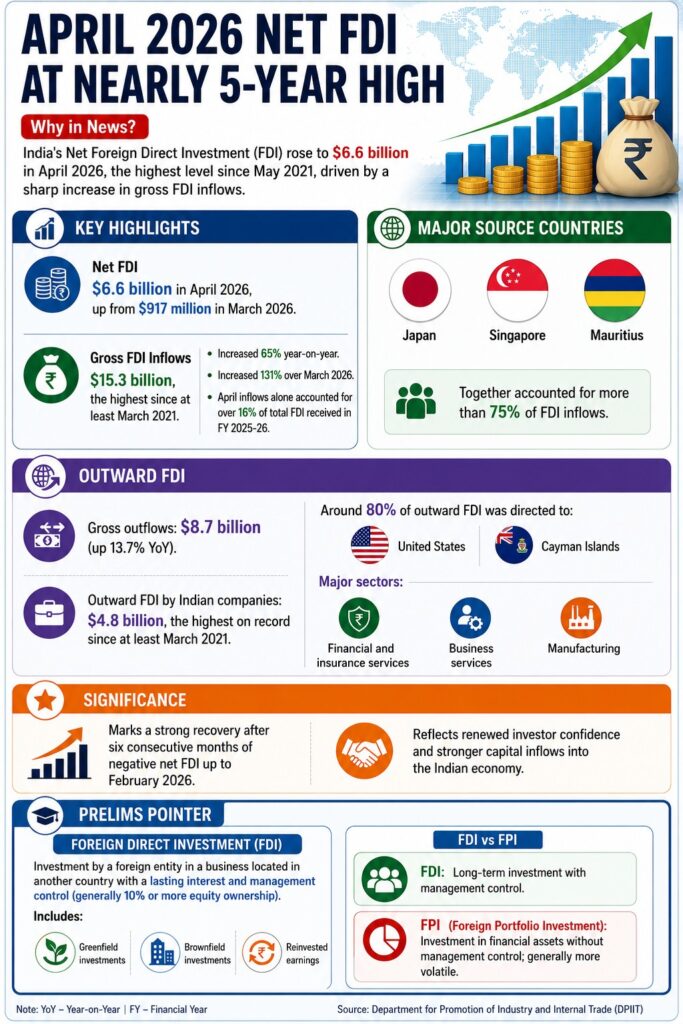
  • April 2026 Net FDI at Nearly 5-Year High

    Why in News?

    India’s Net Foreign Direct Investment (FDI) rose to $6.6 billion in April 2026, the highest level since May 2021, driven by a sharp increase in gross FDI inflows.

    Key Highlights

    • Net FDI: $6.6 billion in April 2026, up from $917 million in March 2026.
    • Gross FDI Inflows:$15.3 billion, the highest since at least March 2021.
      • Increased 65% year-on-year.
      • Increased 131% over March 2026.
    • April inflows alone accounted for over 16% of total FDI received in FY 2025-26.

    Major Source Countries

    • Japan, Singapore, and Mauritius
    • Together accounted for more than 75% of FDI inflows.

    Outward FDI

    • Gross outflows: $8.7 billion (up 13.7% YoY).
    • Outward FDI by Indian companies: $4.8 billion, the highest on record since at least March 2021.
    • Around 80% of outward FDI was directed to United States and Cayman Islands
    • Major sectors Financial and insurance services, Business services, and Manufacturing

    Significance

    • Marks a strong recovery after six consecutive months of negative net FDI up to February 2026.
    • Reflects renewed investor confidence and stronger capital inflows into the Indian economy.

    Foreign Direct Investment (FDI)

    • Investment by a foreign entity in a business located in another country with a lasting interest and management control (generally 10% or more equity ownership).
    • Includes Greenfield investments, Brownfield investments, and Reinvested earnings

    FDI vs FPI

    • FDI: Long-term investment with management control.
    • FPI (Foreign Portfolio Investment): Investment in financial assets without management control; generally more volatile.

    [2021] Consider the following:
    1. Foreign currency convertible bonds
    2. Foreign institutional investment with certain conditions
    3. Global depository receipts
    4. Non-resident external deposits
    Which of the above can be included in Foreign Direct Investments?

    [A] 1, 2 and 3

    [B] 3 only

    [C] 2 and 4

    [D] 1 and 4

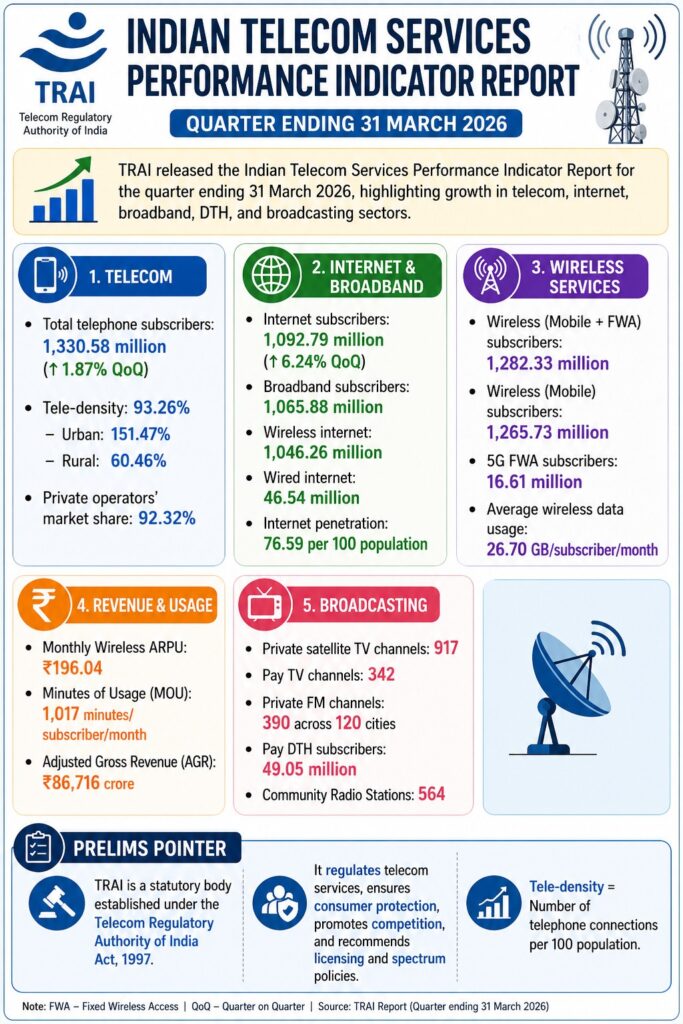
  • Indian Telecom Services Performance Indicator Report (Jan-Mar 2026)

    Why in News?

    TRAI released the Indian Telecom Services Performance Indicator Report for the quarter ending 31 March 2026, highlighting growth in telecom, internet, broadband, DTH, and broadcasting sectors.

    Telecom

    • Total telephone subscribers: 1,330.58 million (↑1.87% QoQ).
    • Tele-density:93.26%: Urban: 151.47% and Rural: 60.46%
    • Private operators’ market share: 92.32%.

    Internet & Broadband

    • Internet subscribers: 1,092.79 million (↑6.24% QoQ).
    • Broadband subscribers: 1,065.88 million.
    • Wireless internet: 1,046.26 million.
    • Wired internet: 46.54 million.
    • Internet penetration: 76.59 per 100 population.

    Wireless Services

    • Wireless (Mobile + FWA) subscribers: 1,282.33 million.
    • Wireless (Mobile) subscribers: 1,265.73 million.
    • 5G FWA subscribers: 16.61 million.
    • Average wireless data usage: 26.70 GB/subscriber/month.

    Revenue & Usage

    • Monthly Wireless ARPU: ₹196.04.
    • Minutes of Usage (MOU): 1,017 minutes/subscriber/month.
    • Adjusted Gross Revenue (AGR): ₹86,716 crore.

    Broadcasting

    • Private satellite TV channels: 917
    • Pay TV channels: 342
    • Private FM channels: 390 across 120 cities
    • Pay DTH subscribers: 49.05 million
    • Community Radio Stations: 564.

    Prelims Pointer

    • TRAI is a statutory body established under the Telecom Regulatory Authority of India Act, 1997.
    • It regulates telecom services, ensures consumer protection, promotes competition, and recommends licensing and spectrum policies.
    • Tele-density = Number of telephone connections per 100 population.

    [2019] With reference to communications technologies, what is/are the difference/differences between LTE (Long-Term Evolution) and VoLTE (Voice over Long-Term Evolution)?
    1. LTE is commonly marketed as 3G and VoLTE is commonly marketed as advanced 3G.
    2. LTE is data-only technology and VoLTE is voice-only technology.
    Select the correct answer using the code given below.

    [A] 1 only

    [B] 2 only

    [C] Both 1 and 2

    [D] Neither 1 nor 2

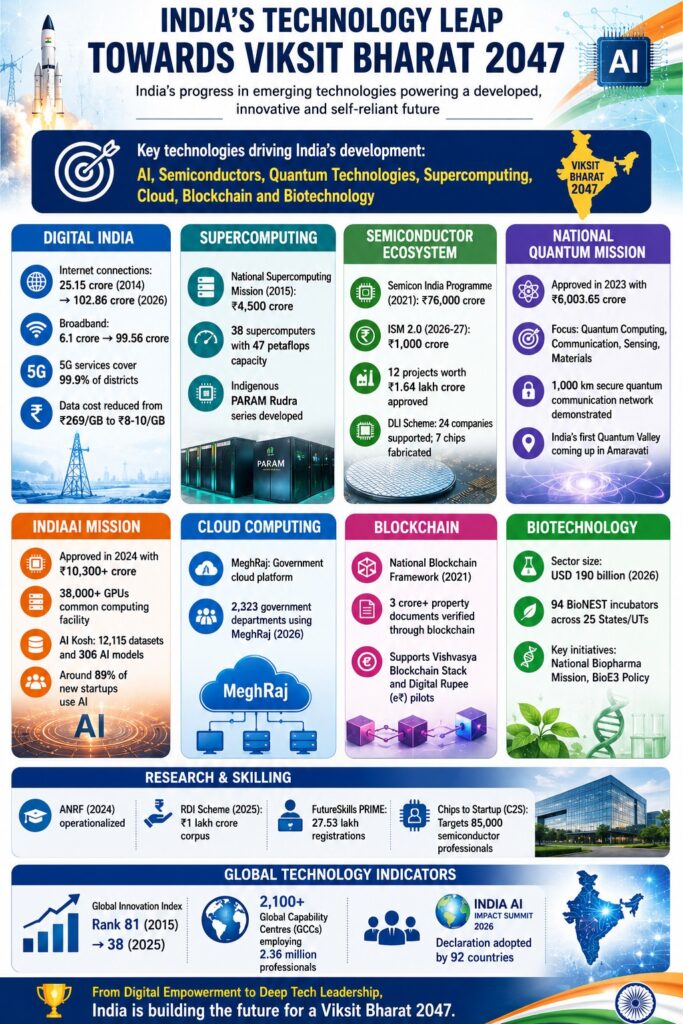
  • India’s Emerging Technology Ecosystem

    Why in the news?

    The Government highlighted India’s progress in AI, semiconductors, quantum technologies, supercomputing, cloud computing, blockchain, and biotechnology as key pillars of Viksit Bharat 2047.

    Digital India

    • Internet connections: 25.15 crore (2014) → 102.86 crore (2026).
    • Broadband: 6.1 crore → 99.56 crore.
    • 5G services cover 99.9% of districts.
    • Data cost reduced from ₹269/GB to ₹8-10/GB.

    Supercomputing

    • National Supercomputing Mission (2015): ₹4,500 crore.
    • 38 supercomputers with 47 petaflops capacity.
    • Indigenous PARAM Rudra series developed.

    Semiconductor Ecosystem

    • Semicon India Programme (2021): ₹76,000 crore.
    • ISM 2.0 (2026-27): ₹1,000 crore.
    • 12 projects worth ₹1.64 lakh crore approved.
    • DLI Scheme: 24 companies supported; 7 chips fabricated.

    National Quantum Mission

    • Approved in 2023 with ₹6,003.65 crore.
    • Focus: Quantum Computing, Communication, Sensing, Materials.
    • 1,000 km secure quantum communication network demonstrated.
    • India’s first Quantum Valley coming up in Amaravati.

    IndiaAI Mission

    • Approved in 2024 with ₹10,300+ crore.
    • 38,000+ GPUs common computing facility.
    • AI Kosh: 12,115 datasets and 306 AI models.
    • Around 89% of new startups use AI.

    Cloud Computing

    • MeghRaj: Government cloud platform.
    • 2,323 government departments using MeghRaj (2026).

    Blockchain

    • National Blockchain Framework (2021).
    • 3 crore+ property documents verified through blockchain.
    • Supports Vishvasya Blockchain Stack and Digital Rupee (e₹) pilots.

    Biotechnology

    • Sector size: USD 190 billion (2026).
    • 94 BioNEST incubators across 25 States/UTs.
    • Key initiatives: National Biopharma Mission, BioE3 Policy.

    Research & Skilling

    • ANRF (2024) operationalized.
    • RDI Scheme (2025): ₹1 lakh crore corpus.
    • FutureSkills PRIME: 27.53 lakh registrations.
    • Chips to Startup (C2S): Targets 85,000 semiconductor professionals.

    Global Technology Indicators

    • Global Innovation Index: Rank 81 (2015) → 38 (2025).
    • 2,100+ Global Capability Centres (GCCs) employing 2.36 million professionals.
    • India AI Impact Summit 2026: Declaration adopted by 92 countries.

    [2022] Which one of the following is the context in which the term “qubit” is mentioned?

    [A] Cloud Services

    [B] Quantum Computing

    [C] Visible Light Communication Technologies

    [D] Wireless Communication Technologies