💥UPSC 2026, 2027, 2028 UAP Mentorship (March Batch) + Access XFactor Notes & Microthemes PDF

Search results for: “”

  • Economic Survey For IAS | Volume 2 | Chapter 9 |Part 3 | Social Infrastructure, Employment and Human Development


    Country A has per capita GDP of 20k$ but only 10% of it’s population is graduate, 50% of it’s women are anemic, children are malnourished. Country B has per capita GDP of only 8k$ but 100% of it’s population is literate, 50% gradate, prevalence of anemia and malnutrition is closed to zero. Which country would you considered more developed?

    As per capita GDP was always considered as very narrow measure of human development as it did not include important aspects of development such as health, education etc., there was a search for a broad measure of human development.

    In this context Indian Economist Amartya Sen and Paki Economist Mahbub ul Haq came up with the concept of human development index. Since 1990 it’s published annually by United Nations Development Program (UNDP) <where is it’s Headquarters? hint HQ of most UN bodies is in one particular location except one.>

    Human Development Report 2015

    Theme – Work for human development <what was the theme of 2014 report?>

    1. Human Development Index


    Three dimension, four indicators (in bracket India’s data)

    1. Health – Life Expectancy at Birth (68 yrs)
    2. Education – Mean years of schooling (5.4) and Expected Years of Schooling (11.7)
    3. Standard of Living – per capita GNI at PPP (5497$) <difference b/w GNI and GDP?, PPP v/s market exchange rate?>

    UNDP uses geometric mean to arrive at HDI. Formula is not important <wiki for curious souls, it’s very simple>

    • India – rank 130/188, HDI value – 0.609 <in 2014 india was at 135 with HDI of .586>
    • Top Three Countries: Norway > Australia > Switzerland
    • Neighbors: Sri Lanka (73) >China (90) > India > Bhutan >Bangladesh >Nepal >Pakistan > Afghanistan
    • BRICS : Russia (50) >Brazil (75) >China (90) >South Africa (116) 
    • India has lowest schooling rates in BRICS
    • Even B’desh has higher Life expectancy than India

    2. Inequality adjusted HDI –

    • calculated by discounting each dimension’s <health, education, standard of living> average value according to its level of inequality
    • India’s inequality adjusted HDI is 0.435 i.e India loses >25% of it’s HDI value due to inequality with maximum inequality in education.
    • Top 3 – Norways, Netherlands, Switzerland

    3. Gender Development Index (GDI)

    • GDI = Female HDI/ Male HDI <.660/.525 = .795>
    • Except for Pakistan and Afghanistan, India’s GDI as well as female HDI values are lower than all other SAARC nations plus China
    • Mean Years of schooling for women (3.6 yrs) is half of mean years of schooling for men (7.2 years)
    • While male GNI per capita in India is double that of B’desh, female GNI per capita is in fact lower than that of B’desh
    • Needlessly to say it indicates extent of educational and skill deprivation of girl children in India’s cultural context

    4. Gender Inequality Index


    Three dimensions, 5 indicators

    1. Reproductive health – MMR and Adolescent Birth Rate
    2. Empowerment – % of women in parliament (12.2%), % of women with some secondary education (27% compared to 56% in men)
    3. Labour market – labour force participation (27% compared to 80% in men)
    • India’s GII of .563 is even higher than Pakistan <in SAARC only Afghanistan behind us>
    • Slovenia is number 1

    5. Multidimensional Poverty Index


    Three dimensions 10 indicators

    1. Health – child mortality and nutrition
    2. Education – Years of schooling, school attendance
    3. Standard of Living – cooking fuel, toilet, water, electricity, floor, assets

    Calculation is not important but each dimension has equal 1/ 3 weight and each parameter within dimension has equal weight

    MPI – H *A

    H: Percentage of people who are MPI poor (incidence of poverty)
    A: Average intensity of MPI poverty across the poor (%)

    • A person is considered poor if they are deprived in at least a third of the weighted indicators
    • The intensity of poverty denotes the proportion of indicators in which they are deprived

    For India survey data is of 2005-06, according to which >50% of population suffering from multidimensional poverty and >25% from severe i.e deprivation in >50% of indicators

    Note – Mention this index in any question of poverty where India poverty line is discussed

    While we are at it, let’s also look at some other similar indexes

    1. Global hunger Index

    • Developed by – International Food Policy Research Institute (IFPRI), Concern Worldwide an Irish NGO is copublisher
    • 2015 theme – Armed Conflict and Chronic Hunger

    Four Indicators

    1. undernourished population
    2. Wasting in Under 5 children <wasting is very low weight for height i.e very thin child>
    3. Stunting in under 5 children <stunting is very low height for age i.e. very short child>
    4. Under 5 mortality rate

    It’s a 100 point scale with zero meaning zero hunger, 100 meaning worst form of absolute hunger

    • India – 80/104 <only Afghanistan and Pakistan worse in SAARC>
    • improved its global hunger index score to 29 in 2015 from 38.5 in 2005
    • 15% of India’s population still don’t get enough calories each day <and it’s only 1800 kcal>
    • 39% children stunted compared to 48% in 2005
    • 15% wasted compared to 20% in 2005

    2. Corruption Perception Index

    • by – Berlin based Transparency International
    • India – 76/168
    • Denmark 1st

    3. Global Happiness Index

    by – Sustainable Development Solutions Network (SDSN), a global initiative for the United Nations

    Six Parameters

    1. GDP per capita
    2. Healthy years of life expectancy
    3. Social support (as measured by having someone to count on in times of trouble)
    4. Trust (as measured by a perceived absence of corruption in government and business)
    5. Perceived freedom to make life decisions
    6. Generosity (as measured by recent donations)
    • Differences in social support, incomes and healthy life expectancy are the three most important factors
    • India – 118/156 <below even Pakistan, Somalia>
    • Denmark 1st

    Income Inequality

    As we saw India loses more than a quarter of it’s HDI due to inequality and income inequality plays a part in that. One of the most common method to measure income inequality is Gini Coeffiient

    Gini Coefficient

    It takes value from 0 to 1 with zero denoting perfect equality (everyone having equal income) and 1 denoting perfect inequality (1 person cornering all the income)

    It’s based on income distribution of a population (Lorenz Curve) which plots the proportion of the total income of the population (y axis) that is cumulatively earned by the bottom x% of the population

    source-wikipedia
    source-wikipedia

    India’s Gini Coefficient-

    • In India, National Sample Survey (NSSO) does not collect data on income but it is based on consumption expenditure <inequality in distribution of income will be more than inequality in distribution of consumption expenditure>
    • India’s gini coefficient is about .34 <gini coefficient >.4 is considered highly unequal. China, USA both >.4>

    Gender Issues

    Source-undp
    Source-undp


    We have already discussed a lot about gender inequality in various indexes as well as low female labour force participation rate in last chapter.

    A few more points before concluding the chapter-

    • Gender discrimination in India, which is embedded in the social fabric, continues in most spheres such as access to education, to social and economic opportunities.
    • The reliance on a legal system to offer gender equality and justice, has not built in a time dimension in the dispensation of justice <tareekh pe tareekh>
    • Gender discrimination starts from the womb with sex determination tests and abortion of the female foetuses, discrimination in terms of nutrition offered to the girl child, the length and type of schooling the girl child avails of vis-à-vis her male siblings, inadequate or lack of access to higher education, discrimination in opportunities of employment and wages paid and unequal share in inheritance.
    • We have relied on the legal route to address each of these discriminations, without matching changes in the social fabric or role model set by leaders in society from all spheres.
    • The legal route suffers from several shortcomings, especially in terms of time taken for dispensation of justice
    • There is a law for everything but compliance requires a lot more to be done

    Let’s look at the conviction rate for crimes against women

    • Out of 38,901 ‘Dowry death’ cases registered
    • only 13.6 per cent of cases have been tried
    • out of which only 4.4 per cent cases have resulted in convictions.

    Deterent effect of conviction under a law is nullified by the slow disposal of cases and low conviction rates in crimes against women

    What is the govt doing?

    • Bank account for women
    • Gender Budgeting –  Magnitude of it increased from 2.79% to 4.46% of total budgets in the Gender Budget Statement during the period 2005-06 to 2015-16 <what is gender budget? what is zero based budgeting?>
    • UJJAWALA : A Comprehensive Scheme for Prevention of trafficking and Resue, Rehabilitation and Re-integration of Victims of Trafficking and Commercial Sexual Exploitation <there is another Ujawal for LPG distribution, UJALA for LED bulbs>
    • One stop crisis centre and Sakhi

    Scheme for minorities

    • Nai Roshni – The Scheme for Leadership Development of Minority Women
    • Nai Manzil: A bridge course to bridge the academic and skill development gaps of the deeni Madrasa passouts with their mainstream counterparts
    • Seekho aur Kamao (Learn & Earn) – Skill Development of Minorities
    • Padho Pardesh – Scheme of Interest Subsidy on Educational Loans for Overseas Studies for the Students Belonging to the Minority Communities.
    • Hamari Dharohar – A scheme to Preserve Rich Heritage of Minority Communities of India under the Overall Concept of Indian Culture
    • USTAAD:– The Scheme aims at upgrading Skills and Training in preservation of traditional   Ancestral Arts/Crafts of minorities
    • Minority Cyber Gram -MCG programme seeks to introduce digital literacy skills in identified minority clusters in India through designated Digital Fellows towards knowledge empowerment and entitlement gains of minority focused groups and beneficiaries

    For all Govt schemes and programmes, follow this collection

  • Regional Comprehensive Economic Partnership (RCEP)

    Mega regional trade deals are in vogue in an otherwise fragile global economy. In an environment of falling aggregate demand, these trade deals are seen as a means to insulate economies from market uncertainties.

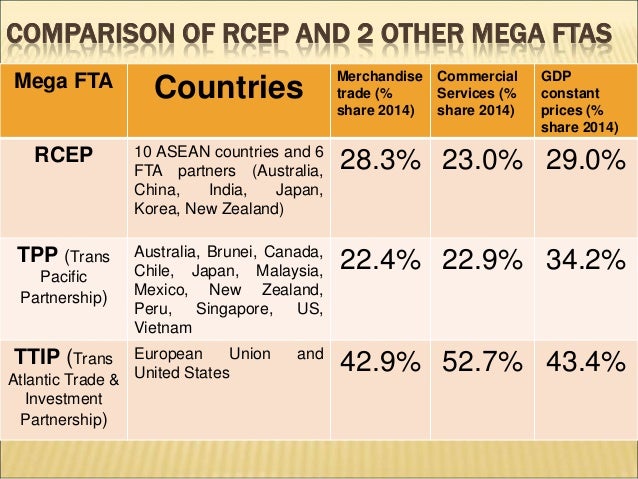
    Three important mega regional’s are currently under negotiation: the Regional Comprehensive Economic Partnership of Asia and the Pacific (RCEP), the Trans-Pacific Partnership (TPP), and the Transatlantic Trade and Investment Partnership (TTIP).

    It is expected that these agreements, once concluded and implemented, will set the stage for a new generation of global trade and investment rules.

    In this article we will explain What is RCEP ,what will be its significance for India and what are the point of contention among countries in RCEP.

    • What is RCEP?
    • Key Features of RCEP
    • Comparison of RCEP with other regional Agreements
    • Significance of RCEP for India
    • Challenges in Final negotiation of RCEP
    • Challenges and concerns for India from Joining RCEP
    • Recent point of contention in RCEP negotiation

    source

    What is RCEP?

    • Regional Comprehensive Economic Partnership (RCEP) is a proposed free trade agreement (FTA) between the ten member states of the Association of Southeast Asian Nations (ASEAN) (Brunei, Burma (Myanmar), Cambodia, Indonesia, Laos, Malaysia, the Philippines, Singapore, Thailand, Vietnam) and the six states with which include India, China, Australia, Japan, South Korea and New zealand.
    • In total, the grouping of 16 nations includes more than 3 billion people, has a combined GDP of about $17 trillion, and accounts for about 40 percent of world trade.
    • If negotiated successfully, RCEP would create the world’s largest trading bloc and have major implications for Asian countries and the world economy.

    Key features of the RCEP

    The RCEP seeks to achieve a modern and comprehensive trade agreement among members. The core of the negotiating agenda would cover trade in goods and services, investment, economic and technical cooperation and dispute settlement. The partnership would be a powerful vehicle to support the spread of global production networks and reduce the inefficiencies of multiple Asian trade agreements that exist presently.

    At the launch of negotiations in 2012, the leaders of each relevant country endorsed the “Guiding Principles and Objectives for Negotiating the Regional Comprehensive Economic Partnership.”

    The key points of this document are as follows:

    (A) Scope of negotiations

    • RCEP will cover trade in goods, trade in services, investment, economic and technical co-operation, intellectual property, competition, dispute settlement and other issues.
    • As expected, ASEAN will be in the “driver’s seat” of this multilateral trade arrangement (though the idea was initially given by Japan), and has been repeatedly endorsed by India.
    • The joint statement issued at the end of the first round of negotiations also reiterated “ASEAN Centrality” in the emerging regional economic architecture.

    (B) Commitment levels

    The RCEP will have broader and deeper engagement with significant improvements over the existing ASEAN+1 FTAs, while recognizing the individual and diverse circumstances of the participating countries.

    (C) Negotiations for trade in goods

    Negotiations should aim to achieve the high level of tariff liberalization, through building upon the existing liberalization levels between participating countries.

    (D) Negotiations for trade in services

    The RCEP will be comprehensive, of high-quality and consistent with WTO rules and all service sectors will be subject to negotiations.

    (E) Negotiations for investment

    Negotiations will cover the 4 pillars of promotion, protection, facilitation and liberalization.

    (F) Participating countries

    Participants will be ASEAN members and FTA Partners. After the completion of the negotiations, countries other than the 16 states may join.

    source

    Significance of RCEP for India

    • India is not a party to two important regional economic blocs: The Asia-Pacific Economic Cooperation and the Trans-Pacific Partnership. New Delhi fears the TPP, although years away from reality, could mean losing some textile and drugs exports to countries like Vietnam, which has embraced both the TPP and the RCEP.
      • TPP is set to change the landscape of global trade. For India, it is most likely to affect sectors like leather goods, plastics, chemicals, textiles and clothing.
      • The RCEP would enable India to strengthen its trade ties with Australia, China, Japan and South Korea, and should reduce the potential negative impacts of TPP and TTIP on the Indian economy.
    • The RCEP agreement would complement India’s existing free trade agreements with the Association of SouthEast Asian Nations and some of its member countries, as it would deals with Japan and South Korea.
    • It would be the world’s largest trading bloc covering a broad spectrum of issues such as trade in goods, services, investment, competition, intellectual property rights, and other areas of economic and technical cooperation.
    • From India’s point of view, the RCEP presents a decisive platform which could influence its strategic and economic status in the Asia-Pacific region and bring to fruition its act east policy.
    • RCEP will facilitate India’s integration into sophisticated “regional production networks” that make Asia the world’s factory. The RCEP is expected to harmonize trade-related rules, investment and competition regimes of India with those of other countries of the group. Through domestic policy reforms on these areas, this harmonization of rules and regulations would help Indian companies plug into regional and global value chains and would unlock the true potential of the Indian economy. There would be a boost to inward and outward foreign direct investment, particularly export-oriented FDI.
    • India enjoys a comparative advantage in areas such as information and communication technology, IT-enabled services, professional services, healthcare, and education services. In addition to facilitating foreign direct investment, the RCEP will create opportunities for Indian companies to access new markets. This is because the structure of manufacturing in many of these countries is becoming more and more sophisticated, resulting in a “servicification” of manufacturing.

    Challenges in Final negotiation of RCEP

    Finalizing the RCEP will not be a cakewalk for India and other countries involved in the negotiations as there are a range of issues that could act as spoilers.

    • Huge economic disparities among the negotiating countries are likely to pose a challenge
    • An inevitable source of trust deficit between China and the rest which has the potential to constrain regional economic cooperation is China’s aggressive postures on territorial disputes with Japan and India and with ASEAN member countries on the South China Sea disputes.This can pose as a hurdle in final negotiation of RCEP
    • The existing 5 ASEAN+1 and 23 ratified bilateral FTAs, varying greatly in their terms, pose a significant hurdle to RCEP negotiations.
    • The lack of commonality across FTAs and varying internal policies of countries would prove to be a difficult task to harmonize and consolidate under RCEP.

    Challenges and concerns for India from Joining RCEP

    For New Delhi, following challenges lie ahead.

    • First, tariff barriers, which have been a matter of discontent in bilateral FTAs, particularly in the case of the ASEAN-India FTA, will be central to the negotiations in the upcoming rounds of RCEP negotiations.
    • Non-trade issues such as environment and labor are likely to be prickly as well and need greater attention. Many Countries in RCEP want a stricter norms and standards on environment and labor issues while India’s interest lie in liberal environment and labor norms as this makes Indian industry competitive. India therefore should bat for liberal environment and labor norms while negotiating in RCEP.
    • India must take steps to strengthen its Medium, Small and Micro Enterprises (MSME) sector, equipping it not only to survive the free flow of trade, but also to become a set of more competitive players. Higher investments in R&D and achieving international standards in terms of delivery are needed.
    • An internal commerce ministry estimate that signing the 16-country Regional Comprehensive Economic Partnership (RCEP) trade agreement will result in a revenue loss of as much as 1.6% of GDP
    • Finally, a major difficulty for India will be negotiating terms with China. India has to be firm and calculative in terms of taking tough policy decisions, while working tirelessly on capacity building of its domestic industries.

    Recent point of contention in RCEP negotiation

    • Recently in the 12thround of RCEP talks The members of the Regional Comprehensive Economic Partnership (RCEP) have, in a sort of ultimatum, asked India to either to consent to eliminate tariffs on most products quickly or leave the talks on the proposed Free Trade Agreement (FTA) that is being negotiated by RCEP itself.
    • The members of RCEP are irked by what they think as India’s obstructionist, defensive and half-hearted approach” that is “delaying” the result of the talks
    • Some member countries, particularly 10- members ASEAN bloc, want India to take a long-term approach and consent to eliminate deities (except in agriculture and industrial goods) on a higher threshold within a decade to help India get the benefit of the opportunities arising out of Global Value Chain.

    References:

  • [Solved] IAS Prelims 2016 Mocks #1

    Update:

    The solutions for this mock are now available in a downloadable pdf. We have tried to make them as detailed as possible and included references and user comments wherever possible. Download link. 


    Here we go. This is the first of the many Prelims mocks coming for you. For detailed syllabus, click this link.

    Note: For readers armed with their Android phones, you shall not be able to comment on this quiz from the App ecosystem, so please return to your desktops and fill in the comments and discuss!

    Q1. Consider the following statements:

    1. River Manas cuts through the Khasi Hills to join Brahmaputra.

    2. Abor Hills are drained by Barak river.

    Which of the above statements is/are correct?

    (a) 1 only

    (b) 2 only

    (c) Both 1 and 2

    (d) Neither 1 nor 2

    Q2. Which of the following is/are correctly matched?

    Hill Station       :       Located in

    1. Mahabaleshwar  :     Satmala Hills

    2. Pachmarhi           :     Mahadeo Hills

    3. Matheron             :     Gawilgarh Hills

    Choose the correct alternative using the codes given below.

    (a) 2 only

    (b) 1 and 3 only

    (c) 3 only

    (d) 1, 2 and 3

    Q3. Narmada River does not have many tributaries primarily because

    1. It flows through the region of scanty rainfall.

    2. The hard rock surface and non-alluvial nature of the peninsular plateau permits little scope for the development of tributaries.

    3. It flows through a narrow valley confined by precipitous hills.

    Choose the correct alternative using the codes given below.

    (a) 1 and 3 only

    (b) 2 only

    (c) 3 only

    (d) 1, 2 and 3

    Q4. ‘Great Channel’ separates which of the following pairs of islands?

    (a) Great Nicobar and Sumatra

    (b) South Andaman and Little Andaman

    (c) Car Nicobar and Little Nicobar

    (d) North Andaman and Little Andaman

    Q5. What is the correct order of the following tributaries of Ganges as they join her from east to west?

    1. Ramganga

    2. Gandak

    3. Son

    4. Saptakoshi

    Choose the correct alternative using the codes given below.

    (a) 1-3-2-4

    (b) 4-3-2-1

    (c) 4-2-3-1

    (d) 1-2-3-4

    Q6. The difference in the length of days and nights at various places is caused due to 

    (a) elliptical orbit of the earth around the sun

    (b) rotation of the earth around its own axis

    (c) revolution of the earth around the sun

    (d) Inclination of the earth’s axis to the plane of its orbit

    Q7. Which of the following regions is conspicuous for the absence of many active volcanoes in comparison to other regions?

    (a) Indonesian Archipelagos

    (b) Western Coast of North America

    (c) Brazilian Coast

    (d) Chilean Coast

    Q8. Which of the following features/landforms are you least likely to observe if you are visiting Himalayan region?

    (a) U-shaped Valleys

    (b) Moraines

    (c) Cirques

    (d) Yardangs

    Q9. “Trees are adapted to withstand the dry summer without shedding of leaves.  Plants have spiny, waxy or small leaves to reduce transpiration. Trees have deep roots to tap water from depths. Thick bark also prevent loss of moisture.”

     Which of the following types of forests have been described above?

    (a) Tropical Deciduous forests

    (b) Mediterranean forests

    (c) Tropical Evergreen forests

    (d) Mid-latitude Evergreen forests

    Q10. Which of the following regions receive heavy rainfall due to South-west monsoon?

    1. Coromandel Coast

    2. East Himalayan region

    3. Malabar Coast

    Choose the correct alternative using the codes given below.

    (a) 1 and 3 only

    (b) 2 and 3 only

    (c) 3 only

    (d) 1, 2 and 3

    Q11. Which of the following is/are the major kharif crops in India?

    1. Cotton

    2. Groundnut

    3. Wheat

    4. Pearl Millet (Bajra)

    Choose the correct alternative using the codes given below.

    (a) 1, 2 and 4 only

    (b) 1 and 2 only

    (c) 1, 2 and 3 only

    (d) 1, 2, 3 and 4

    Q12. Consider the following statements about the geology of India:

    1. The southern plateau block is formed mainly of granites and gneisses.

    2. The Shillong plateau is an extension of the peninsular plateau.

    3. The Deccan lava plateau has a generally homogenous relief.

    Which of the above statements is/are correct?

    (a) 1 only

    (b) 2 and 3 only

    (c) 1 and 3 only

    (d) 1, 2 and 3

    Q13. Consider the following statements about the Census 2011:

    1. The density of population increased in all states and union territories except Arunachal Pradesh.

    2. Male-Female gap in literacy rate has been lowest in the last five decades.

    Which of the above statements is/are correct.

    (a) 1 only

    (b) 2 only

    (c) Both 1 and 2 only

    (d) Neither 1 nor 2

    Q14. Which of the following regions are known for iron ore reserves?

    1. Ruhr region

    2. Kuznetsk basin

    3. Donetsk basin

    Choose the correct alternative using the codes given below.

    (a) 1 only

    (b) 2 and 3 only

    (c) 3 only

    (d) None

    Q15. Consider the following statements about the Sub-Tropical High Pressure Belts?

    1. They are located around 30º latitudes in both the hemispheres and are also known as ‘horse latitudes’.

    2. They are characterised by subsiding dry air and are conspicuous by the presence of tropical deserts.

    Which of the above statements is/are correct?

    (a) 1 only

    (b) 2  only

    (c) Both 1 and 2

    (d) Neither 1 nor 2

    Q16. Earthquakes along the Himalayas and the foothills are best explained in terms of

    (a) plate tectonics

    (b) young age of the Himalayas

    (c) fragile and largely unconsolidated rocks

    (d) divergence of plates

    Q17. Consider the following statements:

    1. Winter rainfall over the plain areas of north-west India is caused by western disturbances.

    2. The rainfall caused by western disturbances increases from north and north-west to the east.

    Which of the above statements is/are correct?

    (a) 1 only

    (b) 2  only

    (c) Both 1 and 2

    (d) Neither 1 nor 2

    Q18. According to the Indian convention, which of the following is the first season of the year?

    (a) Hemanta

    (b) Sharada

    (c) Shishira

    (d) Vasanta

    Q19. The winter rainfall over the plain areas of the north western region of India is largely due to

    (a) South-west monsoon

    (b) North-east monsoon

    (c) Western disturbances

    (d) Convection currents

    Q20. Consider the following statements:

    1. They are generally clayey, deep and impermeable.

    2. On the uplands they have a comparatively lower fertility than on the low lands.

    3. They consist of lime, iron, magnesium and alumina but they lack in phosphorus, nitrogen and organic matter.

    4. They extend over parts of Maharashtra, Madhya Pradesh, Gujarat, Andhra Pradesh and Tamil Nadu.

    Which of the following types of soil has been described in the above statements?

    (a) Alluvial soil

    (b) Black soil

    (c) Red soil

    (d) Laterite soil

    Q21. Which of the following pairs is/are not correctly matched?

    Native Tribe    :      State

    1. Konyak             :    Nagaland

    2. Tagins               :    Arunachal Pradesh

    3. Angami             :    Meghalaya

    4. Abor                  :    Mizoram

    Choose the correct alternative using the codes given below.

    (a) 1 and 2

    (b) 1, 2 and 3

    (c) 3 and 4

    (d) 1, 3 and 4

    Q22. Consider the following statements:

    1. Isotherms are more regular and widely spaced in Northern hemisphere compared to the Southern Hemisphere.

    2. Isotherms bend slightly while crossing from land masses to oceans.

    Which of the above statements is/are correct?

    (a) 1 only

    (b) 2  only

    (c) Both 1 and 2

    (d) Neither 1 nor 2

    Q23. The large difference in rainfall received at Mahabaleshwar and Pune, which are only a few kilometres away, is largely because

    (a) Pune has dry air conditions all the year round

    (b) Mahabaleshwar is situated at a higher altitude than Pune

    (c) Pune is situated in a rain shadow region

    (d) None of the options (a), (b) or (c) sufficiently explains the phenomenon

    Q24. Waves in the open seas are largely caused by

    (a) gravitational pull of the sun

    (b) gravitational pull of the moon

    (c) undulating surface of the oceans

    (d) wind blowing over the sea surface

    Q25. ‘Gaza Strip’, which is frequently in news, is surrounded by

    (a) Israel, Lebanon and Syria

    (b) Mediterranean sea, Israel and Egypt

    (c) Mediterranean sea, Israel and Lebanon

    (d) Mediterranean sea, Israel, Egypt and Lebanon

  • Economic Survey For IAS | Volume 2 | Chapter 9 |Part 2 | Social Infrastructure, Employment and Human Development


    Child Labour

    A multi-pronged strategy to tackle the problem of child labour

    • Statutory and legislative measures <amendment to child labour act>
    • Rehabilitation of children withdrawn from work through specific schemes and universal Social Infrastructure
    • Employment and Human Development
    • Elementary education #supplemented with economic rehabilitation of their families by way of convergence with existing programmes and schemes

    Amendment to the Child Labour (Prohibition & Regulation) Act, 1986

    Source-indianexpress
    Source-indianexpress


    • Complete prohibition on employment of children below 14 years
    • Two exceptions
    • 1. work done in family enterprises and on farmlands provided it is done after school hours and during vacations
    • 2. working as artists in audio-visual entertainment industry, including advertisement, films, television serials  except the circus, provided that such work does not affect the school education.
    • linking the age of prohibition with the age under the RTE Act 2009, and stricter punishment for employers
    • barred employment of adolescents (14 to 18 years) in hazardous occupations and processes like chemicals and mines
    • no penalty for parents for the first offence, the employer will be liable for punishment even for first violation

    Criticism-


    • amendments partially legitimises child labour
    • how it would be ensured that the child is working in a non-hazardous family enterprise and that he/she would be doing so only after school hours

    National Child Labour Project (NCLP) Scheme

    • Under this children rescued from work in the age group of 9-14 years are enrolled in NCLP special training centers
    • they are provided bridge education, vocational training, midday meal, stipend, health care, etc., before being mainstreamed into formal education system.
    • Children in the age group of 5-8 years are directly linked to the formal education system through close coordination with the Sarva Shiksha Abhiyaan (SSA)

    Skills Gap and Employment

    Why skill india


    1. Nearly 90% of employable people did not receive any vocational training <80% of German workforce formally skilled>
    2. Imparting vocational education and training is an effective way of developing skills for improving the employability of the population

    Why vocational education not popular in India

    • perception that vocational education and skill development are meant for people who have failed to join mainstream education <attitudinal factors>
    • perception is strengthened by the significantly lower wages paid to employees with vocational training vis-à-vis those with formal education

    What has govt done so far?

    1. Setting up of the NSDC
    2. establishment of the National Skill Qualification Framework (NSQF) <it will facilitate increased adoption of skill development programmes, with availability of pathways for progression between higher education and skill development
    3. funding initiatives such as the Standard Training and Assessment Reward (STAR) scheme <can you tell us more about STAR?> <What is Udaan scheme?>
    4. Sector Skill Councils (SSCs) -autonomous industry led bodies
    5. create National Occupational Standards (NOSs) and Qualification Packs (QP) for each job role in the sector
    6. develop competency frameworks, conduct training of trainers
    7. conduct skill gap studies and assess through independent agencies
    8. certify trainees on the curriculum aligned to NOSs developed by them

    Four big schemes

    1. National Policy on Skill Development and Entrepreneurship
    2. Pradhan Mantri Kaushal Vikas Yojana (PMKVY)
    3. Deen Dayal Upadhyaya Grameen Kaushalya Yojana (DDU-GKY)
    4. National Action Plan (NAP) for skill training  target of skilling 5 lakh differently-abled persons in next three years

    For detail about these schemes read this story-  Mammoth task of skilling India  and this blog

    Towards A Healthy India

    Goal is to provide accessible, affordable and equitable quality health care, especially to the marginalized and vulnerable sections of the population

    Challenge – paucity of resources (both financial -1.2% of GDP on Health and human, 1 doctor per 1400 as compared to WHO norm of min 1 doctor per 1000), weak social and environmental determinants such as age at marriage, nutrition, pollution, access to potable water and hygienic sanitation facilities

    Health system in India –

    Mix of Public – Sub Centre, Primary Health Centre, Community Health Centre, District Hospital, Medical Colleges and private as well as informal quacks

    Outreach and community level services – provided through coordination b/w ASHA <Accredited Social Health Activist>, Anganwadi Workers (AWW) and the Auxiliary Nurse Midwife (ANM)

    • Note 1– AWW works under ICDS scheme run by WCD ministry.
    • Note 2 – ASHA is a woman resident of the village  married/ widowed/ divorced, preferably in the age group of 25 to 45 years educated up to class 10.  Her Primary role is community mobilization. She works under National Health Mission of Ministry of Health and Family Welfare

    Imp. Points from NSSO survey -Key Indicators of social consumption in India: Health, 2015


    1. Private sector continues to play a significant role in the provision of outpatient and hospitalized care
    2. there has been a nearly two-fold jump in the institutional deliveries since the last such survey.
    3.  >60 % of all institutional deliveries are in the public sector and the Out of Pocket expenditures for childbirth in the public sector is about 1/10 that in the private sector
    4. >70% (72 % <decreased from 78%> in the rural areas and 79 % in the urban areas) of non hospitalised treatment was sought in the private sector
    5. 58% hospitalized treatment in private hospital in rural while 68% in Urban
    6. > 85% population outside health insurance – coverage by government-funded insurance schemes only 13.1 % of rural India and 12 % of urban population
    7. treatment in a private hospital costs four times as much as it does in a public hospital on an average

    Health Indicators and MDG

    Under five mortality -declined from 126 in 1990 to 49 in 2013, much faster than global rate of decline during the same period <target was to reduce it to 1/3 by 2015 i.e 42>

    Maternal Mortality– declined from 437 to 167 <target was to reduce by 3/4 i.e. 109>

    Immunization – From 36 % fully immunized in NFHS- 1,improved to 44 % in NFHS- 3 <NFHS 4 data is available only for 12 states>

    Imp. – % of children who are fully immunized is lower in urban areas compared to rural areas in majority of the States. It indicates that the availability of preventive health care is through the public health system, which needs strengthening in urban areas and hence National Urban Health mission has been launched.

    Source-World Health Statistics 2015
    Source-World Health Statistics 2015


    What is govt doing?

    1. Mission Indradhanush
    2. Four new Vaccines – IPV, MR, Rotavac, Adult JE vaccine
    3. National Iron Plus Initiative – to address anemia among children (6 months to 19 years) and women in reproductive age including pregnant and lactating women in both rural and urban areas
    4. Rashtriya Bal Swasthya Karyakram (RBSK)
    5. Rashtriya Kishor Swasthya Karyakram (RKSK)
    6. National Programme for Prevention and Control of Cancers, Diabetes, Cardiovascular Diseases and Stroke (NPCDCS)- jointly by MoHFW and Ministry of AYUSH on pilot basis in six districts
    7. Jan Aushadhi Scheme < what’s the differenece b/w generics and branded drugs>
    8. Rashtriya Swasthya Suraksha Yojana, or National Health Protection Scheme (NHPS) – new name of RSBY – Cover of 1lakh plus additional cover of 30K for senior citizens
    9. National Dialysis Service Programme – to provide dialysis facilities of chronic Kidney Disease Patients under PPP mode

    Human Resource shortfall (Rural Health Statistics 2015)

    • At the all-India level, CHCs are short of surgeons by 83 per cent of the total requirement <more shortfall in more backward states>
    • Only 27 per cent of the sanctioned posts have been filled

    The Universal Health Coverage (UHC) index

    • developed by the World Bank to measure the progress made in health sector
    • 4 indicators – immunization, diarrhea treatment, impoverishment (financial protection), inpatient admission
    • India ranks 143 among 190 countries in terms of per capita expenditure on health ($146 PPP in 2011).
    • It has 157th position according to per capita government spending on health which is just about $44 PPP

    Housing Amenities, Sanitation, Hygiene and Health (Social Determinants of Health) (2011)

    • access to drinking water within premises – 46.6 %
    • access to tap water – 35.5 %
    • latrine facilities within the household premises – 46. 9 %
    • Great disparities among states

    What is the govt doing?

    Swachh Bharat Mission (Gramin)

    • achieve universal sanitation coverage and eliminate open defecation by 2 October 2019 <150 b’day of Gandhi>
    • aims to promote better hygiene amongst the population and improve cleanliness by initiating Solid and Liquid Waste Management (SLWM) projects

    It will show results only if the constructed toilets are maintained after construction and also utilized by the beneficiaries <need attitude, mindset and behaviour change>

    Poverty

    Absolute Poverty – Basic needs are not fulfilled i.e food, clothing, shelter <basic needs can be anything, in modern societies electricity even internet>

    Relative Poverty – it is in relation to something, say all those earning less than 2/3rd of median income to be considered poor or say bottom 1/3rd to be considered poor

    Poverty line – consumption or income level below which people are considered poor

    Calculating Poverty Line

    Disclaimer- It’s a very crude way just for understanding

    1. Basically idea is to compute minimum consumption level below which someone would be considered poor <consumption can include anything based on sensitivity so starvation line/ destitute line would include only calorie, some others would include health, education, recreation etc. as well>
    2. Then assign a poverty line basket i.e 10 chapatis a day, 100 gm dal, 1 bananana based on a survey <you get the point, right>
    3. Do a sample survey to find out how many people consume less than the poverty line consumption
    4. It would give you % of people living BPL i.e So called Head Count Ratio of country as a whole as well as different states
    5. Assign monetary value to the poverty line basket items based on prices in different states<price of roti, dal, health check up, education cost, rent charges etc.>
    6. It would give you monetary value of poverty line
    7. Poverty line would be different in different states as cost of living and inflation is different
    8. We know how many people are poor in each state but we still don’t know who the poor are <we have only done a sample survey yet>. So now comes the identification problem
    9. To identify the poor, we have to do census <so called BPL census>

    N.C Saxena Committee submitted the methodology for BPL census in rural areas, Hashim Committee in Urban areas <inclusion criteria, exclusion criteria and ranking points based on assets, income, social status, other vulnerabilities etc.> <For More Info Google with the name of committess, this is to give you concept of poverty>

    Recently Socio Economic Caste Census (SECC) was done which can also be used to better identify poor


    We presently use poverty line submitted by Tendulakar Committee but before we come to Tendulkar let’s look at the history of poverty estimation briefly

    Pre independence poverty estimates: by Dadabhai Naoroji in his book, Poverty and the Un-British Rule in India

    The poverty line proposed by him was based on the cost of a subsistence diet consisting of rice or flour, dhal, mutton, vegetables, ghee, vegetable oil and salt

    National Planning Committee (1938) estimates were also based on mimium std of living perspective

    Post independence poverty estimates:

    1. Alagh Committee  (1979) – poverty line for rural and urban areas on the basis of nutritional requirements <Rural 2400 KCal, urban 2100 KCal>

    For subsequent years adjust poverty line basket items price levels for inflation to arrive at poverty line

    2. Lakdawala Committee (1993): consumption expenditure based on calorie consumption as earlier but suggested constructing state specific poverty lines

    Updating them using the Consumer Price Index of Industrial Workers (CPI-IW) in urban areas and Consumer Price Index of Agricultural Labour (CPI-AL) in rural areas <assumes that the basket of goods and services used to calculate CPI-IW and CPI-AL reflect the consumption patterns of the poor>

    Tendulkar Committee (2009) –  it was constituted due to 3 perceived shortcomings in the earlier methodologies

    (i) Consumption patterns were linked to the 1973-74 poverty line baskets (PLBs) whereas there were significant changes in the consumption patterns of the poor since that time

    (ii) issues with the adjustment of prices for inflation

    (iii) earlier poverty lines assumed that health and education would be provided by the State and formulated poverty lines accordingly i.e did not include expenditure on health and education

    It recommended following major changes

    1. a shift away from calorie consumption based poverty estimation
    2. a uniform poverty line basket (PLB) across rural and urban India <alag committee 2400 kcal for rural, 2100 for urban>
    3. incorporation of private expenditure on health and education while estimating poverty
    4. updating poverty lines based on changes in prices and patterns of consumption, using the consumption basket of people close to the poverty line
    5. Poverty line was in form of Rs per capita per month

    The Committee recommended using Mixed Reference Period (MRP) based estimates, as opposed to Uniform Reference Period (URP) based estimates that were used earlier <mixed meaning for some items you would ask how much did you consume in last 1 year say for footwear, clothing etc while for others in last 1 month. On the other hand, in uniform every consumption in just last 1 month>

    4. Rangarajan Committee: Poverty line should be based on

    1. Certain normative levels of ‘adequate nourishment’ plus clothing, house rent, conveyance, education < normative means desirable> < average requirements of calories, proteins and fats based on ICMR norms>
    2. A behaviorally determined level of other non-food expenses <behavioral is consumption as per general behavior>


    1. It reverted to old system of separate poverty line baskets for Rural and urban areas a<contrast with Tendulkar>
    2. Used Modified Mixed reference period <MMRP> < Aparat from 1 month and 1 year data, it included last week data for some items like egg, fish meat>
    3. It used Monthly expenditure of Household of five for the poverty line as living together decreases cost

    We use Tendular data and based on this incidence of poverty declined from 37.2% in 2004-05 to 21.9% in 2011-12 <rural poverty 25.7%, urban 13.7%>

    Discuss – Criticism of poverty line and Tendulkar methodology

    World Bank Poverty Line – US $1.90 a day on Purchasing Power Parity basis


    P.S. – Human Development Index will be discussed in the next part in detail

  • Everything that you should know about the World Trade Organization (WTO)

    World Trade Organization (WTO) as the name suggests, is the organization dealing with the global rules of trade between nations. Its main function is to ensure that trade flows as smoothly, predictably and freely as possible.

    But why do nations trade? Whatever happened to Swadeshi and self sufficiency? 

    • Different factor endowments – simplest and obvious logic is every country does not possess everything. As we do not have sufficient oil reserves, we can’t do anything but import oil. But we also import things we can produce from simplest of things such as toys to complex things such as mobile phones.
    • Choice -from consumers perspective, it gives them more choices <you can buy iphones or Samsung galaxy, micromax or freedom 251>.
    • Market– Similarly it gives bigger market to industries (economies of scale, a concept that cost decreases as the size of an industry increases) <from sale in India to sale to the whole world>
    • Specialization – If countries didn’t trade, or traded only those things which they did not have (essentially raw materiel), they will have to produce everything. It will hamper specialization. Every country will become jack of all trade, master of none. Trade allows countries to specialize in things they do the best based on their comparative and competitive advantage.<If India is good at producing apples and China at oranges, India should only produce apples and exchange them for oranges>
    • Competition and efficiency – Also domestic industries will not face any competition from outside world, less competition, less incentive to become efficient or to innovate , consumers suffer. Thus trade forces industries to become more efficient.
    • Reduction in hostility – Apart from these economic reasons, as countries trade, they become interdependent on each other and thus chances of hostilities or major wars decrease. New ideas also flow along with trade.

    Discussion so far suggests that in an ideal world we should all promote free trade as it increases efficiency and benefits consumers. But the world is not ideal. There are some problems with free trade and hence need for protecionism


    • In developing economies, industries may not even get a chance to grow because they face competition from more established foreign firms <thus the argument for protecting nascent industries by higher tariffs>
    • Trade can lead to over-specialisation <workers at risk of losing their jobs should world demand fall> <suppose India produced only apples and suddenly some virus infest the crop, there wouldn’t be anything else to sell to the world or someone produces better variety of apple somewhere else, Indian apples would lose market> <recall situation of Cuba when sugar prices fell>
    • What if other country started cheating, subsidizing exports to capture the market abroad and when all domestic industries are killed, increasing the prices <every country must play by the same rules>

    It’s clear that trade can not be totally free in a not so ideal world. Countries need some policy levers to allow domestic industries to grow and diversify their economies. Also there’s need for a watchdog/referee who can adjudicate when other countries start cheating.

    Let’s now discuss barriers to trade


    In spite of all the benefits of trade, we all know countries regularly resort to measures which discourage trade (especially imports) to protect domestic industries <hence called protectionist measure> even though they might hurt consumers <problem of silent majority v/s vociferous minority discussed in chapter 2 of economic survey>

    Tariff barriers- custom duties which make imported goods costlier than domestically manufactured goods <it’s imposed to earn revenues for the govt, protect interest of domestic industry>

    Non tariff barrier– Here countries do not impose custom duties but retard flow of trade in other ways.

    Quantitative restrictions- Crude way of doing it is imposing quantitative restrictions on goods imported <quotas, say only up to 100 m tonne of sugar can be imported> or making licenses compulsory to export goods to home country or that only certain licenses can import goods or embargo <banning trade of certain goods with certain countries>

    Standards setting and administrative delays– But countries now employ sophisticated ways to retard flow of trade. Customs official can simply delay clearance of cargo <hence trade facilitation agreement> or can set standards <product using child labor/ environmentally degrading techniques will not be allowed, the problem with TPP> or simply cheat by providing export subsidies or domestic subsidies.

    Two kinds of trade barriers that are allowed for protection of health, safety, environmental protection but are often misused

    1. Technical barriers to trade-technical regulations, standards, and conformity assessment procedures can be set for the protection of human health and safety, or protection of the environment.
    2. Sanitary and Phyto Sanitary Measures – It allows countries to set their own standards for food safety and animals and plant health standards.

    But both the measures specify that standards must not be arbitrary i.e they must be scientific. Also they should not be discriminatory.

    WTO’s role is to reduce these barriers to trade, set rules of the game and adjudicate when one member country accuses other of cheating.

    Let’s learn about WTO in detail


    When? 1995

    Headquarter: Geneva, Switzerland <where are the HQs of IMF and World Bank? Answer in comments> 

    Members: 164 <Afghanistan the most recent member> < latest member of IMF?>

    Origin:

    • US, UK and a few other countries set up, an interim organisation about trade named GATT (General Agreement on Tariff and Trade) in 1947
    • GATT was biased in favour of the developed countries and was called informally as the Rich men’s club.
    • So, the developing countries insisted on setting up of the International Trade Organisation (ITO)
    • That’s the reason, United Nations Conference on Trade and Development (UNCTAD) was set up in 1964 as an alternative, on recommendation of UN committee
    • Next development comes in Uruguay Round of GATT, it sought to expand the scope of the organisation by including, services, investment and intellectual property rights (IPR)
    • Agreements were ratified by the legislatures of 85 member-countries by year-end 1994.
    • On such rectification, the WTO started functioning from Jan 1, 1995 Marrakesh Agreement>

    Why GATT failed to perform? Any Limitations?

    • Institutional structure – Only the set of rules and multilateral agreements, it lacked institutional structure
    • Limited scope – It didn’t cover trade in services, Intellectual Property Rights(IPR) etc.
    • Dispute Resolution Mechanism and Non-tariff barriers – No
    • Representation for developing and new states – No (Western monopoly)

    Objectives of the WTO

    • Raising standards of living and incomes, ensuring full employment, expanding production and trade, optimal use of world’s resources, at the same time extending the objectives to services and making them more precise
    • Introduces the idea of sustainable development in relation to the optimal use of world’s resources, and the need to protect and preserve the environment in a manner consistent with the various levels of national economic development
    • Recognises the need for positive efforts designed to ensure that developing countries, especially the least developed ones, secure a better share of growth in international trade
    • WTO continues the decision-making practice followed under the GATT Decisions will be taken by a majority of votes cast on the basis of one country, one vote . In fact rarely is voting undertaken. Decisions are mostly based on consensus. <What is the basis of voting in IMF? Answer in comments>

    Principles of the trading system

    A) Non-discrimination –

    1) Most favoured nation (MFN) rule

    • The MFN rule requires that a WTO member must apply the same conditions on all trade with other WTO members
    • i.e. a WTO member has to grant the most favorable conditions under which it allows trade in a certain product type to all other WTO members.
    • Grant someone a special favour and you have to do the same for all other WTO members
    • Then how do Free Trdae Agreements (FTAs) work? Well as eveywhere, devil is always in detail, FTAs are exempt from this rule.
    • Did you know that Pakistan has not yet granted India MFN status though we have grated them that status <for long time, there’s talk of Pakistan granting us non discriminating market access (NDMA) as Pakistanis feel, if they grant us MFN status, they would be favouring us the most, hahaha>

    2) The National Treatment Policy

    National treatment means that imported goods should be treated no less favorably than domestically produced goods  <after the foreign goods have entered the market> and was introduced to tackle non-tariff barriers to trade (e.g. technical standards, security standards, discriminating against imported goods)

    B) Reciprocity

    • Granting of mutual concessions in tariff rates, quotas, or other commercial restrictions
    • It implies that these concessions are neither intended nor expected to be generalized to other countries <contrast MFN and reciprocity.>

    C) Binding and enforceable commitments –

    • The tariff commitments made by WTO members in a multilateral trade negotiation and on accession are enumerated in a schedule (list) of concessions
    • These schedules establish “Ceiling bindings”: a country can change its bindings, but only after negotiating with its trading partners, which could mean compensating them for loss of trade <i.e can’t increase tariff beyond these levels>
    • If satisfaction is not obtained, the complaining country may invoke the WTO dispute settlement procedures

    D) Transparency –

    • The WTO members are required to publish their trade regulations, to maintain institutions allowing for the review of administrative decisions affecting trade, to respond to requests for information by other members, and to notify changes in trade policies to the WTO
    • These internal transparency requirements are supplemented and facilitated by periodic country-specific reports (trade policy reviews) through the Trade Policy Review Mechanism (TPRM)
    • WTO system tries also to improve predictability and stability, discouraging the use of quotas and other measures used to set limits on quantities of imports

    E) Safety valves –

    • In specific circumstances, govts are able to restrict trade
    • WTO’s agreements permit members to take measures to protect not only the environment but also public health, animal health and plant health <sanitary and phytosanitary measure, TBT>

    Let’s come to main part of WTO -AGREEMENTS

    <There were many agreements agreed and ratified, but we found only some which are important for us, so let’s analyse them in brief>


    1) Agreement on subsidies and countervailing measures (SCM)

    It deals with the provision of subsidies, and the use of countervailing measures to offset injury caused by subsidized imports

    Definition of subsidy has 3 basic elements:

    1. Financial contribution
    2. By a Government or any public body within the territory of a Member
    3. Which confers a benefit.

    All three of these elements must be satisfied in order for a subsidy to exist SCM applies to non-agricultural products.

    It follows the traffic lights approach and classifies subsidies in 3 categories: <scroll up and look at barriers to trade infograph gain>

    Red:

    Subsidies with high trade-distorting effects, such as export subsidies, and those that favour the use of domestic over imported goods are prohibited. [If suppose, Brazil gives subsidy to its product Exported to India, Then India can ban such items from country]

    Green:

    Subsidies that are not specific to an enterprise or industry or a group of enterprises or industries are non-actionable.
    [No action at all – actionless]

    Amber:

    • Subsidies that are neither red nor green belong to the amber category.
    • They are actionable by the trading partners if their interests are adversely hit.
    • The affected country can seek remedy through the dispute-settlement procedures or go for countervailing duties.
      [Here, India can go either for countervailing duties or dispute-settlement procedure]

    2) General Agreement on Trade in Services – GATS

    The creation of the GATS was one of the landmark achievements of the Uruguay Round, whose results entered into force in January 1995.

    Objectives: same as broad objectives of WTO

    What services are covered under GATS?

    • GATS applies in principle to all service sectors, with 2 exceptions.
    • GATS excludes services supplied in the exercise of governmental authority i.e. services that are supplied neither on a commercial basis nor in competition with other suppliers. Eg.- social security schemes and any other public service, such as health or education, that is provided at non-market conditions.
    • Air traffic rights and services directly related to the exercise of such rights are also exempt

    Four modes under GATS <refer to the infograph above>

    Mode 1: Cross-border supply – There’s no movement of natural persons, no legal presence Eg-  an architect can send his architectural plan through electronic means

    Mode 2: Consumption abroad – movement of natural perosns to avail services elsewhere, eg.- a tourist using hotel or restaurant services abroad

    Mode 3: Commercial presence – legal presence in another country, eg.FDI, joint ventures

    Mode 4: Presence or movement of natural persons – here movement of natural person to provide services , eg. India techies going to USA

    It’s clear India wants liberalization in mode 1 and mode 4 <our BPO industry plus software industry, techies going to US> while developed world want liberalization in mode 3 <100% automatic FDI>

    Let’s understand all 4 modes with an example

    • Suppose Apple <USA company> establishes a subsidiary in India. This is supply of services through Mode 3 i.e. Commercial Presence
    • An architect of the Apple sends blueprints over the Internet to another firm in India- this is Mode 1 i.e. Cross Border Supply
    • An Engineer from the said Apple is deputed to work in the subsidiary in India for a limited period for managerial operations – this is Mode 4 i.e. Movement of Natural Persons
    • Certain trainees from the subsidiary in India visit USA and consume both education and tourism services  – this is Mode 2 i.e. Consumption Abroad for USA

    3) TRIPS

    The Agreement on Trade-Related Aspects of Intellectual Property Rights, sets down minimum standards for many forms of intellectual property (IP) regulation as applied to nationals of other WTO Members.

    Areas of intellectual property that it covers are –

    • Copyright and related rights, Trademarks including service marks
    • Geographical indications (GI) including appellations of origin <Did you remember, Pakistan also claim GI for their Basmati Rice, but recently India got GI tag for Indo-Gangetic plains basmati rice for 6 states>
    • Industrial designs, patents including the protection of new varieties of plants
    • Layout-designs of integrated circuits; and undisclosed information including trade secrets and test data

    3 Main features of Agreement includes –

    Standards –

    • Agreement sets out the minimum standards of protection to be provided by each Member
    • Each of the main elements of protection is defined, namely the subject-matter to be protected, the rights to be conferred and permissible exceptions to those rights, and the minimum duration of protection

    Enforcement – 

    Set of provisions deals with domestic procedures and remedies for the enforcement of intellectual property rights

    Dispute settlement – 

    The Agreement makes disputes between WTO Members about the respect of the TRIPS obligations subject to the WTO’s dispute settlement procedures

    Read story with Explainer on IPRs here, story on WTO and TRIPS here 

    4) Agreement on Agriculture (AoA)

    Objective:

    • To reform trade in the sector and to make policies more market-oriented.
    • This would improve predictability and security for importing and exporting countries alike

    The new rules and commitments apply to:

    1)Market access : various trade restrictions confronting imports

    2)Domestic support:  subsidies and other programmes, including those that raise or guarantee farmgate prices and farmers’ incomes

    Under this, Subsidies are categorized into 3 boxes –

    Green Box –

    • In order to qualify for the Green Box, a subsidy must not distort trade, or at most cause minimal distortion
    • These subsidies have to be govt-funded (not by charging consumers higher prices) and must not involve price support
    • They tend to be programmes that are not directed at particular products, and include direct income supports for farmers that are not related to <decoupled> current production levels or prices.

    <Like in India farmer is supported for specific products and separate support prices are there for rice, wheat etc. An example of Amber box subisdy. On the other hand income support is uniformly available to farmers and crop doesn’t matter, Green box>

    • Green box subsidies are therefore allowed without limits, provided they comply with relevant criteria
    • They also include environmental protection and regional development programmes, research and development subsidies etc
    • Developed countries have shifted most of their subsidies to green box, hence even though they provide more subsidies than us, they still get away with it

    Blue Box

    • Only Production limiting Subsidies under this are allowed. They cover payments based on acreage, yield, or number of livestock in a base year <such as subisdies for leaving the land fallow>
    • Targets price are allowed to be fixed by govt and if market prices are lower, so farmer will be compensated with difference between target prices and market prices in cash. This cash shall not be invested by farmer in expansion of production
    • Loophole here is that there no limit on target prices that can be set and those are often set far above market prices deliberately.
    • USA currently isn’t using this method, instead here EU is active.

    Amber Box –

    • All domestic support measures for agriculture, considered to distort production and trade (with some exceptions) fall into the Amber Box and this is Aggregate measure of support (AMS) i.e AMS is trade distorting subsidy in monetary terms
    • It required member countries to report their total AMS for the period between 1986 and 1988, bind it, and reduce it according to an agreed upon schedule <de minimis level>

    What is De-Minimis provision?

    • Under this provision developed countries are allowed to maintain trade distorting subsidies or ‘Amber box’ subsidies to level of 5% of total value of agricultural output. For developing countries this figure was 10%
    • So far India’s subsidies are below this limit, but it is growing consistently
    • This is because MSP are always revised upward whereas Market Prices have fluctuating trends
    • In recent times when crash in international market prices of many crops is seen, government doesn’t have much option to reduce MSP drastically
    • By this analogy India’s amber box subsidies are likely to cross 10% level allowed by de Minimis provision and hence the Bali deal for public stock holding and MSP <India is seeking permanent solution to this problem>


    3) Export subsidies:

    • These can be in form of subsidy on inputs of agriculture, making export cheaper or can be other incentives for exports such as import duty remission etc.
    • These can result in dumping of highly subsidized (and cheap) products in other country. This can damage domestic agriculture sector of other country
    • These subsidies are also aligned to 1986-1990 levels, when export subsidies by developed countries was substantially higher and Developing countries almost had no export subsidies that time

    Special safeguard mechanism (SSM)

    • A tool that will allow developing countries to raise tariffs temporarily to deal with import surges or price fall
    • is meant to protect the interests of resource-poor and subsistence farmers in the developing nations
    • Critics claim that SSM could be repeatedly and excessively invoked, distorting trade
    • In turn, the G33, a major SSM proponent, has argued that breaches of bound tariffs should not be ruled out if the SSM is to be an effective remedy
    • SSM is quite important in a scenario in which west has significant powers to subsidize their production and in turn, exports

    Special Products

    • At the 2005 WTO Ministerial Conference in Hong Kong, members agreed to allow developing countries to designate an appropriate number of tariff lines as Special Products (SPs) based on food security, livelihood security and rural development
    • They would be given extra flexibility in market access for these products
    • For instance if wheat is important for food security and livelihoods, India many not fully open up this sector but obviously USA wouldn’t agree on that

    Special and Differential Treatment (S&D)

    Special treatment under WTO to Developing and least developed countries. Special safeguard mechanism (SSM) is a demand under this.

    • longer time periods for implementing Agreements and commitments
    • measures to increase trading opportunities for developing countries
    • provisions requiring all WTO members to safeguard the trade interests of developing countries
    • support to help developing countries build the capacity to carry out WTO work, handle disputes, and implement technical standards, and
    • provisions related to least-developed country (LDC) Members

    A few more points before concluding the topic

    Plurilateral agreements – For the most part, all WTO members subscribe to all WTO agreements. After the Uruguay Round, however, there remained four agreements, originally negotiated in the Tokyo Round, which had a narrower group of signatories and are known as plurilateral agreements <contrast with multilateral agreements>

    1. Trade in civilian aircraft
    2. Govt Procurement
    3. Dairy products <terminated in 1997>
    4. Bovine Meat <terminated in 1997>

    Single Undertaking Principle – Nothing is agreed until everything is agreed. Negotiations proceed simultaneously, not sequentially, and all Members must accept all the results

    Dispute Settlement Process

    1. You don’t like what other country is doing, raise a complaint with WTO
    2. 1st step is mediation, talk with the other country, see if problem can be resolved
    3. No resolution, a dispute settlement panel is formed, hears both parties, gives it’s verdicts
    4. Not satisfied with it’s orders, appeal with the appellate body, decision is final
    5. What if country doesn’t comply with the orders? well there’s very little that WTO can do. Other country is free to take retaliatory measures


    WTO timeline


    Further Readings –

  • IAS Prelims tit-bits- Current Affairs part 3

    1. Sugamya Bharat Abhiyan

    1. Accessible India Campaign
    2. focus on making public buildings accessible to Persons with Disabilities
    3. Enhancing the accessibility and usability of Public Transport, and information & communication
    4. It was launched on international day pf persons with disabilities (3rd dec) not on 2nd October
    5. Sugamya Bharat Mobile app

    Discuss – Nodal department and ministry

    2. International Solar Alliance

    1. Countries located b/w tropic of cancer and tropic of Capricorn <sunshine countries>
    2. Was launched in Paris at COP21
    3. HQ will be in India, interim secretariat at Nation Institute of Solar Energy, Gurgaon

    Discuss- States in India through which tropic of cancer passes

    3. Ujjwala and UJALA scheme 

    1. Ujjawala– To extend availability of cooking gas (LPG) to BPL women of 18+ age i.e free LPG connection
    2. Funds from people who opted to omit their LPG subsidy through GIVE UP scheme
    3. UJALA–  Unnat Jyoti by Affordable LEDs for All
    4. Overall target of number of incandescent bulbs to be replaced – 200 million
    5. Every grid-connected consumer <NO BPL/APL> having a metered connection can get the LED bulbs at about 40% of the market price under the UJALA Scheme
    6. Consumers also have the option of paying for the LEDs in equated monthly instalment
    7. Electricity Distribution Company and Energy Efficiency Services Limited (EESL) is the implementing agency
    • Discuss – Domestic Efficient lighting programme (DELP) and Bachat Lamp Yojana
    • Discuss– Compare Incandescent bulb v/s CFL v/s LED

    4. New Horizon

    1. New Horizons is an interplanetary space probe that was launched as a part of NASA’s New Frontiers program
    2. launched in 2006 not last year with the primary mission to perform a flyby study of the Pluto system, and a secondary mission to fly by and study one or more other Kuiper Belt objects (KBOs) <primary mission accomplished>
    3. Pluto is a dwarf planet not planet and has 5 moon <Charon, Hydra, Nix, Styx, Kerberos>
    • Discuss – What is Kuiper belt
    • Discuss – Asteroid, comet, meteor, meteorite

    5. SERVIR-Mekong Project

    1. Combined Project of National Aeronautics and Space Administration (NASA) and the US Agency for International Development (USAID) and 5 SEA Countries – Burma, Cambodia, Laos, Thailand and Vietnam
    2. aims to tap into the latest technologies to help the Mekong River region protect its vital ecosystem
    3. In 2010, SERVIR-Himalaya, was established at the International Centre for Integrated Mountain Development (ICIMOD) in Kathmandu, Nepal
    • Discuss – NISAR mission
    • Discuss – members of Mekpng- Ganga Cooperation


  • [Spiritual Tourism #1] PRASAD Cities- Ajmer and Amaravati

    Although the definition and purposes of Tourism is no longer restricted to Heritage and Pilgrimage cities- its definitely India’s USP due to its Civilizational legacy, and being the birthplace of many religions.

    In this series on Themes in Tourism Industry, we’ll start by taking a trip through History and Culture of Cities of Spiritual / Religious Importance. For its promotion Government of India has launched two schemes PRASAD and Swadesh Darshan for Development of Theme-Based Tourist Circuits. 

    About the PRASAD Scheme

    • PRASAD means Pilgrimage Rejuvenation and Spirituality Augmentation Drive
    • A 100% Centrally Sponsored Scheme under Tourism Ministry
      • Note that funds for any CSS is given to states in installments (20% at approval stage, 60% when 20% work done and rest 20% when 60% work is finished)
    • Provisions under the scheme include
      • Tourism Promotion and Tourist Ecosystem
      • Vocational Training for Tourists and Hospitality Business
        • Hunar se Rozgar tak (HSRT) and earn while you learn programs
      • Improving Tourist Infrastructure

    Provisions regarding Tourist Infrastructure in PRASAD

    • ATM, foreign currency exchange counters
    • Rail, road water transport
    • Green energy streetlights
    • Water adventure sports
    • First-aid centres, Wi-Fi hotspots, Parking facilities
    • Green landscaping, water fountains, walkways, furniture etc.
    • Removing encroachments

    PRASAD versus HRIDAY?

    • HRIDAY means Heritage City Development and Augmentation Yojana
    • While PRASAD is under Tourism ministry <note that Culture ministry is separate from Tourism ministry> while HRIDAY is under Urban Development Ministry
    • PRASAD cities are handpicked because their tourism is centered around faith, spirituality and religion. On the other hand, a HRIDAY city is chosen for its heritage status that goes beyond faith to include aspects of culture such as Architecture (Eg- Cave temples of Badami, Kakatiya Temples of Warangal)
    • HRIDAY is exclusively focused on Infrastructure that preserve the Heritage Character (Museums, Fairs, Festivals etc) , while PRASAD goes beyond that to include Vocational Training programmes and other things that make up Tourism Ecosystem
    • Common outcomes of both are:
      • Increase in Employment, Tourist Footfalls, Cleanliness of Heritage/Pilgrimage cities
      • Decrease in Pollution, Crime rates etc
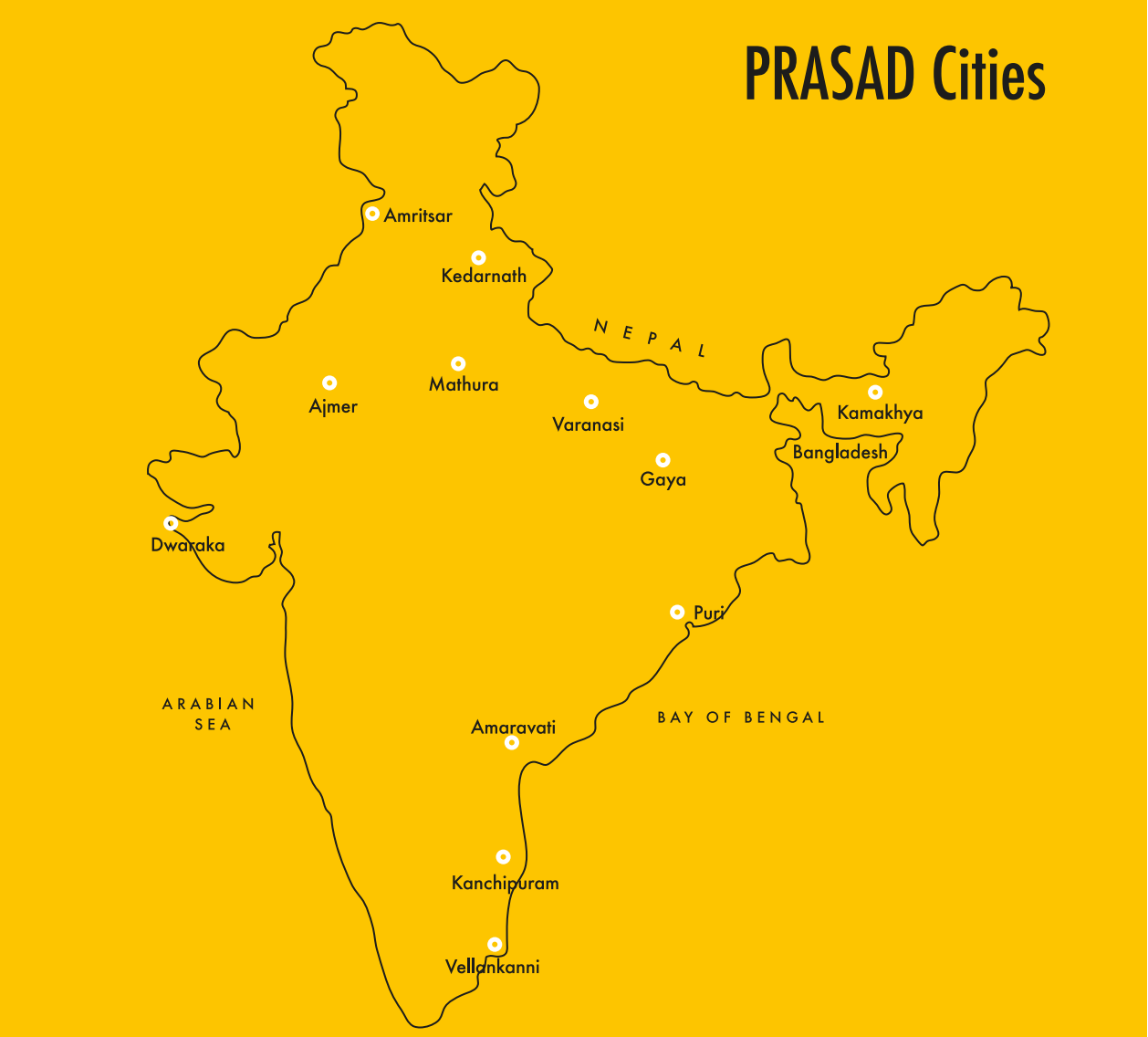
    • There are 12 cities selected for both schemes, but there’s a considerable overlap in the sense that 10 cities are common to both. Only cities separate are:
      • Kamakhya in Assam and Kedarnath in Uttarakhand (PRASAD)
      • Badami in Karnataka and Warangal in Telangana
    • Lets take a tour of those common 10 cities and the other 2 specific to PRASAD.

    Map of PRASAD Cities

    source

    #1: Ajmer

    source
    • Surrounded by the Aravalli Mountains (meaning the “Invincible Hill”)
    • Founded by Ajaipal Chauhan (who established The Chauhan Dynasty – 7th century.
    • Ruled by the legendary Prithviraj Chauhan, the last Hindu king of Delhi.
    • Dargah of the Great Sufi Saint Khwaja Moinuddin Chishti (aka Madina of India)
      • Devotees of all sects and faiths congregate
      • Annual festival of Urs (Death anniversary of a Sufi saint in South Asia, usually held at the saint’s dargah such as Chisti’s; it is celebrated rather than mourned)
      • Picture of harmony and universal brotherhood.
    • Variety of styles of Architecture including lndo-Islamic, Royal Rajasthani, lndo-Saracenic and Jain styles of architecture.
      • Soniji Ki Nasiyan is a famous Digambara Jain temple from Ajmer
    • Ajmer is also the base for visiting Pushkar (11 km), the abode of Lord Brahma and a sacred town of Hindus <Pushkar is far from Mahadeo Hills of MP, remember 2015 prelims question?>
    • Artists of this area
      • Carving on wood and ivory,
      • Blue pottery

    #2: Amaravati

    • What’s in a name?
      • Translates to “The town lives forever”
      • Also referred as Amareswaram
      • Formerly known as Andhra nagari
      • Name derived from famous “Amareswara temple” dedicated to Lord Shiva
    • Ancient Rulers of Amaravati
      • Capital of Satavahanas who ruled from 2nd century BCE to 3rd century CE <most important period for Amaravati>
      • Andhra Ikshvakus
      • Pallava kings
      • Eastern Chalukyas
      • Telugu Cholas
      • Kakatiyas in 11th century CE
    • Medieval Rulers of Amaravati
      • Delhi Sultanate
      • Bahmani Sultanate
      • Vijayanagara Empire,
      • Munsuri Nayaks
      • Sultanate of Golconda
    • Mentions of Amaravati found in:
      • Skanda Purana gives a picture of the place
      • Puranic literature such as Aitreya Brahamana mentions about “Andhra-jati” ruling area we now know as Amaravati
    • The Amaravati Stupa
      • Buddhist stupa (Dhyana) was built during the Reign of Ashoka in 200 BCE
        • Carved with panels that tells the story of Buddha
      • During the period of the Decline of Buddhism, this stupa was also neglected and it was buried
      • Stupa is related to the “Vajrayana” (Tibetan) teachings of Kalchakra (a festival held in 2006, Dalai Lama inaugurated)
      • NOTE: Hiuen Tsang (Xuanzang) also visited Amaravati Stupa in 640 CE

    source
    • Ancient Art (Sculpture) from Amaravati
      • Amaravati art as one of the three major styles or schools of ancient Indian Sculpture
        • Other two being the Gandhara style and the Mathura style.
      • Use of White marble (to Potrays a Greco-Roman influence)
      • Physical beauty with elegance
      • Narrative rather than individualistic (not deities but Humans)
      • Depiction of Kings and Princes
      • Direct result of the close trade and diplomatic contacts between south india and the ancient roma
      • Amaravati has itself yielded a few Roman coins
      • World’s finest examples of Narrative sculpture.

    source

    Published with inputs from Amar 
  • IAS Prelims tit-bits- History part 2

    1. Morley Minto Reform, 1909

    1. 1st name i.e Morley, Secretary of state, 2nd i.e Minto, Viceroy
    2. Prelude – Shimla Deputation led by Agha Khan demanded separate electorate in 1906
    3. Muslim League was founded in 1906 and it intended to preach loyalty to the empire <when was all India Hindu Mahasabha formed and it’s founders?>
    4. Reforms– separate electorate for muslims
    5. Elected members increased in legislative councils but elected non official still in minority
    6. Indirect election <elections for the 1st time>
    7. One Indian to the viceroy’s executive council
    • Discuss- 1st Indian to the viceroy’s executive council
    • Discuss – Progress of separate electorate in subsequent reforms  upto Poona Pact

    2. Montagu Chelmsford Reform

    1. Two lists, central and provincial , in provincial, reserved and transferred
    2. Dyarchy at Provinces i.e. reserve list by the governor, Transferred list by ministers
    3. Elected majority in provincial legislature <contrast this with reform of 1909>
    4. Bicameral legislature at Centre
    5. Secretary of state would now be paid out of British Exchequer <home charges reduced>
    • Discuss – Home charges and economic critique by nationalists
    • Discuss – Dual system/ government or Dyarchy of Clive and it’s end
    • Discuss– Transferred and reserve list


    3. Nehru Report <Motilal>

    Prelude – Challenge by Lord Birkenhead to Indians to produce an agreed constitution accepted by all in the wake of Anti Simon Agitation <No Indian In 7 member Simon commission>

    Recommendations

    1. Dominion Status <when did British 1st concede demand of dominion status>
    2. Joint electorate with reserved seat for minorities at centre and in provinces in which they were in minority
    3. Linguistic Provinces
    4. 19 Fundamental rights <congress resolution on fundamental rights, which session?>

    Jinnah Made 14 demands

    1. Provincial autonomy and residuary power to provinces
    2. Separate electorate
    3. ⅓ Muslim representation in central legislature and all cabinets

    Unhappy with Nehru Report J.L.Nehru Subhash Bose set up Independence for India League

    Discuss – 1st linguistic state in post independence India

    4. Three Round Table Conferences

    Proposed by Lord Irwin to discuss Simon Commission Report

    1st RTC <nov 1930 to jan 1931>

    1. Civil Disobedience Movement had already been started as Gandhi’s 11 demands not accepted by Viceroy
    2. Congress boycotted
    3. Muslim League, Hindu Mahasabha, Liberals, Princes participated <when was liberal party formed and why did it secede from Congress?>
    4. Failure as constitutional advance could not be discussed without congress participation

    2nd RTC <Dec 1931>

    1. After Gandhi Irwin pact (Delhi Pact) led to suspension of CDM
    2. Congress (Gandhi) participated
    3. Failure as session got deadlocked on the question of minorities < separate electorate for Muslims, depressed classes (SC), christians, anglo Indians>

    Result- Two Muslim majority provinces – Sindh and NWFP<No. Of provinces now?> , CDM resumed

    3rd RTC < Nov. 1932>

    1. Congress wasn’t even invited
    2. Labour Party <Britain> refused to attend it
    3. In this conference Chaudhary Rahmat Ali, a student, 1st proposed the name Pakistan

    Outcome – White Paper on the basis of this paper, the Government of India Act 1935 was to be passed.

    • Discuss – Significance of round table in RTC
    • Discuss – two demands of Gandhi which were rejected by Irwin in Gandhi- Irwin Pact
    • Discuss – What was agreed with regard to political prisoners, fines and land confiscated in Gandhi- Irwin Pact

    5. Govt of India Act, 1935

    1. All India Federation  and Bicameral legislature at center <what was there in 1919 act?>
    2. Odd that election to the council of states <upper house> was direct while indirect to the federal assembly
    3. Three lists, federal, provincial and concurrent <v/s 2 list in 1919> <who had residuary powers?>
    4. federal lists into reserved and transferred <in 1919 provincial list was into reserved and transferred>
    5. Provincial autonomy <dyarchy in 1919>
    6. All members of provincial legislature directly elected <contrast this with 1909 and 1919>
    7. Abolished the council of India created by the act of 1858

    Discuss – Following institutions were set up under which acts-

    RBI, central Public service commission, Federal Public Service Commission , office of secretary of state, office of high commissioner for India, Federal court, Supreme Court, Board of Control

More posts