💥Join UPSC 2027,2028 Mentorship (July Batch) + XFactor Notes & Microthemes PDF

Search results for: “”

  • 25th September 2019 | Daily Answer Writing Enhancement

    ANNOUNCEMENT – There is a change in format. Students will now have to post answers on the questions page separately by clicking on the links given below. We plan to track progress for each of the GS papers and to achieve the same, this modification becomes important. Students who are unable to post answers, please email hello@civilsdaily.com. You will receive a resolution for sure. 


    Question 1)

    Beginning with small means, then suddenly astonishing the world by its dazzling promise, the venture of the French in India was destined to end thus early in humiliation and failure. Discuss. (250 Words)


    Question 2)

    Without a systematic adoption of the Circular Economy, managing waste will be an insurmountable problem. (250 Words)

    Question 3)

    For India, climate action is not just a necessity, but an emergency. Discuss. (250 Words)

    Question 4)

    Corruption is an important manifestation of the failure of ethics. Discuss. Also, suggest ways to reduce corruption in government offices. (250 Words)

    Reviews will be provided in a week for. (In the order of submission- First come first serve basis). In case the answer is submitted late the review period may get extended to two weeks.

    *In case your answer is not reviewed in a week, reply to your answer saying *NOT CHECKED*. If Parth Sir’s tag is available then tag him.

    For the philosophy of AWE and payment, check  here: Click2Join

  • [Burning Issue] Corporate Tax Reduction


    Context

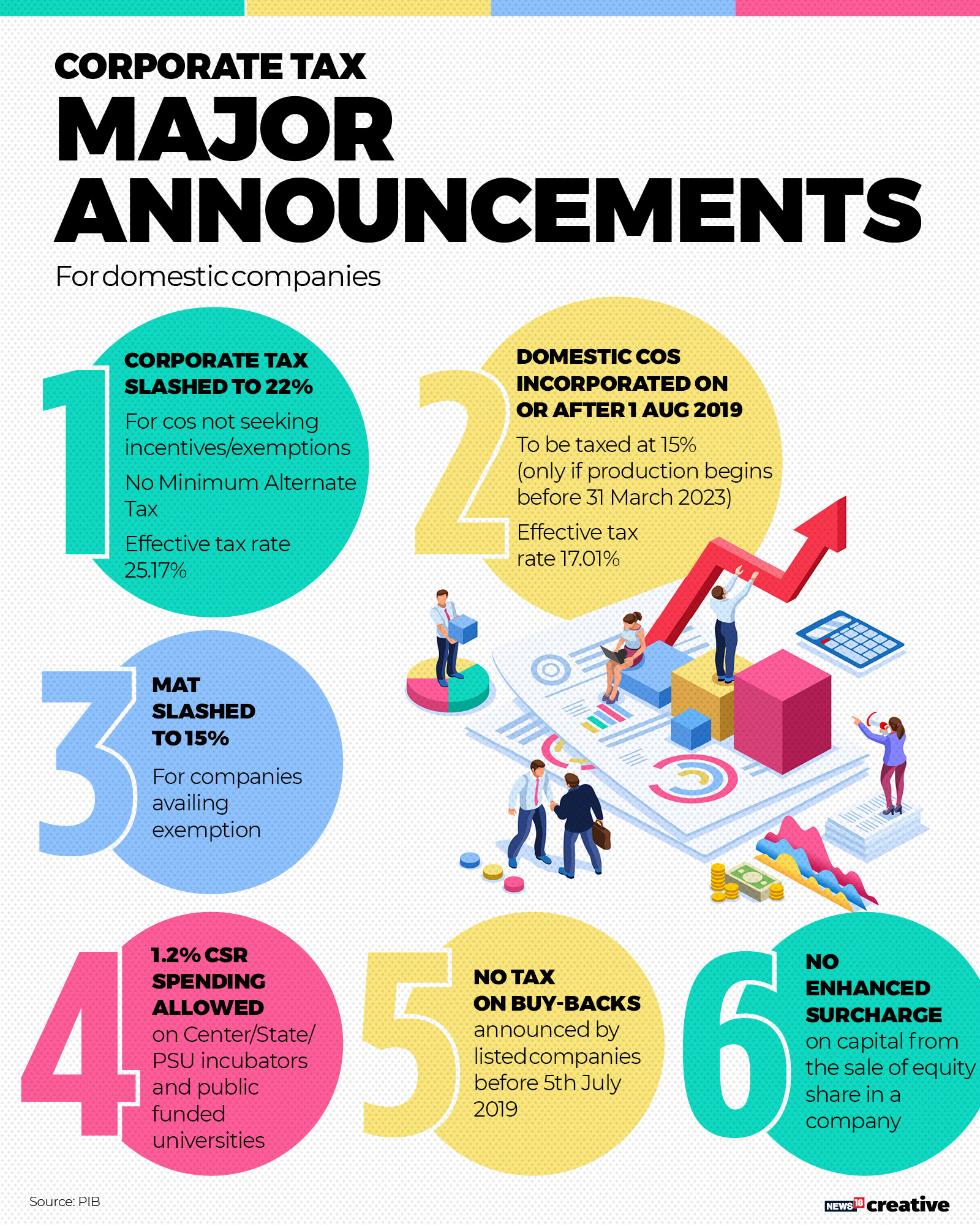
    • Finance Ministry has recently announced a reduction in the base corporate tax rate to 22% from 30% as part of stimulus measures to reverse slowing economic growth.
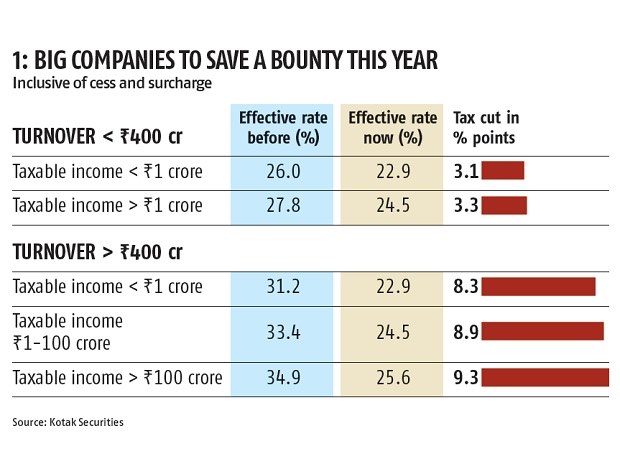
    • The effective tax rate for domestic corporates, inclusive of surcharges, will fall from 34.94% to 25.17% if they stop availing any other tax sops.
    • For new manufacturing firms set up after October 1, 2019 and commencing operations by March 31, 2023, the effective tax rate will fall from 29.1% to 17%.

    Corporate Tax: Background

    • Indian taxation system is divided into two types: One is Direct Taxes and other is Indirect Taxes.
    • Talking about direct taxes, it is levied on the income that different types of business entities earn in a financial year.
    • There are different types of taxpayers registered with Income tax department and they pay taxes at different rates.
    • An individual and a company being a taxpayer are not taxed at the same rate. Therefore, Direct Taxes are again subdivided as:

    Income Tax

    • This tax is paid by the taxpayers other than companies registered under company law in India on the income earned by them.
    • They are taxed on the basis of slabs at different rates.

    Corporate Tax

    • This tax is paid by the companies registered under company law in India on the net profit that it makes from businesses.
    • It is taxed at a specific rate as prescribed by the income tax act subject to the changes in the rates every year by the IT department.

    Corporate Tax in India

    • Domestic as well as foreign companies are liable to pay corporate tax under the Income-tax Act.
    • While a domestic company is taxed on its universal income, a foreign company is only taxed on the income earned within India i.e. is being accrued or received in India.
    • For the purpose of calculation of taxes under Income tax act, the types of companies can be defined as under:
    1. Domestic Company is one which is registered under the Companies Act of India and also includes the company registered in the foreign countries having control and management wholly situated in India. A domestic company includes private as well as public companies.
    2. Foreign Company is one which is not registered under the companies act of India and has control & management located outside India.

    Why has the government slashed Corporate Tax?

    • The corporate tax cut is part of a series of steps taken by the government to tackle the slowdown in economic growth, which has dropped for five consecutive quarters to 5% in the June quarter.
    • The most immediate reason behind the tax cut may be the displeasure that various corporate houses have shown against the government’s policies.
    • Many investors, for instance, were spooked by the additional taxes on them that were announced by the government during the budget in July and began pulling money out of the country.
    • The government hopes that the new, lower tax rates will attract more investments into the country and help revive the domestic manufacturing sector which has seen lackluster growth.

    Why Corporate Tax?

    • The corporate tax rate is a major determinant of how investors allocate capital across various economies.
    • So there is constant pressure on governments across the world to offer the lowest tax rates in order to attract investors.
    • Tax cuts, by putting more money in the hands of the private sector, can offer people more incentive to produce and contribute to the economy.

    Impact of the rate cut

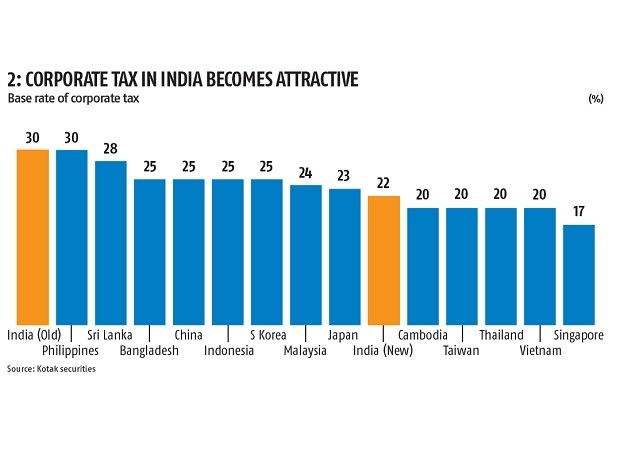
    • The present cut in taxes can make India more competitive on the global stage by making Indian corporate tax rates comparable to that of rates in East Asia.
    • The tax cut, however, is expected to cause a yearly revenue loss of ₹1.45 lakh crore to the government which is struggling to meet its fiscal deficit target.
    • At the same time, if it manages to sufficiently revive the economy, the present tax cut can help boost tax collections and compensate for the loss of revenue.

    I. Relief to big companies

    • Big companies got a relief of close to 10 percentage points in the effective tax rate including cess and surcharge.

    II. Enhanced competitiveness

    • India was earlier at disadvantage because of a couple of factors and on top of it was the high corporate tax rate.
    • After this cut, base corporate tax rate in India has become competitive and should help boost investment.
    • This reduction was a long-pending demand of Indian firms. India is likely to attract investors looking to move out of China.

    III. Enhanced EoDB

    • Singapore with 17 per cent tax rate, and Vietnam, Thailand, Cambodia and Taiwan with 20 per cent base tax rates are the only countries offering lower rates than India
    • India is now much better than China in terms of rate, transparency, and tax administration so companies can now look at India for setting up new units.

    Criticisms of the move

    • Some see the present tax cut simply as a concession to corporate houses rather than as a structural reform that could boost the wider economy.
    • They believe that the current economic slowdown is due to the problem of insufficient demand which cannot be addressed just through tax cuts and instead advocate greater government spending to boost the economy.
    • Others, however, argue that lackluster demand faced by sectors like automobiles is merely a symptom of supply-side shocks such as the GST that have affected various businesses and caused job losses.
    • If so, tax cuts and other supply-side reforms can indeed help the economy recover from its slump.
    • Towards deficit

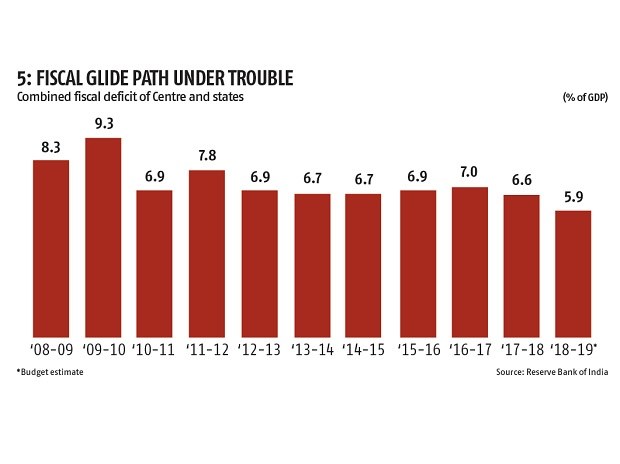
    • The lower tax collection could affect the government’s fiscal glide path.
    • With a minor blip in 2016-17, combined fiscal deficit of Centre and states was nearing the 6 per cent of GDP target.
    • A hole of 0.7 per cent of GDP due to tax cuts could compel them to borrow more, and disturb the bond market.

    Way Ahead

    • Investor confidence in the past, it is worth noting, has been affected by retrospective changes to the law made by governments in the past.
    • The government will need to enact along with these tax cuts other structural reforms that reduce entry barriers in the economy and make the marketplace more competitive.
    • The government could, for instance, extend the tax cuts to smaller businesses.
    • The benefits of the present tax cut will also depend on whether the government sticks to its promises in the long run.


    References

    https://cleartax.in/s/corporate-tax

    https://economictimes.indiatimes.com/definition/corporation-tax

    https://www.thehindu.com/business/Economy/the-hindu-explains-what-corporate-tax-cut-means-for-the-indian-economy/article29470498.ece

    https://www.bloombergquint.com/business/corporate-tax-cuts-assessing-the-multiplier-impact-on-economic-growth

    https://timesofindia.indiatimes.com/business/india-business/corporate-tax-cut-makes-india-an-investment-destination-to-attract-foreign-firms-to-set-up-units-finance-minister/articleshow/71246730.cms

    https://www.livemint.com/opinion/columns/opinion-the-fm-should-extend-the-tax-nudge-to-personal-income-tax-too-1568982792517.html

  • [Video Analysis + Top 10 Ranks] 23 September 2019 | Prelims Daily with Rakesh Sir

    Dear students,

    Here’s a link to the Prelims Daily Quiz Analysis Video. Watch this after you have attempted that day’s Prelims Daily questions [on this link]

    The full playlist is available here [click2watch]

    [WpProQuiz_toplist 244]

    We need your comments, likes, and shares on these videos. The aim of this series is to help you revise news via questions. PLEASE spread the videos.

    What’s wrong with the student’s study habits?

    Only 5% of our students who read news attempt PD. This beats the purpose of reading the news. Even those 5% who attempt PD are unable to get the most out of the initiative. They are either guessing or doing the tests just as a routing activity without engaging in it.

    What’s CD doing to maximize your efforts?

    Now, we have moved one step further with the launch of analysis videos of Prelims Daily (PD). These videos will reveal the critical nitty-gritty surrounding every PD question. It is an unfortunate reality that no single question can be framed to cover all the possible angles.

    The analysis videos will plug this hitherto inevitable gap, thereby making your preparation more methodical, holistic and foolproof. Nothing can be more valuable than experience, and that is precisely what the PD initiative and the analysis videos offer. These will be valuable for both newcomers and senior players in the field.

    PS: We want to be 100% certain that the time and energy spent on making these videos is helping you in your UPSC Prelims preparation. So, pls click on the videos, like, share and comment and let us know your thoughts.

  • 24th September 2019 | Daily Answer Writing Enhancement

    ANNOUNCEMENT – There is a change in format. Students will now have to post answers on the questions page separately by clicking on the links given below. We plan to track progress for each of the GS papers and to achieve the same, this modification becomes important. Students who are unable to post answers, please email hello@civilsdaily.com. You will receive a resolution for sure. 


    Question 1)

    Any single idea of the country is neither necessary nor sufficient for maintaining the unity of India. Comment. (250 Words)


    Question 2)

     Discuss the challenges to the effectiveness of the Paris Climate agreement? (250 Words)

    Question 3)

    Why do you think laws fail beyond a point? Discuss the relevance of ‘nudge’ to bring effective implementation of laws and programs. (250 Words)

    Question 4)

    Albert Einstein has said – “try not to become a man of success, but rather try to become a man of value.” Discuss this statement with its relevance in the present context. (250 Words)

    Reviews will be provided in a week for. (In the order of submission- First come first serve basis). In case the answer is submitted late the review period may get extended to two weeks.

    *In case your answer is not reviewed in a week, reply to your answer saying *NOT CHECKED*. If Parth Sir’s tag is available then tag him.

    For the philosophy of AWE and payment, check  here: Click2Join

  • Civilsdaily’s Faculty’s article published in Indian express. A must-read for Civil Services Aspirants.

    Join Economic Survey and Budget 2019 | Advanced Program Click here

    Join Demystifying Economics- Core & Current Affairs Buildup Lecture Series 2020  Click here

    2020 – Mains Essentials Program . Click here to enrol now! 

    Prime Prelims TS 2020 Barch 3 Time Table

    Click here to Enroll for the Samachar Manthan Yearly 2019-2020

    Economics is one of the primary Pillars of UPSC preparation. It has substantial weightage in Prelims and also in  GS 3rd paper of mains. To ensure that students build  a strong foundation and  a strong hold over the subject, we at Civilsdaily, have the best and most trusted faculty, Himanshu Arora Sir.

    Credentials of Himanshu Sir-

    • MPhil Economics (JNU)
    • Works at Prime Minister Economic Advisory Council
    • Writes regularly in various famous Indian and international weeklies like Millenium post and Huffington Post.
    • Worked as Assistant Professor in Delhi University.

    Here is the article by Himanshu Sir  that was published today in  Financial express

    https://www.financialexpress.com/opinion/big-bank-theory-psu-banks-merger-must-be-followed-by-good-governance/1714342/

    Big Bank Theory: PSU banks merger must be followed by good governance

    By Himanshu Arora

    The government has unveiled a mega plan to merge 10 public sector banks (PSBs) into four, thereby reducing the number of state-owned banks from 18 to 12.

    Under the consolidation process, the Oriental Bank of Commerce and the United Bank of India will be merged in the Punjab National Bank; the Syndicate Bank with the Canara bank; the Andhra Bank and the Corporation Bank with the Union Bank of India; and the Allahabad Bank with the Indian Bank. The aim is to create next-generation financial institutions with stronger balance sheets and bigger lending appetite.

    The proposal to merge poorly-managed banks with well-governed ones has been recommended by numerous committees since the 1990s. A committee under the chairmanship of M Narasimhan recommended the number of PSBs be reduced and 3-4 large banks should be developed as international banks. The report envisaged a three-tier system with 3-4 large banks at the top, 8-10 banks having nationwide presence catering to the needs of industrial and infrastructural sectors, and a large number of regional rural and local banks focusing on agriculture and rural sector.

    Experts believe that reducing the number of state-owned banks will improve the collective performance of the banking system. It will bring economies of scale through optimal use of capital and resources, and ensure higher technical efficiency with higher profitability. The additional resources can be used in hiring domain experts and enhancing manpower, the absence of which is partly responsible for the NPA crisis. The logic being that bigger and well-managed banks are better equipped to respond to the lobg-term finance needs of industrial and infrastructure sectors. Further, PSBs—under stress due to NPAs—would find themselves adequately capitalised. This is expected to aid the banking sector in restart the lending exercise to the productive sectors.

    The next logical step should be to find the right experts who can steer this consolidation—a move that requires a slew of reforms. Governance of PSBs has been a major challenge from the time these banks were nationalised. The Narasimhan committee recommended that banking boards be empowered and adopt a professional corporate strategy.

    The problems of PSBs are structural. The merged banks may fail if governance structures are not reformed. This must be addressed. Accordingly, post-merger, the focus should be on effective governance reforms. The roadmap has been provided by the PJ Nayak committee—legal changes to incorporate banks under the Companies Act and the repeal of bank nationalisation Acts, dissolution of government ownership, and setting up of a Bank Investment Company (BIC). The BIC will act as a safety valve and an institutional firewall between the government and bank managements. The process of appointments to top management needs to be professionalised initially through an interim Banks Board Bureau (BBB), and latter through the BIC. BBB was set up, with a mandate to recommend candidates for top-post in state-banks; effectiveness is debatable.

    Another issue with the proposed merger is the possible creation of what is known as systematically important institutions, which are too big to fail. Indeed, the State Bank of India was categorised by RBI as a systemically important bank whose failure could trigger a situation of bank runs. If such large banks were to fail due to governance issues, it could impact the economy and bring down the whole financial sector. A similar situation was witnessed during the Global Financial Crisis following the collapse of Lehman Brothers in 2008, and no country can therefore afford the failure of a big bank. Historical evidence suggests that if such a situation were to arise, the sovereign will be forced to rescue such large banks. The sovereign guarantees at many times encourage reckless behaviour by banks and creates the problem of moral hazard. Therefore, governance reforms along with effective regulation are essential to curb such moral hazard behaviour. It would require RBI to identify systemically important financial institutions from the merged banks and subject them to higher capital requirements.

    The proposed merger is a good starting point for reforming the Indian banking system, but must be followed by genuine governance reforms.

     

  • Why Grit Is More Important Than IQ When You’re Trying To Crack UPSC?

    Why Grit Is More Important Than IQ When You’re Trying To Crack UPSC?

    “Your Dreams are on the Other Side of Your Grit.”

    If there is just one takeaway which we want you to remember long after you have closed this blog, it is these two equations:

    Talent x Effort = Skill

    Skill x Effort = Achievement

    According to psychologist Angela Duckworth, the secret to outstanding achievement isn’t talent. Instead, it’s a special blend of persistence and passion that she calls “grit.”

    Duckworth has spent years studying people, trying to understand what it is that makes high achievers so successful. And what she found surprised even her. It wasn’t IQ scores. It wasn’t even a degree from a top-ranking engineering or medical school that turned out to be the best predictor of success.

    “It was this combination of passion and perseverance that made high achievers special,” Duckworth said. “In a word, they had grit.”

    GRIT.

    That’s all you need to focus as you fine tune your UPSC prep.

    Being gritty, according to Duckworth, is the ability to persevere, and more! It’s about being unusually resilient and hardworking, so much so that you’re willing to continue on in the face of difficulties, obstacles and even failures. It’s about being constantly driven to improve.

    <Add something which implies why talent alone/skill alone, don’t cut it>

    Back to the two equations now which she uses to explain this concept:

    • Talent x effort = skill

    • Skill x effort = achievement

    Talent is how quickly your skills improve when you invest effort. Achievement is what happens when you take your acquired skills and use them.

    As you can see from the equations, effort counts twice. YOUR Perseverance at the face of difficulty Counts TWICE.

    What’s the practical takeaway?

    1. Sign up for the test series. Make a commitment that no matter what, you will face your scores and improve on them till you gain the mastery.

    2. It means that it’s OK if you aren’t the smartest person in the room or the smartest person on the UPSC prep to begin with. Make sure that the 34 tests you give in the Prime Prelims Program, all point towards an increasing growth curve.

    Our mentors will be with you at every step. We know this is not the most glamorous exercise and many of you will tend to avoid this. That’s where our specially designed courses come in.

    That’s where we egg you to be a better version of yourself. Every week.

    Why? Because grit will always trump talent. Or as Duckworth notes, “Our potential is one thing. What we do with it is quite another.”

    We at Civilsdaily are committed to helping you in the process of figuring out your learning personalities and creating the best time table and suggesting most relevant strategies for your IAS Prep. Please take 5 minutes to fill up this Samanvaya Form. We will arrange a mentor call for you once this is done.

  • 23rd September 2019 | Daily Answer Writing Enhancement

    ANNOUNCEMENT – There is a change in format. Students will now have to post answers on the questions page separately by clicking on the links given below. We plan to track progress for each of the GS papers and to achieve the same, this modification becomes important. Students who are unable to post answers, please email hello@civilsdaily.com. You will receive a resolution for sure. 


    Question 1)

    Neither price support alone nor income support alone will alleviate the problems being faced by Indian Farmers. India needs both price and income support for farmers. Comment? (250 Words)


    Question 2)

    Discuss the relevance of the idea of a Parliamentary Budget Office for India. (250 Words)

    Question 3)

     What are the challenges delaying India’s accession into the RCEP? What should the future negotiations on the deal keep in consideration, for India? (250 Words)

    Question 4)

    It is essential to inculcate moral values in children from early stages itself in order to build a peaceful and prosperous society. In this regard, discuss what values should be emphasised upon while teaching morals to children? (250 words)

    Reviews will be provided in a week for. (In the order of submission- First come first serve basis). In case the answer is submitted late the review period may get extended to two weeks.

    *In case your answer is not reviewed in a week, reply to your answer saying *NOT CHECKED*. If Parth Sir’s tag is available then tag him.

    For the philosophy of AWE and payment, check  here: Click2Join

  • [Video Analysis + Top 10 Ranks] 21 September 2019 | Prelims Daily with Rakesh Sir

    Dear students,

    Here’s a link to the Prelims Daily Quiz Analysis Video. Watch this after you have attempted that day’s Prelims Daily questions [on this link]

    The full playlist is available here [click2watch]

    [WpProQuiz_toplist 243]

    We need your comments, likes, and shares on these videos. The aim of this series is to help you revise news via questions. PLEASE spread the videos.

    What’s wrong with the student’s study habits?

    Only 5% of our students who read news attempt PD. This beats the purpose of reading the news. Even those 5% who attempt PD are unable to get the most out of the initiative. They are either guessing or doing the tests just as a routing activity without engaging in it.

    What’s CD doing to maximize your efforts?

    Now, we have moved one step further with the launch of analysis videos of Prelims Daily (PD). These videos will reveal the critical nitty-gritty surrounding every PD question. It is an unfortunate reality that no single question can be framed to cover all the possible angles.

    The analysis videos will plug this hitherto inevitable gap, thereby making your preparation more methodical, holistic and foolproof. Nothing can be more valuable than experience, and that is precisely what the PD initiative and the analysis videos offer. These will be valuable for both newcomers and senior players in the field.

    PS: We want to be 100% certain that the time and energy spent on making these videos is helping you in your UPSC Prelims preparation. So, pls click on the videos, like, share and comment and let us know your thoughts.