💥Join UPSC 2027,2028 Mentorship (July Batch) + XFactor Notes & Microthemes PDF

Search results for: “”

  • UPSC Civil Services Mains 2019 GS 4 Question Paper

    Dear Students,

    We will be releasing the list of repeated questions from our test series shortly. The paper seemed somewhat straightforward. Many questions were derived from current affairs.

    Click here to get in touch and discuss how you can get an edge in your preparation. 


    There are Twelve Questions divided in 2 SectionsAll Questions are Compulsory.


    SECTION A

    Q1.

    (a) What are the basic principles of public life? Illustrate any three with suitable examples. (150 words) (10 marks)

    (b) What do you understand by the term ‘public servant’? Reflect on the expected role of public servant.  (150 words) (10 marks)

    Q2.

    (a) Effective utilization of public finds is crucial to meet development goals. Critically examine the reasons for under- utilization and mis- utilization of public funds and their implications. (150 words) (10 marks)

    (b) “Non-performance of duty by a public servant is a form of corruption”. Do you agree with this view? Justify your answer (150 words) (10 marks)

    Q3.

    (a) What is meant by the term ‘constitutional morality’? How does one uphold constitutional morality? (150 words) (10 marks)

    (b) What is meant by ‘crisis of conscience’? How does it manifest in the public domain? (150 words) (10 marks)

    Q4.

    (a) Explain the basic principles of citizens’ charter movement and bring out its importance. (150 words) (10 marks)

    (b) There is a view that the official secrets act is an obstacle to the implementation of Rights to Information act. Do you agree with the view? Discuss (150 words) (10 marks)

    Q5.

    (a) What do you understand by probity in governance? Based on your understanding of the term, suggest measures for ensuring probity in government. (150 words) (10 marks)

    (b) “Emotional Intelligence is the ability to make your emotions work for you instead of against you.” Do you agree with this view? Discuss. (150 words) (10 marks)

    Q6. What do each of the following quotations mean to you?

    (a) “An unexamined life is not worth living.” – Socrates (150 words) (10 marks)

    (b) “A man is but the product of his thoughts. What he thinks, he becomes.” – M.K.Gandhi (150 words) (10 marks)

    (c) “Where there is righteousness in the heart, there is beauty in the character. When there is beauty in the character, there is harmony in the home. When there is harmony in the home, there is order in the nation. When there is order in the nation, there is peace in the world.” – A.P.J. Abdul Kalam (150 words) (10 marks)


    SECTION B: Case studies 

    Q7. You are the heading the rescue operations in a area affected by severe natural calamity, thousands of people are rendered homeless and deprived of food, drinking water and other basic amenities. Rescue work has been disrupted by heavy rainfall and damaged to supply routes. The local people are seeding with anger against the delayed limited rescue operations. When your team reaches the affected area, the people there heckle and even assault some of the team members. One of your team member is even severely injured. Faced with this crisis some team member plead with you to call off the operations freeing threats to their life.

    In such trying circumstances, what will be your response? Examine the qualities of a public servant which will be required to manage the situations. (250 words) (20 marks)


    Q8. Honesty and uprightness are the hallmarks of a civil servants. Civil servants possessing these qualities are considered as a back bone of any strong organizations. In line of duty, they take various decisions, at time some become bonafide mistakes. As long as such decisions, are not taken intentionally and do not benefit personally, the officer cannot be said to be guilty. Though such decisions may, at times, lead to unforeseen adverse consequences in the long term.

    In the recent past, a few instances have surfaced where in civil servants has been implicated for bonafide mistakes. They have often been prosecuted and even imprisoned. These instances have greatly rattled the moral fiber of the civil servants.

    How does this trend affect the functioning of civil services? What measures can be taken to ensure that honest civil servants are not implicated for bonafide mistakes on their part? Justify your answer. (250 words) (20 marks)


    Q9. An apparel manufacturing company having large number of women employees was losing sales due to various factors. The company hired a reputed marketing executive, who increased the volume of sales within a short span of time. However, some unconfirmed reports came up regarding his indulgence in sexual harassment at the work place.

     After sometime a women employee launched a formal complaint to the management against the marketing executive about sexually harassing her. Faced with the companies’ indifference, in not taking cognisance of her grievances, she lodged an FIR with police.

     Realizing the sensitivity and gravity of the situation, the company called the women employee to negotiate. In that she was offered a hefty sum of money to withdraw the complaint and the FIR and also give in writing that the marketing executive is not involved in the case.

    Identify the ethical issues involved in this case. What options are available to the women employee? (250 words) (20 marks)


    Q10. In a modern democratic polity there is a concept of political executive and permanent executive elected people’s representatives forms the political executive and bureaucracy forms the permanent executive. Ministers frame policy decisions and bureaucrats execute these. In the initial decades after independence, relationship between the permanent executives and the political executives were characterized by mutual understanding, respect, and cooperation, without encroaching upon each other’s domain.

    However, in the subsequent decades the situation has changed. There are instances of the political executive insisting upon the permanent executives to follow its agenda. Respect for an appreciation of an upright bureaucrats has declined. There is an increasing tendency among the political executive to get involved in routine administrative matters such as transfers, posting etc. Under this scenario, there is a definitive trend towards ‘politicization of bureaucracy’. The raising materialism and acquisitiveness in social life has also adversely impacted upon the ethical values of both the permanent executive and the political executive.

    What are the consequences of this ‘politicization of bureaucracy? Discuss.  (250 words) (20 marks)


    Q11. In one of the districts of a frontier state, narcotics menace has been rampant. This has results in money laundering, mushrooming of poppy farming, arms smuggling and near stalling of education. The system is on the verge of collapse. The situation has been further worsened by unconfirmed reports that local politicians as well as some senior police officers are providing surreptitious patronage to the drug mafia. At that point of time a woman police officer, known for her skills in handling such situations is appointed as superintendent of police to bring the situation to normalcy.

    If you are the same police officer, identify the various dimensions of the crisis. Based on your understanding, suggest measures to deal with the crisis. (250 words) (20 marks)


    Q12. In recent times, there has been an increasing concern in India to develop effective civil service ethics, code of conduct, transparency measures, ethics and integrity systems and anti-corruption agencies. In view of this, there is need being felt to focus on three specific areas, which are directly relevant to the problems of internalizing integrity and ethics in the civil services. These are as follows:

    1. Anticipating specific threats to ethical standards and integrity in the civil services,

    2. Strengthening the ethical competence of civil servant and

    3. Developing administrative processes and practices which promote ethical values and integrity in civil services.

    Suggest institutional measures to address the above three issues. (250 words) (20 marks)


  • [Video Analysis + Top 10 Ranks] 20 September 2019 | Prelims Daily with Rakesh Sir

    Dear students,

    Here’s a link to the Prelims Daily Quiz Analysis Video. Watch this after you have attempted that day’s Prelims Daily questions [on this link]

    The full playlist is available here [click2watch]

    [WpProQuiz_toplist 241]

    We need your comments, likes, and shares on these videos. The aim of this series is to help you revise news via questions. PLEASE spread the videos.

    What’s wrong with the student’s study habits?

    Only 5% of our students who read news attempt PD. This beats the purpose of reading the news. Even those 5% who attempt PD are unable to get the most out of the initiative. They are either guessing or doing the tests just as a routing activity without engaging in it.

    What’s CD doing to maximize your efforts?

    Now, we have moved one step further with the launch of analysis videos of Prelims Daily (PD). These videos will reveal the critical nitty-gritty surrounding every PD question. It is an unfortunate reality that no single question can be framed to cover all the possible angles.

    The analysis videos will plug this hitherto inevitable gap, thereby making your preparation more methodical, holistic and foolproof. Nothing can be more valuable than experience, and that is precisely what the PD initiative and the analysis videos offer. These will be valuable for both newcomers and senior players in the field.

    PS: We want to be 100% certain that the time and energy spent on making these videos is helping you in your UPSC Prelims preparation. So, pls click on the videos, like, share and comment and let us know your thoughts.

  • UPSC Civil Services Mains 2019 GS 2 Question Paper

    Students,

    Go ahead and let us know the innovations possible in these questions !

    We will be out with solutions soon.


    There are TWENTY questions. Answers to questions no. 1 to 10 should be in 150 words, whereas answers to questions no. 11 to 20 should be in 250 words.

    Q1. Do you think Constitution of India does not accept principle of strict separation of powers rather it is based on the principle of ‘checks and balance’? Explain. (10 Marks)

    Q2. “The Central Administrative Tribunal which was established for redressal of grievances and complaints by or against central government employees, nowadays is exercising its powers as an independent judicial authority.” Explain. (10 Marks)     

    Q3. What are the methods used by the farmer’s organizations to influence the policy-makers in India and how effective are these methods? (10 Marks)

    Q4. From the resolution of contentious issues regarding distribution of legislative powers by the courts, ‘Principle of Federal Supremacy’ and ‘Harmonious Construction’ have emerged. Explain. (10 Marks)

    Q5. What can France learn from the Indian Constitution’s approach to secularism? (10 Marks)

    Q6. Despite Consistent experience of high growth, India still goes with the lowest indicators of human development. Examine the issues that make balanced and inclusive development elusive. (10 Marks)  

    Q7. There is a growing divergence in the relationship between poverty and hunger in India. The shrinking of social expenditure by the government is forcing the poor to spend more on non-food essential items squeezing their food-budget – Elucidate. (10 marks)

     Q8. Implementation of Information and Communication technology (ICT) based projects/programmes usually suffers in terms of certain vital factors. Identify these factors and suggest measures for their effective implementation. (10 marks)

     Q9. ‘The time has come for India and Japan to build a strong contemporary relationship, one involving global and strategic partnership that will have a great significance for Asia and the world as a whole.’ Comment. (10 marks)

     Q10. ‘Too little cash, too much politics, leaves UNESCO fighting for life.’ Discuss the statement in the light of US’ withdrawal and its accusation of the cultural body as being ‘anti-Israel bias’. (10 marks)

     Q11. On what grounds a people’s representative can be disqualified under the representation of people act, 1951? Also mention the remedies available to such person against his disqualification. (15 marks)

     Q12. “Parliament’s power to amend the constitution is a limited power and it cannot be enlarged into absolute power”. In the light of this statement explain whether parliament under article 368 of the constitution can destroy the Basic structure of the constitution by expanding its amending power? (15 marks)

     Q13. “The reservation of seats for women in the institution of local self-government has had a limited impact on the patriarchal character of the Indian political process”. Comment. (15 marks)

    Q14. “The Attorney-General is the chief legal adviser and lawyer of the Government of India.” Discuss  (15 Marks)

    Q15. Individual parliamentarian’s role as the national law maker is on a decline, which in turn, has adversely impacted the quality of debates and their outcome. Discuss. (15 marks)

    Q16. ‘In the context of neo-liberal paradigm of developmental planning, multi-level planning is expected to make operations cost-effective and remove many implementation blockages’- Discuss (15 marks)

    Q17. The need for cooperation among various service sectors has been an inherent component of development discourse. Partnership bridges the gap among the sectors. It also sets in motion a culture of ‘collaboration’ and ‘team spirit’. In the light of statements above examine India’s development process. (15 marks)

    Q18. Performance of welfare schemes that are implemented for vulnerable sections is not so effective due to absence of their awareness and active involvement at all stages of policy process. Discuss (15 marks)

    Q19. “The long sustained image of India as a leader of the oppressed and marginalised nations has disappeared on account of its new found role in the emerging global order.’ Elaborate (15 Marks)

    Q20. What introduces friction into the ties between India and United States is that Washington is still unable to find for India a position in its global strategy, which would satisfy India’s national self-esteem and ambitions’. Explain with suitable examples. (15 Marks)


  • [Video Analysis + Top 10 Ranks] 19 September 2019 | Prelims Daily with Rakesh Sir

    Dear students,

    Here’s a link to the Prelims Daily Quiz Analysis Video. Watch this after you have attempted that day’s Prelims Daily questions [on this link]

    The full playlist is available here [click2watch]

    [WpProQuiz_toplist 240]

    We need your comments, likes, and shares on these videos. The aim of this series is to help you revise news via questions. PLEASE spread the videos.

    What’s wrong with the student’s study habits?

    Only 5% of our students who read news attempt PD. This beats the purpose of reading the news. Even those 5% who attempt PD are unable to get the most out of the initiative. They are either guessing or doing the tests just as a routing activity without engaging in it.

    What’s CD doing to maximize your efforts?

    Now, we have moved one step further with the launch of analysis videos of Prelims Daily (PD). These videos will reveal the critical nitty-gritty surrounding every PD question. It is an unfortunate reality that no single question can be framed to cover all the possible angles.

    The analysis videos will plug this hitherto inevitable gap, thereby making your preparation more methodical, holistic and foolproof. Nothing can be more valuable than experience, and that is precisely what the PD initiative and the analysis videos offer. These will be valuable for both newcomers and senior players in the field.

    PS: We want to be 100% certain that the time and energy spent on making these videos is helping you in your UPSC Prelims preparation. So, pls click on the videos, like, share and comment and let us know your thoughts.

  • UPSC Civil Services Mains 2019 Essay Question Paper

    2019 CSM Essay Paper


    SECTION A

    • 1. Wisdom finds truth
    • 2. Values are not what humanity is, but what humanity ought to be
    • 3. Best for an individual is not necessarily best for the society
    • 4. Courage to accept and dedication to improve are two keys to success


    SECTION B

    • 5. South Asian societies are woven not around the state, but around their plural cultures and plural identities
    • 6. Neglect of primary health care and education in India are reasons for its backwardness
    • 7. Biased media is a real threat to Indian democracy
    • 8. Rise of Artificial Intelligence: the threat of jobless future or better job opportunities through reskilling and upskilling
  • [Burning Issue] India’s Space Programme


    Introduction

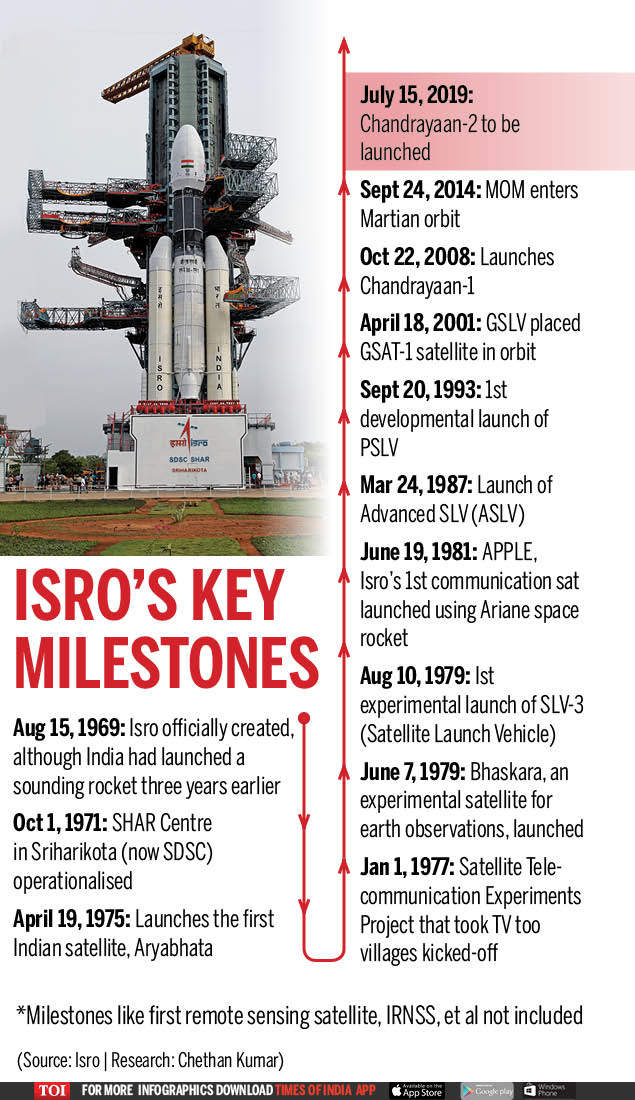
    • Modern space research in India is traced to the 1920s, when scientist S. K. Mitra conducted a series of experiments leading to the sounding of the ionosphere by applying ground-based radio methods in Kolkata.
    • Later, Indian scientists like C.V. Raman and Meghnad Saha contributed to scientific principles applicable in space sciences.
    • However, it was the period after 1945 that saw important developments being made in coordinated space research in India.
    • Organized space research in India was spearheaded by two scientists: Vikram Sarabhai—founder of the Physical Research Laboratory at Ahmedabad—and Homi Bhabha, who established the Tata Institute of Fundamental Research in 1945.

    Vision

    • The Indian space program is driven by the vision of Vikram Sarabhai, considered the father of the Indian space program.
    • Throughout the years, ISRO has upheld its mission of bringing space to the service of the common man, to the service of the Nation.
    • In the process, it has become one of the six largest space agencies in the world.

    Making of ISRO

    • India’s space program began with a vision to harness space technology for national development while pursuing space science research and planetary exploration
    • In this view, the Indian National Committee for Space Research (INCOSPAR) was established in the tenure of PM Nehru under the Department of Atomic Energy (DAE) in 1962.
    • INCOSPAR grew and became ISRO in 1969, also under the DAE. This was done keeping in view the urge of scientist Vikram Sarabhai recognizing the need in space research.
    • In 1972, GoI set up a Space Commission and the Department of Space (DOS) bringing ISRO under the DOS.
    • The establishment of ISRO thus institutionalized space research activities in India. It is managed by the DOS, which reports to the PM of India.

    Applications of India’s space asset

    India’s space mission can be broadly categorized into the following categories:

    1. Launch vehicle fleet like PSLV, GSLV etc,
    2. Satellite programs ex. INSAT,
    3. Satellite Navigation program ex. IRNSSS and NAVIC
    4. Extraterrestrial exploration like Chandrayaan, Mars Orbiter Mission
    5. Human Spaceflight Programme viz. Gaganyaan

    Telecommunication

    • India uses its satellite communication network – one of the largest in the world – for applications such as land management, water resources management, natural disaster forecasting, radio networking, weather forecasting, etc.
    • Business, administrative services, and schemes such as the National Informatics Centre (NIC) are direct beneficiaries of applied satellite technology

    Military

    • Integrated Space Cell, under the Integrated Defence Staff of the Ministry of Defence, has been set up to utilize more effectively the country’s space-based assets for military purposes and to look into threats to these assets.
    • This command leverages space technology including satellites.

    Telemedicine

    • ISRO has applied its technology for telemedicine, directly connecting patients in rural areas to medical professionals in urban locations via satellites.
    • Since high-quality healthcare is not universally available in some of the remote areas of India, the patients in remote areas are diagnosed and analyzed by doctors in urban centers in real-time via video conferencing.

    Biodiversity Information System

    • ISRO has also helped implement India’s Biodiversity Information System, completed in October 2002.
    • Based on intensive field sampling and mapping using satellite remote sensing and geospatial modeling tools, maps have been made of vegetation cover on a 1: 250,000 scale.

    Significant feats

    Disaster Management Support (DMS)

    • ISRO’s technologies and applications have always proved useful during natural calamities.
    • In 2016, ISRO’s support on this front was significant during the Uttarakhand Forest Fires and floods in the north-eastern states of Manipur and Assam.

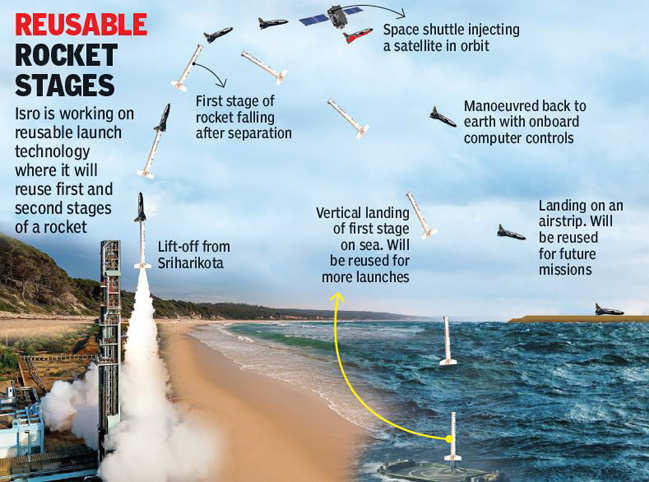
    Reusable Launch Vehicle – Technology Demonstrator (RLV-TD)

    • RLV-TD was successfully flight-tested on May 23, 2016.
    • Critical technologies such as reusable thermal protection system, re-entry mission management, guidance & control along with autonomous navigation were tested during the flight.

    Launch of Cartosat series

    • On June 22, 2016, ISRO put into orbit, India’s Cartosat (Cartosat-2C) earth observation satellite along with 19 other satellites using Polar Satellite Launch Vehicle (PSLV-C34) in a single mission.
    • Cartosat series of satellites will be used for various strategic and civilian applications. It includes Geographical Information System (GIS), Land Information System (LIS), utility management and precision studies.
    • The satellite which has been called ‘India’s eyes in the sky’ by experts due to its high surveillance and monitoring capabilities will assist the other military satellites in the Cartosat series.

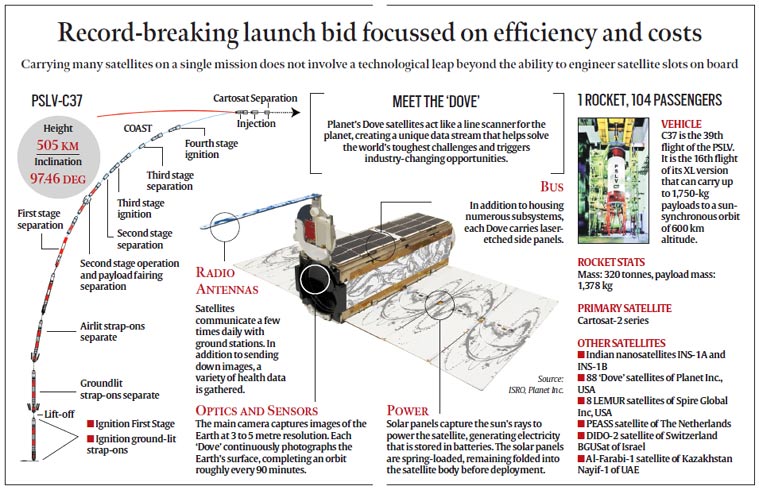
    104 satellites launch

    • India created history by successfully launching 104 satellites on a single mission, overtaking the previous record of 37 satellites launched by Russia in 2014.
    • PSLV-C37 successfully carried and deployed a record of 104 satellites in sun-synchronous orbits.

    Towards Scramjet Engine Technology

    • On August 28, 2016, ISRO successfully conducted its first experimental mission of the Scramjet Engine at SDSRC, Sriharikota.
    • The flight testing of the Scramjet Engine made India the fourth country to demonstrate such capabilities.
    • The technology is expected to radically change the future space transportation systems by ISRO.
    • A fully functional Scramjet Engine is expected to reduce the launch costs by half and minimize the chance of engine failure.

    Important missions

    I. Mars Orbiter Mission (MOM)

    • The Mars Orbiter Mission (MOM) – launched on November 05, 2013 and successfully inserted into Mars orbit on September 24, 2014, has various achievements to its credit.
    • It is the first interplanetary mission realized by India and the first Indian spacecraft to incorporate full-scale onboard autonomy to overcome the long distances and the communication gaps due to non-visibility periods.
    • Marking India’s first venture into the interplanetary space, MOM will explore and observe Mars surface features, morphology, mineralogy and the Martian atmosphere.
    • Further, a specific search for methane in the Martian atmosphere will provide information about the possibility or the past existence of life on the planet.

    II. Chandrayaan Mission

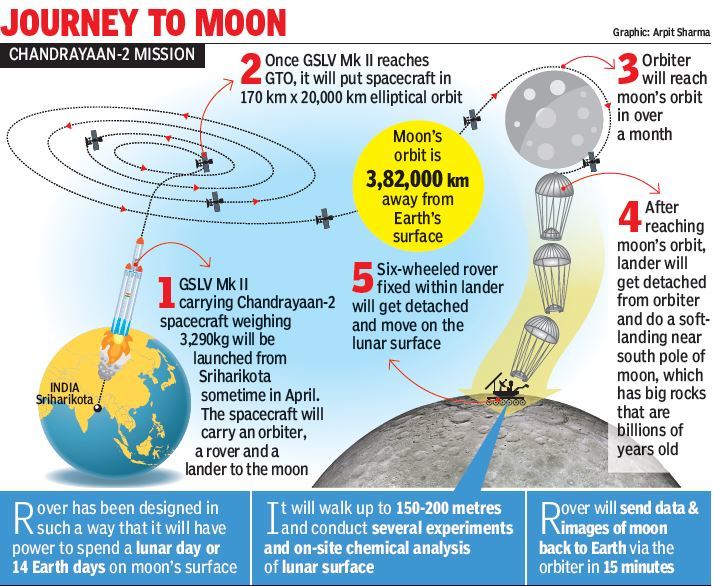
    • Chandrayaan Mission-I in 2008 – discovered the presence of water on the surface of the Moon and turned a new chapter in the world’s understanding of Moon.
    • Chandrayaan-2 which consisted of an Orbiter, Lander and Rover, was all equipped with scientific instruments to study the moon.
    • However, a part of the mission failed as the Vikram lander crash-landed on the lunar surface.

    III. Solar Mission

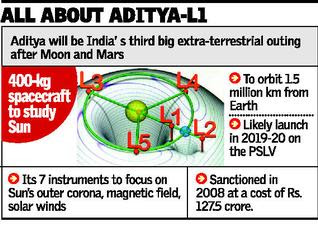
    • Aditya-L1 is India’s first dedicated scientific mission to study the sun.
    • It is meant to observe only the solar corona- the outer layers of the Sun, extending to thousands of km above the disc (photosphere).

    IV. Gaganyaan Mission

    • The human spaceflight program will provide a unique micro-gravity platform in space for conducting experiments and testbed for future technologies.
    • The program is expected to give impetus to economic activities within the country in terms of employment generation, human resource development, and enhanced industrial capabilities.
    • Human Spaceflight capability will enable India to participate as a collaborating partner in future Global space exploration initiatives with long term national benefits.

    Developments so far

    • ISRO has completed the development of launch vehicle GSLV Mk-III which has the necessary payload capability to launch a 3-member crew module in low earth orbit.
    • It has also tested the crew escape system which is an essential technology for human space flight.
    • Elements of the life support system and Space suit also have been realized and tested.
    • In addition, the orbital & re-entry mission and recovery operations have been flight demonstrated in Space Capsule Re-entry experiment (SRE) mission.

    VI. Building own Space station

    • India plans to build a space station as a follow-up programme of the Gaganyaan mission.
    • ISRO chairman K. Sivan has said that India will not join the International Space Station program and will instead build a 20-tonne space station on its own.

    Criticisms of Space Programmes

    • For long, India is known to be making investments in the space arena for social, scientific and security purposes. However many fundamentalists see investment in space as a waste of money.
    • All previous missions of ISRO are about race for planetary resources. Unfortunately, it has not planned for any missions to asteroids, an ideal bed for mineral mining.
    • After Chandrayaan 2 failure there is a danger that future ambitious missions could also end up only as a ‘feel-good program’ with Gaganyaan coming ahead.

    A wise investment

    • Ironically, one of India’s current challenges is the trickling down effect of investments in technology by the ISRO.
    • Many people myopic vision questioned the relevance of space activities in a newly independent nation which was finding it difficult to feed its population.
    • Any space exploration mission undertaken by a developing country like India is likely to prompt the argument that such investments need to be redirected in areas that need immediate intervention (ex. education, health).
    • One of the simplest ways of resolving this debate is to concretely showcase how technologies developed for space missions like Chandrayaan 2 find their way into the daily lives of citizens.
    • However former President APJ Abdul Kalam opined that if Indians were to play a meaningful role in the community of nations, they must be second to none in the application of advanced technologies to their real-life problems.

    Why we must explore?

    • Curiosity and exploration are vital to the human spirit and accepting the challenge of going deeper into space is the way ahead.
    • The intangible desire to explore and challenge the boundaries of what we know and where we have been has provided benefits to our society for centuries.
    • Human space exploration helps to address fundamental questions about our place in the Universe and the history of our solar system.
    • Through addressing the challenges related to human space exploration we expand technology, create new industries, and help to foster a peaceful connection with other nations.

    Way Forward

    • Future readiness is the key to maintaining an edge in technology and ISRO endeavors to optimize and enhance its technologies as the needs and ambitions of the country evolve.
    • Thus, ISRO is moving forward with the development of heavy lift launchers, human spaceflight projects, reusable launch vehicles, semi-cryogenic engines, single and two stage to orbit (SSTO and TSTO) vehicles, development and use of composite materials for space applications, etc.


    References

    https://en.wikipedia.org/wiki/Indian_Space_Research_Organisation#Applications

    http://www.arthapedia.in/index.php?title=Space_Programme_in_India

    https://www.thehindu.com/opinion/lead/expanding-indias-share-in-global-space-economy/article28286469.ece

    https://www.financialexpress.com/lifestyle/science/future-of-space-programme-why-india-needs-to-build-its-own-space-station/1590324/

    https://www.livemint.com/Opinion/jKaufXMBRvrTDZ9oSoH4NL/Isro-A-world-class-Make-in-India-example.html

    https://www.dailyo.in/politics/isro-space-research-chandrayaan-antrix/story/1/25922.html

    https://www.firstpost.com/tech/science/chandrayaan-2-what-isro-must-do-to-make-benefits-of-the-moon-mission-accessible-to-the-common-man-7053791.html

    https://hindustan360.in/the-name-isro-and-global-launch-pad-for-socio-economic-development-hindustan360/

    https://debatewise.org/debates/137-space-exploration-is-a-waste-of-money/#yes2

    https://www.extremetech.com/extreme/268062-5-reasons-space-exploration-is-more-important-than-ever