💥Join UPSC 2027,2028 Mentorship (June Batch) + XFactor Notes & Microthemes PDF

Search results for: “”

  • [Video Analysis + Top 10 Ranks] 20 May 2019 | Prelims Daily with Rakesh Sir

    Dear students,

    Here’s a link to the Prelims Daily Quiz Analysis Video. Watch this after you have attempted that day’s Prelims Daily questions [on this link]

    https://youtu.be/Abcip8u6BA0

    The full playlist is available here [click2watch]

    [WpProQuiz_toplist 134]


    We need your comments, likes, and shares on these videos. The aim of this series is to help you revise news via questions. PLEASE spread the videos.

    What’s wrong with the student’s study habits?

    Only 5% of our students who read news attempt PD. This beats the purpose of reading the news. Even those 5% who attempt PD are unable to get the most out of the initiative. They are either guessing or doing the tests just as a routing activity without engaging in it.

    What’s CD doing to maximize your efforts?

    Now, we have moved one step further with the launch of analysis videos of Prelims Daily (PD). These videos will reveal the critical nitty-gritty surrounding every PD question. It is an unfortunate reality that no single question can be framed to cover all the possible angles.

    The analysis videos will plug this hitherto inevitable gap, thereby making your preparation more methodical, holistic and foolproof. Nothing can be more valuable than experience, and that is precisely what the PD initiative and the analysis videos offer. These will be valuable for both newcomers and senior players in the field.

    PS: We want to be 100% certain that the time and energy spent on making these videos is helping you in your UPSC Prelims preparation. So, pls click on the videos, like, share and comment and let us know your thoughts

  • Last minute tips on how to Maximise your scores in Prelims

    This lecture is meant to help students relax and overcome anxious thoughts.

    Please note down the tips and make sure to practice them.


    https://www.youtube.com/watch?v=Ph59h_BZrzE


    We at Civilsdaily are committed to helping you in the process of figuring out your learning personalities and creating the best time table and suggesting most relevant strategies for your IAS Prep. Please take 5 minutes to fill up this Samanvaya Form. We will arrange a mentor call for you once this is done.

  • AIR 350, AIR 358, AIR 361 – Thanking emails from all !

    Nothing beats the feeling of receiving emails from our students. They will be sharing their strategy and notes very soon. If you have any specific question, please mention them in the comments and those will be specifically answered.

    AIR 361 Abhaysinha Deshmukh

    AIR 350 – Nabal Kumar Jain 


    AIR 358 – Surabhi Agarwal


    We at Civilsdaily are committed to helping you in the process of figuring out your learning personalities and creating the best time table and suggesting most relevant strategies for your IAS Prep. Please take 5 minutes to fill up this Samanvaya Form. We will arrange a mentor call for you once this is done.

  • [Prelims Spotlight] Isro Missions

    1.RISAT-2B: An all-seeing radar imaging satellite

    • he PSLV-C46 is set to launch RISAT-2B from Satish Dhawan Space Centre in Sriharikota.

    RISAT Constellation

    • RISAT-2B, short for “Radar Imaging Satellite-2B”, is the second in a series of satellites used to observe weather conditions on Earth using radar imagery.
    • RISAT-2 was the first satellite in the series, launched for the purpose of surveillance. RISAT-1 was launched later, to become India’s first all-weather radar imaging satellite.
    • RISAT-2B is to be followed by RISAT-2BR1, 2BR2, RISAT-1A, 1B, 2A and so on.
    • ISRO orbited its first two radar satellites in 2009 & 2012 and it plans to deploy four or five of them in 2019 alone.
    • A constellation of such space-based radars means a comprehensive vigil over the country.
    • Once operational, the satellite will be capable of monitoring weather day and night, in all weather conditions.

    2.Phase 4 of Geosynchronous Satellite Launch Vehicle (GSLV)

    • The Union Cabinet has approved ongoing GSLV continuation programme Phase-4 consisting of five GSLV flights during the period 2021-2024.
    • The will enable the launch of 2 tonne class of satellites for Geo-imaging, Navigation, Data Relay Communication and Space Sciences.
    • It will meet the demand for the launch of satellites at a frequency up to two launches per year, with maximal participation by the Indian industry.

    About GSLV

    • GSLV Continuation Programme was initially sanctioned in 2003, and two phases have been completed and the third phase is in progress and expected to be completed by Q4 of 2020-21.
    • GSLV has enabled independent access to space for 2 tonne class of satellites to Geosynchronous Transfer Orbit (GTO).
    • One of the significant outcomes of the GSLV Continuation Programme is the mastering of the highly complex cryogenic propulsion technology, which is an essential technological capability to launch communication satellites to GTO.
    • This has also paved the way for the development of a high thrust Cryogenic engine & stage for the next generation launch vehicle i.e. GSLV Mk-lll.
    • With the recent successful launch of GSLV-F11 on 19th December 2018, GSLV has successfully orbited 10 national satellites.
    • GSLV with the indigenous Cryogenic Upper Stage has established itself as a reliable launch vehicle for communication, navigation and meteorological satellites and also to undertake future interplanetary missions.

    3.Mission Shakti (Anti-Satellite Missile Test)

    • In an incremental advance, India has successfully conducted an Anti-Satellite (ASAT) missile test, named Mission Shakti.
    • India becomes the fourth country in the world to demonstrate the capability to shoot down satellites in orbit.
    • So far, only the United States, Russia and China have this prowess.

    Mission Shakti

    • While Mission Shakti may have targeted an object in outer space, India has long developed the ability to intercept incoming missiles.
    • In 2011, a modified Prithvi missile mimicked the trajectory of a ballistic missile with a 600-km range.
    • The DRDO-developed Ballistic Missile Defence (BMD) Interceptor Missile successfully engaged an Indian orbiting target satellite in Low Earth Orbit (LEO) in a ‘Hit to Kill’ mode.
    • The interceptor missile was a three-stage missile with two solid rocket boosters.

    4.Young Scientist Programme (YUVIKA)

    Young Scientist Programme

    • ISRO has launched a special programme for School Children called “Young Scientist Programme” “YUva VIgyani KAryakram from this year.
    • The Program is primarily aimed at imparting basic knowledge on Space Technology, Space Science and Space Applications to the younger ones with the intent of arousing their interest in the emerging areas of Space activities.
    • The residential training programme will be of around two weeks duration during summer holidays and it is proposed to select 3 students each from each State/ UTs to participate in this programme covering state, CBSE, and ICSE syllabus.
    • Those who have just finished 9th standard (in the academic year 2018-19) and waiting to join 10th standard (or those who have started 10th Std just now) will be eligible for the programme.
    • The selection will be based on the 8th Std marks.
    • Students belonging to the rural area have been given special weightage in the selection criteria.

    5.PSLV-C45/ Emisat Mission

    • For the sheer number of ‘firsts’ to its credit, the scheduled PSLV-C45/Emisat mission scheduled will be a memorable one for the ISRO.

    PSLV-C45/Emisat

    • C-45, which is set for lift-off from the second launchpad at Sriharikota, will mark the 47th flight of the PSLV.
    • It is meant for electromagnetic spectrum measurements, according to the ISRO.
    • It will be released into an orbit at 749 km.
    • EMISAT is primarily based on on the famous Israeli spy satellite called SARAL or (Satellite with ARgos and ALtika), and inherits its SSB-2 bus protocol for conducting sharp electronic surveillance across the length and breadth of India.
    • The satellite would serve as the country’s roving device for detecting and gathering electronic intelligence from enemy radars across the borders as it circles the globe roughly pole to pole every 90 minutes or so.
    • For the third successive PSLV mission, the ISRO plans to reuse the rocket’s spent fourth stage or PS4 to host short experiments.

    6.ISRO, French agency to set up maritime surveillance system

    • ISRO and its French counterpart CNES has sealed an agreement to set up a joint maritime surveillance system in the country.
    • The two nations will explore putting up a constellation of low-Earth orbiting satellites.

    Oceansat-3-Argos Mission

    • The system will be augmented with the launch of Oceansat-3-Argos mission in 2020 along with a joint infrared Earth-observation satellite.
    • These will identify and track movement of ships globally – and in particular those moving in the Indian Ocean region where France has its Reunion Islands.
    • Before that, they will initially share data from their present space systems and develop new algorithms to analyse them, according to the Paris based National Centre for Space Studies.
    • They work together for the design and development of joint products and techniques, including those involving Automatic Identification System (AIS), to monitor and protect the assets in land and sea.

    7. Use of Space Technology in Agriculture Sector

    • The Ministry of Agriculture and Farmers Welfare, has been pro-active in using the space technology in agricultural sector. Take a look of various initiative in the aid of farmers:

    Various institutional measures

    1. The Department of Agriculture, Cooperation and Farmers Welfare established a Centre, called Mahalanobis National Crop Forecast Centre, in 2012.
    2. It works for operationalization of the space technology developed in the Indian Space Research Organization, for crop production forecasting.
    3. The Soil and Land Use Survey of India uses satellite data for soil resources mapping.

    8.India’s communication satellite GSAT-31 launched successfully

    GSAT-31

    1. It was launched in an elliptical Geosynchronous Transfer Orbit with a perigee (nearest point to Earth) of 250 km and an apogee (farthest point to Earth) of 35,850 km, inclined at an angle of 3.0 degree to the equator.
    2. With a lift-off mass of 2536 kg, GSAT-31 will augment the Ku-band transponder capacity in Geostationary Orbit.
    3. The satellite will provide continuity to operational services on some of the in-orbit satellites.
    4. GSAT-31 will provide DTH Television Services, connectivity to VSATs for ATM, Stock-exchange, Digital Satellite News Gathering (DSNG) and e-governance applications.
    5. The satellite will also be used for bulk data transfer for a host of emerging telecommunication applications.
    6. It is the India’s 40th communication satellite which is configured on ISRO’s enhanced ‘I-2K Bus’, utilising the maximum “bus capabilities” of this type.

    9.ISRO launches Human Space Flight Centre in Bengaluru

    Human Space Flight Centre (HSFC)

    1. The HSFC, the hub of ISRO’s future manned missions, was inaugurated at ISRO headquarters in Bengaluru.
    2. Announced on August 15 2018, the country’s first crewed mission is set to happen by 2022, the 75th year of Independence.
    3. HSFC shall be responsible for the implementation of Gaganyaan project — which involves mission planning, development of engineering systems for crew survival in space, crew selection and training and also pursue activities for sustained human space flight missions.
    4. HSFC will take the support of ISRO centres to implement the first developmental [crewed] flight.

    10.ISRO’s first mission of 2019 to put military satellite Microsat-R in space

    • ISRO’s first mission of 2019 will put into space a 130-kg military imaging satellite, Microsat-R.
    • C-44 will be launched from the older First Launch Pad at the Satish Dhawan Space Centre, Sriharikota.

     Details of Launch

    1. The satellite would be placed within 15 minutes after take-off in a polar orbit 274 km away from Earth.
    2. This is much lower than any of its civil Earth observation spacecraft, which fly pole to pole over the globe at between 400 km and 700 km.

    Payload Details

    Microsat-R

    1. Microsat-R and its payload come assembled from a handful of laboratories of the Defence Research and Development Organisation (DRDO).
    2. It is meant for military use.
    3. The satellite was assembled outside and ISRO only interfaced it” with its own systems and the launch vehicle, just as it treats any customer satellite.

    11.Unispace Nanosatellite Assembly & Training Programme of ISRO

    NNATI Programme

    1. It is a capacity building programme on Nanosatellite development.
    2. It is an initiative by ISRO to commemorate the 50th anniversary of the first United Nations conference on the exploration and peaceful uses of outer space (UNISPACE-50).
    3. The programme provides opportunities to the participating developing countries to strengthen in assembling, integrating and testing of Nanosatellite.
    4. UNNATI programme is planned to be conducted for 3 years by U.R. Rao Satellite Centre of ISRO in 3 batches and will target to benefit officials of 45 countries.

    About UNISPACE+50

    1. It is an event marking the 50th year of the first UN Conference on the Exploration and Peaceful Uses of Outer Space.
    2. It is an initiative of United Nations Office for Outer Space Affairs (UNOOSA).
    3. Three such conferences held earlier recognized the potential of space and laid the guidelines for human activities and international cooperation related to outer space.

    11.ISRO successfully launches hyperspectral imaging satellite HysIS

    HysIS

    1. HysIS stands for Hyper Spectral Imaging Satellite.
    2. The objective of the probe is to provide observations within the visible, near infrared and shortwave infrared bands of the electromagnetic spectrum.
    3. The imaging tools will help the HysIS satellite monitor atmospheric activity and climate change, while also assisting studies of Earth’s magnetic field.
    4. These observations will have a host of applications, prime among which relate to agriculture, forestry, water management, and coastal patterns.
    5. The satellite’s payload also consists of a 730W power backup, and a 64Ah Li-ion battery.
    6. It will continue to make observations till 2023, when the mission ends.
    7. After this launch, the next big event for the Indian space organisation will be its awaited mission to the moon – Chandrayaan-2 – in early 2019.

    12.GROWTH-India telescope’s first science observation

    GROWTH-India Telescope

    1. The GROWTH-India telescope was commissioned six months ago soon after which it saw first light, on the night of June 12.
    2. It is part of a multi-country collaborative initiative – known as the Global Relay of Observatories Watching Transients Happen (GROWTH) – to observe transient events in the universe.
    3. The fully robotic telescope is designed to capture cosmic events occurring over relatively shorter periods of the cosmological timescale: years, days and even hours.
    4. Universities and research institutes from the US, the UK, Japan, India, Germany, Taiwan and Israel are part of the initiative.
    5. Their primary research objective is time-domain astronomy, which entails the study of explosive transients and variable sources (of light and other radiation) in the universe.

    13.ISRO telemedicine nodes for soldiers in high-altitude areas

    Telemedicine Nodes by ISRO

    1. In a major effort to improve emergency medical support to soldiers posted in high-altitude areas, especially Siachen, the Integrated Defence Staff of the Defence Ministry and the ISRO signed a MoU to set up telemedicine nodes in critical places across the country.
    2. ISRO will establish 53 more nodes in the first phase over and above the existing 20, in various establishments of the Army, Navy and Air Force across the country.

    14.Chandrayaan-1 data confirms presence of ice on Moon: NASA

    NASA’s Moon Mineralogy Mapper (M3) is testimony

    1. M3, aboard the Chandrayaan-1 spacecraft, launched in 2008 by the Indian Space Research Organisation (ISRO), was uniquely equipped to confirm the presence of solid ice on the Moon.
    2. Scientists used data from NASA’s Moon Mineralogy Mapper (M3) instrument to identify three specific signatures that definitively prove there is water ice at the surface of the Moon.
    3. It collected data that not only picked up the reflective properties we would expect from ice, but was also able to directly measure the distinctive way its molecules absorb infrared light, so it can differentiate between liquid water or vapour and solid ice.
    4. Most of the new-found water ice lies in the shadows of craters near the poles, where the warmest temperatures never reach above minus 156 degrees Celsius.
    5. Due to the very small tilt of the Moon’s rotation axis, sunlight never reaches these regions.

    15.ISRO set to launch its TV channel

    1. The ISRO is all set for a year-long Vikram Sarabhai centenary celebration starting in August 2019 to honour the visionary scientist and its legendary founding father.
    2. In a few months’ time, it plans to roll out a dedicated ISRO TV channel showcasing space applications, developments and science issues, targeting young viewers and people in remote areas in their language.

    Satellite launches now open to public

    1. As it strengthens its public outreach, ISRO will shortly start allowing the public to watch satellite launches from its Sriharikota launch centre.
    2. Selected students of classes 8 to 10 will be the trained at ISRO for a month and taken to various laboratories and centres across the country.

    Vikram Sarabhai- the legend

    1. Sarabhai, the architect of the Indian space programme, the first ISRO chief and renowned cosmic ray scientist, was born on August 12, 1919.
    2. ISRO’s tributes to Sarabhai start with naming the first Indian moon landing spacecraft of the Chandrayaan-2 mission ‘Vikram’.
    3. Sarabhai was only 28 when he sowed the seeds of a space agency around the late 1940s and 1950s.

    16.Upgraded Vikas engine will soon boost ISRO’s rockets

    Adding more thrust

    1. The Vikas engine will improve the payload capability of PSLV, GSLV and GSLV Mk-III launch vehicles.
    2. The space agency has improved the thrust of the Vikas engine that powers all of them.

    Main beneficiary: GSLV Mk III

    1. The main beneficiary of the high-thrust Vikas engine is said to be the heavy-lifting GSLV-Mark III launcher, which ISRO expects will now put 4,000-kg satellites to space.
    2. This would be the third Mk-III and the first working one to be designated Mk III Mission-1 or M1.
    3. The first MkIII of June 2017 started with a 3,200-kg satellite and the second one is being readied for lifting a 3,500-kg spacecraft.
    4. The Vikas engine is used in the second stage of the light lifting PSLV; the second stage and the four add-on stages of the medium-lift GSLV; and the twin-engine core liquid stage of Mk-III.

    17.ISRO’s PRL scientists discover an ‘EPIC’ planet

    India in elite planet-spotting club

    1. A team from the Physical Research Laboratory, Ahmedabad, has spotted for the first time a distant planet six times bigger than Earth and revolving around a Sun-like star about 600 light years away.
    2. EPIC 211945201b (or K2-236b) is the name given to the planet by the discovery team. The host star is named EPIC 211945201 or K2-236.
    3. With this discovery India has joined a handful of countries which have discovered planets around stars,” PRL’s parent ISRO has announced.
    4. The discovery was made using a PRL-designed spectrograph, PARAS, to measure and confirm the mass of the new planet.

    About EPIC

    1. EPIC was found circling very close to the Sun-like star, going around it once in about 19.5 days and unlikely to be inhabitable because of its high surface temperature of around 600°C.
    2. The team found the planet to be smaller in size than Saturn and bigger than Neptune.
    3. Its mass is about 27 times Earth’s and six times that of Earth at radius.
    4. The scientists estimate that over 60% of its mass could be made up of heavy elements like ice, silicates and iron.


  • [Prelims Spotlight] Environment/ Science & Tech Schemes

    1.Phyto-Pharma Plant Mission

    Objectives

    • Rs 50 crore Mission aimed at conservation and cultivation of endangered and threatened endemic medicinal plants, and discovery of new botanical drugs for unmet medical needs using the rich traditional ethno-botanical knowledge and biodiversity of these states and at the same time also improve availability of authentic and quality botanical raw material on sustainable basis for a boom in the phyto-pharmaceutical industry
    • Nodal Ministry –Ministry of Science & Technology


    2.Brahmaputra Biodiversity and Biology Boat

    Objectives

    • B4 will establish a large barge on the river with a well-equipped laboratory for analysis of all components of the entire ecosystem of the river and surroundings. The B4 will link to all the local research institutions along the river, as well as national and international laboratories
    • Nodal Ministry –Ministry of Science & Technology


    3.Secure Himalaya

    Objectives

    • To Conserve Snow Leopard, Uplift Mountain Community Launched


    4.Namami Gange

    Objectives

    • Aims at Ganga Rejuvenation by combining the existing ongoing efforts and planning under it to create a concrete action plan for future. It is an ambitious Union Government Project which integrates the efforts to clean and protect the Ganga river in a comprehensive manner
    • Nodal Ministry –Ministry of Water resources


    5.INSPIRE (INNOVATION IN SCIENCE PURSUIT FOR INSPIRED RESEARCH)

    Objectives

    • To attract talent to Science.
    • To communicate to the youth of the country the excitements of creative pursuit of science, attract talent to the study of science at an early age and thus build the required critical human resource pool for strengthening and expanding the Science & Technology system and R&D base.
    • It does not believe in conducting competitive exams for identification of talent at any level.
    • It believes in and relies on the efficacy of the existing educational structure for identification of talent.
    • INSPIRE has three components:
    • i. Scheme for Early Attraction of Talent (SEATS)
    • ii. Scholarship for Higher Education (SHE)
    • iii. Assured Opportunity for Research Careers (AORC)
    • The Inspire Awards have been renamed as MANAK


    6.JIGYASA –

    Objectives

    • Student-Scientist Connect Programme
    • connecting school students and scientists so as to extend student’s classroom learning with that of a very well planned research laboratory based learning.
    • CSIR + Kendriya Kendriya Vidyalaya Sangathan (KVS)


    7.VAJRA

    Objectives –

    • The Government of India recently launched VAJRA (Visiting Advanced Joint Research) Faculty scheme by the Department of Science and Technology which enables NRIs and overseas scientific community to participate and contribute to research and development in India. The Science and Engineering Research Board (SERB), a Statutory body of the Department will implement the Scheme.
    • International Faculty / scientists/technologists including Non-resident Indians (NRI) and Persons of Indian Origin (PIO) / Overseas Citizen of India (OCI) are offered adjunct / visiting faculty positions in Indian Institutions / Universities for a period of 1-3 months under this scheme. The faculty can also undertake the role of teaching /mentoring apart from R&D.
    • Public funded institutions and national laboratories are allowed to host the VAJRA faculty.
    • Nodal Ministry –Ministry of Science & Technology

    7. National Initiative for Developing & Harnessing Innovation (NIDHI)

    Objectives

    A programme to address the complete chain of innovation ecosystem right from scouting to mentoring to scaling up innovations. launched by DST. Establishment of a research park at IIT Gandhinagar has been supported at a cost of Rs.90 cr.


    8.Surya Jyoti

    Objectives

    • In order to capture day light and concentrate the same inside a dark room, particularly in urban slum or rural areas which lack electricity supply, a low cost and energy efficient Micro Solar Dome (Surya Jyoti) has been tested and developed. -Potential users of this device are10 million households.
    • According to preliminary estimates, if this technology is adopted in 10 million households only, it has the potential of saving 1750 million units of energy.
    • It would also lead to an emission reduction of about 12.5 million ton of CO2 equivalent, hence giving a fillip to the mission of ‘Clean India, Green India’.
    • The manufacturing process, being labour-intensive, would also generate huge job opportunities in the economy.
    • Nodal Ministry – Department of Science & Technology.
  • [Video Analysis + Top 10 Ranks] 18 May 2019 | Prelims Daily with Rakesh Sir

    Dear students,

    Here’s a link to the Prelims Daily Quiz Analysis Video. Watch this after you have attempted that day’s Prelims Daily questions [on this link]

    https://youtu.be/vUtba07fvZ4

    The full playlist is available here [click2watch]

    [WpProQuiz_toplist 133]


    We need your comments, likes, and shares on these videos. The aim of this series is to help you revise news via questions. PLEASE spread the videos.

    What’s wrong with the student’s study habits?

    Only 5% of our students who read news attempt PD. This beats the purpose of reading the news. Even those 5% who attempt PD are unable to get the most out of the initiative. They are either guessing or doing the tests just as a routing activity without engaging in it.

    What’s CD doing to maximize your efforts?

    Now, we have moved one step further with the launch of analysis videos of Prelims Daily (PD). These videos will reveal the critical nitty-gritty surrounding every PD question. It is an unfortunate reality that no single question can be framed to cover all the possible angles.

    The analysis videos will plug this hitherto inevitable gap, thereby making your preparation more methodical, holistic and foolproof. Nothing can be more valuable than experience, and that is precisely what the PD initiative and the analysis videos offer. These will be valuable for both newcomers and senior players in the field.

    PS: We want to be 100% certain that the time and energy spent on making these videos is helping you in your UPSC Prelims preparation. So, pls click on the videos, like, share and comment and let us know your thoughts

  • [Video Analysis + Top 10 Ranks] 17 May 2019 | Prelims Daily with Rakesh Sir

    Dear students,

    Here’s a link to the Prelims Daily Quiz Analysis Video. Watch this after you have attempted that day’s Prelims Daily questions [on this link]

    https://youtu.be/TuJHCuvu5OM

    The full playlist is available here [click2watch]

    [WpProQuiz_toplist 132]


    We need your comments, likes, and shares on these videos. The aim of this series is to help you revise news via questions. PLEASE spread the videos.

    What’s wrong with the student’s study habits?

    Only 5% of our students who read news attempt PD. This beats the purpose of reading the news. Even those 5% who attempt PD are unable to get the most out of the initiative. They are either guessing or doing the tests just as a routing activity without engaging in it.

    What’s CD doing to maximize your efforts?

    Now, we have moved one step further with the launch of analysis videos of Prelims Daily (PD). These videos will reveal the critical nitty-gritty surrounding every PD question. It is an unfortunate reality that no single question can be framed to cover all the possible angles.

    The analysis videos will plug this hitherto inevitable gap, thereby making your preparation more methodical, holistic and foolproof. Nothing can be more valuable than experience, and that is precisely what the PD initiative and the analysis videos offer. These will be valuable for both newcomers and senior players in the field.

    PS: We want to be 100% certain that the time and energy spent on making these videos is helping you in your UPSC Prelims preparation. So, pls click on the videos, like, share and comment and let us know your thoughts

  • [Prelims Spotlight] Wildlife/ forest Conservation Efforts

    1.Purple frog set to be crowned Kerala’s state amphibian

    Purple Frog

    • Quite similar to the lore of King Maveli, researchers have found that the Purple frog (Nasikabatrachus sahyadrensis), which lives almost its entire life in underground tunnels, comes out to the surface for a single day in a year to breed.
    • Once it lays it’s eggs, the bloated frogs characterized by a protruding snout and powerful hind legs return to the earth’s deepest layers.
    • This intriguing frog species is listed as Endangered on the red list of the International Union for Conservation of Nature (IUCN).
    • It feeds mostly on soil-mites, ants and termites using its fluted tongue.
    • The male and female frogs mate underground and once in a year, they come out on the surface to lay thousands of eggs near seasonal streams in the months of May-June.
    • How they time their emergence onto the surface along with the onset of early rains is a mystery that continues to baffle naturalists.

    Why is it so special?

    • It’s endemic to this part of the southern Western Ghats and cannot be found anywhere else.
    • Described for the first time in 2003 by two scientists in the jungles of Kerala, the species sparks feverish imagination among herpetologists worldwide for a number of reasons.
    • It’s evolutionary roots suggest it could have shared space with dinosaurs going back almost 70 million years ago.
    • This could help scientists understand how it’s population may have evolved and learned to overcome the challenges of shifting land masses.
    • A year after it was documented, the frog’s closest relatives were found in Seychelles, an island in the Indian Ocean off East Africa.
    • This discovery led many to ask whether the species could indeed be living proof of the theory of Gondwanaland.

    2.Despite objections, Bannerghatta National Park’s Eco-Sensitive Zone curtailed

    • Bannerghatta National Park’s Eco-Sensitive Zone (ESZ), which provides a regulated buffer zone around protected areas, will remain at 168.84 sqkm despite thousands of citizens formally objecting to the reduction of nearly 100 sq. km. as compared to the original proposal.
    • The new ESZ will range from 100 metres (towards Bengaluru) to 1 kilometre from the periphery of the protected area.

    3.Grizzled Giant Squirrel

    Grizzled Giant Squirrel

    • For the first time, researchers have sighted nests of the grizzled giant squirrel at Pakkamalai Reserve Forests near Gingee in the Eastern Ghats.
    • The grizzled giant squirrel is usually known to nest in the Western Ghats in Southern India ranging from Chinnar Wildlife sanctuary in Kerala to Anamalai Tiger Reserve and Palani hills in Tamil Nadu.
    • Owing to habitat loss and poaching, the species has been categorised as near threatened by the Red List and listed under Schedule II of CITES.
    • It is an endangered species listed under Schedule I of the Wildlife Protection Act, 1972
    • The grizzled giant squirrel is usually known to nest in the Western Ghats in Southern India ranging from Chinnar Wildlife sanctuary in Kerala to Anamalai Tiger Reserve and Palani hills in Tamil Nadu.

    4. Global Assessment Report by IPBES

    Global Assessment Report

    • It is compiled by 145 expert authors from 50 countries and is a cornerstone of an emerging body of research the Intergovernmental Science-Policy Platform on Biodiversity and Ecosystem Services (IPBES).
    • Known as the Global Assessment, the report found that up to one million of Earth’s estimated eight million plants, insect and animal species is at risk of extinction, many within decades.
    • It suggests the world may need to embrace a new “post-growth” form of economics if it is to avert the existential risks posed by the mutually-reinforcing consequences of pollution, habitat destruction and carbon emissions.

    About IPBES

    • The Intergovernmental Science-Policy Platform on Biodiversity and Ecosystem Services (IPBES) is an independent intergovernmental body, established by member States in 2012 under the auspices of UNEP.
    • The objective of IPBES is to strengthen the science-policy interface for biodiversity and ecosystem services for the conservation and sustainable use of biodiversity, long-term human well-being and sustainable development.
    • The IPBES secretariat is based in Bonn, Germany.

    5.Kashmir Stag (Hangul)

    • A massive decline in the population of Kashmir’s iconic wildlife species, the Hangul (Cervus hanglu hanglu), also known as the Kashmir stag, continues to be a big concern.

    Kashmir Stag (Hangul)

    • Hangul, the state animal of Jammu & Kashmir, is restricted to the Dachigam National Park some 15 km north-west of Jammu & Kashmir’s summer capital Srinagar.
    • The Hangul is placed under Schedule I of the Indian Wildlife (Protection) Act, 1972 and the J&K Wildlife Protection Act, 1978.
    • The Hangul was once widely distributed in the mountains of Kashmir and parts of Chamba district in neighbouring Himachal Pradesh.
    • The IUCN’s Red List has classified it as Critically Endangered and is similarly listed under the Species Recovery Programme of the Wildlife Institute of India (WII) and the Environmental Information System (ENVIS) of the MoEFCC.

    5. Asiatic Wild Dogs (Dhole)

    • A recent study has discovered a reduction in Dhole occupancy in Karnataka’s Western Ghats, from 62 percent in 2007 to 54 percent in 2015.

    Asiatic Wild Dogs (Dhole)

    • The dhole is on the IUCN Red List of Endangered Species and is protected under Schedule II of the Wildlife Protection Act, 1972 in India.
    • Globally, dholes have disappeared from approximately 82 percent of their former range.
    • The Western Ghats perhaps supports the largest dhole population in the world and is therefore a critical conservation landscape for the species.

    6. Hump-backed Mahseer

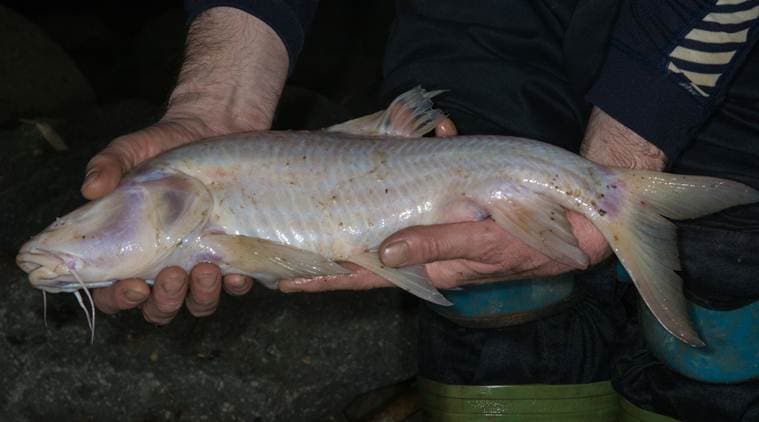
    • The hump-backed Mahseer, found in the waters of the Cauvery, has been added to the IUCN Red List with Critically Endangered Status.

    Hump-backed Mahseer

    • The hump-backed mahseer is a large freshwater fish also called the tiger of the water and found only in the Cauvery river basin including Kerala’s Pambar, Kabini and Bhavani rivers.
    • It is now “Critically Endangered”: more threatened than the tiger is, as per the IUCN’s Red List of Threatened Species.
    • The fish is one of the 229 species added to the Red List last November; this update also reveals that the threat status of 12 other Indian species, including great hornbills, has increased.
    • The inclusion was possible only once the fish got its scientific name last June—Tor remadevii.

    7. Parrotfish in Andaman

    • Coral cover protection along the existing protected marine areas in Andaman and Nicobar islands is necessary for conservation of the endangered Bumphead Parrotfish, a new study has suggested.

    Bumphead Parrotfish

    • Bumphead parrotfish, Bolbometopon muricatum, is an important component of coral reef ecosystem, but is highly endangered globally.
    • It is categorized as ‘vulnerable’ in the Red List of the International Union for Conservation of Nature (IUCN).
    • This fish is a highly prized resource, but is threatened due to limited knowledge about its distribution and abundance in Indian waters.
    • A research recently studied the distribution, abundance and dangers to this species in the waters of Andaman and Nicobar islands.

    8. Herbivore census in Gujarat’s Gir forest

    • Every summer, the Forest Department of Gujarat conducts an Herbivore Census in Gir forest.

    Herbivore Census

    • The Herbivore Census covers ungulates such as spotted deer, blue bulls (nilgais), sambars, Indian gazelles (chinkaras), four-horned antelopes (choshinga) and wild boars, as well as Indian langurs and peafowl.
    • This year’s exercise is of particular significance because it is the last Herbivore Census ahead of next year’s Lion Census, which is a once-in-five-years exercise.

    9.DNA database for Indian Rhino

    • The Environment Ministry has embarked on a project to create DNA profiles of all rhinos in the country.

    DNA Database of Indian Rhino

    • By 2021, the Indian rhino could be the first wild animal species in India to have all its members DNA-sequenced.
    • The project’s proponents include the World Wildlife Fund for Nature-India (WWF-India) and the Centre-funded Wildlife Institute of India (WII).
    • The exercise would be useful in curbing poaching and gathering evidence in wildlife crimes involving rhinos.
    • There are about 2,600 rhinos in India, with over 90% of the population concentrated in Assam’s Kaziranga National Park.
    • Around 60 samples of tissue have been collected so far from some rhinos living outside Kaziranga.

    10.India’s biodiversity-rich zones also ‘hotspots’ of human impacts

    • Human impacts on species occur across 84% of the earth’s surface, finds a study published in PLOS Biology, an international journal dedicated to biological science.

    Human Footprint Data

    • Southeast Asian tropical forests — including India’s biodiversity-rich Western Ghats, Himalaya and the north-east also fall in this category.
    • Malaysia ranks first among the countries with the highest number of impacted species (125).
    • India ranks 16th in such human impacts, with 35 species impacted on average.
    • The study mapped the distribution of eight human activities — including hunting and conversion of natural habitats for agriculture — in areas occupied by 5,457 threatened birds, mammals and amphibians worldwide.

    11.Sundarbans Wetlands

    Sundarbans Wetlands

    • This January 30th, the Indian Sundarban was accorded the status of ‘Wetland of International Importance’ under the Ramsar Convention.
    • It comprises hundreds of islands and a network of rivers, tributaries and creeks in the delta of the Ganga and the Brahmaputra at the mouth of the Bay of Bengal in India and Bangladesh.
    • Located on the southwestern part of the delta, the Indian Sundarban constitutes over 60% of the country’s total mangrove forest area.
    • It is the 27th Ramsar Site in India, and with an area of 4,23,000 hectares is now the largest protected wetland in the country.

    12. Greens in the red: Why Aravallis matter to National Capital Region

    • It was in 1900 that the then Government of Punjab enacted the Punjab Land Preservation Act (PLPA), aimed at “conservation of sub-soil water” and “prevention of erosion” by giving the state power to “regulate, restrict or prohibit” certain activities, including “clearing or breaking up” of land.
    • As a result, for the last 118 years, the Act provided notified tracts of land in the Aravallis protection against real estate construction, urbanisation and mining.

    13. Rhinos without borders is conservation credo

    • International boundaries will not come in the way of conservation of rhinos, said representatives of Asian countries where the one-horned herbivore thrives.

    New Delhi Declaration

    • The Declaration was recently adopted at the second meeting of the Asian rhino range countries.
    • It underscored trans-boundary collaboration among India, Nepal, and Bhutan for the conservation and protection of the greater one-horned rhino.

    Rhinos without Borders

    • There are no rhinos in Bhutan, but some from the Manas National Park in adjoining Assam or Buxa Tiger Reserve in West Bengal are known to cross over occasionally.
    • In Feb, the National Rhino Conservation Strategy for India called for active engagement between India and Nepal to protect the species.
    • The plan said the single population of rhinos in Sukla-Phanta (Nepal), Valmiki Tiger Reserve (India) and Chitwan National Park (Nepal) and Dudhwa (India) is separated by the political boundary between the two countries.

    14. 106 coastal sites picked for conservation

    • The Centre has identified over 100 coastal and marine sites as conservation reserves under its National Wildlife Action Plan for 2017-2031, says a biennial report released by the government.

    Highlights of the Report

    1. Under the National Wildlife Action Plan for the period 2017 to 2031, the government is working towards the conservation of coastal and marine ecosystems from the impacts of climate change.
    2. In the last four and a half years, India has not only been able to sustain but also increase its mangrove cover at a time when these ecosystems are disappearing at an alarming rate across the world.

    15. Centre announces mascot for COP-13 on conservation of migratory species

    • The Centre has announced that the Great Indian Bustard (GIB) will be its mascot for the 13th Conference of Parties (COP) of the UN Convention on the Conservation of Migratory Species (CMS) to be held in Gujarat in 2020.

    About CMS COP-13

    1. Representatives from 129 countries and eminent conservationists and international NGOs working in the field of wildlife conservation are expected to attend the COP-13, to be held in Gandhinagar.
    2. It will provide a global platform for deliberations on the conservation and sustainable use of migratory wild animals and their habitat.
    3. The CMS COP-13 would also bring together the states through which migratory animals pass.

    16. First Captive Elephant Survey

    • The details of the first survey of captive elephants in the country were submitted in an affidavit by the MoEFCC to the Supreme Court.
    • The affidavit comes in the wake of rising elephant deaths and human-elephant conflicts, particularly in Kerala and Assam.

    In Total

    1. According to the affidavit, there are 2,454 elephants in captivity, of which 560 are in possession with forest departments and 1,687 with private individuals.
    2. However, 664 of the total captive elephants in the country are without ownership certificate while there are 85 in zoos, 26 in circuses and 96 in temples.

    17. Sustainable Catchment Forest Management (SCATFORM) Project in Tripura

    • Tripura has launched a project for Sustainable Catchment Forest Management at Hatipara in West Tripura.

    Sustainable Catchment Forest Management (SCATFORM) Project

    1. The project is jointly funded by the Japan International Cooperation Agency (JICA) and Government of India.
    2. It aims to improve quality of forest in the catchment area by sustainable forest management, soil and moisture conservation and livelihood development.
    3. The Tripura Forest Department (TFD) is the Executing Agency of the Project.
    4. Eighty per cent of the project would be funded by JICA while Government of India would fund 20 per cent of the project value.

    18. Asian Waterbird Census (AWC)

    1. AWC, the largest such census in Asia, is organised by Wetlands International, is an international programme that focuses on monitoring the status of waterbirds and wetlands.
    2. The data collected each year is shared by Wetlands International with global conservation organisations such as IUCN and Ramsar Convention, while state coordinators share data with local wildlife departments to ensure conservation and sustainable management of wetlands in the region.
    3. It also aims to increase public awareness on issues related to wetland and waterbird conservation.
    4. The census is carried out each January as a voluntary activity at national and local level.
    5. The AWC is co-ordinated by Wetlands International as part of global programme, the “International Waterbird Census”.
    6. The AWC was started in 1987, and many birders were initiated into bird counting and monitoring through this project.
    7. To take part one simply has to visit a wetland and count the birds he/she see there.

    19.India submits sixth national report to Convention of Biological Diversity

    • India submitted its sixth national report (NR6) to the Convention on Biological Diversity (CBD) highlighting the progress it has made in achieving the 12 National Biodiversity Targets (NBT) set under the convention process.

    Highlights of the Report

    1. The report was submitted online to the CBD Secretariat during the inaugural session of the 13th National Meeting of the State Biodiversity Boards (SBBs).
    2. The report says that India had already exceeded two targets, it was on track to achieve another eight soon.
    3. The remaining two would be met by the stipulated time of 2020.

    20. Asiatic Lion Conservation Project

    Asiatic Lion Conservation Project

    1. The MoEFCC has launched the “Asiatic Lion Conservation Project” with an aim to protect and conserve the world’s last ranging free population of Asiatic Lion and its associated ecosystem.
    2. The project will be funded from the Centrally Sponsored Scheme- Development of Wildlife Habitat (CSS-DWH) with the contributing ratio being 60:40 of Central and State share.
    3. The conservation of Asiatic Lions has always been a priority of Government of India.
    4. The Ministry in the past has supported Asiatic Lion in Gujarat by including it in list of 21 critically endangered species under the species recovery component of CSS-DWH.

    21.India, Nepal, Bhutan plan joint task force to protect wildlife

    • The governments of India, Nepal and Bhutan are actively considering having a joint task force for allowing free movement of wildlife across political boundaries and checking smuggling of wildlife across the Kanchenjunga Landscape.

    About Kanchenjunga Landscape

    1. The Kanchenjunga Landscape is a trans-boundary region spread across Nepal, India and Bhutan.
    2. The landscape stretches along the southern side of Mount Kanchenjunga covers an area of 25,080 sq km spread across parts of eastern Nepal (21%), Sikkim and West Bengal (56%) and western and south-western parts of Bhutan (23%).
    3. Other than seven million people, the Kanchenjunga Landscape is also home to 169 species of mammals and 713 species of birds.
    4. The trio is setting up a joint task force in the road map on achieving the objectives of free movement of wildlife and checking smuggling of wildlife.

    22. SC directs Centre to declare area around national parks as Eco-sensitive

    Expand ESZ

    1. The Supreme Court has directed the Union Environment Ministry to declare 10 km area around 21 national parks and wildlife sanctuaries across the country as ‘eco-sensitive zones’.
    2. A Bench led by Justice Madan B. Lokur took the initiative after its amicus curiae informed the court that the State governments have taken no effort to protect the area around these sanctuaries and parks.
    3. The court recorded that the issue has been pending for the past 12 years.

    23. Country’s first owl festival organized in Pune

    Indian Owl Festival

    1. The Indian Owl Festival, the country’s first owl fest, will be held at Pingori village in Purandar taluka of Pune, Maharashtra.
    2. The two-day festival is organised by Ela Foundation, an NGO working towards nature education and conservation.
    3. It will give information on owl conservation and feature art forms like pictures, paintings, lanterns, lamp shades, posters, origami, stitched articles, poems and stories on owls.
    4. It is a first-of-its-kind festival in the country that is being organised with the intention of creating awareness about owl as a bird and debunking numerous superstitions associated with it.

    24. India gets UN Environment award for combating transboundary environmental crime

    • UN Environment has awarded Wildlife Crime Control Bureau (WCCB), Ministry of Environment with Asia Environment Enforcement Awards, 2018 for excellent work done in combating transboundary environmental crime.

    About the Award

    1. The Asia Environment Enforcement Awards publicly recognize and celebrate excellence in enforcement by government officials and institutions/teams combating transboundary environmental crime in Asia.
    2. The awards are given to outstanding individuals and/or government organizations/teams that demonstrate excellence and leadership in enforcement of national laws to combat transboundary environmental crime.
    3. The award was decided upon by a selection panel set up by the UN Environment and this is the second time in a row the awards are being given by UN Environment to India.

    25. Nature pushed to the brink by ‘runaway consumption’, says WWF


    Triggering another Mass Extinction

    1. Uncontrolled consumption has decimated global wildlife and has triggered a mass extinction and exhausted Earth’s capacity to accommodate humanity’s expanding appetites, warned WWF.
    2. From 1970 to 2014, 60% of all animals with a backbone — fish, birds, amphibians, reptiles and mammals — were wiped out by human activity.
    3. WWF said all this in its “Living Planet” report, based on an ongoing survey of more than 4,000 species spread over 16,700 populations scattered across the globe.