[WpProQuiz 138]
Search results for: “”
-
[Video Analysis + Top 10 Ranks] 22 May 2019 | Prelims Daily with Rakesh Sir
Dear students,
Here’s a link to the Prelims Daily Quiz Analysis Video. Watch this after you have attempted that day’s Prelims Daily questions [on this link]
https://youtu.be/Uh42SXuX3RA
The full playlist is available here [click2watch]
[WpProQuiz_toplist 136]
We need your comments, likes, and shares on these videos. The aim of this series is to help you revise news via questions. PLEASE spread the videos.
What’s wrong with the student’s study habits?
Only 5% of our students who read news attempt PD. This beats the purpose of reading the news. Even those 5% who attempt PD are unable to get the most out of the initiative. They are either guessing or doing the tests just as a routing activity without engaging in it.
What’s CD doing to maximize your efforts?
Now, we have moved one step further with the launch of analysis videos of Prelims Daily (PD). These videos will reveal the critical nitty-gritty surrounding every PD question. It is an unfortunate reality that no single question can be framed to cover all the possible angles.
The analysis videos will plug this hitherto inevitable gap, thereby making your preparation more methodical, holistic and foolproof. Nothing can be more valuable than experience, and that is precisely what the PD initiative and the analysis videos offer. These will be valuable for both newcomers and senior players in the field.
PS: We want to be 100% certain that the time and energy spent on making these videos is helping you in your UPSC Prelims preparation. So, pls click on the videos, like, share and comment and let us know your thoughts
-
[Prelims Spotlight] Location in News
1.Kuril islands – In the news, for dispute between Japan and Russia
2.Falkland island – Argentina seeks support of Saudis for this british territory
3.Rohingya island – Refugees of a distinct Muslim ethnic group who are effectively stateless have been fleeing Myanmar.
4.Houthis – Shia rebels from north Yemen (Shia(Iran support) vs Sunni(Saudi support) conflict in Yemen – so, India’s Rahat operation) so, was in news.
5.Spartly islands –Territorial dispute between Brunei, China,Malaysia,the Philippines,Taiwan, and Vietnam.(Mostly Chinese dominant claim)
6.Taro Island (in Solomon sea) – located nearby to the northeast part Australia
(Planning to migration bcoz of rising seas/Global warming).7. Lake Victoria – It is the largest lake in Africa and chief reservoir of the Nile, lying mainly in Tanzania and Uganda but bordering on Kenya.
8. Fuego Volcano –
• On 3 June 2018,the volcano suddenly produced its most powerful eruption since 1974.
• Guatemala (Central America)9.Sabratha
• UNESCO declared ‘Sabratha’ heritage site to be at high risk, mainly due to damage caused by armed groups.
• It lies on the Mediterranean coast, west of modern Tripoli, Libya.10.Andaman and Nicobar
• The Government recently announced the renaming of
three islands of Andaman and Nicobar archipelago as a
tribute to Netaji Subhas Chandra Bose.
• It lies to the south of Myanmar, west of Thailand, and north
of Indonesia.
• Ross Island was renamed as Netaji Subhas Chandra Bose
Dweep
• Neil Island as Shaheed Dweep
• Havelock Island as Swaraj Dweep. -
Gear up for This week’s Samachar Manthan lecture on 26th May Sunday
Dear students,
We understand that the UPSC exam is a generalist exam. It’s more important to cover more issues than to cover one issue in more depth. Hence, through Samachar Manthan, we are trying to maintain a fine balance of covering many important news items and having a detailed discussion on selected topics which require the same. On daily basis a news gets repeated multiple times. Scattered knowledge is not adequately useful when you have to write a 200 words answer within 6-7 minutes. To handle this, Samachar manthan covers such issues in a comprehensive and consolidated manner which is the smart strategy.
Benefits of Samachar Manthan
- Packed 3 – 3.5 hours Weekly videos will focus on news and its importance from both prelims and mains perspective.
- This program will also help you understand how to utilize current affairs in all your prelims and mains papers.
- This ideology makes this course the best utilization of your time.
- Detailed coverage would mean analysis from all the angles like background or history, features, significance, challenges and way forward. Also, multiple sources like epw, diplomat magazine etc will be referred to in the video lectures.
- Such an approach will help in writing multidimensional answers.
- Also which part of the topic is important from mains and prelims perspective will also be discussed.
- Audio Visual Learning is more impactful than simply glancing through the material. So that you are able to retain information for long also interlink with any new information you get.
- 4 stage structure of Video->Notes->testing->review to perfect your preparation
- The sequence of video->Notes->testing->review is the best way to ensure maximum retention and a rock solid preparation. Each component of the program has been meticulously crafted.
For example this week, we will be covering the following issues;
Economics
[op-ed snap] If food prices rise
Services Trade Restrictiveness Index by OECD
[pib] 7th Economic Census 2019
[op-ed snap] Missing demand: on economic slowdown
[op-ed snap] IBC hits and misses
Graphite mining in Arunachal Pradesh
Reserve Bank proposes 24×7 NEFT money transfer
[op-ed snap] Trade troubles
[op-ed snap] External woes
Masala Bonds
RBI asks NBFCs to appoint Chief Risk Officer
Explained: Why an industrial policy is crucialEnviro & Biodiversity
DNA database for Indian Rhino
Herbivore census in Gujarat’s Gir forest
Coastal Regulation Zone: How rules for building along coast have evolved
[pib] Global Facility for Disaster Reduction and Recovery (GFDRR)
[op-ed snap] Facing the climate emergency
[op-ed snap] Green is cool
[pib] Sasakawa Award for Disaster Risk ReductionGovernance
Global Drug Survey Report 2018
National Institute of Nutrition
International Relations
Explained: Strait of Hormuz — the world’s most important oil artery
[op-ed snap] All out at sea
India signs ‘Christchurch Call to Action’
[op-ed snap] Slippery slope
[op-ed snap]Charting a clear course in the Indo-PacificPolity
[op-ed snap] Redactive pricing audit and the CAG’s duties
[op-ed snap] No apology, please
Explained: Article 324 and the special role of Election CommissionScience Tech
NASA’s Artemis to put first woman on Moon
Person in news: Ishwar Chandra Vidyasagar
Chang’e-4 Mission
Poly-Di-Ketoenamine (PDK): New plastic that could be fully recycledSecurity Issues
[pib] High-speed Expendable Aerial Target (HEAT)And these issues will be covered in detail
- Redactive Pricing Audit
- Strait of hormuz
- Indo Pacific Vision of India
- External Trade Troubles
- Economic Census
- Climate Challenges
So to be thorough in your preparation and to have an integrated approach, join Samachar Manthan here.
-
23rd May 2019 | Prelims Daily with Previous Year Questions
[WpProQuiz 137]
-
[Video Analysis + Top 10 Ranks] 21 May 2019 | Prelims Daily with Rakesh Sir
Dear students,
Here’s a link to the Prelims Daily Quiz Analysis Video. Watch this after you have attempted that day’s Prelims Daily questions [on this link]
https://youtu.be/cV93PAyHdI4
The full playlist is available here [click2watch]
[WpProQuiz_toplist 135]
We need your comments, likes, and shares on these videos. The aim of this series is to help you revise news via questions. PLEASE spread the videos.
What’s wrong with the student’s study habits?
Only 5% of our students who read news attempt PD. This beats the purpose of reading the news. Even those 5% who attempt PD are unable to get the most out of the initiative. They are either guessing or doing the tests just as a routing activity without engaging in it.
What’s CD doing to maximize your efforts?
Now, we have moved one step further with the launch of analysis videos of Prelims Daily (PD). These videos will reveal the critical nitty-gritty surrounding every PD question. It is an unfortunate reality that no single question can be framed to cover all the possible angles.
The analysis videos will plug this hitherto inevitable gap, thereby making your preparation more methodical, holistic and foolproof. Nothing can be more valuable than experience, and that is precisely what the PD initiative and the analysis videos offer. These will be valuable for both newcomers and senior players in the field.
PS: We want to be 100% certain that the time and energy spent on making these videos is helping you in your UPSC Prelims preparation. So, pls click on the videos, like, share and comment and let us know your thoughts
-
[Prelims Spotlight] Indian Paintings and Handicrafts
Indian Paintings
Prehistoric Cave Paintings
- Painted rock shelters by prehistoric cave dwellers
- Notable example → Bhimbetka caves in the Kaimur Range, MP (biggest prehistoric art depositoryin India)
Genres of Indian Painting
- Indian paintings can be broadly classified as murals and miniatures.
- Murals are large works executed on the walls of solid structures directly, as in the Ajanta Caves & Kailash temple (Ellora)
- Miniature paintings are executed on a very small scale for books or albums on perishable material such as paper and cloth.
Mural Paintings
- Mural is the only form of painting that is truly three-dimensional, since it modifies and partakes of a given space.
- Mural paintings are applied on dry wall with the major use of egg, yolk, oil, etc.
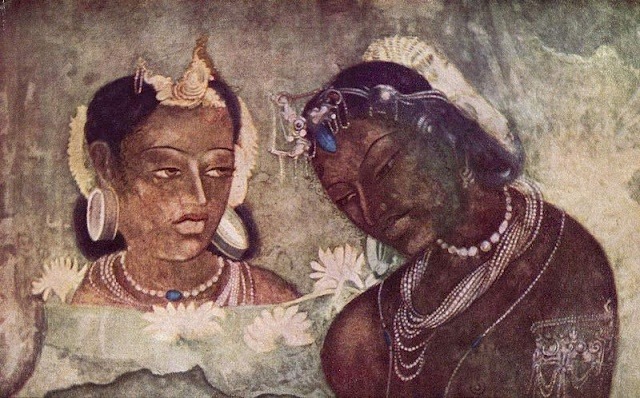
- Notable examples → Ajanta Caves, Bagh Caves, Sittanavasal Caves, Armamalai Cave (Tamil Nadu), Kailasa temple (Ellora Caves)
- Murals from this period depict mainly religious themes of Buddhist, Jain and Hindu
Ajanta Murals Paintings
- Depict a large number of incidents from the life of the Buddha (Jataka Tales)
- Exclusively Buddhist, excepting decorative patterns on the ceilings and the pillars.
Ellora Murals Paintings
- Painted in rectangular panels with thick borders with following
- Prominent features → Sharp twist of the head + painted angular bents of the arms + sharp projected nose + long drawn open eyes + concave curve of the close limbs
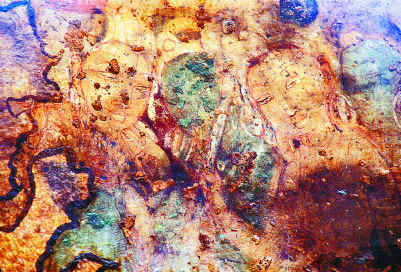
Badami Mural Paintings
- A cave site in Karnataka, patronized by chalukya king, Manglesha
- Depictions in the caves show Vaishnava affiliation, Therefore, the cave is popularly known as Vishnu cave.
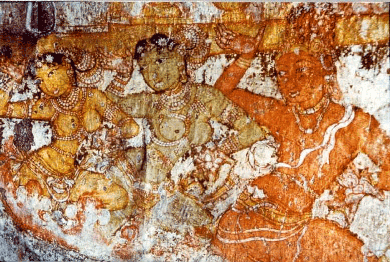
Murals under the Pallava, Pandava and Cholas
- Paintings at the Kanchipuram temple were patronised by Pallava king, Rajsimha
- Paintings at Tirumalaipuram caves & Jaina caves at Sittanvasal were patronised by Padayas
- Paintings at Nartamalai & Brihadeswara temple were patronized by Cholas
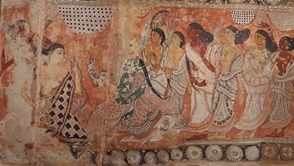
Vijayanagara murals (13th century)
- Paintings at Virupaksha temple (Hamphi) & Lepakshi temple (Andhra Pradesh) were patronised by Vijayanagara Kings
Miniature Paintings
- The Palas of Bengal were the pioneers of miniature painting in India.
- The art of miniature painting reached its glory during the Mughal period.
The Pala School (11th – 12th century)
- Exist in the form of illustrations to the religious texts on Buddhism executed under the Palas of the eastern India & the Jain texts executed in western India
- The Buddhist monasteries of Nalanda, Odantapuri, Vikramsila & Somarupa were great centers of Buddhist learning and art.
- A large number of manuscripts on palm-leaf relating to the Buddhist themes were written, illustrated with the images of Buddhist deities at these centers
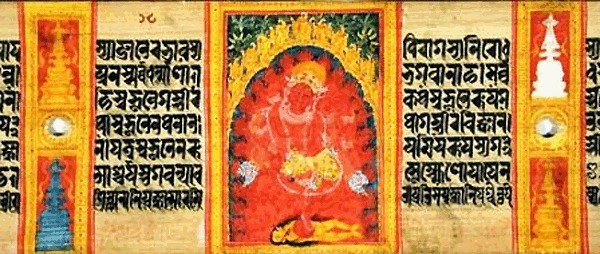
- The Pala painting is characterized by sinuous line and subdued tones of colour
Western Indian School of Painting
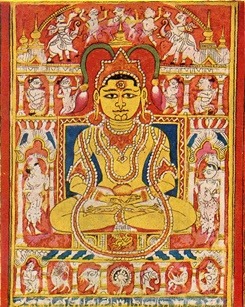
- Also called Jaina Painting, largely devoted to the illustration of Jaina religious texts of the 12th–16th century
- Notable sites → Gujrat, Uttar Pradesh, Central India & Orissa
- Characterized by simple, bright colours, highly conventionalized figures, and wiry, angular drawing
Mughal Paintings (16th – 19th century)
- Mainly confined to miniature illustrations on the books or as single works to be kept in an album
- Mughal paintings were a unique blend of Indian, Persian (Safavi) and Islamic styles
- Marked by supple naturalism → Primarily aristocratic and secular
- Tried to paint the classical ragas and Seasons or baramasa
- Tuti-nama – first art work of the Mughal School.
- Akbar’s reign (1556–1605) ushered a new era in Indian miniature painting.
- At Zenith under Jahangir who himself was a famous painter
- Jahangir encouraged artists to paint portraits and durbar scenes.
- Shah Jahan (1627–1658) continued the patronage of painting.
- Aurangzeb had no taste for fine arts.
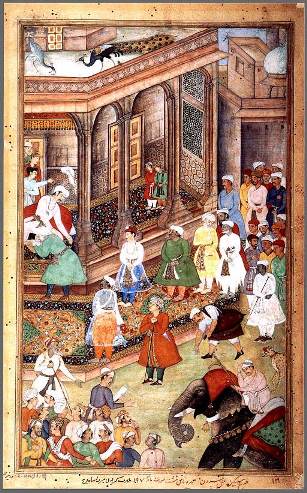
- Most significant are Hamza Nama, Razm-Nama or “The Book of War”, Akbar Nama
- Finest example of this school includes Hamzanama series, started in 1567 & completed in 1582
- Hamzanama → Stories of Amir Hamza, illustrated by Mir Sayyid Ali
- 1200 paintings on themes of Changeznama, Zafarnama & Ramayana
- The paintings of the Hamzanama are of large size, 20” x 27″ and were painted on cloth.
- They are in the Persian safavi style with dominating colours being red, blue and green
- Indian tones appear in later work, when Indian artists were employed
Rajput Painting (16th – 19th century)
- the art of the independent Hindu feudal states in India
- Unlike Mughal paintings which were contemporary in style, Rajput paintings were traditional & romantic
- Rajput painting is further divided into Rajasthani painting and Pahari painting (art of the Himalayan kingdoms)
Central Indian and Rajasthani Schools (17th – 19th Century)
- Deeply rooted in the Indian traditions, taking inspiration from Indian epics, Puranas, love poems & Indian folk-lore
- Mughal artists of inferior merit who were no longer required by the Mughal Emperors, migrated to Rajasthan
Malwa paintings (17th century)
- Centred largely in Malwa and Bundelkhand (MP); sometimes referred as Central Indian painting due to its geographical distribution.
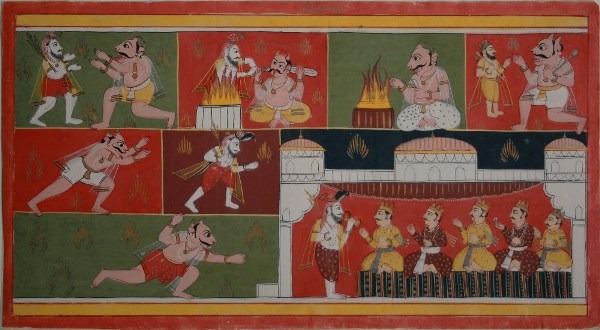
- This school’s most appealing features is its primitive charm & a simple childlike vision
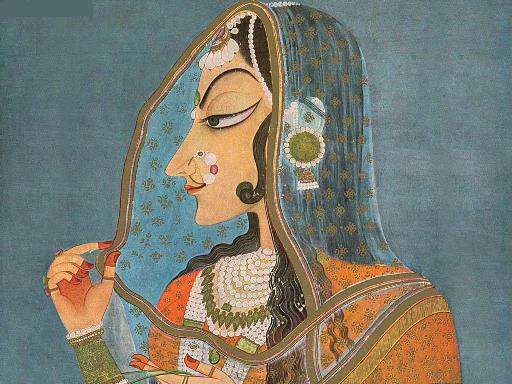
Kishangarh paintings (18th century)
- Distinguished by its individualistic facial type and its religious intensity
- Developed under the patronage of Raja Savant Singh (1748-1757 AD) by master artist Nihal Chand
Mewar (Udaipur) Paintings (17th – 18th century)
- Characterized by bold bright contrasting colours and direct emotional appeal
- The earliest-dated examples come from Ragmala (musical modes) series painted in 1605
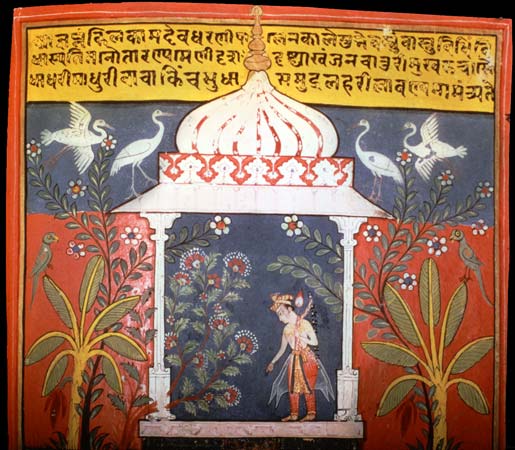
- Reflects portraiture & life of the ruler, along with religious themes
Marwar (Jodhpur) Paintings
- Executed in a primitive and vigorous folk style
- Completely uninfluenced by the Mughal style.
- Portrays court scenes, series of Ragamala & Baramasa
Bundi paintings (Late 17th century)
- Very close to the Mewar style, but the former excels the latter in quality
- Prominent features → Rich and glowing colours, the rising sun in golden colour, crimson-red horizon, border in brilliant red colour (in Rasikpriya series)
- Notable examples → Bhairavi Ragini (Allahabad Museum), illustrated manuscript of the Bhagawata Purana (Kota Museum) & a series of the Rasikapriya (National Museum, Delhi)
Kota paintings (18th – 19th century)
- Very similar to Bundi style of paintings
- Themes of tiger and bear hunt were popular
- Most of the space in painting is occupied by the hilly jungle
The Pahari Schools (17th – 19th Century)
Comprises the present State of Himachal Pradesh, some adjoining areas of the Punjab, the area of Jammu, & Garhwal in Uttarakhand
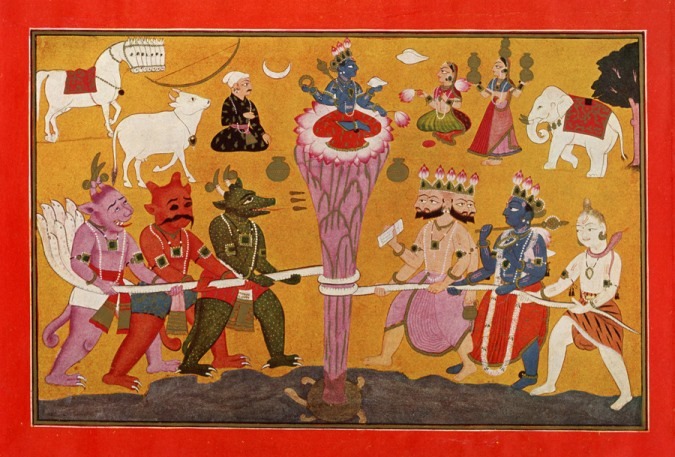
Basohli Paintings (17th – 18th century)
- known for its bold vitality of colour, lines & red borders
- Emotional scenes from a text called “Rasamanjari” → Krishna legend
- Favoured oblong format, with the picture space usually delineated by architectural detail, which often breaks into the characteristic red borders
- Stylized facial type, shown in profile, is dominated by the large, intense eyes
Guler painting (Jammu)
- Mainly consisting of portraits of Raja Balwant Singh of Jasrota (Jammu) designed by Nainsukh
- Colours used are soft and cool unlike Basohli school
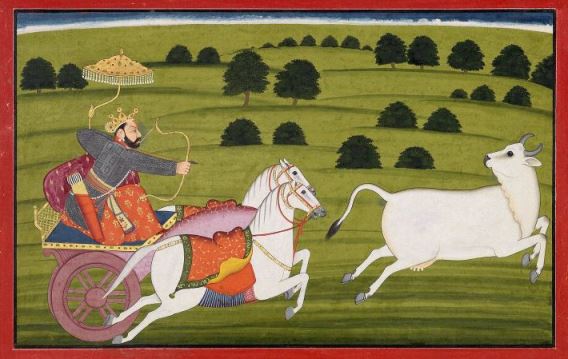
- Style appears to have been inspired by the naturalistic style of the Mughal painting
Kangra painting (Late 18th century)
- The Kangra style is developed out of the Guler style & possesses its main characteristics, like the delicacy of drawing & naturalism
- The Kangra style continued to flourish at various places namely Kangra, GuIer, Basohli, Chamba, Jammu, Nurpur and Garhwal etc.
- However, Named as Kangra style as they are identical in style to the portraits of Raja Sansar Chand of Kangra
- In these paintings, the faces of women in profile have the nose almost in line with the forehead, the eyes are long & narrow, & chin is sharp.
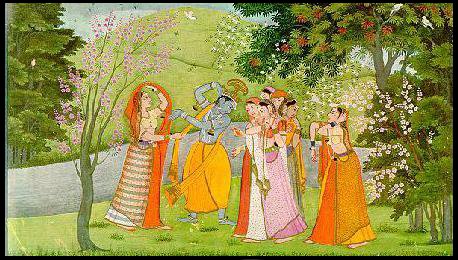
- There is, however, no modelling of figures and hair is treated as a flat mass.
- Paintings of the Kangra style are attributed mainly to the Nainsukh family.
Kullu – Mandi painting
- A folk style of painting in the Kulu-Mandi area, mainly inspired by the local tradition
- The style is marked by bold drawing and the use of dark and dull colours
Independent Paintings
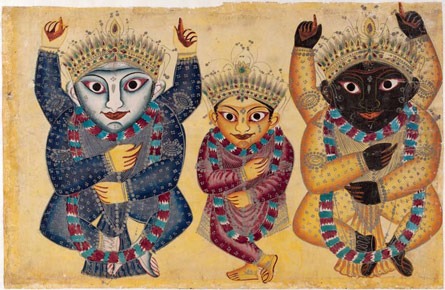
Kalighat Paintings (Kolkata – 19th century)
- Patua painters from rural Bengal came and settled in Kalighat to make images of gods and goddesses in the early 19th century
- They evolved a quick method of painting on mill-made paper
- Used brush and ink from the lampblack
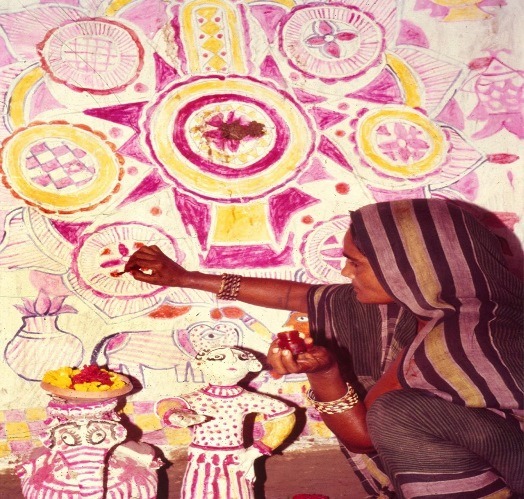
Madhubani Paintings (Mithila – Bihar)
- Colorful auspicious images on the interior walls of homes on the occasion of rituals & festivity → painted by women
- This ancient tradition, especially elaborated for marriages, continues today.
- Used to paint the walls of room, known as KOHBAR GHAR in which the newly wedded couple meets for the first time
- Very conceptual, first, the painter thinks & then “draws her thought”
Phad paintings (Bhilwada, Rajasthan)
- Phad is a painted scroll, which depicts stories of epic dimensions about local deities and legendary heroes.
- Bhopas (local priests) carry these scrolls on their shoulders from village to village for a performance
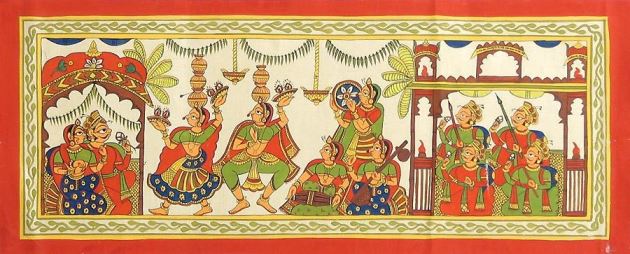
- Represents the moving shrine of the deity and is an object of worship
- Most popular & largest Phad – local deities Devnarayanji and Pabuji
Kalamkari Paintings (Andhra Pradesh)
- Literal meaning is painting done by kalam (pen) , Mainly in Andhra Pradesh (developed under Vijaynagar rulers)
- Stories from the epics Ramayana, Mahabharata and the Puranas are painted as continuous narratives
- Mainly to decorate temple interiors with painted cloth panels scene after scene; Every scene is surrounded by floral decorative patterns
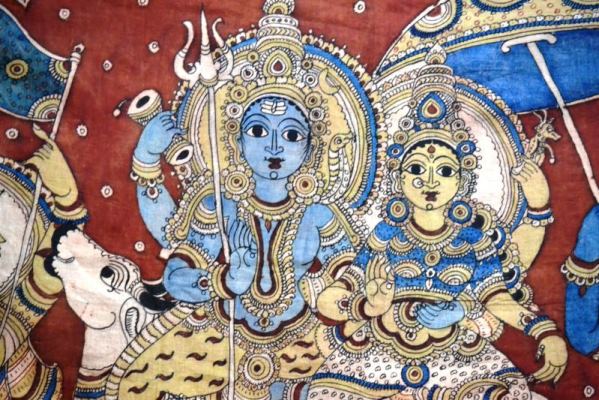
Warli painting
- Practiced in tribal regions of Maharashtra with subjects, predominantly religious
- decorative paintings on floors & walls of ‘gond’ and ‘kol’ tribes homes and places of worship
- made in a geometric patterns like squares, triangles, and circles
- Unlike other tribal art forms, Warli paintings do not employ religious iconography and is a more secular art form.
Handicrafts
Kashmir Embroidered shawls, carpets, namdar silk and walnut wood furniture Rajasthan precious stone and jems + tie & dye (Bandhani) fabric + minakari work Andhra Pradesh Bidri work and Pochampad saris Tamil Nadu bronze sculpture and Kajeevaram silk saris Mysore silk, sandalwood items Kerala ivory carvings and rosewood furniture Assam cane furniture Bengal Bankura terracotta modelling and handloom items Benaras Brocade & silk saris Madhya Pradesh Chanderi and kosa silk Lucknow chikan work (Zardozi Embroidery – Muslims in Lucknow) Punjab Phulkari embroidery Bengal Kantha embroidery Orissa Patola embroidery Budhhists Thangka painting -
UPSC IAS Prelims Trend Analysis Year-wise and subject-wise
Understanding the IAS Prelims Syllabus for Paper 1
UPSC Prelims Polity Trend Analysis: Part 1
UPSC Prelims Polity Trend Analysis: Part 2
UPSC Prelims Polity Trend Analysis: Part 3
UPSC Prelims Polity Trend Analysis part 4
UPSC Prelims Economy Trend Analysis: Part 1
UPSC Prelims Economy Trend Analysis: Part 2
UPSC Prelims Economy Trend Analysis: Part 3
UPSC Prelims Economy Trend Analysis: Part 4
UPSC Prelims Economy Trend Analysis: Part 5
UPSC Prelims Modern History Trend Analysis: Part 1
UPSC Prelims Modern History Trend Analysis: Part 2
UPSC Prelims Modern History Trend Analysis: Part 3
UPSC Prelims Modern History Trend Analysis: Part 4
UPSC Prelims Modern History Trend Analysis: Part 5
UPSC Prelims Geography Trend Analysis: Part 1
UPSC Prelims Geography Trend Analysis: Part 2
UPSC Prelims Geography Trend Analysis: Part 3
UPSC Prelims Geography Trend Analysis: Part 4
UPSC Prelims Geography Trend Analysis: Part 5
UPSC Prelims : Environment and Ecology Approach
UPSC Prelims : Environment and Ecology Analysis part 1
UPSC Prelims : Environment and Ecology Analysis part 2
UPSC Prelims : Environment and Ecology Analysis part 3
UPSC Prelims : Environment and Ecology Analysis part 4
UPSC Prelims : Environment and Ecology Analysis part 5
UPSC Prelims : Science and Technology Analysis part 1
UPSC Prelims : Science and Technology Analysis part 2
UPSC Prelims : Science and Technology Analysis part 3
Prelims 2016 Solutions
IAS prelims 2016 Solutions – Polity
IAS prelims 2016 Solutions – Modern India
IAS prelims 2016 Solutions – Economy
IAS prelims 2016 Solutions – Environment and Ecology
IAS prelims 2016 Solutions – Geography
IAS prelims 2016 Solutions – International Affairs
IAS prelims 2016 Solutions – Govt Policies and Programmes
IAS prelims 2016 Solutions – Science and Technology
Prelims 2015 Solutions
UPSC CSE Prelims 2015 – E&B Solutions
UPSC CSE Prelims 2015 – Geography Solutions
UPSC CSE Prelims 2015 – Polity Solutions
UPSC CSE Prelims 2015 – History Solutions
-
22nd May 2019 | Prelims Daily with Previous Year Questions
[WpProQuiz 136]
-
How To Approach the IAS Prelims – Last 10 weeks

Prelims is almost here. Preparation would be at full swing. It goes without saying, you have to best utilize these ten weeks to maximize your score in prelims and crack it without any hiccups. As time is of essence, I would not waste any more time on introduction and niceties and come straight to the task at hand. And the task is how to best utilize these last 10 weeks and how to approach prelims paper.
This blog is primarily based on a talk delivered at Visionias. Here I would add to those points and give more examples to drive home the essence of the entire talk.
First thing first, nobody can afford to flunk CSAT paper. There is simply no excuse for flunking that paper. To make sure, you don’t flunk the paper, just solve last 4 years UPSC CSAT papers, match your answers with official answer keys and if you score >90 <24 marks cushion over cutoff to discount for a tough paper and bad day> in all 4 papers, you need not touch CSAT.
If you are scoring <80, you need to do some work. You can decide for yourself what needs to be done if you score b/w 80-90.
With CSAT out of the way and whole game being based on general studies, our task in these last 10 weeks is to organize our studies in such a way that examination feels like an extension of our daily routine and we can score maximum marks.
By now, most of you would already have done at least one reading of all the standard books <NCERTs plus Laxmikant, any one book for modern India, G.C Leong, climatology part, Highlights of budget and Eco survey, Current affairs at least from jan to may and later june>. If not, don’t waste any time and finish these books first.
Before moving forward, I take it that basic books are done.
Now some Do’s and Don’ts
Prioritize – Don’t spend disproportionate time on one or two particular subjects or topics <often aspirants spend too much time on art and culture and Environment and ecology with very poor return on your invested time>. Please remember it’s okay to leave a few questions. No body gets all 100 correct and all the questions are of equal marks. So, if you get easy questions wrong and difficult ones correct, it’s not gonna help you.
For instance, You can not get this question incorrect
To uphold and protect the Sovereignty, Unity and Integrity of India” is a provision made in the
(a) Preamble of the Constitution
(b) Directive Principles of State Policy
(c) Fundamental Rights
(d) Fundamental DutiesOr This
Which one of the following is the best description of the term ‘ecosystem’?
(a) A community of organisms interacting with one another.
(b) That part of the Earth which is inhabited by living organisms.
(c) A community of organisms together with the environment in which they live
(d) The flora and fauna of a geographical areaOr Fortaleza declaration or non plan expenditure, repo rate, Basel Committee, Cabinet Mission Plan, Rowlatt Satyagraha etc.
Marking them incorrect is simply criminal and punishment is 1 year rigorous jail term
But it’s okay if you got this wrong
Kalamkari painting refers to
(a) a hand-painted cotton textile in South India
(b) a handmade drawing on bamboo handicrafts in North-East India
(c) a block-painted woollen cloth in Western Himalayan region of India
(d) a hand-painted decorative silk cloth in North-Western IndiaOr This
Which of the following has/have been accorded ‘Geographical Indication’ status?
1. Banaras Brocades and Sarees
2. Rajasthani Daal-Bati-Churma
3. Tirupathi LadduSelect the correct answer using the code given below.
(a) 1 only
(b) 2 and 3 only
(c) 1 only 3 only
(d) 1, 2 and 3You just can not remember all the things that have been accorded GI tag. If your guess turn out to be right, well and good, if not, don’t be too livid on yourself.
Always remember not all questions are doable, your 1st aim should be to mark all doable questions correctly.
2. Solving Question papers– Solve at least 2 papers every week till last Sunday of UPSC <1 test series paper and 1 past year UPSC paper>. There’s no harm in solving 4 papers every week either. You know where to get papers from <you know all about copyrights law enforcement in India, I am not getting paid by coaching industry, wasn’t paid by vision either, no conflict of interest>
Analysis of paper -But just solving isn’t enough. Analyse the paper. Analyse your mistakes. Jot them down in your notebook <doesn’t matter if you have to jot down 80 mistakes>. You would soon realize there’s pattern to your mistakes. Rectify the though process which makes you commit those mistakes.
Go back to standard books and read the topics which you find yourself weak at and improve upon them.
Demolish the myth of negative marking holding you back– In the question paper itself, mark those questions which you are not 100% or even 80% sure <this 100%, 80% is subjective, we all know> and see if marking them benefits you or harm you. Also you would get the knack of marking dicey options correctly. <this exercise is very important, as many of the questions which we solve by calculated guesses turn out to be correct but we attribute them to our knowledge while all the wrong ones are attributed to guesses and then we trash this whole exercise of calculated/ informed guessing>
Practice elimination method and informed guessing
For instance, if the question is-
- Which of the following country is not a member of Mercosur
- Options are – Argentina, Brazil, Venezuela, Mexico
Now even if you don’t remember much about Mercosur but could recall reading about it in an article about trading blocks at CD, you would be able to vaguely remember that it had members from South America and Mexico is in central America or North but not in South so this could be the answer.
Very conservatives among you would not mark such options but IMHO, one should definitely mark such options. It’s not tukka, it’s not cheating. It’s calculated/ informed guessing.
But in exam you may develop cold feet while marking such options, hence it;s important you apply this in test papers, see the benefits for yourself and become confident.
Similarly sometimes you would be able to eliminate two options, it’s advisable to mark a tukka b/w the two options <You can do the math of probablity for CSAT>
Consider this question (Pre 2015)
Consider the following statements
1. The Executive Power of the Union of India is vested in the Prime Minister.
2. The Prime Minister is the ex officio Chairman of the Civil Services Board.
Which of the statements given above is / are correct?(a) 1 only
(b) 2 only
(c) Both 1 and 2(d) Neither 1 nor 2
- Everyone should know that 1st statement is incorrect <if you don’t know this, no need to do PHD in art and culture but immediately go back to Laxmikant>
- Statement 2 even if you don’t know IMO, you should mark either b or d after doing akkad bakkad bambe bo <you can do the math of probability>
What if you are able to eliminate one option?
You should mark based on your preparation and risk appetite
For instance this question ( Pre 2015)
In the ‘Index of Eight Core Industries’, which one of the following is given the highest weight?
(a) Coal production
(b) Electricity generation
(c) Fertilizer production
(d) Steel productionAnyone with slightest knowledge, commonsense and logic can easily eliminate fertilizer <agriculture’s contribution to GDP <18%, fertilizer ka kitna hoga> with more logic you can reach to electricity, I applied but reached to steel and my answer turned out to be incorrect <don’t mark in 1/3 if you feel you are comfortable in prelims, no point in going for glory>
In tests as also in exam, read every question and every option carefully. Don’t leave a question even if you don’t have much idea about without reading the options. Apply all your previous knowledge and all the logic at your disposal to see if you can arrive at correct answer or if you can eliminate at least two options.
For instance this question (prelims 2015)
Which one of the following best describes the main objective of ‘Seed Village Concept’?
(a) Encouraging the farmers to use their own farm seeds and discouraging them to buy the seeds from others
(b) Involving the farmers for training in quality seed production and thereby to make available quality seeds to others at appropriate time and affordable cost
(c) Earmarking some villages exclusively for the production of certified seeds
(d) Identifying the entrepreneurs in village and providing them technology and finance to set up seed companiesMany of you would leave this question just after reading seed village concept. I didn’t have any idea either. But let’s read the options
- 1st options seems like a BS option. Why should anyone discourage farmers from buying seeds from others if they are of good quality
- 3rd option, is it even possible to earmark some villages exclusively for seed production i.e leave your animal husbandry, farming, other activities just produce seeds.
- Now you can choose from b and d. In the exam I chose d which was incorrect but the point I am trying to make is don’t move without reading all the options
Some important red flags which should alert you to the possibility of statement being wrong. In such situations, you should pause and think about that possibility. I am not saying that statement with red flags would always be incorrect, what I am saying is you should pause and think about that possibility.
Such red flags are
- Broad sweeping statements – all, always, only
- Unnecessary negative sentence which seems odd or seems logically incorrect
- Too much over exaggeration
Now I discuss such statements and questions asked in last year’s exam
1. With reference to ‘Indian Ocean Rim Association for Regional Cooperation (IOR-ARC)’, consider the following statements:
1. It was established very recently in response to incidents of piracy and accidents of oil spills.
2. It is an alliance meant for maritime security only.
Which of the statements given above is / are correct?(a) 1 only
(b) 2 only
(c) Both 1 and 2
(d) Neither 1 nor 2Discussion- Look at the statement 2 –Maritime security only. You should observe this and think if it can be false. It’s actually false as this organization has noting to do with security <economy actually>. Also if it had to focus on maritime security only statement could have been, It is an alliance meant for maritime security. <ye to nhi likha hoga naa that can’t talk about anything except security>
Now look at the statement one – very recently <could it not be recently, it’s a very lame reason actually> but you should think, be skeptic, mark them right if you are sure they are right.
Also statement 1 and 2 contradict each other. Accident of oil spills are not related to maritime security.
Imp.- You should know that this organization is focused on economy and both the statements become incorrect automatically and no such tikdam required
2. With reference to inflation in India, which of the following statements is correct?
(a) Controlling the inflation in India is the responsibility of the Government of India only
(b) The Reserve Bank of India has no role in controlling the inflation
(c) Decreased money circulation helps in controlling the inflation
(d) Increased money circulation helps in controlling the inflation- Option 1 only should make you think, <it’s logical that inflation would be the responsibility of both govt and RBI, yes primary responsibility of RBI but even only RBI would be incorrect>
- Also if statement one is true, two has to be true and both can’t be true simultaneously <single choice answer>
- Statement c and d are opposite so one has to be true unless money supply has no role in inflation
Note– Very easy question, done your NCERT, solved all economy questions I solved for you in the forum, no need for any tikdam
3. With reference to bio-toilets used by the Indian Railways, consider the following statements:
1.The decomposition of human waste in the bio-toilets is initiated by a fungal inoculum.
2. Ammonia and water vapour are the only end products in this decomposition which are released into the atmosphere.Which of the statements given above is/are correct?
(a) 1 only
(b) 2 only
(c) Both 1 and 2
(d) Neither 1 nor 2Option 2- why only water vapour and NH3, why not CO2 and other gases. Stands to reason. Again it should make you think. You should not mark a statement incorrect just because you see only.
Note- I don’t think anyone would remember all the gases which are released so this question is apt to be solved by our tikdam after thinking about the statement
4. Which of the following statements is/are correct regarding National Innovation Foundation-India (NIF)?
1. NIF is an autonomous body of the Department of Science and Technology under the Central Government.
2. NIF is an initiative to strengthen the highly advanced scientific research in India’s premier scientific institutions in collaboration with highly advanced foreign scientific institutions.Look at the exaggeration in the statement 2. High advanced scientific research with highly advanced foreign institutions. This made me think and I recalled that NIF was actually for grass root level innovation. Again the point is I knew about NIF but I was still going with the flow and marked the option as correct until I focused on exaggeration. So, imp think is stopping and thinking
NOTE- Knowing about NIF was imp. These tikdams work only when you are well prepared.
5. With reference to ‘fly ash’ produced by the power plants using coal as fuel, which of the following statements is/are correct?
1. Fly ash can be used in the production of bricks for building construction.
2. Fly ash can be used as a replacement for some of the Portland cement concrete.
3. Fly ash is made up of silicon dioxide and calcium oxide only, and does not contain any toxic elements.Look at the statement 3. Why can’t there be anything else in fly ash? I didn’t know much about that but I thought if that was the case, they should have written made up of silicon dioxide and calcium oxide, what was the need of silly only?
6. With reference to ‘dugong’, a mammal found in India, which of the following statements is/an; correct?
1. It is a herbivorous marine animal.
2. It is found along the entire coast of India.
3. It is given legal protection under Schedule I of the Wildlife (Protection) Act, 1972.Select the correct answer using the code given below.
(a) 1 and 2
(b) 2 only
(c) 1 and 3
(d) 3 onlyLook at the statement 2. It should at least make you think, at least 1 km stretch mein to nhi milta hoga. Now you can say what if the statement was deer is found everywhere in India?? Tikdam is only to stop you and make you consider the other possibility
Some questions where logic can help you
7. Which one of the following issues the ‘Global Economic Prospects’ report periodically?
(a) The Asian Development Bank
(b) The European Bank for Reconstruction and Development
(c) The US Federal Reserve Bank
(d) The World BankGlobal report should be published by a global body, right. You can easily rule out Fed and European Bank. Asian bank can also be ruled out similarly <though there is a possibility of even regional institutions publishing global reports>
8. With reference to the Indian Renewable Energy Development Agency Limited (IREDA), which of the following statements is/are correct?
1. It is a Public Limited Government Company.
2. It is a Non – Banking Financial Company.Select the correct answer using the code given below.
(a) 1 only
(b) 2 only
(c) Both 1 and 2
(d) Neither 1 or 2Option 1 you can mark correct by name of agency, option 2 if you know it’s function
9. Kalamkari painting refers to
(a) a hand-painted cotton textile in South India
(b) a handmade drawing on bamboo handicrafts in North-East India
(c) a block-painted woollen cloth in Western Himalayan region of India
(d) a hand-painted decorative silk cloth in North-Western IndiaKalam means pen, option c is easily incorrect but if you don’t know difficult to mark in 1/3
10. Consider the following statements :
1 The Legislative Council of a State in India can be larger in size than half of the Legislative Assembly of that particular State
2. The Governor of a State nominates the Chairman of Legislative Council of that particular State.Which of the statements given above is/are correct?
(a) 1 only
(b) 2 only
(c) Both 1 and 2
(d) Neither 1 nor 2If you don’t remember the exact provisions, think what would be the purpose of making a law if size could be more than half. If it can be more than half, it can be anything. Provisions are made to limit size (<15% size of CoM, <1/3 size of councils>
Note- Again better to know exact provisions so that tikdam is needed only in difficult questions
11. With reference to Indian economy, consider the following statements:
1. The rate of growth of Real Gross Domestic Product has steadily increased in the last decade.
2. The Gross Domestic Product at market prices (in rupees) has steadily increased in the last
decade.Which of the statements given above is/are correct?
(a) 1 only
(b) 2 only
(c) Both 1 and 2
(d) Neither 1 nor 2I don’t need to say anything about this question. Whether you know anything or not, this question can not be marked incorrect
12. The term ‘IndARC’, sometimes seen in the news, is the name of
(a) an indigenously developed radar system inducted into Indian Defence
(b) India’s satellite to provide services to the countries of Indian Ocean Rim
(c) a scientific establishment set up by India in Antarctic region
(d) India’s underwater observatory to scientifically study the Arctic regionName se clear hai India and Arctic. option D
13. The Genetic Engineering Appraisal Committee is constituted under the
(a) Food Safety and Standards Act, 2006
(b) Geographical Indications of Goods (Registration and Protection) Act, 1999
(c) Environment (Protection) Act, 1986
(d) Wildlife (Protection) Act, 1972Whenever Bt cotton or BT brinjal issue comes up, environment ministry pange karti so obviously EPA
Note– This should be known so no need for tikdam
14. With reference to the Union Government, consider the following statements
1. The Department of Revenue is responsible for the preparation of Union Budget that is presented to the Parliament.
2. No amount can be withdrawn from the Consolidated Fund of India without the authorization from the Parliament of India.
3. All the disbursements made from Public Account also need the authorization from the Parliament of India.Which of the statements given above is / are correct?
(a) 1 and 2 only
(b) 2 and 3 only
(c) 2 only
(d) 1, 2 and 3Apply all and no principle, think. If you mark it incorrect without thinking, you would be wrong. If you stop and think you would realize statement 2 is correct, If you don’t know you would mark statement 3 also as correct which is a incorrect statement
Moral of the story- Red flags are to make you stop and think, not for marking indiscriminately
15. With reference to Indian history, which of the following is/are the essential elements of the feudal system?
1. A very strong centralized political authority and a very weak provincial or local political authority
2. Emergence of administrative structure based on control and possession of land
3. Creation of lord-vassal relationship between the feudal lord and his overlordSelect the correct answer using the code given below.
(a) 1 and 2 only
(b) 2 and 3 only
(c) 3 only
(d) 1, 2 and 3Statement 1, see the exaggeration. Very strong, very weak. It’s a red flag. Pause and think. If you think, you would realize it actually makes sense, correct statement but if you mark indiscriminately based on red flags only, you would be in trouble
16. With reference to the art and archaeological history of India, which one among the following was made earliest?
(a) Lingaraja Temple at Bhubneshwar
(b) Rock-cut Elephant at Dhauli
(c) Rock-cut Monuments at Mahabalipuram
(d) varaha Image at UdayagiriEliminate option 1, temple would not be constructed before rock cut architecture. This is the question, you can mark incorrect. No need to go after such questions. It’s important to focus on high yielding topics.
Some questions from prelims 2014
- The scientific view is that the increase in global temperature should not exceed 2 °C above pre-industrial level. If the global temperature increases beyond 3 °C above the pre-industrial level, what can be its possible impact/impacts on the world?
1. Terrestrial biosphere tends toward a net carbon source
2. Widespread coral mortality will occur.
3. All the global wetlands will permanently disappear.
4. Cultivation of cereals will not be possible anywhere in the world.Look at option 3 and 4 <all, anywhere> Pause and think, obviously incorrect
2. Consider the following countries:
1. Denmark
2. Japan
3. Russian Federation
4. United Kingdom
5. United States of AmericaWhich of the above are the members of the ‘Arctic Council ‘?
(a) 1, 2 and 3
(b) 2, 3 and 4
(c) 1, 4 and 5
(d) 1, 3 and 5Everyone would know UK is incorrect. Choice b/w option a and d that is b/w USA and Japan. Even if you don’t know anything tukka laga do
3. Which reference to Agni-IV Missile, which of the following statements is/are correct?
1. It is a surface-to-surface missile.
2. It is fueled by liquid propellant only.
3. It can deliver one-tonne nuclear warheads about 7500 km away.Statement 2, pause and think, it could be correct also. actually it’s incorrect. Statement 3 is also incorrect <even Agni 5 does not have that much range>
4. With reference to two non-conventional energy sources called ‘coal bed methane’ and ‘shale gas’, consider the following ‘statements:
1. Coal bed methane is the pure methane gas extracted from coal seams, while shale gas is a mixture of propane and butane only that can be extracted from fine-grained sedimentary rocks.
2. In India abundant coal bed methane sources exist, but so far no shale gas sources have been foundLook at the statement 1 only, pause and think why only propane and butane. Actually mainly methane hota hai
Similarly statement 2, no shale gas source, not even one? pause and think
5. Consider the following international agreements:
1. The International Treaty on Plant Genetic Resources for Food and Agriculture
2. The United Nations Convention to Combat Desertification
3. The World Heritage ConventionWhich of the above has / have a bearing on the biodiversity?
(a) 1 and 2 only
(b) 3 only
(c) 1 and 3 only
(d) 1, 2. and 3Common sense, all 3, statement 1 mentions genetic, statement 2 desert, statement 3 heritage, natural heritage sites
6. What are the significance of a practical approach to sugarcane production known as ‘Sustainable Sugarcane Initiative’?
- Seed cost is very low in this compared to the conventional method of cultivation.
- Drip irrigation can be practiced very effectively in this.
- There is no application of chemical/ inorganic fertilizers at all in this.
- The scope for intercropping is more in this compared to the conventional method of cultivation.
Select the correct answer using the code given below.
- 1 and 3 only
- 1, 2 and 4 only
- 2, 3 and 4 only
- 1, 2, 3 and 4
Statement 3, no chemicals, none at all, pause and think, this could be true but read the question again practical method. <practical mein to thoda scope hoga hi chemicals ka>
7. Other than poaching, what are the possible reasons for the decline in the population of Ganges River Dolphins?
1. Construction of dams and barrages on rivers
2. Increase in the population of crocodiles in rivers
3. Getting trapped in fishing nets accidentally
4. Use of synthetic fertilizers and other agricultural chemicals in crop-fields in the vicinity of riversSelect the correct answer using the code given below.
(a) 1 and 2 only
(b) 2 and 3 only
(c) 1, 3 and 4 only
(d) 1, 2, 3 and 4Look at option 2, pause and think, crocodile seriously?
I think, with these examples it would be amply clear that one need to finish basic books, read questions and options carefully, pause and think when red flags so indicate, practice test papers, revise weaker topics etc. etc.
What to do in Exam Hall
- Don’t go in the exam hall with any pre-conceived notion of number of questions to be attempted. Attempt as many as you know, make informed guesses, use elimination method, mark where you are able to eliminate two options
- Don’t speculate cut off in the exam hall itself. Your task is to maximize your score. 10 extra marks wouldn’t hurt you
- Don’t make mistakes in bubbling the circles <keep ample time for that>
What not to do after Prelims
- Don’t engage in futile speculation of cutoff
- Don’t try to correct your wrong answers by sending 100 URLs to your friends
- Take a few days break and start studying for mains
My prelims marks
- 2015 – 142 + 182 <rank 20>
- 2014 – 125 +157/ 175 <interview, back to square one>
- 2013 – 118 +192 <interview, back to square one> <2013 and 2014 marks could be +- 2 either side>
P.S. As I have clearly said, there’s no substitute for hard work and studying standard books. Once you are done with them, practicing papers help in knowing our weak areas and taking corrective steps. Red flags and tikdams are like check lists which enable us to pause and rethink and prevent us from making mistakes
P.P.S. Constructive criticism is welcome but please don’t get personal. Leave a comment if you appreciate the article. Too lazy to leave a comment, just order a pizza for me.
Best Luck
From Civilsdaily
Be a regular on the Civilsdaily App (Free for Download) & read the monthly CivilsDigest magazine for handy revision. Click here to buy.