Important Announcement: In the month of February, we will be covering UPSC Mains GS questions of 2019. This will give you real time experience of attempting GS questions of UPSC Mains.
Reviews will be provided in a week. (In the order of submission- First come first serve basis). In case the answer is submitted late the review period may get extended to two weeks.
*In case your answer is not reviewed in a week, reply to your answer saying *NOT CHECKED*. If Parth Sir’s tag is available then tag him.
For the philosophy of AWE and payment, check here: Click2Join
More than six years after the Lokpal law received the President’s assent, the institution of the Lokpal is yet to play any significant role in tackling corruption in the country.
Delay in appointment
Five-year delay in appointment: For more than five years, the chairperson and members of the Lokpal were not appointed.
LoP issue: The government claimed that since no one could be recognised as the Leader of the Opposition (LoP) after the 2014 general election, the committee responsible for selecting members of the Lokpal could not be constituted.
This malady could have been easily remedied by either recognising the leader of the single largest party in Opposition in the Lok Sabha as the LoP, or by amendment as was done for the selection committee of the CBI Director.
However, neither recourse was taken.
Truncated appointment committee
Special invitee: The leader of the largest Opposition party in the Lok Sabha was invited for meetings of the selection committee as a ‘special invitee’.
Which he declined on grounds that it was mere tokenism.
Non-starter
More than 10 months later, however, evidence suggests that the Lokpal is a non-starter.
No rules prescribing the form: Till date, the government has not made rules prescribing the form for filing complaints to the Lokpal.
No rules regarding asset disclosure: The Central government has also failed to formulate rules regarding asset disclosure by public servants.
In order to ensure independent and credible action on allegations of corruption, the Lokpal was empowered under the law to set up its own inquiry wing headed by a Director of Inquiry and its own prosecution wing headed by a Director of Prosecution.
The Inquiry and prosecution wing not set up yet: The inquiry and prosecution wings of the anti-corruption ombudsman are yet to be set up.
The Lokpal has also not appointed the Director of Inquiry or Prosecution.
Regulations for inquiry and investigation not made: Regulations which the Lokpal was obligated to make under the law are yet to be made, including those specifying the manner and procedure of conducting preliminary inquiry and investigation.
Legal veracity of the decisions uncertain: Since necessary procedures to operationalise the law are yet to be put in place, the legal veracity of the decisions of the Lokpal could potentially be challenged in a court of law.
Conclusion
The failure to operationalise the Lokpal in an effective manner lays bare the lack of will of the government. It took nearly half a century for the Lokpal law to be enacted from the time the need for the oversight institution was first articulated. The government must act to have an effective, independent and empowered Lokpal.
UPSC released the notification for Civil Services (Preliminary) Examination, 2020 on February 12, 2020.
Civil Services vacancies since 2014:
Year Vacancies Forms filled
2014 1291 9.47 lakh
2015 1129 9.5 lakh
2016 1079 11.36 lakh
2017 980 10 lakh
2018 782 10.65 lakh
2019 896 12 lakh
This year the overall seats are 796, spread across various services including IAS, IFS, IPS, IRS (IT), IRS (C&CE), etc and the numbers will go down in the coming years. 12 lakh applications are expected to be filled this year.
Out of ~2000 students selected for Interviews, ~400 were enrolled in our programs, over 1100 used our app and current affairs on a regular basis. Another 200 have used us sparingly.
We have launched the Decimate Prelims Program. We are putting in our best effort to help all our students get a competitive edge.
It is time to get serious with your preparation and we have got your back.
After numerous conversations with so many aspirants, we have started understanding your problems better and standardizing solutions for the same.
These are being incorporated into our Samanvaya program. It is these practices that will make the program more effective.
At the core of Samanvaya lies the fact that each one of you will have a unique journey while preparing for the exam. Some will get through on the first attempt without much effort while others will take both more time and more effort. We want to understand you better to help you optimize your journey so you can focus on the right things and not waste time on the wrong ones. We are asking you to tap into the valuable experiences of mentors who underwent the same grind and realize the pitfalls and understand the shortcuts to make it.
Samanvaya program involves the following –
1. Identifying your weaknesses
Over 80% of students who claimed to have revised NCERTs were unable to answer basic questions. Many were not comfortable with at least 1 GS subject and Optional. Many struggled with ‘What went wrong’ after 2-3 years of hard work.
Our mentors will help you assess your preparedness and suggest accurate strategies.
2. Strategy and study plan discussions
Over 90% of students couldn’t stick to a plan. Study plans and strategies are iterative in nature and we want to help you with that. Many are unable to perform in tests despite preparing hard. This could be due to a variety of factors – lack of adequate prep, jitters in the exam hall, inadequate revision, lack of practice of test series or just a bad day at work. Tell us what you think went wrong and we’ll figure out a way to get you over the line next time.
3. Helping you understand the exam better
Which books to read, different approaches, etc. Over 60% of students we talked to did not find NCERTs relevant and saw no point in being thorough with them.
4. Lack of motivation
We have all had those days when it’s been hard to motivate ourselves to hit the books and just study. It happens to the best of us sometimes and for some of us, it happens more frequently. And it is understandable, Civil Service preparation is a long and often lonely process. Every aspirant, from toppers to those who have quit have been overwhelmed by this process at some point.
Samanvaya Code of Conduct
Be honest with your mentors about your preparation levels and stage.
Follow their advice and participate in tests and assignments that they set for you
Stay active in the telegram groups, ask doubts, don’t hold yourself back.
Don’t expect spoonfeeding. You have to drive the initiative.
When Prime Minister Narendra Modi welcomes U.S. President Donald Trump to India this month the two leaders are expected to sign a first-ever trade agreement.
What will be on the agenda of the trade deal?
GSP issues: The restoration of India’s Generalised System of Preferences benefits,
Pricing of medical devices.
And agriculture trade are all important.
Incremental outcomes: If the two sides continue efforts to achieve incremental outcomes, the start of negotiations on a comprehensive free trade agreement (FTA) could even be a credible scenario. Presently, this is not the case.
What could be the incremental outcomes?
The most obvious candidates are-
Intellectual property rights (IPR).
IPR has historically been an area of contention between the two, but discussions on IPR have progressed well in recent years.
Digital trade.
Both are grappling with the appropriate scope and approach for regulating electronic commerce issues in this digital age.
Ideally, there should be room to seriously consider better ways to encourage skilled professionals to work in the other’s economy.
Progress on the investment
There are already some shared interests in the area of investment.
For example, India invests in the U.S. and continues to seek U.S. investment in India.
FDI issue: Foreign direct investment (FDI), this is an important moment to do more to encourage it than simply welcoming it.
Need to negotiate o investment: Ideally, the two sides should move ahead to negotiate an agreement on investment matters that can provide greater transparency, predictability, and regulatory certainty to investors from the other country.
Negotiation on FDI off the table: It appears that the traditional approach through which countries pursue commitments on FDI, bilateral investment treaties, or ‘BITs’ (bilateral investment treaties) is off the table.
The Trump administration has put a hold on negotiating additional BITs and appears to be suspicious of how well they balance U.S. interests.
The Indian government is similarly sceptical of BITs, having cancelled all existing ones soon after it came into office.
Need for the new approach on the investment issues
Until they resume their work on BITs, the two sides may find common ground in devising a new approach to investment issue.
What the new approach involve?
Taking cues from their respective FTAs: A starting point should be to review what they have done in their recent FTAs.
Abandonment of investor-state dispute settlement: The recently concluded U.S.-Mexico-Canada Agreement contains a novel approach on investment notably its abandonment of investor-state dispute settlement with respect to the U.S. and Canada.
Similarly, the Regional Comprehensive Economic Partnership, which India had been negotiating with ASEAN, Australia, China, Japan, Korea, and New Zealand, does not include investor-state dispute settlement.
While India chose not to join the Regional Comprehensive Economic Partnership when it was concluded at the end of last year, it appears to have been on board with the FTA’s investment provisions.
Where the agreement focus as of now? For now, however, both countries should focus on what is doable. A U.S.-India investment agreement could focus on-
Fair treatment for investors from the other country.
Regulatory transparency and predictability.
And approaches for resolving concerns short of investor-state dispute settlements.
At a later stage: At a later stage-
Most likely when the two are prepared to negotiate a more comprehensive bilateral FTA, they can go further on investment matters.
Conclusion
A new, hybrid approach on investment would be a substantial step in the right direction. It will be critical to sustaining momentum coming out of a first trade deal when the two leaders meet in Delhi. If India and the U.S. fail this test, the trade relationship is more likely to languish than blossom.
In the run-up to the budget, there was enormous pressure on the finance minister to launch a fiscal stimulus so as to pump-prime the economy. That she did not succumb to the temptation is a big relief.
Why fiscal stimulus is unwarranted?
There is already considerable stimulus in the system.
Excessive fiscal deficit: To her credit, the finance minister took a step towards transparency by admitting to off-balance-sheet borrowings of 0.8 per cent of GDP for both the current and next fiscal year.
Acknowledging that the fiscal deficit would actually be higher at 4.6 per cent and 4.3 per cent of GDP respectively. This is already excessive.
Unrealistic projection of revenue growth: Add to this the unrealistic projections of revenue growth and disinvestment proceeds for next year and we have a potentially unsustainable fiscal situation.
Any stimulus on top of this would have been clearly
Possibility of undermining the RBI’s efforts
Fiscal pressure could harm the RBI’s efforts to revive the economy in the following ways-
Harming long term investment rates: Fiscal pressures will undermine the Reserve Bank of India’s struggle to revive investment by bringing down long-term interest rates.
Rating downgrades: It could result in a sovereign rating downgrade and jeopardise efforts to attract foreign capital.
Increase in inflationary pressure: It can stoke inflationary pressures, something we cannot afford when inflation is above the RBI’s target rate.
Pressure on the external sector: And most importantly, it can lead to pressures on the external sector.
Past experiences: The balance of payments crisis of 1991 and the near crisis of 2013 in the wake of taper tantrums were, at their heart, a consequence of extended fiscal profligacy.
Counter-arguments of the supporters of the stimulus and fallacies in it
Low Debt-to-GDP ratio: It is argued that our debt-to-GDP ratio is low in international terms.
Misleading comparison: The data don’t bear this out. In any case, our experience, as well as research, shows that international comparisons of debt-to-GDP ratios, without reference to other parameters, are misleading.
Debt in domestic currency: It is also argued that we do not need to worry because our debt is mostly in domestic currency unlike that of many emerging economies.
The fallacy in this argument: Our debt in the domestic market didn’t protect us from previous crises, and there is no reason to believe that it will protect us from the next one, especially as our foreign debt is proportionally higher than before.
Robust foreign exchange reserves: It is argued that our foreign exchange reserves are robust and a balance of payments crisis is improbable. Such complacency is misplaced.
Fallacy- No forex is large enough in bad times: We should not forget the lesson that in good times any amount of forex reserves looks like it is too large, but in bad times no amount of reserves is large enough.
Quality of fiscal consolidation
Quality a cause for concern: As much as the headline fiscal deficit numbers are a cause for concern, the underlying quality of fiscal consolidation is a bigger concern.
Increasing revenue deficit: Conveniently off the radar, the revenue deficit, far from coming down, is actually going up.
Two-third borrowing to finance revenue expenditure: This year, more than two-thirds of what the government is borrowing is going to finance current expenditures like salaries, pensions, interest payments and subsidies.
That ratio will rise to three-quarters next year.
Crowding out of the expenditure: This debt-financed revenue expenditure is simply unsustainable as it will increasingly crowd out capital expenditure.
Red flags on the state finances.
Another dimension of the quality of fiscal consolidation is the combined fiscal position of states which is, in fact, the big elephant in the room.
Together, states spend one-and-a-half times more than the Centre.
Larger development impact than Centre: Studies show that how efficiently states spend their money has a much greater development impact as compared to the Centre.
Red flags by the RBI on states finances: The states are not doing a good job. In its latest annual report on state finances, the RBI raised several red flags on state finances-
states’ increasing weakness in their own revenue generation.
Their unsustainable debt burdens.
And their tendency to retrench capital expenditures in order to accommodate fiscal shocks such as farm loan waivers, power sector loans under UDAY and a host of income transfer schemes.
Consequences in the market: The market will penalise mismanagement of public finances; it does not care who is responsible — the Centre or states — for an unsustainable fiscal stance.
Conclusion
The fear of one-off fiscal stimulus becoming permanent: By far the biggest fear about a fiscal stimulus is that it is tempting to plunge into a spending programme saying it is a one-off and will be withdrawn when the pressure eases. Experience shows that it is very difficult to bail out. It is good that the finance minster avoided doing any such thing.
As Milton Friedman famously said, there is nothing more permanent than a temporary government programme.
Need to kick-start the private investment: What the economy needs for a sustained turnaround is kick-starting private investment.
Implementation of reforms: A necessary condition for inspiring investor confidence is the implementation of structural and governance reforms. This will be a long-haul.
That the budget did not launch the journey is a big disappointment. But, at least, the budget did not make a bad situation worse by embarking on fiscal adventurism.
It’s better, as Keynes said, to be roughly right than precisely wrong.
UPSC released the notification for Civil Services (Preliminary) Examination, 2020 on February 12, 2020.
A separate notification for the Indian Forest Service (Preliminary) Examination is also released on the same date CSE notification is published. The Preliminary Exam for both CSE and IFoS is common.
UPSC Civil Services (Prelims) and Indian Forest Services (Prelims) 2020 is scheduled to be conducted on May 31st, 2020.
Last day to register for the Prelims Examination is March 3rd, 2020.
This year the overall seats are 796, spread across various services including IAS, IFS, IPS, IRS (IT), IRS (C&CE) etc.
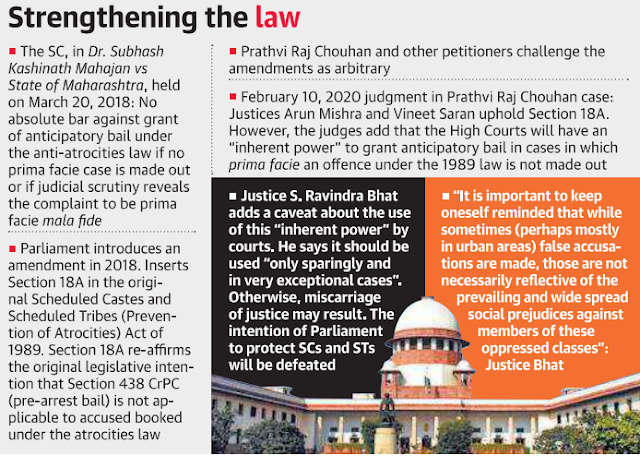
The Supreme Court has upheld the SCs/STs (Prevention of Atrocities) Amendment Act of 2018, which nullified it’s own controversial March 20, 2018 judgement. Earlier judgment had diluted the original 1989 legislation, saying they were using its provisions to file false criminal complaints against innocent persons.
Why such ruling?
The 2018 Act had nullified a March 20 judgment of the Supreme Court, which allowed anticipatory bail to those booked for committing atrocities against Scheduled Castes and Scheduled Tribes members.
The original 1989 Act bars anticipatory bail.
The Supreme Court verdict saw a huge backlash across the country. Several died in ensuing protests and property worth crores of rupees was destroyed.
The government reacted by filing a review petition in the Supreme Court and subsequently amended the 1989 Act back into its original form.
The government had enacted the Amendments, saying the SCs and STs continued to face the same social stigma, poverty and humiliation which they had been subjected to for centuries.
Why was the SC/ST Act enacted?
Since crimes against SCs and STs are fundamentally hate crimes, the Rajiv Gandhi enacted the Act in 1989.
It gave furtherance to the provisions for abolition of untouchability (Article 17) and equality (Articles 14, 15).
Why it was amended?
The Bench reasoned that human failing and not caste is the reason behind the lodging of false criminal complaints.
The Supreme Court condemned its own earlier judgment, saying it was against “basic human dignity” to treat all SC/ST community members as “a liar or crook.”
Caste of a person cannot be a cause for lodging a false report, the verdict observed.
Members of the SCs and STs, due to backwardness, cannot even muster the courage to lodge an FIR, much less, a false one, the judgment noted.
The Subhash Kashinath Mahajan case
Mahajan was Director of Technical Education in Maharashtra.
Two non-SC officers had made an adverse entry on the character and integrity of a Dalit employee, whom Mahajan in 2011 denied sanction for prosecution against those officers.
The denial was challenged on the ground that the state government and not the director was the competent authority.
The apex Court held that safeguards against blackmail are necessary as by way of rampant misuse, complaints are largely being filed against public servants with oblique motive for the satisfaction of vested interests.
In what manner had the 2018 judgment diluted provisions for arrest?
ANTICIPATORY BAIL
In section 18 of the Act, Parliament had laid down that the provision of anticipatory bail under Section 438 of the CrPC of 1973 will not be available to an accused under the Act.
The provision of anticipatory bail was introduced for the first time on the recommendation of 41st Law Commission in 1973.
It is a statutory right, not part of the right to life and personal liberty under Article 21 of the Constitution, and thus there is no fundamental right to anticipatory bail.
In the 2018 judgment, the Court laid down safeguards, including provisions for anticipatory bail and a “preliminary enquiry” before registering a case under the Act.
While review the Bench said Section 18 was enacted to instil a sense of deterrence and relied on Kartar Singh (1994) in which the court had held that denial of anticipatory bail does not violate Article 21.
FIR
The court had observed that “liberty of one cannot be sacrificed to protect another”, and the “Atrocities Act cannot be converted into charter for exploitation or oppression by unscrupulous persons or by police for extraneous reasons”.
He ordered that neither is an FIR to be immediately registered nor are arrests to be made without a preliminary inquiry by an SSP.
An arrest can only be made if there is “credible” information and police officer has “reason to believe” that an offence was committed.
In the review judgment, Justice Mishra said public servants already have a remedy in false cases under CrPC Section 482 and can get such FIRs quashed by High Courts.
He rejected the need of an SSP’s approval for arrest.
PERMISSION
In 2018, the court had said that even if a preliminary inquiry is held and a case registered, arrest is not necessary, and that no public servant is to be arrested without the written permission of the appointing authority.
The court extended the benefit to other citizens and said they cannot be arrested without the written permission of the SSP of the district.
In review the court said that the decision on arrest is to be taken by the investigating authority, not the appointing authority.
Were other provisions diluted?
The court had observed that interpretation of Atrocities Act should promote constitutional values of fraternity and integration of the society.
This may require ‘check on false implication of innocent citizens on caste lines’.
Observing that the law should not result in caste hatred, the court overlooked the fact that the Act had to be enacted due to caste hatred.
The review judgment said that such riders for registering a report are wrong and it would give an advantage to upper castes whose complaints can be registered without any such inquiry.
How frequently do SCs/STs face atrocities?
A crime is committed against an SC every 15 minutes. Six SC women are raped every day on an average.
Between 2007 and 2017, there was a 66 per cent growth in crimes against SCs.
Data from the National Crime Record Bureau, which the 2018 judgment was based on, showed cases of rape of SC women had doubled in 10 years.
A member in Rajya Sabha appeared to abandon his plan of introducing a private member’s Bill on the Uniform Civil Code (UCC), a code that would be applicable to all religious communities in personal matters such as marriage, divorce, inheritance and adoption.
Private Member’s Bill
A private member’s Bill is different from a government Bill and is piloted by an MP who is not a minister. An MP who is not a minister is a private member.
Individual MPs may introduce private member’s Bill to draw the government’s attention to what they might see as issues requiring legislative intervention.
Difference between private and government Bills
While both private members and ministers take part in the lawmaking process, Bills introduced by private members are referred to as private member’s Bills and those introduced by ministers are called government Bills.
Government Bills are backed by the government and also reflect its legislative agenda.
The admissibility of a Private Bill is decided by the Chairman in the case of the Rajya Sabha and the Speaker in the case of the Lok Sabha.
Before the Bill can be listed for introduction, the Member must give at least a month’s notice, for the House Secretariat to examine it for compliance with constitutional provisions and rules on legislation.
While a government Bill can be introduced and discussed on any day, a private member’s bill can only be introduced and discussed on Fridays.
Has a private member’s bill ever become a law?
No private member’s Bill has been passed by Parliament since 1970.
To date, Parliament has passed 14 such Bills, six of them in 1956.
In the 14th Lok Sabha, of the over 300 private member’s Bills introduced, roughly four per cent were discussed, the remaining 96 per cent lapsed without a single dialogue.
The selection of Bills for discussion is done through a ballot.
As the geography of arsenic contamination spreads, there is an urgent need for governments to reorient mitigation measures. That’s because the focus till now has only been on drinking water, but new research says arsenic has contaminated our food chain.
Arsenic contamination of water
Arsenic contamination in groundwater is one of the most crippling issues in the drinking water scenario of India.
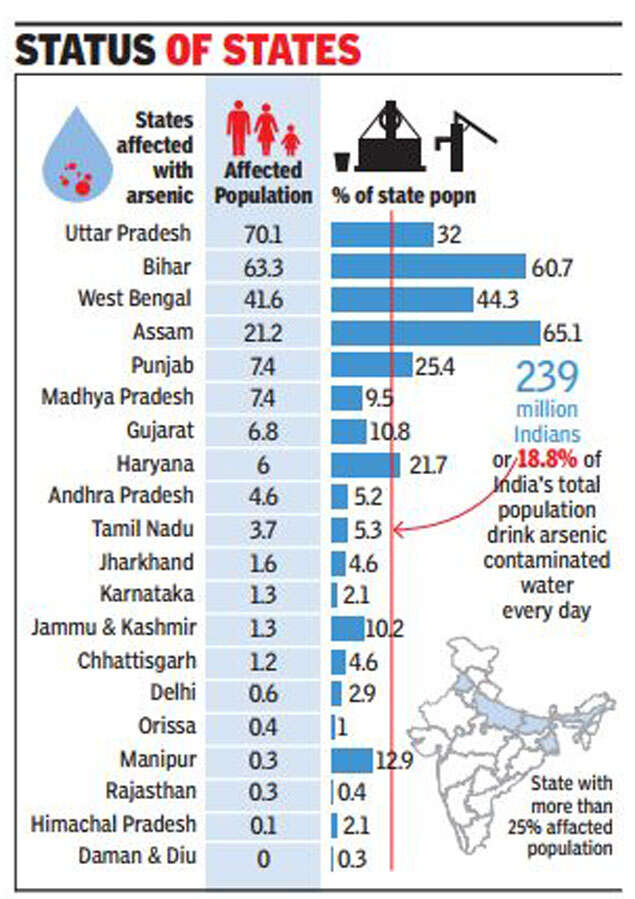
According to the latest report of the Central Ground Water Board (CGWB), 21 states across the country have pockets with arsenic levels higher than the BIS stipulated permissible limit of 0.01 milligram per litre (mg/l).
The states along the Ganga-Brahmaputra-Meghna (GBM) river basin — Uttar Pradesh, Bihar, Jharkhand, West Bengal and Assam — are the worst affected by this human-amplified geogenic occurrence.
In India, arsenic contamination was first officially confirmed in West Bengal in 1983.
Close to four decades after its detection, the scenario has worsened.
About 9.6 million people in West Bengal, 1.6 million in Assam, 1.2 million in Bihar, 0.5 million in Uttar Pradesh and 0.013 million in Jharkhand are at immediate risk from arsenic contamination in groundwater.
Effects of arsenic poisoning
Long-term exposure to arsenic in drinking water can cause cancer in the skin, lungs, bladder and kidney. It can also cause other skin changes such as thickening and pigmentation.
The likelihood of effects is related to the level of exposure to arsenic and in areas where drinking water is heavily contaminated, these effects can be seen in many individuals in the population.
Increased risks of lung and bladder cancer and skin changes have been reported in people ingesting arsenic in drinking water at concentrations of 50 µg/litre, or even lower.
Affecting food
Recent research says arsenic contamination in groundwater has penetrated the food chain.
It eventually causes photo-accumulation of arsenic in the food crops, especially in the leaves, can emanate from contaminated water sprayed on them.
Yet the focus remained on drinking water, and the affected regions became the primary stake-holder in the mitigation approach.
Way forward
Mitigation measures — that are currently focused on drinking water — must have a more comprehensive approach to ensure arsenic-free water for drinking and agricultural products.
That means that the government must check for arsenic in water used for agricultural produce.
Both the Union and state governments must work toward facilitating research that can investigate the accumulation of arsenic in crops and addressing the agricultural concerns of the affected regions.
They must watch out for arsenic percolation in the food chain and the possibilities of biomagnification.
The government needs to also conduct a larger study on the arsenic contamination of our food chain and its health impacts to understand its spatial spread through the agricultural supply chain.