💥UPSC 2026, 2027, 2028 UAP Mentorship (March Batch) + Access XFactor Notes & Microthemes PDF

Search results for: “”

  • Census 2011 | The basics and summary of important findings

    Index

    • What is the census?
    • When was the first census in India held
    • Why the census is important
    • Key Findings of the Census of India 2011

    census_2011_image_1

    What is the census?

    Census is nothing but a process of collecting, compiling, analyzing, evaluating, publishing and disseminating statistical data regarding the population. It covers demographic, social and economic data and are provided as of a particular date.

    When was the first census in India held?

    Census operations started in India long back during the period of the Maurya dynasty. It was systematized during the years 1865 to 1872, though it has been conducted uninterruptedly from the year 1881 being a trustworthy resource of information.

    Why is the census important?

    1. The Indian Census is the most credible source of information on Demography (Population characteristics), Economic Activity, Literacy and Education, Housing & Household Amenities, Urbanisation, Fertility and Mortality, Scheduled Castes and Scheduled Tribes, Language, Religion, Migration, Disability and many other socio-cultural and demographic data since 1872. Census 2011 is the 15th National Census of the Country. This is the only source of primary data in the village , town and ward level, It provides valuable information for planning and formulation policies for Central and the State Governments and is widely used by National and International Agencies, scholars, business people, industrialists, and many more.

    2. The delimitation/reservation of Constituencies – Parliamentary/Assembly/Panchayats and other Local Bodies is also done on the basis of the demographic data thrown up by the Census. Census is the basis for reviewing the country’s progress in the past decade, monitoring the ongoing Schemes of the Government and most importantly, plan for the future.

    Key findings of Census of India 2011 (Summary for UPSC Notes)
    Source
    Key Findings Data & Statistics
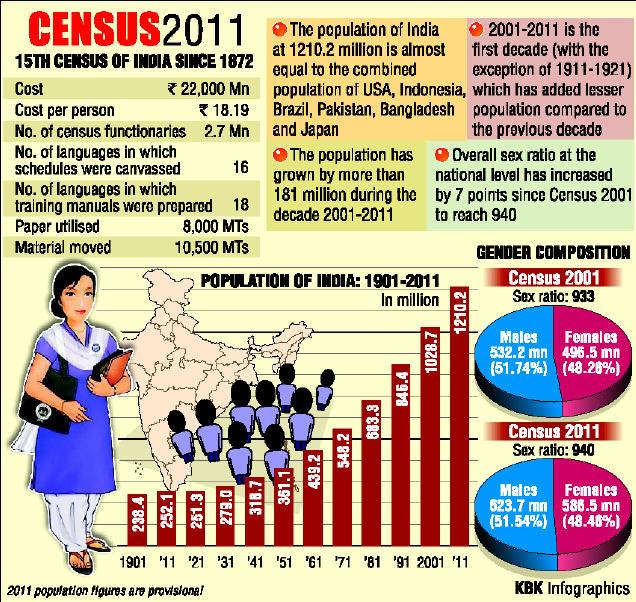
    Total Population (2011) 1.21 billion (an increase of 17.7% from the previous decade).
    Male-Female Population Growth Males: Increased by 90.97 million. Females: Increased by 90.99 million. Growth rate: Females (18.3%) higher than Males (17.1%).
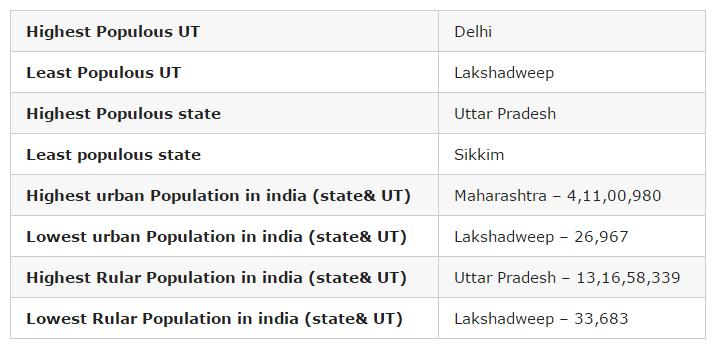
    Rural vs Urban Population Rural: 833.5 million (more than two-thirds). Urban: 377.1 million (urban proportion increased to 31.2% from 17.3% in 1951). Highest urban population in Delhi (97.5%).
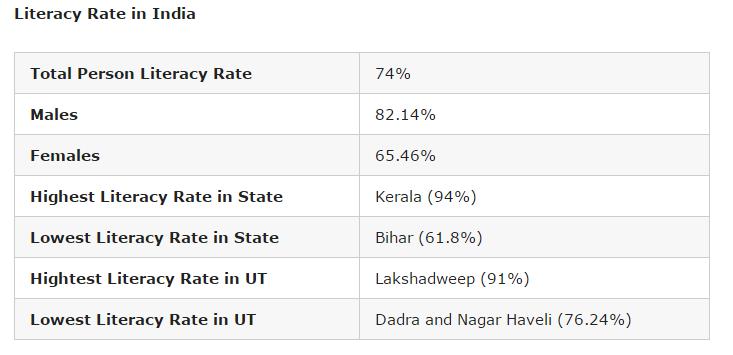
    Literacy Rate 73% (up from 64.8% in 2001). Male literacy: 80.9%, Female literacy: 64.6%. Highest literacy rates: Kerala (94%), Lakshadweep (91.8%), Mizoram (91.3%).
    Population Density Increased from 325 (2001) to 382 (2011) per sq. km. Highest density: Delhi (11,320 per sq. km). Lowest: Arunachal Pradesh (17 per sq. km).
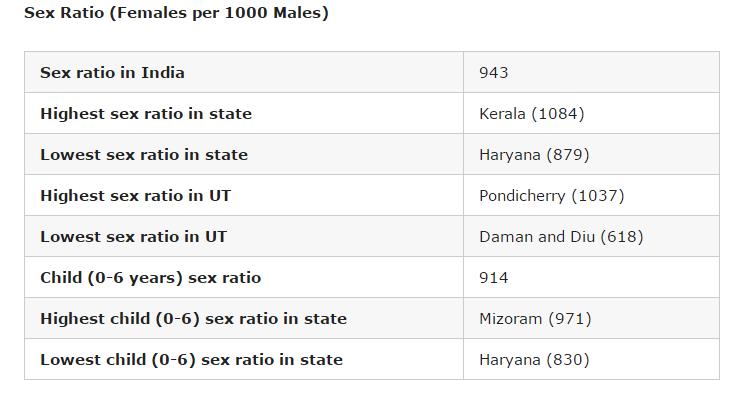
    Sex Ratio 940 females per 1000 males (an increase from 933 in 2001). Highest: Kerala (1,084 females per 1000 males). Lowest: Haryana (879 females per 1000 males).
    Child Population (0-6 years) 164.5 million (0.4% increase from 2001). Child sex ratio: 919 females per 1000 males (a decline from 927 in 2001).
    SC/ST Population SC: 201.4 million (20% increase from 2001). ST: 104.3 million (23.7% increase from 2001).
    Religious Demographics Hindus: 79.8%, Muslims: 14.23%, “No Religion” category: 2.87 million (0.24%).
    Median Marriage Age Men: 23.5 years (up from 22.6 in 2001). Women: 19.2 years (up from 18.2 in 2001).

    1. Population of India as per 2011 Census

    • India’s total population stands at 1.21 billion, which is 17.7 per cent more than the last decade, and growth of females was higher than that of males.
    • There was an increase of 90.97 million males and increase of 90.99 million females. The growth rate of females was 18.3 per cent which is higher than males — 17.1 per cent. India’s population grew by 17.7 per cent during 2001-11, against 21.5 per cent in the previous decade.
    • Among the major states, highest decadal growth in population has been recorded in Bihar (25.4 per cent) while 14 states and Union Territories have recorded population growth above 20 per cent.

    2. Rural and urban population as per 2011 Census Data

    • Altogether, 833.5 million persons live in rural area as per Census 2011, which was more than two-third of the total population, while 377.1 million persons live in urban areas. Urban proportion has gone up from 17.3 per cent in 1951 to 31.2 per cent in 2011. Empowered Action Group (EAG) states have lower urban proportion (21.1 per cent) in comparison to non-EAG states (39.7 per cent).
    • Highest proportion of urban population is in NCT Delhi (97.5 per cent). Top five states in share of urban population are Goa (62.2 per cent), Mizoram (52.1 per cent), Tamil Nadu (48.4 per cent), Kerala (47.7 per cent) and Maharashtra (45.2 per cent).

    3. Literacy Rate as per Census of India 2011

    • Literacy rate in India in 2011 has increased by 8 per cent to 73 per cent in comparison to 64.8 per cent in 2001.
    • While male literacy rate stands at 80.9 per cent – which is 5.6 per cent more than the previous census, the female literacy rate stands at 64.6 per cent — an increase of 10.9 per cent than 2001.
    • The highest increase took place in Dadra and Nagar Haveli by 18.6 points (from 57.6 per cent to 76.2 per cent), Bihar by 14.8 points (from 47.0 per cent to 61.8 per cent), Tripura by 14.0 points (from 73.2 per cent to 87.2 per cent)
    • Improvement in female literacy is higher than males in all states and UTs, except Mizoram (where it is same in both males and females) during 2001-11.
    • The gap between literacy rate in urban and rural areas is steadily declining in every census. Gender gap in literacy rate is steadily declining in every census. In Census 2011, the gap stands at 16.3 points.
    • Top five states and UTs, where literacy rate is the highest, are Kerala (94 per cent), Lakshadweep (91.8 per cent), Mizoram (91.3 per cent), Goa (88.7 per cent) and Tripura (87.2).
    • The bottom five states and UTs are Bihar (61.8 per cent), Arunachal Pradesh (65.4 per cent), Rajasthan (66.1 per cent), Jharkhand (66.4 per cent) and Andhra Pradesh (67 per cent).
    4. Census 2011 Population Density Data

    • The density of population in the country has also increased from 325 in 2001 to 382 in 2011 in per sq km. Among the major states, Bihar occupies the first position with a density of 1106, surpassing West Bengal which occupied the first position during 2001.
    • Delhi (11,320) turns out to be the most densely inhabited followed by Chandigarh (9,258), among all states and UT’s, both in 2001 and 2011 Census. The minimum population density works out in Arunachal Pradesh (17) for both 2001 and 2011 Census.

    5. India’s Sex ratio as per 2011 Census

    • The sex ratio of population in the country in 2011 stands at 940 female against 1000 males, which is 10 per cent more than the last census when the number female per thousand male stood at 933. Haryana has the dubious distinction of having the worst male-female ratio among all states while Kerala fares the best.
    • The number of females per 1000 males in Haryana in 2011 stands at 879 followed by Jammu and Kashmir (889 female) and Punjab (895 females).
    • The other two worst-performing states in terms of skewed sex ration are Uttar Pradesh (912 females) and Bihar (918 females).
    • Five top performing states in terms of sex ratio were Kerala (1,084 females), Tamil Nadu (996), Andhra Pradesh (993), Chhattisgarh (991), Odisha (979).
    6. Child population in India as per Census of India 2011

    • Child population in the age of 0 to 6 years has seen an increase of 0.4 per cent to 164.5 million in 2011 from 163.8 million in 2001.
    • The child population (0-6) is almost stationary. In 17 states and UTs, the child population has declined in 2011 compared to 2001.
    • With the declaration of sex ratio in the age group 0-6, the Census authorities tried to bring out the recent changes in the society in its attitude and outlook towards the girl child. It was also an indicator of the likely future trends of sex ratio in the population.
    • There has been a decline of 8 per cent in the sex ratio of 0-6 age group. In 2011, the child sex ratio (0-6) stands at 919 female against 1000 male in comparison to 927 females in 2001.
    • Male child (0-6) population has increased whereas female child population has decreased during 2001-11. Eight states, Jammu and Kashmir, Rajasthan, Uttar Pradesh, Bihar, Jharkhand, Arunachal Pradesh, Mizoram, and Meghalaya have proportion of child population more than 15 per cent.
    • The worst performing states in regard to sex ration in the age group of 0 to 6 years are Haryana (834 females), Punjab (846), Jammu and Kashmir (862), Rajasthan (888) and Gujarat (890).
    • The best performing states are Chhattisgarh (969), Kerala (964), Assam (962), West Bengal (956) Jharkhand (948) and Karnataka (948).

    7. SC/ST data as per 2011 Census Data

    • According to the Census, Scheduled Castes are notified in 31 states and UTs and Scheduled Tribes in 30 states. There are altogether 1,241 individual ethnic groups, etc. notified as SC’s in different states and UT’s.
    • The number of individual ethnic groups, etc. notified as ST’s is 705. There has been some changes in the list of SC’s/ST’s in states and UT’s during the last decade.
    • The SC population in India now stands at 201.4 million, which is 20 per cent more than the last census. The ST population stands at 104.3 million in 2011 – 23.7 per cent more than 2001.

    8. Religious demographics as per Census of India 2011

    The religious data on India Census 2011 was released by the Government of India on 25 August 2015. Hindus are 79.8% (966.3 million), while Muslims are 14.23% (172.2 million) in India. For the first time, a “No religion” category was added in the 2011 census. 2.87 million Were classified as people belonging to “No Religion” in India in the 2011 census. – 0.24% of India’s population of 1.21 billion. Given below is the decade-by-decade religious composition of India till the 2011 census. There are six religions in India that have been awarded “National Minority” status – Muslims, Christians, Sikhs, Jains, Buddhists and Parsis.

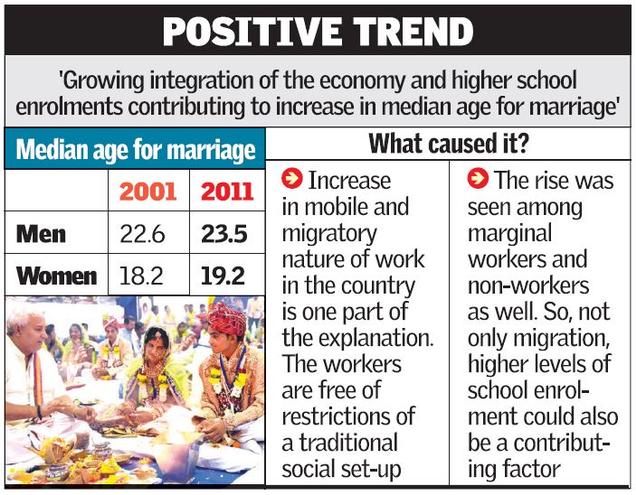
    9. Median marriage age as per Census 2011

    The median age increased for men – from 22.6 (2001) to 23.5 (2011) and for women – from 18.2 (2001) to 19.2 (2011)
    Source

    The next part of the series will cover the 2011 Socio Economic Caste Census (SECC). You must have read about it many times in the news, reading it on Civils Daily will make you clear as to what it’s actually about!

    FAQs

    1. What is the percentage of the child population in India according to Census 2011?

    According to the Census 2011, children aged 0-6 years constituted 13.12% of India’s total population.

    2. What are the important facts from Census 2011?

    • Total Population: 1.21 billion.
    • Male-Female Ratio: 940 females per 1000 males.
    • Literacy Rate: 74.04% (Male: 82.14%, Female: 65.46%).
    • Decadal Growth Rate: 17.64%.
    • Child Sex Ratio: 919 females per 1000 males.

    3. What is the caste-wise population distribution in India as per Census 2011?

    • The caste-based population data is not published as part of Census 2011. However, estimates suggest that Scheduled Castes (SCs) and Scheduled Tribes (STs) constitute around 16.6% and 8.6% of the total population, respectively.

    4. Where can I get a summary of the 2011 Census for UPSC?

    Various summaries and detailed PDF documents on Census 2011 tailored for UPSC preparation are available on government and educational platforms. You can find them by searching “Census 2011 UPSC PDF” or referring to sources like Civilsdaily and NCERT resources

    5. When is the latest Census of India conducted?

    The latest census was planned for 2021, but it has been delayed due to the COVID-19 pandemic. The data collection is still pending as of the last update.

  • 12 Oct 2016 | Debate | Should we go for more surgical strikes?

    Despite the recent surgical strikes there have been more attacks on army installations and increased infiltration attempts. The Pampore operation is still going on. See here for a brief update – http://indianexpress.com/article/india/india-news-india/pampore-security-operation-to-flush-out-militants-enters-third-day-3078056/

    Today’s debate is – If you were the National Security Advisor and were given the responsibility of deciding, by the PM, whether to go for more surgical strikes or not, what would be your decision? Keep in mind that the Pakistani Army is now more alert and future surgical strikes could result in Indian casualties.

  • 12 Oct 2016 | GS4 | The public will only trust the government when it delivers its services efficiently. What are the challenges in delivering services efficiently? How will you improve the delivery?

    GS4 (Quality of service delivery)

    The public will only trust the government when it delivers its services efficiently. What are the challenges in delivering services efficiently? How will you improve the delivery?

    Best answer

    Srishty Srivastava wrote the best answer for this question and got a score of 4.5/10 (if the best answer is an image, it cannot be uploaded here, hence scroll down to see those). The answer is being reproduced below for everyone’s convenience. Of course these answers can always be improved. (Best answer  of a particular only involves those given on that day, later answers may not have been checked)

    The public’s faith and trust in the government depends on its ability to perform its duties in an proper manner. Service delivery is an important duty of the government and so, failure in providing public services tarnishes the credibility of the establishment.
    Challenges in delivering service are manifold:-
    1. Citizen Charter:- Lack of uniformity in standards at state level, ambitious standards that are difficult achieve.
    2. Poor targetting and leakages resulting in exclusion and inclusion errors
    2. Ineffective monitoring and review mechanism in order to flag off inefficiencies in processes
    3. Lack of an effective grievance redressal mechanism
    4. Bureaucratic Apathy
    5. Corruption, Nepotism, conflict of interest starting from the lower rungs to the top of hierarchy
    6. Lack of active disclosures under RTI due to problems with handling and storing data resulting in lack accountability and transparency

    The solution would lie in:
    1. embracing e-governance and ICT solutions to solve the problems of lack of accountability and transparency. Only digitisation of processes would not solve the problem. Revamping of the entire process is needed in application of ICT.
    2. Citizen Charter Bill may help in streamlining and homogenising the service standards, quality control, redressal mechanism.
    3. Active transparency under RTI must be encouraged and incentivised.
    4. Grievance redressal must be made more user-friendly and time-bound with better UI, information placement, system of escalation in case of dissatisfaction with remedial measures.
    5. Bureaucracy must be empathetic to the needs of citizens and ensure that laws are not used to exploit the citizens but to aid them.

    Servitude, sense of social justice, empathic responses to the needs of citizens and accountability in duty are the essence of a successful public service delivery paradigm. Therefore, an attitudinal change is required on part of the government. The rest will follow.

  • 12 Oct 2016 | GS3 | In order to curb the level of vehicular pollution and not to be left behind than the developed nations, India has decided to meet the implementation of BS VI norms by 2020 skipping BS V implementation. What are Bharat Stage (BS) norms? What are the benefits of these norms and what are the challenges automobile manufacturers and the consumers face if India skip BS V and directly implements BS VI?

    GS3 (Science and Technology- developments and their applications and effects in everyday life Achievements of Indians in science & technology; indigenization of technology and developing new technology)

    In order to curb the level of vehicular pollution and not to be left behind than the developed nations, India has decided to meet the implementation of BS VI norms by 2020 skipping BS V implementation. What are Bharat Stage (BS) norms? What are the benefits of these norms and what are the challenges automobile manufacturers and the consumers face if India skip BS V and directly implements BS VI?

    Best answer

    Akshay Bansode wrote the best answer for this question and got a score of 4/10 (if the best answer is an image, it cannot be uploaded here, hence scroll down to see those). The answer is being reproduced below for everyone’s convenience. Of course these answers can always be improved. (Best answer  of a particular only involves those given on that day, later answers may not have been checked)

    Bharat Stage is Indian Standard of Pollution control norms.Its applicable on Oil Manufacturing Company and Automobile Manufacturer. With successive upgradation Pollution control norms become more strict like,
    — Lesser content of so2/no2 released.
    — proper filtration of PM level and other toxic particle.
    With 2020 Country aims to implement BS-6 fully.

    Benefits:
    1) BS is in sync with european standard thus No question on India’s Standard of Pollution control.
    2) Will contribute more to India’s INDC efforts as BS triggered Pollution control norms with successive upgradation.
    3) BS-6 will filter low PM level from air along with no2 and so2 hence will benefit in fight against astham and lungs problem.
    4) will be in line with Article 21 right to Pollution free environment.

    Challenge faced on direct jump to BS-6 skipping BS-5 norms:

    A) Automobile Mfg:
    1) Adaptation of Technology may take some time hence can harm Market since Foreign Firms already has advanced technology.
    2) Finance needed for upgradation of Technology.
    3) Added Mfg cost will increase Market prices of Automobile hence dwarfing of consumer base.

    B) Consumer:
    1) As Oil Manufacturing Company also need to upgrade fuel hence added petroleum cost will effect transportation cost.
    2)It may lead to inflation too
    3) Interest on car loan too may change.

    Way Forward:
    — Govt should subsidize OMC and Automobile Mfg for Adaptation to fuel standard.
    — Govt can Consider for MoU with developed country for transfer of Technology.

  • 12 Oct 2016 | GS2 | According to some experts, SC has been unable to focus on matters of constitutional importance due to regular functioning. For what reasons does India need a National Court of Appeal? Critically examine the pros and cons of having a National Court of Appeal.

    GS2 (Structure, organization and functioning of the Executive and the Judiciary Ministries and Departments of the Government)

    According to some experts, SC has been unable to focus on matters of constitutional importance due to regular functioning. For what reasons does India need a National Court of Appeal? Critically examine the pros and cons of having a National Court of Appeal.

    Best answer

    Bhavika wrote the best answer for this question and got a score of 4.5/10 (if the best answer is an image, it cannot be uploaded here, hence scroll down to see those). The answer is being reproduced below for everyone’s convenience. Of course these answers can always be improved. (Best answer  of a particular only involves those given on that day, later answers may not have been checked)

    Currently the Supreme court is the court of appeal for all 24 High courts of the country which has led to the huge case pendency & backlogs also leads to difficulties for a common man.It is in this context that the idea of NCA with regional or zonal courts of appeal is mooted.

    NEED-

    1. people have to face both physical and financial difficulties to travel & stay in New delhi.
    2. almost all cases from HCs arrive to SC for appeal which leads to erosion of authority of HCs & inablity of SC to concentrate on determining only fundamental questions of constitutional importance.

    PROS-

    1. access to justice due to geographical proximity
    2. speedy & efficient delivery of justice
    3. increase in powers & authority of regional courts
    4. save time and expertise

    CONS-

    1. require an amendment in Article 130 of the Constitution which is impermissible as this would change the constitution of the Supreme Court completely.
    2.dilute constitutional superiority of SC
    3. conflict between courts on the question of jurisdiction
    4. lack of competent human resource
    5. dire need is not presented by the states or political class

    WAY FORWARD-

    1. arbitration centres and lok adalats
    2. strengthen subordinate judiciary (high courts)
    3. The challenges to orders of tribunals must only be allowed to be entertained by Division Benches of High Courts and not directly to the Supreme Court.

    Thus we need to strategize and reconfigure our existing judicial hierarchy to the rising challenges before adding a new layer to it.

  • 12 Oct 2016 | GS1 | Recently Bihar government has put a ban on alcohol consumption in the state. What are the social and economic costs the state may suffer due to the ban? Do measures like alcohol ban prove effective in reforming the society and reducing cases of domestic violence?

    GS1 (Indian society)

    Recently Bihar government has put a ban on alcohol consumption in the state. What are the social and economic costs the state may suffer due to the ban? Do measures like alcohol ban prove effective in reforming the society and reducing cases of domestic violence?

    Best answer

    Aman Chauhan wrote the best answer for this question and got a score of 5/10 (if the best answer is an image, it cannot be uploaded here, hence scroll down to see those). The answer is being reproduced below for everyone’s convenience. Of course these answers can always be improved. (Best answer  of a particular only involves those given on that day, later answers may not have been checked)

    Populistic promises like alcohol ban find ample support from women section in the society . Alcohol menace leads to
    1. Increased road traffic accidents
    2. Increased domestic violence against women
    3. Decreased family fortunes
    4. Increased health woes
    5. Increases crime in society

    From TamilNadu ,Gujarat(dry state) to Bihar and Kerala ,govt is resorting to banning alcohol sale in the states to curb this menace arising out of its consumption .But, it has its social and economic costs like – 1.It deprives individual of right to choice and personal liberty.

    2.criminalises the activity of sales and leads to bootlegging ,liquor mafias and increased sale of spurious liquor along with corruption eg. Recently 15 people died due to consumption of spurious liquor in Bihar.

    3. Takes away precious revenue – Approximately 30000crore was earned in revenues in 2015-16 from sale of alcohol and excise on manufacturing spirits . This income helps to splurge expenditure on social sector like free rice to all ration card holders , financing noon meal schemes in schools and anganwadis.

    4.Tourism industry of that particular state takes a hit as it is seen as unattractive to tourists due to such bans for eg. Kerala 5. Disposes people to more harmful addictions of cannabis ,LSD,cocaine ,etc.
    6.Its noted that manual labour often take some amounts of alcohol which helps them to do heavy lifting and loading without hampering their working capacity. Alcohol ban may be unwanted for such labourers

    Undoubtedly , ban on consumption of intoxicating substances is Gandhian DPSP but, it doesn’t magically transform the society and increases other ills ,domestic violence decreases marginally but families worsen due to spike in consumption of other harmful substances . So way forward is –

    1. Find alternate sources of revenue
    2.ramp up law and order machinery to check sale of spurious liquor
    3.check its sale to juveniles
    4.Increase awareness about domestic violence act
    5.spreading awareness campaigns and advertisements about ills of alcohol consumption so that individuals monitor themselves rather than the government .

    History is against total clampdown on liquor consumption. what govt can do is regulate
    rather then introduce a blanket ban.

  • 12 Oct 2016 | Prelims Daily: CA Questions with Tikdams & Tidbits

    Dear students,

    When you submit your answer, if possible, give some reasoning & more info. along with the ABACAA format. Elaborate on what you know. This helps the whole community to know more and learn more!


    Q.1) Consider following statements in regard with ‘Nobel Memorial Prize in Economic Sciences’.

    1. This year’s Nobel Prize in Economic Sciences goes to contributions in Game theory.

    2. Contract theory explains how contracts help people deal with conflicting interests.

    3. The economics prize is not an original Nobel Prize, and was added in 1968.

    Which of the statements given above is/are correct?  

    a) 1 and 2 only

    b) 3 only

    c) 2 and 3 only

    d) 1, 2 and 3 only


    Q.2) Consider following statements about ‘Montreal protocol on Substances that Deplete the Ozone Layer’.

    1. Protocol to the Vienna Convention for the Protection of the Ozone Layer

    2. This Protocol does not address hydrofluorocarbon (HFC), but these substances figure in the Kyoto Protocol

    Which of the statements given above is/are correct?  

    a) 1 only

    b) 2 only

    c) Both 1 and 2

    d) Neither 1 nor 2


    Q.3) The amendment to the Montreal Protocol to phase out the use of HFCs is likely to be finalised in which of the following country?

    a) Rwanda

    b) South Africa

    c) Kenya

    d) India


    Q.4) Consider following statements.

    1. A new termite species, Glyptotermes Chiraharitae, has been discovered in the Malabar Wildlife Sanctuary

    2. The species are named ‘Chiraharitae’, after the tropical evergreen forests of the Eastern Ghats

    Which of the statements given above is/are correct?  

    a) 1 only

    b) 2 only

    c) Both 1 and 2

    d) Neither 1 nor 2


    Q.5) Consider following statements about ‘Pradhan Mantri Kaushal Vikas Yojana’.

    1. Scheme is implemented by Ministry of Skill Development and Entrepreneurship through the National Skill Development Corporation (NSDC).

    2. Skill training is based on the National Skill Qualification Framework (NSQF) and industry led standards.

    Which of the statements given above is/are correct?  

    a) 1 only

    b) 2 only

    c) Both 1 and 2

    d) Neither 1 nor 2


    IMPORTANT STUFF: 

    1. These questions are mostly derived from our daily newscards. Reading daily news from Civilsdaily’s App (click here) or website + solving these questions will help you reinforce the basics.

    2. For a comprehensive preparation of IAS Prelims 2017 – consider joining one of the three Prelims Modules by CD – prelims.civilsdaily.com

    3. Solutions will be uploaded at 8 p.m. Click here for solutions.

    4. For attempting previous Prelims Daily Questions – Click here

    5. How to apply Tikdams? Read this, this and this

  • Internal Security Issues 102 – Jammu and Kashmir Issue | Part 3

    In the third part of the Kashmir issue series, we focus on the the steps being taken by the Government to address the issue and the way ahead. (The first part of the series analysing historical causes behind the Kashmir unrest can be found here. The second part of the series which explains the contemporary issues can be found here.)

    Steps being taken by the Government to address the issue:

    1. Special Industry Initiative (SII J&K) ‘UDAAN’

    The Government of India has launched the Scheme Special Industry Initiative for Jammu & Kashmir “Udaan” in the nature of a partnership between the corporates of India and the Ministry of Home Affairs. The Scheme is being implemented by the National Skill Development Corporation (NSDC).

    The Programme aims at providing skills and enhancing employability of unemployed youths of J&K who are graduates, post graduates or three year engineering diploma holders.

    2. Schemes like ‘Nai Manzil’ and ‘USTAAD’

    Nai Manzil Scheme is an integrated Education and Livelihood Initiative for the Minority Communities. The scheme aims to benefit the minority youths who are school-dropouts or educated in the community education institutions like Madrasas, by providing them an integral input of formal education (up till Class VIII or X) and skill training along with certification. The scheme covers the entire country and was launched in Jammu and Kashmir on 20th January 2016.

    The USTAAD (Upgrading the Skills and Training in Traditional Arts/Crafts for Development) scheme aims to preserve rich heritage of traditional arts and crafts of minorities and build capacity of traditional artisans and craftsmen.

    3. People to People Contact Across LoC (Confidence Building Measures)

    •  Cross LoC Travel

    A fortnightly bus service was started across LoC in 2005. Taking into account the good response to these Confidence Building Measures (CBMs) from both sides of the LoC, the fortnightly bus services on both the routes were converted into a weekly service in 2008.

    • Cross LoC Trade between J&K and PoJK
    • Upgradation of Trade Facilitation Centre (TFC) Sites at Salamabad and Chakan-da-Bagh

    4. Protection of Human Rights in J&K

    The Security Forces are under instructions to respect the human rights of all people and work steadfastly with a humane face while performing their day-to-day operational duties. Every reported case of alleged human rights violations is taken serious note of, and investigation is done promptly in a transparent manner.

     The way ahead:

    The problem with our handling of the Kashmir issue is that we look for solutions only when there is trouble. But once the trouble subsides, the issues are kept on a backburner. There is therefore a need to look for sustainable political solutions some of which could be:

    1. Repeal or at least amend AFSPA

    Even a symbolic and geographically limited revocation of the Armed Forces Special Powers Act (AFSPA) would signal the right intention of the Indian state to the Kashmiri people. A token beginning, at the least, should be made to set the stage for a gradual process of AFSPA revocation

    2. Release political prisoners.

    3. Institute a broad based inquiry into extrajudicial killings in Kashmir.

    4. Open a result oriented dialogue with the Valley’s dissidents to discuss the larger political questions. If the Indian state could strike a peace deal with the Naga insurgents, why not Kashmir?

    5. Kashmir needs political engagement along with economic uplift.

    6. While it is necessary to take stern action against terrorism and insurgency, such action should not adversely affect civil liberties and human rights of people.

    7. Public awareness and involvement is critical. Integral to any move towards betterment is better educating the public and creating more opportunities for people from either side of the border to interact so as to decrease the rift that has emerged between civilians in India and Pakistan.

    8. The world today is far more concerned about Pakistan’s role as an incubator of terror. The world knows that if Pakistan has its way in Kashmir, it will give a huge boost to terror. Therefore all that remains to be done is addressing the grievances of Kashmiris and winning back their confidence.

    Conclusion:

    No democracy would easily permit secession of any of its parts, and no democracy can afford to ignore for long the wishes of any of its people. With terrorism engulfing the region and the Islamic State waiting at the gates for an opening, India can ill afford not to pacify its domestic insurgencies.

    Addressing the true elements of the conflict involves striving for justice, truth, peace, mercy and ultimately reconciliation.

    Truth relates to acknowledging the past, the rights and the wrongs, the decisions made, actions taken and their consequences on all involved. Justice and mercy are then integral to providing closure to grievances that arise from these truths, in the form of legal retribution, simple acknowledgment of wrongdoing, mercy for Kashmiris who joined the militancy by recognizing the concerns and circumstances that led them to turn violent and assistance to the people to help them rebuild their lives and livelihoods and move forward. Peace is related not only to a ceasefire but also to the re-establishing of relationships across the various borders that this conflict entails and provide the integral basis for long term reconciliation.

    Quotable Quotes

    “When a state resorts to violence against its own citizens, it is confessing that it no longer has the strength and power of legitimate authority to command the compliance without coercion”

    “The problem with violence is that the end to which it is directed is always in danger of being overwhelmed by the means it justifies”


  • Internal Security Issues 102 – Jammu and Kashmir Issue | Part 2

    In the second part of the Kashmir issue series, we focus on the recent developments in Kashmir and the surrounding issues, e.g. the 2014 Assembly Elections, the recent curfew and the pellet guns issue, the issue of article 370, the issue of return of Kashmiri Pandits and some positive developments. (The first part of the series is here.)

     The 2014 Assembly Elections and a hope for change:

    Jammu & Kashmir held Assembly elections in November-December 2014, the results of which are significant for two reasons:

    • The elections witnessed the highest voters’ turnout in the last 25 years (more than 65%) despite repeated boycott calls by separatist Hurriyat leaders.
    • The coming together of the Peoples Democratic Party (PDP) and Bharatiya Janata Party (BJP) presents a historic opportunity to bridge two divides. The first is the divide between the Jammu and Kashmir regions of the state. The second is the divide between the Kashmir Valley and the Indian Union.

    The recent turmoil and the pellet guns issue:

    In early July a young Kashmiri Burhan Wani was killed by the Indian security forces in an encounter. He was commander of the military outfit Hizbul Mujahideen.

    Burhan Wani was projected as a hero and a victim of state atrocities by the local Hurriyat leaders, Pakistani media and certain sections of Kashmiri media and population.

    Consequently, his death was followed by violent protests from Kashmiris who defied curfews with attacks on security forces and public properties. At least 68 civilians and two security officials died and more than 9,000 people were injured in over 50 days of violence according to official tallies.

    The use of pallet guns by the army and police to control the mob and restore law and order was also put under lot of criticism as it led to injuries and blinding of many people.

    The crisis is projected as the worst since 1990s.

    Concerns:

    • The Indian state has been subjected to a lot of criticism in the wake of dying civilians. But a simple comparison from other conflict zones in the world would show that a casualty figure of 70 in 45 days of controlling very violent crowds shows exemplary restraint by the Indian forces.
    • The use of pellet guns which have led to more than 100 eye surgeries and numerous blindings are an area of concern. Pellet guns have been used to break up protests in Egypt, Bahrain and Tunisia, but most countries do not use them on unarmed civilians, as the pellets spray widely and cannot be aimed. The MHA has now decided that while a total suspension of pellet guns would not be possible, given the imperative of the security of the personnel of the CRPF and J&K police but a greater reliance would be placed on PAVA shells which contain Pelargonic Acid Vanillyl Amide, an organic compound found in chilli pepper.
    • The profile of the protesters—a large number of them barely out of their teens—also raises important questions. Do these young men know what they are doing? Or are they being used by separatist and Islamist forces in the Valley and outside for their political objectives? The death of young men is an effective way of evoking horror from across the world, in the process painting the Indian state as a brutal regime.

    Other Issues:

    The issues regarding Article 370

    What is Article 370?

    • Article 370 of the Indian Constitution is a ‘temporary provision’ which grants special autonomous status to Jammu and Kashmir.
    • Except for defence, foreign affairs, finance and communications, the Parliament needs the state government’s concurrence for applying all other laws.

    Is Article 370 still intact in its original form?

    1. No, the “autonomy” has been diluted:

    • A series of Presidential Orders have eroded Article 370 substantially.
    • In fact today the autonomy enjoyed by the State is a shadow of its former self, and there is virtually no institution of the Republic of India that does not include J&K within its scope and jurisdiction.

    2. The only substantial differences from many other States relate to:

    • Permanent residents and their rights;
    • The non-applicability of Emergency provisions on the grounds of “internal disturbance” without the concurrence of the State;
    • The name and boundaries of the State, which cannot be altered without the consent of its legislature.

     Can Article 370 be Revoked Unilaterally?

    Article 370 can be revoked only if a new Constituent Assembly of Kashmir recommends revocation. Since the last Constituent Assembly was dissolved in January 1957 after it completed the task of framing the state’s Constitution, so if the parliament agrees to scrap Article 370, a fresh constituent Assembly will have to be formed.

    The constituent Assembly will consist of the same MLAs elected to the State Assembly. Simply put, the Centre cannot repeal Article 370 without the nod of J&K State.

     Should Article 370 be revoked?

    • Arguments in favour:
      1. It has created certain psychological barriers and it is the root cause of all the problems in J&K.
      2. This article encourages secessionist activities within J&K and other parts of the country.
      3. At the time of enactment, it was a temporary arrangement which was supposed to be repealed gradually.
      4. It acts as a constant reminder to the Muslims of J&K that they have still to merge with the country.
    • Arguments Against:
    1. Abrogation of the article 370 will have serious consequences. It will encourage secessionists to demand plebiscite which will lead to internationalization of the issue of J&K.
    2. The contention of Article giving rise to secessionist activities is baseless as states like Assam and Punjab, which do not have any special status have experienced such problems too. Also, separatism grows when people feel disconnected from the structures of power and the process of policy formulation; in contrast, article 370 is synonymous with decentralisation and devolution of power which ensures popular participation in the running of the polity.
    3. It would not only constitute a violation of the solemn understanding given by India through the instrument of accession, but would also create unnecessary misgivings in the minds of people of J&K, making the issue more sensitive.

    Conclusion:

    It can be argued that abrogation of the Article is avoidable as it will certainly be raised internationally by Pakistan and will give a chance to the international community to intervene in J&K. So, maintaining the status-quo would be the best possible strategy as of now.

    The question of Kashmiri pundits

    The exodus of the Kashmiri Pandits from the Kashmiri valley in the early 1990s and the question of their home coming ever since has been both a political and emotional issue.

    Efforts for their return to Kashmir would essentially face the following issues:

    • An assurance of security of life and property for all people who return.
    • Townships in the absence of livelihood opportunities are meaningless. Recreating that environment will be a very tough challenge.

    The question of separate townships: The community in which one lives is a big source of security. Given the history and their concerns for security, pundits would want to live together but the idea of separate townships also poses the following concerns:

    1. Security implications : It is possible that a Pandit township may seem like a more attractive, high-profile target for terrorist groups than dispersed dwellings, and this threat perception is likely to turn these settlements into not just ghettos but heavily militarized compounds, further compromising the prospect for normal life as far its resettled residents are concerned.
    2. Separate townships may be a barrier to unity and intermingling of cultures.

    At the same time, the question of moving the returning pundits to their original homes needs detailed deliberation as many may have been destroyed while others have changed hands. The central as well as state governments need to formulate back-up plans for new permanent houses for those whose property cannot be retrieved for various reasons.

     Previous efforts to resettle Kashmiri pundits:

    An effort was made to resettle Kashmiri Pandits in 2007 under a government job scheme but many people who returned say that they are not happy. They live in migrant colonies and do not have basic amenities like a ration card or even a voter ID card. Some Pandit families in exile remain fearful about continuing threats, and wonder about the wisdom of relocating themselves for a second time when the outcome is uncertain, and their children have developed roots elsewhere in India.

    The way ahead:

    The Kashmiri Pandit community has the right to go back to its state and live peacefully without feeling threatened. But this problem can only be solved if the issue of separatism is addressed. That needs a rethink on political, economic and cultural policies.

    A Silver lining:

    But Kashmir’s story has positives to look at as well.

    • If there is a Burhan Wani, there is also a Shah Faesal who topped the Union Public Service Commission exams in 2009. Since then, scores of Kashmiris have cracked the exams. As many as 10 candidates from the Valley have cleared the exams this year itself including the second rank holder Athar Aamir-ul-Shafi Khan.
    • Around 20,000 aspirants turned up last year to fill 55 vacancies in the Indian army.
    • Despite Hurriyat hardliner Syed Ali Shah Geelani’ s call to Kashmiris against joining police service last month, more than 5000 youth filed applications and appeared for fitness tests for the post of special police officers in various districts.
    • A budding entrepreneurship narrative has already taken root in the state.

    Thats it for this part!

    The next part in this series will analyse the steps being taken by the Government to address the issue and the way ahead (Click here for part 3). This is supposed to be one of the most comprehensive series in Internal Security related Issues. Your feedback is welcome! 🙂

  • 11 Oct 2016 | GS4 | Is diligence an important value for a civil servant? How would you inculcate it?

    GS4 (Ethics in public administration)

    Is diligence an important value for a civil servant? How would you inculcate it?

    Best answer

    Srishty Srivastave wrote the best answer for this question and got a score of 4.5/10 (if the best answer is an image, it cannot be uploaded here, hence scroll down to see those). The answer is being reproduced below for everyone’s convenience. Of course these answers can always be improved. (Best answer  of a particular only involves those given on that day, later answers may not have been checked)

     Diligence implies steadfast application, assiduousness and industry. It is important for a civil servant as it stems from the belief that work is an end in itself and not a means to an end. Work performed as duty with diligence will be better performed than work performed for some material or non-material gain. As a civil servant, service to the public is our duty, therefore it must be performed with all the diligence and sincerity that one possesses. Therefore, diligence is important in application of other values as well.
    Diligence will make a civil servant go beyond his office hours to complete the assigned work. It will make him/her put in extra effort in reaching out for participation of people and undertaking better due diligence in regulatory compliance.
    It can only be inculcated by a strong motivation towards work and by attempting to think of work not only as a means to achieve something bigger and better like prestige, social status, power but as a reward in itself. Hence, this inculcation can only be an intrinsic one by a change in attitude and mindset towards work. While attitude alignment can be done by rewards and punishments coming from an external source, the transcendence of external gratification can only come from within.

More posts