Please explain planned and non planned expenditure.also capital and revenue expenditures can be planned or unplanned or both ?
Search results for: “”
-
[Solved] IAS Prelims 2016 Mocks #3
Update:
The solutions for this mock are now available in a downloadable pdf. We have tried to make them as detailed as possible and included references and user comments wherever possible. Download link.
“So, let us begin this week with ECOPOL 🙂 Let us see if you just read through the news and events or went a step further to dig some background information about them to stay many steps ahead of your competitors!”
Note #1: For readers armed with their Android phones, you shall not be able to comment on this quiz from the App ecosystem, so please return to your desktops and fill in the comments and discuss!
Note #2: We encourage the test takers to elaborate on their answers in their comments below. That helps us have a better discussion and we will chip in to clarify your doubts or give more information.
1. Consider the following statements:
1. Rural Employment Generation Programme was launched during 1985-86 to provide self-employment opportunities in rural areas.
2. Swarnajayanti Gram Swarozgar Yojana was launched during 1995-96 to bring assisted poor families above the poverty line.
Which of the above statements is/are correct?
(a) 1 only
(b) 2 only
(c) Both 1 and 2
(d) Neither 1 nor 2
2. Which of the following terms indicates a mechanism used by commercial banks for providing credit to the government?
(a) Cash Reserve Ratio
(b) Statutory Liquidity Ratio
(c) Debt Service Obligation
(d) Liquidity Adjustment Facility
3. Which of the following is/are among the indicators used to measure gender inequality in the Gender Inequality Index, introduced in the Global Human Development Report 2010?
1. Maternal Mortality Rate
2. Access to legal system
3. Participation in Labour force
4. Education level
Choose the correct alternative using the codes given below.
(a) 1, 3 and 4 only
(b) 1, 2 and 4 only
(c) 2 and 3 only
(d) 1, 2, 3 and 4
4. Which of the region/grouping of countries has the highest share in overall remittances to India?
(a) EU
(b) North America
(c) GCC
(d) East Asia
5. Which of the following constitute the capital receipts of the central government?
1. Grants from foreign countries
2. Recovery of loans from state governments
3. Resale of shares of Public Sector Undertakings
4. Interest income on the loans extended by it
Choose the correct alternative using the codes given below:
(a) 2 and 3 only
(b) 1, 2 and 3 only
(c) 2, 3 and 4 only
(d) 1 and 4 only
6. Which of the following is/are the tools of ‘Fiscal Policy’?
1. Open Market Operations
2. Taxation
3. Public Expenditure
Choose the correct alternative using the codes given below.
(a) 3 only
(b) 2 and 3 only
(c) 1 and 2 only
(d) 1, 2 and 3
7. ‘Theory of Surplus Value’ is a characteristic feature of which of the following political theories?
(a) Liberalism
(b) Gandhism
(c) Welfareism
(d) Marxism
8. Consider the following statements with respect to the Indian political system:
1. The Cabinet is responsible to the Lok Sabha only.
2. The President is the Head of the State.
3. Every state has equal representation in the Rajya Sabha.
Which of the above statements is/are correct?
(a) 1 and 3 only
(b) 2 only
(c) 1 and 2 only
(d) 1, 2 and 3
9. Which of the following provisions of the Indian Constitution work to protect, preserve and uphold the inviolability of human right in India?
1. Fundamental Rights
2. Directive Principles of State Policy
Choose the correct alternative using the codes given below.
(a) 1 only
(b) 2 only
(c) Both 1 and 2
(d) Neither 1 nor 2
10. In case of states with bicameral legislature, if a money bill passed by the lower house goes to the upper house and no action is taken on it by the upper house for 14 days then the bill
(a) is deemed to have lapsed
(b) is referred to the joint sitting of the state legislature
(c) is deemed to have passed in the form in which it was passed by the lower house
(d) is referred to the Governor for his/her interjection in the matter
11. Which of the following were among the founding member countries of ASEAN?
1. Malaysia
2. Philippines
3. Singapore
4. Indonesia
5. Thailand
Choose the correct alternative using the codes given below.
(a) 2, 3 and 4
(b) 1, 2 and 5
(c) 1, 3, 4 and 5
(d) 1, 2, 3, 4 and 5
12. Which/Who of the following is regarded as the protector and guarantor of the Fundamental Rights enshrined in the Indian constitution?
(a) Supreme Court
(b) President
(c) Parliament
(d) Prime Minister’s Office
13. When the Lok Sabha is dissolved
(a) the Speaker tenders its resignation
(b) the Speaker is removed by an Presidential order
(c) the Speaker continues to hold its position till its successor is elected
(d) the Speaker is removed by a resolution passed in the upper House
14. Which of the following make a part of the Money Stock of an economy?
1. Demand deposits held with commercial banks
2. Currency notes
3. Deposits of commercial banks with the central bank
Choose the correct alternative using the codes given below.
(a) 1 and 2 only
(b) 2 only
(c) 1 and 3 only
(d) 1, 2 and 3
15. The Legal reserves of a commercial bank are maintained with the
(a) central bank only
(b) commercial bank itself and the central bank
(c) central bank and the government
(d) commercial bank itself
16. ‘Stagflation’ is characterised by
(a) High inflation and High unemployment
(b) Low inflation and High unemployment
(c) Low inflation and Low unemployment
(d) High inflation and Low unemployment
17. Foreign Direct Investment (FDI) under the automatic route requires prior approval by the
1. Central Government
2. Reserve Bank of India
Choose the correct alternative using the codes given below.
(a) 1 only
(b) 2 only
(c) Both 1 and 2
(d) Neither 1 nor 2
18. Which one of the following statements is/are not correct?
1. Index of Industrial Production (IIP) is released on a monthly basis only.
2. IIP is released by the Central Statistics Office.
3. Electricity has highest weightage among the indicators used to calculate IIP.
Choose the correct alternative using the codes given below.
(a) 3 only
(b) 1 and 3 only
(c) 2 only
(d) 1, 2 and 3
19. The World Investment Report is brought out by
(a) WTO
(b) IMF
(c) UNCTAD
(d) WEF
20. Which of the following best describes the ‘Bank Rate’?
(a) It is the minimum rate at which commercial banks can advance loans to the clients
(b) It is the rate charged by the central bank for lending funds to the commercial banks
(c) It is the rate that a commercial bank charges from another commercial bank for providing overnight funds to the later
(d) It is the rate which the central bank provides to the commercial bank for parking their surplus funds with the former
21. Which of the following is not a fundamental duty as envisioned in the Indian constitution?
(a) To protect the natural environment
(b) To safeguard public property
(c) To participate in electoral process
(d) To develop scientific temper
22. To protect the domestic industries against the onslaught of unfair competition from cheap imports, anti dumping duty is recommended by the
(a) Ministry of Commerce
(b) Prime Minister’s Office
(c) Ministry of Finance
(d) Confederation of Indian Industry
23. Consider the following statements:
1. A person cannot be appointed the administrator of more then one Union Territory concurrently.
2. Governor of a state cannot be appointed the administrator of a Union Territory concurrently.
Which of the above statements is/are correct?
(a) 1 only
(b) 2 only
(c) Both 1 and 2
(d) Neither 1 nor 2
24. Consider the following statements:
1. NITI Aayog is an attached office of the PMO.
2. Department of Space works under the administrative control of Ministry of Science and Technology.
Which of the above statements is/are correct?
(a) 1 only
(b) 2 only
(c) Both 1 and 2
(d) Neither 1 nor 2
25. Which of the following departments is/are engaged in the protection of intellectual property rights in India?
1. Department of Industrial Policy and Promotion
2. Department of Higher Education
3. Department of Information Technology
4. Department of Agriculture and Cooperation
Which of the above statements is/are correct?
(a) 1 and 2 only
(b) 1, 2 and 4 only
(c) 3 and 4 only
(d) 1, 2, 3 and 4
-
sir, my request to Dr. V to please post geography tit bits too as your work
Work is awesome.
Pleaee do it Dr. V.
-
Global Warming and Greenhouse Gases
Read primer on environmental issues first if you have not read that

Source-dec.ny.gov
Global Warming
Sun is the source of all energy and all life on earth. Sun emits energy in the form of short wave radiations (high energy i.e shortwave)-
- A part of which is reflected back by clouds, aerosols, atmosphere
- A part passes through the atmosphere to reach the earth’s surface which emits it back in the form of longwave radiation – Infra red (low energy, long wave) which warms the atmosphere <atmosphere is warmed by Longwave radiation not shortwave, hence temperature decreases with elevation so called lapse rate> <How does temperature inversion happen then?> and thus there is no net addition to earth’s temperature <oversimplified model but for now it would do>
Note here that, at night when earth would be the net emitter, temperature would reach dangerously low levels. Then how is avg temperature of earth is maintained at levels conducive to life on earth?
Role of Green Houses Gases
- Such gases present in the atmosphere serve as a blanket which trap/absorb some of that Infrared radiation emitted by earth and send some of that back to earth <this effect is k/as Greenhouse effect, you would have observed this in car parked in Sun> and thus help maintain average temperature of earth to 14 <w/o such gases avg temperature would be -16 and life would be impossible on earth>
- But any increase in such gases would result in more heat trapping resulting in increase in the temperature of earth being reflected in Global warming <Why is Venus hotter than Mercury when Mercury is closest to the Sun>
Global warming changes the climate of earth hence Global Warming and climate change are often used anonymously.
Greenhouse Gases
Most abundant GHGs in earth’s atmosphere are–
Water Vapour> CO2> CH4> N2O> Tropospheric Ozone>CFCs <plz note that tropospheric ozone is both a GHG and a pollutant, also included under Air Quality Index. Which other gases are included in AQI?>
- Water vapour has the max overall effect on greenhouse effect but as water vapour is not directly increased or decreased by Human activities, we are not concerned about amount of water vapour in the atmosphere <we are concerned about anthropogenic i.e human induced global warming>
- But as atmosphere warms, there would be more water vapour <more water getting converted into vapour> which would trap even more heat, resulting in even warmer atmosphere <positive reinforcement, so called vicious cycle so common in climate systems>
Global warming Effect of a GHG and GLobal Warming Potential (GWP)
Each gas’ effect on climate change depends on three main factors:
- How Much <higher the concentration, higher the warming>
- How long <more the life span, greater the warming>
- How Powerful <efficiency of heat trapping>
Last 2 factors together determine global warming potential
GWP over 100 years time scale <reference GWP of co2 (lifetime 30-95 years) being taken as 1>
- CH4 -25 <lifetime is only 12 years>
- N2O- 300 <lifetime of >100 years>
- CFC, HFCs, NF3, SF6 etc have over 1000 times GWP than that of CO2 as their lifetime is much longer <not easily degraded> and efficiency of trapping heat much higher.
Let’s Now look at Global Emission by Economic Source
Electricity and Heat Production (25%)>Agriculture, Forestry and land use changes (contribution of agriculture alone is 14%)>Industry (21%)
Kyoto Protocol of UNFCCC initially vowed to reduce concentration of 6 major GHGs and in 2nd Commitment period another gas was added. Let’s look at those 7 in detail

Source-dreamstime
- CO2 – Burning down of Fossil fuels, cutting down and burning of Trees
Concentration of CO2 has increased from 280 in 1750 (pre industrial revolution) to 400 in 2015 i.e increased by 40%
- CH4- Primary source is Agriculture and Animal Husbandry <cows and sheep produce methane when they digest food>, manure when it decays, released from wetlands <waterlogged areas>, leakages during natural gas extraction, transportation < Natural gas is nothing but methane>
- N20– Excess use of nitrogenous fertilizers and bacteria breaking down nitrogen <what is nitrogen fixation and bacteria which helps in that?>, Fossil fuel Burning, Industrial process (nitric acid, synthetic fibres) <what is laughing gas and tear gas?>
- Hydrofluorocarbons (HFC)– refrigerants, aerosol propellants, solvents, and fire retardants. They were used as replacement to CFC and HCFC which was phased out under Montreal Protocol (deplete ozone layer) but they are even more powerful GHG. Now USA is trying to include HFC in montreal protocol even though they do not deplete ozone <what would then be used in refrigeration?>
- Perfluorocarbons (PFC) – aluminum production and semiconductors
- Sulfur Hexafluoride (SF6) – magnesium processing and semiconductor manufacturing, tracer gas for leak detection, electrical transmission equipment, induding circuit breakers.
- Nitrogen Trifluoride (NF3) – latest addition, uses similar to PFCs in electronics industry, semiconductors
- Note 1 – CFCs and HCFCs which are potent GHGs are not included in Kyoto Protocol as they were already being phased out under Montreal Protocol
- Note 2 – Only molecule containing both Chlorine and Fluorine deplete ozone layer, Fluorinated compounds do not, so HFC, NF3, SF6, PFC etc do not deplete ozone layer
Short Lived and Long Lived Climate Forcers
- Factors external to the climate system which force or push the climate towards a new long-term state – either warmer or cooler depending on the cause of change.
- For instance, GHGs would be positive climate forcers (both natural and anthropogenic) as they push climate warming.
- Long-life gases such as CO2, N2O,Fluorinated compounds once emitted exert their effect for long and are k/as Long Lived climate forcers.
- On the other hand gases such as Methane, tropospheric ozone have a very short life and reducing their emission will quickly lead to reduction in their concentration. Black Carbon or soot is one such very short lived climate forcer.
Black carbon –component of fine particulate matter and is formed through the incomplete combustion of fossil fuels and biomass. It’s a positive climate forcing agent and warms the atmosphere by –
- Directly absorbing sunlight
- Reducing albedo when deposited on snow and ice <what is albedo?>
- Indirectly by effects on cloud formation

It has major adverse health effects also <you know about PM 2.5> and contains many carcinogens <cancer causing agent>
Note- BC is the most effective form of PM, by mass, at absorbing solar energy: per unit of mass in the atmosphere, BC can absorb a million times more energy than CO2
- Effect of clouds on global warming?
- What is brown carbon and blue carbon?
Some short lived climate Forcers have cooling effects. For instance – Sulfur aerosols . Fossil fuel combustion emits sulfur dioxide also which then combines with water vapour to form tiny droplets (aerosols) which reflect sunlight <but aerosol lasts 3 days, CO2 warms for 100 years>. But same Sulfur/sulfate is responsible for acid rain
These aerosols are responsible for cooling observed after volcanic eruption and are being investigated for geoengineering <what is geoengineering?>
Now a few charts you need to look at carefully as they would form the basis of climate negotiations we would discuss in the next article
1. Top 10 Absolute emitters of the world
China is the world’s largest emitter and emits about 1/4th of total world emission. India is at 4th spot.

source-wri.org
2. Top 10 Absolute emitter in per capita terms
Note that the chart below describes emissions of top 10 absolute emitters only. Among all countries, Qatar top the list. See how low India’s per capita emissions are

3. Emission intensity
It matters as India has pledged to reduce its emission intensity <by how much? what did China promise?> even though our intensity is already at the level of EU. One of the reason of our low intensity is domination of services sector which is comparatively less energy and GHG intense but as India tries to push it’s manufacturing sector achieving the target of emission intensity might become a tall order

Source-wri.org
4. Cumulative GHG emission
They describe a country’s total historic emissions and thus historical responsibility. Just look at the share of US and EU. India’s is not even 5% with 17% of global population

source-wra.org
In the next part we will discuss climate negotiations.
-
7 Common Myths About Working With the Indian Government
We recently published a blog inspired by working with the Government and many officals at various levels. The article has been received well by many. Thought it would be interesting for the members of this forum.
-
Primer To Environmental Issues

Source-azquotes.com
Since the advent of Industrial revolution humankind has been exploiting the nature like never before. Forests and trees are cut to make way for agriculture land, large factories, transport vehicles etc emit lots of CO2 and other gases and pollutants. But it was all forgotten as it came with immense prosperity.
But since the 2nd half of 20th century, citizens world over started getting conscious of this unbridled exploitation of nature. There were also signs suggesting this exploitation was unsustainable and harming us. That even the climate was changing.
Climate is the weather conditions prevailing in an area in general or over a long period. Climate of any region is generally stable. Climate change is changes in that stable climate due to anthropocentric or natural factors.
In 1966, the World Meteorological Organization (WMO) proposed the term climatic change to encompass all forms of climatic variability on time-scales longer than 10 years, whether the cause was natural or anthropogenic. But soon it was realized that major factor was human intervention and since then we are concerned about anthropogenic climate change.
International Conferences on Environment

Source-nature.com
UN conference on Human Environment (UNCHE):-
- An international conference under the UN aegis in 1972- UN conference at Stockholm to discuss issues realted to environment and development
- came out with a declaration containing 26 principles concerning environment and development
- led to creation of UN Environment Programme (UNEP)- an agency of United Nations with HQ in Nairobi, Kenya, which coordinates its environmental activities and assist developing countries in implementing environmentally sound policies
World Commission on Environment and Development (WCED)-
- As things did not change much after UNCHE and its Declaration remained on paper, UN set up a commission in 1984 to give a report on environment and development, World Commission on Environment and Development (WCED) – Brundtland Commission <after its chairperson Norwegian PM’s name>
- Came out with the report Our Common Future in 1987 and enunciated the concept of sustainable development
- Gave the most iconic definition of that concept to this date
Sustainable development is development that meets the needs of the present without compromising the ability of future generations to meet their own needs
Note that the definition contains two key concepts-
- the concept of needs, in particular the essential needs of the world’s poor, to which overriding priority should be given; and
- the idea of limitations imposed by the state of technology and social organization on the environment’s ability to meet present and future needs <so called carrying capacity>
In 1988, UNEP <set up after UNCHE) and WMO set up an organization called IPCC – Intergovernmental Panel on Climate change which analyses and synthesizes scientific literature available on climate change and produces assessment reports (1st in 1990, 2nd 1995, 3rd- 2001, 4th- 2207, 5th -2014)
UN Conference on Environment and Development (UNCED)-
Brundtland commission report resulted in landmark 1992 summit, UN Conference on Environment and Development (UNCED) at Rio De janeiro <What is Brazil’s capital?>, also k/a Earth Summit
It resulted in 3 legally binding documents –
- UN framework convention on Climate Change (UNFCC) <entered into force in June 1994> <1st assessment report of IPCC had already come out in 1990>
- UN Convention on Biological Diversity (UNCBD) <entered into force in DEC 1993>
- UN convention to Combat Desertification (UNCCD) <entered into force in Dec 1996>
The summit also resulted in 3 non-binding documents
- Rio Declaration on Environment and Development
- Agenda 21 <21 is agenda for 21st century, UNCCD was the result of direct recommendation of Agenda 21>
- Forest Principles
World Summit on Sustainable Development (WSSD)-
- 10 years after 1st earth summit, another Summit took place, this time in Johannesburg , known as World Summit on Sustainable Development (WSSD).
- US boycotted the summit and I don’t need to tell you the fallout of that
UN conference on Sustainable Development (UNCSD) –
- Another earth summit was convened 10 years later, this time again in Rio, UN conference on Sustainable Development (UNCSD). <Are you following that they are changing the name of summits and if you don’t pay close attention, you can mark an MCQ incorrect.>
- Primary Outcome of the summit was the non binding document <documents of every summit were non binding> The Future We Want
- Summit also Proposed Sustainable Development Goals (SDGs) to replace Millennium Development Goals (MDGs) in 2015. <MDG were agreed upon at the UN’s millennium summit in 2000>
Meeting of parties to UNFCC
Meanwhile after coming into force of UNFCC in 1994, various parties (nations) to the conference started meeting every year to come to a legally binding document to reduce GHG to a level that would prevent dangerous anthropogenic interference with the climate system.
Kyoto Protocol –
- In 3rd such meeting in 1997, called CoP 3 (3rd Conference of Parties) at Kyoto, Japan, Parties came to a conclusion and Kyoto Protocol was signed <entered into force in 2002> <there are frameworks/conventions and under them there are protocols which contain detailed legally binding provisions>
- Basic objective was to reduce emission of anthropogenic GHG to limit global warming. It followed the principles of UNFCC such as Common But Differential Responsibility and Respective Capabilities (CBDR-RC)
- USA never ratified the KP, Canada walked out in 2011. But anyway 1st commitment period followed from 2008-2012.
- 2nd Commitment period is from 2012 to 2020 in which only 37 countries have binding targets. <Japan, NZ and Russia participated in 1st commitment period but not in 2nd>
As KP clearly seemed to be failing, negotiation started for separate treaty under UNFCC for measures to be taken after 2020 resulting in Paris Agreement of Dec. 2015.
Meeting of Parties to CBD
Similarly Parties to CBD started meeting since 1994 <they meet every 2 years while UNFCC parties meet every year>. Convention has 3 main goals <UNFCCC only 1 – Climate change>
- conservation of biological diversity
- sustainable use of its components; and
- fair and equitable sharing of benefits arising from genetic resources
Cartagena Protocol – At COP 5 in 2000, they adopted Cartagena protocol on Biosafety – to protect biological diversity from the potential risks posed by living modified organisms resulting from modern biotechnology..
Nagoya Protocol– In 2010 they adopted -Nagoya Protocol on Access to Genetic Resources and the Fair and Equitable Sharing of Benefits Arising from their Utilization
UN declared the decade 2010-2020 as decade of biodiversity
UN convention to Combat Desertification–
- UNCCD is the only internationally legally binding framework set up to address the problem of desertification
- The Convention is based on the principles of participation, partnership and decentralization
- in 1994 treaty signed to prevent and reverse land degradation
- in 2009, agreed on 11 indicators to measure progress towards the goal of reducing land degradation
- In 2013 Canada withdrew from this convention as well
Montreal Protocol – A similar environmental issue which came into prominence in 1980s was ozone hole or ozone depletion. To recover lost ozone, in 1987 Montreal Protocol(to Vienna convention) on substances that deplete ozone was signed and it was a remarkable success.
Many other international organization sprang up in 80s and 90s to protect environment and biodiversity. Many other conventions were also signed. Some of them are –
- Stockholm Convention on Persistent Organic Pollutants (POPs)
- Minamata Convention on Mercury
- Basel Convention on the Control of Transboundary Movements of Hazardous Wastes and Their Disposal
- Rotterdam Convention on the Prior Informed Consent Procedure for Certain Hazardous Chemicals and Pesticides in International Trade
- Vienna Convention on Civil Liability for Nuclear Damage
- Ramsar Convention on Wetlands <where is Ramsar?>
- Bonn convention on Convention on the Conservation of Migratory Species of Wild Animals<Capital of East and West Germany?>
- Convention on International Trade in Endangered Species of Wild Fauna and Flora, Washington Convention
Before we end this chapter, a brief summary
- 1972 – UN conference on Human Environment at Stockholm, Formation of UNEP
- 1987- World Commission on Environment and Development (WCED)-Brundtland commission, report- Our Common Future, Defined Sustainable Development
- 1987 – Montreal Protocol to Vienna Convention
- 1988 – WMO and UNEP together formed IPCC
- 1992 – UN conference on Environment and Development / earth summit at Rio, led to UNFCC, UNNCCD, CBD
- 1997 – Kyoto Protocol
- 2002 – World Summit on Sustainable Development /Rio + 10 at Johannesburg
- 2012 – UN conference on sustainable development/ Rio + 20, report – future we want, SDGs
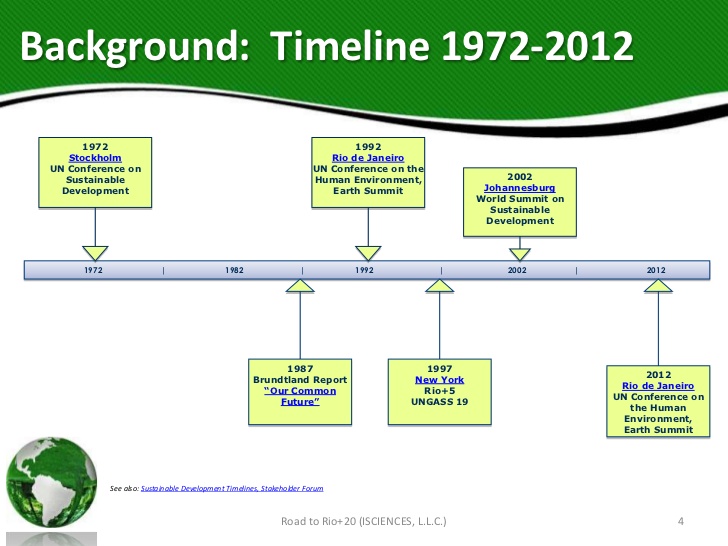
Source-slideshare
Plz note that in the pic above, conference of 1972 and 1992 are interchanged. Learn what is written in text.
In the subsequent articles we would now discuss these issues (climate change, ozone depletion, acid rain, air pollution. biodiversity etc) in detail.
-
Port Infrastructure and Shipping Industry – Sagarmala Project, SDC, CEZ, etc.
India has a coastline spanning 7516.6 kilometers, forming one of the biggest peninsulas in the world.

According to the Ministry of Shipping, around 95 per cent of India’s trading by volume and 70 per cent by value is done through maritime transport. It is serviced by 13 major ports, 200 notified minor and intermediate ports. The total 200 non-major ports are in the following States:-
Maharashtra (48); Gujarat (42); Tamil Nadu (15); Karnataka (10); Kerala (17); Andhra Pradesh (12); Odisha (13); Goa (5); West Bengal (1); Daman and Diu (2); Lakshadweep (10); Pondicherry (2); and Andaman & Nicobar (23).

source
Present situation of Indian Ports
- The development of port infrastructure in India is not on par with other ports across the world. China’s 10th largest port is 50% bigger than India’s largest, all of India’s 12 ports that are officially classified as “major” carry less traffic between them than the single port-city of Singapore.
- Colombo can handle more container traffic than all of India’s ports put together — With something like three-quarters of that being transshipment of containers from India, because India’s ports are too shallow to accommodate big container vessels. For a country with a long maritime tradition, this is a pathetic state of affairs.
- Indian ships account for a tiny part of the country’s trade: About 15%, compared to the international norm of 40%. It has no civilian shipyards to compare with the world’s best. The two or three private ones that look to build commercial vessels are deep in debt and short of orders; most Indian ship-owners prefer to look to foreign yards, because of better quality and assurance on delivery schedules. In short, India’s maritime business needs a booster shot.
What’s the reason for such situation?
- The cost-inefficiency and non-competitiveness of the cargo has resulted in higher through-port and transport costs.
- Shipping lines avoid touching ports in India because of the long waiting time. The capacity of various ports including Mumbai has already been exhausted and now capacities of other ports like JNPT are on the verge of exhaustion.
- The turnaround time at ports in India is one of the biggest handicaps logistics service providers have to deal with. The major reason for the poor turnaround time at Indian ports is that they are not comparable to global standards.
- There are 12 types of different taxes that Ships have to pay at our Ports
- Three-quarters of Traffic Which Colombo port handles consists of transshipment of containers from India, because India’s ports are too shallow to accommodate big container vessels. This is the reason why Colombo Port handles more ships than all of India’s ports put together.
- Governance issues: Major ports managed by Central govt. while minor ports by state govt. So skewed distribution of traffic, , lack of coordination in port traffic management and non-uniform tariff,resulting in suboptimal utilization of port infra.
- Political pressure, lack of autonomy, absence of incentives, excessive bureaucracy, and hierarchical rigidities are contributors to the current state of the Indian ports
- Inadequate dredging and container handling facilities
- Many major ports are affected by silting and require frequent dredging
- Except for Bombay and Madras, other ports do not have the facility of night navigation and pilots. This hampers working round the clock
Steps taken by Government to improve the situation
- The government has launched Sagarmala and its prime objective is to “promote port-led direct and indirect development and to provide infrastructure to transport goods to and from ports quickly, efficiently and cost-effectively.”
- Under this plan, a comprehensive and integrated planning for Sagarmala for the entire coastline shall be prepared within six months which will identify potential geographical regions to be called Coastal Economic Zones (CEZs).
- Government has proposed Central Ports Act 2016 to replace major port trusts act 1963 to give more power and autonomy to the major sea ports. Under the proposed act the Major ports will be able to lease land for port-related use for up to 40 years, and for non-port related activities up to 20 years
- Government has given SEZ status to JNPT port
- Passing of National Water ways Act 2015 and Coastal shipping agreement with Bangladesh which will give boost to coastal and inland waterways.
- Port led industrialization and modernization of adjacent situated areas has been envisaged as mechanism for enhancing indigenous manufacturing potential and creating employment opportunities
- Government has allowed 100% FDI for port development projects
- 100% income tax exemption from income tax is extended to companies investing in port infrastructure. Further, a 10-year tax holiday has been given to enterprises engaged in the business of developing, maintaining and operating ports, inland waterways and inland ports.
- Government has proposed to work towards converting 12 public port trusts in India into corporations under the Companies Act to bring greater efficiencies in operations, raise funds for growth and compete better with their private sector counterparts.
- The Centre recently gave its ‘in-principle’ approval to set up the country’s13th major port at Enayam in Tamil Nadu
What more should be done?
As India eyes resurgence in port-led activities in the country the above mentioned problems faced by Indian ports, indicate the need for the Central government to undertake measures to facilitate trade through Indian ports, either in terms of building and maintaining infrastructure for handling desired capacities or undertaking relevant policy and regulatory reforms. These Reforms should include
- In terms of infrastructure, it is important to maintain draft to serve bigger vessels, ensure mechanisation of ports through introduction of new equipment and procedures, build new facilities, upgrade existing facilities and automate systems/procedures.
- In terms of policy and regulatory reforms, it is important to streamline tariff determination by TAMP along with a provision for periodic revisions, ensure transparent and effective contractual arrangements in PPPs, implement strengthened communication platforms for seamless information flow among stakeholders, strengthen system integration, ensure paperless clearance of procedures and transactions, develop user information portals
- We also need corporatization of our major ports.
- More major Sea ports should be built
There is also need to improve the road connectivity between the ports and Hinterland.
-
IAS Prelims tit-bits- Economy part 1 and 5 Questions
1. GDP and GNP
- Gross Domestic product (GDP) is money value of final goods and services inside the Domestic economy whether produced by nationals or foreigners
- Gross National product (GNP) is money value of Final goods and services produced by Nationals whether they produce it within the nation or abroad
- GDP = GNP – Net Factor Income from abroad
- Nominal GDP (GDP at market price) is at current market prices while Real GDP (GDP at constant price) is adjusted for inflation w.r.t base year
- Measure of that inflation is not CPI or WPI but GDP Deflator
- GDP Deflator = Nominal GDP/Real GDP
- Net Domestic Product = GDP – Depreciation
- GDP at market price = GDP at factor cost + Indirect taxes – subsidies
- Discuss – Recent changes to the method of calculating GDP
- Discuss – what are these factors in factor cots
2. Fiscal Deficit, Revenue Deficit, Primary Deficit
- Fiscal Deficit = Total expenditure – Total non debt creating receipts ( total revenue receipt plus non debt creating capital receipt)
- In the above formula only debt creating capital receipt is excluded which is borrowing and that is exactly the fiscal deficit
- Revenue deficit = revenue receipt -revenue expenditure
- Effective revenue deficit = revenue deficit-grants for creation of capital assets
- Primary deficit = fiscal deficit -deficit due to interest paid
Note – As grants are donation, creates no liability, are not to be repaid, they come under revenue budget not capital part similarly under international transaction grants come under current account not capital account
- Discuss – FRBM act targets
- Discuss – Deficit financing and monetizing deficits
3. Current account and Capital account
- Current account deals with current, ongoing, short term transactions like trade in goods, services (invisible)
- It includes 1.trade in goods (BoT), 2.trade in services (invisible trade), 3.investment income,4.Unilateral transfers – GIFTS, GRANTS ,REMITTANCES
- Capital account deals with investments (FDI, FII, FPI), loans (ECB, External Commercial Borrowings), reserves (dollar, Special Drawing Right , gold etc). <bulk transactions which create liabilities>
- Balance of Payment is systematic record of all the transaction of a country with the world
Note – Grants, remittances etc. are in current account not capital account
Note 2- Investment income is under current account while Investments under capital account
- Discuss – Balance of Trade v/s Balance of Payment
- Discuss – Current account deficit
4. Plan v/s non plan expenditure
- Plan expenditure simply means expenditure according to erstwhile 5 year plans (mostly for creation of capital assets)
- all other things included in non plan -interest payment , subsidies, pensions, military expenditure etc
Discuss – Why is plan- non plan division being done away with
5. Monetary Policy and Fiscal Policy
- Monetary Policy – what RBI does i.e interest rates (Repo, reverse repo, MSF, bank rate), Open Market Operations, CRR, SLR
- It affects money supply in the economy
- Fiscal Policy – what govt., finance ministry does, mainly taxes and expenditure (subsidies, wages etc)
- It mainly affects aggregated demand in the economy
Discuss – Countercyclical monetary and Fiscal Policies
5 Questions
#1. Net National product at factor cost is equal to
(a) Gross Domestic product + Net factor income from abroad – depreciation
(b) Gross National product at market prices -indirect taxes + subsidies – Depreciation
(c) Gross domestic product – depreciation + Indirect taxes -subsidies
(d) National product at market prices + Indirect taxes + subsidies + Depreciation2. The balance of payments of a country is a systematic record of (2012)
- (a) all import and export transactions of a country during a given period normally a year
- (b) goods exported from a country during a year
- (c) economic transaction between the government of one country to another
- (d) capital movements from one country to another
£3. Which of the following constitute Capital Account? (2013)
- 1. Foreign Loans
- 2. Foreign Direct Investment
- 3. Private Remittances
- 4. Portfolio Investment
Select the correct answer using the codes given below.
- (a) 1, 2 and 3
- (b) 1, 2 and 4
- (c) 2, 3 and 4
- (d) 1, 3 and 4
£4. The national income of a country for a given period is equal to the: (2013)
- (a) total value of goods and services produced by the nationals
- (b) sum of total consumption and investment expenditure
- (c) sum of personal income of all individuals
- (d) money value of final goods and services produced
5. With reference to Union Budget, which of the following is/are covered under Non-Plan Expenditure?
- 1. Defense -expenditure
- 2. Interest payments
- 3. Salaries and pensions
- 4. Subsidies
Select the correct answer using the code given below.
- a. 1 only
- b. 2 and 3 only
- c. 1, 2, 3 and 4
- d. None
-
IAS Prelims tit-bits- Polity part 8
1. President and Vice President
- President is a part of parliament, VP is not
- VP is chairperson Of RS but not a member of it
- Qualification – President should be qualified for election as a member of LS, VP as a member of RS
- Min. age for both is 35 while for LS election it’s 25 and RS election, it’s 30
- President takes oath to preserve, protect and defend the constitution, VP does not take oath to protect the constitution
- Discuss – Which other constitutional functionaries take oath to protect, preserve and defend the constitution
- Discuss – who administers oath to President and VP, speaker and deputy speaker?
- Discuss – who is chairperson of upper house in states?
2. Schedules of Constitution
- 1st schedule-names of states and UT, 2nd- emoluments, allowances, privileges, 3rd Oaths
- 4th Allocation of seats in RS
- 5th and 6th – schedule areas and tribal areas
- 7th – 3 lists
- 8th schedule – languages
- 9th schedule – added by 1st amendment to protect laws from judicial review
- 10th schedule – anti defection law
- 11th and 12th, Rural and Urban Local Bodies
- Discuss – Which schedules can be amended by simple majority, which require special majority and which would require ratification from states
- Discuss – when was the 10th schedule 1st added to the constitution
- Discuss – present status of 9th schedule
- Discuss – Difference b/w schedule 5 and schedule 6
3. Parts of the constitution
- Part 1 – union and its territory
- Part 2 – citizenship
- Part 3- Fundamental Rights
- Part 4- DPSP
- PArt 4A- Fundamental duties
- Note – Other parts not important, parts are sequential article wise
- Discuss – Status of OCI & PIO cards
4. Union Territories
- Administered by an administrator appointed by President
- Governor of a state can also be appointed administrator of a UT as well
- Delhi and Puducherry have a legislative assembly and elected council of minister
- Still, Parliament can make laws on all 3 lists even in case of Delhi and Puducherry
- Parliament can also establish a high court for UT <how many UTs have a high court of their own?>
- If LG does not agree with the advice of CoM, he refers the matter to president and in the meantime acts on his own discretion <what happens if governor does not agree with the advice of CoM?>
- In case of failure of constitutional machinery, President can impose his rule on Delhi and Puducherry <what happens in case of failure of constitutional machinery in states?>
- Delhi and Puducherry have representation in RS as well
Discuss – Ordinance promulgating power of LG
5. National Green Tribunal
- enacted under Art 21, which includes right to a healthy environment
- mandated to make and endeavour for disposal of applications or appeals finally within 6 months of filing of the same
- Principal bench – New Delhi, 4 circuit Benches – Bhopal, Pune, Kolkata and Chennai
- Original Jurisdiction on matters of “substantial question relating to environment
- Very Imp.- not bound by the procedure laid down under the Code of Civil Procedure, 1908, but guided by principles of natural justice
- Discuss – Qualifications of chairperson and members
- Discuss– Articles related to RTE act and RTI act
