Hi! Please consider categorising stories according to the mains GS papers syllabus, and where they occur in that paper. Because sometimes the phrases used in the UPSC syllabus makes it difficult to gauge which stories to cover under which part or rather phrase mentioned in the syllabus.
Search results for: “”
-
Agriculture supply chain
सामान्यतः हम हमेशा कहते हैं की ‘सप्लाई चैन’ में तमाम बिचौलियों की वजह से खाद्य वस्तुओं के दाम आसमान छुते हैं साथ ही इन्हीं दलालों अथवा बिचौलियों द्वारा किसानों का खून भी चूसा जाता है जो काफी हद तक सही भी है। ‘एकोनिमिक सर्वे 2015-16’ में भी इस समस्या से निजाद पाने की वकालत की गई है और निःसंदेह होनी भी चाहिए। लेकिन क्या इस सिक्के के दुसरे पहलू पर भी विचार किया जाना चाहिए? क्योंकि इन्हीं बिचौलियों की वजह से काफी रोजगार उत्पन्न होते होंगे या नहीं होते मुझे नहीं पता, अगर इन बिचौलियों को समाप्त भी कर दिया जाए तो एक भीषण बेरोजगारी का संकट मुझे नजर आता है !!! आप लोगों का क्या विचार है? क्या किसी के पास इससे संबंधित कोई आर्टिकल या केस स्टडी है ? अगर है तो कृपया शेयर करें ।
and english medium aspirants!, please share your views , हिंदी में पूछा इसका ये मतलब नहीं की आप लोगों से नहीं पूछा गया है । 🙂 बिचौलियों को हटाया जाना चाहिए या नहीं? -
Biofuel Policy
Everything you wanted to know about Biofuels
India is set to announce a policy on flexible-fuel cars, cars that can run on bio-ethanol and petrol, or a blend of both.
Biofuel production would help farmers by supporting the diversification of agriculture into energy, power and bio-plastics.
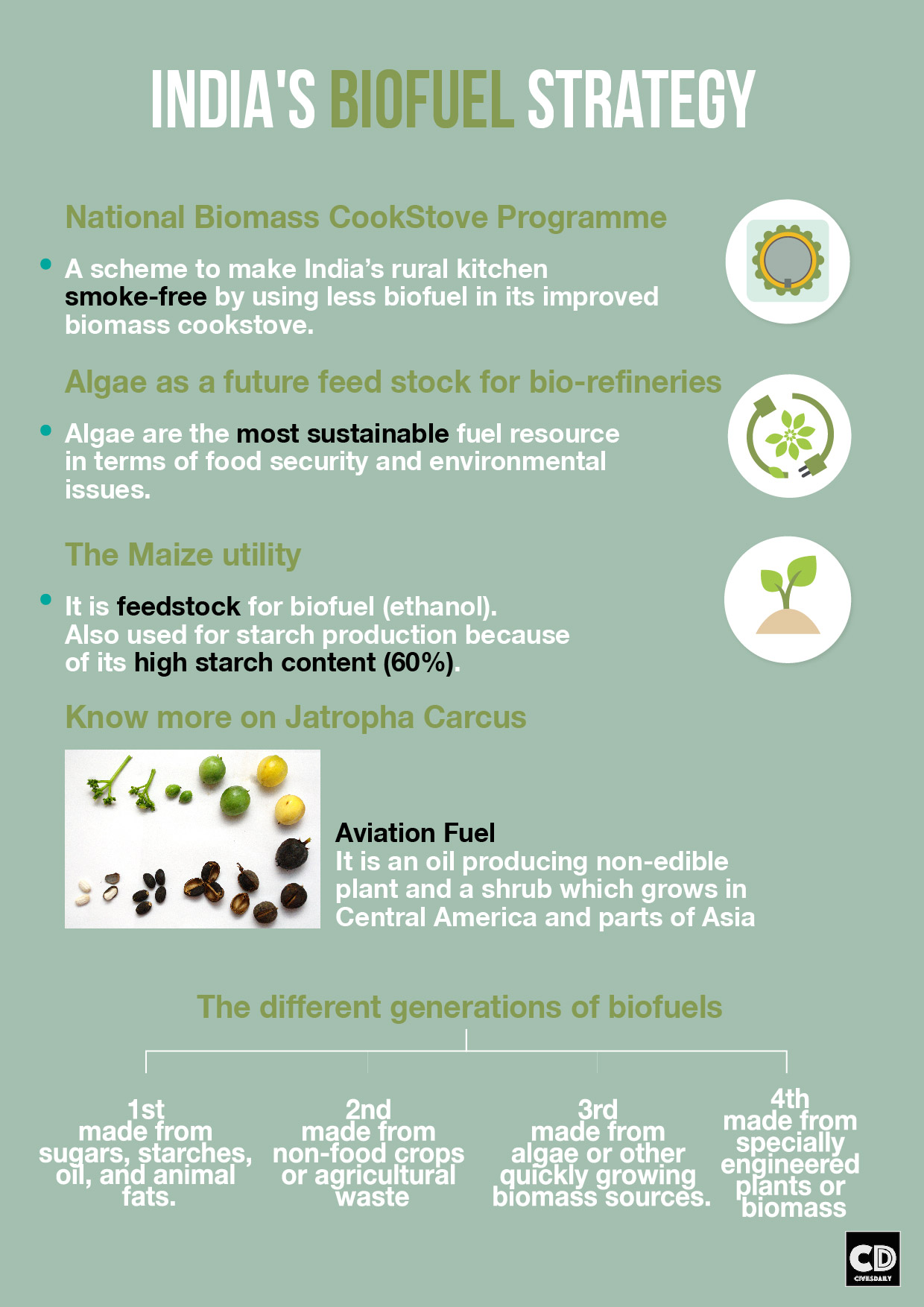
What are Biofuels?
Simply put, fuels produced directly/indirectly from organic material i.e. biomass including plant materials and animal waste.
Biofuels can be solid, liquid or gaseous.
Primary Biofuels
Those organic materials which are used in an unprocessed form such as fuel wood, wood chips and pellets, primarily for heating, cooking, electricity production.
Secondary Biofuels
Those materials which result from processing of biomass.
Example: Liquid fuels such as ethanol and biodieselWhat are different generations of Biofuels?
First Generation
The first generation fuels are conventional biofuels made from sugar, starch or vegetable.
Issue: They come from a biomass that is also a food source, so it requires a lot of land to grow at a time when there is food shortage in the world.Let’s learn about some of the famous examples in this category.
Ethanol – It is a type of alcohol which can be produced by any feedstock containing significant amount of sugar. It can be blended with petrol or burned in nearly pure form in slightly modified spark-ignition engines.
1 litre of ethanol produces energy equivalent to two-third of energy produced by 1 litre of petrol.
Is there any benefit of blending except providing an alternative to sugar industry? Of course, it improves combustion performance and lowers the emissions of Carbon Mono-oxide and Sulfur Di-oxide.
Biodiesel – It is produced by combining vegetable oil or animal fat with alcohol. It can be blended with traditional diesel fuel or burned in its pure form in compression ignition engines.
Source – rapeseed, soyabeen, palm, coconut or jatropha oils.
Energy content is 88-95 % of diesel
Second Generation
They come from non-food biomass such as wood, organic waste, food waste, specific biomass crops.
Issue: The second-generation fuel sources compete with food production for land.Third Generation
They are specifically engineered crops such as algae as the energy source. These algae are grown and harvested to extract oil within them.
Fourth Generation
They are aimed at not only producing sustainable energy but also a way of capturing and storing carbon-dioxide. They are carbon-negative i.e. it takes away more carbon-dioxide than it produces.
National Policy on Biofuels 2015
The Policy endeavors to facilitate and bring about optimal development and utilization of indigenous biomass feedstocks for production of bio-fuels.
- It envisages that biofuels will be produced using non-food feedstock on waste lands
- Encouraged the use of renewable energy resources as alternate fuels to supplement transport fuels
- Proposed an indicative target of 20% biofuel blending by 2017
- Major thrust for development of second generation biofuels
- A Biofuel Steering Committee will be set up to oversee implementation of the Policy
Criticism – Govt launched National Biodiesel Mission identifying Jatropha as the most suitable tree-borne oilseed for bio-diesel production, which failed miserably. The policy is also criticized for being largely sugarcane centric.
What is the proposal under flex-fuel policy?
It aims at decreasing pollution by adopting cleaner alternatives against fossil fuels. It encourages a diversion in the sugar industry’s output away from sugar towards ethanol.
Sugar industry has an excess supply problem and it helps farmers because of diversification of agriculture into energy, power and bio-plastics.
What are the challenges to implement this policy?
- Additional sugarcane cultivation or it can be met by improved farm practices/HYV canes
- Installing special dispensing units at petrol pumps across the country
- Automakers need to be given adequate time to comply
- Oil marketing companies will have to augment storage capacity for ethanol
- Reforming tax structure so that transport of ethanol across state boundaries is not expensive
Published with inputs from Pushpendra - It envisages that biofuels will be produced using non-food feedstock on waste lands
-
Solar Panel Dispute at WTO
India & US at loggerheads on the Solar Panel dispute

What is the origin of the dispute?
In 2010, India launched its national solar programme, which aims at adding 1,00,000 MW of solar power capacity by 2022.
So, govt. wanted to incentivise the production of solar energy within the country. Therefore, they agreed to enter into long-term power purchase agreements with solar power producers, providing the guarantee for the sale of the energy produced. Thereafter, it would sell such energy through distribution utilities to the ultimate consumer.
Bone of Contention
However, there was a clause that a solar power producer, to be eligible to participate under the programme, is required compulsorily to use certain domestically sourced inputs, namely solar cells and modules for certain types of solar projects. In other words, unless a solar power producer satisfies this domestic content requirement, the govt will not ‘guarantee’ the purchase of the energy produced.
What is India’s argument?
India principally relied on the ‘govt procurement’ justification, which permitted countries to deviate from their national treatment obligation provided that the measure was related to “the procurement by governmental agencies of products purchased for governmental purposes and not with a view to commercial resale or use in production of goods for commercial sale”.
India also argued that the measure was justified under the general exceptions since it was necessary to secure compliance with its domestic and international law obligations relating to ecologically sustainable development and climate change.
What is US’ argument?
In 2013, the U.S. brought a complaint before the WTO arguing that the domestic content requirement imposed under India’s national solar programme is in violation of the global trading rules.
It said that India has violated its “national treatment” obligation by unfavourably discriminating against imported solar cells and modules. In other words, India was discriminating between solar cells and modules (which were otherwise identical) on the basis of the national ‘origin’ of the cells and modules, a clear violation of its trade commitment.
Us has argued that India can achieve its clean energy goals faster and more cost-effectively by allowing solar technologies to be imported from the US and other producers.
What was the WTO judgment on the issue?
WTO concluded that India had violated its national treatment obligation, by imposing a mandatory domestic content requirement. The panel found India violated global trade rules by imposing local content requirements for solar cells and solar modules.
Agreement’s Violated: India violated its commitments under the global trading rules, specifically the General Agreement on Tariffs and Trade (GATT) and the Agreement on Trade Related Investment Measures (TRIMs).
Explanation: The product being subject to the domestic content requirement was solar cells and modules, but the product that was ultimately procured or purchased by the govt was electricity. Therefore, the domestic content requirement was not an instance of “government procurement”.
Room for Negotiation
The verdict was delayed for over 2-3 months, so that India and US can reach an agreement. In this regard, changes were suggested by New Delhi to its solar power programme. India proposed that it would use the domestic content requirement measures for buying solar panels for its own consumption such as by the railways and defence and would not sell the power generated from such subsidized panels for commercial use. However, the US may have rejected India’s offer.
Why is the ruling being criticized?
Various environmentalists have criticized the ruling, as it undermines India’s efforts towards promoting the use of clean energy. It threatens the clean energy economy and undermined actions to tackle the climate crisis.
What is the criticism to India’s stand?
There appears to be no rational basis for how mandatory local content requirements contribute towards promoting the use of clean energy. If the objective is to produce more clean energy, then solar power producers should be free to choose energy-generation equipment on the basis of price and quality, irrespective of whether they are manufactured locally or not.
It is also argued that by mandatorily requiring solar power producers to buy locally, the govt is imposing an additional cost for the production of clean energy, which will be ultimately passed on to the ultimate consumer.
What is alternative in India’s hand?
Though, the WTO decision may impact the ‘Make in India’ campaign. But, the govt. can give preferential treatment to clean energies in the form of tax rebates for solar power producers, tax breaks, ensuring a strong line of long term credit at low rates, collaborating with global leaders to enhance domestic research and development.
Future
The reports indicate that India will prefer an appeal to the appellate body. Simultaneously, India may be exploring the option of filing a counter complaint against the US, as many of its state’s such as Michigan, Texas and California having also reportedly been accused of employing mandatory local content requirements in the renewable energies sector.
Experts argue that govt should work towards building a business and regulatory environment, which is conducive to manufacturing. The need is for systemic changes in the form of simpler, transparent and consistent laws and effective dispute resolution mechanisms.
Published with inputs from Pushpendra
-
Roundup of the week (March 27 – April 2) – Polity & Governance
#5. Defence Procurement Procedure 2016
India is world’s largest arms importer and even after 68 years of independence, India imports more than 65% of it’s defence needs. To promote indegenisation and give fillip to domestic industry DPP 2016 was launched at defence EXpo.
Whats new <Copy paste from newscard>
#1. Included a new category to acquire weapons–IDDM (Indigenously Designed, Developed and Manufactured)
#2. IDDM will be the first preferred category of preference
#3. Defence Acquisition Council (DAC) to take a “fast-track” route to acquire weapons, something which was limited to only armed forces till now <who chairs DAC meetings? Who are it’s members? Answer in comments>
#4. Defence export clearances will now be granted online
Let’s look into details
To qualify for IDDM the equipment procured from an Indian vendor would have to be indigenously designed and account for a minimum of 40% of indigenous content (IC) on cost basis.
So far, technology was imported and the products manufactured at home, at cut-rate prices. Now, the emphasis is on ensuring that Indian players tap the best domestic technical intellect, generously invest in R&D, and thereby , retain ownership of the all-important technology applied.
– If the equipment is not indigenously designed, but constitutes 60% IC on cost basis of total contract value, it would be treated as Buy (Indian-IDDM).
– Stressing on the need for domestic sourcing, the policy also increases the minimum IC threshold for other categories.
– For example, under Buy (Indian), an equipment from Indian vendors could be procured, only if it comprises of a minimum of 40% IC on cost basis of the total contract value.
– Make category has been sub classified into 2 parts which would promote SMEs
Good news for foreign investors – threshold for discharging offset obligations has been marked up, from the existing R300 crore to R2,000 crore. Apart from this govt has also decided to fast track the procedures.
All of this will give fillip to make in India and job creation. It will also bring down dependence on imports.
But the all important chapter on strategic partners is yet to be notified.
What more needs to be done-
#1. The FDI ceiling in defence should be revised upward from current 49%. Original equipment makers are not willing to part with their technology when they don’t have control.
#2. Employ multipliers (assigning higher value) where foreign companies manufacture defence wares identified to be of critical need for the services in offset clauses
Read these two very interesting articles
#6. High court allows entry of women in Sani temple
Observations of high court
#1. There is no law that prevents women from entering a place of worship
#2. If men are allowed entry, women should be allowed too
#3. It is the State government’s duty to protect the rights of women
#4. Under the Maharashtra Hindu Place of Worship (Entry Authorisation) Act, 1956, if any temple or person prohibits any person from entering a temple, then he or she faces a six-month imprisonment
We discussed this issue in detail in article landmark judgement: Supreme Court of Hinduism here
-
Roundup of the week (March 27 – April 2) – IR
#2. Nuclear Security Summit 2016 (last summit)
Imp facts for prelims
– The first Nuclear Security Summit was held in Washington, DC in 2010, and was followed by Seoul in 2012 and The Hague in 2014 and again in Washington in 2016
– There is no new organisation being set up, three existing institutions are expected to adopt specific action plan <UN, IAEA and Interpol>
– NSS covers nuclear material only for non-military purposes, 83% of the nuclear material falls outside its ambit
– Russia did not attend the summit
Threat of nuclear terrorism and need for enhanced nuclear security assumes importance as one of the Brussels suicide bomber was found to have tracked the movement of a senior official of a Belgian nuclear power plant. Also the ISIS has shown it’s interest in acquiring nuclear weapons.
Threats of nuclear terrorism
#1. Acquiring a nuclear weapon from the arsenal of a nuclear state <very unlikely and even if they do acquire, if would be difficult for them to mount them on missiles and launch. Also a code has to be broken before nuclear bombs can be launched>.
#2. Acquiring enough fissile material to construct an improvised nuclear device <again unlikely as first getting enough material is difficult, techology f bomb making even more challenging>
#3. Acquiring radioactive material from civilian sources such as hospitals or university laboratories, mixing them up with conventional explosives to make a radioactive dispersal device or ‘dirty bomb <most likely scenario as security and tracking is not foolproof in such places. Though damage would be limited but mass panic and hysteria plus cost of clean up>
#4. Sabotage a nuclear facility leading to large-scale loss of lives and destruction <have already tried to do that in Pak>
In this context, Pakistan becomes a dangerous state as it is installing short range tactical nuclear weapons and they are mounted on battlefield and thus more susceptible to being acquired by terrorists<What’s the difference b/w tactical and strategic weapons. Answer in comments.>
What has Summit achieved so far?
– About 15 MT of highly enriched uranium (HEU) have been down- blended to low-enriched uranium <can you tell us the difference b/s HEU and LEU>
– A number of reactors using HEU have either been shut down or switched their fuel
– 12 countries have given up all HEU, and fuel repatriation to source countries has been accelerated
However the major drawback of this process is that there is no legally binding outcome at the end of six years
What is the outcome of this summit
Amendment to nuclear security treaty that would tighten protections against nuclear theft and smuggling
What has PM Modi announced?
– Accord a high national priority to nuclear security through strong institutional framework, independent regulatory agency and trained and specialized manpower.
– Development and deployment of technology to deter and defend against nuclear terrorism including physical and cyber barriers, technological approaches, setting up a facility for medical grade ‘Moly-99’ using low enriched Uranium and using vitrified forms of vulnerable radioisotopes such as Ceasium-137,
– Counter nuclear smuggling and strengthen the national detection architecture for nuclear and radioactive material< dedicated counter-nuclear smuggling team has been set up>
– 1m$ contribution to the nuclear security fund of IAEA. A workshop with IAEA experts on International Physical Protection Assessment Service (IPPAS) will also be held in India
– Sharing of best practices through Centres of Excellence such as our own
– Host a meeting of Global Initiative to Combat Nuclear Terrorism in 2017.
– International conference on countering nuclear smuggling is also being planned with Interpol
These are very very important points for pelims as well as mains <Moly 99, vitrified cesium, IPPAS etc> <Btw what’s the difference b/w nuclear safety and security? Answer in comments.>
#3. India-EU summit
EU-28 is India’s largest trading partner and biggest source of FDI <which country is our largest trading partner? Which country is our no.1 export market and which country export us the most? answers in comments>.
The EU-India strategic partnership was launched in 2004. The last summit i.e. 12th edition was held in 2012 in New Delhi
Outcomes of the summit
‘EU-India Agenda for Action 2020‘ as a common road map for the strategic partnership in the next five years
Terrorism: Joint Declaration on Counter-terrorism to step up cooperation to counter radicalisation and violent extremism
Climate Change -Joint Declaration on a Clean Energy and Climate Partnership
Loan assistance to Lucknow Metro by European Investment Bank (EIB)
Water Partnership: enhance cooperation on environment issues, including on the ‘Clean Ganga’ and ‘Clean India’ flagship programmes.
Science and Technology Cooperation Agreement: extend this agreement until 2020 to boost innovation and research in India and Europe.
Common Agenda on Migration and Mobility: aimed at organising regular migration and prevention of irregular migration and human trafficking.
Broad Based Trade and Investment Agreement (BTIA)
It has been pending since 2007 and was suspended last year when EU imposed ban against more than 700 generic drugs . Both sides have agreed to resume negotiations
What’s holding back the signing of BTIA
India’s interests
#1. Greater market accesses to its professionals (MODE 4 of GATS)
#2. Data Secure status to allow SMEs to compete in BPO, KPO space (Mode 1 of GATS)- he high cost of compliance with existing EU’s data protection laws and procedures renders Indian small and medium enterprises (SMEs) un-competitive <what is data secure status? Answer in comments>
#3. EU To reduce its agriculture subsidies
EU’s demands
#1. Lowering of tariffs on automobiles and wine spirits and dairy products
#2. But tariff cuts in the agricultural sector would mean Europe’s heavily subsidised agro industry will dump its surplus here, hitting Indian farmers <INdia’s concern>
#3. Further liberalization of FDI in multi-brand retail and insurance, and presently closed sectors like accountancy and legal services <Mode 3 of WTO)
#4. TRIPS + IPR regime- data exclusivity protection measures (which allow pharmaceutical companies to exclusively retain rights to their test results for a certain period) would delay the supply of Indian generic medicines <strict no no for India) <what is data exclusivity? Answer in comments>
- For more follow this story- India EU Foreign Policy Watch
- India EU BTIA this the Diplomat article
- For summit declaration this businesstandard article
We shall explain GATS and TRIPS plus in detail in separate article on WTO.
#4. PM’s visit to Saudi Arabia
#1. Saudi Arabia is our largest supplier of oil (20%) and the fourth largest trading partner s><who is the largest trading partner? Answer in comment>
#2. The population of Indian expats in the Kingdom is estimated to be around 2.96m ( of our 7m diaspora in West Asia ).
#3. The Saudi king is the custodian of the two holy mosques and this matters a great deal to India’s 170 million Muslims, the country’s largest religious minority.
In 2010 on PM Singh’s visit to Riyadh, ties were elevated to the status of strategic partnership. Since then intelligence and security cooperation has expanded manifold and Saudi extradited Abu Jindal to India.
Focus areas
– Counter terrorism <deradicalization, counter radicalization and intelligence cooperation>
– Military cooperation-Training and Joint execrcises
– Trade and investment <attracting Saudi investment into infrastructure. Investment so far has been below par>
Tight rope walk
– Balancing relations with Saudi , Iran and Israel at the same time
– India’s stand on war in Syria and Yemen
Aim
To dehyphenate India from Pak where relationship with Saudi is concerned as Stronger relationships with Pakistan’s allies can help India get a more sympathetic hearing on global and regional forums and put pressure on Islamabad to rein in militants.
-
Roundup of the week (March 27 – April 2) – Economics
Part 1 discusses FDI in e-commerce
#1. FDI in e-commerce
Before coming to the actual policy announcement and nitty gritty of that, it’s important to understand some basics without going into technical details (various comments on our e commerce story).
What is e commerce?
Simple, electronic commerce i.e buying and selling of goods and services using electronic or digital means
It can be done many ways
#1. Inventory led model – It’s simply like your kirana store or Walmart if you will i.e. you own what you sell. Suppose, I want to open my e commerce firm. I will start mt website (drvbaniyastore.com) buy and stock all the goods I want to sell and deliver them to consumers. It’s actual retailing.
#2. Marketplace model– It’s like your mall, say select city walk Saket . Different vendors, Lewis, Svmsung, apple, individual service providers (mobile repair shop) etc can open their shops in the mall. Consumer comes to mall, shops from different vendors, Mall only connect buyers to consumers. So, if I want to start my own e commerce firm, I will start my website, different vendors will be listed on my website, consumers will choose products they like from vendor they like. My task would only be to connect consumers to vendors and producers.
#3. Hybrid model- mix of both
Then there is B2B and B2C.
B2B or business to business– It’s like wholesaler or producer shipping goods to retailers i.e. they do not supply goods directly to consumers. For instance, consider apple factory which would supply iphones only to retailers like mobile store.
B2C or business to consumer- It’s like your kirana store, actual retailing.
So, what was the policy until now?
# Until now, 100% FDI in B2B commerce was allowed.
# FDI in multi brand retail though allowed at 51% (announced by UPA govt in 2012) comes with many riders and present govt does not support the policy. Effectively FDI in multibrand retail is not allowed.
# There was complete lack of clarity with regard to FDI in e commerce (market place model)
e commerce firms took advantage of this vacuum and confusion to bring FDI through complex structures and this policy attempts to bring some clarity and sanity in this sector.
What’s new in the policy that is making headlines?
Policy allows 100% FDI by automatic route in e commerce market place model <makes eminent sense, they are just connecting buyers and sellers>. Flipkarts and Amazons and Snapdeals were already opearting under this model and policy merely makes de jure what has hitherto been de facto. <Tell us the meaning of de jure and de facto in comments>
It restrict sells from a single vendor to maximum of 25% <makes sense, in a well functioning market, one vendor should not be allowed to concentrate all the sales>. But problem is for both Amazon and Flipkart their biggest vendor account for >40% of sales.
the responsibility for both delivery and quality of the product and related warranties will lie with the seller <again makes sense, if you buy some product from a store in mall, you don’t go to mall manager to claim your warranty but manager of that particular shop. But think what happens to that Flipkart advertisement about return of goods. Does not appear a consumer friendly initiative>
But e-commerce firms can provide support services to sellers, including warehousing, logistics, call centres and payment collection <makes sense to me. Even a mall provides some support services to it’s vendors>
prohibits ventures from “directly or indirectly” influencing the sale price of goods <makes sense, whatever discounts etc are given, are given by vendors not malls so how can Amazon give you discount> i.e vendors can still offer discounts but marketplace i.e amazons and Flipkarts of this world can’t influence prices.
This indirectly provision is very interesting.
Let’s see at present how discounts work <indirectly influencing the prices> step by step
#1. Amazon recommends the amount of discounts to its sellers on products, but doesn’t force them to adopt these suggested prices.
#2. Sellers, however, end up keeping these suggested prices because Amazon finances the discounts
#3. At the end of a certain period, sellers send a debit note to Amazon. This note contains the amount of discount that the seller gave on apparel, electronics, toys and other products sold on the site.
#4. Amazon then pays the seller by cheque.
All of it is shown as promotional funding/ marketing expense. Of course, we can all see how Amazon is trying to bypass regulations.
#1. It disallows any FDI in inventory led model <again makes sense. Inventory led model is actual retailing. If you don’t allow FDI in multi brand retail how can you allow FDI in retailing through backdoor using digital means>
#2. By the same logic, hybrid products are also disallowed <they include component of inventory>
One major effect of disallowing FDI in inventory led model is that e tailers who were selling goods with their brands will no longer be able to do so. <You are the owner of your own brand i.e you own inventory and FDI there is not allowed. This might create problem for Myntras of this world who sell their own fashion brands but also other brands>
But 100% FDI was already allowed in single brand retail i.e Nike can sell it’s own product but products of no other brand. This policy allows Nike to sell their branded product online also.
Announcements related to e commerce in the past
#1. Budget allowed 100% FDI in marketing of food products produced and manufactured in India.
#2. In November last year, the government allowed a manufacturer to sell its products manufactured in India through retail e-commerce.
Now let’s come to the larger issue of merits and demerits of the policy
– Policy clarifies the provisions wrt marketplace model. There were concerns that even this was not allowed <there are cases in high courts, ED is investigating claims of FEMA violation. Btw can you tell us someyhing about FEMA and FERA? Answer in comments>
– Unambiguous stance on inventory led model
But why does govt not permit FDI in multi brand retail?
simple- Employment/Jobs- Largest employer outside agriculture. Concern that Walmarts and Tescos of this world will wipe out your kirana stores. <both sides cite their own studies>
What’s the problem with discount? They were helping consumers, no?
Opponents say that those discounts are example of predatory pricing. These companies are incurring massive losses due to discounts but are acquiring customers. Venture capital and private equity backing them have deep pockets. They will discount till they drive competitors <your kirana store> out of market and then enjoy an oligopoly.And in any case how can a marketplace offer discounts. They should be offered by vendors <can you differentiate venture capital, angel investor and private equity>
Concerns of JNU Jhola Chaap Professors and Jholachaaps sitting in RSTV studios
#1. It’s clear they were violating the law earlier. Instead of punishing them, govt is actually rewarding them by legitimizing their business.
#2. They will keep on violating the law i.e employ inventory led model, deep discounts etc with impunity<they know govt will legitimize that too>
#3. Even if govt wanted to take action, govt does not have the capacity to monitor their businesses and take action
#4. Influencing prices directly or indirectly is too vaguely worded and their hotshot lawyers will take care of this provision
#5. It will hurt interests of small kirna stores and ultimately consumers
My take (obviously shamelessly borrowed from multiple sources)-
#1. It seems like a good policy which bring clarity to the sector.
#2. Supply chain efficiency and multi brand retail will ultimately be required to build warehouses and store agri and other products.
#3. We need not fear the foreign competition but empower our kirana stores to become more efficient and cost competitive. They will be forced to innovate and that’s good thing.
#4. Govt’s role is to provide social safety nets not to prevent technological disruption.
#5. Of course all anti competitive practices, price rigging etc should be strictly dealt with and for this we need to empower competition commission of India both by a better statute and better financial and human resources.
If you want to read more, these four Livemint articles will provide you the best understanding
- Half-Hearted attempt to liberalize
- Govt allows 100% FDI in eCommerce
- Will it stop online discounts
- Govt warns on discounts
Update on Solar Dispute in WTO (covered in last round up)
#1. By focusing its arguments (or future measures) on the goal of developing a manufacturing capacity that serves a domestic demand not adequately served by international markets, India might have greater success
#2. Given the breadth of local content requirements within the United States, India could also eventually bring a claim against the United States based on these programmes.
-
SDG GOAL NO. 12
KINDLY TELL THE VARIOUS INITIATIVES BY THE GOI TO ENSURE FOLLOWING GOAL IS MET.
