💥UPSC 2026, 2027, 2028 UAP Mentorship (March Batch) + Access XFactor Notes & Microthemes PDF

Search results for: “”

  • Different levels of Diplomacy | Track 1, Track 2, Track 3

    The Ministerial Session of the eighth edition of Delhi Dialogue, the pre-eminent annual Track 1.5 dialogue process for brainstorming on all aspects of the ASEAN-India relationship, took place in the evening of 18 February 2016 at New Delhi.

    We will talk at lengths on the ASEAN-India relationship as we develop our introductory series on IR for IAS further, but today let’s understand diplomacy in its tracks!

    Traditionally, the term “diplomacy” referred to interaction between nation-states. More recently, however, scholars have delineated several levels of diplomacy. Tracks 1 and 2 are the most frequently used terms.

    CLICK:-REGISTER & DISCUSS ETHICS CASE STUDIES & YOUR UPSC PREPARATION WITH CD MENTORS FOR FREE

    #1. Track 1 Diplomacy:

    Official discussions typically involving high-level political and military leaders and focusing on cease-fires, peace talks, and treaties and other agreements. Heads of states meet, have hi-tea, discuss issues and release joint statements etc.


    #2. Track 2 Diplomacy:

    Unofficial dialogue and problem-solving activities aimed at building relationships and encouraging new thinking that can inform the official process.

    Since it is unofficial –  you can expect to see influential academic, religious, and NGO leaders and other civil society actors who can interact more freely than high-ranking officials. Think of Baba Ramdev and Amir Khan trying to chit chat with officials of Pak Foreign ministry, cajoling them into buying an idea (hopefully for more peace and er. yoga!)

    Here’s where we see the emergence of term – Track 1.5 to denote a situation in which official and non-official actors work together to resolve conflicts. Read this press release from MEA in the light of this definition – Ministerial Session of Delhi Dialogue VIII


    #3. Track 3 Diplomacy:

    People-to-people diplomacy undertaken by individuals and private groups. It would not be further from truth if we say that the “aam aadmi” of India does not really hate his counterpart at Pakistan. Beyond the media and political blur, there are a lot of initiatives which get people closer (do we hear bollywood).

    Pakistan loves our films and actors, we love their cuisine and musicians!

    Normally focused at the grassroots level, this type of diplomacy often involves organizing meetings and conferences, generating media exposure, and political and legal advocacy for marginalized people and communities.


    #4. Multitrack Diplomacy:

    A term for operating on several tracks simultaneously, including official and unofficial conflict resolution efforts, citizen and scientific exchanges, international business negotiations, international cultural and athletic activities, and other cooperative efforts.


    Reference – UNITED STATES INSTITUTE OF PEACE

    CLICK:-REGISTER & DISCUSS ETHICS CASE STUDIES & YOUR UPSC PREPARATION WITH CD MENTORS FOR FREE
  • Economic Survey: 6 Important suggestions which Sarkar must take

    “I am the chief economic adviser, not the chief political decider,” chief economic advisor Arvind Subramaniam said in response to a question about whether the suggestions in the Economic Survey 2015-16 will find space in the budget.

    But, you are an aspirant, aren’t you? And in a rare case that the interview panel grills you on your analysis on the Economic Survey, here’s what can save your ass!

    #1. Do something urgently on subsidies

    The survey lists seven items – kerosene, electricity, LPG, railways, petrol, diesel, aviation turbine fuel and gold – on which the implicit subsidy to the rich amounts to RS 10 lakh crore! “. . . rectifying some egregious anomalies may be good not only from a fiscal and welfare perspective, but also from a political economy welfare perspective, lending credibility to other market-oriented reforms,” the Survey says.

    #2. Work seriously on ending tax exemptions

    • No profession should escape the tax net
    • Clear reference to agricultural income, which is not taxed at all
    • While the government is working on ending tax exemptions for the corporate sector, what about the agriculture sector!

    #3. Don’t raise exemption thresholds

    • The Survey junks the theory put out by Thomas Piketty that India under-taxes and under-spends
    • Bring more people under tax net. Let the threshold stay where it is!

    #4. Spread the JAM (Jan Dhan Yojana, Aadhar and Mobile transactions) trilogy to new areas

    • How to go about it? What about its efficacy? The Survey suggests doing this based on two criteria – the extent of leakages and the extent of central government control
    • Subsidies with higher leakages have larger returns after introduction of JAM
    • It will be easier to roll out JAM in areas where the central government is the main provider of the subsidy

    #5. Focus on easier exits

    Not just about corporate exits! The Survey expands the paradigms of exits

    • Allow easier entry to encourage competition; address legal lacuna through laws (which is being done with the new bankruptcy law)
    • In the case of agriculture, exit from the current cereal-centric, regionally concentrated, input-intensive policies to pulses-oriented, regionally-broad based, more-for-less inputs system

    #6. Undertake serious reform of the fertiliser sector

    The Survey suggests a cap on the number of subsidised bag each farming household can purchase and insistence on biometric authentication at the point of sale (POS)


    Source: Swarajyamag

    PS: This was just a trailer. Original series on Economic Survey with back2basics reference coming soon.

  • Horrifying economic terms!

    What are real growth and nominal growth? Can someone please explain me in layman terms? Thanks a ton to the kind soul! 😛

  • Analysis | Previous year’s IAS Mains questions from IR

    The aim of this post is to give you a bird’s eye view of what is usually asked in IAS Mains. Don’t fear the IR monster but be cautious about preparing it well.

    We are going to pick up questions topic wise, from IAS Mains 2013 – 2015. Hope you remember the portions of IAS Mains (Paper 2) syllabus which deal with IR.

    1. India and its neighborhood – relations
    2. Bilateral, regional and global groupings and agreements involving India and/or affecting India’s interests
    3. Effect of policies and politics of developed and developing countries on India’s interests, Indian diaspora.
    4. Important International institutions, agencies and fora, their structure, mandate

    Topic: India and its neighborhood – relations

    Mains 2015 –

    Q. Project `Mausam’ is considered a unique foreign policy initiative of the Indian Government to improve relationship with its neighbors. Does the project have a strategic dimension? Discuss.
    <China as Neighbour, considered special relevance to ques, China’s Maritime silk route and answer to string of pearls>

    Q. Terrorist activities and mutual distrust have clouded India-Pakistan relations. To what extent the use of soft power like sports and cultural exchanges could help generate goodwill between the two countries? Discuss with suitable examples.
    <Shiv Sena protests over Ghulam Ali’s concert>

    Mains 2014 –

    Q. With respect to the South China sea, maritime territorial disputes and rising tension affirm the need for safeguarding maritime security to ensure freedom of navigation and overflight throughout the region. In this context, discuss the bilateral issues between India and China.
    <Remember Chinese claims, 9 dashed line [Spratlys claim] – Tension in south china sea> < The most cliched issue in foreign policy>

    Mains 2013 –

    Q. The proposed withdrawal of International Security Assistance Force (ISAF) from Afghanistan in 2014 is fraught with major security implications for the countries of the region. Examine in light of the fact that India is faced with a plethora of challenges and needs to safeguard its own strategic interests.
    <India’s large geostrategic and geoeconomic interests in Afghanistan>

    Q. What do you understand by ‘The String of Pearls’? How does it impact India? Briefly outline the steps taken by India to counter this.
    <Chinese dominant intentions in the Indian Ocean region><The most cliched issue>

    Q. The protests in Shahbag Square in Dhaka in Bangladesh reveal a fundamental split in society between the nationalists and Islamic forces. What is its significance for India?
    <Very much in news, similar to Arab spring>

    Q. Discuss the political developments in Maldives in the last two years. Should they be of any cause of concern to India?
    <Arrest of president Nasheed, cancellation of GMR deal, Indian diplomacy found wanting>

    Q. In respect of India — Sri Lanka relations, discuss how domestic factors influence foreign policy.
    <PM’s refusal to attend CHOGM summit in SL over DMK’s blackmail was the immediate context for the question>

    Q. What is meant by Gujral doctrine? Does it have any relevance today? Discuss.
    <I.K.Gujral died on nov. 30th 2012, expected question>


    Bilateral, regional and global groupings and agreements involving India and/or affecting India’s interests

    Mains 2015 – 

    Q. Increasing interest of India in Africa has its pros and cons. Critically examine.
    <Largest gathering of African leaders in Oct, 2014 in New Delhi>

    Q. The aim of Information Technology Agreements (ITAs) is to lower all taxes and tariffs on information technology products by signatories to zero. What impact should such agreements have on India’s interests?
    <It was on the plurilateral agenda in the upcoming WTO talks to be held after mains exam, proves importance of cursory newspapers to follow evolution of topics even a day before mains or following newscards in 15 minutes daily>

    What are newscards? Download our #1 trending android app for IAS prep!

    Q. Some of the International funding agencies have special terms for economic participation stipulating a substantial component of the aid to be used for sourcing equipment from the leading countries. Discuss on merits of such terms and if, there exists a strong case not to accept such conditions in the Indian context.
    <JICA funding DMIC require sourcing content from Japan>

    Mains 2013 –

    Q. Economic ties between India and Japan while growing in the recent years are still far below their potential. Elucidate the policy constraints which are inhibiting this growth.


    Important International institutions, agencies and fora, their structure, mandates

    Mains 2015 –

    Q. Discuss the impediments India is facing in its pursuit of a permanent seat in UN Security Council.
    <Very much in news due to starting of text based negotiations on security council reforms in september>

    Mains 2014 –

    Q. India has recently signed to become founding a New Development Bank (NDB) and also the Asian Infrastructure Investment Bank (AIIB). How will the role of the two Banks be different? Discuss the significance of these two Banks for India.
    <In the news, proliferation of multilateral development banks, role complementary, supplementary or competitive>

    Q. WTO is an important international institution where decisions taken affect countries in profound manner. What is the mandate of WTO and how binding are their decisions? Critically analyse India’s stand on the latest round of talks on Food security.
    <Static portion related to dispute settlement mechanism with dynamic part being WTO decision on Indian poultry import ban from US and India’s domestic content requirement for solar panels>

    Mains 2013 –

    Q. The World Bank and the IMF, collectively known as the Bretton Woods Institutions, are the two intergovernmental pillars supporting the structure of the world’s economic and financial order. Superficially, the World Bank and the IMF exhibit many common characteristics, yet their role, functions and mandate are distinctly different. Elucidate.
    <Static, repeat question from previous year mains paper>


    Moral of the story?

    1. IR constitutes a very important part of GS paper 2 and and also GS paper 3 (cross cutting themes of terrorism and internal security challenges in border areas having linkages with neighbouring countries) with 5 to 6 very doable questions being asked every year.
    2. Questions are mostly from current hot trending topics.
    3. Knowledge of static content helps in understanding the issue better and filling in the answer but there’s no requirement of PHD in historical aspects of relationships.
    4. International organizations are important for prelims as well so do static part of international organizations well.
  • How to read the Economic Survey

    Welcome to the introductory post. Read the subsequent parts of this exhaustive series on the Indian Economic Survey (Click Here).


    economic survey


    Economic survey for 2015-16 has been released. As we all know, it’s a very important document for exam purposes. You can download it for FREE from here.

    As with the last year, this year’s survey is a two volume book. Volume one deals with conceptual and analytical issues while volume two deals with the state of economy and sectors of economy in some detail with more focus on immediate issues and statistics. I have just finished reading volume one and I am going to discuss how to read this document effectively.

    There are 11 chapters in the volume one. Every chapter is important, so sit tight and read one chapter at a time and take notes. Except for chapter 1 which is some 36 pages long, every other chapter is only 9 to 13 pages long which will take about 45 min to 1 hour each for reading and taking notes.

    Chapter one basically gives broad overview of the economy, challenges and opportunities, analyses pros and cons of rapid fiscal consolidation. It also gives glimpses of what to expect from the subsequent chapters. I will suggest, you all begin with chapter one.

    Three most enlightening chapters of the survey are-

    1. Chapter 2, The Chakravyuha Challenge of the Indian Economy – It highlights the problem of difficult exit of firms just as Abhimanyu could not exit from Chakravyuha. The survey aptly describes it as “From socialism with restricted entry to “marketism” without exit“.
    2. Chapter 6, Bounties for the Well-Off – It’s a real eye opener and describes in detail government subsidies (implicit and explicit) for the well off section of society, what could only be described as Socialism for the rich and Capitalism for the poor.
    3. Chapter 7, Fiscal Capacity for the 21st Century – Best chapter of the survey by many miles. It would clear all your doubts regarding government taxation and expenditure, whether government spends less or more and how middle class simply exits from the state if state’s role is seen as primarily distributional.

    All other chapters are equally great but I found these three very different and interesting.

    Some do’s and don’ts

    1. Don’t try to finish the survey or even first volume in one go, read one chapter at a time
    2. You should read volume one from cover to cover. It’s very interesting and will help you in essay, paper 2, paper 3 as well as paper 4, yes in ethics paper
    3. Volume two is not that important. What is to be read from that will be updated tomorrow
    4. Take simultaneous notes while reading a chapter, note down important points and doubts and get them resolved in doubts clearing forum
    5. Many times, the stuff put in the box have been directly asked in Mains. Do read them properly. But some box are highly technical, for instance first two boxes of chapter one, no need to go into nitty-gritty of them. Just try to understand the basic idea.

    These could be the best 150 pages you would ever read for exam purpose. So, don’t wait for the substandard summaries to arrive in the market. You all have ample time before prelims, start reading one chapter a day. You will gain immense knowledge.

    Of course, we shall be covering important portions of survey here at CD but you should read the full volume, especially the three chapters I mentioned.

  • Railway Budget 2016-17: Reorganize, Restructure & Rejuvenate

    Suresh Prabhu has set out an ambitious medium-term goal to reset the country’s oldest institution, including its governance, and restore its key place in the Indian economy. Railway is facing twin challenges of finances and ability to be a growth driver for the economy

    Few Glimpses of Railway Budget 2016-17

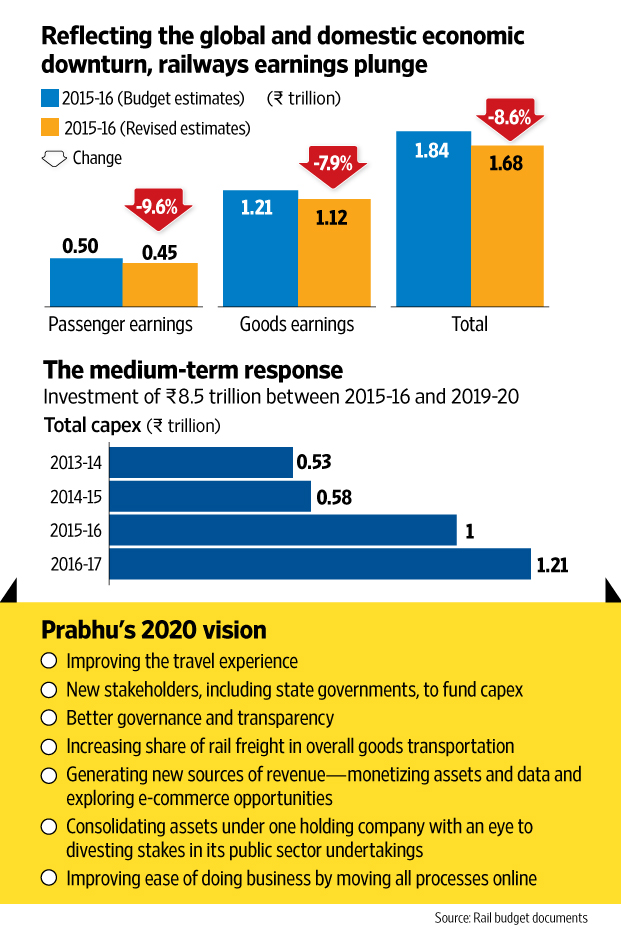
    • The minister fixed the revenue target for next fiscal at Rs.1.84 trillion, marginally above the budget estimate of 2015-16, though it failed to achieve its target for this year by a big margin
    • Railways will have to bear the burden of an additional payout of Rs.28,000 crore as part of the 7th Pay Commission recommendations
    • The railways will end up with operating ratio of 90 for 2015-16. For 2016-17, it expects the operating ratio to further worsen to 92 
    • No changes in passenger fares and freight rates

    Finances

    Railwaythe

    There is shortfall in traffic receipts worsened by low freight demand from core sector. The Railway minister outlined the medium-term plan of investing Rs.8.5 trillion by 2019-20. The investment plan for 2016-17 is Rs 1,21,000 crore –

    • Transfer from the Union budget – Rs.45,000 crore
    • Internal resources – Rs.12,700 crore
    • Partnerships with state governments – Rs.18,000 crore
    • Life Insurance Corporation of India – Rs.23,000 crore
    • Indian Railway Finance Corporation – Rs.21,700 crore

    Do you know about Sundry earnings of Railways?

    Sundry Earnings: All earnings on add-on services (which are not free of cost), including WiFi, concierge service, advertising, etc. Simply put, Railway puts all its non-tariff earning as Sundry Earnings in its account books. 

    These earnings stood at an estimated Rs. 6229 crore this year.

    Budget Proposal

    • The target of non-tariff earnings for next year has been scaled up by 53% to Rs. 9590 crore
    • Advertising is a major source of non-tariff revenues. So, Railways will install around 20,000 screen across its ecosystem to display ads
    • The Railways will also monetise its data bank on passengers so that frequent travellers get value-added, targeted services
    • Railways to monetise land on tracks by leasing out for horticulture and tea plantation
    • Holding company to be explored for monetising assets of Railway companies

    Freight

    Challenge: The freight business provides two-thirds of Indian railways’ revenues, but it is struggling with capacity constraints and slow industrial demand. Also, our freight rates are among the highest in the world, which make our products uncompetitive.

    Budget Proposal: To expand the list of commodities it services—increasing it to 40 from nine at present by including automobiles, packaged consumer goods, cotton, fruits and vegetables.

    Dedicated Freight Corridors: It is proposed to take up the following freight corridors:

    • North-South connecting Delhi to Chennai,
    • East-West connecting Kharagpur to Mumbai
    • East Coast connecting Kharagpur to Vijayawada

    Impact: They can radically slash transit time for goods. Also, shifting of freight traffic from existing tracks to the new corridors would release capacities, helping increase speed of passenger trains.

    Criticism: The high freight rates have diverted railway traffic to roads. In fact, discounting for the fuel component in freight charges, the rates should have been reduced this year.

    New Trains

    The budget announced 4 new types of trains:

    • Antyodaya Express: A long-distance, fully unreserved, superfast train service, for the common man, to be operated on dense routes
    • Humsafar: It will be a fully air-conditioned train for the budget passengers
    • Tejas: It will showcase the future of train travel. It will travel at 130 km an hour and offer on-board WiFi services
    • Uday: It will be an overnight double decker service for the busiest routes in the country with 40% more carrying capacity

    Better Governance

    Challenges: Departmental orientation, absence of cross-functional collaboration and lack of business focus

    Budget Proposal: To reorganize the Railway Board along business lines and suitably empower Chairman, Railway Board to lead the organization effectively

    Vulnerable Sections : Old People/ Disabled/ Women/ Porters

    • A “Saarthi seva” will be introduced to help the old and disabled at stations. Railways to increase lower berth quota for senior citizens by 50%.
    • Disabled enabled toilet in 11 Class-A stations this year
    • 33% reservation to women in reserved quota in Railways
    • Porters to be called ‘Sahayaks’ now. They will be trained in soft skills

    Sanitation

    • 17000 bio toilets and additional toilets at 475 stations will be provided before the close of this year
    • World’s first Bio-Vacuum toilet was developed by IR and is being used in Dibrugarh Rajdhani Express
    • For those queasy about train travel because of dirty toilets and coaches, the minister has “clean-my-coach” on demand through SMS

    Improving Railway Stations

    • 400 stations to be re-developed through PPP
    • Beautification of stations at pilgrimage centres: Ajmer, Amritsar, Gaya, Mathura, Nanded, Nashik, Puri, Tirupati, Varanasi, Nagapattinam and others

    Technology

    • 400 railway stations to be equipped with wifi, 100 this year.
    • To reduce the waiting period for passengers, the railways will introduce bar-coded tickets at select stations.
    • Scanners and access control on a pilot basis on major stations.

    Railway Budget: Few Shortfalls

    • There is a shortfall in the number of engines required to run even our existing fleet of freight and passenger vehicles. With increased capacity, we will need many more locomotives. The budget does not indicate a comprehensive strategy for these issues
    • Most tracks and rolling stock are already fit for speeds above 100 kmph for passenger services and above 75 kmph for goods services. However, average speeds of passenger services are around 40-50 kmph and those of freight 20-25 kmph. This is because we don’t have the capacity to run them at optimum speed. Increasing capacity by doubling/ quadrupling lines would in itself improve speeds. Budget does not have much to offer to overcome this lacunae

    Want to read more?

    Published with inputs from Pushpendra
  • Part 6 | I am the most backward! | Landmark Judgements that Transformed India


    This is an issue that affects almost every citizen. Perhaps every Indian has had arguments on this which often end in acrimony. This is also an immensely political issue which crops up just before every major election. No doubt then, battles have been fought in courts, legislatures as well as on streets. At one point it took a very ugly and vicious turn and threatened to tear apart entire fabric of society.

    Yes, we are talking about issue of reservation in jobs and educational institutions. We will limit our arguments to legal and constitutional angles and some politics (can’t help it) without going into philosophical and practical desirability or otherwise of such provisions.

    Before we analyse Parliament and Supreme Court back and forth on the issue of reservation, let’s have a look at relevant constitutional provisions as they existed before amendments.

    Article 15

    Prohibition of discrimination on grounds of religion, race, caste, sex or place of birth

    • (1) The State shall not discriminate against any citizen on grounds only of religion, race, caste, sex, place of birth or any of them
    • (3) Nothing in this article shall prevent the State from making any special provision for women and children

    Article 16

    Equality of opportunity in matters of public employment
    (1) There shall be equality of opportunity for all citizens in matters relating to employment or appointment to any office under the State
    (2) No citizen shall, on grounds only of religion, race, caste, sex, descent, place of birth, residence or any of them, be ineligible for, or discriminated against in respect or, any employment or office under the State
    (4) Nothing in this article shall prevent the State from making any provision for the reservation of appointments or posts in favor of any backward class of citizens which, in the opinion of the State, is not adequately represented in the services under the State

    Article 29

    Protection of interests of minorities

    (2) No citizen shall be denied admission into any educational institution maintained by the State or receiving aid out of State funds on grounds only of religion, race, caste, language or any of them.

    Article 46, a DPSP

    • Promotion of educational and economic interests of Scheduled Castes, Scheduled Tribes and other weaker sections
    • The State shall promote with special care the educational and economic interests of the weaker sections of the people, and, in particular, of the Scheduled Castes and the Scheduled Tribes, and shall protect them from social injustice and all forms of exploitation

    Article 335

    • Efficiency in administration
    • The claims of the members of the Scheduled Castes and the Scheduled Tribes shall be taken into consideration, consistently with the maintenance of efficiency of administration.

    Article 340

    Appointment of a Commission to investigate the conditions of backward classes.

    Note that I have highlighted the word “only” every time. “Only” here implies that state can not discriminate on religion, race, caste etc only but can discriminate on other grounds.

    Now let’s come back to the courts

    #1. Champakam dorairajan v/s state of madras

    She challenged madras govt orders of caste quotas in medical colleges-

    1. Discrimination based only on caste not allowed under Article 15
    2. Discrimination in admission to public funded institutions not allowed (Art. 29)
    • Government claimed it was following instructions given under Art. 46
    • But court concluded that Fundamental Rights trump DPSP and quashed the unconstitutional order related to reservation

    Predictably parliament passed 1st CAA (Constitutional amendment)

    Along came art 15 (4)

    Nothing in this Article or in Clause 2 of Article 29 shall prevent the state from making any special provision for the advancement of any socially and educationally backward classes of citizens or for the Scheduled Castes and the Scheduled Tribes.

    Public sort of accepted the reservation but governments can take people for a ride, right! Mysore increased reservation to 68%.

    #2. Balaji vs State of Mysore

    Argument was that extravagant quota was a fraud on constitutional policy of reservation.

    Supreme court concurred and balanced the competing interests of rewarding merit and uplifting weaker sections by prescribing 50% limit.

    Court also held that whole caste was an important criteria it could not be the only criteria to ascertain backwardness since other religions did not have caste.

    #3. In comes the Mandal commission

    • In pursuant of art 340, president set up 1st backward class commission known as Kaka Kalelkar commission in 1953
    • It identified more than 2000 castes as backward on the basis of education, employment, trade and occupation and most importantly position in traditional Hindu caste system
    • Obviously recommendations were consigned to respective dustbins and states were left free to frame their own criteria
    • Janata party had promised to constitute 2nd backward class commission and Morarji desai appointed a Commission under B.P. Mandal. It applied 11 relative indicators under 3 broad groupings, social, educational, and economic and came to conclusion that more than 3700 Castes were backward.

    Following points are to be noted:

    1. 1st commission had identified about 2000 castes as backward
    2. Last caste census was conducted in 1931. Basically we were data which was 50 years old
    3. It inferred 52% of the population as OBC which nobody took seriously

    To not breach 50% ceiling it recommended 27% reservation in jobs including govt aided pvt. firms as well as educational institutions.

    By the time recommendations came, Janata govt had already fallen. Indira Gandhi consigned it to the same fate as earlier recommendations.

    Now some politics

    In 1990 when V.P. Singh’s corruption crusade was going nowhere, he played the master card of Mandal. Well if one govt order can get 52% of population voting for you, who would need support of kisan leaders like Charan Singh.

    He released 2 office memorandums:

    1. 27% reservation for OBCs in govt. jobs
    2. 10% for economically weaker among general. It was to blunt the criticism from upper castes.

    These announcements provoked unprecedented violence, protests and rioting in northern India. Rajiv Gandhi had shown the younger generation the dreams of 21st century but India seemed to be in drift. Corruption scandals had left them disillusioned. Now their whole career was at stake. They boycotted classes, torched vehicles etc. It took an ugly turn when in a tragic incident, Rajiv Goswami, student of Hindu college, DU immolated himself in public in front of live cameras. This sparked off a series of over 100 immolation. Whole nation was horrified. Unsure of whether to support or oppose reservation, Advani started his rath yatra. Shah Bano case had already polarized the communal atmosphere. Rest is a very tragic story which will be told some other day.


    Rest continues in the next post of this series. Want to read more?


  • Starting a comprehensive series on IR for Pre & Mains

    Hey guys,

    Hopefully you have read the primer post on IR above – https://www.civilsdaily.com/an-ias-aspirants-guide-to-cracking-international-relations/

    What we intend to do in subsequent long form posts is – Profile each major/ minor organisation of importance under these heads –

    1. Origin
    2. Members
    3. Reason for existence
    4. Advantage India?
    5. Evolution and importance in world scenario
    6. Concerns

    —-

    We are focussing on ASIA first – covering all important organisation of developmental/ economic importance – example – SAARC, BIMSTEC, MGC, ASEAN, BRICS etc.

    Here’s the plan – We do not want to miss out on any information worthy of inclusion so get your thinking hats on and share important news around these organisations in this thread. Look forward to your help and contribtion.

  • An IAS Aspirant’s guide to cracking International Relations

    IR forms quite an important portion of the GS Paper 2 syllabus – UPSC Syllabus | GS Paper 2 | IAS Prep. In this post, we are going to analyse this portion, answer some basic doubts and help you get started with IR.


    After this introductory post, jump onto the compiled collection on International Organisations – Click here

    #1. Why do IAS aspirants tend to neglect IR?

    1. Because it is so overwhelmingly dynamic
    2. Not much of an importance in prelims

    For a beginner, the pain point with IR is a general lack of familiarity with the subject matter. It is very less likely that one could/would Modi Ji’s entourage in real time. The deals and negotiations, the untimely withdrawal from strategic talks and the bold diplomatic parley etc. seem so overwhelming that we look skywards! Without a proper backstory, these developments look disconnected.

    Besides, when would we be mugging the articles for polity or read about those eloping monkeys for environment & biodiversity, haan?

    Add to that, prelims is not really bullish about the complexities of inter country relations, hence aspirants tend to leave IR for the end of time.

    Confronted by these practical issues, we are going to relook the IR portion of IAS Mains (GS Paper 2) and World Affairs (Prelims) to try and help you get familar with them.


    #2. Official UPSC Syllabus of International Relations (IR) for GS Paper II

    1. India and its neighborhood – relations
    2. Bilateral, regional and global groupings and agreements involving India and/or affecting India’s interests
    3. Effect of policies and politics of developed and developing countries on India’s interests, Indian diaspora.
    4. Important International institutions, agencies and fora, their structure, mandate

    #3. Deconstructing IR – What are you exactly supposed to prepare for?

    You are not supposed to do a PHD in IR. That’s for sure. Why this red flag? The flipside of preparing sincerely for UPSC is that sometime the subject matter becomes so appealing that you start to get drawn into it. You tend to lose a sense of space and time and inadvertently step into the shoes of a hardcore foreign policy analyst (which is not what UPSC wants you to be!)

    Reading about the genesis of ASEAN and taking note of its evolution trajectory is great but getting into the thick of each meeting with micro-analysis on the terms of agreements may leave you with a lot lesser time to prepare for other subjects.

    Focus on two things – Get the context and remember the facts correct!

    [Get the context] India and the world: Catch up with the backstory and look out for conflicts

    As an aspirant, you are expected to think through the changing scenario, understand the evolution and weigh the pros and cons of a treaty/ diplomatic move which disrupts the status quo. Easier said than done, right?

    Understand India’s backstory first

    To get upto speed with the backstory, you may try to get your hands on Pax Indica by Shashi Tharoor. This will do good to bring you upto speed with our past with most of the important nations. Doing this increases your odds of understanding the current affairs with some context. Alternatively, we will also try to come up with short anecdotal pieces wrt our evolution with our neighbours and the world.

    Once you are comfortable with that, look out for latest conflicts and controversies which shape our negotiations with various bilateral, regional and global groupings. UPSC is going to pick up one of these and grill you on that!

    Other useful resources:

    1. Ministry of external affairs for bilateral relations – The holy grail of all official communications
    2. Distinguished lecture series (MEA)
    3. C. Raja Mohan @Indian Express – He often comments on our bilateral developments and many of the pieces are wonderful to read
    4. India’s world @RSTV
    5. Institute for Defence Studies and Analyses (IDSA) – engages in advanced research in international relations, especially strategic and security issues
    6. Ask and expect @IDSA – aimed at promoting awareness and discussion on contemporary security issues. A very active forum on IR
    7. Latitude @Time Now – It’s not all about Arnab!

    [Remember the facts] Important institutions, International groupings: Find out why they exist and you will be comfortable with them

    The problem with these venerated organisations and groupings is that there are so many of them and they are ever so evolving! Don’t believe us? Here’s an example –

    • 1975: Group of 6 – FMs and central bank governors from France, West Germany, Italy, Japan, the United Kingdom and the United States
    • 1976: Group of 7 – G6 + Canada
    • 1997: Group of 8 – G7 + Russia (in 1997) + European Union (considered an implicit part)
    • 2014: Group of 7 – Russia suspended after Crimean crisis

    There is a Group 20 (G20) as well but we will come to that. Point being that to understand this jugglery well, you need to know each organisation and its evolution in full and then connect the dots as they intersect with each other.

    This part of the IR makes up for a lot of prelims related questions – Remember a question on Mekong Ganga Cooperation in Pre 2015?

    We plan to cover each of these organisations, starting ASIA first so that you get a sense of their origins, members, evolution and conflicts and most of all, their reason of existence!


    #4. Tackle the low hanging fruits first!


    All pumped up? Let’s get you familiar with some of the questions from IR @Mains (2013 – 2015) in the next post.

    Post that, we will be tackling the journey of important regional and international organisations which affect India’s interest in some way or the other. These are important both wrt prelims and mains. UPSC has an uncanny habit of asking for member countries or important reports and you have got to prepare well for that!


    More in this series – 

  • What does the gdp value in percentage mean??

    ESurvey mentioned GDP to be 7.5%. It is 7.5% of what?? Of last year? Base Year?

More posts