Are remittances or loan taken taken from IMF or world bank calculated in GNP or not?
Search results for: “”
-
The amazing life of Pratap Bhanu Mehta
If you have an hour to spare, which is a lot to ask for 😉 try giving this a shot. It’s an amazing discussion and Bhanu Mehta is at its best!
-
RSTV | India’s World | Causes and Impact of Fall in Oil Prices
Today onwards, we will try to discuss one RSTV or DD NEWS video everyday. We shall not restrict ourselves to issues discussed in video but take a more holistic look at all the issues involved in a very simple yet comprehensive manner. Doubts if any can be asked in the comment box below.
Please note that this is on best effort basis. An alarming lack of participation will see me packing my bags and going of to himalayas for nirvana or a frostbite (whichever comes first!)
Today we discuss causes and impact of falling oil prices.
Context : Crude oil price has been in free fall and Brent crude price has declined from 110$ a barrel in mid 2014 to 30$ a barrel.
Q. What are the reasons behind this sudden decline?
1. Glut in the market (increased supply)-
US shale oil, Rising production in post war Iraq
2. Slowdown in demand for oil
Global slowdown, Chinese slowdown, climate change concerns
3. Tactic by S. Arabia to price out US shale producers
4. Geopolitical conspiracy theory– to punish Russia and Iran, both being heavily dependent on oil revenues
Q. Earlier OPEC used to cut supplies to stabilize the prices, why has it not done so this time?
1. S. Arabia is the swing producer. It can produce oil at 10$ a barrel. It declined to cut production to maintain market share.
2. After shale bonanza, US seemed to be withdrawing from middle east oil market, thus effectively from middle east geopolitics, backing Saudis got from US will no longer be forthcoming in such a scenario. Saudi seems to want to suck US back into the equation.
Q. Will prices remain at such low level?
1. At very broad macro level, such prices reflect very weak global economy. Global demand is very muted. In fact almost all commodities are down. Global demand is unlikely to pick anytime soon. Prices are likely to hover around at 20 to 40$ a barrel.
2. After sanctions relief, Iranian crude will enter the market, Iraq is increasing its supply leading to further glut in the market and putting downward pressure on prices.
Q. What will be the impact of falling crude prices on Major oil producing nations?
They are in for a very tough time.
1. Russia is already into recession due to sanctions and falling prices.
2. S. Arabia is likely to run 20% budget deficit, yes 20%. IMF has warned that, at this rate, huge war chest of 1t$ of forex reserves will exhaust within 5 years.
3. Dubai has already started raising user charges.
Effect of all this would be breakdown of compact b/w state and citizen where citizens have sort of parted with their democratic rights in lieu of cheap services which would no longer be forthcoming.
Q. What will be its impact on emerging economies?
1. Most of them are oil importers. To the extent low prices bring down input costs, it will benefit them.
2. But low oil prices also reflect weakening of global demand and that harms emerging market exports.
3. World financial system is very petrodollar dependent. Pull out of sovereign wealth funds from markets would bring down stock market, that may have negative effect on demand through wealth effect.
Q. What would be its impact on India? How should India best utilize this opportunity?
1. Massive forex savings- 10$ decline in crude price improve our net trade or current account balance by 9.4b$.
2. Decreases our subsidy bill, this fiscal deficit.
3. Brings down input cost, increasing competitiveness and reducing inflation.
4. Govt. mop up revenue by increasing indirect taxes on petrol and diesel.
To take full benefit of falling oil prices, govt. need to use the money to boost public investment in infrastructure. It would generate demand in the short term while improving productivity growth in the long term.
Today onward, we shall discuss one RSTV or DDNEWS video everyday. We shall not restrict ourselves to issues discussed in video but take a more holistic look at all the issues involved in a very simple yet comprehensive manner. Doubts if any can be asked in the comment box below.
Today we discuss causes and impact of falling oil prices.
Context : Crude oil prices have been in free fall and Brent crude prices have declined from 110$ a barrel in mid 2014 to 30$ a barrel.
Q. What are the reasons behind this sudden decline?
1. Glut in the market (increased supply)-
US shale oil, Rising production in post war Iraq
2. Slowdown in demand for oil
Global slowdown, Chinese slowdown, climate change concerns
3. Tactic by S. Arabia to price out US shale producers
4. Geopolitical conspiracy theory– to punish Russia and Iran, both being heavily dependent on oil revenues
Q. Earlier OPEC used to cut supplies to stabilize the prices, why has it not done so this time?
1. S. Arabia is the swing producer. It can produce oil at 10$ a barrel. It declined to cut production to maintain market share.
2. After shale bonanza, US seemed to be withdrawing from middle east oil market, thus effectively from middle east geopolitics, backing Saudis got from US will no longer be forthcoming in such a scenario. Saudi seems to want to suck US back into the equation.
Q. Will prices remain at such low level?
1. At very broad macro level, such prices reflect very weak global economy. Global demand is very muted. In fact almost all commodities are down. Global demand is unlikely to pick anytime soon. Prices are likely to hover around at 20 to 40$ a barrel.
2. After sanctions relief, Iranian crude will enter the market, Iraq is increasing its supply leading to further glut in the market and putting downward pressure on prices.
Q. What will be the impact of falling crude prices on Major oil producing nations?
They are in for a very tough time.
1. Russia is already into recession due to sanctions and falling prices.
2. S. Arabia is likely to run 20% budget deficit, yes 20%. IMF has warned that, at this rate, huge war chest of 1t$ of forex reserves will exhaust within 5 years.
3. Dubai has already started raising user charges.
Effect of all this would be breakdown of compact b/w state and citizen where citizens have sort of parted with their democratic rights in lieu of cheap services which would no longer be forthcoming.
Q. What will be its impact on emerging economies?
1. Most of them are oil importers. To the extent low prices bring down input costs, it will benefit them.
2. But low oil prices also reflect weakening of global demand and that harms emerging market exports.
3. World financial system is very petrodollar dependent. Pull out of sovereign wealth funds from markets would bring down stock market, that may have negative effect on demand through wealth effect.
Q. What would be its impact on India? How should India best utilize this opportunity?
1. Massive forex savings- 10$ decline in crude price improve our net trade or current account balance by 9.4b$.
2. Decreases our subsidy bill, this fiscal deficit.
3. Brings down input cost, increasing competitiveness and reducing inflation.
4. Govt. mop up revenue by increasing indirect taxes on petrol and diesel.
To take full benefit of falling oil prices, govt. need to use the money to boost public investment in infrastructure. It would generate demand in the short term while improving productivity growth in the long term.
-
Economy Doubts Clearing Forum
This thread is dedicated to queries related to economy. Ask any economy related query and get that resolved within 48 hours. Members are requested to chip in to resolve queries of fellow community members.
For queries related to other subjects, use this thread for the time being.
https://www.civilsdaily.com/cdhub/topic/doubts-clearing-forum/
-
Pradhan Mantri Fasal Bima Yojana – Min Premium, Max Insurance

The government’s new crop insurance scheme could be a lifesaver for farmers at a time when the pain of rural distress is unimaginable, as they are facing three successive crop failures due to inclement weather conditions.
In 2015-16, the central assistance towards drought relief is several times higher than what it spends to subsidise crop insurance premiums every year.
Before the scheme was announced, a RBI-constituted committee has also emphasized on the same.
What were the recommendations of RBI-constituted committee?
- The committee called for phasing out interest subsidy on short-term agricultural loans.
- The money saved should be used for into an universal crop insurance scheme for farmers.
Reasons underlying the recommendation:
- NSSO data shows that banks and cooperative societies account for 57.7% of outstanding loans of farming households.
- The dependence on informal credit increases with reduction in the landholding size.
- Farming is increasingly done by tenant cultivators/ share croppers.
- Since, farmer has no regular income, so they are forced to go to money lenders to sustain their consumption.
- Govt. spends nearly Rs.13000 crore annually on interest subvention for crop loans, which can be redirected towards subsidy on insurance premium.
<The govt. rolled out Modified National Agricultural Insurance Scheme for the XII plan period across India, but it failed to solve the agrarian crisis.>
Let’s analyse the short-coming in the earlier crop-insurance scheme
- Premium rates were as high as 25%.
- Lack of awareness.
- Sum insured were way below the gross value of output for most crops.
- Policy claims can’t even cover half of the value of produce when the crop suffers heavy damage.
- The money pay back procedure was too complicated.


What are the features of Pradhan Mantri Fasal Bima Yojana?
The scheme will replace the existing two schemes National Agricultural Insurance Scheme as well as the Modified NAIS. The new Crop Insurance Scheme is in line with ‘One Nation – One Scheme’ theme.
Nodal Agency: Department of Agriculture, Cooperation & Farmers Welfare , Ministry of Agriculture & Farmers Welfare. It will implement the scheme in co-ordination with various other agencies such as financial institutions, PRIs, etc.
- Uniform premium to be paid by farmers. <Rate of premium will be about 1/10th of existing rates>
- Kharif crops – 2%
- Rabi crops – 1.5%
- Horticulture & commercial crops – 5% <of premium amount>
- No upper limit on govt. subsidy, even if the balance premium is 90%, govt. will bear the burden.
- Govt. liability on premium subsidy would be shared between Centre and States on a 50:50 basis.
- Smart phones, remote-sensing drones and GPS technology will be used to capture and upload data of crop cutting to reduce the delays in claim payment to farmers.
- The scheme aims to increase insurance coverage to 50% from the existing levels of 25-27% of crop area.
- The new scheme will also be executed by private insurance companies.
- There will be exemption from Service Tax liability of all the services involved in the implementation of the scheme.
Risk Covered
A Comprehensive risk insurance is provided to cover yield losses due to:
- Non-preventable risks, such as Natural Fire and Lightning, Storm, Hailstorm, Cyclone, Typhoon, Tempest, Hurricane, Tornado.
- Risks due to Flood, Inundation and Landslide, Drought, Dry spells, Pests/ Diseases.
- In cases where majority of the insured farmers of a notified area, having intent to sow/plant and incurred expenditure for the purpose, are prevented from sowing/planting the insured crop due to adverse weather conditions, shall be eligible for indemnity claims upto a maximum of 25% of the sum-insured.
- In post-harvest losses, coverage will be available up to a maximum period of 14 days from harvesting for those crops which are kept in “cut & spread” condition to dry in the field.
International Experience
The mechanism of higher subsidy for crop premiums in Indian scheme is not out of line with international standards.
- The US covers over 120 million hectares and gives subsidy to the tune of around 70%.
- China insures its farmers for a sown area of around 75 million hectares with a subsidy on premiums of about 80%.
How the scheme overcomes the shortcomings of previous scheme?
- Farmers will have to pay the low premium rates and balance premium will be paid by the govt. to provide full insured amount, against the crop loss on account of natural calamities.
- The sum insured will be calculated by multiplying the MSP of a crop with the average 7-year threshold yield for the particular village panchayat area where it is grown.
- The improvement over previous scheme is that the premiums will be determined by the sum insured, unlike currently where premium determines sum insured.
- CACP( Commission for Agricultural Costs and Prices) has argued that premium will drop to 3.5% of sum insured if 50% of India’s gross cropped area is insured.
- Once the new scheme kicks in, farmers in high-risk areas would stand to benefit the most
One of the best thing is that it will also rid farmers of the web of complex rules of the earlier insurance schemes.
How is current Insurance coverage in the country?
- Currently, only 45.82 million hectares out of 195 million hectares was covered under crop insurance in 2014.
- Coverage is higher in states of Rajasthan, Karnataka, Bihar, Odisha and Chattisgarh.
- UP, West Bengal and Gujarat are worst performers in terms of coverage.
<There are various suggestions pouring from wide spectrum of society to implement scheme in a better manner to mitigate the agrarian distress and suicides>
What steps could be taken to implement scheme in a better manner?
- Crop insurance should be done in a transparent manner & within a specified period of time.
- Make use of advanced technology like automatic weather stations, drones and low earth orbit satellites.
- Compensation must be paid to farmers account directly, within a short duration after assessment of crop damage.
- Accountability of each stakeholder needs to be clarified and fixed.
- Crop-damage assessment must be done within 2 weeks of the extreme weather event.
- Implementing the scheme will require huge premium subsidy outgo, more so in a drought year.
What kinds of financial and technological infrastructure is required?
- Information has to be digitised plot wise, the plot of the tiller who has paid the premium has to be synchronised/seeded with their bank account, Aadhar and mobile number.
- Ministry of rural development will be required to clean up land records.
- Ministry of agriculture and farmer’s welfare to digitise plot-wise information.
- Banks to seed the account of tillers.
Published with inputs from Pushpendra -
Power and Privileges of Parliament
One fine gentleman has been summoned recently by RS Parliamentary Committee of Privileges for making public a CAG report even before it could be placed before the Parliament. In this context let us discuss Art 105, the privileges and the contempt.
-
The Superman Collector

Prashanth Nair is a 2007 batch IAS Officer. He is now currently serving as Collector, Kozhikode. The young IAS officer is known for his crowdsourcing campaigns.
What is so s(pe)/(o)cial about him?
Being social
“The people are out there in social media, so we need to be there. It’s as simple as that. Pasting notices on the notice boards of the village office is no longer the way to reach out to the public. Social media as a platform makes administration more transparent, seamless, fast, publicly accountable, and ‘informal’,” says Prashanth.
- His followers fondly call him “Collector Bro”.
- He has 1, 69, 273 likes on Facebook to his page. Go have a look!
- Add to that, he has android & iOS apps to reach him.

So famous a government official! how is that possible?
# 1. Biryani to clean pond
He made an offer which Kozhikode’s residents couldn’t refuse. He recently posted a message on his Facebook page asking people of Koyilandy in the district to help clean a 14-acre pond filled with water hyacinth and slush. In return, he promised them a plate of Kozhikode’s famous Malabar biriyani.
In response to his call, quite a few volunteers got together to clean up the 14-acre Pisharikavu pond. Prashant took to Facebook to thank them all.
The money for providing biriyani was taken out of the district administration’s drought prevention fund. Prashant has always batted for the need to keep water bodies clean.
# 2. Operation Suleimani
Named after the iconic spiced tea of the region, Operation Sulaimani is a decentralised participatory project to address hunger in urban areas. Through the scheme, poor people in the city could eat at restaurants by producing food coupons given by the district administration.# 3. Compassionate Kozhikode Project
He had launched yet another social project called ‘Compassionate Kozhikode’ or CK, which aims to “generate and nurture the spirit of compassion in individuals”. CK is founded on a firm faith in the innate goodness in each one of us. CK believes that most of the human beings are basically compassionate and capable of expressing it when opportunities are made visible. “Some of these featured initiatives we hope will be a tipping point for building a compassionate destination out of Kozhikode. Compassionate Kozhikode is an attempt to trigger and develop the spirit of compassion in individuals.
Here, go ahead give it a look –
# 4. Kozipedia
Kozhipedia, offers a platform for people to share information and to know more about Kozhikode.
The gathered info can be useful for planning of developmental projects, disseminating essential information to the public, tourism, nature conservation are some of them.
Do we expect such a guy to be without controversies?
# 1. War against illegal quarrying
Prasanth has been waging a relentless war against illegal quarrying and sand mining. A powerful pressure group involved in quarrying and sand mining in the district is intensely lobbying to remove district Collector N. Prasanth from the post.
# 2. Blamed by politicians
He has been criticised by politicians for keeping an active virtual profile, but he has no qualms about it. In a rapidly changing India where smartphones and Internet users multiply by the day, Prashant represents a new breed of administrators who wants to capitalise on the situation to reach out to more people.
Prashanth Nair’s words on Kerala’s development
Prashanth believes the public must be active stakeholders in the development process.
Kerala may be endowed with high human development indicators and laudable literacy initiatives, but it is sorely lacking in infrastructure building and a push for jobs. A recent ‘Ease of doing business’ survey by the World Bank showed Kerala languishing in the 18th position.
The public needs to be taken into confidence and strong and credible leadership should own up these initiatives. The public is often faced with a trust deficit issue when it comes to trusting new initiatives. This is where smart and credible social selling becomes relevant.

When asked about his future aspirations, this is what he has to say: “I wish to see a compassionate population in my district, people who care for each other. Our focus should shift from structures and concrete to people.”
Published with inputs from Swapnil | Image Credits - Facebook -
Hybrid Annuity Model: A win- win for everyone. But how?
Last week, government approved the hybrid annuity model ( HAM ) as one of the modes for implementing highway development projects. This model was proposed by NHAI as investment dried up in other modes of road development projects such as BOT (Toll) and BOT (annuity).
In this article, we shall understand different modes of PPP projects for highway development.
There are 4 modes under which projects are awarded to private developers –
#1. BOT (toll) – Build Operate Transfer and Toll
As the name suggests, private party is responsible for building the project i.e. acquire land, procure raw material, design and construct the road i.e. private party bears construction risk.
They operate and maintain (O&M) the road during concession period as per agreed specifications i.e. private party bears O&M risk.
During concession period, they collect the toll. They recover their costs via toll collected during concession period i.e. private party bears Traffic or Commercial risk.
If traffic does not materialize as per their projections, they won’t be able to recover their investment or if goons of Shiv Sena assaults toll operators, private players again lose.
Private party has to arrange all the finance to build the project. Government awards contract to the party which is willing to share maximum toll revenue with the govt. Sometimes upfront viability gap funding (VGF) is provided for financially unviable projects.
Clearly private party bears maximum risk in BOT (toll).
#2. BOT (annuity)
What is annuity?
An annuity is a series of equal payments at regular intervals. Eg. pension payments, insurance payments etc.
BOT (annuity) was designed because BOT (toll) entailed too much risk and private developers were not willing to invest in the project.
This model is exactly similar to BOT (toll) except that private party does not bear traffic or commercial risk.
How do they recover their investment then?
NHAI pay them regular annuity during concession period. Obviously developer that demands minimum annuity will be selected.
#3. EPC – Engineering Procurement Construction
Govt policy paralysis, difficulty in land acquisition, high cost of financing etc meant that private interest dried up even in BOT (annuity) and govt. brought EPC mode to award the projects.
As the name suggests, private party only design the project, acquire raw material and construct the road i.e. private party bears only construction risk.
Immediately after the construction, the road is transferred to NHAI. 100 % upfront funding comes from government coffers. Government acquires the land, provides all the regulatory clearances.
In strict terms, EPC is not actually a PPP project. Private player bears virtually zero risk. Private player behaves as a contractor and constructs the road just as contractors build our houses.
As you could imagine, EPC model was putting lot of strain on government finances. Why? Well, one of the main motive of bringing private players is that private players will bring capital and supplement limited public capital. But here private players were bringing ZERO capital. Govt. had to think of an innovative project and along came…
#4. Hybrid Annuity Model (HAM)
What is hybrid? Simply put, it’s a mix of EPC and BOT (annuity)
- Annuity? Private players don’t collect toll but recover investment via annuities
- EPC? Govt. provide 40% of project cost
BOT (annuity) part – Private player brings 60 % of capital. NHAI will pay annuity over concession period. Private player will be responsible for O&M of the project.
Other features of the project-
- Life cycle cost will be the bidding parameter
- Separate provision for O & M payments
- Provision for inflation adjusted project cost over time
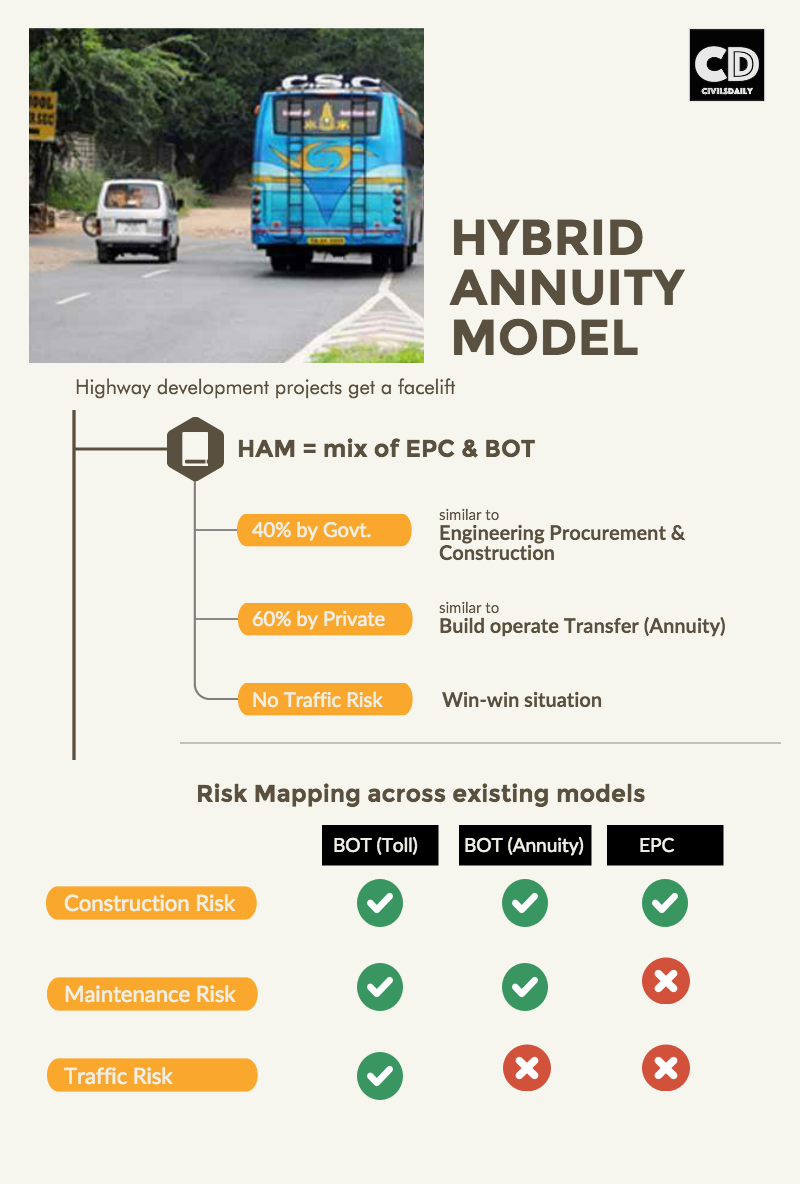
How it is a win – win situation?
- Private player has to arrange for only 60% of project cost. Exposure and risk reduces
- All regulatory clearances risk, compensation risk, commercial risk and traffic risk is borne by government, so risk for private sector is minimal
- Govt. has to cough up only 40 % of initial funding
- Operation and maintenance by private player. Better expertise, better quality of services
- Finally comfort to lenders ( banks ) through assured annuity payments
Hope you got the key differences! If I left out something, feel free to ping back on the comments.
#Q1. What do you mean by the hybrid annuity model? Does this model provide for optimal risk sharing? Suggest some measures to reform overall PPP framework in the country with special reference to reasons for stalled PPP projects in last few years.
#Q2. Funding for infrastructure projects remain weak in India. Discuss various steps taken by govt to provide funding to infrastructure sector. Also suggest measures govt. can take to develop corporate bond market to fund infrastructure projects.
-
All motivation no questions no debates
It is wonderful to see everyone chipping in to suggest strategies and sharing motivational articles but equally disheartening to see the threads with questions gathering dust. In nutshell we are motivated enough to prepare but just not motivated enough to practice questions. So I guess there is not point in wasting time and efforts. Bye bye folks.
-
The Non-Dalit's Guide To Debating Meaningfully About Caste
It’s heartbreaking that a bright, young man — Rohith Vemula — had to commit suicide for us to pay heed to caste-based injustices, but still, this is a conversation that has been long overdue.
http://www.huffingtonpost.in/yashica-dutt-/so-you-want-to-meaningful_b_9129308.html?ncid=fcbklnkinhpmg00000001
