💥UPSC 2026, 2027, 2028 UAP Mentorship (March Batch) + Access XFactor Notes & Microthemes PDF

Search results for: “”

  • Dealing with Pakistan – Are you a Hawk or a Dove?

    Terrorist attack on Pathankot airbase after PM Modi’s Birthday Diplomacy has once again brought to spotlight challenges of dealing with Pakistan. Successive governments have tried to engage pakistan. PM vajpayee’s Bus Yatra to Lahore, Manmohan-Musharraf talks, PM Modi’s shawl diplomacy at the swearing in ceremony are some of the examples. Successive govt have also failed in their attempts to normalise relations with Pakistan. Question remains as to, what should be the best way to deal with Pakistan?

    In this article, we try to answer some of the pertinent questions related to India’s Pakistan policy through the perspective of dove and hawk.

    Some strategic commentators like to point out that there is a pattern to attack. Every attempt by India to improve relations with Pakistan has evoked this kind of response.

    1. Lahore bus trip of Vajpayee was followed by Kargil attack.
    2. Parliament was attacked after failed Agra summit.
    3. When indian forces were deployed at border in response, attack at Kaluchak.
    4. After Musharraf manmohan talk ran into rough weather, Mumbai serial train bombing and 26/11.
    5. Ufa meeting was followed by Gurdaspur attack.

    #1. Who are the elements within Pakistan who do not want normal relations between two countries?

    Dove- Apart from jihadists, there are elements within the army who do not want any sort of movement towards any sort of rapprochement. But attacks do not necessarily imply that they were sanctioned by the top brass of Pak military.

    Hawk- No evidence of split in Pakistani army. There may be differences of opinion but army remains a professional force controlled by army chief. Attackers must at least have the tacit approval of generals. Pakistani generals including Musharraf have been on record saying they use terrorists as instrument of state policy. This is part of their security doctrine.

    #2. Are these attacks timed to prevent normalisation of relations?

    Dove- Yes, certainly. Attackers do not want normal people to people relations. Pattern of their attacks bear testimony to this. They want to derail bilateral talks,

    Hawk- They attack India to bring us to accept their agenda i.e. talk on Kashmir, Baluchistan etc.   They believe,unless there’s terrorism, India won’t discuss the agenda Pakistan wants.

    #3. What about talks? Should talks be cancelled?

    Dove- There are no other options available and calling off the talk would be playing into the hands of terrorists. They should not be allowed to derail the peace process.

    Hawk- Talks can not be an end in themselves. What is more important is what do we talk about? Pakistani generals have responded to all the concession given by PM in this manner. Now talk has to be on terror and terror only.

    We also need to keep in mind, any talk with political establishment will not be successful until Pakistanis themselves are able to bring military on board

    #4. If not talk, what are the other options?

    Dove- Army is not a monolith,not everyone want bad relations with India. we should cultivate relations with the moderate elements within Pakistani establishment and civil society, create vested interests in favour of normal ties. War does not serve any purpose. There’s no alternative to talks.

    Hawk- Only answer we have been able to devise to Pak provocation is to call off the talks. 

    Answer to low intensity warfare is low intensity warfare and it’s not bomb for bomb but emasculation of state structures. India should be prepared to hit pakistan where it hurts at the time and place of its choosing. There are so many internal fissures inside pakistan. We can exploit them.

    #5. But wouldn’t unstable Pakistan be even more of a problem for India?

    Dove- Destabilizing Pak doesn’t serve India’s interests. Creation of Bangladesh hasn’t necessarily helped our security. Instability there will lead to chaos which would spill over and would be disastrous for our security and other interests.

    Hawk-  Our problem is our fear that instability in Pakistan will harm us irreparably and our premise that stability of Pak is in our interest and the fond hope that political class and civil society will one day come up. If Baluchistan, frontiers were not there, what would remain is Punjab and it would be a  weakened Punjab and its Punjab that’s creating problems.

    Let’s not discuss whether a strong Pak is good for India, or weak Pak is good for India, of course no Pak is best for India.

    #6. But why does Pakistan do it? What does it tell about the nature of Pak state?

    Dove- Defiance is essential to ensure normal disparity never fully operate. Military obviously control its pak policy and elements within military and Jihadist groups carry out such attacks to maintain control over Pak society.

    Hawk- It’s not a state with an army but army with a state. They have gone on a completely different trajectory. It is virtually becoming a theocratic state. Also there is deep criminalization of Pakistani state. Madrasas, jihadist groups, sectarian groups, organized crimes they have all become interlinked.

    #7. What should India do to prevent such attacks?

    Dove- Strengthen our own security. Carry on with talks to build positive momentum in bilateral relationship. Strengthen the hands of civilian govt there.

    Hawk- Strengthen our security. Complete the fencing. Drug smuggling is rampant which can’t happen unless there is connivance on both sides. If smugglers can sneak through, so can terrorists.

    We also need to improve our  technical capabilities. They were using mobile phones and we were not even able to pinpoint exact locations.

    We must also establish deterrence that mischief will be countered by robust action on the ground. Carrot and stick policy ie  carrot of talk and stick of robust punishment on the ground.

    #8. Can we carry out Myanmar like hot pursuit or operation like Neptune spear?

    Dove- It will only escalate tensions and won’t be in the interest of either side. There would be too much pressure from international community. There’s vast difference in the capabilities of India and USA..

    Hawk- We need to get rid of monkey of being a soft state off our back. If we so decide, we can undertake Myanmar like operation. There is a role of violence in state craft especially when we are dealing with very very violent actors.

    #9. What about the role of international community, external pressure?

    Dove- We are responsible member of international community. We should try to put pressure on Pakistan to stoop its territory from being used as launching pad for terrorism. We should not do anything that sully our image.

    Hawk- Pakistan don’t feel any pressure, why do we feel pressure of international community! Everyone knows Pak is epicenter of terrorism yet Pak cleverly plays its card of being a nuclear armed state and gets away with everything.

    Finally, something both dove and hawk agree on –

    Fact remains that Pakistan will have to come to conclusion that good relations with India are in their own interest. It’s a society in deep crisis. Frankenstein monster has come to bite its own master. There is an urgent need of a civil society movement to overhaul the whole power equation and social structure of Pak society.

  • Zika Virus Outbreak

    Everything you wanted to know about Zika virus

    The World Health Organization (WHO) expects that Zika virus, a mosquito-borne disease, spreading through the Americas, to affect between 3 million and 4 million people. Let’s analyse this in brief!

    Where was the first Zika virus outbreak identified?

    • Zika virus is an emerging mosquito-borne virus that was first identified in Uganda in 1947 in rhesus monkeys through a monitoring network of sylvatic yellow fever.
    • It was subsequently identified in humans in 1952 in Uganda and the United Republic of Tanzania.
    • Outbreaks of Zika virus disease have been recorded in Africa, the Americas, Asia and the Pacific.

    Trivia : Do you know why is it called Zika Virus?

    It was first isolated from Rhesus monkeys in Zika forest near Lake Victoria in Uganda.

    Find Out why was Ebola virus named as such?


    What makes this outbreak different?

    • The current outbreak, the first ever in the western hemisphere, is a big deal for a number of reasons
    • We now know that it’s not adults who have the most to lose but their unborn babies
    • Microcephaly is a condition where a baby is born with an abnormally small head and brain defects
    • Worldwide it affects only 1 in 30,000 to one in 250,000 newborns
    • In Brazil there are usually a few hundred cases annually at most, but since October 2015, there have been 3,500 new microcephaly cases

    But, what is microcephaly?

    • Microcephaly is a rare condition where a baby has an abnormally small head.
    • This is due to abnormal brain development of the baby in the womb or during infancy.
    • Babies and children with microcephaly often have challenges with their brain development as they grow older.
    • Microcephaly can be caused by a variety of environmental and genetic factors such as Downs syndrome; exposure to drugs, alcohol or other toxins in the womb; and rubella infection during pregnancy.

    How does the Zika virus spread?

    • Zika virus is transmitted to people through the bite of an infected mosquito from the Aedes genus, mainly Aedes aegypti in tropical regions
    • This is the same mosquito that transmits dengue, chikungunya and yellow fever
    • Zika virus disease outbreaks were reported for the first time from the Pacific in 2007 and 2013 (Yap and French Polynesia, respectively), and in 2015 from the Americas (Brazil and Colombia) and Africa (Cape Verde)

    How bad is it now?

    • As of January 23, 2016, the Zika virus has spread to 21 countries and territories of the Americas
    • It’s speculated that the virus must have arrived in Brazil along with the throngs that swept in during the 2014 FIFA World Cup
    • Things look so grim that governments of 4 South American countries are now advising women to not get pregnant until the situation is brought under control
    • The WHO has predicted that the virus is likely to spread all over North and South America, except for Chile and Canada where the Aedes aegypti mosquito is not present
    • The reason that the WHO thinks these countries are so susceptible is that their populations have not been exposed to the virus before and hence have no immunity

    Is there a cure?

    • No, there isn’t. There exists medication for symptomatic relief but these are quite useless now that we know about the microcephaly link
    • Research on the Zika virus is still quite primitive
    • Given its generic symptoms in adults, it’s very easy to miss or misdiagnose
    • Moreover, the virus doesn’t seem to show effects in common lab animals like mice and rats. Getting monkeys is extremely tough because of restrictions on primate research
    • Vaccine development and antiviral drug discovery efforts are on but this takes time, and with the Zika virus, we’ll be starting from scratch

    Does Brazil have a way out?

    • Brazil needs an immediate plan of action for more than one reason
    • Rio de Janeiro is frantically spraying insecticides at the parade grounds where the annual carnival celebrations will commence soon
    • In August, the city is due to host the Olympics

    What about India?

    • India is one of the Aedes aegyptis’s many homes but the Zika virus itself has not ever been detected in our country so far
    • However, in a study in the 1950s, healthy individuals from 6 Indian states showed passive immunity to the virus
    • This means that though their blood contained antibodies against the virus, this was not because they were exposed to the virus
    • Usually passive immunity is acquired through vaccines, from mother-to-child transmissions or breast milk
    • In the case of India, where the Zika virus is not known to exist, the antibodies probably arose from exposure to similar viruses
    • Nevertheless, theoretically, Zika can spread anywhere that the mosquito exists
    • That means India, too. Indians are just as susceptible if they travel to high-risk countries


    Is there something more that you wanted to know which we did not answer yet? Drop in with your questions.


    Published with inputs from Arun | Image - Outbreaknews
    
  • Gloabalisation and Blizzards

    The weather Gods also seem to have understood the meaning of Globalisation as it seems “Snowzilla’ is making its presence felt in Delhi. Between there is no connection in the Headline and the content of this article. It is just the same old MCQs:

    1. Which of the following is/are correctly matched?
    Ancient Town : Location
    1. Ujjayini : Malwa
    2. Pratisthana : Sothern Deccan
    3. Tamralipti : Godavari Delta
    4. Bhrigukachchha : Broach, Gujarat
    Choose the correct alternative using the codes given below:
    (a) 2 and 3 only
    (b) 1 and 4 only
    (c) 1 and 3 only
    (d) 2 and 4 only

    2. Among the following, you are most likely to get caught in a Blizzard if you are visiting
    (a) Perth
    (b) Durban
    (c) New York
    (d) Santiago

    3. Consider the following statements:
    1. Terrestrial Biodiversity declines as we move from the poles towards the equator.
    2. Oceanic Biodiversity is much greater than the Terrestrial biodiversity.
    Which of the above statements is/are correct?
    (a) 1 only
    (b) 2 only
    (c) Both 1 and 2
    (d) Neither 1 nor 2

    4. Which of the following type of climates is typified by a warm moist summer and a cool, dry winter?
    (a)The warm temperate eastern margin climate
    (b) The temperate continental climate
    (c) The warm temperate western margin climate
    (d) The Savanna climate

    5. Which of the following is/are correctly matched?
    1. Unakoti Rock Carvings : Assam
    2. Tombs of Ahom Kings, Charaideo : Tripura
    3. Ancient Temples of Bishnupur : West Bengal
    Choose the correct alternative using the codes given below:
    (a) 3 only
    (b) 1 and 3 only
    (c) 1 and 2 only
    (d) 1, 2 and 3

  • Start-up India, Stand up India : Wings to fly [Part II]

    We have seen first part of Action plan for Start ups, now let’s see another part in brief!

    Let’s see Funding Support and Incentives?

    #Providing Funding Support through a Fund of Funds

    1. In order to provide funding support to Startups, Government will set up a fund with an initial corpus of INR 2,500 crore and a total corpus of INR 10,000 crore over a period 4 years (i.e. INR 2,500 crore per year) .
    2. The Fund will be in the nature of Fund of Funds, which means that it will not invest directly into Startups, but shall participate in the capital of SEBI registered Venture Funds.
    3. The funds of fund shall ensure support to a broad mix of sectors such as manufacturing, agriculture, health, education, etc.

    #Credit Guarantee Fund for Startups

    • To catalyse entrepreneurship by providing credit to innovators.
    • In order to overcome traditional Indian stigma associated with failure of Startup enterprises in general.
    • To encourage experimentation among Startup entrepreneurs through disruptive business models, credit guarantee comfort would help flow of Venture Debt from the formal Banking System.

    #Tax Exemption to Startups for 3 years

    • With a view to stimulate the development of Startups in India and provide them a competitive platform, it is imperative that the profits of Startup initiatives are exempted from income-tax for a period of 3 years.
    • This fiscal exemption shall facilitate growth of business and meet the working capital requirements during the initial years of operations.

    #Launch of Atal Innovation Mission (AIM) with SETU Program

    To serve as a platform for promotion of world-class Innovation Hubs, Grand Challenges, Startup businesses and other self-employment activities, particularly in technology driven areas.

    The Atal Innovation Mission (AIM) shall have 2 core functions:

    • Entrepreneurship promotion –

    Through Self-Employment and Talent Utilization (SETU), wherein innovators would be supported and mentored to become successful entrepreneurs and establishment of 500 Tinkering Labs.

    • Innovation promotion –

    To provide a platform where innovative ideas are generated.

    Launch of Grand Innovation Challenge Awards for finding ultra-low cost solutions to India’s pressing and intractable problems

    The main components proposed to be undertaken as part of the mission include:

    #1. Setting up of 7 New Research Parks Modeled on the Research Park Setup at IIT Madras

    • To propel successful innovation through incubation and joint R&D efforts between academia and industry
    • The IIT Madras Research Park endeavors to enable companies with a research focus to set up a base in the Park and leverage the expertise of IIT Madras.
    • Creating a collaborative environment between industry and academia through joint research projects and consulting assignments.

    #2. Promoting Startups in the Biotechnology Sector

    Department of Biotechnology endeavors to scale up the number of Startups in the sector by nurturing approximately 300-500 new Startups each year to have around 2,000 Startups by 2020.

    The Department of Biotechnology shall be implementing the following measures along with its PSU Biotechnology Research Assistance Council (BIRAC) :

    • Biotech Equity Fund – BIRAC AcE Fund in partnership with National and Global Equity Funds (Bharat Fund, India Aspiration Fund amongst others) will provide financial assistance to young Biotech Startups.
    • Bengaluru-Boston Biotech Gateway to India has been formed.
    • Letter of Intent has been signed between DBT, GoI and Department of IT, Government of Karnataka for the same.

    Finally, can we expect Startup India will be the real boost for Make in India and Digital India Mission ? Let us know!

    Would you like to give answer of this question!

    #Q.Will the Start-up India campaign end up making India the start-up hub of the world? Critically comment.


    Published with inputs from Arun
  • Part 4 | Whose law is it anyway? | Landmark Judgements that Transformed India

    The story of landmark judgments continue and we are here with the tale of a judgement which ignited passions then, and is still hotly debated in the context of Indian secularism.


    Consider the following facts –

    1. It’s lawful for a Muslim man to keep more than one wife but not for a Hindu man. Of course no woman Hindu or Muslim can have more than 1 husband in our patriarchal society.
    2. Hindus can form an undivided family (HUF) to manage their assets better and in the process reduce their taxes but not Muslims or Christians.
    3. Christians can’t file for divorce before completion of 2 years of marriage while other communities can do so after 1 year of marriage.
    4. Christian women get no share in the property of deceased children while different rules apply to other communities.

    These observations prompt one to ask, whose law is it anyway!

    This chaotic situation is the result of religious laws governing matters relating to marriage, divorce, succession, inheritance, maintenance etc.

    The question of uniform civil code had been raised time and again since independence but post supreme court judgement in 1985 on “the maintenance a divorced Muslim woman would be entitled to receive”, this question has acquired a distinct communal overtone.

    In this mini series we discuss the tale of Shah Bano case . This is the story of a judgement which would lead to politics of Mandal- Kamandal and set off a chain reaction which would set ablaze fires of communalism and set off one of the biggest communal riot in the post independence history of India. It would change the politics of India and relationship b/w 2 major communities forever.

    But before we come to the judgment, let us briefly have a look at the constitutional provisions relating to religious freedom, secularism and supreme court interpretations of the same.

    Art 15– No discrimination on grounds of religions, race,caste, sex, place of birth only.

    Art 25– Freedom of conscience and free profession, practice and propagation of religion subject to reasonable restrictions on the grounds of public order, health and mortality.

    Art 25 (2) provides for regulating secular activities associated with religious practices and social welfare and reform.

    Art 26– right to establish and administer religious institutions.

    Art 27–  Prohibit state from levying tax proceeds of which are used for the benefit of a particular religion.

    Art 28– deals with issue of religious instruction in educational institutions.

    Art 44- A DPSP provides for  uniform civil code

    CAA 42nd inserted secularism in preamble.

    In S.R.Bommai vs Union of India case, supreme court held secularism as a basic feature of the constitution.


    Origin of different personal laws

    #1. The Lex Loci Report of October 1840

    1. It emphasized the importance and necessity of uniformity in codification of Indian law, relating to crimes, evidences and contract.
    2. It also recommended that personal laws of Hindus and Muslims should be kept outside such codification. 

     #2. Queen’s 1859 Proclamation promised absolute non-interference in religious matters. So while criminal laws were codified and became one for the whole country, personal laws continue to be governed by separate codes for different communities.

    What was the reason?

    Indians resisted British attempts to change their religious and customary practices and British realized it the hard way with various sporadic localized revolts and massive mutiny of 1857.

    Charter act of 1813 had allowed missionaries to come to India and promote Christianity. To impress the liberal govt in Britain (2 main parties in Britain that time were liberals and conservatives, labour party came later ) to grant them another 20 years of trade monopoly, EIC, promoted activities of missionaries and under leadership of Bentinck passed many social reform legislation like abolition of Sati in 1829.  But primary motive being money and loot, they abandoned it when they saw it hurting their commercial interests.

    The same situation was allowed to continue post independence. Constitution was written in the shadow of partition. There was tremendous anxiety among the minority community so founding fathers thought it fit to prescribe principle of UCC in DPSP. It was their fond hope that with time, minorities will feel safe and parliament would be able to legislate a uniform civil code.

    Apart from very chaotic situation different codes for different communities create, religious laws of every community discriminated against women. .Laws had to be reformed and for that very reason art 25 (2) provides for state intervention in secular practices associated with religion.

    To reform Hindu laws, Hindu code bill was piloted by Dr Ambedkar which legalized divorce, provided for only monogamy, gave inheritance rights to daughters. Amid intense opposition of the code being anti Hindu, a diluted version was passed via 4 different legislation.

    1. the Hindu Marriage Act,
    2. Succession Act,
    3. Minority and Guardianship Act
    4. Adoptions and Maintenance Act.

    For instance diluted Hindu Succession Act, 1956, originally did not give daughters inheritance rights in ancestral property. They could only ask for a right to sustenance from a joint Hindu family. But this disparity was removed by an amendment to the Act in 2005.

    Similarly in Gita Hariharan case, supreme court while interpreting Minority and Guardianship Act, declared mothers also the natural guardian of child even when father is alive.

    Special marriage act was enacted in 1956 which provided for civil marriages outside of any religious law .

    Other personal laws remained unreformed and most visible aspect at least in public consciousness of unreformed laws were provisions of triple talaq and polygamy in Muslims.


    Let’s come back to the judgment 

    Shah Bano, a 73 yr old woman was divorced by her husband by triple talaq and was denied maintenance. She approached the courts.

    District Court and high court ruled in her favour that led to her lawyer husband moving to supreme court.

    Facts of the case

    1. Under Muslim personal law, maintenance was to be paid only till period of iddat( roughly 90 days ).
    2. Section 125 of crpc  (criminal procedure code) that applied to all citizens, provided for maintenance of wife.

    A five judge constitutional bench of supreme court unanimously ruled in her favour. But it also passed some adverse remarks about Muslim personal laws and failure of parliament to legislate UCC.

    Note that judgement came not very long after 1984 anti Sikh riots.  Muslims felt under siege and all India Muslim personal law board and conservatives vigorously defended the application of their own personal laws. Govt was accused of imposing Hindu culture on minorities. It was seen as a threat to Muslim personal law which they considered their identity. The fact that none of 5 judges who advocated for uniform civil code was Muslim did not help the matter but was evidence of imposition of Hindu values over Muslims. Media sensationalism did not help matters either.

    Aftermath and impact

    Rajiv Gandhi govt. buckled under pressure and passed The Muslim Women’s (Protection of Rights on Divorce) Act (MWA) was passed in 1986, which made Section 125 of the Criminal Procedure Code inapplicable to Muslim women.

    This law was exact opposite of its name as any sane person can see it was passed to neutralize supreme court judgement in Shah Bano case.

    Rajiv govt was accused of minority appeasement and perhaps to compensate the other side or by sheer coincidence, magistrate in Ayodhya ordered opening of the gates of disputed Babri masjid. Bofors scandal wrecked his Mr clean image and govt fell in 1989 and in ensuing general election VP Singh of national front became the PM. He played the Mandal card and in response, Advani started rath yatra. Politics of kamandal had begun . All of this would have very tragic consequences but that’s the story for some other day.

    Daniel Latifi case

    MWA was challenged on the grounds that it violated right to equality (art 14, 15) as well as right to life (art 21).

    Supreme court while holding the law as constitutional, harmonised it with section 125 and held that amount received during iddat period should be sufficient to maintain her during iddat as well as provide for her future.

    Different personal laws for different communities esp provision of polygamy for Muslim men gave rise to the phenomenon of converting into Muslim just for the sake of remarrying without divorce. Everyone would have heard the tale of Chand Mohammad(deputy CM of Haryana) and Fiza.

    Sarla Mudgal v.Union Of India

    Supreme Court in its judgement in 1995 held such practice as illegal and criminal.

    Again an appeal was made to parliament to have a re look at UCC.

    Supreme court parroted Sarla Mudgal lines again in Lily Thomas case 5 years later but still many Hindus convert to Islam just to remarry.

    in spite of the chaotic situation and denial of rights to women, governments hav  failed to even put out a draft UCC. This leads us to ask-


    Some thought questions related to UCC –

    #1. Would there ever be suitable conditions  for the enactment of UCC?  What would be those conditions like? Would not vested interests always thwart attempt to bring a UCC?

    #2. If parliament does indeed decides to bite the bullet and passes UCC,what could be the adverse consequences of the same?

    #3. What should be the broad principles on which such UCC be based?

    #4. Should supreme court not strike down all the provisions which are discriminatory to women or violate their human rights as being unconstitutional ?

    #5. What do u think should be the way forward ?

    In the next article we shall discuss more fundamental questions related to Indian secularism like right to freedom to convert, extent of state intervention in religious affairs, desirability or otherwise of a secular court interpreting scriptures and determining what’s core religious practice and what’s not and by extension what can be restricted and what can not be ?

  • A brief history of the Greek crisis: A ppt format

    Hi All,

    I have been talking about the issues involved in the Greek public debt crisis at various fora and this is a baseline ppt I had prepared for my talks. A lot of the material on this presentation is collated from different sites and articles that I’ve been reading whilst preparing; the ppt is of value primarily to students or researchers looking for a quick reference on the crisis. The presentation covers main issues upto 15th July 2015.

    There is a lot of action that happens around this ppt when I support it with the talk, so in that sense, a new reader may find some gaps in it. If you want to know more about a particular issue, just write in and I’ll try to send you some material around it. Here it is..

    A brief History of Greece Crisis

    These are the main themes covered in the presentation:

    1. History on the formation of the European common market

    2. Maastricht treaty entry level criteria and movement towards convergence

    3. Problems associated with the Maastricht: Connection to Greece

    4. Euro launch in 1999

    5. Why Greece wanted to enter the Euro: Benefits from having a common currency

    6. Change in the growth profile of Greece post-entry

    7. How the yield spreads, fiscal deficits, CAD and other indicators for Greece moved pre and post entry

    8. Tipping point for the crisis in 2009

    9. Reaction of core group in the EU

    10. Bailout by the Troika

    11. Greek elections and effects of Tsipras coming into power

    12. Suspension of bailout and near-collapse of Greek banks

    13. The crazy referendum held on July 5th

    14. Why Tsipras HAD to accept bailout

    15. The new bailout terms by IMF, EU and ECB

    Hope you enjoy this study material!

  • Inspiring stories – Aspirants who cleared UPSC with constraints

    Found this one… thought of sharing –

    http://social.yourstory.com/2015/11/muhammad-ali-shihab/

    Muhammad Ali Shihab was born in Edavannappara, a remote village in Kerala’s Malappuram district. He spent his childhood helping his father sell betel leaves and bamboo baskets in a makeshift pan shop. After his father’s death, he was put into an orphanage, since his mother was too poor to bring him up properly. He had to fail in Class V in order to get admission to the orphanage.

    Shihab received good guidance in the orphanage. His only hope was excelling at studies and taking life head on. In an interview given to the Hindu, he said, “I used to read in scant light under the cover of bed-sheet and pillows in order not to disturb my friends sleeping in the neighbouring beds of the dormitory. In fact, I was violating the orphanage rules.” While in the orphanage he completed his elementary education and graduated in history through distance learning.

  • Geography | Ocean Currents

    Ocean Currents can be a confusing topic. Understanding the complete mechanism and various interrelationships in play when it comes to ocean currents can be overwhelming. The following visualisation by NASA will help you understand the role of ocean and ocean currents. Many terms and themes discussed here will be taken up in subsequent sections.

    Ocean Currents are influenced by 2 kinds of forces.

    1. Primary or Causation forces – that initiate the movement of water.
    2. Secondary forces – that modify the flow of the waters.

    Primary forces 

    Ocean is driven by the atmosphere above it in 2 ways

    1.Wind Stress or Frictional Drag – Friction between wind and oceans creates a frictional drag known as wind-stress. It impacts the upper 100m of the ocean surface and sets the water in motion.

    2.Insolation – Heating by solar energy. The heating causes water to expand.

    >Causes water to expand. In the equatorial regions, the height is 8cm higher. This causes a slight gradient and water tends to flow down the slope.

    >Causes precipitation and evaporation which changes the salinity and hence the density of water.

    Secondary forces

    1.Coriolis Force – The effects of this force has been discussed in atmospheric circulations. It causes winds to deflect toward the right in the Northern Hemisphere and toward the left in the Southern Hemisphere, resulting in curved paths. It has a similar impact on Ocean Currents deflecting them to the right in the Northern Hemisphere and to the left in the Southern Hemisphere.

    2.Gravity – Gravity acts of the density difference of water. Density is a function of temperature and salinity and insolation, precipitation and evaporation plays an important role.

    3.Shape of the ocean basin –

    *NCERT somewhat differs in its definition of Primary and Secondary forces, but the above classification is apter.

    Types of Ocean Currents

    There are 2 types of Ocean Currents

    1. Surface Currents also called Wind-Driven Currents 

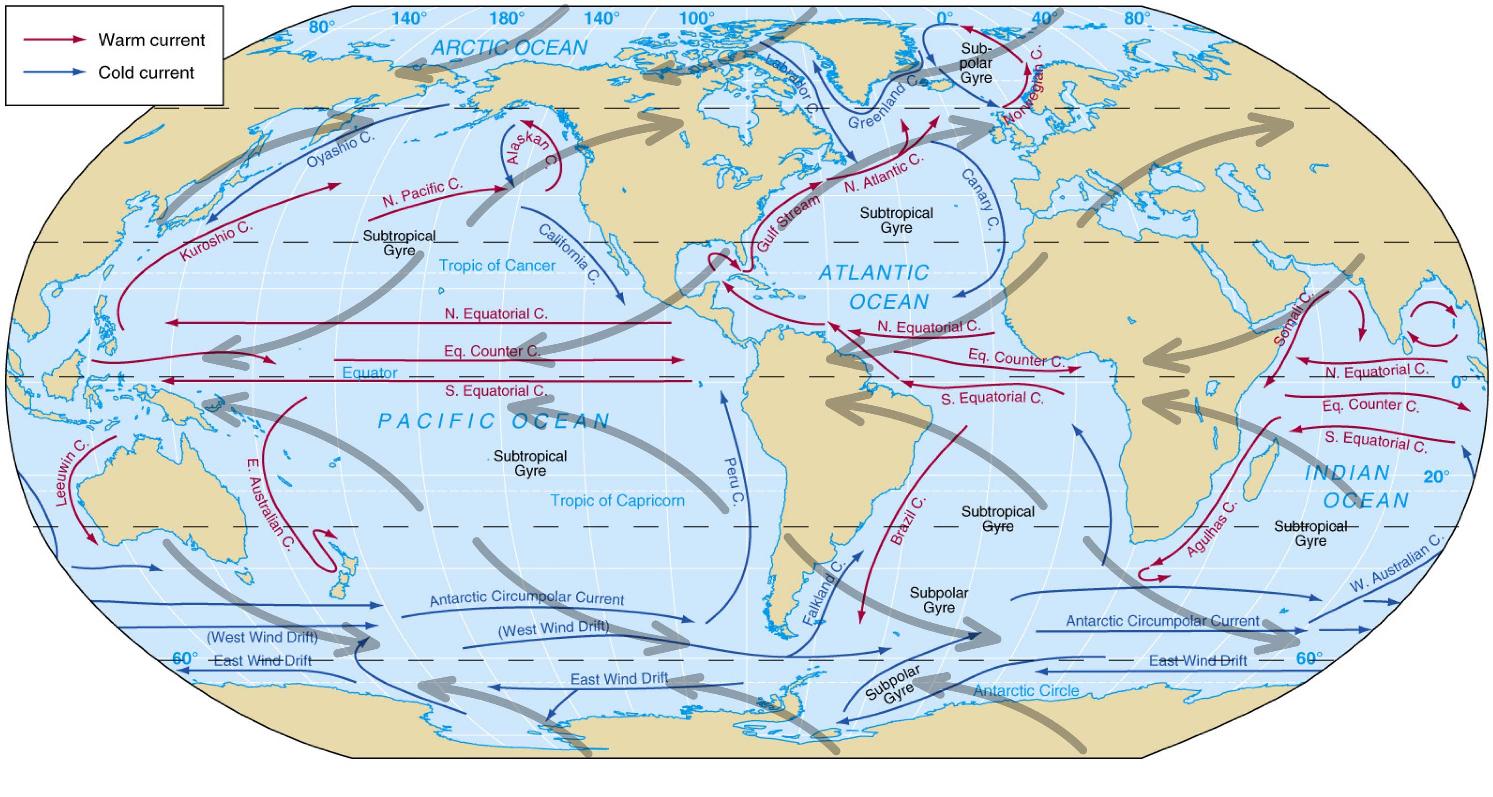
    The Surface Currents are a result of the Wind-stress and are modified by Coriolis force. Hence Surface currents mimic Atmospheric Wind Circulations. The diagram below shows how Easterlies are inline with equatorial current, the Westerlies are inline with Kuroshio and Gulf Stream.

    Ocean currents are constrained by the continental masses that border the three major oceans. This causes slight variations in their movement.

    To understand the mechanism, we touch upon few concepts.

    Ekman Spiral

    Ekman Spiral is the result of Coriolis force on the movement of surface water. The wind-stress moves the uppermost layer of water. This layer, in turn, drags the layer below it. Each deeper layer moves more slowly than the layer above it until the movement ceases at a depth of about 100 meters.

    All layers of water are deflected by Coriolis force to the right in the Northern Hemisphere and to the left in the Southern Hemisphere. As a result, each successive layer moves 45 deg. to the direction of drag force being applied. The diagram below captures this aptly. This creates a twisting effect creating the spiral. The spiral is known as Ekman Spiral and each subsequent layer is called the Ekman Layer.

    The average movement of all the layers comes out to be 90 deg to the direction of the surface wind.

    Gyres

    Ekman Spiral give rise to ‘Gyres’. These are ocean-circling currents that occur north and south of the equator. They do not occur at the equator, where the Coriolis effect is not present. There are five in all: two in the Pacific – north, and south of the equator, two in the Atlantic, and one in the Indian Ocean, south of the equator. In the northern Indian Ocean, the landmasses of Asia prevent the formation of a full gyre. Instead, there is a seasonally reversible current, driven by the Monsoon winds.

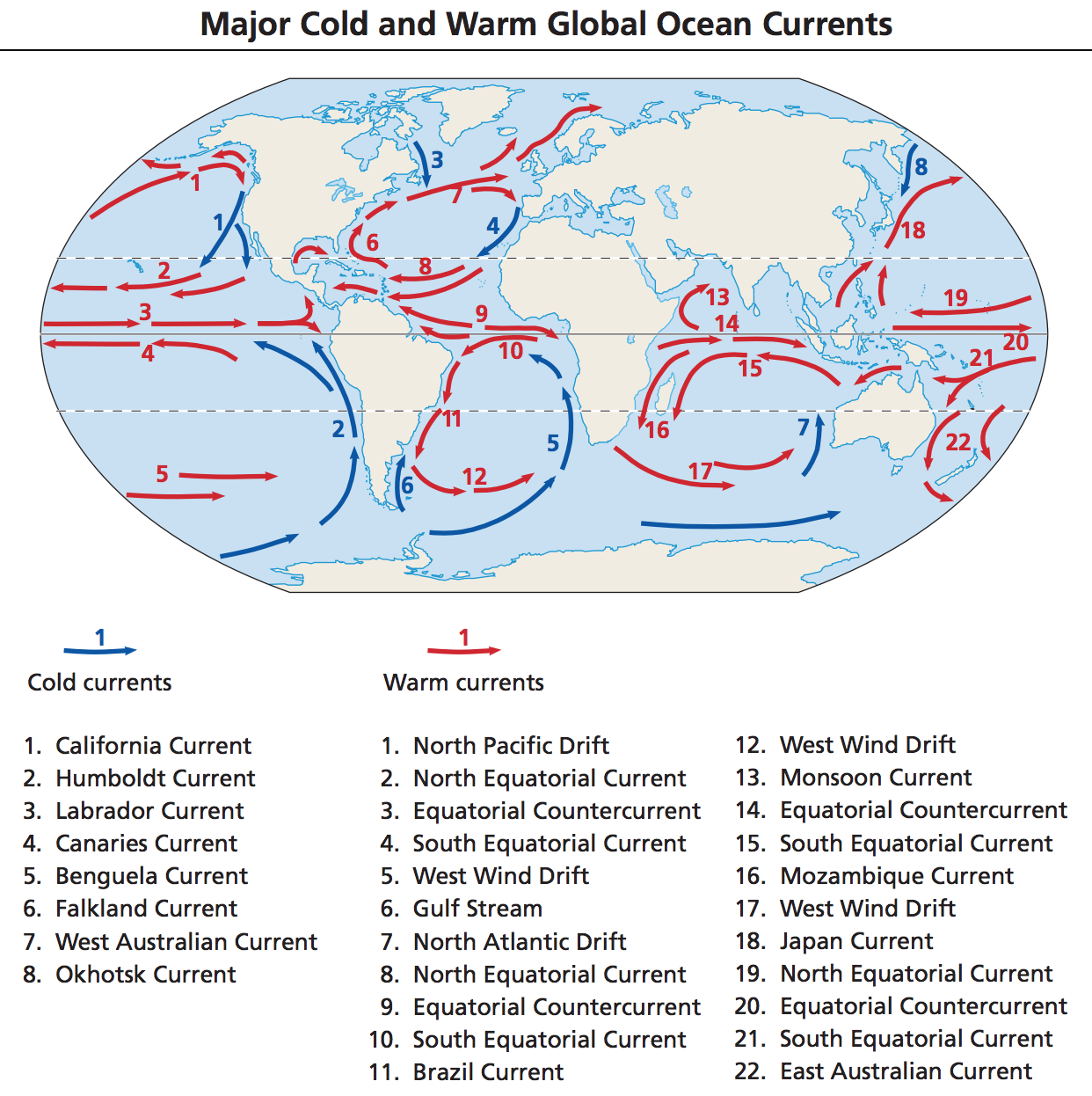
    Surface ocean currents are further divided into warm and cold currents


    2. Deep-water Currents also called Thermohaline Currents

    While wind effects drive ocean currents in the upper 100 meters of the ocean’s surface, ocean currents also flow thousands of meters below the surface. These deep-ocean currents are driven by differences in the water’s density, which is controlled by temperature (thermo) and salinity (haline). This process is known as thermohaline circulation.

    Cold, salty water is dense and sinks to the bottom of the ocean and eventually returns to the surface through mixing. On a global scale, this sinking and rising of ocean water creates what scientists call the ‘great ocean conveyor belt.’

    Case Study: The Gulf Stream

    Gulf Stream is where you don’t see a clear-cut distinction between the Wind-Driven and Thermohaline.The first part of the Gulf Stream that represents the warm waters to a certain extent are Wind Driven


More posts