💥UPSC 2026, 2027, 2028 UAP Mentorship (March Batch) + Access XFactor Notes & Microthemes PDF

Search results for: “”

  • Foreign Policy Watch: India-Russia

    India-Russia relations : Momentum in transforming Strategic Partnership


    In late December, Indian Prime Minister made his first state visit to Russia to take part in the 16th annual bilateral summit. PM Modi and Russian President Vladimir Putin used the summit to review bilateral ties across a number of areas. Let’s glance over revamped relations of India-Russia!


    Can we have some background of bonding legacy?

    • Relations with Russia are a key pillar of India’s foreign policy, and Russia has been a longstanding time-tested partner of India.
    • India & Russia signed “Declaration on the India-Russia Strategic Partnership” in October 2000.
    • Under the Strategic Partnership, several institutionalized dialogue mechanisms operate at both political and official levels to ensure regular interaction and follow up on cooperation activities.
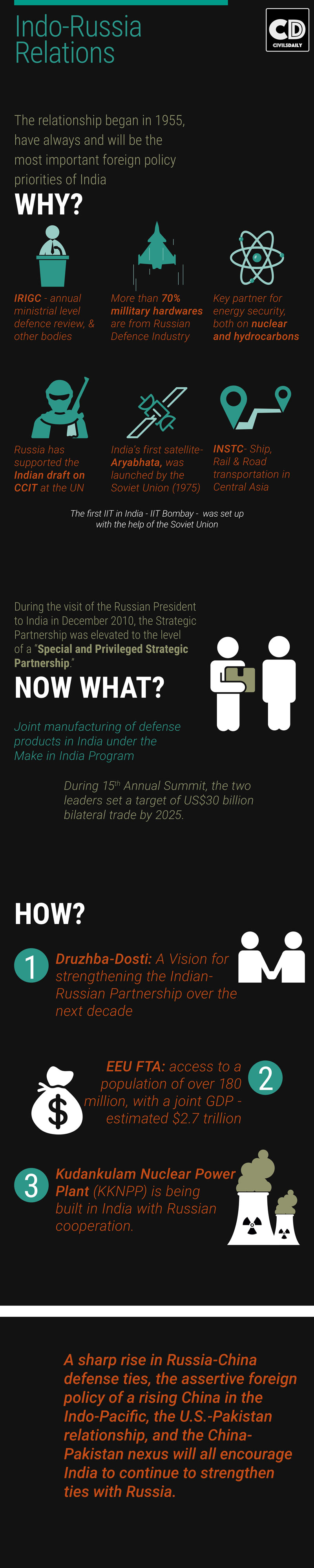
    • During the visit of the Russian President to India in December 2010, the Strategic Partnership was elevated to the level of a “Special and Privileged Strategic Partnership.

    Let’s dive into the PM’s visit for bilateral summit in Russia?

    • With the signing of sixteen agreements, this is being seen as very significant in sustaining and expanding India-Russia ties.
    • One major step taken is a deepening of India’s defense partnership with Russia for Make in India.
    • On the eve of Modi’s visit to Russia, the Indian government announced the purchase of five S-400 supersonic air defense systems from Russia, costing around $6 billion.
    • For instance, the two sides agreed that the Kamov 226 helicopter would be manufactured in India.

    How will bilateral partnership boost Make in India programme?

    • India and Russia agreed to strengthen the defense partnership in line with the “Make in India” program. So while only the public sector has been involved in defense cooperation between the two countries to date.
    • The new initiatives will encourage joint manufacturing of defense products in India and motivate the private sector to play a role in developing a strong defense manufacturing base in India.
    • It should be emphasized that “Make in India” also aims at having India emerge as an essential player in the global defense market.
    • India is forecast to spend $250 billion over the next decade upgrading its military and Russia wants to seize the opportunity to become a major part of this mission, expressing its readiness to work jointly with India on defense manufacturing.

    So, How does economic and trade cooperation matters in economic growth?

    • Enhancing trade and economic cooperation between India and Russia is a key priority for the two governments.
    • On the economic front, India and Russia decided to institutionalize the CEO’s Forum, which will meet twice a year – once in India and the other in Russia.
    • During 15th Annual Summit, the two leaders set a target of US$30 billion bilateral trade by 2025.
    • Hydrocarbons is an active area for exploring cooperation between the two countries.
    • In May 2014, ONGC and Rosneft signed an MoU for bilateral cooperation in subsurface surveys, exploration, appraisal and hydrocarbons production in the offshore Arctic region of Russia.
    • In September 2015, OVL signed an agreement with Rosneft to acquire 15% stakes in Vankorneft project.
     

    Did you know about India-Eurasian Economic Union FTA?

    • Moscow is a gateway for India to Central Asia.
    • In this regard a significant move by PM Modi was the effort to move forward on the India-Eurasian Economic Union (EEU) Free Trade Agreement (FTA).
    • The EEU FTA will introduce the free movement of goods, capital, services and people-people contacts and provides for common transport, agriculture and energy policies, with provisions for a single currency and greater integration in the future.
    • The FTA between India and the EEU comprises of Russia, Belarus, Armenia, Kyrgyzstan, and Kazakhstan.
    • It offers India access to a huge market with a population of over 180 million, with a joint GDP of an estimated $2.7 trillion.
    • As Russia tries to re-calibrate its economic orientation towards the Asian region, India, as one of the fastest growing G20 economies can be a significant partner for Russia.

    Shall we move into Political Relations?

    • Annual Summit meeting is the highest institutionalized dialogue mechanism under the Strategic Partnership between India and the Russian Federation.
    • So far, 15 Annual Summit meetings have taken place alternatively in India and Russia with the 15th Annual Summit held in New Delhi during the visit of President Putin to India on 11 December 2014.
    • During the Summit, 20 documents were signed covering cooperation in nuclear energy, defence, hydrocarbons, science & technology, trade and investment etc.
    • Prime Minister Modi and President Putin also adopted a Joint Statement “Druzhba-Dosti: A Vision for strengthening the Indian-Russian Partnership over the next decade.”

    Let’s see our Defence Cooperation with Mighty Russia?

    • India-Russia military technical cooperation has evolved from a simple buyer – seller framework to one involving joint research, development and production of advanced defence technologies and systems.
    • BrahMos Missile System, Joint design and development of the Fifth Generation Fighter Aircraft, as well as the licensed production in India of SU-30 aircraft and T-90 tanks, are examples of such flagship cooperation.
    • An Indian contingent participated in the military parade in Moscow on 9 May 2015, during the 70th anniversary of the victory in the World War II.
    • The Inter Governmental Commission on Military Technical Cooperation (IRIGC-MTC) is in place to review defence cooperation between the two countries.

    Let’s know about importance of International North-South Trade Corridor (INSTC) ?

    • The INSTC was initiated by Russia, India and Iran in September 2000.
    • To establish transportation networks among the member states and to enhance connectivity with the land locked region of Central Asia.
    • The North-South Transport Corridor is an ancient route that connected South Asia with North Europe for centuries.
    • This route was used by the European, Indian, Russian and many other foreign traders.
    • During the late 17th and early 19th centuries, Indian traders used this route to reach out to the Central Asian markets.
    • The modern day INSTC is a multi-modal transportation route linking Indian Ocean and Persian Gulf to the Caspian Sea via Iran, and onward to northern Europe via St. Petersburg in Russia.

    How is it important to India to protect its strategic and economic interest?

    • The INSTC envisages movement of goods from Mumbai (India) to Bandar Abbas (Iran) by sea, from Bandar Abbas to Bandar-e-Anzali (an Iranian port on the Caspian Sea) by road.
    • Then from Bandar-e-Anzali to Astrakhan (a Caspian port in the Russian Federation) by ship across the Caspian Sea, and thereafter from Astrakhan to other regions of the Russian Federation and further into Europe by Russian railways.
    • Given India’s strategic interests in the West and the Central Asian region, and need for greater economic and energy cooperation between South, Central and the West Asian region.
    • New Delhi has stepped up its engagement to reconnect with its extended neighbourhood.

    Was there any momentum on Nuclear power deal?

    • Russia is an important partner in peaceful uses of nuclear energy and it recognizes India as a country with advanced nuclear technology with an impeccable nonproliferation record.
    • In December 2014, Department of Atomic Energy (DAE) and Russia’s Rosatom signed the Strategic Vision for strengthening cooperation in peaceful uses of atomic energy between India and Russia.
    • Kudankulam Nuclear Power Plant (KKNPP) is being built in India with Russian cooperation.
    • KKNPP Unit 1 became operational in July 2013, and attained full generation capacity on 7 June 2014.
    • While its Unit 2 is in the process of commissioning in the later part of 2015.
    • India and Russia have signed a General Framework Agreement on KKNPP Units 3 & 4 and subsequent contracts are under preparation.

    What’s Next to the geopolitical space?

    • Needless to say, defence remains at the centre-stage of the bilateral relationship, although with a diversified supplier base India is at a better position today to negotiate deals with Russia especially concerning technology transfer and co-production.
    • A sharp rise in Russia-China defense ties, the assertive foreign policy of a rising China in the Indo-Pacific, the U.S.-Pakistan relationship, and the China-Pakistan nexus will all encourage India to continue to strengthen ties with Russia.
    • It is clear that India-Russia relations remain vital for both countries amid a changing regional and global security environment.

    Published with inputs from Arun
  • How to cover a topic holistically for your IAS Preparation?

    Overtime I have been asking you to prepare every topic ‘holistically’ considering all its dimensions.

    But what exactly is this ‘covering a topic holistically with all its dimensions’?

    Leaving literary verbose aside and truth be told, it simply means pondering over a topic for a while to see to which other topics it is related to and coming up with some questions that can be framed from it. And that is all we can do or should do while covering a topic ‘holistically’.

    Let me explain it with an example.

    Let us pick up the topic “Disaster and Disaster Management.” So, what other topics it can get connected to, keeping our imagination grounded in practicality, otherwise it can be connected to everything and anything.

    First of all it gets directly connected to “Important Geophysical phenomena such as earthquakes, Tsunami, Volcanic activity, cyclone etc.” from GS1.

    Why? Because these events are disastrous. Right? So while you cover this topic, you shall also cover earthquake, cyclones and Tsunami. Or if you have covered that topic before, you will have enough information to use in this topic.

    But indirectly it is connected to important social issues. Which may be more important because this dimension, if covered in an answer sets it apart from rest of the answers of other candidates.

    How? After Nepal earthquake, there were reports of human trafficking. Now if this dimension is mentioned in your answer while covering the aftershocks of a disaster, shall not it set your answer apart from other run-of-the-mill answers because most of the other answers shall be still hovering around broken bridges, number of casualties and shortage of essentials (not that they are to be missed in the answer)?

    After every disaster, we hear reports of anthropogenic philanthropy but at the same time we hear of cases of unethical behaviour of the highest order. Cases of hoarding of essentials, charging high prices, human trafficking, embezzlement of relief funds, et al keep making news. And if you were there as the in-charge of relief operations then what shall be the options available with you to set the things right? Is not it a fit case for a case study in GS4?

    So, go ahead, frame a case study, engage in group discussion and come up with a practical answer for dealing with such situations or to deal with any ethical dilemmas that you may face in such situations.

    Then while we read newspapers, we get to know so many things which are impossible to get from any other source. I still remember reading an article in The Hindu about the ‘Himalayan Tsunami’ which mentioned that no state had a State Disaster Response Force in place at that time.

    Will you get this information from any other source? However disturbing it may be, but what a piece of information while you answer that why our post-disaster response is in shambles?

    Now moving on, while we ponder over this topic, what all things come up in your mind? Here is what comes to my:

    1. What is ‘Disaster’ and ‘Disaster Management’?
    2. What is the disaster profile of our country?
    3. Why is there a spike in the frequency and intensity of disasters?
    4. What can be done to mitigate the effects of disasters?
    5. Who are more vulnerable to disasters?
    6. What is pre- and post-disaster management?
    7. What are economic and social impact of a disaster?
    8. Any case study of success in disaster preparedness? I remember reading about Odisha’s response in the face of Phailin and how it became a case study of near perfect management.
    9. National Disaster Management Act (NDMA) and its features.
    10. What is the present state of our preparedness?
    11. How well NDMA has been executed?

    And that is all. If you can answer all this, you can tweak the information you shall hold by answering them to write a decent enough answer to every disaster related question in the exam.

    And have it from me, the confidence that you shall get by answering these questions will get reflected in your writing, your interview and any discussion you may get engaged in.

    That is all for now! Keep Learning!

  • My Fears

    Many have a notion that only ‘super genius’ can get into Indian Administrative Service’.

    The incidents which I am going to share is not the most inspirational story around the world. But definitely Civil Service aspirants will get inspired knowing how much ‘Ordinary person’ I was before getting into IAS and in fact even after getting into IAS.


    I was 6 years old at that time. It was Children’s Sunday in my Church and the entire focus of that day’s sermons would be on children. As part of Children’s Sunday, children should go to the altar of the church and sing songs and recite biblical verses which they had learnt in Sunday School.

    My Sunday School Teacher in the previous week asked me to learn just 2 verses in 23 rd Chapter of Psalms in Bible and recite in front of everyone. Each of the Sunday School Children had different tasks and as I was just 6 years old, my assignment was just to recite 2 verses.

    I memorized those 2 verses the entire week and was very confident. My brother’s assignment was to recite around 10 verses from a different chapter. As he was 5 years older than me, he was given a bigger assignment. On Children’s Sunday,I was sitting beside my mom.The service began and the Church was full because the entire congregation of around 100 people were present. My mom asked me whether I remembered those 2 verses.

    If anyone had asked Abdul Kalam whether he knew basics of missile technology how he would have reacted, the same way I reacted.

    The proceedings started and children started performing their tasks with lot of applause from the church. After few minutes, Sunday School teacher called my name in the microphone and told Israel would recite verses from Psalms. I got up confidently. I saw entire crowd seeing me. As I moved forward to the altar of the Church, I could see all eyes watching me.

    I had an unusual sensation which I later realised as ‘fear’. Once I reached the altar, microphone was adjusted to my height. Once I faced the entire crowd looking at me, that unusual sensation became acute. I could feel the lub dub of my heart. I started reciting “The Lord is my Shepherd”. Next line was “I shall not want”. But seeing around 100 faces in front of me, I forgot the verses. I started repeating “The Lord is my Shepherd”. My head became blank. I could not move forward to the next line. I could see my brother who was sitting in first row, laughing at me.

    Again I tried, but nothing came out of my mouth. My Sunday School Teacher realised that Lord had let down Israel. She came forward, adjusted the microphone,completed the verses and called the next name. I did not walk back to my mom. I could hear giggling here and there. I went to the back door of the Church and sat. I felt as if the whole Sky had fallen on me. It was terrible feeling. I was sitting not knowing what to do next. Then I could hear my Brother’s name called. My prayer to Lord was that he should also forget otherwise he would make fun of me throughout my life. As he confidently continued his verses, my confidence declined.


    18 years later, I got appointed as a Lecturer in Mechanical Engg Department of Sri Ram Engineering college which is around 30 kms away from Chennai. I was assigned to handle one subject for final year students, 2 subjects for 2nd year students and one subject for 1st year students. That was my first day in College and unfortunately I had to give lecture to Final Year Students on my very first day. I had to handle the 3rd period. During first 2 periods I was sitting in the library and was taking notes for my lecture. Once tea break was given I could hear students rushing out and my lub dub suddenly started.

    The same uneasy sensation in my heart which I felt 18 years before again started. It was 10 minutes ‘tea break’ and after that I had to go and give lecture that too to final year students.After 10 minutes, bell rang and I started moving to the final year class.Students were rushing in and my lub dub further deteriorated.Instead of entering the class, I went back to my chamber. My HOD Prof Radhakrishnan saw me on my way and asked me why I had not gone to class. I told I came back for chalk piece.

    He then took me to class (may be he would have thought seeing my pale face that i would run away) and introduced me to students as the new lecturer and left the class. I did not know what to start because I was blank. I saw the attendance register. There were around 40 students and in the pretext of introducing to each other, I took attendance and asked each of the student,his schooling, place of birth etc to kill the time. As I was nearing the last 10 students, I was shivering inside with the fear that what I would do next after ‘Attendance’. So I started asking more details for last 10 students like their hobbies, parents occupation etc.I heard the bell ringing when 2 more students were left. It was a great relief as the period got over.

    I told ‘thank you’ to students and rushed out. I went straight to my HOD’s Chamber and told that I was going to resign. He smiled and asked me to sit and asked whether students teased. I told no and and explained how I managed taking attendance.He laughed for next 10 minutes. Then he gave me a cup of tea and started giving me lecture. Like Lord Krishna tutored Arjuna, for next few hours he tutored me on how to manage “stage fear”. The focus of his advice was, everyone including PM of India would have fear in their maiden speech but they manage the fear positively.He canceled my classes for next 2 days and tutored me whenever he found time.He gave me very practical tips on how to capture the attention of audience.I gained lot of confidence and when I went for next class I had the lub dub but I managed it effectively. I started using the tips he gave. Within few days the lub dub stopped totally and I became a popular lecturer among students, thanks to Prof Radhakrishnan.


    After working as a Lecturer for some time, I got qualified in Civil Service Exam and got IRTS and later IAS. In Railway Academy (Railway Staff College,Baroda) and IAS Academy(LBSNAA,Mussorie) the trainee had to do presentation invariably once in every 10 days on some topic or other. So I became seasoned and I totally forgot this ‘stage fear’.

    But once I started working in West Bengal as Sub Divisional Officer(SDO), a new problem arose. It was ‘language fear’. I could read,write and speak in ‘Bengali’ language but I had a fear to address public gatherings in Bengali language. Speaking with common man in Bengali is different but once we address in ‘stage’ we should follow certain grammar and I was not good in it. So whenever I was invited to any public function, my first condition was that I won’t address the gathering and I used to take a deputy magistrate(State service officer) who used to address on behalf of me. I managed this way for more than a year in Bengal.

    Almost after a year, things changed. I was to launch a new tribal health programme called ‘Jeevan Jyothi’ in one of my naxal affected blocks called Belpahari block.Few days before the launch,I invited my ‘District Magistrate’ to inaugurate this scheme. The then District Magistrate was Mr.Narayan Swaroop Nigam IAS, who was a young, honest and efficient officer. He was a mentor to me. Happily he agreed to be the chief guest for the occasion. On the day before the programme he asked me to send the programme schedule by email. I did not include my name in the programme because the tribals would not understand a speech in English and I cannot make a speech in Bengali.

    Once DM saw the programme schedule he called me and asked why I was not addressing the gathering. As if I was too generous I told,”Sir I want to complete the programme within a short time so that tribal people can return to their villages before dusk”.

    He told that my speech of 10 minutes won’t make a big difference and he told that he would reduce his speech by 10 minutes so that I could address the gathering. I was taken aback. I tried to give few more lame reasons but he told that I had to address. I did not know what to do.I decided to tell the truth and told him about my problem in addressing the crowd in Bengali. He told,” Israel, I knew it even before you telling me.I don’t want my SDO to avoid giving speech in Bengali.You are like my younger brother.You have to start learning instead of avoiding. So tomorrow you have to give speech in Bengali. Its an order”.

    My first reaction was to fall sick and avoid next day’s function but I knew it wont work with my DM who was a very good person by heart but was also a very strict officer. I did not have any option. I called one of my deputy magistrate Mr.Maity and asked him to prepare a speech. I then started memorising till 3 am in the morning. Next day was a tensed day for me. In the function when my turn came, my long time ally ‘lub dub’ and unusual sensation in my heart started. I was sweating like anything in that cold hilly place.

    I don’t remember what exactly I talked.Somehow I managed and completed my speech. The entire gathering including DM clapped for next 5 minutes. Once I got seated after my maiden address in Bengali language ,my deputy magistrate came and told in my ears,”Don’t worry sir. Only you and me know that you have forgotten 75% of speech. Anyhow,speech was not bad”.

    P.S – I gradually picked up public speaking in Bengali language within few months because I did not have any other choice.

  • Tourism Sector

    It’s no secret that our Tourism Industry remains heavily underemployed, highly unregulated and its true potential to both Economy and workforce is still unharnessed. 

    With 32 UNESCO recognized natural and cultural heritage sites, India ranks second in Asia and fifth in the world. Still, India’s share in ITAs (International tourist arrivals) is a paltry 0.6%. 

    source

    Why are International / Foreign Tourists important?

    • For one, they bring in much valued Foreign Currency which contributes to our Foreign Exchange Reserves and keeps our Balance of Payment robust. <Note that Tourist expenditure in India counts as “Exports” under BoP accounting>
    • India’s receipts from tourism during 2012 ranked 16th in the world, and 7th among Asian and Pacific countries (World Tourism Organization Report)
    • It helps stabilize our currency in International Market
    • Builds Brand India (Incredible !ndia campaign has proven to boost foreign tourism more than domestic tourism)
    • Although it is notable that domestic tourists contribute to more than 75% of the revenue from Tourism Sector, but its denominated in INR
      • Note:  Under 7th Schedule division of Powers, Pilgrimages outside India comes under Union’s List while those Inside India is covered by State List.

    India’s Comparative performance in International tourist arrivals (ITAs)

    • ITA simply means the percentage of outbound tourists travelling to another country in proportion to all outbound tourists of the world combined.
    • France has the highest share of ITAs, despite being much smaller than a continent size country like India. (India’s share in ITA is 0.6% compared to 7.8 per cent in France)
      • Foreign tourist arrivals by source country: Largest foreign tourists are from USA, 2nd largest from Bangladesh and third largest from UK.
      • Tamil Nadu witnesses most foreign tourist visits.
    •  Although ITAs in India registered a growth of 10.6%, countries like Vietnam and Indonesia continue to have higher shares of FTAs than India
      • Internationally ranking pitiably 41st in terms of Foreign Footfalls- India gets only 77 lakh foreign tourists every year.
      • Travel & Tourism Competitiveness Report 2015 (World Economic Forum) ranks India 52nd out of 141 countries overall in areas other than Foreign Footfall.
        • India has quite good air transport (ranked 35th)
        • Reasonable ground transport infrastructure (ranked 50th).
    • Target: In next 3-5 years, we want to receive >1 crore tourists (and 1% of the ITAs should be in India)

    Who qualifies as a foreign tourist?

    • Staying at least twenty four hours in the country
    • Purpose of whose journey can be classified as either
      • Leisure (recreation, holiday, health, study, religion and sport)
      • Business, family, mission, meeting
    • Following are excluded from category of Foreign Tourists:
      • Persons arriving to take up an occupation or engage in activities remunerated from within the country are not treated as foreign tourists
      • Nationals of Nepal and Bhutan entering India through land routes, are also not included in the data series on foreign tourism

    Burning issue of Foreign Tourists and Sexual Assaults

    • Its noteworthy that 40% of the foreign tourists who came to India in 2013 were women
    • Delhi has repeatedly topped the survey for being the most unsafe and hostile city for Foreign Tourists.
    • How can this be prevented?
      • Foreign tourists in India are advised to take the same precautions like domestic tourists take
      • Code of conduct for tourist destinations and the stake holders there has also been fixed.
      • Accused should be apprehended by the police authorities within a few days and action be initiated to bring the culprits to justice
      • E.g. In the Madhya Pradesh incident in March, 2013, the accused were tried in a Fast Track Court and sentenced to life imprisonment within four months.

    What are other benefits of Tourism Sector to India?

    Economy: 

    • Contributes to 9% of global GDP, In India’s case it contributed 6.8% of the GDP

    Employment and demographics:

    • It is a labour intensive industry (Employs 8.7% of India’s workforce) and provides livelihood to non-farm sector
    • Although Tourism in India being largely an unorganized sector activity, potential for employment is still untapped
    • Women comprise 70% of the workforce and 50% of the workforce is below 25 years

    Other benefits apart from Employment:

    • Helps preserve heritage and culture (Fundamental Duty and DPSP)
    • Niches such as Rural tourism, and Ecotourism can help reverse migration to urban areas
    • Tourism sector can be a powerful antidote to poverty, it eliminates the disadvantage of market inacessibility suffered by poor in respect of their goods and services by bringing consumers to their doorstep

    Tourism reforms by integration with ongoing schemes

    It is said that Tourism as a sector doesn’t need huge budgetary expenditure for its rise as a “sunrise industry”. Here, we look at some of the ways we can make it so by integrating with ongoing schemes of Government of India.

    1. Infrastructure Reforms and Tourism

    • Sagarmala project beginning with Char Dham Yatra linking Puri Jagannatha Temple to Dwaraka by sea via various places off religious interest enroute
    • MNREGA labour for creating permanent assets like tourism infrastructure and facilities


    2. Taxation Reforms, Startup India and Tourism

    • Solve the Multiple Taxation Issues (give tax concessions to Tourism Sector)
    • Tour Operators don’t need to pay service tax, if serving foreign tourist for foreign trips. (e.g. Yatra.com etc)
    • Special Tourism Zones shall be notified and developed to encourage investment in identified areas along with PPP
    • Incentivize Startups which promote Tourism in Niche areas such as Adventure Tourism, Ecotourism, Rural Tourism
    • Devise a National Tourist Maps promoting Unique / Mystery Spots, and Less Known Destinations


    3. Tourist Training Schools, Skill India and Tourism

    • Skill and Etiquettes training to tour operators
    • Certification programmes like Hunar se Rozgar tak (HSRT) and earn while you learn programs
      • Vocational training for tourist guides hospitality business
      • Aims to train 8th class passouts (upto age of 28 years) in Food Production and Beverages services
      • Conducted through Institute of Hotel Management and Food Craft Institutes
      • Diploma in Tourism Management through ITIs


    4. Swachh Bharat and Tourism:

    • Litter/Recycling Bins at accessible places
    • Special focus on cleanliness and women safety of tourist sites
    • Partnering with Shulabh International (NGO) for scaling up pay-and-use toilets rather than depending on free public utilities (as it has been observed that former type remain more user friendly due to regular maintenance than government ones)


    5. Green Urban Policies and Tourism

    • Attempts should be made to design climatically responsive and location sensitive tourism architecture
    • Use energy efficient materials for pavements leading to a tourist landmark (minimal use of hardscape materials)
    • Solar lighting and use of renewable energy must be encouraged


    6. Conservation and Tourism

    • Adopt the principle of “First Conservation Later Tourism” for Cultural Heritage
    • Discourage fountains and water based elements in areas facing water paucity
    • Discourage large scale illumination in areas with electricity shortage (Without compromising on security, of course)


    7. Sugamya Bharat (Accessible India) and Tourism

    • Promote Universally accessible infrastructure for ease of access by differently abled and elderly
    • Use signages that conform to World Tourism Organization, and UNESCO charters for World Heritage Sites

    Annex: Eased norms for Tourit Visa

    • E-visa
      • Will increase foreign tourists by 25%.
      • Foreigner applies online (as opposed to Consulate/Embassy) he’ll get Visa in five days
    • Visa on arrival
      • Foreigner applies online three days before his arrival in India
      • Gets visa on airport, 30 days validity
      • As of 2015, this facility has been enlarged to cover 180 countries
  • e-Commerce: The New Boom

    The recent changes in e-commerce sector


    DIPP recently notified a new FDI policy for e-commerce and certain other rules <What exactly e-commerce is? Answer in comments>

    What are the rules?

    1. 100% foreign direct investment is permitted in the marketplace model of e-commerce
    2. FDI is not permitted in inventory based model of e-commerce

    Additional to these rules for FDI, the other rules are:

    1. An e-commerce entity may provide logistic, warehousing , order fulfilment, call centre, payment collection and other services
    2. An e-commerce entity will not permit more than 25% of the total sales should not be done by one vendor or its group companies
    3. The seller shall be responsible for post sales, warranty and guarantee of goods sold by it
    4. The e-commerce entity will not directly or indirectly affect the sale price of goods or services while maintaining a level playing field

    What does it mean?

    Now let’s analyse its impacts on various stakeholders, one-by-one

    #1. E-Commerce Players


    • Price determination- This is a grey area with unclear rules. One interpretation could be that Govt will determine the price and not the market. This could upset the markets
    • Clearly defining the models- This is a positive development. The marketplace and inventory based models are now concretely and clearly defined by law
    • Group companies- Group companies (Flipkart- WS Retail, Amazon- Cloudtail) are created to work around the e-retail rule which doesn’t allow FDI in B2C multi-brand retail

    The companies will now have to figure out a new way to scale down sales through their group companies

    • Discounts- The rule in itself is notvery clear as it doesn’t explictly spell out the terms ‘deep discounting’ or ‘discount’

    Example- Amazon uses the term ‘promotional funding’ to describe its discounting model, and as is clear, technically doesn’t affect the actual price of the product

    Even though the note says the rules are effective immediately, discounting has continued as is. It shows that that this is still a grey area

    • Inventory based models- This model, which is effectively under multi brand retail, remains out of the FDI route

    #2. The Consumer

    • E-commerce companies have brought in deep competition in the retail sector by way of offering discounts
    • How are the discounts funded? Part of this is funded through a cash burn, and part through operating efficiencies over the brick and mortar setup <What is cash burn? Answer in comments>
    • Restraints on discounts, if workout in real, consumers will lose a lot of power in terms of price and choice

    #3. Brick and Mortar Players


    • Effects on brick and mortar retailers will depend on how the restraints on discount work out
    • Footfalls in Brick & Mortar retail had dropped dramatically, and the pricing change may now draw consumers back
    • However, e-commerce companies and strong retailer lobbies will obviously work to keep their dominance


    Conclusion:

    • Overall, the move is in the right direction, but it lacks strength and complete clarity on various issues (such as pricing, discounting)
    • The grey area in pricing is very open to interpretation, especially on the point of determining the right price, and could be an anti-market move
    • Retail sectr still remains affected by a lot of interest groups and a solid policy change to actually reform retail remains

    After this, you can read this story for more insights- Disrupting the disruptors (The Hindu)

  • IAS Mains 2015 GS Paper Analysis: The Ringside View

    Ok, so finally the cat is out of the bag and so are the number of analysis!

    Some viewing it as a different coloured cat this time, some claiming a particular question was frame taking a cue from a particular news which appeared on a particular date in the newspaper (phew!), some delving deep into the question-wise analysis while others still wondering what exactly happened!

     Even though the real UPSC- bashing will start only after the Optional Papers are over, let us see if we can really make out anything from investing time in analysing the GS papers.


    #1. Questions can be divided into the statements picked up from different sources and others which were actually framed with just the topic in mind.

    The former one are naturally difficult to deal with while the second category is still manageable.

     The questions from GS 1 as under are more likely statements picked up from the novels/books/reference sources that the examiner might have read out of hobby or may be with an ulterior motive to vent his/her anger at UPSC candidates in the guise of  keeping its standards high.

    “The ancient civilization in Indian sub-continent differed from those of Egypt, Mesopotamia and Greece in that its culture and traditions have been preserved without breakdown to the present day. Comment.”

    “Mesolithic rock cut architecture of India not only reflects the cultural life of the times but also a fine aesthetic sense comparable to modern painting. Critically evaluate this comment.”

    I, for one, refuse to believe that this question was asked because a Mesolithic site was discovered and the news appeared in the Hindu on 09.11.2015. A one-off discovery does not really motivates an examiner to frame a question. And, even if the assertion is assumed to be true, we cannot really do anything about it. Every other day some sites are discovered and until and unless a particular discovery becomes all too important and appears regularly in news, we really need not rack our brains doing a PhD on them.

    “It would have been difficult for the Constituent Assembly to complete its historic task of drafting the Constitution for Independent India in just three years, but its experience gained with the Government of India Act, 1935 .Discuss.”

    It shall be foolhardy to set ourselves a target of reading all the novels/books available in the remote hope of getting a statement from them in the paper. The cost-benefit ration shall be extremely poor. And have it from me the battle shall not be won by such questions. Even the topper might not have attempted them well. So don’t lose your sleep over them.


    #2. Major events of last two-three years assume significance as many a questions are being from them.

    This should not come as a surprise as UPSC is known to keep the topics that become too common in cold storage to revive them in coming years. But we must give it to UPSC that while framing questions from such events they pick up only the ones that really got everyone sit and take notice.

    “What are the economic significances of discovery of oil in Arctic Sea and its possible environmental consequences?”

    “Public health system has limitation in providing universal health coverage. Do you think that private sector can help in bridging the gap? What other viable alternatives do you suggest?


    #3. Though not a rule but it was generally observed that UPSC shied away from controversial topics (even if moved enough eyeballs) that had political underpinnings.

    This time around they picked up such issues and framed questions.

    “Khap panchayats have been in the news for functioning as extra – constitutional authorities, often delivering pronouncements amounting to human right violations. Discuss critically the actions taken by the legislative, executive and judiciary to set the things right in this regard.

     The only reference to Khaps was in a Psychology Paper – II way back in 2009 or 2010.


    #4.  Issues that appear that appeared too simplistic or routine to warrant any serious attention from Mains point of view were converted to questions.


    “Mumbai, Delhi and Kolkata are the three Mega cities of the country but the air pollution is much more serious problem in Delhi as compared to the other two. Why is this so?

    “Does the right to clean environment entail legal regulation on burning crackers during Diwali? Discus in the light of Article 21 of Indian Constitution and judgements of the apex in this regard.

     It has been observed that so-called simple issues are more complex to answer. 


    #5. GS2 and GS3 remain heavily lopsided towards Current Affairs which should be a respite.

     “Too many questions to be quoted here.”


    #6. Geography continues its march with not too difficult or unheard of topics.

    “India is well endowed with fresh water resources. Critically examine why it still suffers from water scarcity.”

    “How far do you agree that the behaviour of the Indian monsoon has been changing due to humanizing landscape? Discuss.”


    #7. They stick to the pattern of asking questions from the topics that generally remain in oblivion.

    It seems to be their way of ensuring that these topics get the respect they deserve.

    “Livestock rearing has a big potential for providing non- farm employment and income in rural areas. Discuss suggesting suitable measures to promote this sector in India.”


    #8. World History remains hinges on popular topics. It is expected to remain so for at least few more years till they exhaust the common topics.

    “Why did the industrial revolution first occur in England? Discuss the quality of life of the people there during the industrialization. How does it compare with that in India at present times?”

    “To what extend can Germany be held responsible for causing the two World Wars? Discuss critically.”


    #9. The number of questions has been maintained at 20 in all three papers which can be taken as a hint that now UPSC is really serious about “content matters more than the size of the answer.”

    No 25 questions papers where candidates need to rush even to attempt all questions. They might continue with this pattern in coming years as well.


    #10. What does all this entail for a future aspirant?

    • Cover all topics.
    • While reading a topic, think over its different dimensions and answer them all before you label it as “covered”.
    • Newspaper continues to remain the latest textbook to be covered every day.
    • No escape from note-making and keep updating them.
    • While reading issues, try to answer the seemingly innocuous questions in pointed manner. Many might have fumbled for words while answering “What is ISIS and its mission?”
    • Do not read too much into the paper and drive judgements. Every years papers looks the toughest for first few months and then it appears quite easy.
    • Do not think that you can never answer such questions and shall never be able to secure a rank. Many a toppers shall have below 100 marks in multiple papers. So take it easy.
    • Study regularly (14 hour study one fine day and then a 2 day break is not the way to go), Stay focused, Don’t just listen to advice but also follow them, Don’t compare yourself to others but just make yourself better than you were the previous day!

    That’s all for now. Stay blessed!

  • Day 3: IAS Mains 2015 General Studies Paper 4

    Instructions: Word limit in questions, wherever specified, should be adhered to.

    Note: The number of marks carried by a question/part is indicated against it.

    Section A

    #1(a) What is meant by ‘environmental ethics’? Why is it important to study? Discuss any one environmental issue from the viewpoint of environmental ethics. (150 words) (10 marks)

    #1(b) Differentiate between the following (200 words) (10 marks)

    (i) Law and ethics

    (ii) Ethical management and management of ethics

    (iii) Discrimination and preferential treatment

    (iv) Personal Ethics and Professional Ethics


    #2) Given are two quotations of moral thinkers/philosophers. For each of these bring out what it means to you in the present context.

    (a) “The weak can never forgive; forgiveness is the attribute of strong.” (10 marks) (150 words)

    (b) “We can easily forgive a child who is afraid of the dark; the real tragedy of life is when men are afraid of the light” (10 marks) (150 words)


    #3(a) “A mere compliance with law is not enough, the public servant also have to have a well developed sensibility to ethical issues for effective discharge of duties” Do you agree? Explain with the help of two examples where (i) an act is ethically right, but not legally and (ii) an act is legally right, but not ethically. (10 marks) (150 words)

    #3(b) How do the virtues of trustworthiness and fortitude get manifested in public service? Explain with examples (10 marks)  (150 words)


    #4(a) Social values are more important than economic values. Discuss the above statement with examples in the context of inclusive growth of a nation.  (150 words)  (10 marks)

    #4(b) Some recent developments such as introduction of RTI Act, media and judicial activism, etc. are proving helpful in bringing about greater transparency and accountability in the functioning of the government. However, it is also being observed that at times the mechanisms are misused. Another negative effect is that the officers are now afraid to take prompt decisions. Analyse the situation in detail and suggest how the dichotomy can be resolved. Suggest how these negative impacts can be minimised. (150 words)  (10 marks)


    #5) Two different kinds of attitudes exhibited by public servants towards their work have been identified as bureaucratic attitude and the democratic attitude. (10 marks) (150 words)

    (a) Distinguish between these two terms and write their merits and demerits.

    (b) Is it possible to balance the two too create a better administration for the faster development of our country?


    #6) Today we find that in-spite of various measures of prescribing codes of conduct, setting up vigilance cells/commissions, RTI, active media and strengthening of legal mechanism, corrupt practices are not coming under control. (10 marks) (150 words)

    (a) Evaluate the effectiveness of these measures with justifications

    (b) Suggest more effective strategies to tackle this menace


    #7) At the international level, bilateral relations between most nations are governed on the policy of promoting one’s own national interest without any regard for the interest of other nations. This lead to conflicts and tension between the nations. How can ethical consideration help resolve such tensions? Discuss with specific examples. (10 marks) (150 words)


    #8) Public servants are likely to confront with the issues of “Conflict of Interest”. What do you understand by the term “Conflict of Interest” and how does it manifest in the decision making by public servants? If faced with the conflict of interest situation how would you resolve it? Explain with the help of examples. (10 marks) (150 words)

    Section B

    #9) A private company is known for its efficiency, transparency and employee welfare. The company though owned by a private individual has a cooperative character where employees feel a sense of ownership. The company employs nearly 700 personnel and they have voluntarily decided not to form union.

    One day suddenly in the morning, about 40 men belonging to political party gate crashed into the factory demanding jobs in the factory. They threatened the management and employees, and also used foul language. The employees feel demoralized. It was clear that those people who gate crashed wanted to be on the payroll of the company as well as continue as the volunteers/members of the party.

    The company maintains high standards in integrity and does not extend favours to civil administration that also includes law enforcement agency. Such incident occur in public sector also. (20 marks) (250 words)

    (a) Assume you are the CEO of the company. What would you do to diffuse the volatile situation on the date of gate crashing with the violent mob sitting inside the company premises?

    (b) What can be the long term solution to the issue discussed in the case?

    (c) Every solution/action that you suggest will have a negative and a positive impact on you as (CEO), the employees and the performance of the employees. Analyse the consequences of each of your suggested actions.


    #10) You are the Sarpanch of a Panchayat. There is a primary school run by the government in your area. Midday meals are provided to children attending the school. The headmaster has now appointed a new cook in the school to prepare the meals. However, when it is found that cook is from Dalit community, almost half of the children belonging to higher castes are not allowed to take meals by their parents. Consequently the attendance in the schools falls sharply. This could result in the possibility of discontinuation of midday meal scheme, thereafter of teaching staff and subsequent closing down the school. (20 marks) (250 words)

    (a) Discuss some feasible strategies to overcome the conflict and to create right ambiance.

    (b) What should be the responsibilities of different social segments and agencies to create positive social ambiance for accepting such changes?


    #11) One of the scientists working in the R&D laboratory of a major pharmaceutical company discovers that one of the company’s bestselling veterinary drugs has the potential to cure a currently incurable liver disease which is prevalent in tribal areas. However, developing a variant of the drug suitable for human being entailed a lot of research and development having a huge expenditure to the extent of Rs. 50 crores. It was unlikely that company would recover the cost as the disease was rampant only in poverty stricken areas having very little market otherwise.

    If you were the CEO, then (20 marks) (250 words)

    (a) Identify the various actions that you could take

    (b) Evaluate the pros and cons of each of your actions


    #12) There is a disaster prone state having frequent landslides, forest fires, cloudbursts, flash floods and earthquakes, etc. Some of these are seasonal and often unpredictable. The magnitude of the disaster is always unanticipated. During one of the seasons a cloudburst caused a devastating floods and landslides leading to high casualties. There was major damage to infrastructure like roads, bridges and power generating units. This led to more than 100000 pilgrims, tourist and other locals trapped across different routes and locations. The people trapped in your area of responsibility includes senior citizens, patients in hospitals, women and children, hiker, tourist, ruling parties, regional presidents along with his family, additional chief secretary of the neighboring state and prisoners in jail.

    As a civil services officer of the state, what would be the order in which you would rescue these people and why? Give Justifications (20 marks) (200 words)


    #13) You are heading a district administration in a particular department. Your senior officer calls you from the State Headquarters and tells you that a plot in Rampur village is to have a building constructed on it for a school. A visit is scheduled during which he will visit the site along with the chief engineer and the senior architect. He wants you to check out all the papers relating to it and ensure that the visit is properly arranged. You examine the file which relates to the period before you joined the department. The land was acquired for the local panchayat at a nominal cost and the papers showed that clearance certificates are available for the two of the three authorities who have to certify the site’s suitability. There is no certification by the architect available on file. You decide to visit Rampur to ensure that all is in the order as stated on file. When you visit Rampur, you find that the plot under reference is a part of Thakurgarh fort and that the walls, ramparts, etc., are running across it. The fort is well away from the main village, therefore a school here will be a serious inconvenience for the children. However, the area near the village has potential to expand into a larger residential area. The development charges on the existing plot, at the fort, will be very high and question of heritage site has not been addressed. Moreover, the Sarpanch, at the time of acquisition of the land, was a relative of your predecessor. The whole transaction appears to have been done with some vested interest. (25 marks) (250 words)

    (a) List the likely vested interest of the concerned parties.

    (b) Some of the options for action available to you are listed below. Discuss the merits and demerits of each of the options:

    (i) You can await the visit of the superior officer and let him take a decision.

    (ii) You can seek his advice in writing or on phone.

    (iii) You can consult your predecessor/ colleagues, etc, and then decide what to do.

    (iv) You can find out if any alternate plot can be got in exchange and then send a comprehensive written report.

    Can you suggest any other option with proper justifications?


    #14) You are recently posted as district development officer of a district. Shortly thereafter you found that there is considerable tension in the rural areas of your district on the issue of sending girls to schools.

    The elders of the village feel that many problems have come up because girls are being educated and they are stepping out of the safe environment of the household. They are the view that the girls should be quickly married off with minimum education. The girls are also competing for jobs after education, which have traditionally remained in boys’ exclusive domain, adding to unemployment amongst male population.

    The younger generation feels that in the present era, girls should have equal opportunities for education and employment, and other means of livelihood. The entire locality is divided between sexes in both generations. You come to know that in Panchayat or in other local bodies or even in busy crosswords, the issue is being acrimoniously debated.

    One day you are informed that an unpleasant incident has taken place. Some girls were molested, when they were en route to schools. The incident led to clashes between several groups and a law and order problem has arisen. The elder after heated discussion have taken a joint decision not to allow girls to go to school and to socially boycott all such families, which do not follow their dictate. (250 words) (25 marks)

    (a) What steps would you take to ensure girls’ safety without disrupting their education?

    (b) How would you manage and mould patriarchic attitude of the village elders to ensure harmony in the inter- generational relations?


  • Day 3: IAS Mains 2015 General Studies Paper 3

    The IAS Mains 2015 General Studies Paper 3 is done with. Here are the 20 questions which formed the part of the 3 hour paper.

    Instructions: Answer the following questions in not more than 200 words each. Contents of the answers are more important than their length. All questions carry equal marks.

    Note: Each question carries 12.5 Marks (12.5×20 = 250 Marks ). All are compulsory.


    1. The nature of economic growth in India in recent times is often described as a jobless growth. Do you agree with this view? Give arguments in favour of your answer.
    2. Livestock rearing has a big potential for providing non- farm employment and income in rural areas. Discuss suggesting suitable measures to promote this sector in India.
    3. In the view of the declining average size of land holdings in India which has made agriculture non – viable for a majority of farmers should contract farming and land leasing be promoted in agriculture? critically evaluate the pros and cons.
    4. How can the Digital India program help farmers to improve farm productivity and income? What step has the government taken in this regard?
    5. In what way could replacement of price subsidy with direct benefit Transfer (DBT) change the scenario of subsidies in India? Discuss.
    6. What are the impediments in marketing and supply chain management in developing the food processing industry in India? Can e-commerce help in overcoming this bottleneck?
    7. Craze for gold in Indian has led to surge in import of gold in recent years and put pressure on balance of payments and external value of rupee. In view of this, examine the merits of Gold Monetization scheme.
    8. “Success of make in India program depends on the success of Skill India programme and radical labour reforms.” Discuss with logical arguments.
    9. To what factors can be the recent dramatic fall in equipment cost and tariff of solar energy be attributed? What implications does the trend have for thermal power producers and related industry?
    10. There is a clear acknowledgement that Special Economic Zones (SEZs) are a tool of industrial development, manufacturing and exports. Recognising this potential, the whole instrumentality of SEZs require augmentation. Discuss the issue plaguing the success of SEZs with respect to taxation, governing laws and administration.
    11. What do you understand by “Standard Positioning System” and “Precision positioning system” in the GPS era? Discuss the advantage India perceives from its ambitious IRNSS programme employing just seven satellites.
    12. What are the areas of prohibitive labour that can be sustainably managed by robots? Discuss the initiatives that can propel the research in premier research institutes for substantive and gainful innovation.
    13. Discuss the advantage and security implication of cloud hosting of servers vis-a-vis in house machine based hosting for government business.
    14. India’s Traditional Knowledge Digital Library (TKDL) which has a database containing formatted information on more than 2 million medicinal formulations is proving a powerful weapon in country’s fight against erroneous patents. Discuss the pro and cons of making the database available publicly available under open source licensing.
    15. Discuss the Namami Gange and National Mission for Clean Ganga (NMCG) programmes and causes of mixed results from the previous schemes. What quantum leaps can help preserve the river Ganga better than incremental inputs?
    16. The frequency of earthquakes appears to have increased in the Indian subcontinent. However, India’s preparedness for mitigating their impact has significant gaps. Discuss various aspects.
    17.  Human right activists constantly highlight the fact that the Armed forces (Special Powers) Act, 1958 (AFSPA) is a draconian act leading to cases of human right abuses by security forces. What sections of AFSPA are opposed by the activists. Critically evaluate the requirement with reference to the view held by Apex Court.
    18. Religious indoctrination via social media has resulted in Indian youth joining the ISIS. What is ISIS and its mission? How can ISIS be dangerous to the internal security of our country.
    19. The persisting drives of the government for development of large industries in backward areas have resulted in isolating the tribal population and the farmers who face multiple displacements. With Malkangiri and Naxalbari foci, discuss the corrective strategies needed to win the Left Wing Extremism (LWE) doctrine affected citizens back into mainstream of social and economic growth.
    20. Considering the threats cyberspace poses for the country, India needs a “Digital Armed Forces” to prevent crimes. Critically evaluate the National Cyber Security Policy, 2013 outlining the challenges perceived in its effective implementation.


    For the UPSC Syllabus of GS Paper 3, click here.


  • Striking the Sec 66A of IT Act: The Shreya Singhal Case

    Supreme Court takes freedom of speech to the Net by striking down much abused Section 66A. The apex court has reaffirmed the importance of free speech.

    Do you remember? It is the same provision which became famous following the arrest of two girls for posting content against the bandh called for Bal Thackeray’s death. Since then, several arrests have been made by different State police.

    The provisions were challenged in Supreme Court by a law student, and the case came to be known as – Shreya Singhal vs Union of India 2015.

    What are the provisions of Information Technology Act, 2000?

    • It regulates the use of internet including the message service, social media, etc.
    • It creates separate offences for the misuse of internet & prescribes higher punishment for similar offences committed in print/electronic media.
      For Example –

      • Sec 66A made defamation as cognizable offence with a punishment of not more than 3 years with/without fine. <But, same offence is a non-cognizable offence under IPC>
      • Sec 67A of IT Act, confers a punishment that may range from 5-10 years of imprisonment with 1-2 lakh fine, for transmitting the obscene or vulgar offences across internet.< A similar offence would attract lesser punishment under IPC>
    • Sec 69A provided power to govt. to issue directions to block public access of any information through any computer source.

    Why Section 66A was challenged?

    • Section 66A had extremely wide parameters, which allow whimsical interpretations by law enforcement agencies.
    • There was no clarity over terms like offensive, grossly menacing, causing annoyance, etc opening it to many interpretations.
    • It outlawed all political satire, cartoons, caricatures and spoof writing indirectly.

    What was Govt. of India’s stand to protect Section 66A?

    • The Section 66A of the IT Act acts as a necessary deterrent against publishing or writing “objectionable” or “grossly offensive” contents in cyberspace.
    • The provision is essential for controlling inflammatory content provoking violence.
    • The Centre failed to impress the bench, by assuring that it will be administered in a reasonable manner.

    How Section 66A was in conflict with Fundamental Rights?

    It violated the freedom of speech and expression given under Article 19 (1)(a).

    ISP argued that it even violated right to equality given under Art. 14, as separate offences cannot be created for people using internet. < However, SC rejected this opinion, because there is clear intelligible difference between internet and other medium of communication. Can you imagine, what is the difference, please post in the comments box>

    What was court’s judgment in Shreya Singhal vs Union of India Case?

    • SC held that Sec 66A is unconstitutional and void on the ground that it was excessively vague, open-ended and undefined.
    • It did not give clear direction, either to the users of internet or to the law enforcement agencies on what acts performed on internet would amount to defamation.
    • Court held that vagueness of Sec 66A, took away the freedom of speech and the right to descent. It had a intimidating effect on free speech.

    Why scrapping Section 66A may not be in India’s best interests?

    • Some experts argue that India’s IT Act provides legal remedies for a just a handful of cyber crimes & many have been left out.
    • The new kinds of cyber crimes are emerging on a daily basis, which was facilitated by the vagueness of Sec 66A.
    • The ruling will only mean several steps backwards for the govt. and the country on this aspect.
    • However, it maybe very difficult to prove instances of cyber stalking, bullying or annoyance by applying provisions of the non-Internet world. < These activities are easily facilitated by the instant nature of the Internet>

    Why did SC upheld Section 69A of the IT Act?

    • SC upheld the constitutional validity of section 69A, which is exercised by govt. to issue directions to block an internet site.
    • Although, reasons for blocking have to be recorded in writing, which would be amenable to judicial scrutiny.
    • Powers under section 69A comes under ‘reasonable’ restriction as expressed in article 19(2) and thus it is legal.

    Published with inputs from Pushpendra

More posts
