💥Mains Ready By December. Smash Mains & Smash PYQ Admissions Open

Search results for: “”

  • Civil Aviation Sector in India

    Civil Aviation Sector in India

    In India, a beginning in the air transport was made in the year 1920, when the government first decided to prepare air routes between Mumbai and Kolkata. The civil aviation work actually started in in 1924-25, but the progress was slow until the outbreak of the second World War.

    Hindustan Aeronautics Limited: The Hindustan Aircraft (now Hindustan Aeronautics Limited), was founded in 1940.  It was started at Bangalore (now Bengaluru) as a repair, overhauling and assemblage depot, has now grown into an important manufacturing plant. It has designed and manufactured trainer air-crafts. It belongs to the aerospace and defence industry. It is managed by Ministry of Defence.


    Civil Aviation Recent Developments: A Snapshot

    India is the 9th largest civil aviation market in the world, In FY17, domestic passenger traffic witnessed a growth rate of 21.5 per cent

    In FY17, airports in India witnessed a domestic passenger traffic of about 205 million people.

    Investments worth US$ 6 billion are expected in the country’s airport sector in 5 years

    India’s civil aviation market is set to become the world’s 3rd* largest by 2020 and expected to be the largest by 2030


    Growth Potential & Drivers of Indian Aviation Industry


    Airport Authority of India


    Airports & Airstrips in India


    Major Airline Operator in India


    Private Sector Participation in Airport Development

    Until 2013, AAI was the only major player involved in developing and upgrading airports in India.

    Post liberalisation, private sector participation in the sector has been increasing.

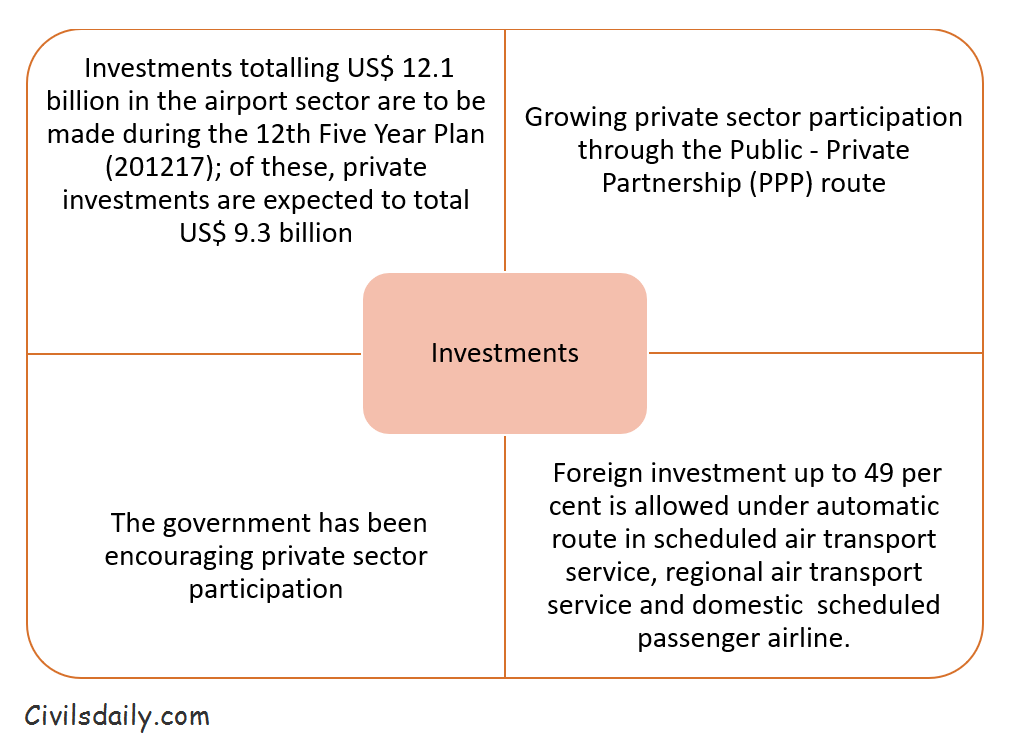
    Private sector investment increased to US$9.3 billion during the 12th Five Year Plan from US$ 5.5 billion in the previous plan.

    1. Recourse to the Public Private Partnership (PPP) model has boosted private sector investments in airports
    2. PPP route for five international airports (Delhi, Mumbai, Cochin, Hyderabad, Bengaluru) most noteworthy
    3. In Union Budget 2017, Government of India has decided to develop select airports in tier 2 cities under PPP model in order to attract investments from private players.
    4. Increasing share of private sector in equity component of major airports:
    • 74 per cent private shareholding in IGI Airport (Delhi) – owned majorly by GMR (54 per cent), Fraport AG (10 per cent), Eraman Malaysia (10 per cent); rest of the shares owned by AAI
    • 74 per cent private shareholding in CSI Airport (Mumbai) – owned majorly by GVK (50.5 per cent), Bid Services Division (Mauritius) Ltd. (13.5 per cent), ACSA Global (10 per cent); rest of the shares owned by AAI
    • 74 per cent private shareholding in RGI Airport (Hyderabad) – owned majorly by GMR (63 per cent), Malaysia Airports Holdings Berhad (11 per cent); rest of the shares owned by Government of India (13 per cent) and Government of Andhra Pradesh (13 per cent)
    • 74 per cent shareholding in Kempagowda International Airport (Bengaluru) – owned majorly by Siemens Project Ventures, Germany (40 per cent), Unique (Flughafen Zurich AG) Zurich Airport, Switzerland (17 per cent), L&T, India (17 per cent); rest of the shares owned by AAI (13 per cent) and KSIIDC, which is an agency owned by the state of Karnataka, India (13 per cent).

    In March 2017, by selling off 2 offshore bonds, GMR plans to raise US$250-300 million for refinancing their debt. In June 2017, GMR announced plans to refinance loans and divest assets in road and power sectors to cut debt so as to invest up to Rs. 7,400 (US$ 1.15 billion) crore to expand Delhi and Hyderabad airports.

    Successful PPP Model Airports in India

    Presently India has 5 PPP airports each at Mumbai, Delhi, Cochin, Hyderabad and Bengaluru, which together handle over 55 per cent of country’s air traffic.

    Government of India has approved 15 greenfield PPP projects which are expected to increase the air traffic in India. These projects would be setup in Goa, Navi Mumbai, Maharashtra, Bijapur, Gulbarga, Karnataka, Kerala, West Bengal, Madhya Pradesh, Sikkim, Puducherry and Uttar Pradesh.

    Government Initiatives in Civil Aviation Sector


    By
    Himanshu Arora
    Doctoral Scholar in Economics & Senior Research Fellow, CDS, Jawaharlal Nehru University


  • Road Transport in India

    Road Transport in India

    Classifications of Roads

    Roads are mainly classified into following Categories:


    Road Network in India


    Importance of Road Transport


    Road Development in India

    The major initiative undertaken by the government for the development of road sector are:

    • The National Highway Development Project (NHDP).
    • Pradhan Mantri Bharat Jodo Pariyojana (PMBJP): linking of major cities to National Highways.
    • Pradhan Mantri Gram Sadak Yojana (PMGSY): Construction of Rural roads.


    National Highway Development Project

    NHDP deal with the development of high quality highways. NHDP is the largest highway project undertaken in the country. It has been implemented by the National Highway Authority of India (NHAI).

    Initially, The National Highway Development Project (NHDP) consists of two major components:

    The “Golden Quadrilateral”: The Golden Quadrilateral” project will connect the four major metropolitan cities (Delhi. Mumbai, Chennai & Kolkata) with 4-6 lane highways, with a total length of about 5,850 km.

    The “North South – East West” projects: The “North South – East West” project will connect the Northern most point of the country to the Southernmost, and similarly from East to West, with a total length of about 7,300 km

    The NHDP was expected to cost Rs 540 billion, when started in 1998. The financing pattern of this project indicates that private sector participation in the form of investment amounts to only Rs 40 billion (7.4 per cent of the total).

    Over the course of the project, institutions like the World Bank, Asian Development Bank (ADB) and Japanese Bank for International Cooperation (JBIC) are expected to finance about Rs 200 billion; another Rs 200 billion of investment would be financed from the cess.

    NHDP consists of following Phases:

    1. Phase 1 and Phase 2: The phase envisages construction of 4 & 6 lane highways of about 14000 KMs. The two phases comprise construction of “Golden Quadrilateral” and North South (Sri Nagar to KanyaKumari) – East West (Silichair to Porbandar) Projects.
    2. Phase 3: The phase consists of construction of 4-6 lane National highways of 12100 KMs connecting state capitals, tourist places, industrial centres.
    3. Phase 4: The phase involved upgradation and strengthening of 20000 KMs of single/two lane national highways.
    4. Phase 5: The phase involved construction of 6 lane national highways of 6500 KMs.
    5. Phase 6 & 7: The phase 6 & 7, involved construction of 1000 KMs of expressways and construction of 700 KMs of ring roads of major towns and bypasses and other elevated roads, tunnels, underpasses on national highways respectively.


    Problems of the Road Sector


    Road Sector in India Recent Developments


    Expansion of Roadways:


    Road Development Program for North East Region

    The Special Accelerated Road Development Programme for the North-Eastern region (SARDP-NE) is aimed at developing road connectivity between remote areas in the North East with state capitals and district headquarters

    SARDP-NE is vested with the development of double-/four-lane national highways of about 7,530 kms and double-laning improving about 2,611 kms of state roads, as on FY16

    Implementation of the road development programme would facilitate connectivity of 88 district headquarters in North Eastern states to the nearest National Highways

    The project would be undertaken in following 3 phases:


    Policy Initiatives by the Government


    By
    Himanshu Arora
    Doctoral Scholar in Economics & Senior Research Fellow, CDS, Jawaharlal Nehru University
  • Infrastructure Sector in India: Growth Drivers; Government Policy Initiatives

    Growth Drivers for Infrastructure Sector in India

    Recent Government Initiatives


    Construction Sector


    Affordable Housing Scheme


    Infrastructure Development in North Eastern States


    Metro Rail and Mono Rails


    Mono Rail


    By
    Himanshu Arora
    Doctoral Scholar in Economics & Senior Research Fellow, CDS, Jawaharlal Nehru University
  • Infrastructure Development in India

    Infrastructure Development in India

    Historical Timeline

    Infrastructure Sector: Recent Developments

    FDI Flows in the Infrastructure Sector

    Infrastructure Projects Completed during 12th Five-Year Plan


    Expansion of Roads: Recent Trends

    Revenue growth of Indian Railways

    Power Generation Capacity

    • Installed capacity increased steadily over the years, posting a CAGR of 10.57 per cent in FY09–17 and stood at 326.84 (GW).
    • As of June 2017, energy generation from conventional sources stood at 307.7 billion units (BU).

    Performance of Eight Core Infrastructure Sector


    By
    Himanshu Arora
    Doctoral Scholar in Economics & Senior Research Fellow, CDS, Jawaharlal Nehru University


  • Infrastructure Sector in India: Definitions; Growth and Infrastructure Linkage

    Infrastructure Sector

    Definitions:

    Infrastructure is a key driver of the overall development of Indian economy. Infrastructure sector focuses on major infrastructure sectors such as power, roads and bridges, dams and urban infrastructure.

    “Infrastructure is generally understood as the basic building blocks required for an economy to function efficiently”.

    The National Statistical Commission headed by Dr. C. Rangarajan, attempted to identify infrastructure based on some characteristics. The Rangarajan Commission indicated six characteristics of infrastructure sectors:

    Based on these features (except b, d, and e), the Commission recommended inclusion of following in infrastructure in the first stage:

    Dr. Rakesh Mohan Committee in “The India Infrastructure Report” included:

    The World Bank treats power, water supply, sewerage, communication, roads & bridges, ports, airports, railways, housing, urban services, oil/ gas production and mining sectors as infrastructure.

    The Economic Survey considers power, urban services, telecommunications, posts, roads, ports, civil aviation, and railways under infrastructure sector.

    Why do Infrastructure Matter for Growth & Development?

    There is, indeed, a plethora of anecdotal and more technical evidence that suggests development of infrastructure can lead to growth and development of an economy.

    The argument is particularly true for the developing countries which lack adequate infrastructure facilities. Intuitively, it should make sense to assume that the more developed a country is, the higher its infrastructure facilities and hence the lower the return from additional investment in roads, railways, ports etc. However, the less developed a country is, the more likely the infrastructure is to matter, because the returns from the Infrastructure development will be much more than the cost of the projects.

    Example: A massive road-building exercise in a poorly developed state can offer a one-time boost production activity and productivity of workers in the state.

    Infrastructure Sectors & Growth

    Any modern textbook on industrial economics or industrial organization will point out that for industries that enjoy network externalities (positive spill over effects/benefits to other sectors/industries), the social rate of return has to be higher than the private rate of return in these projects—assuming that the regulation does not allow the network externality to be turned into a private rent. In other words, their impact on GDP and its growth should be high. This explains for instance why the growth impact of the telecoms sector so often come out to be high. But for specific countries or regions, this could also be true for transport or electricity.

    In general, however, all infrastructure subsectors can be good examples of sectors in which such network externalities can matter. This section reviews the main lessons available on each subsector on the growth impact of each infrastructure subsector.

    Energy Sector

    The importance of energy sector especially electricity in promoting growth and development via human development and physical development is well known. The single most reason obstructing the growth of the industrial sector in general and manufacturing in particular in India is deficiency of continuous power supply (electricity/electrification) to run factories.

    Various studies have found out that, there exist a positive impact on energy infrastructure on the growth of an economy. Therefore, investing in the energy sector may be the safest bet to achieve a high growth. This should not be a surprise, energy is indeed an input into any of the other infrastructure subsectors—for instance, water for irrigation purpose is often pumped through the electric pumps.

    Telecommunication

    The impact of telecommunication on the growth is found to be maximum. The availability of fixed line phones and mobile phone penetration have effectively transformed the Indian economy and has given boost to Businesses like BPOs and KPOs (Knowledge Processing Outsourcing).

    The recent growing research on the importance of the access to internet to increase competition in the private and public sector and from increasing competition to the higher social return and growth of industries is well documented.

    Transport

    For developing countries like India, the estimated growth effects of transport investments have been very strong. This has been a common finding in research over the last 20 years or so. This is not surprising since the transport facilities in India are weak. The main impact of improved transportation facilities on the development has to come from quality, from addressing bottlenecks or from capturing new network or suprational effects which have not been internalized in older designs of the transport networks.

    In fact, studies have found, that for most of the developing countries, the construction of Roads, Railways, Highways, Airports and Sea Ports have contributed positively towards increasing growth.

    For instance, roads are needed in Africa, if Africa wanted to match the growth rate of the rest of the world. Construction of Roads & Highways are essential to reduce differences across regions in India. Ports are needed in India, if India, wants to increase its exports and become a major player in the Global Economy.


    By
    Himanshu Arora
    Doctoral Scholar in Economics & Senior Research Fellow, CDS, Jawaharlal Nehru University
  • 11 Oct 2017 | Prelims Daily with Previous Year Questions & Tikdams

    Q.1) Consider the following statements regarding the ‘P5+1’ countries:
    1. Germany is a member of ‘P5+1’.
    2. All the five permanent members of UN Security Council are not members of ‘P5+1’
    Which of the statements given above is/are correct?
    a) 1 only
    b) 2 only
    c) Both are correct
    d) None is correct

    Q.2) The Term ‘Intifada’ is related to
    a) Spain
    b) Israel
    c) Russia
    d) Monglolia

    Q.3) Which of the followig Department/Ministry/Tribunal deals with the matter related to Anti-Dumping?
    a) Department of Industry Policy and Promotion(DIPP)
    b) Minsitry of Finance
    c) Customs, Excise and Service Tax Appellate Tribunal (CESTAT)
    d) None of the above

    Q.4) Consider the following:
    1. Indonesia
    2. Thailand
    3. Bangladesh
    Which of the above have FTA with India under aegis of ASEAN?
    a) 3 only
    b) 1 and 2 only
    c) 2 and 3 only
    d) All Of the above

    Q.5) Consider the following statements regarding FDI and FPI:
    1. FPI tends to involve establishing more of a substantial, long-term interest in the economy of a foreign country.
    2. FDI is an equity investment with a shorter time frame for investment return
    Which of the above is/are correct?
    a) 1 only
    b) 2 only
    c) Both 1 and 2
    d) Neither 1 nor 2

    Q.6) What is/are the purpose/purposes of ‘Marginal Cost of Funds based Lending Rate (MCLR)’announced by RBI?(CSE: 2016)
    1.These guidelines help improve the transparency in the methodology followed by the banks for determining the interest rates on advances
    2.these guidelines helps ensure the availability of bank credit the interest rate which are fare to the borrowers as well as the banks
    Select the correct answers using the code given below
    a) 1 only
    b) 2 only
    c) Both 1 and 2
    d) Neither 1 nor 2

    Q.7) What is/are the unique about the ‘Kharai Camel’ a breed found in India(CSE: 2016)

    1.It is capable of swimming up three kilometers in seawater
    2.Its survives by grazing on mangroves
    3.It lives in the wild and cannot be domesticated
    Select the correct answers using the code given below
    a) 1 only
    b) 2 only
    c) Both 1 and 2
    d) Neither 1 nor 2

    Q.8) Recently, our scientists have discovered a new and distinct spices of banana plant which attains a height of about 11 meters and has orange – colored form of pulp. In which part of India has been discovered?(CSE: 2016)
    a) Andaman Islands
    b) Anaimalai Forests
    c) Maikala Hills
    d) Tropical rainforest of North east


    IMPORTANT STUFF: 

    1. Daily newscards have been enriched with back2basics and note2students – Make notes daily

    2. Join Full Year Prelims TS – prelims.civilsdaily.com

    3. Solutions will be uploaded at 11.30 p.m. Click here for Solutions

    4. For attempting previous Prelims Daily Questions – Click here

  • 10 Oct 2017 | Prelims Daily with Previous Year Questions & Tikdams

    Q.1) Consider the following statements regarding the ‘National Company Law Tribunal:’
    1. It is a quasi-judicial body .
    2.It was established under the Companies Act 2013.
    Which of the statements given above is/are correct?
    a) 1 only
    b) 2 only
    c) Both are correct
    d) Neither 1 nor 2

    Q.2) ‘Consumer Confidence Survey’ is done by which of the following organisation/ministries?
    a) Ministry of Finance
    b) Reserve Bank of India
    c) Ministry of Corporate Affairs
    d) Central Statistics Office (CSO)

    Q.3) Which of the following statements regarding the ‘Rashtriya Swasthya Bima Yojana (RSBY)’ is/are correct?
    1. It was introduced for Below Poverty Line (BPL) families.
    2. It was launched in 2016.
    Select the correct option using the codes given below.
    a) 2 only
    b) Neither 1 nor 2
    c) Both are correct
    d) 1 only

    Q.4) Recently, The technical group on tuberculosis in the ministry of health has given approval to a new Drug(to be used as a cure for Tuberculosis). The name of the drug is
    a) Delamanid
    b) Bedaquiline
    c) Isoniazid
    d) None of the above

    Q.5) Who of the following had first deciphered the edicts of Emperor Ashoka
    a) George Buhler
    b) James Prinsep
    c) Max Muller
    d) William Jones

    Q.6) With reference to the ‘Gram Nyayalaya Act’ which of the statements is/are correct?
    1.As per the act, Gram Nyayalayas can hear only civil cases not criminal cases
    2.The Act allows only social activists as medeators/reconcillators
    Select the correct answers using the code given below
    a) 1 only
    b) 2 only
    c) Both 1 and 2
    d) Neither 1 nor 2

    Q.7) With reference to the ‘Trans pacific Partnership’ consider the following statements:
    1.It is an agreement among all the Pacific Rim countries except China and Russia
    2.It is a strategic alliance for the purpose of maritime security only
    Which of the statements is/are correct?
    a) 1 only
    b) 2 only
    c) Both 1 and 2
    d) Neither 1 nor 2

    Q.8) Consider the following statements:
    The India – Africa summit
    1.Held in 2015 was the third such summit
    2.Was actually initiated by Jawaharlal Nehru in 1951
    Which of the statements is/are correct?
    a) 1 only
    b) 2 only
    c) Both 1 and 2
    d) Neither 1 nor 2


    IMPORTANT STUFF: 

    1. Daily newscards have been enriched with back2basics and note2students – Make notes daily

    2. Join Full Year Prelims TS – prelims.civilsdaily.com

    3. Solutions will be uploaded at 11.30 p.m. Click here for Solutions

    4. For attempting previous Prelims Daily Questions – Click here

  • Economics of Animal Rearing in India

    Economics of Animal Rearing

    India’s Position in Global Livestock Economy.

    Importance of Livestock sector in the Indian Economy.

    Importance of Livestock sector in achieving Inclusive Growth in India

    • Distribution of livestock is more equitable than that of land. In 2003 marginal farm households (≤1.0h hectare of land) who comprised 48% of the rural households controlled more than half of country’s cattle and buffalo and two-thirds of small animals and poultry as against 24% of land. Between 1991-92 and 2002-03 their share in land area increased by 9 percentage points and in different livestock species by 10-25 percentage points.
    • Livestock has been an important source of livelihood for small farmers. They contributed about 16% to their income, more so in states like Gujarat (24.4%), Haryana (24.2%), Punjab (20.2%) and Bihar (18.7%).
    • The agricultural sector engages about 57% of the total working population and about 73% of the rural labour force. Livestock employed 8.8% of the agricultural work force albeit it varied widely from 3% in North-Eastern states to 40-48% in Punjab and Haryana. Animal husbandry promotes gender equity. More than three-fourth of the labour demand in livestock production is met by women. The share of women employment in livestock sector is around 90% in Punjab and Haryana where dairying is a prominent activity and animals are stallfed.
    • The distribution patterns of income and employment show that small farm households hold more opportunities in livestock production. The growth in livestock sector is demand-driven, inclusive and pro-poor. Incidence of rural poverty is less in states like Punjab, Haryana, Jammu & Kashmir, Himachal Pradesh, Kerala, Gujarat, and Rajasthan where livestock accounts for a sizeable share of agricultural income as well as employment. Empirical evidence from India as well as from many other developing countries suggests that livestock development has been an important route for the poor households to escape poverty.

    Livestock population (2012 Livestock census)

    Sl. No Species Number

    (in millions)

    Ranking in the world population
    01 Cattle 190.9 Second
    02 Buffaloes 108.7 First
    Total (including Mithun and Yak) 300 First
    03 Sheep 65.0 Third
    04 Goats 135.2 Second
    05 Pigs 10.3
    06 Others 1.7
    Total livestock 512.3
    Total poultry 729.2 Seventh
    07 Duck  

    Fifth

    08 Chicken
    09 Camel Tenth

    Schemes/Policies Launched for Livestock Sector by the Government

    National Livestock Mission

    The National Livestock Mission (NLM) has commenced from 2014-15. The Mission is designed to cover all the activities required to ensure quantitative and qualitative improvement in livestock production systems and capacity building of all stakeholders. The Mission will cover everything germane to improvement of livestock productivity and support projects and initiatives required for that purpose subject. This Mission is formulated with the objective of sustainable development of livestock sector, focusing on improving availability of quality feed and fodder. NLM is implemented in all States including Sikkim.

    NLM has 4 submissions as follows:

    The Sub-Mission on Fodder and Feed Development will address the problems of scarcity of animal feed resources, in order to give a push to the livestock sector making it a competitive enterprise for India, and also to harness its export potential. The major objective is to reduce the deficit to nil.

    Under Sub-Mission on Livestock Development, there are provisions for productivity enhancement, entrepreneurship development and employment generation (bankable projects), strengthening of infrastructure of state farms with respect to modernization, automation and biosecurity, conservation of threatened breeds, minor livestock development, rural slaughter houses, fallen animals and livestock insurance.

    Sub-Mission on Pig Development in North-Eastern Region: There has been persistent demand from the North Eastern States seeking support for all round development of piggery in the region. For the first time, under NLM a Sub-Mission on Pig Development in North-Eastern Region is provided wherein Government of India would support the State Piggery Farms, and importation of germplasm so that eventually the masses get the benefit as it is linked to livelihood and contributes in providing protein-rich food in 8 States of the NER.

    Sub-Mission on Skill Development, Technology Transfer and Extension: The extension machinery at field level for livestock activities is very weak. As a result, farmers are not able to adopt the technologies developed by research institutions. The emergence of new technologies and practices require linkages between stakeholders and this sub-mission will enable a wider outreach to the farmers.All the States, including NER States may avail the benefits of the multiple components and the flexibility of choosing them under NLM for a sustainable livestock development.

    Rashtriya Gokul Mission

    Key features of the mission

    • The Mission aims to conserve and develop indigenous breeds in a focused and scientific manner and for that breeding facilities will be set up for varieties with high-genetic pedigree”. Indigenous cattle are largely ignored in India despite the fact that they are better adapted to the country’s climate”.
    • The aim of the mission is to protect Indigenous cow from being cross-bred into different varieties.
    • Focus will be largely to give a push to local breeding programme on the line of elite local breeds like Gir, Sahiwal, Rathi to enhance milk production.
    • The local cow breed will be protected through traditional-style “gaushalas” or cattle-care centres. • The scheme has provision to acknowledge those farmers who works rigorously in the direction. • The “Gopal Ratna” awards will be conferred to them. • The scheme also makes a point about upkeep of cattle after their milk producing phase gets over and then they often used for the purpose of meat. Official reaction.
    • An amount of Rs 500 crore has been earmarked for Bovine Breeding and Dairy Development programme and out of which Rs 150 crore will be specially allocated for the protection of indigenous cow breeds.

    Idea behind the Mission?

    • The idea is to increase milk production which is dismal in comparison to US, UK, and Israel.
    • Though India has attained the numero uno position in milk production but that is only because the country is home of world’s largest livestock population.
    • Through the programme, the aim is to increase high yield per cow which is very low in comparison to the European countries like US. Low yield per cow in India
    • The average daily milk yield for crossbred cattle in India is at 7.1 kg per day while it is at 25.6 in UK, US (32.8) and Israel (38.6).
    • The reason behind the low yield in India is because of intrinsic and extrinsic factors both.
    • The intrinsic factor is low genetic potential while extrinsic is related with number of reasons like poor nutrition and feed management, inferior farm management practices and inefficient implementation of breed improvement programs.
    • At present, India is largely using Jersey, a native of Netherlands and British origin Holstein for cross-breeding purposes.

    Operation flood/ White Revolution in India:

    ‘Operation flood’ a program started by National Dairy Development Board (NDDB) in 1970 made India the largest producer of the milk in the world. This program with its whopping success was called as ‘The White Revolution’. The main architect of this successful project was Dr. Verghese Kurien, also called the father of White Revolution.

    In 1949 Mr. Kurien joined Kaira District Co-operative Milk Producers’ Union (KDCMPUL), now famous as Amul.

    Kurien has since then built this organization into one of the largest and most successful institutions in India. The Amul pattern of cooperatives had been so successful, in 1965, then Prime Minister of India, Shri Lal Bahadur Shastri, created the National Dairy Development Board (NDDB) to replicate the program on a nationwide basis citing Kurien’s “extraordinary and dynamic leadership” upon naming him chairman.

    Operation Flood Phases

    The Operation Flood was completed in three phases:

    Phase I (1970-79):- During this phase 18 of the country’s main milk sheds were connected to the consumers of the four metros viz. Mumbai, Delhi, Chennai and Kolkata. The total cost of this phase was Rs.116crores. The main objectives were, commanding share of milk market and speed up development of dairy animals respectively hinter- lands of rural areas.

    Phase II (1981–1985):- The management increased the milk sheds from 18 to 136; 290 urban markets expanded the outlets for milk. By the end of 1985, a self-sustaining system of 43,000 village cooperatives with 42.5 lakh milk producers were covered. Domestic milk powder production increased from 22,000 tons in the pre-project year to 140,000 tons by 1989, all of the increase coming from dairies set up under Operation Flood.

    Phase III (1985–1996):- The dairy cooperatives were enabled to expand and strengthen the infrastructure required to procure and market increasing volumes of milk. Veterinary first-aid health care services, feed and artificial insemination services for cooperative members were extended, along with intensified member education. It went with adding 30,000 new dairy cooperatives to the 42,000 existing societies organized during Phase II. Milk sheds peaked to 173 in 1988-89 with the numbers of women members and Women’s Dairy Cooperative Societies increasing significantly.

    Amul: (“priceless” in Sanskrit. The brand name “Amul,” from the Sanskrit “Amoolya,” formed in 1946, is a dairy cooperative in India.

    It is a brand name managed by an apex cooperative organization, Gujarat Co-operative Milk Marketing Federation Ltd. (GCMMF), which today is jointly owned by some 2.8 million milk producers in Gujarat, India. The White Revolution’s model dairy board was that of Amul. The whole program of NDDB was largely based the working of this dairy board. The three-tier ‘Amul Model’ has been instrumental in bringing about the White Revolution in the country.

    Achievements of the White Revolution

    • The phenomenal growth of milk production in India – from 20 million MT to 100 million MT in a span of just 40 years – has been made possible only because of the dairy cooperative movement. This has propelled India to emerge as the largest milk producing country in the World today.
    • The dairy cooperative movement has also encouraged Indian dairy farmers to keep more animals, which has resulted in the 500 million cattle & buffalo population in the country – the largest in the World.
    • The dairy cooperative movement has spread across the length and breadth of the country, covering more than 125,000 villages of 180 Districts in 22 States.
    • The movement has been successful because of a well-developed procurement system & supportive federal structures at District & State levels.

    Blue Revolution in India

    Realizing the immense scope for development of fisheries and aquaculture, the Government of India has restructured the Central Plan Scheme under an umbrella of Blue Revolution.

    The restructured Central Sector Scheme on Blue Revolution: Integrated Development and Management of Fisheries (CSS) approved by the Government provides for a focused development and management of the fisheries sector to increase both fish production and fish productivity from aquaculture and fisheries resources of the inland and marine fisheries sector including deep sea fishing.

    The scheme has the following components:
    i. National Fisheries Development Board (NFDB) and its activities.
    ii. Development of Inland Fisheries and Aquaculture.
    iii. Development of Marine Fisheries, Infrastructure and Post-Harvest Operations.
    iv. Strengthening of Database & Geographical Information System of the Fisheries Sector.
    v. Institutional Arrangement for Fisheries Sector.
    vi. Monitoring, Control and Surveillance (MCS) and other need-based Interventions.
    vii. National Scheme on Welfare of Fishermen.

    The Scheme Blue Revolution: Integrated Development and Management of Fisheries is being implemented in consultation with all States & UTs. Besides the activities undertaken under both the marine and inland sectors, no specific role for the coastal states has been defined.

    The Blue Revolution is being implemented to achieve economic prosperity of fishermen and fish farmers and to contribute towards food and nutritional security through optimum utilization of water resources for fisheries development in a sustainable manner, keeping in view the bio-security and environmental concerns.

    Under the scheme, it has been targeted to enhance the fish production from 107.95 lakh tonnes in 2015-16 to about 150 lakh tonnes by the end of the financial year 2019-20. It is also expected to augment the export earnings with a focus on increased benefit flow to the fishers and fish farmers to attain the target of doubling their income.

    The Department has prepared a detailed National Fisheries Action Plan-2020(NFAP) for the next 5 years with an aim of enhancing fish production and productivity and to achieve the concept of Blue Revolution. The approach was initiated considering the various fisheries resources available in the country like ponds & tanks, wetlands, brackish water, cold water, lakes & reservoirs, rivers and canals and the marine sector.

    Challenges faced by the fisheries sector 

    • Shortage of quality and healthy fish seeds and other critical inputs.
    • Lack of resource-specific fishing vessels and reliable resource and updated data.
    • Inadequate awareness about nutritional and economic benefits of fish.
    • Inadequate extension staff for fisheries and training for fishers and fisheries personnel.
    • Absence of standardization and branding of fish products.

    The Way Forward 

    • Schemes of integrated approach for enhancing inland fish production and productivity with forward and backward linkages.
    • Large scale adoption of culture-based capture fisheries and cage culture in reservoirs and larger water bodies are to be taken up.
    • Sustainable exploitation of marine fishery resources especially deep sea resources and enhancement of marine fish production through sea farming, mariculture.

    Poultry Sector in India

    Growth of India’s Poultry sector in Recent years

    • Indian Poultry Industry is one of the fastest growing segments of the agricultural sector today in India. As the production of agricultural crops has been rising at a rate of 1.5 to 2% per annum while the production of eggs and broilers has been rising at a rate of 8 to 10% per annum. Today India is world’s fifth largest egg producer in the world. Indian broiler production at 3.8 million tons is the fourth largest in the world after US, Brazil and China.
    • The broiler growing companies are becoming bigger and the feed mills are getting larger. More than 60 per cent of the feed is being processed. The layer farming with 220 million layers is growing at six to eight per cent and the egg prices are at record high.
    • The 67,000-crore Indian poultry industry is expected to report higher margins in the years to come.
    • The Indian Poultry Industry has undergone a paradigm shift in structure and operation. A very significant feature of India’s poultry industry is its transformation from a mere backyard activity into a major commercial activity in just about four decades which seems to be really fast. The kind of transformation has involved sizeable investments in breeding, hatching, rearing and processing. Indian farmers have moved from rearing non-descript birds to today’s rearing hybrids such as Hyaline, Shaver, and Babcock which ensure faster growth, good livability, excellent feed conversion and high profits to the rearers.
    • The organized sector of Indian Poultry Industry is contributing nearly 70% of the total output and the rest 30% in the unorganized sector.
    •  Due to the demand for poultry increasing and production reaching 37 billion eggs and 1 billion broilers, the Poultry Industry today employs around 1.6 million people. At least 80% of employment in Indian Poultry Industry generates directly by the farmers, while 20 % is engaged in feed, pharmaceuticals, equipment and other services according to the requirement. Additionally, there might be similar number of people roughly 1.6 million who are engaged in marketing and other channels servicing the poultry sector.

    Reason Behind this growth

    • The contributing factors behind this growth are – growth in per capita income, a growing urban population and falling poultry prices.
    • The Indian Poultry Industry has grown largely due to the initiative of private enterprises, minimal government intervention, and very considerable indigenous poultry genetics capabilities, and support from the complementary veterinary health, poultry feed, poultry equipment, and poultry processing sectors. India is one of the few countries in the world that has put into place a sustained Specific Pathogen Free (SPF) egg production project.

    Challenges the Poultry sector is facing

    • In last 2 years the Poultry sector is facing distress due to number of factors
    • There is disparity between states and hence an impairment in growth of the sector. About 60% of the egg production comes from Andhra Pradesh. Commercial poultry farming yet to make a mark in states like Odisha, Bihar, MP, Rajasthan. This disparity has resulted in uncertainty in sector.
    • Recent heatwaves in Andhra Pradesh and Telangana region has resulted in high chicken prices due to killing of birds. As a result, poultry feed demand has fallen.
    • Avian influenza was another issue which has resulted which has devastating effect on Indian poultry, and it still continues to haunt the sector due to low demand and less exports
    • Shortage of raw material is another issue. Price of soybean meal, the major and only source of protein has increased about 75%, which has forced the feed manufacturers to comprise in terms of diet given to birds.
    • Shortage of human resources is another problem because of the absence of veterinarians, researchers, in areas where expertise knowledge is required.
    • Indian poultry sector is still unable to tap the benefit of international market. Lack of adequate cold storage, warehouses is the major factor affecting poultry sector in India.
    • Majority of the production is by unorganized which is another threat faced by sector.
    • Usually, summer sees a production drop of five to 10 per cent; this year, with the heat and drought, there is a 25-30 per cent drop. The drought has hit water supply for the birds and the latter’s mortality rate has risen in recent months, pushing up prices for broilers and eggs.

    Way Forward

    The Following measures should be taken by the Government to improve the situation.

    • Strong marketing network to set the industry free from the clutches of middlemen.
    • Government support to public poultry educational and R&D institutions.
    • Building infrastructure to meet the growing manpower demand of the poultry sector.
    • Promote both mass production as well as production by masses.
    • Support and promotion of the processing sector.
    • Insurance against losses.
    • Provision of subsidies, and credit


    By
    Himanshu Arora
    Doctoral Scholar in Economics & Senior Research Fellow, CDS, Jawaharlal Nehru University