Back2Basics
Search results for: “”
-
India Internal Security | Extremism- Introduction, causes
It is a truism that under development often creates the conditions for insurgency and spread of extremist ideologies among the people, who perceive that their needs are not being taken care of by the government.
While it has been the policy of governments around the world today to emphasise on “inclusive development”, there are always groups in every state who feel alienated because they perceive that they are left out of the developmental efforts. Such perceptions coupled with inefficient and corrupt governance create an ideal condition for extremism and militancy.
More than lack of development, it is the perception of injustice, misgovernance and inability of the system to engage the disaffected lot that leads people to violence and extremism.
Extremism:
Extremism can be defined as any ideology considered to be far outside the mainstream attitudes of a society or to violate common moral standards.
It means an ideology deflected from the mainstream of common moral standards which can be perceived as good or bad depending upon the political and philosophical values.
Left Wing Extremism or Naxalism (as it called in India, because of its origin from a village called Naxalbari in West Bengal) is an ideology based on far left radical thoughts. It drives its thoughts from communism and emphasises advancement of people’s social and economic life by establishing classless society through armed revolution.
Charu Mazumdar was an active leader of the area and was mobilizing peasants against the state for an armed conflict. On the other hand, there were repetitive incidences of Class conflicts between peasants and zamindars. One such conflict escalated and Zamindar was expelled from his land. After this police came to his rescue and was surrounded by about thousand peasants armed with bows, arrows, lathis etc. One Police officer was killed. Police force few days after responded with brutal force and 9 women and 2 children were killed.
In response, revolutionary leaders fled the area and declared armed struggle against the state of India. They formed a new party Communist Party of India (Marxist-Leninist) in 1969 and this was motivated and influenced deeply by Communist Party of China.
After independence Nehruvian Panchsheel stressed the need to recognise tribal rights over land and forests and allow them to develop along the lines of their own genius. In reality, however, tribal communities have been systematically alienated from their traditional rights over natural resources like land, forests, water and commons, which has eroded the very basis of their existence.
The major issues faced by tribals in the Eastern India are:
- mining-related displacement of PVTGs,
- trafficking of women and girls,
- oppression by CRPF especially on tribal women,
- village schools being occupied by para-military forces,
- violation of PESA and FRA,
- acute poverty conditions of PVTGs like Mankidia, Khadia and Paudi Bhuiyan and high prevalence of malnutrition and starvation deaths among these communities
Since the Eastern India is rich in natural resources including forests, minerals and mines, tribal face exploitation and harassment from government and corporate bodies targeting to extract those resources for their profit.
There is continuous tussle between naxals and security forces in every tribal village. As a result the tribal are getting sandwiched between these forces.
Tribal livelihood is at stake due to depletion of natural resource base. Forceful displacement from their homeland destroys their traditional governance system.
People in power and government fail to understand their need-based economy and introduce privatisation and globalisation.
The major issues faced by tribals in the the Southern India are:
Issues of the tribal in southern states are different from other central and eastern states. Tribal in southern states – Kerala, Tamil Nadu, Karnataka and Andhra Pradesh face different forms of discrimination.
- There is no schedule area in any southern states except Andhra Pradesh.
- PVTGs like Errula tribes face many forms of exploitation in their day-to-day life. They are deprived of natural resources and livelihood.
- The status and condition of women and girls is more deplorable than tribal men. Some tribal like Irulas, who depend on the sea coast, are increasingly losing their access to the sea and its resources, due to the interference of big trawlers and climate-related challenges like frequent high tides.
- Hunger, dignity and lack of governance are important issues of tribal in these States.
- Availability, accessibility and affordability of food and other essentials are very important but not in place.
- The law and order situation in tribal areas is totally disturbed and out of control.
Extremism in North East
A cursory look at the demographic mosaic of northeastern India would show that this region is home to a curious amalgam of cross-cutting societies. What compounds the problem of this plurality is the fact that the tendency for ethnopolitical assertion is high among almost all the groups.
This is primarily because the political boundaries in most cases do not coincide with the existing social boundaries. The northeastern units of the Indian federation, in spite of several political permutations and combinations, have not been able to cater to the demands of all the ethnic categories clamouring for recognition of their distinctive identity.
The social continuities that stretch across the territorial frontiers have led to demands by the politically fragmented groups to redraw international boundaries and also to reorganise states within the Indian Union.
In many cases due to external manipulations and support, these fragmented ethnopolitical groupings have taken to arms and have adopted a line of confrontation with the state and central administration.
The Islamic extremism in India’s Northeast is generally associated with the Islamic extremist groups of Bangladesh such as Jamaat-ul-Mujahideen Bangladesh (JMB) and Harkat-ul Jihad al-Islami Bangladesh (HuJI-B) who have expanded their area of operations into India particularly in Assam and West Bengal, where a large number of illegal Bangladeshi migrants have settled down over the years.
Association of these militant groups with Pakistani agencies is well-known. As these groups remain on the lookout for local recruits and to expand their bases into Indian territories, the threat to Indian interests persists.
These terrorist groups, as well as Pakistan’s Inter-Services Intelligence (ISI), have reportedly colluded with various militant groups of Northeast such as the United Liberation Front of Assam (ULFA), United National Liberation Front (UNLF), etc. to carry out terrorist activities against India.
The Bangladeshi, Pakistani, as well as global terrorist groups who are on the look out to expand their bases and activities into Indian territories, may, therefore, attempt to take advantage of the situation, which may lead to enhanced security challenges in the Northeast region.
-
India Internal Security | Efforts by Government to address Extremism
The government followed a two-pronged approach which combines security forces action with accelerated development of the extremist affected area.
1. Developmental efforts
‘Clear, hold and develop’ strategy
Military operations have not been abandoned and individual states continue to undertake area clearing operations, such exercises appear to form parts of a new ‘clear, hold and develop’ strategy that uses development as a tool to win back the support of the tribal population, who overwhelmingly appear to sympathize with the extremists.
Since early 2011 there is a renewed focus on carrying out development initiatives in areas cleared of Maoist presence. Several flagship projects of the government to improve connectivity of tribal areas with the administrative centers, to provide employment to the tribal youth and to ensure the health and educational facilities have been launched.
Integrated Action Plan (IAP):
Planning commission implemented IAP for 82 LWE affected tribal and backward districts to provide public infrastructure and services. Major works under IAP include construction of school, buildings, anganwadi centre, drinking water facilities, rural road, construction of panchayat bhawan, community halls, playground etc.
Prime Minister Rural Development Fellowship (PMRDF):
It is launched by Ministry of Rural Development for providing capacity building opportunity to well qualified young professional to carry out grass root development in LWE affected districts.
They would work along with district administration on any matter related to IAP, thus providing the tribal with points of contact and humane touch in understanding their problems.
Panchayat (Extension to Scheduled Areas) (PESA) ACT 1996:
It is an important legislation empowering tribals in the field of local self-government through gram sabha.
Surrender Cum Rehabilitation Scheme:
It is launched in on 1st April 2013 for extremists, allowing them to wean away from extremist movements and ensure that didn’t join the movement again. The scheme takes care of rehabilitation of extremists to mainstream life, and helps them to live a better life.
2. Security related measures:
i) SAMADHAN-
Central Government announced a new strategy against the Maoists—SAMADHAN.
The acronym SAMADHAN is-
S-smart leadership, A-aggressive strategy, M-motivation and training, A-actionable intelligence, D-dashboard-based KPIs (key performance indicators) and KRAs (key result areas), H-harnessing technology, A-action plan for each theatre and N-no access to financing.
- Smart leadership
In the LWE-affected areas, there is a need of leadership which, despite adversity, can keep the jawans enthusiastic and teach them only to win. The central forces and the local police were asked to work under a coordinated plan.
- Aggressive strategy
It is necessary to analyse incidents where security forces suffered heavy losses. Proactive approach along with aggression in thinking, operations and development such as road construction should be adopted.
- Motivation and training
It was important for the stakeholders to make efficient use of resources and have knowledge of enemy’s strengths and weaknesses. Focus should be on training of security forces and providing them adequate facilities. Security forces must learn the culture and languages of the locals to earn their trust.
- Actionable intelligence
It is important to establish a good network with the locals. Surrendered LWE cadre should be used for intelligence collection and there was a need to depute “Shadow Intelligence Officers” to trace prominent LWE targets.
- Dashboard KPIs and KRAs
These should be determined for the state police and the central forces to assess their preparedness as well as performance.
- Harnessing technology
Technology is a force multiplier and there was a need to use more of it such as as UAVs. Along with it high-resolution cameras, GPS tracking and satellite images must be used. To prevent looting of weapons by the extremists, there is a need to have trackers in weapons and biometrics and unique identification numbers for explosives.
- Action plan for each theatre
To counter LWE in different states, there is a need to fight on multiple fronts and create separate action plans for each front.
- No access to financing
Choking LWE’s financial resources was the “basic mantra” in this fight to prevent them from getting weapons, ammunition, and food. “The 9/11 incident was not a “failure of intelligence but the failure of imagination”. We have to work to “outthink” and and “outmanoeuvre” the LWE.
ii) Operation Green Hunt
It was an operation in Central India, an all-out offensive by paramilitary forces and the state forces. The operation is believed to have begun in November 2009 along five states in the “Red Corridor” namely Chhattisgarh, Jharkhand, Andhra Pradesh and Maharashtra.
In September 2009 the press reported on the progress of “Operation Green Hunt”: a massive 3 day joint operation in which the central CoBRA force and state police battled Naxal forces in Dantewada.
iii) Salwa Judum
Salwa Judum (meaning “Peace March” or “Purification Hunt” in Gondi language) was a militia that was mobilised and deployed as part of anti-insurgency operations in Chhattisgarh, India, aimed at countering Naxalite violence in the region.
Salwa Judum started in 2006 as a people’s resistance movement against the Naxalites.
The militia, consisting of local tribal youth, received support and training from the Chhattisgarh state government.
The Supreme Court of India declared the militia to be illegal and unconstitutional, and ordered its disbanding. The Court directed the Chhattisgarh government to recover all the firearms, ammunition and accessories. The use of Salwa Judum by the government for anti-Naxal operations was criticised for its violations of human rights and poorly trained youth for counter-insurgency roles.
-
India Internal Security | Developmental issues related to rise and spread of extremism
Developmental issues which pertain to the spread of extremism are linked to lack of access to basic resources to sustain the livelihood.
However, development is a useful tool against extremism but it must operate in tandem with the security forces.
Some of the developmental issues which lead to the spread of extremism are listed below-
Forest Laws-
In the name of development, habitat of principal Adivasi communities were declared reserve forests & in accordance with Forest conservation Act 1980, no forest land can be diverted to nonforest use without permission
Rights of primitive forest dwellers were restricted resulting in losing access to land.
This resulted in mass resentment leading to extremist activities.
Land Fragmentation-
40% of rural households have no land or less than half of acre of land
Increased small/marginal land holdings and no land reforms, Insecurity, and exploitation of tenants creates Unrest which leads to extremism
Special Economic Zones (SEZ)-
Large tracts of land are being acquired across the country for this purpose. Land is livelihood resource for farmers. A farmer’s life is completely dependent upon the land.
SEZ requires a single huge block of land and government is taking harsh steps in acquiring the land. Farmers are not getting proper compensation for the land being taken away from them. These atrocities lead them into extremist thoughts.
Extremists have stated one of their objectives as fighting against India’s efforts to set up SEZ in tribal areas reflecting the adverse effect of development.
Encroachment on Common Property Resources-
Common Property Resources (CPR’s) include community pastures, watershed drainages, village tanks etc. and are vital for rural areas to develop.
CPR’s contributes effectively to the rural economy and provides sustenance to local communities.
But due to industrialization, privatization and development projects, the CPRs area is shrinking and this also increases resentment of villagers.
Displacement due to developmental projects-
Displacement/ forced eviction of people occur due to developmental projects such as irrigation, industrial projects, mining projects, power plants etc. It can be physical, emotional or cultural.
Tribal people are most prone to displacement because tribal areas are rich in mineral resources such as Orissa, Jharkhand. This imparts multidimensional trauma on them leading to serious consequences.
Unemployment-
- Unemployment and insecurity of livelihood are growing source of dissatisfaction and anger among youth, both in urban and rural areas.
- Minimum wages for agricultural workers are not implemented,
- the share of workers in unorganized sector has increased, there is no effective coverage of labour welfare laws.
This multifaceted form of exploitation in the absence of any developmental propaganda forms the major cause of the spread of extremism.
Environmental degradation-
- Land is being targeted by land mafias for mineral extraction and in that process agricultural land gets barren
- Pollution of water & air resources also happens and people are deprived of basic necessities to survive
Tourism-
Tourism industry in this development scenario is posing a great threat to the existing cultural-economy-governance matrix of tribal life which is interwoven with ecology.
The introduction of foreign influence and commercialization is triggering the process of disintegration of tribal society leading to extremist activities
-
India Bhutan Relations: Key Developments

source
Importance of Bhutan for India
- Bhutan in a buffer state between India and china. Bhutan shares a 470 km long border with China. Traditionally, the Himalayan kingdom acted as a buffer state between the India and China.
- Strategic importance: The Chumbi Valley is situated at the trijunction of Bhutan, India and China and is 500 km away from the “Chicken’s neck” in North Bengal, which connects the northeast with rest of the country.
- To contain insurgency in North-East: Bhutan has in the past cooperated with India and helped to flush out militant groups like United Liberation Front of Asom (ULFA) and National Democratic Front of Bodoland (NDFB) from the Himalayan nation.
- To check Chinese inroad in Bhutan: China is interested in establishing formal ties with Thimphu, where it does not yet have a diplomatic mission. Bhutan is strategically important for both India and China. Chinese territorial claims in western Bhutan are close to the Siliguri Corridor.
- Energy security: Hydro-electric power generated by Bhutan’s run-of-the river dams is the economic bedrock of the India-Bhutan relationship. India has helped finance the dams through a combination of aid and loans and buys the excess electricity at very low prices.Three hydro-electric projects (HEPs) totaling 1416 MW, (336 MW Chukha HEP, the 60 MW Kurichu HEP, and the 1020 MW Tala HEP), are already exporting electricity to India.In 2008 the two governments agreed to further develop a minimum of 10,000 MW hydropower generation capacities by 2020 and identified ten more projects.
Indo-Bhutanese relationship: Historical Perspective
- With land area of roughly 38,394 sq km and located between India and China, Bhutan is a small Himalayan kingdom with a total population of 6,95,819 and is of great strategic consequence for India’s neighbour-hood policy.
- Bhutan’s population can be conveniently categorised into three groups: the Sharchops, Lhotshampas and the Ngalungs (often called Drukpas). While the Sharchops and the Ngalungs live in the Eastern and Western Bhutan respectively, Lhotshampas reside in the Southern region. The Ngalungs are the ruling group who control the monarchy and the National Assembly, with a prominent place in the economy.
For much of its history, Bhutan has preserved its isolation from the outside world, staying out of international organisations and maintaining few bilateral relations. Bhutan became a protectorate of British India after signing a treaty in 1910 allowing the British to “guide” its foreign affairs and defence.
A protectorate, in its inception adopted by modern international law, is a dependent territory that has been granted local autonomy and some independence while still retaining the suzerainty of a greater sovereign state.
Bhutan was one of the first to recognise India’s independence in 1947 and both nations fostered close relations, their importance augmented by the annexation of Tibet in 1950 by the People’s Republic of China and its border disputes with both Bhutan and India, which saw close ties with Nepal and Bhutan to be central to its “Himalayan frontier” security policy.
India shares a 605 kilometres (376 miles) border with Bhutan and is its largest trading partner, accounting for 98 percent of its exports and 90 percent of its imports.
Initiation of Indo-Bhutanese relations
The signing of the Treaty of Punakha in 1910 with British India and the Chinese invasion of Tibet (1910-12), along with subsequent claims made on Bhutan resulted in the tide turning events in Indo-Bhutan relationship.
This treaty of Punakha, signed in between the Druk Gyalpo (King of Bhutan) and the Political officer of Sikkim C. A. Bell on 8th of January 1910, served to expel any claims that China might have tried to make, yet it was mute on the status of Bhutan, and the legality of its relationship with the British India.
For the Bhutanese, this was a source of uncertainty over its relations with India at the time when British rule was nearing an end.
After India’s independence in 1947, a standstill agreement was signed with each of the external states, for e.g. Sikkim, Nepal and Tibet which defined the relationship with these kingdoms in explicit terms and ensured the continuance of existing relations until new agreements were made but this was not the case with Bhutan.
Its status as a country with respect to India became clear following Prime Minister Jawaharlal Nehru’s invitation to participate in the Asian Relations Conference in 1947.
Formal bilateral relations between Bhutan and India were established in January 1968 with the appointment of a special officer of the Government of India to Bhutan. The India House (Embassy of India in Bhutan) was inaugurated on May 14, 1968 and Resident Representatives were exchanged in 1971.
Ambassadorial level relations began with the upgrading of residents to embassies in 1978. Bhutan gradually began to diversify its relations with the international community, thereby projecting its status as an independent and sovereign nation. With India sponsoring Bhutan’s application for UN membership in 1971, the leaders of the two countries demonstrated that Article 2 of the Indo-Bhutan Treaty was not a restricting factor in the exercise of Bhutan’s foreign policy.
The Treaty of 1949 had ten Articles. The very first Article tries to perpetuate Indo-Bhutanese friendship for all time to come by stating, “There shall be perpetual peace and friendship between the Government of India and the Government of Bhutan.” However, the most important provision in the treaty is its Article 2, according to which, “The Government of India undertakes to exercise no interference in the internal administration of Bhutan.
On its part, the Government of Bhutan agrees to be guided by the advice of the Government of India in regard to its external relations.” The point that had provoked some amount of criticism or controversy pertains to the second part of this Article since it tries to qualify Bhutan’s external relations. The treaty also established a free trade regime between India and Bhutan. Further, the citizens of both countries residing in each other’s territory will be treated on par with own citizens. The treaty also had provisions for extradition of Indian citizens in Bhutan and of Bhutanese citizens in India when required, and the procedure for the same has been spelt out. The mechanism for settling disputes arising out of differences in interpretation or application of the treaty is also mentioned. It is also stated that the treaty shall continue in perpetuity unless terminated or modified by mutual consent.
The Treaty of 1949
The basis for bilateral relations between India and Bhutan is formed by the Indo-Bhutan Treaty of 1949. On August 8, 1949 Bhutan and India signed the Treaty of Friendship, calling for peace between the two nations and non-interference in each other’s internal affairs. However, Bhutan agreed to let India “guide” its foreign policy and decided that both nations would consult each other closely on foreign and defence affairs. The treaty also established free trade and extradition protocols.
The Treaty of 2007
The treaty of 1949 between India and Bhutan was updated in 2007. The most significant change was in Article 2. The new Article 2 is worded as follows:
“In keeping with the abiding ties of close friendship and cooperation between Bhutan and India, the Government of the Kingdom of Bhutan and the Government of the Republic of India shall cooperate closely with each other on issues relating to their national interests. Neither Government shall allow the use of its territory for activities harmful to the national security and interest of the other.”The updated India-Bhutan Friendship Treaty not only reflects the contemporary nature of the relationship but also lays the foundation for their future development in the 21st century. Amongst others, the Treaty provides for perpetual peace and friendship, free trade and commerce, and equal justice to each other’s citizens.
Economy: A broad overview
A great shift in Bhutanese economy is that it is on the verge of opening up. Recently, during the question hour session of the National Assembly, which was held on February 18, 2014, the issue of “ease of doing business”in Bhutan was raised. Since 2010, preparations have been underway in Bhutan to expand and liberalize investment policies. For instance the Foreign Direct Investment (FDI) Policy and the Economic Development Policy were released; where by achieving self-reliance was identified as the key goal. In 2012, rules and regulations related to FDI were passed, which established the key criteria for doing business in Bhutan.
While the roles of key committees and respective power of the department were established, coordination between different departments, infrastructure development, would be the key to facilitate and invite investment.
In early 2013, the Economist described Bhutan as fifth fastest growing economy, with a GDP growth rate of 8.5 percent. However there is an over-reliance of the economy on the hydro sector. Diversification of the economy to generate jobs which can absorb the youth of Bhutan has emerged as a single most area of concern.
Economic Cooperation between Bhutan and India
Mutually beneficial economic linkages between India and Bhutan have been an important element in the bilateral relationship. India continues to be the largest trade and development partner of Bhutan. Planned development efforts in Bhutan began in the early 1960s. The First Five Year Plan (FYP) of Bhutan was launched in 1961. Since then, India has been extending financial assistance to Bhutan’s FYPs. The 10th FYP ended in June 2013. India’s overall assistance to the 10th FYP was Rs. 3625 crores, excluding grants and concessional loans for hydropower projects, various subsidies and excise duty refund.Hydropower is one of the main pillars of bilateral cooperation. Three Hydropower projects developed with Indian assistance and which have already been completed are 1020 MW Tala Hydroelectric Project, 336 MW Chukha Hydroelectric Project, 60 MW Kurichhu Hydroelectric. Ten more projects have been agreed to. Of these three are already under construction – Punatsangchhu-I Hydro Electric Project, Punatsangchhu–II and Mangedechhu HEPs. Negotiations are underway for the remaining seven projects of Kholongchhu, Amochhu,
Wangchu and Bunakha Reservoir, Kuri Gongri, Chamkharchhu and Sankosh.GOI also provided Rs. 300 crores towards the establishment of Dungsum Cement Plant at Nganglam with
a capacity to produce 1 million ton of cement every year. The project is expected to be commissioned shortly.
Standby Credit Facility
GoI extended a standby credit facility of Rs 1000 crores to RGoB to help Bhutan overcome the rupee liquidity crunch. This Credit Facility was provided at a concessional interest rate of 5% per annum. It is valid for 5 years.
Trade with India
India is not only Bhutan’s main development partner but also its leading trade partner. The existing free trade regime between India and Bhutan was last renewed in 2006 for a period of 10 years. The India-Bhutan Trade and Commerce Agreement was first signed in 1972.
The major items of exports from Bhutan to India are electricity (from Tala, Chukha and Kurichhu Hydroelectric Projects), base metals and articles, minerals, vegetable fat and oils, alcoholic beverages, chemicals, cement, timber and wood products, cardamom, fruit products,potatoes, oranges and apples, raw silk, plastic and rubber products.
Major exports from India to Bhutan are petroleum products, mineral products, base metals and articles, machinery, automobiles & spares, vegetable,nuts, spices, processed food and animal products, chemicals, wood, plastic and rubber.
The Agreement on Trade and Commerce also provides for duty free transit of Bhutanese merchandise for trade with third countries.
Sixteen exit/entry points in India identified in the Protocol for Bhutan’s third country trade are: Jaigaon, Chamurchi, Ulta Pani, Hathisar (Gelephu), Darranga, Kolkata, Haldia, Dhubri, Raxaul, Panitanki, Changrabandh, Phulbari, Dawki, New Delhi, Chennai and Mumbai. Of these, Kolkata, Haldia, Mumbai and Chennai are the designated seaports, Dhubri is the riverine route, New Delhi, Chennai,Mumbai and Kolkata are the air routes and Raxaul is the rail route. The others are the designated road routes.
Domestic Politics and India
Understanding Bhutan’s key foreign policy developments will be incomplete without taking into account its domestic developments. The 2013 elections were indeed an insightful eye-opener for understanding Bhutan’s democratization process.
A not much talked about factor in the 2013 elections in Bhutan is the role of the King. Given the debate during the 2013 elections in Bhutan, and India’s role in shaping the outcome, one cannot miss the role of the monarchy.
So far it was being said that India had withdrawn the subsidy on cooking gas on the eve of the second round of polling to teach Mr. Thinley a lesson for holding talks with China without taking New Delhi into confidence.
According to sources, there was no deliberate effort to damage Mr. Thinley’s electoral prospects and he remains a formidable political figure with whom India would have to do business in future. As the controversy peaked in Bhutan, the government did think of proposing an interim solution but stayed its hand as this would have complicated the issue.
The first round of elections was contested by four parties when the subsidy controversy was nowhere on the horizon. Mr. Thinley’s DPT won 44.52 per cent of the votes. The second round took place after India suspended the subsidy but its vote share only fell by a few decimal points, according to flash results. This means the DPT’s vote share remained unaffected though it had been suggested that India suspension of the subsidy would hurt the party badly.
DPT’s challenger, the People’s Democratic Party (PDP) won only 33 per cent of the votes in the first round. But in the second round, its vote share shot up because of the higher index of opposition unity. After trailing the DPT by 12 percentage points in the first round, the PDP was astute enough to co-opt six candidates from the two parties eliminated after the first round of voting. This aspect has been “carefully kept out of the commentary” on the Bhutan elections, the sources noted.
The DPT’s unchanged vote share means that despite getting just 15 of the 47 seats, the party and Mr. Thinley will continue to exert considerable influence in Bhutan politics. India would hardly have tried to marginalise such a figure, the sources added.
However, Bhutan is the top most priority for India which is overlooked by the foreign secretary of India himself and attributing the withdrawal of subsidies to a “goof up” does not sound convincing. The domestic debates took place before the elections highlight the friction between the monarchy and the DPT (Druk Phuensum Tshogpa).
The DPT convention, which took place in Thimpu highlighted a few critical factors. One of the issues that came to the fore was allegations held against the Palace Secretariat and the Army, accusing them of a non-ethical role in Bhutan’s politics. Since, the army is headed by the King himself, critical conclusions can be drawn from this. Interesting, while these issues have not been discussed much, there has been less political activity in Thimpu post 2013 elections.
India, Bhutan and China

source
The China-India-Bhutan triad has become the centre of many conversations. The roots go back to the much talked about Rio +20 summit at Brazil on June 21, 2012, when the then Bhutanese premier met Chinese premier Wen Jiabao, at the sidelines of the summit. The media picked up the conversations of Thinley and Wen.
While the former was noted as saying that China was ready to forge diplomatic relations with Bhutan, complete border demarcation at an early date and strength exchanges in various fields, the latter described the visit as of “ great historic significance, as it marks the first meeting between the heads of the two government…”Thinley was further quoted as saying-“Bhutan firmly sticks to the one-China policy, and has strong desire to strengthen understanding of and friendship with China. Bhutan wishes to forge formal diplomatic ties with China as soon as possible. It is also willing to settle border issues with China in a cooperative manner, enhance bilateral economic and trade cooperation….”Even before, the dust settled on this episode, a controversy about certain tenders being qualified to buy Chinese buses brought the China factor to the fore.While there has been some controversy about the transparency of the tendering process, the mandated authority, Bhutan Post Corporation Limited (BPCL), publicly stated in a clarification letter that TATA city buses— imported from India by Samden Vehicles (SV), were not working satisfactorily within one year of their import.Though SV challenged the final decision of BPCL, the episode was however symbolic of Bhutan’s interest in Chinese goods and also was suggestive of China’s influence on various stakeholders in Bhutan’s domestic politics.During the twenty-first boundary talks, it was significant that the talks witnessed a shift from the disputed North-Western area, close to Siliguri corridor to central parts of Bhutan, which is the Jakarlung and Pasamlung valley. This shift and development could be significant, as it raises question on whether some understanding has been reached in the North-Western areas. These facts as they appeared in the media, forces one to ask two simple questions:-
Have Bhutan-China border negotiations already reached some political compromise, or is it that Bhutan is now surrendering slowly to Chinese claiming tactics on its North-Western border with China?
As of today, Bhutan does not have formal diplomatic relations with China. Responding to questions about the possibility of China opening a consulate in Thimphu on the sidelines of the Indian Prime Minister’s visit to Bhutan, Prime Minister Tobgay responded that the resolution of border dispute is a pre-condition to the establishment of formal diplomatic relations and without that, the question of opening a consulate did not arise. This puts any further speculation on this front to rest and provides India more time in building on its exclusive sphere of influence in the country.
Given the contours of India-Bhutan-China border discourse, there are clues here, that there is a pattern in making. How the new government handles these sensitive issues is therefore a question of some reckoning.
The Recent Landmark visit by Indian Prime Minister
Given the background of troubled relationship with majority of its neighbours, in an unprecedented move, Narendra Modi invited all the heads of the SAARC member countries to his swearing-in ceremony at Rashtrapati Bhavan, with nearly all attending. The invitation for all SAARC heads of state to attend his swearing-in was about re-establishing India’s commitment to positive ties with its neighbors and projecting an image of leadership in India’s backyard. One could interpret the move as homage to the Gujral Doctrine.
With this situation in hand, Bhutan was chosen as the first foreign destination after the swearing in event. The visit sought to build business ties, including a hydro-electric deal, other than the process of weaning away Bhutan from the recent overtures made by the Chinese foreign office.
Besides being the friendliest neighbour, Bhutan is of immense strategic importance to India. In the past insurgent groups from Northeast India had taken sanctuary along Bhutan’s treacherous border with the Indian state of Assam and there are reports about Chinese army’s activities in north and northwest Bhutan recently.
For Bhutan, this visit was important to ensure continuity and to be sure of India’s adherence to earlier agreements in the face of a change of guard in New Delhi. The visit was also an opportunity to understand the foreign policy priorities of the new Government.
There were also concerns within the Himalayan kingdom that a ban on the export of certain food items, in order to rein in the inflationary pressures in India, would impact the landlocked country adversely. On the whole, analysts and former Indian diplomats insisted that this is an important relationship where cooperation on a number of areas is of mutual benefit.
HIGHLIGHT of the Joint Statement
- The two sides exchanged views and held discussions on bilateral relations and economic cooperation in regional and multilateral forums.
- Government of India (GoI) reassured Bhutan of its continued commitment to capacity building, especially in the education and IT sectors in Bhutan.
- The GoI satisfaction on the progress made in the hydropower sector and reiterated its commitment to achieving the 10,000MW target.
- GoI exempted Bhutan from any ban or quantitative restrictions on export of milk powder, wheat, edible oil, pulses and non-basmati rice.
- An announcement was made by the GoI regarding doubling of the Nehru-Wangchuck scholarship of Rs 20 million per year. India will also provide grant assistance for establishment of the digital section.
-
India Myanmar Relations: Key Developments
source
Importance of Myanmar to India
To tackle insurgency in North-East:
- Myanmar is central to Northeast India’s security as “a large number of cross-border ethnic groups and insurgents from Northeast India have military bases in Myanmar.
- Last year, Indian troops reportedly crossed into Myanmar territory to target a National Socialist Council of Nagalim (Khaplang) military camp.
- Myanmar has reiterated its resolve not to allow its territory to be used against India.
Act-East policy
- Myanmar’s importance lies in its geo-strategic location at the tri-junction of east, south-east and south Asia.
- Myanmar is strategically important to India as it is the only ASEAN country that shares a border with India.
- In geopolitical terms, New Delhi saw Myanmar as a buffer state with China.
- Myanmar is a crucial link to Bangladesh-China-India-Myanmar Economic Corridor.
Energy security
- Myanmar is on India’s energy security radar on account of its “abundant oil and natural gas” reserves.
- Oil and gas companies ONGC Videsh and GAIL are aggressively scouting for more exploratory blocks in Myanmar.
- A peaceful Northeast has great potential to develop economically with its rich biodiversity, hydropower and precious mineral resources, once it is properly integrated to the Southeast Asian economy.
- Myanmar is an important partner in strengthening our energy security. Recognizing this, an MOU on Co-operation in the Petroleum Sector between MOP&NG and Ministry of Energy of Myanmar was signed during President’s visit to Myanmar in March 2006.
- Of all the heavy investments in the Myanmar, India has mostly invested in the field of oil and gas sector.
Trade and investment opportunities
- The Myanmar economy is moving away from a centrally-planned superstructure to a market-led Framework.
- Myanmar — like the other CLMV countries (Cambodia, Laos, Myanmar and Vietnam) — represents a rapidly growing economy with rising consumption, strategic location and access, rich natural resources (oil, gas, teak, copper and gemstones), biodiversity and an industrious workforce with low wages. And it offers significant opportunities for trade in goods and services, investment and project exports.
- Bilateral trade rose from US$ 328 million in 1997-98 to US$ 2.052 billion in 2015-16. Myanmar is the
- Second largest supplier of beans and pulses to India.
- India is presently the ninth largest investor with an approved investment of US$ 730.649 million by 22 Indian companies. Most of India’s investments have been in the oil and gas sector.
- India’s engineering sector is eyeing the Myanmar market to create a bigger presence for engineering exports.
Economic development of North-East
India is focusing on connectivity to integrate north-east region with Myanmar and also with ASEAN. Myanmar also offers us an alternative access route to the Northeast.
Regional cooperation
- ASEAN: Myanmar is only ASEAN country which shares a land border with India.
- BIMSTEC: Myanmar became a member of BIMSTEC in December 1997. Myanmar is a signatory to the BIMSTEC Free Trade Agreement.
- Mekong Ganga Cooperation: Myanmar is a member of the Mekong Ganga Cooperation(MGC) since its inception in November 2000.
- SAARC: Myanmar was given the status of observer in SAARC in August 2008.
Historical Background
- At the time of its independence in 1948, Myanmar had not joined the Commonwealth due to too much bitterness towards British. Immediately afterwards, Burma came under the grip of communists {Red Flag, White Flag, Thirty Comrades, Revolutionary Burma Army etc. were some of the groups}. In 1962, the Military of Burma overthrew the democratic regime. Since then, Burma has been under direct or indirect Military rule until recently when democracy has returned to the country. During initial days of military rule, there was bitterness in India-Myanmar relations.
- Burma not only became more and more isolated from world but also from its own neighbours except China. The Burmese rulers ordered expulsion of Indian community from there because India supported the pro-democracy movement. Its leader General Ne Win not only took anti-India, anti-Soviet stand, but also withdrew from the Non-alignment Movement in 1979. Between 1962 and 1974, the supreme body in Burma was a Revolutionary Council headed by the general, and almost all aspects of society (business, media, production) were nationalized or brought under government control under the Burmese Way to Socialist which combined Soviet-style nationalization and central planning with the governmental implementation of superstitious beliefs. A new constitution of the Socialist Republic of the Union of Burma was adopted in 1974, until 1988, the country was ruled as a one-party system, with the General and other military officers resigning and ruling through the Burma Socialist Programme Party (BSPP). During this period, Burma became one of the world’s most impoverished countries.
- In 1987, India’s Prime Minister Rajiv Gandhi visited Burma to seek ways to normalize relations. However, the relations worsened after the military junta’s bloody repression of pro-democracy agitations in 1988, which led to an influx of Burmese refugees into India. However, since 1993 the governments of the Indian Prime Ministers P.V. Narasimha Rao and Atal Bihari Vajpayee changed course and began cultivating ties with Myanmar, as part of Look East Policy, aimed to increase India’s participation and influence in Southeast Asia and to counteract the growing influence of the People’s Republic of China. At the same time, India continued to sympathize with prodemocracy groups and awarded the Jawaharlal Nehru Award for international Understanding to Aung San Suu Kyi in 1993, by which time she had already become persona non grata to the Myanmar government.
FLAGSHIP PROJECTS
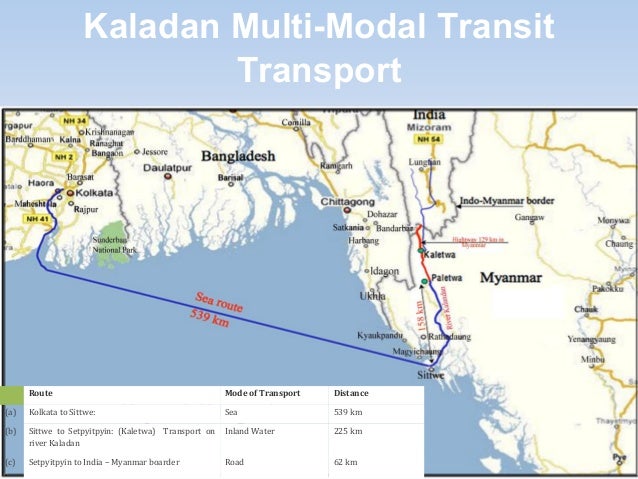
Kaladan Multi-Modal Transit Transport Project source
What it is?
- The Kaladan Multi-Modal Transit Transport Project is a project that will connect the seaport of Kolkata with Sittwe seaport in Myanmar by sea; it will then link Sittwe seaport to Lashio in Myanmar via Kaladan river boat route and then from Lashio on to Mizoram in India by road transport.
Benefits for India
- Current route from North East to Kolkata port via chicken neck faces heavy traffic; cargo via this route takes many days to reach a port.
- This project will reduce distance from Kolkata to Mizoram by approximately 1000 km and cut travelling time to 3-4 days for transport of goods
- Apart from development of North-East region, this route is necessary in case of any conflict with China as the present route, i.e., chicken neck could be blocked by China in conflict situation.
- The access to the sea that the project provides its Northeastern states could boost their economies.
- It would strengthen India’s trade and transport links with Southeast Asia.
- It not only serves the economic, commercial and strategic interest of India but also contributes to the Development of Myanmar and its economic integration with India.
- It will be instrumental for “act-east policy”.
India-Myanmar-Thailand trilateral highway
- India’s renewed commitment to complete the 3,200-km India-Asean trilateral highway that extends from Moreh in India to Mae Sot in Thailand via Mandalay, Myanmar.
DEMOCRATIC TRANSITION IN MYANMAR
Myanmar has sworn in Htin Kyaw as the country’s first civilian President in more than 50 years.
- Mr. Htin Kyaw’s government would be its most democratic administration since 1962 when the military seized power.
- Ms. Suu Kyi’s National League for Democracy (NLD) won 77 per cent of the elected seats in Parliament. She cannot lead the government because of a constitutional provision that bars her since her sons are British and not Myanmar citizens.
Background
- The National League for Democracy( NLD) won Myanmar’s last free and fair election in 1990 in a landslide, but the result was ignored by the then ruling military. The NLD boycotted a 2010 poll held under military rule.
- The Union Solidarity and Development Party (USDP), which is dominated by military and civil servants, will be the NLD’s biggest opponent.
- Ms. Suu Kyi’s own presidential aspirations are curtailed by a clause in the constitution that bars individuals with children holding foreign citizenship from becoming head of state.
Political reforms in Myanmar
A process of reform has been under way in Myanmar since November 2010, when military rule was replaced by a new military-backed civilian government.
- Release of Aung San Suu kyi from house arrest.
- The release of political prisoners.
- Free and fair by-poll elections in 2012 that saw Aung San Suu Kyi enter Parliament.
- The lifting of censorship on media houses.
Military holds on Parliament
- As per 2008 constitution, 25 per cent of the seats in the Upper and Lower houses of Hluttaw (House of Representatives) will be nominated by the military.
- The all-important Defence and Home portfolios remain with the Tatmadaw (The Myanmar Armed Forces),regardless of who comes to power.
Challenges for new government
Economic development:
- Myanmar is one of the poorest nations in Asia. In the years of isolation under the junta, economic growth stagnated, trapping millions in acute poverty.
From military:
- One-quarter of seats in both Houses of Parliament are reserved for the military. This prevents anyconstitutional amendments without the military’s approval.
- The military also has direct control of three key Ministries: defence, home affairs and border affairs.
Ethnic conflict and issue of soverignty:
- Myanmar’s biggest challenge in the coming years will be to control, consolidate and protect its borders and its sovereignty. Moving forward on a comprehensive peace agreement with the ethnic nations and containing insurgencies will be its primary goal.
- Myanmar has been the site of serious conflicts between Buddhist and Muslim communities, particularly in Rakhine State.
Cooperation between India and Myanmar in the regional/Sub-regional Context
ASEAN: Myanmar became a member of ASEAN in July 1997. As the only ASEAN country which shares a land border with India, Myanmar is a bridge between India and ASEAN. A few proposals for cooperation have been implemented and some are under discussions with Myanmar within the framework of ASEAN’s IAI programme.
BIMSTEC: Myanmar became a member of BIMSTEC in December 1997. Myanmar is a signatory to the BIMSTEC Free Trade Agreement. Myanmar is the lead country for the energy sector. Myanmar trades mostly with Thailand and India in the BIMSTEC region. Myanmar’s major exports to India are agricultural products like beans, pulses and maize and forest products such as teak and hardwoods. Its imports from India include chemical products, pharmaceuticals, electrical appliances and transport equipment. The 13th BIMSTEC Ministerial Meeting was held in Myanmar in January 2011.
Mekong Ganga Cooperation: Myanmar is a member of the Mekong Ganga Cooperation (MGC) since its inception in November 2000. MGC is an initiative by six countries – India and five ASEAN countries namely, Cambodia, Laos, Myanmar, Thailand and Vietnam – for cooperation in the fields of tourism, education, culture, transport and communication. The chairmanship of MGC is assumed by member countries in alphabetical order.
SAARC: Myanmar was given the status of observer in SAARC in August 2008.
Development of strategic ties
- India’s move to forge close relations with Burma are motivated by a desire to counter China’s growing influence as a regional leader and enhance its own influence and standing. Concerns and tensions increased in India over China’s extensive military involvement in developing ports, naval and intelligence facilities and industries, specifically the upgrading of a naval base in Sittwe, a major seaport located close to the eastern Indian city of Kolkata. India’s engagement of the Burmese military junta has helped ease the regime’s international isolation and lessen Burma’s reliance on China. Both nations sought to cooperate to counteract drug trafficking and insurgent groups operating in the border areas. India and Myanmar are leading members of BIMSTEC and the Mekong-Ganga Cooperation, along with Vietnam, Laos, Cambodia and Thailand, helping India develop its influence and ties amongst Southeast Asian nations.
- India was hesitant in reacting to the 2007 Burmese anti-government protests that had drawn overwhelming international condemnation. India also declared that it had no intention of interfering in Burma’s internal affairs and that the Burmese people would have to achieve democracy by themselves as it respects the sovereignty of Myanmar. This low-key response has been widely criticised both within India and abroad as weakening India’s credentials as a leading democratic nation. Indo-Burma relations went into pleasant phase over Burmese steps towards democracy.
- As of 2013, India has provided loan to Myanmar for its development, about US$500 million.
- India and Myanmar are set to cooperate in military and help modernize Myanmar’s military.
Rohingya issue
- The plight of the Rohingyas from Myanmar and Bangladesh is being described as Asia’s biggest mass exodus. The Rohingyas are minority Muslim community in the predominantly Buddhist Myanmar and they reside in Rakhine province of that country. After the major Buddhist-Rohingya riots in 2012 a large number of Rohingyas fled to the neighboring Bangladesh. Thousands who remained back became internally displaced and their properties were displaced and were chased out of their homes. They now live in crowded camps within Myanmar. Periodically they try and escape the inhuman conditions they are forced to live in and are facilitated by people smugglers. As in the past they have sought greener pastures in Malaysia, Thailand and Indonesia. None of the countries want them now. Rohingyas are collectively dubbed as ‘boat people’ by the media.
- The Rohingya people are considered ‘stateless entities’, as the Myanmar government has been refusing to recognise them as one of the ethnic groups of the country. There is no legal protection for them from the government of Myanmar. To escape the dire situation in Myanmar, the Rohingya try to illegally enter Southeast Asian states, begging for humanitarian support from potential host countries. The modern Burmese state is built upon the concept of Buddhist Burmese supremacy; this concept has been used by the military as a pretext for their rule. The Rohingya are not allowed to register their marriage and they are not allowed to have education.
- Their condition is even when they travel to other countries. When the refugees arrive in Thailand and Malaysia, they are still at the mercy of traffickers, who detain them in jungle prisons and demand ransoms from friends and family. If they can pay, they are released, but if they cannot they are often killed. Thailand police discovered 24 bodies in the mountains of southern Thailand in May, believed to be the victims of smugglers. Most refugees that arrive in Thailand or Malaysia look to stay and get work and then send money home to their families. The refugees work in the fishing or farming industries and often don’t get paid or face dire working conditions. Those that have made out of Myanmar by boat face an uncertain future.
- Malaysia is not a signatory to the 1951 Refugee Convention and does not possess a legislative and administrative framework to address refugee matters. Therefore, the inclusion of more Rohingya refugees would have further strained Malaysia’s domestic capacity to cope with illegal immigrants in the country.
- Malaysia and Indonesia have agreed to provide temporary shelter for the refugees in their respective countries for up to a year, after which the international community should assist to repatriate and resettle the refugee to a third country. The Rohingya refugee crisis also poses domestic challenges for Malaysia. The growing presence of Rohingya refugees could worsen the social, economic and political problems associated with illegal immigrants in Malaysia.
- Atrocities committed against Rohingya Muslims in Rakhine state is being seen as a crime against humanity. Malaysia, Indonesia and Thailand had recently sparked growing international outrage by driving off boats overloaded with starving Rohingya as well as Bangladeshis. The UN’s refugee agency, the UNHCR, believes at least 2,000 migrants may be stranded on boats off the Myanmar-Bangladesh coasts, held in horrific conditions for weeks by traffickers who are demanding that passengers pay to be released. The UN says the Rohingya are one of the most persecuted groups in the world. Neither Bangladesh nor Myanmar recognises them as citizens. In Buddhist-majority Myanmar, even the name Rohingya is taboo. Myanmar officials refer to the group as “Bengalis” and insist they are illegal immigrants from Bangladesh, even though most have lived in the country for generations.
- Whatever be the solution, it really has to be a humanitarian approach, making sure lives are not lost and looking at temporary solutions in each of the affected countries – Malaysia, Thailand and Indonesia. The United States has asked the Myanmar to give full rights to the minority to help end the exodus. The temporary solution is a settlement arrangement for the asylum seekers and refugees who are coming to these countries. There has to be a mechanism and strategy at the regional level that allows countries of the ASEAn region to have an oversight on coordinated management. The approach might be slightly different in every country, but it has to be an overarching strategy. ASEAN has to put pressure on Burma in order to make changes to the lives of people in Rakhine state. This is a long-term strategy.
Indo-Myanmar Border issue:
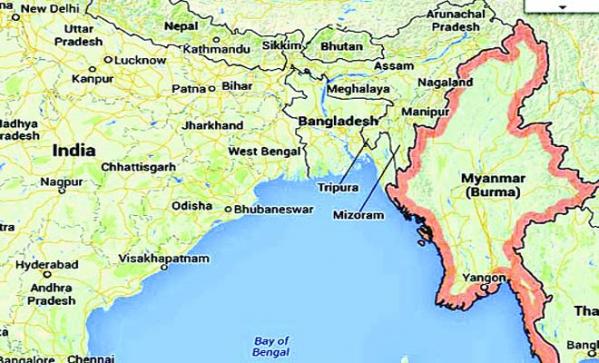
Indo Myanmar Border The border with Myanmar also remains operationally active and several insurgent groups have secured sanctuaries for themselves in Myanmar despite the cooperation extended by the Myanmar’s army.
The cross-border movement of Nagas and Mizos for training, purchase of arms and shelter when pursued by Indian security forces, combined with the difficult terrain obtaining in the area, make this border extremely challenging to manage.
This border is manned by the Assam Rifles since 2002 with some help from Indian Army.
India shares 1,643 km. long border with Myanmar. Arunachal Pradesh, Nagaland, Manipur and Mizoram are the FOUR States, which share the border with Myanmar. India and Myanmar permit a Free Movement Regime up to 16 km across the border. This makes the International Border extremely porous.
The border runs along hilly and inhospitable terrain which grossly lacks basic infrastructure and provides
Cover to the activities of various Indian Insurgent Groups (IIGs). The unfenced Indo-Myanmar border with free movement regime is thus being exploited by various Indian Insurgent Groups (IIGs).
Assam Rifles has been deployed for counter-insurgency and border guarding role on this border. Out of sanctioned strength of 46 battalions, 31battalions are for counter-insurgency and 15 battalions are for border guarding role. Presently, all 15 border guarding battalions are deployed along Indo-Myanmar
Border on Company Operating Base (COB) approach. The companies are deployed on all routes of ingress/egress and are checking infiltration, smuggling of arms, ammunition, drugs, fake Indian currency notes, etc.
Recent dispute: Border Fencing Between BP No.79 and 81 in Moreh
In order to check the problem of increased militant activities in the Indo-Myanmar border area, the Government of India sanctioned an action in early 2013 to fence the area between BP No. 79 to 81 on the Indo-Myanmar Border (approx. 10 km). This initiative has recently led to various protests in Manipur.
First episode in July 2013
The intermittent protests against the construction of a border fence started in July, 2013 by various political parties and the affected people in Manipur. The protesters claim that the 10-km fence between border pillars no. 79 and 81, which is being constructed several metres inside the Indian territory because of Myanmar’s objections, would result in Manipur loosing substantial portions of its territory to Myanmar. They demanded that the Central government should first resolve the border dispute with Myanmar and conduct a joint survey of the border before constructing the fence.
On August, 2013: The Myanmarese army reportedly tried to set up a camp by felling trees in Hollenphai village near border pillar no. 76. While the Ministry of Home Affairs (MHA) denied any intrusion into the Indian Territory by the Myanmarese army, the local people alleged harassments by the ‘intruders’.
The subsequent visits of the state Governor and other high ranking officials to the affected area failed to assuage the feelings of the local people and the protest against the construction of the fence continues even today.
Despite these protests, the Central government has decided to go ahead with the construction of fencing – a decision based on the successful experiment along the India-Pakistan and India-Bangladesh borders, where the fence has been effective in checking infiltration and illegal migration to a large extent.
Vulnerable Factors @ Indo-Myanmar border
- First, even though the international boundary between the two countries had been formally delimited and demarcated following the 1967 Boundary agreement, the boundary has not crystallised on the ground.
- This is because like most of the boundaries that India shares with its neighbours, the India-Myanmar boundaries is also an artificial line which is superimposed on the socio-culturallandscape of the borderland.
- Second, the border traverses a region which is infested with numerous insurgencies. These insurgencies have hampered the nation building process in this part of India.
a.) These insurgencies have delayed the crystallisation of the international border with Myanmar and have contributed towards sustaining these insurgencies for so long.
- Third, the India-Myanmar border has a unique arrangement in place called the Free Movement Regime. The FMR permits the tribes residing along the border to travel 16-km across the boundary without visa restrictions.
b.) While the FMR has helped the tribes continue maintain their age old ties, it has also become a cause of concern for the security establishment. The insurgents have been taking advantage of The FMR and have been crossing over to Myanmar to receive training in arms, establish safe Havens and re-enter India to carry out subversive attacks.
Over the years, the India-Myanmar border has become the main conduit for the trafficking of arms and high quality heroin from Myanmar. Smuggling of ephedrine and pseudo-ephedrine and trafficking of women and children from the Northeast to Myanmar and further to Southeast Asia are also rampant along the border.
- Fourth, the policymakers in Delhi have not given adequate attention to the India-Myanmar border and as a result it continues to be poorly managed.
- The Assam Rifles which has been deployed along the border to guard the boundary has also been straddled with responsibility of maintaining internal security. Given the security situation of the region, the force has deployed 31 of its 46 battalions for counter insurgency operations and only 15 battalions for guarding the border.
- Even these 15 battalions are not placed at the border but they operate from company operated bases which are located far inside the Indian Territory. In short, the Assam Rifles functions more like a counter insurgency force rather than a border guarding force.
Similarly, infrastructural facilities at Moreh and Zokhawatar – the two designated points for normal trade and border trade respectively – is poor. The land customs station lack screening and detection machines, communication devices, banking facilities, warehouses, parking and quarantine facilities.
Lack of support from military Junta govt in Myanmar
India’s patchy engagement with the military junta in Myanmar and its initial support to the democratic movement in that country have been largely responsible for Myanmar’s reluctance to cooperate with India.
Recommendations:
Given that the vulnerability of the India-Myanmar border is posing a serious challenge to the internal security of the country, the Government of India should pay immediate attention to effectively manage this border.
- It should first strengthen the security of the border by either giving the Assam Rifles the single mandate of guarding the border or deploying another border guarding force such as the Border Security Force (BSF).
- It should initiate a revision of the FMR and reduce the permitted distance of unrestricted travel.
- The construction of the ICP along with other infrastructure should be expedited.
- Finally, India should endeavour to meaningfully engage with Myanmar and solicit its cooperation in resolving all outstanding issues and better manage their mutual border.
MoUs signed during the recent President of Myanmar visit to India (29th August, 2016)
- MoU on Cooperation in the construction of 69 Bridges including AP Aproach Roads in the Tamu-Kyigone-Kalewa Road Section of the Trilateral Highway in Myanmar
- MoU on Cooperation in the construction/upgradation of the Kalewa-Yagyi Road Section.
- MoU on Cooperation in the Field of Renewable Energy.
- MoU on Cooperation in the field of Traditional Systems of Medicine
Future trends and Conclusion
- It is clearly evident that Myanmar plays an important and pivotal role not only linking India with the ASEAN and South-East Asian countries but also in eradicating insurgent groups in north-eastern parts of the Indian Territory.
- The first is where will be a direct economic development for India second will also help to India to pacify its north-eastern parts of peace and development both with the help of Myanmar.
- Moreover, Myanmar is not only a fresh economic opportunity for India to invest and garner; it is a chance to overcome the decades’ long neglect of Northeast India by linking its infrastructure and commerce with Myanmar. India could reignite the Bay of Bengal with a surge of commercial activity reviving its eastern ports.
- Also if both nations are determined then the illicit drug trafficking and inflow of narcotics/heroin from Myanmar into the alcohol prohibited states of Nagaland, Manipur and Mizoram can be extirpated completely.
- Myanmar which has recently gained democracy also seek forward to new developmental, political and economic reforms and India by helping can be on the better side of mutual benefits.
- An increasing consciousness in India about Myanmar’s importance should motivate academia, think tanks, NGOs, artists, media and strategic community to re-discover and strengthen links with their counterparts in Myanmar.
-
Myanmar: Backgrounder with Timelines
Backgrounder
1852 – Britain annexes lower Burma, including Rangoon, following the second Anglo-Burmese war.
1885-86 – Britain captures Mandalay after a brief battle; Burma becomes a province of British India.
1937 – Britain separates Burma from India and makes it a crown colony.
Japanese occupation
1942 – Japan invades and occupies Burma with some help from the Japanese-trained Burma Independence Army, which later transforms itself into the Anti-Fascist People’s Freedom League (AFPFL) and resists Japanese rule.
1945 – Britain liberates Burma from Japanese occupation with help from the AFPFL, led by Aung San.
1947 – Aung San and six members of his interim government assassinated by political opponents led by U Saw, a nationalist rival of Aung San’s. U Nu, foreign minister in Ba Maw’s government, which ruled Burma during the Japanese occupation, asked to head the AFPFL and the government.
Independence
1948 – Burma becomes independent with U Nu as prime minister.
Mid-1950s – U Nu, together with Indian Prime Minister Nehru, Indonesian President Sukarno, Yugoslav President Tito and Egyptian President Nasser co-found the Movement of Non-Aligned States.
1958-60 – Caretaker government, led by army Chief of Staff General Ne Win, formed following a split in the ruling AFPFL party.
1960 – U Nu’s party faction wins decisive victory in elections, but his promotion of Buddhism as the state religion and his tolerance of separatism angers the military.
One-party, military-led state:
1962 – U Nu’s faction ousted in military coup led by Gen Ne Win, who abolishes the federal system and inaugurates “the Burmese Way to Socialism” – nationalising the economy, forming a single-party state with the Socialist Programme Party as the sole political party, and banning independent newspapers.
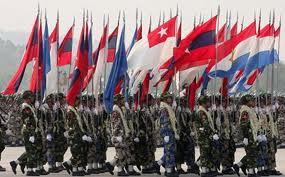
Burma’s military junta source
1974 – New constitution comes into effect, transferring power from the armed forces to a People’s Assembly headed by Ne Win and other former military leaders; body of former United Nations secretary-general U Thant returned to Burma for burial.
1975 – Opposition National Democratic Front formed by regionally-based minority groups, who mounted guerrilla insurgencies.
1982 – Law designating people of non-indigenous background as “associate citizens” in effect bars such people from public office.
Riots and repression:
1987 – Currency devaluation wipes out many people’s savings and triggers anti-government riots.
1988 – Thousands of people are killed in anti-government riots. The State Law and Order Restoration Council (Slorc) is formed.
1989 – Slorc declares martial law, arrests thousands of people, including advocates of democracy and human rights, renames Burma ‘Myanmar’, with the capital, Rangoon, becoming Yangon. NLD leader Aung San Suu Kyi, the daughter of Aung San, is put under house arrest.
Thwarted elections

Anti-government protests in 1988 triggered martial law and mass arrests source
1990 – Opposition National League for Democracy (NLD) wins landslide victory in general election, but the result is ignored by the military.
1991 – Aung San Suu Kyi awarded Nobel Peace Prize for her commitment to peaceful change.
1992 – Than Shwe replaces Saw Maung as Slorc chairman, prime minister and defence minister. Several political prisoners freed in bid to improve Myanmar’s international image.
1995 – Aung San Suu Kyi is released from house arrest after six years.
1996 – Aung San Suu Kyi attends first NLD congress since her release; Slorc arrests more than 200 delegates on their way to party congress.
1997 – Burma admitted to Association of South East Asian Nations (Asean); Slorc renamed State Peace and Development Council (SPDC).
Release of pro-democracy supporters:
2000 September – Ruling council lifts restrictions on movements of Aung San Suu Kyi and senior NLD members.
2000 October – Aung San Suu Kyi begins secret talks with ruling council.
2001 Ruling council releases some 200 pro-democracy activists. Government says releases reflect progress in talks with opposition NLD leader Aung San Suu Kyi who remains under house arrest.
Conflicting signals:
2002 May – Pro-democracy leader Aung San Suu Kyi released after nearly 20 months of house arrest.
Aung San Suu Kyi taken into “protective custody” after clashes between her supporters and those of government.
2003 November – Five senior NLD leaders released from house arrest after visit of UN human rights envoy.
2004 January – Government and Karen National Union – most significant ethnic group fighting government – agree to end hostilities.
2004 May – Constitutional convention begins, despite boycott by National League for Democracy (NLD) whose leader Aung San Suu Kyi remains under house arrest. The convention adjourns in July.
New capital:
2005 November – Myanmar says its seat of government is moving to a new site near the central town of Pyinmana; it is later given the name Nay Pyi Taw.
2007 January – China and Russia veto a draft US resolution at the UN Security Council urging Myanmar to stop persecuting minority and opposition groups.
2008 January- A series of bomb blasts hits the country. State media blame “insurgent destructionists”, including ethnic Karen rebels.
2008 April – Government publishes proposed new constitution, which allocates a quarter of seats in parliament to the military and bans opposition leader Aung San Suu Kyi from holding office.
Cyclone:
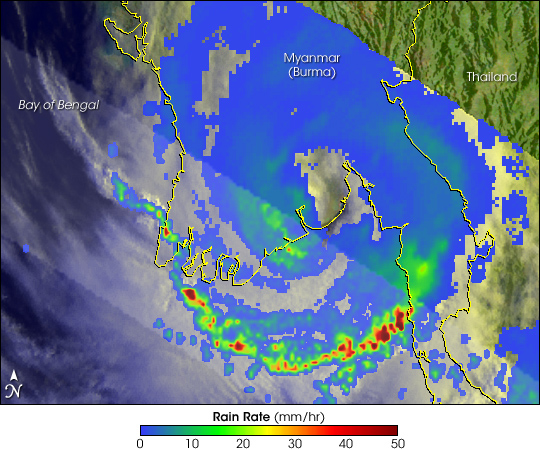
Cyclone Nargis 2008 May – Cyclone Nargis hits the low-lying Irrawaddy delta. Some estimates put the death toll as high as 134,000.
The regime was accused of blocking aid, refusing initial access to humanitarian workers
Referendum on new constitution proceeds amid humanitarian crisis following cyclone. Government says 92% voted in favour of draft constitution and insists it can cope with cyclone aftermath without foreign help.
Junta renews Aung San Suu Kyi’s house arrest.
2008 November – Dozens of political activists given sentences of up to 65 years in series of secretive trials.
2008 December – Government signs deal with consortium of four foreign firms to pipe natural gas into neighbouring China, despite protests from human rights groups.
2009 January – Thailand expels hundreds of members of Muslim Rohingya minority who appeared off its coast. Myanmar denies the minority’s existence. Several hundred Rohingyas are subsequently rescued from boats off the coast of Indonesia.
2009 April – The National League for Democracy (NLD) main opposition group offers to take part in planned elections if the government frees all political prisoners, changes the constitution and admits international observers.
2009 May – The EU extends the 2006 sanctions for another year, but adds that they can be reviewed in the event of moves towards democracy.
UN and aid agencies say hundreds of thousands in the Irrawaddy Delta still need assistance a year after Cyclone Nargis. The UN says Myanmar now allows it to bring in all the staff it needs.
Aung San Suu Kyi trial:
2009 August – Opposition leader Aung San Suu Kyi is convicted of breaching conditions of her house arrest, following visit by an uninvited US national in May. The initial sentence of three years’ imprisonment is commuted to 18 months’ house arrest.

The main military-backed party claimed victory in the 2010 election source
2009 September – US Secretary of State Hillary Clinton announces plans for engagement with military rulers.
2009 October – Aung San Suu Kyi begins talks with Myanmar’s military leaders and is allowed to meet Western diplomats.
2010 March – Government announces that long-awaited election laws have been passed, with provisions for an electoral commission hand-picked by the junta.
NLD votes to boycott polls. A splinter party – National Democratic Front (NDF) – later gains legal status and plans to compete in polls.
2010 October – Government changes country’s flag, national anthem and official name.
2010 November – Main military-backed party, the Union Solidarity and Development Party (USDP), claims resounding victory in first election for 20 years. Opposition groups allege widespread fraud and the election is widely condemned as a sham. The junta says the election marks the transition from military rule to a civilian democracy.
Junta retires to wings:
2011 March – Thein Sein is sworn in as president of a new, nominally civilian government.
2011 August – President Thein Sein meets Aung San Suu Kyi in Nay Pyi Taw.
2011 September – President Thein Sein suspends construction of controversial Chinese-funded Myitsone hydroelectric dam, in move seen as showing greater openness to public opinion.
2011 October – Some political prisoners are freed as part of a general amnesty. New labour laws allowing unions are passed.
2011 November- Pro-democracy leader Aung San Suu Kyi says she will stand for election to parliament, as her party rejoins the political process.
2011 December – US Secretary of State Hillary Clinton visits, meets Aung San Suu Kyi and holds talks with President Thein Sein. US offers to improve relations if democratic reforms continue.
Re-publication censorship was scrapped in 2012, but state control of media remains strong
President Thein Sein signs law allowing peaceful demonstrations for the first time; NLD re-registers as a political party in advance of by-elections for parliament due to be held early in 2012.
Burmese authorities agree truce deal with rebels of Shan ethnic group and orders military to stop operations against ethnic Kachin rebels.
2012 January – Government signs ceasefire with rebels of Karen ethnic group.
Partly-free elections held:
2012 April – NLD candidates sweep the board in parliamentary by-elections, with Aung San Suu Kyi elected. The European Union suspends all non-military sanctions against Burma for a year.
2012 May – Manmohan Singh pays first official visit by an Indian prime minister since 1987.
2012 August – President Thein Sein sets up commission to investigate violence between Rakhine Buddhists and Rohingya Muslims in the west, in which dozens have died.
Myanmar abolishes pre-publication media censorship.
President Thein Sein tells the BBC he would accept opposition leader Aung San Suu Kyi as president if she were elected.
Foreign ties:
2012 November – Visiting European Commission chief Jose Manuel Barroso offers Myanmar more than $100m in development aid.
Around 90 people are killed in a renewed bout of communal violence between Rakhine Buddhists and Rohingya Muslims.
US President Barack Obama visits to offer “the hand of friendship” in return for more reforms. He urges reconciliation with the Rohingya minority.
2013 January-February – The army surrounds Laiza, the biggest town controlled by Kachin rebels. The government and rebels agree to disengage and start a political dialogue after Chinese-sponsored talks.
2013 March – Rioting between Muslims and Buddhists in Meiktila, south of Mandalay, leaves at least 10 people dead.
2013 April – Four private daily newspapers appear for the first time in almost 50 years as the state monopoly ends.

Violence has flared between Rohingya Muslims and Buddhists in Rakhine province source
2013 May – President Thein Sein visits Washington. President Obama praises Myanmar’s political and economic progress, but criticises violence against Rohingya Muslims.
Six Muslims are jailed over the Meiktila clashes in March. No Buddhists are convicted.
2014 April – At least 22 people are killed in fighting between government troops and ethnic Kachin rebels in the north.
Government announces release of 3,000 prisoners. Burma watchers say most are petty criminals, but include ex-military intelligence officers imprisoned along with former Prime Minister Khin Nyunt, who was freed in 2012.
2015 February – Flare-up in fighting with Kokang separatists in Shan State near the border with China leaves nearly 50 soldiers dead. Government puts Kokang region under temporary martial law.
Government withdraws temporary voting rights from Muslim Rohingyas ahead of proposed constitutional referendum, following street protests by Buddhists.
Peace hopes:
2015 March – A draft ceasefire agreement is signed between the government and 16 rebel groups.
2015 May – Hundreds of Muslim Rohingyas migrants leave by sea in flimsy boats, along with migrants from Bangladesh. UN criticizes failure of south-east Asian states to rescue them.
2015 July-August – Floods affect much of low-lying parts of country, killing 100 people and displacing a million others.
2015 November – Opposition National League for Democracy – led by Aung San Suu Kyi – wins enough seats in parliamentary elections to form a government.
2016 March – Htin Kyaw sworn in as president, ushering in a new era as Aung San Suu Kyi’s democracy movement takes power after 50 years of military domination.
-
Civilsdaily Listicles & Titbits | High Yield Material for Quick Prelims Revision
When done with basic book reading and Prelims is near, many aspirants face the dilemma of how to revise entire syllabus and then remember important points from it.
We understood this problem and our team worked together to compile all important topics at one place through excel sheets and Dr V compiled all important static syllabus points through Titbits.
The excel sheets prepared by us are available to view and download below (best viewed on desktop/ large screens):
- Important Acts/bills- Bills/Acts/Amendments which have been in news from 2014-2017- Click2view
- Declarations, conventions, protocols- Contains important IR pacts signed in the last few years- Click2view
- Important Books/ Texts in Indian History – IAS Pre & beyond- Click2view
- Satellites, Space Missions, Space Tech by India –Click2view
- Important Historical Sculptures- Click2view
- Important Temples/Monasteries/Stupa/Caves- Click2view
- Key/important Terms related to Ancient/ Medieval History- contains nearly 180 terms from the most authentic history textbooks of our times Click2view
- Tribes in India, their festivals, and culture- Click2view
Read all Titbits here
- Polity Titbits: Fundamentals of Polity and Constitution Click2read
- Polity Titbits: Important articles/schedules of Constitution Click2read
- Polity Titbits: Functions/powers of legislature Click2read
- Polity Titbits: Functions/powers of executive Click2read
- Polity Titbits: Functions/powers of Judiciary Click2read
- Polity Titbits: Constitution- Special provisions Click2read
- Polity Titbits: Constitutional, Statutory and quasi-judicial bodies Click2read
- Polity Titbits: Panchayati Raj- Local governance Click2read
-
[Official Answer] 21 Aug 2017 | Target Mains: GS Questions With Official Answers
GS Paper 1
Role Played in Freedom Struggle
- Rajendra Prasad was man of courage, dedication, conviction and utmost sincerity. His name symbolised honesty and modesty. He was an active participant in crucial freedom movements like Non Cooperation Movement, Salt Satyagraha and Champaran Agrarian Agitation.
- Rajendra Prasad came under the spell of Mahatma Gandhi in 1917 when the latter organized the Champaran Satyagraha to liberate the peasants from exploitation by the British Indigo planters. Under the active guidance of Mahatma Gandhi, he gave a new lead to the various movements in Bihar, with a view to taking the country nearer to the goal of freedom and economic regeneration Inspired by Gandhian ideology.
- He concurred with Gandhiji that the only effective weapon to deal with the British Government’s inhuman actions and repressive laws was, ‘non-cooperation’. He was the first leader from Bihar to sign and undertake a pledge requiring every Satyagrahi to remain non-violent during the protest against the Rowlatt Act which came to be dubbed as the ‘Black Act.
- ln 1923, Rajendra Prasad actively participated in the Flag Satyagraha at Nagpur. The British Government arrested him for taking part in the 1930 Satyagraha. The second long spell of imprisonment that Rajendra Prasad suffered was immediately after the passing of the Quit India Resolution in 1942 and he remained in jail for nearly three years till 1945.
Role played in making of the Constitution
- When the Constituent Assembly was formed in 1946 to frame a Constitution for free lndia, Dr.RajendraPrasad, who had been elected as a member of the Assembly from the Bihar Province, was given the onerous responsibility of being its President. As President of the Constituent Assembly, he guided and regulated its proceedings with utmost firmness, infinite patience, incisive intellect and abundant grace. He always permitted members to have a free, frank and full discussion on issues before them and won the appreciation of every section of the House for his qualities, objectivity and impartiality.
Role played by Him in Post Independent India.
- Dr. Rajendra Prasad was unanimously elected as the provisional President of India on 24 January 1950.He served as the President of India for three terms the only person to do that.
- As President Rajendra Prasad, along with India’s first Prime Minister, Pandit Jawaharlal Nehru, was able to establish many precedents and conventions culminating in a healthy political relationship between the Head of State and the Head of Government. With the passage of time, these precedents have become the cornerstone of our vibrant parliamentary democracy and have helped it in striking firm roots.
- Even though Rajendra Prasad occupied the highest office in India, he led a very simple life. His integrity, purity of character, humility and devotion, love of humanity and depth of vision marked him out as a towering personality in our national firmament Rajendra Prasad not only gave the most precious years of his life to the freedom struggle but also worked for the betterment of the under-privileged throughout his life. He was a great humanist whose heart always went to the poor and the distressed.
GS Paper 2
- There has been debate since last general election about the system of election our country is having i.e. First Past the Post System. Apprehensions are now being raised that in recent years the FPTP system is not the best suited for India.
- The reason behind this is that, the party getting maximum number of votes is declared elected (won) with majority irrespective of the votes polled even as low as 27% and the number of votes other parties get.
- As evident from the recent UP election where results have indicated that a party getting 39 percent vote share won 312 seats and parties getting 22 percent and 21 percent got only 47 and 19 seats respectively.
- This initiated our parliamentary panel to explore for different system of elections, other than the first past the post system.
Our Constitutional framers favoured First Past the Post System because:
- FTPT is simple to use and easy to understand. It provides clear-cut choice for voters between two main parties. It allows voters to choose between people rather than just between parties. Thus, voters can assess the performance of individual candidates rather than just having to accept a list of candidates presented by a party. It gives a chance for popular independent candidates to be elected.
- However, the issue is that the victorious party has most often not secured the majority of votes. It is possible for a party to win majority of the seats with just 20-26% of vote share; by the same token, a party may not get a simple majority even with 74% of vote share. There is, hence, a mismatch between the number of seats won and the percentage of vote secured by the party.
Further criticisms of FPTP are as follows:
- Distortion of electoral process
- Excludes smaller parties from fair representation
- Encourages caste, religion, Ethnicity and regional politics.
- Exaggerates the phenomenon of ‘regional fiefdoms’
- We note here that during the drafting of the Constitution, various systems of proportional representation were considered, but the FPTP system was eventually adopted to avoid fragmented legislatures and to facilitate the formation of stable governments.
Proportional Representation:
- Concerning the above facts there has been debates and discussions regarding doing away with FPTP system and adopting the Proportional Representation system in India. Proportional representation (PR) is a concept in which the number of seats won by a party or group of candidates is proportionate to the number of votes received.
- Proportional representation undoubtedly falls second in competition with the FPTP system in terms of simplicity in voting, but it scores higher in terms of convenience during campaign. Candidates can simply focus pointed attention on defined groups to appeal to, and consequently, the problems of campaign financing do not feature as prominently in the process.
- Because parties are granted seats in accordance with their vote share, numerous parties get seats in the legislature in the proportional representation system, without any party gaining a majority. This detracts from the stability of the system.
- Coalition government becomes inevitable, with challenges to such governments also becoming frequent. This is also why the Constituent Assembly decided that proportional representation would not be suited to the Parliamentary form of government that our Constitution lays down.
- One potential drawback of this system is that the relationship between a voter and the candidate may dilute, for the candidate may now be seen as representing the party and not the constituency. The other way of looking at this is that a constituent could approach any representative of their choice in case of a grievance, which plays out as an advantage of this system.
Conclusion:
- As the discussion above has demonstrated, both electoral systems come with their own merits and demerits – proportional representation theoretically being more representative, while the FPTP system being more stable.
- It can be suggested from the experience of other countries to follow a hybrid pattern combining elements of both direct and indirect elections. This, in turn will necessitate an increase in the number of seats in the Lok Sabha, which raises concerns regarding its effective functioning.
GS Paper 3
Source: https://www.civilsdaily.com/op-ed-snap-getting-charged-up/
https://www.civilsdaily.com/op-ed-snap-the-hybrid-route/
Electric vehicles are the future of India’s transportation system and could save billions of dollars in fuel cost while also reducing pollution, a report released by NITI Aayog. In light of this, the Government’s announcement that only EVs will be sold in India from 2030s makes great prominence. It is also believed that this would also save around one giga tonne of carbon emissions between 2017 and 2030. However, there are some major challenges in achieving this target. These are as follows:
- Increased dependence: India will have to depend on countries like China for raw materials like Lithium required for EV Batteries due to its local unavailability
- Huge Investment Requirement: Due to ever growing population of India, huge investment through private participation and local manufacturing units is required to cater their needs
- Large Infrastructure Requirement: Electric Vehicles require large scale presence of Charging Infrastructure to be successful
- Affordability issues: The demand for Electric Vehicles depends on its affordability, which is not so at present E.g. GST regime’s favor for fossil fuel run vehicles and increasing lithium prices increase cost of EVs and reduce demand.
- Procurement of critical minerals: According to a study on India’s critical non-fuel minerals by the CEEW, manufacturing lithium-ion batteries would require critical minerals
The steps that should be taken to promote and spur electric vehicles are:
- Land Acquisition should be easier for faster deployment of dedicated charging spots, charging infrastructure and setting up of Local EV Manufacturing Units.
- Acquisition of overseas natural mineral reserves. These minerals include cobalt, graphite, lithium and phosphate.
- There is a need to formulate policies which can encourage domestic public and private mining companies to invest in overseas lithium mining assets.
- India must focus on creating a vibrant battery research and development ecosystem domestically.
- Recycling lithium batteries will significantly reduce the burden in procuring fresh resources
- Expansion of National Electric Mobility Mission and indigenous manufacturing under FAME scheme should be undertaken on a war footing.
While India is facing rapid urbanization over the next three-to-four years, it must not follow the American model of urbanization which was essentially based on availability of cheap land, water and oil. Electric vehicles are the future of transportation and India needs to embrace them. Like it or not, electric vehicles will happen in India. The challenge is how to do it rapidly and how to do in scale and size. That should be the imperative.
GS Paper 4
(a) Unite the poor and marginalized so that they could raise their voice effectively.
(b) Moblise the public opinion against the managed media.
(c) Compel the state government to take remedial measures in order to set things right.
(a) It is very important for the poor and marginalized to raise their voice to break the nexus of bureaucracy, elected representatives and contractors. The social activist can unite the people on common issues and on problems which people suffer at ground level. This will help to make sure people’s participation. Same was done by Gandhi in movements like civil disobedience when people realised that they are being heard. It will help to make sure they are united to fight for the cause they are suffering.
(b) To mobilize the public opinion against the managed media, it is necessary people influence the media and put the pressure on it. It is seen that the actions are moved by the people’s opinion, civil society organizations etc. When the people are united, the media will have no option rather than to emerge out of the nexus which governs it. For it, it is very important to make the people stand united and stand together.
(c) The state government is too mismanaged and driven by corrupt officials. They can be approached to tell how the things are going wrong and how are the poor and marginalized sections are suffering because of it. This can be done through NGOs or other civil society organizations. If they do not pay attention to it, a group of people can form a united organization and take steps to change the way things have been going wrong. It is worth learning from life of Gandhi that public opinion has the strength to change government functioning if they wish for it. The same can be replicated in this case also.
-
21 Aug 2017 | GS 4 | A young social activist has become very popular within a short period of 5 years because of his honesty, integrity, and human values. He finds rampant corruption in government offices and mismanagement is rural development schemes, which affects the poor and marginalized section of the society. He notices that it is a nexus of bureaucracy, elected representatives and contractors for this sorry state of affairs. It is unfortunate that a section of media has been managed by the nexus. The social activist, having deeply influenced by Gandhian principle wants to correct the things. What steps and action he will take to: (a) Unite the poor and marginalized so that they could raise their voice effectively. (b) Moblise the public opinion against the managed media. (c) Compel the state government to take remedial measures in order to set things right.
GS Paper 4
Q.4) A young social activist has become very popular within a short period of 5 years because of his honesty, integrity, and human values. He finds rampant corruption in government offices and mismanagement is rural development schemes, which affects the poor and marginalized section of the society. He notices that it is a nexus of bureaucracy, elected representatives and contractors for this sorry state of affairs. It is unfortunate that a section of media has been managed by the nexus. The social activist, having deeply influenced by Gandhian principle wants to correct the things. What steps and action he will take to:
(a) Unite the poor and marginalized so that they could raise their voice effectively.
(b) Moblise the public opinion against the managed media.
(c) Compel the state government to take remedial measures in order to set things right.