💥UPSC 2027,2028 Mentorship (April Batch) + Access XFactor Notes & Microthemes PDF

Search results for: “”

  • On gravity’s role on Earth’s journey through space

    Why in the News?

    The article becomes relevant at the start of a new year, as it reflects on Earth’s continuous journey around the Sun at nearly 1,07,000 km per hour. It points out that even at such enormous speed, life remains stable because gravity keeps everything in balance. The piece recalls an important scientific milestone, the rejection of the ether theory in 1887, and pays tribute to Prof. Jayant Narlikar, founder of IUCAA, after his recent passing. It contrasts old beliefs about “aether” with today’s scientific understanding of vacuum and gravitational forces. The striking figures, Earth travelling nearly 1 billion kilometres in a year and about 40,000 kilometres in an hour, highlight how vast this motion is, even though we do not feel it in everyday life.

    What is Gravity?

    1. Gravity is a fundamental, invisible force of attraction that pulls any two objects with mass toward each other. 
    2. Its strength depends on the mass of the objects and the distance between them
    3. Gravity governs both terrestrial and cosmic systems. 
    4. It explains falling objects, planetary motion, and Earth’s stable revolution around the Sun. 
    5. The Earth completes one revolution in 365 days while travelling nearly one billion kilometres annually at high velocity. This motion remains unnoticed due to gravitational balance and absence of resistive friction in space.

    How Does Gravity Function as a Centripetal Force?

    1. Centripetal Mechanism: Gravity acts as the centripetal force pulling bodies towards a centre, ensuring orbital motion.
    2. Bicycle Analogy: Pulling a string tied to a rotating object redirects its motion inward, similar to gravitational pull maintaining planetary orbits.
    3. Planet-Sun Interaction: Earth does not fall into the Sun because forward motion balances gravitational pull.
    4. Universal Application: The same mechanism explains the Earth-Moon system and other celestial rotations.

    Why Do Objects Fall Toward Earth?

    1. Universal Gravitation: Objects fall toward Earth because Earth is the heaviest nearby mass.
    2. Mass Attraction: All objects with mass attract one another.
    3. Everyday Example: Falling bodies move toward Earth’s centre unless acted upon by another force.

    How Fast Is Earth Travelling in Space?

    1. Annual Distance: Earth travels nearly 1,000,000,000 km in one year.
    2. Hourly Speed: Approximate orbital speed equals 1,07,000 km per hour.
    3. Comparative Illustration: A car travelling at 100 km per hour without stopping would take around 1,000 years to cover a comparable distance.
    4. Temporal Perspective: Earth covers nearly 40,000 km in about one hour.

    Why Is There No Friction in Space?

    1. Friction Concept: Friction arises due to surrounding particles resisting motion.
    2. Earthly Examples: Air slows a bird; water resists a fish; road friction stops a car.
    3. Vacuum Condition: Space lacks resisting medium, preventing deceleration of planetary motion.
    4. Energy Continuity: Continuous motion persists without need for refuelling unlike vehicles requiring oil.

    What Was the Ether Hypothesis and Why Did It Fail?

    1. Ether Assumption: Earlier belief held that an invisible material called “aether” filled space.
    2. Michelson-Morley Experiment (1887): Attempted to detect ether; failed to find evidence.
    3. Scientific Outcome: Demonstrated absence of ether, marking a major conceptual correction.
    4. Modern Understanding: Space functions as vacuum without a resistive medium.

    What Is the Significance of Space Studies in India?

    1. Institutional Role: IUCAA in Pune advances astrophysics research.
    2. Scientific Leadership: Prof. Jayant Narlikar contributed to cosmological theories and public science communication.
    3. Recognition: Awarded Padma Vibhushan in 2004.
    4. Public Outreach: Science communication through television series such as “Brahmand.”

    Conclusion

    Earth’s silent, high-speed journey through space is sustained by the precise balance of gravity and motion. What once required speculative ideas like “ether” is now explained through tested scientific principles. By reflecting on these discoveries, and the contributions of scientists like Jayant Narlikar, it reinforces the importance of scientific temper in understanding our place in the universe.

    PYQ Relevance

    [UPSC 2017] How does the Juno Mission of NASA help to understand the origin and evolution of earth?

    Linkage: Juno’s study of Jupiter’s gravitational structure reinforces the article’s explanation of gravity as the fundamental force shaping Earth’s origin and sustaining its motion through space.

  • India–Seychelles Joint Vision SESEL

    Why in the News

    India and Seychelles adopted a Joint Vision for Sustainability, Economic Growth and Security through Enhanced Linkages (SESEL) during the State Visit of Seychelles President Patrick Herminie to India. The visit coincides with 50 years of Seychelles’ independence and 50 years of India–Seychelles diplomatic relations.

    Key Outcomes 

    Strategic and Political

    • Reaffirmation of special maritime partnership between India and Seychelles
    • Seychelles recognised as a key pillar of India’s Vision MAHASAGAR
    • Agreement to intensify political and parliamentary exchanges

    Development Partnership

    • India announced a Special Economic Package of USD 175 million
      • USD 125 million Rupee denominated Line of Credit
      • USD 50 million Grant assistance
    • Focus areas include sustainability, defence, maritime security, capacity building and inclusive growth

    Digital Public Infrastructure

    • India to assist Seychelles in building Digital Public Infrastructure
    • Includes digital payments and e governance systems

    Health and Food Security

    • Donation of 10 ambulances to Seychelles
    • Seychelles to recognise Indian Pharmacopoeia, easing access to affordable medicines
    • Donation of 1000 metric tonnes of grains to strengthen food security
    • Cooperation on hospital construction and public health capacity

    Capacity Building

    • Expanded cooperation under Indian Technical and Economic Cooperation
    • Training for civil servants, defence personnel and health professionals
    • Customised training through National Centre for Good Governance
    • Cooperation in cybersecurity, financial intelligence and MSME promotion

    Climate Action and Renewables

    • Cooperation under the International Solar Alliance
    • Support for Multi Hazard Early Warning Systems
    • Seychelles to join the Coalition for Disaster Resilient Infrastructure
    • India to provide technical support for green transport and power grid management

    Trade, Tourism and Connectivity

    • Direct flights boosted Indian tourist arrivals
    • Agreement to explore further air connectivity
    • Focus on blue economy, fisheries, AI, digital services and affordable housing

    Hydrography and Blue Economy

    • Establishment of Seychelles Hydrographic Unit with Indian assistance
    • Conduct of joint hydrographic surveys
    • Third Joint Commission Meeting on Hydrography to be held in Seychelles in 2026
    [2025] Consider the following countries: I. United Arab Emirates 

    II. France 

    III. Germany 

    IV. Singapore 

    V. Bangladesh 

    How many countries amongst the above are there other than India where international merchant payments are accepted under UPI? 

    (a) Only two (b) Only three (c) Only four (d) All the five

  • NHRC takes suo motu cognizance of stranded Indian workers in Dubai

    Why in the News

    The National Human Rights Commission has taken suo motu cognizance of reports that Indian migrant workers from Jharkhand are stranded in Dubai, allegedly facing passport seizure, unpaid wages and denial of return to India.

    Key Facts  

    • Number of workers affected: At least 14
    • Home districts: Giridih, Hazaribagh and Bokaro in Jharkhand
    • Nature of employment: Transmission line work
    • Allegations:
      • Passports seized by employer
      • Wages unpaid
      • Salary deductions to recover airfare costs
      • Charges imposed for accommodation
      • Inability to afford food
    • Action by NHRC:
      • Issued notices to the Chief Secretary of Jharkhand
      • Notice to the State Migrant Workers Control Room
      • Sought a detailed report within two weeks

    Note:

    • The present case directly demonstrates the suo motu powers of NHRC based on media reports.
    • NHRC is a statutory body, not constitutional.
    • Its recommendations are advisory, not binding.
    • It does not have punitive powers but can recommend action.
    [2023] Consider the following organizations/bodies in India: 1. The National Commission for Backward Classes 

    2. The National Human Rights Commission 

    3. The National Law Commission 

    4. The National Consumer Disputes Redressal Commission 

    How many of the above are constitutional bodies? 

    (a) Only one (b) Only two (c) Only three (d) All four

  • Safe Landing Patch Identified near Mons Mouton for Chandrayaan 4

    Why in the News

    A study by ISRO Space Applications Centre has identified a safe landing patch near Mons Mouton for Chandrayaan-4, India’s first lunar sample return mission.

    About Moon’s Mons Mouton

    • Mons Mouton is a large flat topped lunar mountain massif
    • Officially named by the International Astronomical Union

    Location

    • Situated in the south polar region of the Moon
    • Lies close to the rim of the South Pole Aitken Basin
    • Approximately 160 km from the lunar south pole

    Origin

    • Formed due to rim uplift during ancient massive asteroid impacts
    • Represents exposed deep lunar crust, rare and scientifically valuable

    Key Physical Features

    • Width of nearly 100 km
    • Elevation of about 6,000 metres above surrounding terrain
    • Rugged topography with craters and boulder fields
    • Unique illumination conditions
      • Some regions receive near continuous sunlight
      • Others remain in permanent shadow
    • Can be observed during favourable libration even with amateur telescopes
    [2009] India has recently landed its Moon Impact Probe on the Moon. Among the following countries, which one landed such probe on the Moon earlier? (a) Australia 

    (b) Canada 

    (c) China 

    (d) Japan

  • Gross NPAs of SCBs at Historic Low

    Why in the News

    The Finance Ministry informed that the gross non performing assets ratio of Scheduled Commercial Banks has declined to a historic low of 2.15 percent as of September 30, 2025, the lowest level seen in more than a decade.

    Key Facts 

    • Gross NPA ratio of SCBs: 2.15 percent
    • Trend: Continuous decline for the last eight financial years
    • Comparison: Lower than the level seen in 2010-11

    Bank wise Gross NPA Ratio as on Sept 30, 2025

    • Public Sector Banks: 2.50 percent
    • Private Sector Banks: 1.73 percent
    • Foreign Banks: 0.80 percent

    Reasons for Decline in NPAs

    • Asset Quality Review initiated by Reserve Bank of India in 2015
    • Government’s 4R strategy
      • Recognition of NPAs
      • Resolution and recovery
      • Recapitalisation of PSBs
      • Reforms in banking and financial ecosystem
    • Improved underwriting standards
    • Stronger balance sheets and sustained profitability of banks
    [2019] What was the purpose of the Inter-Creditor Agreement signed by Indian banks and financial institutions recently? (a) To lessen the Government of India’s perennial burden of fiscal deficit and current account deficit 

    (b) To support the infrastructure projects of Central and State Governments 

    (c) To act as independent regulator in case of applications for loans of Rs. 50 crore or more 

    (d) To aim at faster resolution of stressed assets of Rs. 50 crore or more which are under consortium lending

  • New Dragonfly Species Discovered in Kerala

    Why in the News

    Researchers have identified and described a new species of dragonfly from Kerala, named Lyriothemis keralensis, highlighting the rich and still underexplored biodiversity of the Western Ghats.

    Key Facts 

    • Scientific name: Lyriothemis keralensis
    • Taxonomic group: Order Odonata, Family Libellulidae
    • Location of discovery: Varapetty near Kothamangalam, Ernakulam district, Kerala
    • Habitat:
      • Vegetated pools and irrigation canals
      • Shaded pineapple and rubber plantations
    • Seasonal visibility:
      • Adult dragonflies seen only during the Southwest monsoon from late May to August
      • Remains in aquatic larval stage during the rest of the year
    [2023] Which of the following organisms perform waggle dance for others of their kin to indicate the direction and the distance to a source of their food? 

    (a) Butterflies 

    (b) Dragonflies   

    (c) Honeybees 

    (d) Wasps


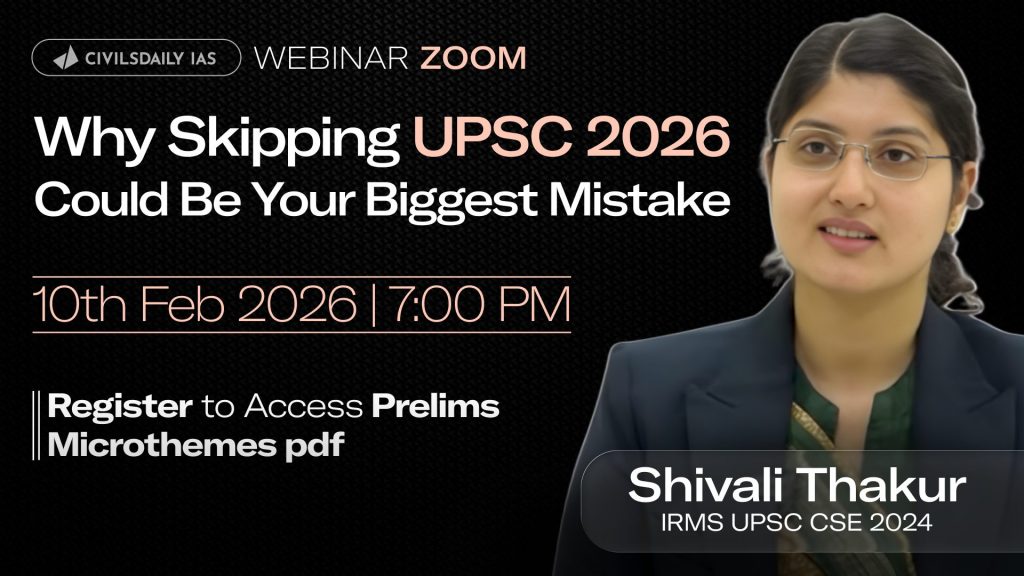
  • 🔴[UPSC Webinar for 2026] By Shivali Thakur, IRMS,UPSC CSE 2024 | Why Skipping 2026 Could Be Your Biggest Mistake | Join on 10th Feb at 7PM

    🔴[UPSC Webinar for 2026] By Shivali Thakur, IRMS,UPSC CSE 2024 | Why Skipping 2026 Could Be Your Biggest Mistake | Join on 10th Feb at 7PM

    Register for the session


    Read about Webinar

    “I almost skipped an attempt once. That decision cost me more than I expected.”

    Many aspirants think skipping an attempt is being strategic.
    In reality, most skip because of fear, confusion, or incomplete preparation, not because the attempt is actually unviable.

    In this session, I want to talk honestly about why skipping UPSC 2026 could be your biggest mistake, and how to take a clear, rational decision instead of an emotional one.

    Shivali Thakur , IRMS, UPSC CSE 2024

    What I’ll do in this live session:

    1. The real reasons aspirants skip an attempt (and why most are flawed)
    I’ll break down the common justifications , “not ready yet”, “need one more year”, “weak in prelims” and explain which ones are valid and which ones quietly delay success.

    2. What an attempt actually gives you, even if you don’t clear
    From exam temperament to question reading maturity, I’ll explain why serious attempts compound learning in ways preparation alone never can.

    3. How to objectively assess your readiness for UPSC 2026
    Not motivation. Not fear.
    A clear framework to judge:
    • Coverage
    • Revision depth
    • Elimination ability
    • Exam temperament

    4. When skipping does make sense, and when it absolutely doesn’t
    This is not a “don’t skip at all” talk.
    It’s about skipping for the right reasons, not comforting excuses.


    Who should attend:

    • Aspirants confused about attempting UPSC 2026
    • Those feeling “almost ready but not confident”
    • Anyone planning to skip without a clear decision framework

    Join us, for a 45 minute live Zoom session on 10th Feb at 7PM.

    See you in masterclass.


    It will be a 45 minute session, post which we will open up the floor for all kinds of queries which a beginner must have. No questions are taboo and Shivali Ma’am is known to be patiently solving all your doubts.

    Join us for a Zoom session on 10th Feb at 7 PM. This session is a must attend for you If you are attempting UPSC for the first time or have attempted earlier and now preparing for 2026/2027, then it is going to be a valuable session for you too.

    See you in the session”

    Register for the session for a complete in-depth UPSC Prep


    In this Civilsdaily masterclass, you will get:

    1. A 45-minute deep dive on how to plan your UPSC strategy from the start to the end.
    2. How do first-attempt IAS Rankers get the most out of their one year prep?
    3. Insider tips that only the top IAS and IPS rankers know and apply to get rank.

    By the end, you’ll have razor-sharp clarity and a clear path to crack UPSC with confidence and near-perfect certainty. 

    Join UPSC session on 10th Feb, at 7 PM

    (Don’t wait—the next webinar/session won’t be until End Feb’26)


    These masterclasses are packed with value. They are conducted in private with a closed community. We rarely open these webinars for everyone for free. This time we are keeping it for 300 seats only.

    Ready to attend the UPSC Webinar?


    Not sure yet?

    We recommend you register here. It takes less than 10 seconds to register.

    • No spam! Once in a while, we’ll only send you high-quality exam-related content. 
    • We will inform you about the upcoming Masterclasses that might benefit you.
    • You can demand one free mentorship call from verified Civilsdaily mentors. 
    • You can always choose to unsubscribe. 
  • [9th February 2026] The Hindu OpED: A social media ban will not save our children

    PYQ Relevance

    [UPSC 2023] Child cuddling is now being replaced by mobile phones. Discuss its impact on the socialization of children.

    Linkage: This GS-I (Society) question examines the impact of digital technology on family structures, early childhood development, and patterns of socialization.

    Mentor’s Comment

    The debate on banning social media for minors has intensified following policy moves globally and in India. The article argues that prohibition is a simplistic response to a complex structural problem. It cautions against moral panic-driven regulation and instead calls for building a healthy digital media ecosystem grounded in accountability, research, and child protection safeguards.

    Why in the News?

    The issue gains prominence due to a growing global shift toward restricting adolescent access to social media platforms. In 2024, Australia passed a law prohibiting anyone under 16 from holding accounts on major platforms such as Instagram, TikTok, YouTube, Snapchat, and X. It mandates age verification and imposes fines up to $50 million for non-compliance. In February 2026, Spain announced similar restrictions. These measures represent one of the first large-scale legislative attempts to exclude minors from digital platforms entirely. In India, policymakers are considering comparable measures amid rising concern over screen addiction and adolescent mental health.

    Why is a Social Media Ban Being Considered?

    1. Adolescent Mental Health Concerns: Links heavy social media use with anxiety, depressive symptoms, self-harm, and body image dissatisfaction. Evidence remains associational, not causal.
    2. Screen Addiction Narrative: Frames excessive digital engagement as primary cause of adolescent distress.
    3. Policy Response Shift: Australia’s 2024 legislation bans under-16 accounts on major platforms. Imposes mandatory age verification and fines up to $50 million.
    4. International Replication: Spain (February 2026) announced similar prohibition for minors under 16.
    5. Moral Panic Dynamics: Political responses seek visible control measures during public tragedies, producing symbolic crackdowns.

    Does Evidence Justify Blanket Prohibition?

    1. Systematic Reviews: Identify small but consistent associations between heavy usage and mental health challenges.
    2. Gendered Impact: Greater vulnerability among adolescent girls.
    3. Absence of Causality: Studies do not establish direct cause-effect relationship.
    4. Indian Context Gap: Limited domestic studies, but global findings signal caution in usage effects.

    Why May Bans Fail in the Indian Context?

    1. Enforcement Constraints: Adolescents evade age restrictions easily.
    2. VPN Circumvention: Strict age-gating pushes minors toward unregulated platforms or dark web spaces.
    3. Encrypted Migration: Movement to platforms like Instagram or encrypted environments reduces oversight.
    4. Mass Surveillance Risk: Identity verification frameworks risk linking minors’ online activity to government databases.
    5. Gender Inequality Reinforcement: 33.3% of women in India use internet versus 57.1% of men. Bans may disproportionately restrict girls’ mobility and digital access.
    6. Community Loss: For queer and differently-abled teens in small towns, social media provides safe communities otherwise unavailable offline.
    7. Democratic Deficit: Policy decisions occur without consulting adolescents directly.

    What Structural Problems Are Being Ignored?

    1. Platform Design Incentives: Engagement-maximizing algorithms encourage addictive use.
    2. Profit Model Dependence: Revenue tied to user attention and data extraction.
    3. Content Moderation Gaps: Inconsistent enforcement and opaque governance structures.
    4. Digital Protection Weakness: India’s Digital Personal Data Protection Act, 2023 relies on parental consent gating, which may result in exclusion or false declarations.
    5. Under-Regulated AI Integration: Generative AI chatbots integrated into platforms increase exposure to unverified health advice and harmful interactions.
    6. Emerging Risks: AI-related cases include sexualised interactions with minors and alleged self-harm inducement.

    What are the Policy Alternatives Available?

    1. Platform Accountability: Legally enforceable “duty of care” obligations.
    2. Independent Regulation: Oversight by expert regulators, not solely by the Ministry of Electronics and IT.
    3. Research Infrastructure: Longitudinal studies on children’s digital well-being across class, caste, gender, and region.
    4. Notice-and-Repair Model: Move beyond takedown mechanisms to systemic platform design reform.
    5. Healthy Media Ecology: Balance innovation with child safety and democratic transparency.
    6. Avoid Illusion of Control: Recognize that bans offer symbolic reassurance without systemic resolution.

    Conclusion

    Blanket prohibition simplifies a complex structural issue. It risks deepening inequalities, encouraging circumvention, and expanding surveillance frameworks. Sustainable reform requires platform accountability, independent oversight, evidence-based research, and systemic redesign of digital environments.

  • Why borrowings have now begun biting govts

    Why in the News?

    Government borrowing costs are rising even after successive repo rate cuts by the Reserve Bank of India (RBI). Since February 2025, the RBI has reduced the repo rate by 100 basis points from 6.5% to 5.5%. However, yields on 10-year government securities have increased from 6.66% to 6.73% during the same period.

    This divergence is significant because bond yields typically soften after rate cuts. Instead, governments are now paying 0.4-0.5 percentage points more to borrow compared to 10-15 years ago. The issue affects both the Centre and States, which together budgeted gross market borrowings exceeding ₹40 lakh crore in 2025-26. Rising yields increase interest burdens and crowd out developmental expenditure.

    Why Are Borrowing Costs Rising Despite Repo Rate Cuts?

    1. Limited Monetary Transmission: Repo rate reduced from 6.5% to 5.5% since February 2025. 10-year G-sec yields increased from 6.66% to 6.73% during the same period.
    2. Higher Risk Premium: Markets demand higher yields due to elevated debt levels and fiscal pressures.
    3. Liquidity Tightening: RBI reduced bond purchases and ended aggressive liquidity injections.
    4. Foreign Outflows: Net FPI outflows of $12.5 billion during April-September 2025 reduced bond demand.

    How Large Is the Government Borrowing Programme?

    1. Gross Borrowing (Centre): ₹14.90 lakh crore budgeted for 2025-26.
    2. Gross Borrowing (States): ₹18.14 lakh crore budgeted.
    3. Combined Gross Borrowing: Exceeds ₹40 lakh crore.
    4. Net Borrowing (Centre): ₹11.73 lakh crore in 2025-26.
    5. Net Borrowing (States): ₹10.75 lakh crore in 2024-25.

    What Is the Status of Outstanding Liabilities?

    1. Centre’s Liabilities: Increased from 48.1% of GDP (2015-16) to above 55% in 2025-26.
    2. States’ Liabilities: Increased from 22.3% (2015-16) to 29.2% in 2025-26.
    3. Combined Liabilities: Exceed 80% of GDP.
    4. Interest Burden: Governments now pay 0.4-0.5 percentage points more compared to 10-15 years ago.

    What Role Has Liquidity Played?

    1. Pandemic Liquidity Surge: RBI expanded liquidity during 2020-22 to manage economic slowdown.
    2. Subsequent Tightening: RBI reversed bond purchases and injected limited liquidity.
    3. Foreign Exchange Dynamics: RBI sold dollars to stabilize the rupee, reducing domestic liquidity.
    4. Capital Inflows: Net foreign capital inflows modest at $18 billion during April-September 2025.

    How Does This Affect Fiscal Management?

    1. Higher Interest Payments: Expands revenue expenditure commitments.
    2. Reduced Fiscal Space: Limits developmental and capital spending.
    3. Crowding-Out Effect: High government borrowing absorbs financial resources.
    4. State-Level Stress: States face similar yield pressures amid large borrowing programmes.

    Conclusion

    Rising borrowing costs despite repo rate cuts indicate structural stress in India’s fiscal and financial architecture. Elevated debt levels, reduced liquidity support, and weak monetary transmission have increased the interest burden on both the Centre and States.

    Sustained high yields risk expanding revenue expenditure, compressing capital spending, and constraining developmental priorities. The situation underscores the need for calibrated fiscal consolidation, improved debt management, and better coordination between monetary and fiscal policy to ensure macroeconomic stability without compromising growth.

    PYQ Relevance

    [UPSC 2019] The public expenditure management is a challenge to the Government of India in context of budget making during the post liberalization period. Clarify it.

    Linkage: The question examines fiscal discipline, debt sustainability, and expenditure prioritisation under the post-liberalisation framework. The article highlights rising borrowing costs and elevated liabilities, which intensify interest burdens and constrain public expenditure management, making budget balancing more complex.

  • How is India tackling mental health crisis?

    Why in the News?

    The Economic Survey flagged rising digital addiction and screen-related mental health disorders, particularly among children and adolescents. The Union Budget announced strengthening of mental health infrastructure, including establishment of a second campus of NIMHANS in North India and upgradation of premier institutions in Ranchi and Tezpur. Despite increased allocation from ₹683 crore (2020-21) to ₹1,898 crore (2024-25), mental health spending remains about 2% of total health outlay.

    What is the Scale of India’s Mental Health Burden?

    1. Suicide Burden: Accounts for nearly one-third of global suicides; depression and addiction contribute significantly to disease burden.
    2. Economic Impact: Mental health conditions impose an estimated economic loss of $1.03 trillion between 2012 and 2030.
    3. Treatment Gap: 70-92% of individuals with mental disorders lack proper treatment due to low awareness, stigma, and workforce shortages.
    4. Human Resource Deficit: 0.75 psychiatrists per 1,00,000 population against the recommended 3 per 1,00,000.
    5. Adolescent Vulnerability: Rising digital addiction and screen-related disorders flagged in the Economic Survey.

    What Institutional Measures Have Been Announced?

    1. National institute of mental health and Neuro Sciences (NIMHANS) Expansion: Establishes second campus of National Institute of Mental Health and Neurosciences in North India.
    2. Institutional Upgradation: Upgrades premier institutions in Ranchi and Tezpur to improve regional access.
    3. Centre of Excellence Expansion: Sanctions over 20 Centres of Excellence to train postgraduate students in mental health.
    4. Advanced Treatment Infrastructure: Establishes 47 PG departments in mental health.
    5. Primary Healthcare Integration: Integrates mental health services under Ayushman Arogya Mandirs and Health and Wellness Centres.
    6. Tele-MANAS Helpline: Provides 24×7 free mental health support via toll-free number 14416 and 1-800-891-4416; operational across 36 States/UTs and supported by 23 specialised mentoring institutes.

    How Has Budgetary Allocation Evolved?

    1. Allocation Increase: Raises allocation from ₹683 crore (2020-21) to ₹1,898 crore (2024-25).
    2. Relative Share: Maintains mental health share at approximately 1% of total health budget and about 2% of national health outlay.
    3. Historical Underfunding: Reflects long-standing low fiscal prioritisation despite rising burden.

    Where Do Structural Gaps Persist?

    1. Low Budgetary Share: Limits impact due to marginal share within overall health expenditure.
    2. Underutilisation of Funds: Prevents full utilisation of allocated funds at national level.
    3. Institution-Centric Focus: Directs significant funds towards tertiary institutions such as NIMHANS and Centres of Excellence.
    4. Limited Community-Based Models: Weakens early intervention and preventive mental health services.
    5. Capacity Constraints: Maintains shortage of trained professionals, with only 9% gap reduction in access to mental healthcare.

    What Approach is Required Going Forward?

    1. Affordable Access: Ensures continuity of care and long-term treatment.
    2. Preventive Focus: Reduces years lived with disability through early detection.
    3. Human Resource Strengthening: Expands trained workforce capacity.
    4. Community Integration: Integrates mental well-being into school curricula and workplace policies.
    5. Whole-of-Community Model: Mainstreams mental health beyond hospital-centric systems.

    Conclusion

    India’s mental health crisis reflects a structural mismatch between the scale of the burden and the scale of response. Rising suicides, a 70-92% treatment gap, severe psychiatrist shortages, and mental health spending hovering around 1-2% of the health budget indicate systemic under-prioritisation despite recent institutional expansion.

    Strengthening tertiary institutions alone cannot address a crisis rooted in access, stigma, affordability, and preventive failure. A shift towards community-based care, workforce expansion, full utilisation of allocated funds, and integration of mental well-being into schools and workplaces is essential to convert policy intent into measurable public health outcomes.

    PYQ Relevance

    [UPSC 2023] Explain why suicide among young women is increasing in Indian Society. 

    Linkage: UPSC frequently frames GS-I Society questions around emerging social vulnerabilities reflected in current data trends. The article highlights India accounting for nearly one-third of global suicides and flags rising mental health distress, making youth and gender-specific suicide patterns directly relevant to contemporary exam themes.

More posts