💥UPSC 2026, 2027, 2028 UAP Mentorship (March Batch) + Access XFactor Notes & Microthemes PDF

Search results for: “”

  • Under Constitution, law declared by the Supreme Court is binding on all

    law

    Vice President Jagdeep Dhankhar questioned the landmark 1973 Kesavananda Bharati case verdict that gave the basic structure doctrine, saying it set a bad precedent and if any authority questions Parliament’s power to amend the Constitution, it would be difficult to say ‘we are a democratic nation’.

    What did the SC say?

    • Vice-President’s public criticism of the National Judicial Appointments Commission (NJAC) judgment may be seen as comments by a high constitutional authority against “the law of the land” (Art. 141).
    • That is, as long as the NJAC judgment, which upholds the collegium system of judicial appointments, exists, the court is bound to comply with the verdict.
    • The Parliament is free to bring a new law on judicial appointments, possibly through a constitutional amendment, but that too would be subject to judicial review.

    What is Article 141?

    • Article 141 provides that the law declared by the Supreme Court shall be binding on all courts within the territory of India.
    • The law declared has to be construed as a principle of law that emanates from a judgment, or an interpretation of law or judgment by the Supreme Court, upon which, the case is decided.
    • This article forms the basis of Doctrine of Precedent in India.

    What has the VP accused the judiciary of?

    • Dilution of Parliamentary Sovereignty: The Vice-President had remarked that judicial review, as was done in the case of the NJAC law, diluted parliamentary sovereignty. He had used terms like “one-upmanship”.
    • Curb on Legislature: The Vice-President had said he did not “subscribe” to the landmark Kesavananda Bharati judgment of 1973 which limited the Parliament’s power under Article 368 to amend the Constitution.
    • Disregard to the mandate of people: Dhankhar said no institution can wield power or authority to neutralise the mandate of people.

    Notes for Aspirants

    A classic observation in this regard was made by Chief Justice Patanjali Shastri in State of Madras versus V.G. Row (1952).  Justice Shastri’s words were reproduced by Chief Justice J.S. Khehar in his lead opinion for the Constitution Bench in the NJAC case in October 2015.

    (1) Actual nature of Judicial Review

    • Justice Shastri said judicial review was undertaken by the courts “not out of any desire to tilt at legislative authority in a crusader’s spirit, but in discharge of a duty plainly laid down upon them by the Constitution”.
    • The Kesavananda Bharati verdict (1973) had made it clear that judicial review is not a means to usurp parliamentary sovereignty.
    • It is a “system of checks and balances” to ensure constitutional functionaries do not exceed their limits.

    (2) Limitations to Article 368

    • Article 368 postulates only a ‘procedure’ for amendment of the Constitution.
    • The same could not be treated as a ‘power’ vested in the Parliament to amend the Constitution so as to alter the ‘core’ of the Constitution, which has also been described as the ‘basic structure’ of the Constitution.

    Back2Basics: Doctrine of Precedent

    • Any judicial system’s structure places a high priority on the notion of precedent.
    • It suggests that a judgement made by a court at the top of the judicial food chain binds courts below it.
    • According to Article 141 of the Indian Constitution, all lower courts must abide by the Supreme Court’s interpretation of the law.
    • Similar to this, a State’s High Court’s decision is binding on all Lower Courts within that state, and a division bench of a State High Court’s ruling is binding on the Justices sitting singly in that High court.


    Crack Prelims 2023! Talk to our Rankers

    (Click) FREE 1-to-1 on-call Mentorship by IAS-IPS officers | Discuss doubts, strategy, sources, and more

  • Notification of Minorities  

    The Delhi government has suggested that the Centre can grant “migrated minority” status to Hindus who have moved to the national capital from places like Jammu and Kashmir or Ladakh where they are a religious minority.

    What is the news?

    • The suggestion by the Delhi government is part of a compilation of views collected by the Centre from 24 States.
    • It studies whether religious and linguistic minority communities should be identified and notified by the Union or the respective States.
    • It is part of an affidavit submitted by the Centre in the Supreme Court.

    Who are the Minorities?

    • Muslims, Sikhs, Christians, Buddhists, Jain and Zorastrians (Parsis) have been notified as minority communities under Section 2 (c) of the National Commission for Minorities Act, 1992.
    • As per the Census 2011, the percentage of minorities in the country is about 19.3% of the total population of the country.
    • The population of Muslims are 14.2%; Christians 2.3%; Sikhs 1.7%, Buddhists 0.7%, Jain 0.4% and Parsis 0.006%.
    • Minority Concentration Districts (MCD), Minority Concentration Blocks and Minority Concentration Towns, have been identified on the basis of both population data and backwardness parameters of Census 2001 of these areas.

    Defining Minorities

    • The Constitution recognizes Religious minorities in India and Linguistic minorities in India through Article 29 and Article 30.
    • But Minority is not defined in the Constitution.
    • Currently, the Linguistic minorities in India are identified on a state-wise basis thus determined by the state government whereas Religious minorities in India are determined by the Central Government.
    • The Parliament has the legislative powers and the Centre has the executive competence to notify a community as a minority under Section 2(c) of the National Commission for Minorities Act of 1992.

    Article 29: It provides that any section of the citizens residing in any part of India having a distinct language, script, or culture of its own, shall have the rights of minorities in India to conserve the same. Article 29 is applied to both minorities (religious minorities in India and Linguistic minorities in India) and also the majority. It also includes – rights of minorities in India to agitate for the protection of language.

    Article 30: All minorities shall have the rights of minorities in India to establish and administer educational institutions of their choice. Article 30 recognises only Religious minorities in India and Linguistic minorities in India (not the majority). It includes the rights of minorities in India to impart education to their children in their own language.

    Article 350-B: Originally, the Constitution of India did not make any provision with respect to the Special Officer for Linguistic minorities in India. However, the 7th Constitutional Amendment Act, 1956 inserted Article 350-B in the Constitution. It provides for a Special Officer for Linguistic Minorities appointed by the President of India. It would be the duty of the Special Officer to investigate all matters relating to the safeguards provided for linguistic minorities under the Constitution.

    Various states on Minorities

    • Maharashtra has notified ‘Jews’ as a minority community within the State.
    • Again, Karnataka notified Urdu, Telugu, Tamil, Malayalam, Marathi, Tulu, Lambadi, Hindi, Konkani and Gujarati as minority languages within the State.

    Why in news?

    • The Centre was responding to a petition filed stating that the followers of Judaism, Baha’ism and Hinduism — who are the real minorities in Ladakh, Mizoram, Lakshadweep, Kashmir, Nagaland, Meghalaya, Arunachal Pradesh, Punjab and Manipur.
    • They however cannot establish and administer educational institutions of their choice.
    • The Centre said the allegation was “not correct”.
    • The government’s affidavit explained that Parliament and State legislatures have concurrent powers to enact laws to provide for the protection of minorities and their interests.

    Crack Prelims 2023! Talk to our Rankers

    (Click) FREE 1-to-1 on-call Mentorship by IAS-IPS officers | Discuss doubts, strategy, sources, and more

  • FSSAI sets standards for Basmati Rice

    basmati

    In a bid to promote the business around basmati rice, the Food Safety and Standards Authority of India (FSSAI) notified standards for basmati rice. They will be enforced from August 1, 2023.

    Food Safety and Standards Authority of India (FSSAI)

    • The FSSAI is an autonomous body established under the Ministry of Health & Family Welfare, Government of India.
    • It has been established under the Food Safety and Standards Act, 2006 which is a consolidating statute related to food safety and regulation in India.
    • It is responsible for protecting and promoting public health through the regulation and supervision of food safety.
    • It is headed by a non-executive Chairperson, appointed by the Central Government, either holding or has held the position of not below the rank of Secretary to the Government of India.


    Basmati Rice

    • Basmati, pronounced is a variety of long, slender-grained aromatic rice which is traditionally grown in India, Pakistan, and Nepal.
    • As of 2019, India accounted for 65% of the international trade in basmati rice, while Pakistan accounted for the remaining 35%.
    • Many countries use domestically grown basmati rice crops; however, basmati is geographically exclusive to certain districts of India and Pakistan.
    • India accounts for over 70% of the world’s basmati rice production.
    • The areas which have a geographical indication are in the states of Punjab, Haryana, Himachal Pradesh, Delhi, Uttarakhand, Western Uttar Pradesh and Jammu and Kashmir.

    What are the standards set out by FSSAI?

    • Fragrance: Basmati has the characteristic fragrance identified with this variety and is free from artificial fragrances and colouring.
    • Grain size: The authority has also set standards on parameters such as average size of grains and their elongation ratio after cooking.
    • Vital contents: It has set the maximum limits for moisture, amylose content, uric acid, damaged grains and presence of non-basmati rice.
    • Varieties included: The standards are applicable to brown basmati rice, milled basmati rice, parboiled brown basmati rice and milled parboiled basmati rice.

    Economics of Basmati

    • Basmati rice is exported out of India and had an annual forex earning of Rs 25,053 crore during 2021-22.
    • India accounts for two-thirds of the global supply of basmati rice.

    Significance of the move

    • FSSAI hopes that the standards would protect consumer interest and ensure the quality of basmati rice.
    • In 2020, India’s application for a geographical indication tag recognised in the European Union market was put on hold after Pakistan opposed the move.
    • Before this, in 1997, Texas-based Company RiceTec developed American basmati varieties and patented them.
    • These were introduced in the international market as ‘Kasmati’ and ‘Texmati’.
    • However, the patent was contested in the year 2000 by the Centre for Scientific and Industrial Research (CSIR), India’s premier science and industry organisation, saying the term ‘basmati’ could be used only for rice grown in India and Pakistan.


    Crack Prelims 2023! Talk to our Rankers

    (Click) FREE 1-to-1 on-call Mentorship by IAS-IPS officers | Discuss doubts, strategy, sources, and more

  • 1st-ever 3D map of Local Bubble’s magnetic fields

    bubble

    Researchers have generated a 3D magnetic map of the giant cosmic cavity called Local Bubble that surrounds the solar system could reveal the universe’s secrets, including questions about the origins of stars.

    What is the Local Bubble?

    • The Local Bubble is a 1,000-light-year-wide cavity or a super-bubble.
    • It is a relative cavity in the interstellar medium (ISM) of the Orion Arm in the Milky Way.
    • Local Bubble is thought to have originated from supernovae roughly 14 million years ago. Supernova is a cosmic explosion occurring when stars meet their end.
    • Space is full of these super-bubbles that trigger the formation of new stars and planets and influence the overall shapes of galaxies.

    How are they formed?

    • Super-bubbles are comparable to holes in Swiss cheese. Supernova explosions blow holes in the cheese. New stars form around these holes.
    • However, mechanisms powering the formation and expansion of the Local Bubble are not well-understood.
    • Further, there is little information on how magnetic fields likely impact the bubble and local star formation.
    • Max Planck has provided information on the magnetic alignment of cosmic dust. This alignment can indicate the orientation of the magnetic field acting on the dust particles.


    Crack Prelims 2023! Talk to our Rankers

    (Click) FREE 1-to-1 on-call Mentorship by IAS-IPS officers | Discuss doubts, strategy, sources, and more

  • In news: Gangasagar Mela

    ganga

    Lakhs of pilgrims are descending on Sagar Island in the southernmost tip of West Bengal for the annual Gangasagar Mela, being held between January 12 and 14, to celebrate Makar Sankranti.

    What is Gangasagar Mela?

    • Every year during Gangasagar mela, devotees from all over the country gather at the confluence of the Ganga and the Bay of Bengal to take a sacred dip during Makar Sankranti (mid-January).
    • The mela is said to be India’s second largest pilgrimage gathering after the Kumbh Mela.
    • Gangasagar, the largest and the oldest living tradition in Bengal, has been mentioned in Indian epics such as the Ramayana and Mahabharata, putting its existence as early as 400 BCE.
    • Legends suggest that the first Kapil Muni’s temple was constructed by Queen Satyabhama in 430 AD, and the present idol was established by Swami Ramanand in 1437, marking the beginning of a pilgrimage that remains timeless till today.

    About Sagar Island

    ganga

    • Sagar Island is an island in the Ganges delta, lying on the Continental Shelf of Bay of Bengal about 100 km (54 nautical miles) south of Kolkata.
    • This island forms the Sagar CD Block in the Kakdwip subdivision of South 24 Parganas district in the Indian State of West Bengal.
    • Although Sagar Island is a part of the Sundarbans, it does not have any tiger habitation or mangrove forests or small river tributaries as is characteristic of the overall Sundarban delta.
    • This island is a place of Hindu pilgrimage.
    • Every year on the day of Makar Sankranti (14 January), hundreds of thousands of Hindus gather to take a holy dip at the confluence of river Ganges and Bay of Bengal and offer prayers (puja) in the Kapil Muni Temple.


    Crack Prelims 2023! Talk to our Rankers

    (Click) FREE 1-to-1 on-call Mentorship by IAS-IPS officers | Discuss doubts, strategy, sources, and more

  • Discretionary Haj Quota in India

    haj

    The Union Minister for Minority Affairs has done away with the discretionary Haj quota for pilgrims, in keeping with Prime Minister’s resolve to end VIP culture in the country.

    About Haj Pilgrimage

    • The holy Haj is an annual Islamic pilgrimage to Mecca, Saudi Arabia, the holiest city for Muslims.
    • It is considered to be a mandatory religious duty for all adult Muslims physically and financially capable of doing so.
    • The rites of pilgrimage are performed over five to six days, in Dhu al-Hijjah, the last month of the Islamic calendar.

    How is it managed?

    • For the Kingdom of Saudi Arabia, the pilgrimage poses a massive logistical challenge.
    • Housing, feeding and facilitating safe pilgrimages for millions of pilgrims who descend upon Mecca from across the world during a brief period of time is difficult, to say the least.
    • Thus, Saudi Arabia allots country-wise quotas which determine the total number of pilgrims who can make a journey from a particular country.
    • These quotas are broadly allotted on the basis of the number of Muslims a country houses. However, the quotas are also major diplomatic issues.
    • Every year, countries lobby Saudi Arabia for more slots. After a Covid-19-related lull, the pilgrimage will resume at its full scale in 2023.

    How India manages this?

    • India signed the Haj 2023 bilateral agreement with Saudi Arabia.
    • According to the agreement, a total of 1,75,025 Indian Haj pilgrims will be able to perform Haj, reportedly the highest in history.
    • This quota allotted to India is then further distributed by the Ministry of Minority Affairs and the Haj Committee of India (HCoI) to various stakeholders.
    • According to the 2018-22 policy document, 70 per cent of India’s total quota goes to the HCoI and 30 per cent goes to private operators.

    Distribution of Quotas

    • Out of the total number of slots with the HCoI, 500 are held under the Government discretionary quota whereas the rest are distributed to different states on the basis of their Muslim population.
    • A draw of lots is conducted in each state to determine who makes the journey in case the number of applicants exceed the number of slots available.

    What are the haj discretionary quotas?

    • The “Government discretionary quota” is further divided in two, 200 seats are with the Haj Committee itself and 300 are with people holding important offices at the Centre. These include,
    1. 100 with the President
    2. 75 with the Prime Minister
    3. 75 with the Vice President
    4. 50 with the Minister of Minority Affairs
    • As per the old policy, these seats could be allocated to individuals who applied for the pilgrimage through normal means but were unsuccessful in getting a slot for the pilgrimage.
    • This quota has now been abolished with these seats being added back to the general pool.


    Crack Prelims 2023! Talk to our Rankers

    (Click) FREE 1-to-1 on-call Mentorship by IAS-IPS officers | Discuss doubts, strategy, sources, and more

  • Marine Plastic Waste Problem of India

    Plastic

    Context

    • India generates 55 million tonnes of municipal waste, of which only 37 per cent is treated, according to the Central Pollution Control Board. Only 60 per cent of the total collected plastic waste is recycled, while the fate of the remaining 40 per cent is not accounted.

    Crack Prelims 2023! Talk to our Rankers

    Geographical location and trade of India

    • Huge coastline: India has a coastline spanning 7,517 kilometres. It is spread across eight states and borders a 2.02 million square kilometre of Exclusive Economic Zone (EEZ).
    • Large coastal population: India’s eight coastal states house a population of 420 million. Of this, about 330 million live on or within 150 km of a coast. Three in four metro cities of the country are located on the coast. Coastal districts are home to nearly 14.2 per cent of the country’s total population.
    • High trade waters and oceans: Around 95 per cent of India’s trade by volume and 68 per cent by value is executed through waterways.

    Reasons for marine Plastic pollution

    • Rapid urbanization and changing lifestyle: Growing population, rapid urbanisation, shifting consumption pattern and changing lifestyles have resulted in the mismanagement of plastic waste, leading to the accumulation of municipal solid waste.
    • Most plastic through land-based source: Most of these items, especially plastic items, contribute significantly to the growing burden of marine debris. Land-based sources account for most of the plastic in the water.
    • Unfiltered waste carried by rivers: Unaccounted waste from urban agglomerations is carried by river systems to oceans for final dumping.
    • High percentage of dumping of garbage: The country’s coastline contributes to its ecological richness, biodiversity and economy. Every year, thousands of tonnes of garbage, composed of plastics, glass, metals, sanitary products, clothes, etc., are dumped into it. However, plastics contribute a major portion of about 60 per cent of the total marine debris that reaches the oceans.

    Initiatives by Government

    • Beach clean-up initiatives: The Ministry of Earth Sciences, through its attached office National Centre for Coastal Research (NCCR), has undertaken beach clean-up initiatives, awareness programmes and beach litter quantification studies at regular intervals.
    • Scientific study on marine pollution: Many studies have been conducted across coastal states and U Territories Puducherry, Andaman and Nicobar and Lakshadweep. NCCR has initiated monitoring of the temporal and spatial distribution of marine litter along the Indian coasts and adjacent seas in 2018, 2019 and 2021.
    • Swachh Sagar, Surakshit Sagar campaign: An average of 0.98 metric tonnes of trash per km stretch of coastline, averaging a weight concentration of 0.012 kilograms per metre square, accumulated along the Indian coastline, noted Swachh Sagar, Surakshit Sagar campaign, 2022.
    • Attempt by TREE foundation: Attempts made by some organisations in rescuing marine species from the debris are worth mentioning. TREE Foundation, a Chennai-based non-profit, has been incessantly working on this. Their efforts on this front have shed light on the magnitude of the problem of ghost nets.
    • Stakeholders approach: Over the last 20 years, through a multi-disciplinary approach involving people from all sections of society particularly unemployed youth from artisanal fishing communities, the foundation has saved and released more than 3,101,000 Olive Ridley turtles.

    What should be the way forward?

    • National Marine litter Policy of India: The National Marine litter Policy of India, announced in 2018, should be formulated.
    • Plastic distribution study: Marine litter and microplastics distribution and characterization study should be conducted across the Indian coast.
    • Coastal city forum: A forum of coastal cities should be created for ensuring cross-learning ecosystem and to build a synergetic association of urban local bodies and local administration located on the coast.
    • Long term vision plan: A long-term vision plan should be developed for promoting partnerships among coastal towns, cities and urban administration for the reduction of marine litter and the creation of sustainable waste management ecosystems. Initiatives like a multi-stakeholder approach that will recognize knowledge, expertise, technology, research, capacity building and advocacy as key drivers to safeguard life below water can be beneficial.
    • Awareness campaign: Regular beach clean-up and awareness programmes should be conducted instead of annual ones.
    • Effective ban: Many states claim Single Use Plastic above 50 microns is banned, but on the ground, the ban is not effective. Steps can be taken to execute such legislations.

    Conclusion

    • Marine plastic pollution is killing the marine ecosystem, animals, plants and corals etc. apart from ocean trade land based plastic generation should be priorities while managing the marine pollution. Present approach of governments across the world is less than sufficient to tackle marine pollution.

    Mains Question

    Q. What are some of the initiatives to tackle the marine pollution in India? suggest the way forward to handle the menace of marine pollution.

    (Click) FREE 1-to-1 on-call Mentorship by IAS-IPS officers | Discuss doubts, strategy, sources, and more

  • Analyzing Multilateralism in Light of BIMSTEC

    Multilateral

    Context

    • While the efficacy of multilateral cooperation is often questioned amidst the compelling the politics of force and global power politics, the world simply does not yet have any other alternative to structured cooperation. Much like the progress and relevance of multilateral cooperation, the fate of BIMSTEC too needs to contextualized in a world order that demands action and resolve.

    Crack Prelims 2023! Talk to our Rankers

    What is BIMSTEC?

    • The Bay of Bengal Initiative for Multi-Sectoral Technical and Economic Cooperation: (BIMSTEC) is an international organisation of seven South Asian and Southeast Asian nations, housing 1.73 billion people and having a combined gross domestic product of US$4.4 trillion (2022).
    • Members: The BIMSTEC member states Bangladesh, Bhutan, India, Myanmar, Nepal, Sri Lanka, and Thailand are among the countries dependent on the Bay of Bengal.

    Present status of BIMSTEC

    • Poor connectivity and resources: On the one hand, the geographical limits of BIMSTEC suffer from poor intra-regional connectivity which is fundamental to enhancing economic engagement; on the other, the grouping itself is beleaguered by the lack of an institutional structure, operational blueprint, and financial resources.
    • New found interest: The BIMSTEC has indeed shown intent in recent years with member nations taking the first steps since the organisation’s inception towards according the latter agency, mobility, and funds.
    • Most recent activities: These include the adoption of a charter that accords the grouping a legal status; a reduction in the number of priority areas from 14 to seven pillars thereby allowing for more focused engagement, the signing of memorandums on technology transfer, diplomatic training and a master plan on connectivity all of which are of import to the grouping’s future as aspirational countries in a region that has already become the gravitational centre of global geopolitics.
    • Outcome of economic and political stability: The ‘renewed interest’ after remaining dormant for over two decades is attributed to the economic and political stability and growth that member states (barring Myanmar) have witnessed together with the world’s interest being directed towards the opportunities and Indo-Pacific and an increasingly hostile China.
    • BIMSTEC has lot of ground to cover: As a regional organisation, the BIMSTEC is, on paper, well-positioned to gear shared efforts towards the harnessing of economic, natural, and labour potential of member nations.

    Understanding the Multilateral cooperation/Multilateralism

    • Hybrid rather than binary affairs: An assessment of multilateralism has to move away from binary understandings of world architectures. They are in essence, hybrid affairs, combining universal aspirations such as human rights with a more prosaic system of managed competition. This format is here to stay.
    • Achieving common objectives through collective strengths: Multilateral organisations help as facilitators of regional objectives by pooling the strengths of members for advancement, as lobbying entities for regional aspirations and demands on the global stage functions which form the core purpose of these groupings. But multilateralism also suffers from its own set of drawbacks.
    • Political disagreements: Perhaps the biggest limitations of multilateral engagement are ineffectiveness and becoming unwieldy as they comprise several member countries in terms of certain types of decision-making, particularly, those which are political.
    • This is particularly true of large regional or global organisations, with ASEAN being the exception that proves the rule.
    • Mini-laterals: To mitigate this challenge, smaller and more focused undertakings began in recent years in the form of mini-lateral engagement to enable smaller, and more ‘like-minded’ nations to band together for function-based cooperation.
    • BBIN as an example: In the South Asian region, an example of mini-lateral engagement is the BBIN sub-regional framework which has, however, because of the operational complexities, continued to struggle.

    What should be the way forward?

    • Addressing the illegal migration: Multilateral forums also allow for united articulations of challenges unique to particular regions. Among the BIMSTEC’s common challenges are irregular migration, environmental degradation, transnational crimes, terrorism and insurgencies and drug trafficking, the efforts towards the mitigation of many of which, particularly the issue of migration and climate action, need the involvement of the world’s major powers.
    • Support through G20 presidency: India’s G20 presidency in 2023 offers a unique opportunity to leverage New Delhi’s enhanced position in global politics to usher support for BIMSTEC’s necessities and objectives.
    • Intent is stronger than hurdles: The success of groupings be it large or small rests on intent shown by members regardless of operational, financial, political or institutional constraints.
    • Finance, institutions and structure: A grouping that comprised members from what is frequently referred to as the least integrated region in the world, without sufficient financing, and devoid of institutional structures to guide its operations, there has been much to be concerned about regarding BIMSTEC. And yet, because the grouping has demonstrated intent, so far, BIMSTEC’s promise holds more sway than its impediments.

    Conclusion

    • BIMSTEC have suffered from lack of funding, dedicated institution and proper structuring of the grouping. Hopefully new mini-laterals (BBIN) will revive the BIMSTEC in much objective stronger and successful way. India should take the lead in revival of this multilateral forum.

    Mains Question

    Q. Analyze the present status of BIMSTEC. What are the weaknesses of BIMSTEC and suggest way forward?

    (Click) FREE 1-to-1 on-call Mentorship by IAS-IPS officers | Discuss doubts, strategy, sources, and more

  • Supreme Court’s ‘Basic Structure’ verdict set bad precedent: VP

    court

    The Vice-President while addressing the 83rd Conference of Presiding Officers said that the Kesavananda Bharati case judgment of 1973 set a bad precedent by seeking to establish judicial supremacy.

    Kesavananda Bharati Case (1973)

    • The Kesavananda Bharati judgement, was a landmark decision of the Supreme Court that outlined the basic structure doctrine of the Indian Constitution.
    • The case is also known as the Fundamental Rights Case.
    • The SC in a 7-6 decision asserted its right to strike down amendments to the constitution that were in violation of the fundamental architecture of the constitution.
    • The Court asserted through the Basic Structure doctrine that the constitution possesses a basic structure of constitutional principles and values.
    • Key outcomes were:
    1. Judicial Review: The Court partially cemented the prior precedent Golaknath v. State of Punjab, which held that constitutional amendments through Article 368 were subject to fundamental rights review, but only if they could affect the ‘basic structure of the Constitution’.
    2. Exceptions to Judicial Review: At the same time, the Court also upheld the constitutionality of the first provision of Article 31-C, which implied that amendments seeking to implement the Directive Principles, which do not affect the ‘Basic Structure,’ shall not be subjected to judicial review.

    Why are we discussing it now?

    Ans. Centre vs. Judiciary Tussle

    • The doctrine forms the basis of power of the Indian judiciary to review and override amendments to the Constitution of India enacted by the Parliament.
    • Since few days, Judiciary and Executive are at loggerheads.
    • In political sphere, there is a greater resentment against the SC verdict striking down the NJAC Act.
    • Comments over appointment/transfer of judges in non-transparent manner has become a very common.


    National Judicial Appointment Commission (NJAC)

    • The NJAC was a body that was proposed to make appointments of Chief Justices, Supreme Court judges, and High Court judges in a more transparent manner as compared to the existing collegium system.
    • It sought to replace the Collegium System.
    • It was proposed via the National Judicial Appointments Commission Bill, 2014.
    • The bill was passed by both the houses; Lok Sabha and Rajya Sabha, and also received the President’s assent.
    • The commission was established by the 99th Constitutional Amendment Act, 2014.
    • The Act proposed that the members of NJAC would be composed of members from the legislative, judicial, and civil society.


    Reasons behind VP’s harsh comments

    Ans. Parliamentary Supremacy (Mandate of the People) overpowers Basic Structure

    • VP said that in a democratic society, “the basic” of any “basic structure” has to be the supremacy of the mandate of the people.
    • Thus the primacy and sovereignty of Parliament and legislature is inviolable.
    • He said all constitutional institutions — judiciary, executive and legislature— are required to remain confined to their respective domains and conform to the highest standards of propriety and decorum.
    • He said the power of Parliament to amend the Constitution and deal with legislation should not be subject to any other authority.

    Conclusion

    • After analyzing both NJAC and the collegium system, it can be inferred that neither of the methods is complete and both lack certain aspects.
    • Many former judges and legal experts are supporting the NJAC.
    • However, legal jurists are divided on NJAC, with some supporting it while others calling for amendments to the Act.
    • It is quite evident that neither the collegium system nor the NJAC is accurate; both have some shortcomings.


    Crack Prelims 2023! Talk to our Rankers

    (Click) FREE 1-to-1 on-call Mentorship by IAS-IPS officers | Discuss doubts, strategy, sources, and more

  • Free foodgrain scheme named ‘PM Garib Kalyan Anna Yojana’

    The Centre has named its new free foodgrain scheme under the National Food Security Act, 2013, as ‘Pradhan Mantri Garib Kalyan Anna Yojana (PMGKAY)’.

    PM Garib Kalyan Anna Yojana

    • PM had approved the new integrated food security scheme for providing free foodgrains for a year beginning January 1, 2023 to beneficiaries under the NFSA –
    1. Antyodaya Anna Yojana (AAY)
    2. Primary Household (PHH)

    How is it different from earlier scheme?

    • The difference between the two schemes is that about 81 crore NFSA beneficiaries were entitled to get free of cost 5 kg foodgrain per person in a month over and above their monthly entitlements.
    • However, they were required to pay the subsidised rate of foodgrains (Rs 3 per kg rice, Rs 2 per kg wheat and Rs 1 per kg coarse grains) to purchase the quantity for which they were entitled–35 kg per Antyoday Anna Yojana Household and 5kg per person to a Priority Household in a month.
    • In the new scheme, the government has done away with the subsided prices and is providing foodgrains free of cost for a year.
    • Now the additional quantity, which was available during the Covid pandemic, will not be provided to these beneficiaries.
    • They will receive as much quantity of foodgrains, for which they are entitled under the NFSA.

    Implementation strategy

    • For effective and uniform implementation of NFSA 2013, PMGKAY will subsume the two subsidy schemes of Department of Food & Public Distribution –
    1. Food Subsidy to FCI and
    2. Food Subsidy for decentralized procurement states dealing with procurement, allocation and delivery of free foodgrains to the states under NFSA

    National Food Security (NFS) Act

    • The NFS Act, of 2013 aims to provide subsidized food grains to approximately two-thirds of India’s 1.2 billion people.
    • It was signed into law on 12 September 2013, retroactive to 5 July 2013.
    • It converts into legal entitlements for the existing food security program of the GoI.
    • It includes the Midday Meal Scheme, Integrated Child Development Services (ICDS) scheme and the Public Distribution System (PDS).
    • Further, the NFSA 2013 recognizes maternity entitlements.
    • The Midday Meal Scheme and the ICDS are universal in nature whereas the PDS will reach about two-thirds of the population (75% in rural areas and 50% in urban areas).
    • Pregnant women, lactating mothers, and certain categories of children are eligible for daily free cereals.

    Key provisions of NFSA

    • The NFSA provides a legal right to persons belonging to “eligible households” to receive foodgrains at a subsidized price.
    • It includes rice at Rs 3/kg, wheat at Rs 2/kg, and coarse grain at Rs 1/kg — under the Targeted Public Distribution System (TPDS).
    • These are called central issue prices (CIPs).


    Crack Prelims 2023! Talk to our Rankers

    (Click) FREE 1-to-1 on-call Mentorship by IAS-IPS officers | Discuss doubts, strategy, sources, and more

  • What is VSHORAD Missile System?

    vshorad

    The Defence Acquisition Council (DAC) is set to procure the Very Short Range Air Defence System or VSHORAD (IR Homing) missile system.

    VSHORAD Missile System

    • Meant to kill low altitude aerial threats at short ranges, VSHORADS is a man portable Air Defence System (MANPAD).
    • It is designed and developed indigenously by DRDO’s Research Centre Imarat (RCI), Hyderabad, in collaboration with other DRDO laboratories and Indian Industry Partners.
    • The missile is propelled by a dual thrust solid motor—incorporates many novel technologies including miniaturised Reaction Control System (RCS) and integrated avionics, which were successfully proven during the tests conducted last year.
    • The DRDO has designed the missile and its launcher in a way to ensure easy portability.

    Unique features

    • Being man portable and lightweight compared to the other missile systems in the Army’s armoury, it can be deployed in the mountains close to the LAC at a short notice.
    • Others like the Akash Short Range Surface to Air Missile System are heavier with a theatre air defence umbrella.
    • They are perceived to be the best option for mountain warfare since they can be deployed quickly in rugged terrain.

    Significance of the missile

    • The development comes amid the ongoing military standoff with China at the LAC in eastern Ladakh and reports of air violations by China along the LAC last year.
    • India has been in talks with Russia since 2018 to procure the Igla-S air defence missiles at a cost of $1.5 billion under the VSHORAD programme in a bid to replace the Russian Igla-M systems.


    Crack Prelims 2023! Talk to our Rankers

    (Click) FREE 1-to-1 on-call Mentorship by IAS-IPS officers | Discuss doubts, strategy, sources, and more

  • (Get recorded session) 50 Important Topics from which almost 90 questions in UPSC Prelims 2023 will be asked | FREE Webinar by Santosh Sir, Assistant Commissioner,GST

    (Get recorded session) 50 Important Topics from which almost 90 questions in UPSC Prelims 2023 will be asked | FREE Webinar by Santosh Sir, Assistant Commissioner,GST

    12th January (Thursday) at 7 PM | Game-changing masterclass by Santosh sir | 90% of questions in UPSC prelims 2023 will come from these 50 broad themes.


    Listen to Santosh Sir

    Santosh Sir’s Guidance

    Have you ever asked yourself why UPSC conducts Prelims? To know how many books you’ve read or how many revisions have you made? 

    None of the above.

    The Prelims exam is the first stage to measure how objective you are. How aware you are of your surroundings. Apart from that how you are able to take risks.

    It is strictly an aptitude test based on your knowledge and awareness.

    Clearing the UPSC Prelims exam can be even tougher task to tackle for those who are stuck in some kind of blind revisions of NCERTs as well as Advanced books. It’s sometimes found that 99% of Prelims candidates remain engrossed in revising Test series, Yellow books of current affairs, and Notes just before D-day.

    But is there any guarantee that the above things will definitely sail every aspirant through the first and the most deadly hurdle of UPSC, the Prelims? NOPE

    So, if you’re aspiring to crack the UPSC Prelims exam 2023 in less than 5 months, the road ahead might appear intimidating but it is not impossible.

    Santosh Gupta (the UPSC Prelims Guru) will share the 50 most important topics for UPSC prelims 2023 and 5 techniques that you can use to maximize your chances of clearing the exam with 95% accuracy – so never ever miss such a crucial LIVE session!

    Webinar Details:

    Date: 12th January (Thursday)

    Time: 7 PM onwards

    • Mode: Online, Zoom link will be emailed to you
    • Post-webinar Civilsdaily strategy pack will be shared with you via email
    • Recording of the webinar can be requested by filling up the same registration form

    The awesome masterclass is an opportunity to grasp the outstanding tips on the 50 Most Important Topics & 5 Techniques To Ace UPSC Prelims 2023 With 95% Accuracy

    Whether it is your 1st attempt, 2nd attempt, or 3rd, this webinar will help you immensely to clear UPSC Prelims 2023 with ease.

    Tavishi failed thrice in the Prelims before but after joining Santosh sir’s mentorship cleared Prelim 2022 on her 4th attempt.

    Key takeaways discussed in the webinar:

    • 50 Most Important Topics after a comprehensive trend analysis of the past 5 yrs’ UPSC Prelims GS 1 paper. So, how to change your preparation methods right now?
    • To beat the uncertainty, which 5 techniques are essential to attempt UPSC Prelims 2023 paper with 95% Accuracy?
    • How to solve unexpected questions or bouncer questions? These are questions you’ve never anticipated while preparing for the Prelims.
    • Strategy for the next 4.5 months and how to utilize remaining time to the fullest.
    • Significance of Current Affairs. Is it really declining in Prelims? How to cover current affairs?
    • How to cover GS static syllabus and connect it with current affairs for UPSC prelims 2023?
    • What is logic based questions solving in prelims? Solving MCQs even when you don’t know the exact answer.
    • Using Time-Tested Elimination Techniques. How to use these techniques in sample questions? only generalized preparation is not enough. You have to be ready for the worst. Besides usual ordinary questions, you have to solve more or less offbeat questions. Remember, Offbeat questions require an offbeat approach and it gets 125+ in prelims for you. So, how to apply ‘Intelligent guessing’, ‘the way of thinking, and ‘Core common sense.
    • How to stay alert at the 5 worst mistakes areas, like unknown extremely factual questions, Random questions such as from sports in 2021, Questions from old current affairs, Ques. that are not directly from current affairs but inspired by current affairs, and Questions based on common sense such as questions in prelims-2021 and 2022. 
    • Learn time management in the exam hall. Most of the time, twisted questions force you to take more time to answer. So, How to filter out and attempt easy questions in the first round quickly and move on to the next with which moderate to difficult questions? will be discussed thoroughly. 
    • How to avoid silly mistakes by using common sense to the plausibility of statements given. Usually, low-confident aspirants do not attempt these types of questions and overconfident ones make mistakes by overthinking.

    What successful students say


    What The Hindu mentioned about Civilsdaily Mentorship

    Webinar masterclass on 12th Jan (Monday), 7 pm

    12th January (Thursday) at 7 PM | Ultimate Guide for UPSC Prelims 2023 by Santosh Sir | 50 Most Important Topics & 5 Techniques To Ace UPSC Prelims 2023 With 95% Accuracy

  • MPSC Rajyseva 2023: 20 Best Practices of Answer Writing to Score like Topper in MPSC/UPSC Mains | 1-1 LIVE session by IRS, Soham Mandhare & Vaibhav Sanas Senior Faculty, Civilsdaily Pune

    MPSC Rajyseva 2023: 20 Best Practices of Answer Writing to Score like Topper in MPSC/UPSC Mains | 1-1 LIVE session by IRS, Soham Mandhare & Vaibhav Sanas Senior Faculty, Civilsdaily Pune

    12th January (Thursday) 5 to 6 PM | 20 Best Practices of Answer Writing to Score like Topper in MPSC Mains | 1-1 LIVE session by Soham Mandhare IRS officer & Vaibhav Sanas Senior Faculty, Civilsdaily Pune | Register and receive CD’s mains Notes and PDF post webinar session

    Table of Content


    Broadly speaking, two types of skills are required for creating excellent, rule-of-thumb answers in MPSC mains- execution of facts and integration of an administrator-like opinion.

    And it’s true that almost 100 out of 100 toppers develop these 2 must-have skills. And these must-have skills completely depend on the 20 best practices of MPSC mains answer writing.

    Besides, an aspirant should understand the bare minimum requirements needed for effective answer writing. Because these 1750 marks of the Mains exam will decide your IAS destiny. 

    Though MPSC has given a very detailed and crisp syllabus, it can’t resist the urge of adding surprising elements in questions every year to keep candidates on their toes and to test their mettle. 

    To boost your Mains score by more than 100 marks. And that is enough to make the difference where a single mark can decide success and failure. 

    Acknowledging the need to ensure the removal of difficulties, the students face, Soham Mandhare IRS officer & Vaibhav Sanas Senior Faculty, Civilsdaily Pune are conducting an on-demand MASTERCLASS on What the 20 Best Practices of Answer Writing to Score like Topper in Mains & How to boost your mains Score in 2023, sticking to the basic sources, and practicing answer writing in expert-prescribed ways, even after many things are pending.

    This is the right time to focus on the principles that Soham sir & Vaibhav sir will discuss in the FREE MASTERCLASS.  (details below)

    Masterclass details:

    Topic: 20 best practices of answer writing to score like toppers in MPSC/UPSC 2023 Mains  

    Date: 12th January (Thursday).

    Time: 5 to 7 PM

    • Mode: Online, Zoom link will be emailed to you
    • Post-webinar Civilsdaily strategy pack will be shared with you via email
    • Recording of the webinar can be requested by filling up the same registration form

    The awesome masterclass is an opportunity to grasp the outstanding tips on the MPSC Rajyseva 2023: 20 best practices of answer writing to score like toppers in Mains.

    So, whether you’re a beginner or a veteran, this masterclass is going to be a game-changer.

    The main points to be discussed:

    “*The 20 best answer writing practices are divided into 3 sections:- 5 basics, 5 intermediate, and 10 advanced”

    1. Identifying and tackling directive words and tail words in the Mains Question. There are more than 30 directives and you must answer according to that only. We will discuss how to approach an answer wrt to these directives

    2. When, where, and how to use diagrams, flowcharts, tables, etc?

    It is a common notion that more diagrams = more marks, but this is not true. You must draw diagrams/flowcharts to address certain parts of the question only. 

    3. Understanding the core and non-core parts of the questions. 

    There is one part of the Mains question that is directly asked and is an obvious question. The non-core part at times might not be obvious but you must address that. 

    4. How to use anecdotes, facts, data, examples, and case studies? – even using the most common ones in the most impactful manner, in such a manner that it fetches you more marks

    5. How to answer a question with limited content or knowledge? Basically – Bouncer/googly questions. Keywords in question: Pravin sir will thoroughly explain what each keyword means. Analyzing critically is different from explaining or elaborating. So, how to read the question carefully and then start answering?

    6. How to complete the paper in 3hours? And what should be the correct sequence of answering sections in the Mains paper? 

    This is very essential to maintain your speed as well as consistency in your thinking process. 

    7. Make a trade-off between quality and quantity in your answers. You might now be able to recall every piece of info for all the answers.

    8. When to write answers in Paragraph form and when to write in heading, subheading, and points? What should be the ideal length of a sentence, paragraph, and number of points?

    9. What should be your strategy for the last week before Mains 2022?

    10. How to go about the Final Revision before Mains 2022? Focus on making more revisions: If you can’t remember any points, how to put things in your notes during the exam? What are the exact ways to revise at least 10 times before the exam? Things must be your tips.
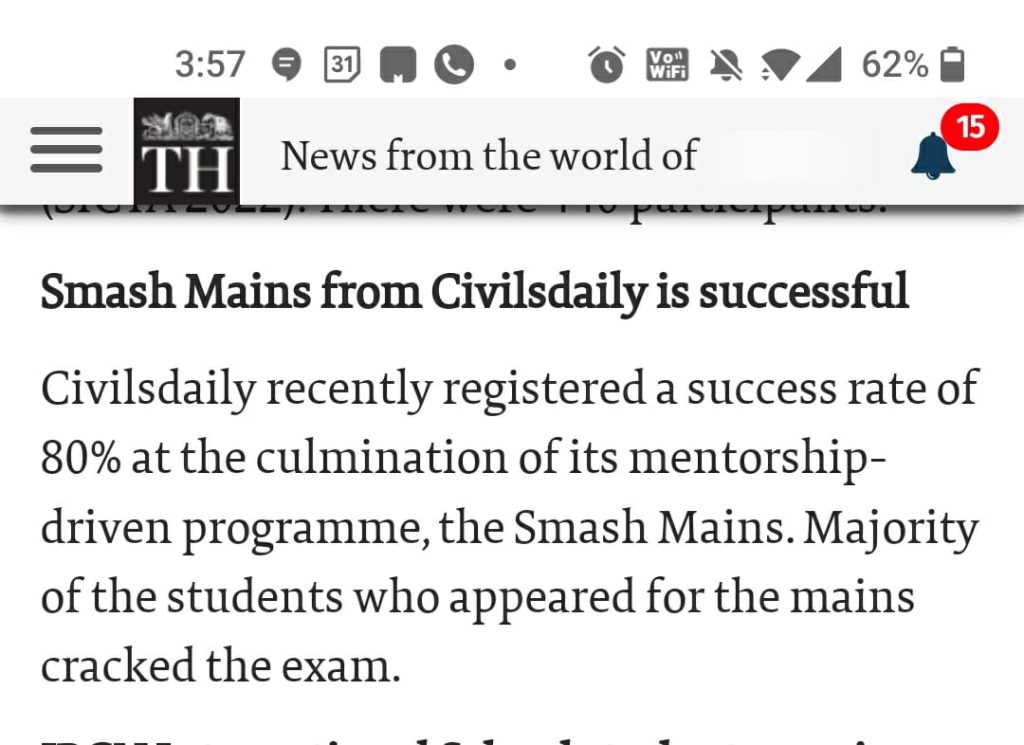


    What The Hindu opined about Civilsdaily Mentorship

    12th January (Thursday) 5 to 6 PM | 20 Best Practices of Answer Writing to Score like Topper in MPSC Mains | 1-1 LIVE session by Soham Mandhare IRS officer & Vaibhav Sanas Senior Faculty, Civilsdaily Pune

  • If Japan goes nuclear, should India welcome the decision?

    nuclear

    Context

    • Japan’s National Security Strategy released in December is a remarkable document. Russia’s invasion of Ukraine, China’s assertive rise, and Democratic People’s Republic of Korea (DPRK-North Korea) provocations are listed as key developments creating for Japan the most severe and complex security environment since the end of the Second World War.

    Crack Prelims 2023! Talk to our Rankers

    nuclear

    What are Japan’s new concerns?

    • Chinese increasing military power: Unconstrained by bilateral or multilateral agreements, Chinese military power is noted as growing exponentially. In less than a decade, the Chinese nuclear arsenal would match numbers currently held by the US and Russia. Expectations are low that the US would have the will or the capacity to bring China to the arms control table.
    • DPRK is riding a runaway proliferation train: Having shaken off all the limits to its nuclear programme it pretended to accept during the Trump Administration, its nuclear programme is perhaps now unstoppable.
    • The inadequacy of its current defence posture and its military alliance with the US: As underlined by the document, extended deterrence including nuclear weapons is the cornerstone of the US-Japan alliance. Its success until now allowed Japan the luxury of its three nuclear no’s policy no production, possession, or introduction of nuclear weapons on its territory.

    nuclear

    What worries Japan in its future adequacy and the options

    • The stated option: The National Security Strategy calls for Japan to strengthen the deterrence and response capabilities of its alliance with the US, including extended deterrence by the US, backed by its full range of capabilities, including nuclear.
    • Possibility trends of nuclear-sharing by Japan: The unstated part is the possibility of nuclear-sharing by Japan. If implemented, this may be new to Asia but is a long-standing US practice with its key NATO allies in Europe. US willingness to share nuclear-powered submarines with Australia as part of AUKUS is an indicator of possible trends.
    • Possibility of Japan itself acquiring nuclear weapons: The document makes no reference to this. But there are references to the US – in Japan’s view the world’s greatest comprehensive power finding it increasingly difficult to maintain a free and open international order. Behind Japanese politeness, the message is clear.
    • Strategic autonomy in Japanese style: Significantly, the document adds that Japan would seek to strengthen its defence capabilities to the point at which Japan is able to take primary responsibility for its defence, without excluding support from the US.

    nuclear

    How India should view this development?

    • If Japan goes nuclear, India should welcome the decision: In our separate ways, India and Japan privileged nuclear disarmament as a priority. But there comes a time when this national preference must be subordinated to the demands of national security.
    • Understanding the reason: India reached this conclusion reluctantly but with good reason in 1998. If Japan were to reach the same conclusion, it too would have good reason to do so.
    • Ensuring self-defence capabilities and Upholding the sovereignty: Its technological capabilities are not in doubt. It is for Japan to exercise its inherent and inalienable right of ensuring the necessary means of self-defence. Thinking the unthinkable in terms of changing policy is an attribute of sovereignty, not its negation.

    Way ahead

    • Japan’s turn towards an explicit nuclear option will come, if at all, not out of choice but out of necessity.
    • Its strategic predicament, laid bare by the document, is compounded by the lack of easy answers, a predicament that India should view with sympathy and understanding of a fellow Asian country.
    • Japan is also a strong supporter of the NPT, and its derivative non-proliferation regime but it is also painfully aware that the NPT does precious little to constrain China, nor for that matter DPRK.
    • The gap between Japan’s security needs in a nuclearized world and its non-nuclear public sentiment was papered over in the past by US extended deterrence. It looks less likely that will be the case in the future.

    Conclusion

    • A multipolar Indo-Pacific can be truly multipolar only if Japan is assured of national defence through the means of its choosing. As a strategic partner and friend, we must keep faith that Japan will make the right decision at the right time.

    Mains question

    Q. Recently Japan released its National security strategy. In this backdrop discuss what concerns Japan and how India should view this development?

    (Click) FREE 1-to-1 on-call Mentorship by IAS-IPS officers | Discuss doubts, strategy, sources, and more

  • Day 9| Daily Answer Wars| CD WarZone

    Topics for Today’s question:

    GS-2       Welfare schemes for vulnerable sections of the population by the Centre and States and the performance of these schemes; mechanisms, laws, institutions and Bodies constituted for the protection and betterment of these vulnerable sections.

    Question:


    HOW TO ATTEMPT ANSWERS IN DAILY ANSWER WARS (DAW)?

    1. Daily 1 question either from General Studies 1, 2, 3 or 4 will be provided via live You Tube video session.
    2. You can write your answer on an A4 sheet and scan/click pictures of the same.
    3. The answer needs to be submitted by joining the telegram group given in the link below.

      https://t.me/cdwarzone

    *In case your answer is not reviewed, reply to your answer saying *NOT CHECKED*. 

    1. For the philosophy of Daily Answer Wars and payment: 

More posts