Why in the News?
India has moved sugar from the “restricted” category to the “prohibited” category till September 2026, effectively banning exports at a time when global prices remain attractive. The decision marks a sharp shift from India’s recent role as a major sugar exporter, with shipments touching nearly 11 million tonnes annually. This is due to the fears of domestic shortages due to a weak monsoon risk from El Niño and fertiliser disruptions arising from the Iran-West Asia conflict.
Why has India prohibited sugar exports despite adequate domestic stocks?
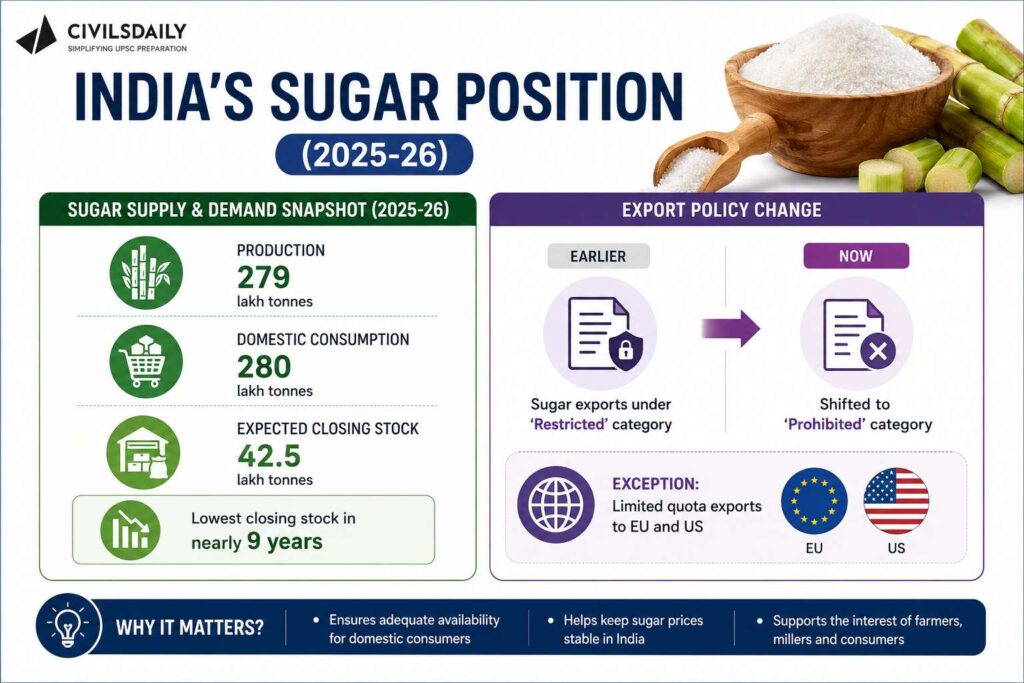
- Stock Preservation: Ensures sufficient domestic sugar availability amid uncertainty. India expects 279 lakh tonnes of production against 280 lakh tonnes of domestic consumption, leaving little surplus.
- Closing Stocks: Prevents depletion of reserves. Sugar closing stocks are projected at only 42.53 lakh tonnes, the lowest since 2016-17, compared to 143.33 lakh tonnes in 2018-19.
- Export Curtailment: Restricts outward shipments to avoid shortages. India exported nearly 11 million tonnes in earlier years, but exports for 2025-26 are estimated at only 6.5 lakh tonnes.
- Inflation Management: Reduces risk of food inflation. The government already faces pressure from fuel and fertilizer inflation, making sugar price volatility politically sensitive.
- Policy Shift: Reflects stronger precautionary intervention. Sugar has moved from the “restricted” category to “prohibited category”, representing a more stringent control regime.
How can El Niño affect India’s sugar economy?
- Monsoon Disruption: Alters rainfall distribution. El Niño, caused by abnormal warming of the eastern equatorial Pacific Ocean, weakens monsoon circulation and raises risks of rainfall deficiency.
- Sugarcane Vulnerability: Affects water-intensive crops disproportionately. Sugarcane requires high water availability and remains sensitive to rainfall stress.
- Crop Timing: Creates risks for recently planted crops.
- In Uttar Pradesh, sugarcane planted during February-April 2025 will mature in 11-12 months, making it dependent on monsoon conditions.
- Nearly 75% sugarcane in Maharashtra belongs to the pre-season crop, planted between July-December, making rainfall variability significant.
- Climate Forecast: Increases uncertainty for agricultural planning. Global climate models indicate a 50% probability of El Niño conditions emerging during the second half of 2025.
How has the Iran conflict influenced India’s sugar policy?
- Fertiliser Supply Risks and Production CostsInput Disruptions:
- Sugarcane requires high doses of urea. Disruptions to Gulf-based supply chains, where 63% of India’s nitrogen fertilizer imports (urea/ammonia) originate, threaten to create shortages during the sowing season.
- Rising Costs: War risk insurance and higher freight rates have significantly increased the cost of imported raw materials for fertilizers, potentially lowering yields if farmers struggle to afford them
- Food Inflation Management: The government is monitoring the crisis through a special group of ministers to ensure domestic availability of sugar. This sector is viewed as sensitive to inflation, particularly when international prices are lower than domestic ones, as noted in a March 2026 report.
- Geopolitical Linkage: Expands non-traditional security concerns. Agricultural decisions increasingly reflect developments in energy corridors and maritime chokepoints.
Why are sugar stocks becoming a policy concern?
- Nine-Year Low: Indicates tightening domestic supply. Sugar closing stocks may decline to 42.53 lakh tonnes, the lowest in nearly a decade.
- Production-Consumption Gap: Limits export flexibility. Production of 279 lakh tonnes remains marginally below domestic demand of 280 lakh tonnes.
- Administrative Uncertainty: Raises concerns over reporting accuracy. Sugar mills file monthly P-II returns regarding stocks, but actual physical availability may vary.
- Precautionary Governance: Avoids crisis response later. The government seeks to prevent a sudden shortage that could force emergency imports.
Does banning sugar exports improve food security or distort markets?
Banning sugar exports is a double-edged policy that achieves short-term domestic stability at the cost of long-term economic efficiency. It simultaneously improves immediate food security and distorts agricultural markets.
- Improvement in Food Security: Ensures domestic affordability. Export restrictions shield consumers from price spikes.
- It shields local consumers
- It controls food inflation: Sugar is a key ingredient in processed foods. Controlling its price prevents a cascading inflationary effect on essential consumer goods.
- It ensures adequate buffer stock: Restricting exports ensures that the country maintains a reliable domestic supply, neutralizing risks from weather-induced crop failures.
- Depresses Farmer Income: Artificially capping domestic prices prevents sugarcane farmers and mills from profiting from lucrative global market premiums.
- Damages Trade Reliability: Abrupt policy shifts harm India’s reputation as a reliable global trade partner. It forces international buyers to permanently shift to competitors like Brazil or Thailand.
- Market Distortion: Encourages informal trade channels. Historically, excessive restrictions on commodities with high demand can incentivise smuggling.
- Discourages Sector Investment: Unpredictable export bans create policy uncertainty, which discourages private capital investment in modernizing refinery and storage infrastructure.
How does the issue reflect the growing climate-geopolitics nexus in agriculture?
The sugar crisis highlights the emerging climate-geopolitics nexus, where environmental shocks and geopolitical conflicts no longer act in isolation. Instead, they compound each other to threaten global food systems.
- The Multiplier Effect: Climate Shocks Meet Geopolitical Chokepoints
- Double Vulnerability: Extreme weather events (like erratic monsoons) shrink domestic sugar yields, while simultaneous conflicts in the Gulf disrupt the import of critical inputs like fertilizers.
- Chokepoint Dependency: Agriculture is bound to maritime corridors; a crisis in the Strait of Hormuz directly threatens the domestic supply of urea.
- From Subsidies to Security
- Weaponised Scarcity: Food and input supplies are increasingly used as geopolitical leverage. This forces nations to shift from open trade to defensive, protectionist policies.
- National Security Priority: Agricultural policies have shifted from simple farm-income management to a core pillar of national security. This is aimed to shield populations from externally driven food inflation.
- Institutional Overlap: The Need for Integrated Policy
- Breaking Silos: Managing modern agricultural stability requires synchronized actions across traditionally separate sectors:
- Ministry of Agriculture: Optimising crop patterns for climate resilience.
- Ministry of External Affairs: Securing alternative fertilizer corridors.
- Ministry of Commerce: Calibrating sudden, reactive export bans
Conclusion
India’s sugar export ban reflects a precautionary response to converging risks from El Niño, fertiliser insecurity and inflation pressures. While the move strengthens short-term domestic food security, long-term resilience requires crop diversification, efficient water use, climate-resilient agriculture and stable trade policy.
PYQ Relevance
[UPSC 2024] Elucidate the importance of buffer stocks for stabilizing agricultural prices in India. What are the challenges associated with the storage of buffer stock? Discuss
Linkage: The sugar export ban directly concerns buffer stocks, domestic availability and price stabilisation, core GS-3 themes under food security and agricultural markets. India prohibited sugar exports due to concerns over declining closing stocks and possible supply disruptions from El Niño and fertiliser shortages. This reflects the role of strategic stocks in preventing inflation and ensuring food security