💥UPSC 2027,2028 Mentorship (April Batch) + Access XFactor Notes & Microthemes PDF

Search results for: “”

  • [FREE pdf]All Govt. Schemes Compilation for Prelims 2024

    [FREE pdf]All Govt. Schemes Compilation for Prelims 2024

    Hello aspirants, how is the josh!

    Get 100 Schemes PDF Now


    This is Zeeshan Hashmi. I want all my students to beat prelims cutoffs by a comfortable margin.

    Govt. Schemes are the top theme among the 20 SureShot Themes that require focused attention. At least 3-5 questions are expected from it.

    [2023]Consider the following statements in relation to Janani Suraksha Yojna:

    1. It is safe motherhood intervention of the State Health Departments.

    2. Its objective is to reduce maternal and neonatal mortality among poor pregnant women.

    3. It aims to promote institutional delivery among poor pregnant women.

    4. Its objective includes providing public health facilities to sick infants up to one year of age.

    How many of the statements given above are correct?

    (a) Only one

    (b) Only two

    (c) Only three

    (d) All four

    [2022]With reference to Ayushman Bharat Digital Mission, consider the following statements :

    1. Private and public hospitals must adopt it.

    2. As it aims to achieve universal health coverage, every citizen of India should be part of it ultimately.

    3. It has seamless portability across the country.

    Which of the statements given above is/are correct?

    (a) 1 and 2 only

    (b) 3 only

    (c) 1 and 3 only

    (d) 1, 2 and 3

    But getting these questions right is not easy. With over 1000 schemes, portals, and initiatives – it is impossible to memorize all the details.

    We are releasing 100 Govt. Schemes that have been in the news repeatedly over the last 1.5 years. We are providing news links and dates so you can refer to articles and establish their relevance.

    Our 1st priority is to ensure we dont get a single question wrong from these 100 schemes.

    Get 100 Schemes PDF Now


    Dominate Prelims Phase 1 will start on 25th Jan. We will focus on covering 15 High Yielding Topics like Govt Schemes, International Organizations, Species, etc. You can expect up to 50 questions from these 15 themes. With just 5 months to go, your 1st reading should happen RIGHT NOW

    After the class, we will continue the discussion on telegram. If we have to ensure we dont miss a single question, we will have to put in more effort beyond the classroom.

    On 8th, the 1st lecture will be on Govt. Schemes with Jatin Sir. See you there!

    I want to attend lecture


  • Kannada Signboard Controversy and Vandalism in Bengaluru

    kannada

    Introduction

    • Activists protested against non-Kannada signboards in Bengaluru, leading to vandalism across the city.

    Kannada Signboards Issue

    • Demand for Kannada Signboards: The issue dates back to the early 2000s when Bengaluru emerged as a global IT hub. The then Chief Minister S.M. Krishna issued a circular in 2002 for Kannada signboards, which lacked legal backing.
    • Legal Challenges: Attempts to mandate Kannada signboards faced legal hurdles, with the High Court staying and striking down related rules in 2009 and 2014.

    Recent Developments: Legislation and Protests

    • Kannada Language Comprehensive Development Act, 2022: The Act, passed by the State Legislature in 2022, mandates that 60% of signboards be in Kannada.
    • KRV’s Campaign: KRV campaigned for the implementation of this norm, leading to the protest and subsequent vandalism.
    • State Government’s Ordinance: The government plans to promulgate an ordinance to clarify the 60:40 rule for signboards and set a compliance deadline of February 28.

    Impact on Commercial Establishments

    • Anxiety among Businesses: The new rule has caused concern among retailers, with fears of increased vigilante actions and financial burdens due to signboard changes.
    • Opposition from Retailers: The Retailers Association of India and other business groups have opposed the mandate, citing its impact on Bengaluru’s cosmopolitan nature and brand image.

    Political Dynamics

    • Election Context: The issue has gained political significance ahead of the parliamentary polls, with both the Congress and BJP staking positions on the language issue.
    • Kannada as a Political Plank: Despite political consensus on promoting Kannada, the language has not been a successful political issue in the state.

    Concerns over Bengaluru’s Image

    • Brand Bengaluru at Risk: The vandalism and language controversy could potentially harm Bengaluru’s reputation as a global investment destination.
    • Calls for Government Action: Industry leaders and civic activists have urged the government to take measures to restore confidence and preserve the city’s inclusive culture.

    Conclusion

    • Need for Sensible Policy: The government faces the challenge of promoting Kannada while maintaining Bengaluru’s cosmopolitan and investor-friendly image.
    • Addressing Vandalism: Strong action against vandalism and a balanced approach to language policy are essential to prevent further damage to Bengaluru’s brand and social harmony.
  • Secularism and Multiculturalism in India and Europe

    Secularism and Multiculturalism

    Introduction

    • Prof. Akeel Bilgrami, a distinguished professor from Columbia University, delivered a lecture at Madras Christian College in Tambaram.
    • His talk, titled ‘Gandhi in his time and ours: Reflections on Secularism and Multiculturalism’, explored the nuances of secularism in India and Europe.

    Prof Bilgrami on Secularism

    He emphasized on three commitments primarily on which Secularism is based:

    1. Freedom of Religion: The first commitment emphasizes the freedom of religious belief and practice.
    2. Constitutional Principles: The second commitment involves principles unrelated to religion, such as equality and freedom of speech, enshrined in the constitution.
    3. Meta-Commitment: The third commitment dictates that in case of a clash between the first two, the constitutional principles must take precedence.

    Gandhi’s Perspective on Secularism

    • European Context: Gandhi viewed secularism as a doctrine to address the damage caused by religious majoritarianism in Europe.
    • Irrelevance to India: He believed that the issues secularism aimed to address in Europe were not present in India, making it irrelevant in the Indian context.
    • Nationalism and Anti-Imperialism: For Gandhi, nationalism was synonymous with anti-imperialism and inherently inclusive, contrasting with European forms of nationalism.

    Distinguishing Secularisation from Secularism

    • Secularisation: Prof. Bilgrami described secularisation as a social process involving the loss of religious belief and changes in religious practices.
    • Secularism: In contrast, secularism is a political doctrine advocating for the separation of religion from politics.

    Rejecting the Notion of ‘Indian’ Secularism

    • Misconception: Prof. Bilgrami dismissed the popular notion that ‘Indian’ secularism is about the acceptance of all religions.
    • Pluralism vs. Secularism: He clarified that the acceptance of all religions is more accurately described as pluralism, not secularism.

    Conclusion

    • Deeper Understanding: Prof. Bilgrami’s lecture provided a deeper understanding of secularism and its application in different contexts.
    • Relevance to Contemporary India: His insights are particularly relevant in contemporary India, where secularism and multiculturalism continue to be subjects of intense debate and discussion.
    • Future Discourse: The lecture sets the stage for further discourse on how secularism should be interpreted and implemented in India’s diverse and multi-religious society.
  • India’s ‘Deep Tech’ Policy to get Cabinet nod

    deep tech

    Introduction

    • The Indian government is set to approve a new ‘deep tech’ policy. Following public comments on the draft released in July 2023, the final version of the policy is ready for Cabinet approval.

    Understanding ‘Deep Tech’  

    • Definition and Scope: ‘Deep tech’ refers to startups that develop intellectual property based on new scientific breakthroughs, aiming for significant impact. Ex. AI, ML, Blockchain, Quantum Computing etc.
    • Startup India Data: As per Startup India, there are 10,298 startups in various sub-sectors of deep tech as of May 2023.
    • Exclusion Criteria: Businesses based on easily replicable ideas do not qualify as deep tech startups.

    Draft National Deep Tech Startup Policy (NDTSP) 2023

    • Policy Goals: The NDTSP aims to address challenges in funding, talent acquisition, and scaling R&D operations for deep tech startups.
    • Strategic Approach: The policy is designed to promote innovation, economic growth, and societal development in the deep tech sector.

    India’s Deep Tech Ecosystem

    • Global Ranking: India ranks third globally in the startup ecosystem, with over 3000 deep tech businesses.
    • Sectoral Expansion: These firms are expanding into areas like agriculture, life sciences, chemistry, aerospace, and green energy.

    Policy Foundations and Prospects

    • Public Consultation: The draft policy was open for public feedback until September 15, after consultations with stakeholders in the deep tech ecosystem.
    • Key Pillars: The policy focuses on securing India’s economic future, progressing towards a knowledge-driven economy, bolstering national capability, and encouraging ethical innovation.

    Policy Elements and Recommendations

    • Funding and Innovation: The policy proposes financial support through grants, loans, and venture capital, along with regulatory simplifications and academia-industry collaboration.
    • Talent Development: Emphasis on STEM education, training opportunities, and attracting international talent.
    • Infrastructure and Technology Access: Establishment of deep tech incubation centers, testing facilities, and shared infrastructure resources.
    • Public Procurement and Market Opportunities: Encouraging government agencies to adopt deep tech solutions and facilitating international market access.
    • Intellectual Property Protection: Establishing a uniform IP framework and implementing cybersecurity measures.

    Conclusion

    • Transformative Potential: The NDTSP is poised to guide India’s deep tech landscape, fostering technological innovation and economic growth.
    • Measuring Success: The policy’s effectiveness will be gauged by its impact on startups, innovation depth, and societal transformation.
    • Democratizing Deep Tech: The strategy aims to make deep tech benefits accessible across society, leveraging research-driven breakthroughs for national advancement.
  • Paleolithic Tools Discovered in Telangana’s Mulugu District

    Paleolithic

    Introduction

    • Floods Uncover Historical Artifacts: The recent floods in Mulugu district, Telangana, have led to the discovery of Paleolithic quartzite tools, shedding new light on the region’s ancient human habitation.
    • Discovery by Amateur Historians: The tools were found in a dried-up stream bed by a team led by Sriramoju Haragopal, an amateur historian.

    About Paleolithic Age

    Details
    Timeframe Approximately 2.6 million years ago to about 10,000 BCE.
    Characteristics Marked by the use of stone tools by early humans. Tools were mainly hand axes, cleavers, and choppers.
    Major Sites
    • Bhimbetka in Madhya Pradesh
    • Soan Valley in Punjab
    • Sites in Rajasthan, Karnataka, and Maharashtra
    • Narmada Valley in Central India
    • Attirampakkam in Tamil Nadu
    • Hunsgi in Karnataka
    • Kurnool in Andhra Pradesh
    • Didwana in Rajasthan
    • Belan Valley in Uttar Pradesh
    Lifestyle Nomadic hunter-gatherers; relied on hunting animals and gathering plants for food.
    Cultural Developments Development of basic stone tools and control of fire.
    Art and Symbolism Evidence of early art found in Bhimbetka rock shelters, with paintings and engravings.
    Climate and Environment Varied climatic conditions over millennia; included ice ages and warmer periods.
    Human Species Mainly Homo erectus and Homo sapiens.

    Details of the Discovery

    • Location of Find: The hand axes were discovered between Gurrevula and Bhupatipuram villages in Mulugu district.
    • Specific Find: Researchers found a significant stone axe measuring 15.5 cm in length, 11 cm in width, and 5.5 cm in thickness.

    Context and Comparison

    • Global Significance: Similar hand axes have been discovered worldwide, indicating a common tool type used by early humans for various purposes.
    • Historical Context in India: The first discovery of a Paleolithic site in India was in 1863 at Attirampakkam near Madras (now Chennai), with bifacial hand-axes dating back to about 15 lakh years, known as the Madras Hand-Axe Industry or Madrasian Culture.

    Historical Significance

    • Paleolithic Era Tools: According to paleontologists, the stone axe dates back to the Lower Paleolithic period, approximately 30 lakh years ago.
    • Tool Identification: The tools were identified based on their chipping style, material, and size, typical of Paleolithic hunter-gatherers who used heavy quartzite for large tools.
  • ISRO Successfully Tests Polymer Electrolyte Membrane Fuel Cell in Space

    Fuel Cell

    Introduction

    • The Indian Space Research Organisation (ISRO) has successfully tested a 100 W class Polymer Electrolyte Membrane Fuel Cell based Power System (FCPS) in space.
    • The FCPS was part of the POEM3 orbital platform, launched onboard PSLV-C58 on January 1, 2024.

    About FCPS Experiment

    • Primary Goal: The experiment aimed to assess the operation of Polymer Electrolyte Membrane Fuel cells in space and gather data for future mission designs.
    • Power Generation: During the test, 180 W power was generated using Hydrogen and Oxygen gases, providing valuable data on the performance of the power system.

    About Polymer Electrolyte Membrane (PEM) Fuel Cells

    Details
    Basic Principle Converts chemical energy from hydrogen into electrical energy, producing water and heat as byproducts.
    Key Components Membrane Electrode Assembly (MEA)

    Platinum-based catalyst

    Gas Diffusion Layers (GDLs)

    Bipolar Plates

    Operation Hydrogen Oxidation: At the anode, hydrogen molecules (H2) are split into protons (H+) and electrons (e-).

    Proton Conduction: The PEM allows only protons to pass through to the cathode, blocking electrons.

    Electron Flow: Electrons travel through an external circuit to the cathode, creating an electric current.

    Oxygen Reduction: At the cathode, oxygen molecules (O2) from the air combine with the protons and electrons to form water (H2O).

    Heat Production: The reaction generates heat, which can be used for heating purposes in some applications.

    Types of Membranes Perfluorosulfonic acid (PFSA) membranes (common)

    Hydrocarbon-based membranes (alternative)

    Advantages High power density

    Low operating temperatures (60-80°C)

    Zero emissions with pure hydrogen

    Applications in Space and Society

    • Multipurpose Space Use: Fuel cells are particularly suitable for human space missions, providing essential power, water, and heat from a single system.
    • Societal Benefits: They have significant potential for societal applications, including as replacements for conventional vehicle engines and in standby power systems.
    • Advantages over Batteries: Fuel cells offer range and refuelling times comparable to conventional engines and are expected to enable emission-free transportation.
  • Cabinet approves Prithvi Vigyan Scheme for Earth Sciences

    prithvi

    Introduction

    • The Union Cabinet, led by Prime Minister, has sanctioned the “Prithvi Vigyan (Prithvi)” scheme, a significant project of the Ministry of Earth Sciences.
    • With a budget of Rs 4,797 crore, the scheme is planned for the period from 2021 to 2026.

    About Prithvi Vigyan Scheme

    • Consolidation of Programs: The Prithvi scheme unifies five existing sub-schemes:
    1. Atmosphere & Climate Research-Modelling Observing Systems & Services (ACROSS),
    2. Ocean Services, Modelling Application, Resources and Technology (O-SMART),
    3. Polar Science and Cryosphere Research (PACER),
    4. Seismology and Geosciences (SAGE),
    5. Research, Education, Training and Outreach (REACHOUT).
    • Aim: This integration is designed to enhance our understanding of Earth’s systems and apply scientific knowledge for societal, environmental, and economic benefits.

    Objectives and Focus Areas  

    • Comprehensive Observations: The scheme emphasizes long-term monitoring across the atmosphere, ocean, geosphere, cryosphere, and solid earth to track Earth System’s vital signs and changes.
    • Development of Predictive Models: It focuses on creating models for weather, ocean, and climate hazards and advancing climate change science.
    • Exploration Initiatives: Exploration of Polar Regions and high seas is a key aspect, aiming to discover new phenomena and resources.
    • Technological Advancements: The scheme also stresses the development of technology for the sustainable exploitation of oceanic resources for societal applications.

    Role of the Ministry of Earth Sciences

    • Provision of Critical Services: The Ministry is responsible for delivering crucial services related to weather, climate, ocean and coastal states, hydrology, seismology, and natural hazards.
    • Support in Disaster Management: These services are essential for issuing forecasts and warnings for natural disasters, thereby aiding in disaster preparedness and risk mitigation.

    Holistic Approach to Earth System Sciences

    • Broad Scope of Study: Earth System Sciences involve studying the atmosphere, hydrosphere, geosphere, cryosphere, and biosphere, and their complex interactions.
    • Integrated Research Efforts: The Prithvi scheme aims to address these components comprehensively, enhancing understanding and providing reliable services for India.

    Impact and Future Prospects

    • Addressing Major Challenges: The scheme’s integrated research and development efforts will tackle significant challenges in various fields like weather, climate, oceanography, cryospheric studies, and seismology.
    • Harnessing Resources Sustainably: It explores sustainable methods to utilize both living and non-living resources, contributing to national development and environmental conservation.
  • Celebrating CivilsDaily’s Foundation weekend | 50% OFF on UPSC SMP Foundation-UAP programs | Hurry!🎁The offer ends on 9th January

    Celebrating CivilsDaily’s Foundation weekend | 50% OFF on UPSC SMP Foundation-UAP programs | Hurry!🎁The offer ends on 9th January

    Get mentored by an IAS Topper

    Now avail a 50% off on UPSC Super Mentorship programs (6-9th Jan)

    Call/whatsapp directly: +91 7303316700

    As we mark the Foundation Day of Civilsdaily, we’re filled with immense gratitude and excitement. It’s a time for us to reflect on our journey and the incredible strides we’ve made together with our aspirants.

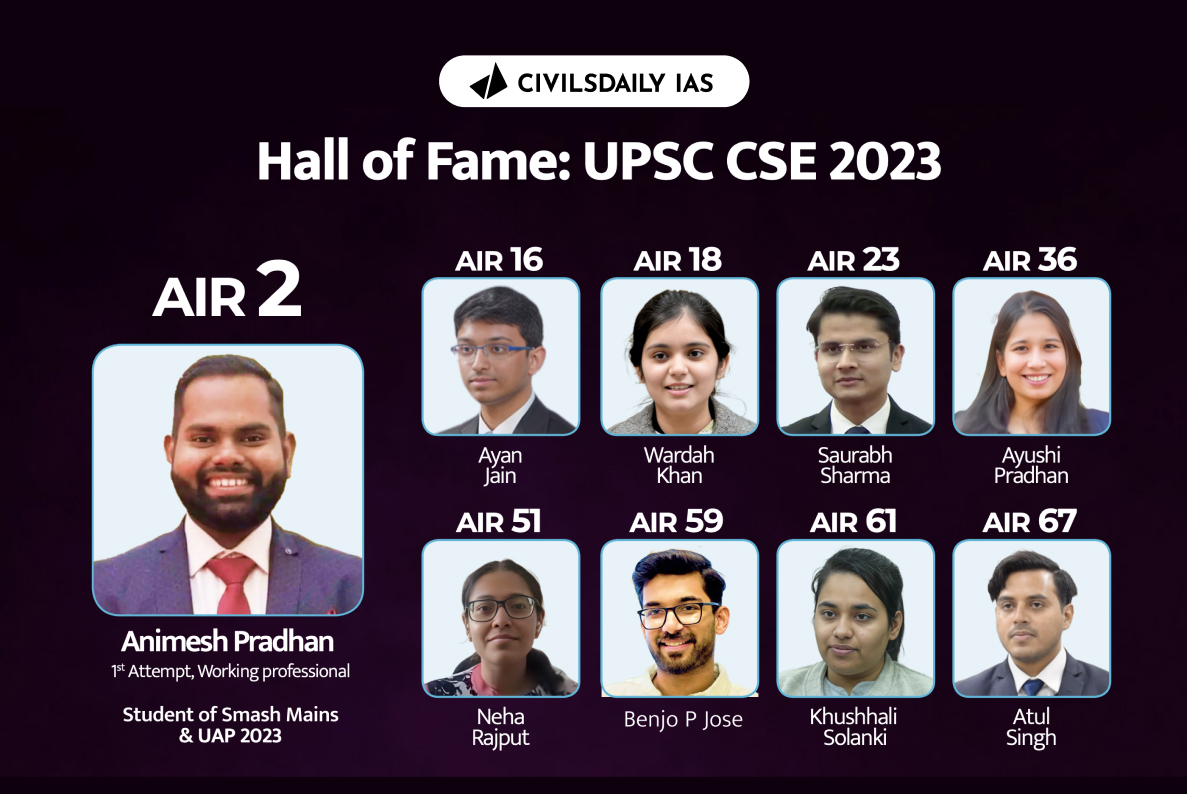
    Since our inception, we have had the privilege of guiding hundreds of aspirants to the hallowed halls of LBSNAA, with over 400 rankers in the last few years alone. This illustrious list includes AIR 1, 2, 3, 6, 10, 11, 13, 14, and many more, each a testament to our commitment and dedication.

    To mark this special occasion and to reaffirm our commitment to nurturing India’s future, we are thrilled to announce a 50% discount on our Super Mentorship Program – Foundation and UAP.

    This offer is tailored for UPSC 2024, 2025, and 2026 aspirants and is our way of celebrating the Foundation Day over this weekend.

    It’s a gesture to make quality preparation, mentorship by IAS rankers, and senior mentors more accessible, ensuring that the best and most deserving candidates enter the civil services and make us all proud.

    Get 50% off on UPSC IAS Super Mentorship programs (6-9th Jan)

    Whether you’re a UPSC beginner, a veteran, or an aspirant trying to improve your rank, we have something for everyone. And with the added benefit of the discount, now is the perfect time to gear your preparation in the right direction.

    At Civilsdaily, we understand the dreams that bring you to us. Becoming an IAS officer is not just about acing an exam; it’s about answering a calling to serve the nation. We recognize the challenges that come with this dream – the vast syllabus, the intense competition, and the psychological toll it takes.

    upsc ias
    Civilsdaily Hall of Fame 2022

    Our commitment to you goes beyond providing education; it’s about being your steadfast partner in this journey, helping to weed out challenges and keep you two steps ahead of the competition.

    Our Super Mentorship Programs are carefully crafted to address these challenges. With personalized guidance from those who have walked this path and succeeded, your preparation becomes a transformative experience.

    Our focus is on keeping you concentrated, making every study session count, and ensuring your preparation is comprehensive and effective.

    Affordability and accessibility are at the heart of our mission. This Foundation Day, our 50% discount offer is a step towards ensuring that financial constraints do not hinder the aspirations of capable and dedicated candidates like you. As we celebrate this day, we invite you to join us in this special offer, a step towards realizing your IAS dream.

    Civilsdaily is more than just an institution; we are a community, a family that shares in your aspirations and is dedicated to making them a reality. With our mentorship, resources, and support, you’re preparing not just for an exam but for a future that will impact millions.

    Join us in this Foundation Day celebration and take a significant step towards your IAS goal. Let’s make your dream a reality, together.

    Happy Foundation Day! Here’s to many more years of success and achievements.

    🎁50% instant discount on IAS Foundation & UAP Program

    Limited time offer: 6th to 9th January 2024

    Call directly and avail 50% discount +91 7303316700

  • The Ayes always have it: Why voice votes in Parliament are bad for democracy

    Recording each vote - The Hindu

    Central Idea:

    The article discusses the absence of voting records during the recent Parliament session, highlighting the significance of recorded votes in representing legislators’ stances and fostering transparency in the legislative process. It also explores the impact of the Anti-Defection Law on MPs’ dissent and the increasing use of voice votes, leading to a lack of accountability.

    Key Highlights:

    • 19 bills were passed in the recent Parliament session, but voting records were not made available.
    • The use of voice votes, lacking individual records, is a preferred method for passing legislative motions.
    • The Anti-Defection Law has limited MPs’ ability to dissent, reducing the significance of debates and votes.
    • The scarcity of voting records hampers Opposition parties in communicating their positions to the electorate.

    Key Challenges:

    • Lack of transparency due to the absence of voting records.
    • The impact of the Anti-Defection Law on MPs’ freedom to dissent.
    • Dismissal of division calls during crucial legislative moments.

    Key Terms:

    • Voice vote
    • Anti-Defection Law
    • Division call
    • Legislative transparency
    • Accountability
    • Dissent

    Key Phrases:

    • “A shadow of opacity has fallen over our legislative processes.”
    • “The scarcity of voting records can be a symptom of a deeper problem.”
    • “The impact of the Anti-Defection Law on MPs’ dissent is a matter of concern.”

    Key Quotes:

    • “Transparency defines the measure to which our parliamentarians’ political decisions are traceable, which begets accountability.”
    • “The right to a division, meant to be readily available, has become shrouded in subjective judgement.”

    Key Examples and References:

    • The passage of the Jan Vishwas Bill 2023 and the farm bills through voice votes.
    • Asaduddin Owaisi’s dissent on various bills, illustrating the importance of voting records.
    • Dismissal of division calls during the passage of the Weapons of Mass Destruction Bill and the Electricity Amendment Bill.

    Key Facts:

    • In Modi I, 40 divisions were raised for 180 bills, while in Modi II, only 20 divisions were allowed for 209 bills.
    • Only 15.4% of bills in the BJP’s 10-year tenure have voting records.

    Critical Analysis:

    The article critically examines the impact of voice votes, the Anti-Defection Law, and the dismissal of division calls on legislative transparency and accountability. It emphasizes the need for voting records to ensure a clear representation of MPs’ stances.

    Way Forward:

    • Reevaluate the impact of the Anti-Defection Law on MPs’ dissent.
    • Ensure the availability of voting records to enhance legislative transparency.
    • Address the dismissal of division calls to uphold the right to record votes.
    • Promote a more accountable and transparent legislative process through recorded votes.

    In essence, the article advocates for the restoration of transparency in the legislative process through the provision of voting records and a reconsideration of the Anti-Defection Law’s impact on MPs’ dissent.

More posts