Researchers have identified and described a new species of dragonfly from Kerala, named Lyriothemis keralensis, highlighting the rich and still underexplored biodiversity of the Western Ghats.
Key Facts
Scientific name: Lyriothemis keralensis
Taxonomic group: Order Odonata, Family Libellulidae
Location of discovery: Varapetty near Kothamangalam, Ernakulam district, Kerala
Habitat:
Vegetated pools and irrigation canals
Shaded pineapple and rubber plantations
Seasonal visibility:
Adult dragonflies seen only during the Southwest monsoon from late May to August
Remains in aquatic larval stage during the rest of the year
[2023] Which of the following organisms perform waggle dance for others of their kin to indicate the direction and the distance to a source of their food?
“I almost skipped an attempt once. That decision cost me more than I expected.”
Many aspirants think skipping an attempt is being strategic. In reality, most skip because of fear, confusion, or incomplete preparation, not because the attempt is actually unviable.
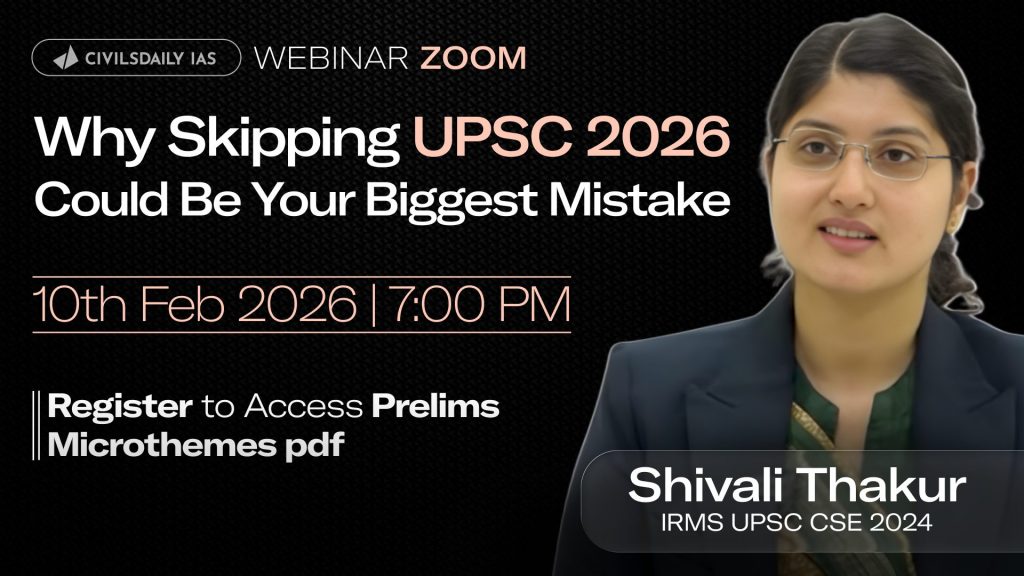
In this session, I want to talk honestly about why skipping UPSC 2026 could be your biggest mistake, and how to take a clear, rational decision instead of an emotional one.
Shivali Thakur , IRMS, UPSC CSE 2024
What I’ll do in this live session:
1. The real reasons aspirants skip an attempt (and why most are flawed) I’ll break down the common justifications , “not ready yet”, “need one more year”, “weak in prelims” and explain which ones are valid and which ones quietly delay success.
2. What an attempt actually gives you, even if you don’t clear From exam temperament to question reading maturity, I’ll explain why serious attempts compound learning in ways preparation alone never can.
3. How to objectively assess your readiness for UPSC 2026 Not motivation. Not fear. A clear framework to judge: • Coverage • Revision depth • Elimination ability • Exam temperament
4. When skipping does make sense, and when it absolutely doesn’t This is not a “don’t skip at all” talk. It’s about skipping for the right reasons, not comforting excuses.
Who should attend:
Aspirants confused about attempting UPSC 2026
Those feeling “almost ready but not confident”
Anyone planning to skip without a clear decision framework
It will be a 45 minute session, post which we will open up the floor for all kinds of queries which a beginner must have. No questions are taboo and Shivali Ma’am is known to be patiently solving all your doubts.
Join us for a Zoom session on 10th Feb at 7 PM. This session is a must attend for you If you are attempting UPSC for the first time or have attempted earlier and now preparing for 2026/2027, then it is going to be a valuable session for you too.
See you in the session”
Register for the session for a complete in-depth UPSC Prep
(Don’t wait—the next webinar/session won’t be until End Feb’26)
These masterclasses are packed with value. They are conducted in private with a closed community. We rarely open these webinars for everyone for free. This time we are keeping it for 300 seats only.
[UPSC 2023] Child cuddling is now being replaced by mobile phones. Discuss its impact on the socialization of children.
Linkage: This GS-I (Society) question examines the impact of digital technology on family structures, early childhood development, and patterns of socialization.
Mentor’s Comment
The debate on banning social media for minors has intensified following policy moves globally and in India. The article argues that prohibition is a simplistic response to a complex structural problem. It cautions against moral panic-driven regulation and instead calls for building a healthy digital media ecosystem grounded in accountability, research, and child protection safeguards.
Why in the News?
The issue gains prominence due to a growing global shift toward restricting adolescent access to social media platforms. In 2024, Australia passed a law prohibiting anyone under 16 from holding accounts on major platforms such as Instagram, TikTok, YouTube, Snapchat, and X. It mandates age verification and imposes fines up to $50 million for non-compliance. In February 2026, Spain announced similar restrictions. These measures represent one of the first large-scale legislative attempts to exclude minors from digital platforms entirely. In India, policymakers are considering comparable measures amid rising concern over screen addiction and adolescent mental health.
Why is a Social Media Ban Being Considered?
Adolescent Mental Health Concerns: Links heavy social media use with anxiety, depressive symptoms, self-harm, and body image dissatisfaction. Evidence remains associational, not causal.
Screen Addiction Narrative: Frames excessive digital engagement as primary cause of adolescent distress.
Policy Response Shift: Australia’s 2024 legislation bans under-16 accounts on major platforms. Imposes mandatory age verification and fines up to $50 million.
International Replication: Spain (February 2026) announced similar prohibition for minors under 16.
Moral Panic Dynamics: Political responses seek visible control measures during public tragedies, producing symbolic crackdowns.
Does Evidence Justify Blanket Prohibition?
Systematic Reviews: Identify small but consistent associations between heavy usage and mental health challenges.
Gendered Impact: Greater vulnerability among adolescent girls.
Absence of Causality: Studies do not establish direct cause-effect relationship.
Indian Context Gap: Limited domestic studies, but global findings signal caution in usage effects.
Why May Bans Fail in the Indian Context?
Enforcement Constraints: Adolescents evade age restrictions easily.
VPN Circumvention: Strict age-gating pushes minors toward unregulated platforms or dark web spaces.
Encrypted Migration: Movement to platforms like Instagram or encrypted environments reduces oversight.
Mass Surveillance Risk: Identity verification frameworks risk linking minors’ online activity to government databases.
Gender Inequality Reinforcement: 33.3% of women in India use internet versus 57.1% of men. Bans may disproportionately restrict girls’ mobility and digital access.
Community Loss: For queer and differently-abled teens in small towns, social media provides safe communities otherwise unavailable offline.
Democratic Deficit: Policy decisions occur without consulting adolescents directly.
Profit Model Dependence: Revenue tied to user attention and data extraction.
Content Moderation Gaps: Inconsistent enforcement and opaque governance structures.
Digital Protection Weakness: India’s Digital Personal Data Protection Act, 2023 relies on parental consent gating, which may result in exclusion or false declarations.
Under-Regulated AI Integration: Generative AI chatbots integrated into platforms increase exposure to unverified health advice and harmful interactions.
Emerging Risks: AI-related cases include sexualised interactions with minors and alleged self-harm inducement.
What are the Policy Alternatives Available?
Platform Accountability: Legally enforceable “duty of care” obligations.
Independent Regulation: Oversight by expert regulators, not solely by the Ministry of Electronics and IT.
Research Infrastructure: Longitudinal studies on children’s digital well-being across class, caste, gender, and region.
Government borrowing costs are rising even after successive repo rate cuts by the Reserve Bank of India (RBI). Since February 2025, the RBI has reduced the repo rate by 100 basis points from 6.5% to 5.5%. However, yields on 10-year government securities have increased from 6.66% to 6.73% during the same period.
This divergence is significant because bond yields typically soften after rate cuts. Instead, governments are now paying 0.4-0.5 percentage points more to borrow compared to 10-15 years ago. The issue affects both the Centre and States, which together budgeted gross market borrowings exceeding ₹40 lakh crore in 2025-26. Rising yields increase interest burdens and crowd out developmental expenditure.
Why Are Borrowing Costs Rising Despite Repo Rate Cuts?
Limited Monetary Transmission: Repo rate reduced from 6.5% to 5.5% since February 2025. 10-year G-sec yields increased from 6.66% to 6.73% during the same period.
Higher Risk Premium: Markets demand higher yields due to elevated debt levels and fiscal pressures.
Liquidity Tightening: RBI reduced bond purchases and ended aggressive liquidity injections.
Foreign Outflows: Net FPI outflows of $12.5 billion during April-September 2025 reduced bond demand.
How Large Is the Government Borrowing Programme?
Gross Borrowing (Centre): ₹14.90 lakh crore budgeted for 2025-26.
Reduced Fiscal Space: Limits developmental and capital spending.
Crowding-Out Effect: High government borrowing absorbs financial resources.
State-Level Stress: States face similar yield pressures amid large borrowing programmes.
Conclusion
Rising borrowing costs despite repo rate cuts indicate structural stress in India’s fiscal and financial architecture. Elevated debt levels, reduced liquidity support, and weak monetary transmission have increased the interest burden on both the Centre and States.
Sustained high yields risk expanding revenue expenditure, compressing capital spending, and constraining developmental priorities. The situation underscores the need for calibrated fiscal consolidation, improved debt management, and better coordination between monetary and fiscal policy to ensure macroeconomic stability without compromising growth.
PYQ Relevance
[UPSC 2019] The public expenditure management is a challenge to the Government of India in context of budget making during the post liberalization period. Clarify it.
Linkage: The question examines fiscal discipline, debt sustainability, and expenditure prioritisation under the post-liberalisation framework. The article highlights rising borrowing costs and elevated liabilities, which intensify interest burdens and constrain public expenditure management, making budget balancing more complex.
The Economic Survey flagged rising digital addiction and screen-related mental health disorders, particularly among children and adolescents. The Union Budget announced strengthening of mental health infrastructure, including establishment of a second campus of NIMHANS in North India and upgradation of premier institutions in Ranchi and Tezpur. Despite increased allocation from ₹683 crore (2020-21) to ₹1,898 crore (2024-25), mental health spending remains about 2% of total health outlay.
What is the Scale of India’s Mental Health Burden?
Suicide Burden: Accounts for nearly one-third of global suicides; depression and addiction contribute significantly to disease burden.
Economic Impact: Mental health conditions impose an estimated economic loss of $1.03 trillion between 2012 and 2030.
Treatment Gap: 70-92% of individuals with mental disorders lack proper treatment due to low awareness, stigma, and workforce shortages.
Human Resource Deficit: 0.75 psychiatrists per 1,00,000 population against the recommended 3 per 1,00,000.
Adolescent Vulnerability: Rising digital addiction and screen-related disorders flagged in the Economic Survey.
What Institutional Measures Have Been Announced?
National institute of mental health and Neuro Sciences (NIMHANS) Expansion: Establishes second campus of National Institute of Mental Health and Neurosciences in North India.
Institutional Upgradation: Upgrades premier institutions in Ranchi and Tezpur to improve regional access.
Centre of Excellence Expansion: Sanctions over 20 Centres of Excellence to train postgraduate students in mental health.
Advanced Treatment Infrastructure: Establishes 47 PG departments in mental health.
Primary Healthcare Integration: Integrates mental health services under Ayushman Arogya Mandirs and Health and Wellness Centres.
Tele-MANAS Helpline: Provides 24×7 free mental health support via toll-free number 14416 and 1-800-891-4416; operational across 36 States/UTs and supported by 23 specialised mentoring institutes.
How Has Budgetary Allocation Evolved?
Allocation Increase: Raises allocation from ₹683 crore (2020-21) to ₹1,898 crore (2024-25).
Relative Share: Maintains mental health share at approximately 1% of total health budget and about 2% of national health outlay.
Low Budgetary Share: Limits impact due to marginal share within overall health expenditure.
Underutilisation of Funds: Prevents full utilisation of allocated funds at national level.
Institution-Centric Focus: Directs significant funds towards tertiary institutions such as NIMHANS and Centres of Excellence.
Limited Community-Based Models: Weakens early intervention and preventive mental health services.
Capacity Constraints: Maintains shortage of trained professionals, with only 9% gap reduction in access to mental healthcare.
What Approach is Required Going Forward?
Affordable Access: Ensures continuity of care and long-term treatment.
Preventive Focus: Reduces years lived with disability through early detection.
Human Resource Strengthening: Expands trained workforce capacity.
Community Integration: Integrates mental well-being into school curricula and workplace policies.
Whole-of-Community Model: Mainstreams mental health beyond hospital-centric systems.
Conclusion
India’s mental health crisis reflects a structural mismatch between the scale of the burden and the scale of response. Rising suicides, a 70-92% treatment gap, severe psychiatrist shortages, and mental health spending hovering around 1-2% of the health budget indicate systemic under-prioritisation despite recent institutional expansion.
Strengthening tertiary institutions alone cannot address a crisis rooted in access, stigma, affordability, and preventive failure. A shift towards community-based care, workforce expansion, full utilisation of allocated funds, and integration of mental well-being into schools and workplaces is essential to convert policy intent into measurable public health outcomes.
PYQ Relevance
[UPSC 2023] Explain why suicide among young women is increasing in Indian Society.
Linkage: UPSC frequently frames GS-I Society questions around emerging social vulnerabilities reflected in current data trends. The article highlights India accounting for nearly one-third of global suicides and flags rising mental health distress, making youth and gender-specific suicide patterns directly relevant to contemporary exam themes.
The National Highways Authority of India has proposed constructing a soundproof barrier wall along a highway stretch passing close to the Ranganathittu Bird Sanctuary in Karnataka to minimise the impact of traffic noise on wildlife.
About Ranganathittu Bird Sanctuary
Located near Srirangapatna, Karnataka
Situated on the banks of the Cauvery River
Declared a bird sanctuary in 1940
What is the NHAI Proposal?
Construction of a sound barrier wall along a highway stretch near the sanctuary
The objective is to reduce vehicular noise and disturbance
Proposal applies to the eco sensitive zone and buffer area of the sanctuary
Clearance required from the National Board for Wildlife
Why are Sound Barriers Important Near Protected Areas?
Noise pollution affects
Bird breeding behaviour
Nesting success
Feeding and migration patterns
Traffic movement can fragment habitats
Sound barriers act as mitigation measures, not expansion approvals
Legal and Regulatory Framework
Wildlife clearance mandatory for projects near protected areas
Eco sensitive zones notified under the Environment Protection Act, 1986
NBWL clearance required for projects affecting wildlife habitats
Reflects principle of sustainable infrastructure development
[2020] Which of the following Protected Areas are located in Cauvery basin? 1. Nagarhole National Park
2. Papikonda National Park
3. Sathyamangalam Tiger Reserve
4. Wayanad Wildlife Sanctuary
Select the correct answer using the code given below:
(a) 1 and 2 only (b) 3 and 4 only (c) 1, 3 and 4 only (d) 1, 2, 3 and 4
Police in Meghalaya have been directed by the judiciary to identify and act against owners of illegal rat hole coal mines, following repeated mining accidents and continued violations despite a long standing ban.
What is Rat Hole Coal Mining?
Rat hole mining is a primitive and hazardous method of coal extraction where miners dig narrow horizontal or vertical tunnels, often just large enough for a person to crawl through.
This practice is mainly found in parts of Meghalaya due to unique land ownership patterns.
Judicial Background
The National Green Tribunal banned rat hole coal mining in 2014. The ban was imposed due to
Severe environmental damage
Frequent loss of lives
Absence of safety standards
Why Does Illegal Mining Continue?
Coal bearing land is often privately or community owned
Weak enforcement and local political economy
High demand for coal and informal labour
Difficult terrain and limited monitoring capacity
[2018] How is the National Green Tribunal (NGT) different from the Central Pollution Control Board (CPCB)? 1. The NGT has been established by an Act whereas the CPCB has been created by an executive order of the Government
2. The NGT provides environmental justice and helps reduce the burden of litigation in the higher courts whereas the CPCB promotes cleanliness of streams and wells, and aims to improve the quality of air in the country.
Which of the statements given above is/are correct?
(a) 1 only (b) 2 only (c) Both 1 and 2 (d) Neither 1 nor 2
Some States have raised concerns over indications that the Sixteenth Finance Commission may recommend phasing out or scrapping Revenue Deficit Grants (RDG), arguing that it could adversely impact fiscally weaker States.
What are Revenue Deficit Grants?
Revenue Deficit Grants are statutory transfers recommended by the Finance Commission to States whose revenue expenditure exceeds revenue receipts even after tax devolution.
Their objective is to ensure that States can meet basic administrative and social sector expenditure without resorting to excessive borrowing.
Constitutional Basis
Provided under Article 275 of the Constitution
Grants are charged on the Consolidated Fund of India
Why are Revenue Deficit Grants Given?
To correct vertical fiscal imbalance between Centre and States
To support States with weak revenue raising capacity
To ensure minimum standards of public services across States
To prevent revenue deficits from crowding out capital expenditure
What is the Proposal of the 16th Finance Commission?
Move towards eliminating revenue deficits rather than financing them
Encourage States to undertake fiscal discipline and tax reforms
Shift focus from revenue support to performance based and capital linked transfers
Reduce long term dependence of States on unconditional grants
Concerns Raised by States
Hill and special category States depend heavily on RDG
Post GST regime has reduced States’ fiscal flexibility
Fear of widening inter State fiscal disparities
Risk of increased borrowing and debt stress
Significance for Fiscal Federalism
Tests the balance between fiscal autonomy and fiscal responsibility
Reflects shift from entitlement based transfers to outcome based federalism
Could redefine the nature of Centre State financial relations
[2025] Which of the following statements with regard to recommendations of the 15th Finance Commission of India are correct? I. It has recommended grants of ₹4,800 crores from the year 2022–23 to 2025–26 for incentivizing States to enhance educational outcomes
II. 45% of the net proceeds of Union taxes are to be shared with States
III. ₹45,000 crores are to be kept as performance-based incentive for all States for carrying out agricultural reforms
IV. It reintroduced tax effort criteria to reward fiscal performance.
India and Malaysia signed multiple agreements to expand bilateral cooperation in trade, defence, energy, semiconductors, digital technologies, and local currency trade settlement during the visit of the Indian Prime Minister to Malaysia.
Key Agreements and Outcomes
11 agreements and MoUs signed covering trade, defence, energy, advanced manufacturing, and semiconductors
Framework pact for semiconductor cooperation, including supply chains and manufacturing ecosystems
Agreement to promote local currency trade settlement using Indian Rupee and Malaysian Ringgit
Expansion of cooperation in counter-terrorism, intelligence sharing, and maritime security
Decision to establish an Indian Consulate General in Malaysia
Malaysia reiterated support for India’s permanent membership in a reformed UNSC
Strategic and Economic Significance
Indo-Pacific and ASEAN
Reinforces India’s Indo-Pacific vision
Emphasises ASEAN centrality, especially the role of ASEAN
Trade and Economy
Local currency settlement reduces dependence on US dollar
Supports India’s push for internationalisation of the Rupee
Boosts trade resilience amid global financial volatility
[UPSC 2018] In what ways would the ongoing US-Iran Nuclear Pact Controversy affect the national interest of India? How should India respond to this situation?
Linkage: It falls under GS II-Effect of policies and politics of developed countries on India’s interests, focusing on sanctions, energy security, strategic autonomy, and West Asia stability. Iran’s unrest and economic collapse show how the U.S.-Iran nuclear dispute disrupts regional stability and directly affects India’s energy security and connectivity interests.
Mentor’s Comment
Iran is witnessing its most serious internal crisis since the 2022-23 unrest, marked by economic collapse, mass protests, and renewed geopolitical pressure. The current phase of instability is unfolding in the immediate aftermath of a brief but intense war with Israel and amid heightened U.S. coercive posturing. This editorial examines how domestic economic fragility, external pressures, and governance constraints have converged to place Iran at a critical crossroads. Here repression risks deepening instability, and reform coupled with global re-engagement remains the only viable exit.
Why in the News?
Iran is facing its largest nationwide protests since the 2022-23 Mahsa Amini unrest, triggered initially by a strike by Tehran shopkeepers on December 28 against the sharp collapse of the Iranian rial. What makes this moment significant is the convergence of economic freefall, post-war vulnerability, and overt foreign signalling, including claims by Israel’s Mossad of field-level presence and explicit U.S. threats of force. At least 12 protest-related deaths have been reported within a week, underscoring the scale and volatility of the crisis.
Introduction
Iran’s current unrest is not an episodic protest cycle but a manifestation of structural economic decay and political rigidity. The collapse of the rial, runaway food inflation, declining oil revenues, and daily power outages have eroded regime legitimacy. While President Masoud Pezeshkian has signalled limited social relaxation, especially on morality policing, his administration remains constrained on economic reform and national security. The state’s reliance on repression and attribution of unrest to foreign interference risks aggravating an already combustible situation.
What triggered the current wave of protests?
Currency Collapse: Sharp fall in the Iranian rial since the June 2025 war directly affected traders and households, triggering the initial strike.
Continuity with Past Unrest: Represents the largest mobilization since the Mahsa Amini-led protests of 2022-23, signalling unresolved grievances.
How severe is Iran’s current economic crisis?
Food Inflation: Reached 64% in October, the second highest globally after South Sudan, indicating acute cost-of-living stress.
Currency Devaluation: Rial has lost 60% of its value since the June 2025 war, eroding savings and purchasing power.
Oil Export Decline:2025 oil exports fell by ~7% compared to the 2024 average, tightening fiscal space.
Energy Shortages:Daily power outages have become routine, reflecting infrastructure stress and governance failure.
How is post-war geopolitics amplifying domestic instability?
War Aftermath: The unrest comes six months after a 12-day Iran-Israel war, which already strained Iran’s economy and security apparatus.
Israeli Signalling:Mossad publicly claimed operational presence “in the field” with protesters, intensifying regime paranoia.
U.S. Threat Posture: U.S. President Donald Trump warned on January 2 that the U.S. was “locked and loaded” to use force if protesters were killed.
External Pressure Effect: Foreign threats have reinforced regime defensiveness while worsening civilian suffering.
How is the Iranian state responding internally?
Repression: Security warnings against “rioters” and reported deaths indicate reliance on coercive control.
Limited Social Relaxation: President Pezeshkian has relaxed morality police enforcement, signalling tactical social easing.
Economic Paralysis: The President admitted in December that the government was “stuck” and incapable of performing “miracles”.
Blame Externalisation: Default regime response continues to attribute crises to foreign interference.
Why is repression proving counterproductive?
Cycle of Crisis: Economic deterioration combined with repression is reinforcing instability rather than restoring order.
Public Anger Reservoir: Years of shrinking economic opportunity and erosion of political and personal freedoms have accumulated latent discontent.
Ideological Fatigue:Religion and nationalism are no longer sufficient buffers against economic hardship.
Legitimacy Erosion: Persistent hardship weakens the regime’s social contract and coercive credibility.
What path does the editorial suggest forward?
Domestic Reform: Calls for tackling corruption and initiating meaningful economic reform.
Empowering Moderates: Urges external actors to engage and empower President Pezeshkian, not undermine him.
Re-engagement with the World: Emphasises that isolation and coercion deepen instability.
Strategic Restraint: Warns against threats issued on Israel’s behalf, which harden regime paranoia.
Value Addition: Regional and Global Political Impact of Iran’s Imbroglio
Impact on the Middle East
Regional Power Balance: Weakens Iran’s capacity to project influence across Iraq, Syria, Lebanon, and Yemen, altering the regional balance vis-à-vis Israel and Gulf Arab states.
Proxy Network Stress: Economic strain constrains Iran’s ability to sustain allied non-state actors, increasing volatility and fragmentation within proxy theatres.
Escalation Risks: External pressure combined with internal unrest raises incentives for diversionary foreign policy actions, heightening conflict risks in the Gulf and Levant.
Israel-Iran Confrontation: Mossad’s public signalling and Iran’s internal vulnerability increase the likelihood of covert and overt escalatory cycles.
Gulf Security Architecture: Reinforces security anxieties among Gulf Cooperation Council states, accelerating defence alignment and external security dependence.
Impact on India
Energy Security: Iran’s instability and sanctions-related disruptions affect global oil supply dynamics, exposing India to price volatility and import uncertainty.
Connectivity Projects: Political instability undermines strategic projects such as Chabahar port, affecting India’s access to Afghanistan and Central Asia.
Strategic Autonomy: Intensified U.S.-Iran tensions constrain India’s diplomatic space, complicating balanced engagement with West Asia, Israel, and the U.S.
Diaspora and Trade: Regional instability increases risks for Indian diaspora, remittances, and trade flows across the Gulf region.
Regional Stability Interest: Sustained unrest weakens India’s vision of a stable West Asia essential for economic and maritime security.
Impact on the Global Order
Sanctions Fatigue: Highlights the limits of coercive economic tools, demonstrating how prolonged sanctions can erode civilian welfare without political moderation.
Norms of Intervention: U.S. threats of force linked to internal unrest blur lines between humanitarian concern and strategic coercion.
Energy Markets: Iran-related instability contributes to structural volatility in global energy markets, affecting inflation and growth worldwide.
Multipolar Contestation: Iran’s crisis becomes another arena for great-power signalling, deepening geopolitical fragmentation.
Authoritarian Resilience Debate: Raises questions about the sustainability of repression-led governance under prolonged economic stress.
Conclusion
Iran’s current unrest reflects a convergence of economic collapse, governance rigidity, and external pressure. Continued reliance on repression and isolation risks deepening internal instability and regional spillovers. Sustainable stability lies in economic reform, political accommodation, and calibrated international re-engagement rather than coercive containment.
![🔴[UPSC Webinar for 2026] By Shivali Thakur, IRMS,UPSC CSE 2024 | Why Skipping 2026 Could Be Your Biggest Mistake | Join on 10th Feb at 7PM](https://d18x2uyjeekruj.cloudfront.net/wp-content/uploads/2026/02/Shivalithumb12-1-1568x882.jpg)