💥UPSC 2026, 2027, 2028 UAP Mentorship (March Batch) + Access XFactor Notes & Microthemes PDF

Search results for: “”

  • Unresolved constitutional cases

    Context

    As 2021 draws to a close, a look at the Supreme Court of India’s docket reveals a host of highly significant constitutional cases that were long-pending when the year began, and are now simply a year older without any sign of resolution around the corner.

    How delay in judicial process matters differently for the State and individual?

    • While the violation of rights — whether through executive or legislative action — is relatively costless for the state, it is the individual, or individuals, who pay the price.
    • Making the Constitution effective: Consequently, a Constitution is entirely ineffective if a rights-violating status quo is allowed to exist and perpetuate for months, or even years, before it is finally resolved.
    • This point, of course, is not limited to the violation of rights, but extends to all significant constitutional questions that arise in the course of controversial state action.
    • Missing the accountability: Issues around the federal structure, elections, and many others, all involve questions of power and accountability, and the longer that courts take to resolve such cases, the more we move from a realm of accountability to a realm of impunity.
    • The longer such cases are left hanging without a decision, the greater the damage that is inflicted upon our constitutional democracy’s commitment to the rule of law.

    Significant cases that are unresolved

    [a] Challenge to the dilution of Article 370

    • There is the constitutional challenge to the Presidential Orders of August 5, 2019, that effectively diluted Article 370 of the Indian Constitution, and bifurcated the State of Jammu and Kashmir into two Union Territories, controlled by the Centre.
    • It raises the question of whether the Centre can take advantage of an Article 356 situation in a State — a time when no elected government and Assembly is in existence — to make permanent and irreversible alterations in the very structure of the State itself.
    •  Implications for federal structure: The answer will have important ramifications not just for Jammu and Kashmir but for the entire federal structure:
    • India has a long history of the abuse of Article 356 to “get rid of” inconvenient State governments, and a further expansion of the power already enjoyed by the Centre will skew an already tilted federal scheme even further.
    • Power of the Parliament to alter convert State into UT: The case also raises the question of whether, under the Constitution, the Union Legislature has the authority not simply to alter State boundaries (a power granted to it by Article 3 of the Constitution), but degrade a State into a Union Territory.
    • If it turned out that the Union Legislature does have this power, it would essentially mean that India’s federal structure is entirely at the mercy of Parliament.

    [2] Constitutional challenge to the electoral bond scheme

    • Opaque and structurally biased: The electoral bonds scheme authorises limitless, anonymous corporate donations to political parties, making election funding both entirely opaque to the people, as well as being structurally biased towards the party that is in power at the Centre.
    • Impact on integrity and right of the citizens to informed vote: In numerous central and State election cycles in the last four years, thousands of crores of rupees have been spent in anonymous political donations, thus impacting not only the integrity of the election process but also the constitutional right of citizens to an informed vote.
    • However, other than two interim orders, the Supreme Court has refused to accord a full hearing to the constitutional challenge.

    [3] Other significant cases

    • Statutory basis of the CBI: As far back as 2013, the Gauhati High Court held that the Central Bureau of Investigation (CBI) was not established under any statutory authority.
    • This verdict was immediately stayed when it was appealed to the Supreme Court, but in the intervening years, it has never been heard.
    • Challenge to the CAA: More recently, constitutional challenges to the Citizenship (Amendment) Act (CAA), filed in the immediate aftermath of the legislation’s enactment, remain unheard.
    • Challenge to the UAPA: The challenges to the much-criticised Section 43(D)(5) of the Unlawful Activities (Prevention) Act, which makes the grant of bail effectively impossible, and is responsible for the years-long incarceration of several people.
    • The challenge to Section 43(D)(5) is perhaps the case that most directly affects civil rights, as the section continues to be applied on a regular basis.

    Implications of the delay

    • Favouring one party: The Supreme Court’s inaction is not neutral, but rather, favours the beneficiaries of the status quo.
    • In other words, by not deciding, the Court is in effect deciding — in favour of one party — but without a reasoned judgment that justifies its stance.
    • Impact on accountability: Judicial evasion of this kind is also damaging for the accountability of the judiciary itself.
    • The Court’s inaction plays as significant a role on the ground as does its action, there is no judgment — and no reasoning — that the public can engage with.
    • Impact on the rule of law: For obvious reasons, this too has a serious impact on the rule of law.

    Consider the question “What are the implications of the delay in deciding the constitutionally significant cases? Suggest the way forward.”

    Conclusion

    The current CJI has been on record stressing the importance of the rule of law and the independence of the judiciary. One way of demonstrating that in action might be to hear — and decide — the important constitutional cases pending before the Court.

    UPSC 2022 countdown has begun! Get your personal guidance plan now! (Click here)

  • 7th December 2021| Daily Answer Writing Enhancement(AWE)

    Topics for Today’s questions:

    GS-1    Salient features of world’s physical geography

    GS-2    Bilateral, regional and global groupings and agreements involving India and/or affecting  India’s interests.

    GS-3    Inclusive growth and issues arising from it.

    GS-4    Probity in Governance: Concept of public service; Philosophical basis of governance and probity.

    Questions:

    Question 1)


    Q.1 The ocean floor is not just a vast plain but it is full of relief. Describe the various relief features of ocean basins. (10 Marks)


    Question 2)

    Q.2 While both India and Russia have drifted apart from the depth of past partnerships, there is a need for stabilising their political ties within the changed context. Comment. (10 Marks)

    Question 3)

    Q.3 The roots of the cooperatives in India dates back to pre-Independence times. Its history is chequered with successes and failures. In this context, examine the challenges facing cooperatives in India and suggest the way forward. (10 Marks)

    Question 4)  

    Q.4 While individual beliefs and values determine one’s subjective responsibility, it is the operational environment which guides/shapes the objective responsibility. Congruence between the two is inevitable for realizing the goal of objectivity in administrative decisions. Analyse. (10 Marks)


    HOW TO ATTEMPT ANSWERS IN DAILY ANSWER WRITING ENHANCEMENT(AWE)?

    1. Daily 4 questions from General studies 1, 2, 3, and 4 will be provided to you.

    2. A Mentor’s Comment will be available for all answers. This can be used as a guidance tool but we encourage you to write original answers.

    3. You can write your answer on an A4 sheet and scan/click pictures of the same.

    4.  Upload the scanned answer in the comment section of the same question.

    5. Along with the scanned answer, please share your Razor payment ID, so that paid members are given priority.

    6. If you upload the answer on the same day like the answer of 11th  October is uploaded on 11th October then your answer will be checked within 72 hours. Also, reviews will be in the order of submission- First come first serve basis

    7. If you are writing answers late, for example, 11th October is uploaded on 13th October, then these answers will be evaluated as per the mentor’s schedule.

    8. We encourage you to write answers on the same day. However, if you are uploading an answer late then tag the mentor like @Staff so that the mentor is notified about your answer.

    *In case your answer is not reviewed, reply to your answer saying *NOT CHECKED*. 

    For the philosophy of AWE and payment: 

  • Q.4 While individual beliefs and values determine one’s subjective responsibility, it is the operational environment which guides/shapes the objective responsibility. Congruence between the two is inevitable for realizing the goal of objectivity in administrative decisions. Analyse. (10 Marks)

    Mentor’s Comments-

    • Since the overall theme of the question is regarding objectivity in decision-making, firstly bring out why objectivity is required in administrative decision.
    • Then, elaborate on its constituents and argue how a complementarity will lead to objective decision-making.
    • Finally suggest some measures for ensuring the same.
  • Q.3 The roots of the cooperatives in India dates back to pre-Independence times. Its history is chequered with successes and failures. In this context, examine the challenges facing cooperatives in India and suggest the way forward. (10 Marks)

    Mentor’s comment-
    • https://www.thehindu.com/opinion/op-ed/cooperation-awaits-its-finding-raiffeisen-moment/article37858033.ece
    • In the intro, mention the context of Verghese Kurien’s contribution to the success of one of the most successful cooperatives in India.
    • In the body mention brief history of the cooperative in the colonial period. Next, mention the challenges such as excessive state control, lack of state support, corruption etc.
    • In the suggestions mention reducing the powers of RCS, ending the urban-rural dichotomy, ending the regulation by RBI, and ending the multi-agency approach etc.
    • Conclude by mentioning the need to implement the suggestions to revive the movement in India.
  • Q.2 While both India and Russia have drifted apart from the depth of past partnerships, there is a need for stabilising their political ties within the changed context. Comment. (10 Marks)

    Mentor’s comment-
    • https://indianexpress.com/article/opinion/columns/russian-president-vladimir-putin-india-visit-pm-modi-agenda-7657862/
    • In the intro, mention the recent visit of the Russian president.
    • In the body, mention the changed geopolitical context in the form of rise of the assertive China, US-China rivalry, increasing closeness between China and Russia and its impact on India-Russia ties.
    • In the next part, mention the need for strengthening the ties as both sides know the dangers of over-reliance on the other partners. Mention the unrealised trade potential, improving the defence ties etc.
    • Conclude by mentioning the need for laying a clear path for expansive economic cooperation, and generating a better understanding of each other’s imperatives on Afghanistan and the Indo-Pacific.
  • Q.1 The ocean floor is not just a vast plain but it is full of relief. Describe the various relief features of ocean basins. (10 Marks)

    Mentor’s Comments-

    • Introduce with a short note on evolution of knowledge about the ocean floor.
    • Discuss the various divisions of ocean floor such as continental shelf, continental slope, deep sea plain, oceanic trenches.
    • Discuss the major and minor relief features in ocean floors.
    • Use diagrams to illustrate.
    • Conclude suitably.
  • What is Armed Forces (Special Powers) Act, 1958?

    The death of at least 14 civilians in Nagaland as a result of the action of the Indian Army has brought back into focus the controversial Armed Forces (Special Powers) Act, 1958 [AFSPA].

    AFSPA: A Backgrounder

    • The AFSPA, 1958 came into force in the context of insurgency in the North-eastern States decades ago.
    • It provides “special power” to the Armed Forces applies to the Army, the Air Force and the Central Paramilitary forces etc.
    • It has been long contested debate whether the “special powers” granted under AFSPA gives total immunity to the armed forces for any action taken by them.

    Armed Forces (Special Powers) Act, 1958

    • Armed Forces Special Powers Act, to put it simply, gives armed forces the power to maintain public order in “disturbed areas.”
    • AFSPA gives armed forces the authority use force or even open fire after giving due warning if they feel a person is in contravention of the law.
    • The Act further provides that if “reasonable suspicion exists”, the armed forces can also arrest a person without warrant; enter or search premises without a warrant; and ban the possession of firearms.

    What are the Special Powers?

    The ‘special powers’ which are spelt out under Section 4 provide that:

    (a) Power to use force, including opening fire, even to the extent of causing death if prohibitory orders banning assembly of five or more persons or carrying arms and weapons, etc are in force in the disturbed area;

    (b) Power to destroy structures used as hide-outs, training camps, or as a place from which attacks are or likely to be launched, etc;

    (c) Power to arrest without warrant and to use force for the purpose;

    (d) Power to enter and search premises without a warrant to make arrest or recovery of hostages, arms and ammunition and stolen property etc.

    What are the Disturbed Areas?

    • A disturbed area is one that is declared by notification under Section 3 of the AFSPA.
    • As per Section 3, it can be invoked in places where “the use of armed forces in aid of the civil power is necessary”.

    Who can declare/notify such areas?

    • The Central Government or the Governor of the State or administrator of the Union Territory can declare the whole or part of the State or Union Territory as a disturbed area.
    • A suitable notification would have to be made in the Official Gazette.

    Presently ‘Disturbed Areas’

    • AFSPA is currently in force in Assam, Nagaland, Manipur, 3 districts of Arunachal Pradesh, and areas falling within the jurisdiction of 8 police stations in Arunachal Pradesh bordering Assam.
    • In Jammu and Kashmir, a separate law Armed Forces (Jammu and Kashmir) Special Powers Act, 1990 has been in force.

    AFSPA: Is it a License to Kill?

    While the operation of the Section has been controversial in itself, it has attracted much criticism when actions have resulted in the death of civilians.

    • Power to kill: Section 4 of the Act granted officers the authority to “take any action” even to the extent to cause the death.
    • Protection against prosecution: This power is further bolstered by Section 6 which provides that legal can be instituted against the officer, except with the previous sanction of the Central Government.

    Supreme Court’s Observations over AFSPA

    • These extra-judicial killings became the attention of the Supreme Court in 2016.
    • It clarified that the bar under Section 6 would not grant “total immunity” to the officers against any probe into their alleged excesses.
    • The judgment noted that if any death was unjustified, there is no blanket immunity available to the perpetrator(s) of the offense.
    • The Court further noted that if an offense is committed even by Army personnel, there is no concept of absolute immunity from trial by the criminal court constituted under the CrPC.

    Constitutionality of AFSPA

    • Attempts have been made to examine the constitutionality of the Act on the grounds that it is contravention to the:
    1. Right to Life and Personal Liberty (Article 21) and
    2. Federal structure of the Constitution since law and order is a State subject

    Recommendations to repeal AFSPA

    (1) Justice B.P. Jeevan Reddy Commission

    • The 2004 Committee headed by Justice B.P. Jeevan Reddy, the content of which has never officially been revealed by the Government, recommended that AFSPA be repealed.
    • Additionally, it recommended that appropriate provisions be inserted in the Unlawful Activities Prevention Act, 1967 (UAPA) instead.
    • It also recommended that the UAPA be modified to clearly specify the powers of the armed forces and paramilitary forces and grievance cells should be set up in each district where the armed forces are deployed.

    (2) ARC II

    • The Administrative Reforms Commission in its 5th Report on ‘Public Order’ had also recommended that AFSPA be repealed.
    • It recommended adding a new chapter to be added to the Unlawful Activities Prevention Act, 1967.
    • However, the recommendation was considered first and then rejected.

    Other issues with AFSPA

    (1) Sexual Misconduct by Armed Forces

    • The issue of violation of human rights by actions of armed forces came under the consideration of the Committee on Amendments to Criminal Law (popularly known as Justice Verma Committee) set up in 2012.
    • It observed that- in conflict zones, legal protection for women was neglected.

    (2) Autocracy

    • The reality is that there is no evidence of any action being taken against any officer of the armed forces or paramilitary forces for their excesses.

    Caution given by the Supreme Court

    A July 2016 judgment authored by Justice Madan B. Lokur in Extra Judicial Execution Victim Families Association quoted the “Ten Commandments” issued by the Chief of the Army Staff for operations in disturbed areas:

    1. Definite circumstances: The “power to cause death is relatable to maintenance of public order in a disturbed area and is to be exercised under definite circumstances”.
    2. Declaration preconditions: These preconditions include a declaration by a high-level authority that an area is “disturbed”.
    3. Due warning: The officer concerned decides to use deadly force on the opinion that it is “necessary” to maintain public order. But he has to give “due warning” first.
    4. No arbitrary action: The persons against whom the action was taken by the armed forces should have been “acting in contravention of any law or order for the time being in force in the disturbed area”.
    5. Minimal use of force: The armed forces must use only the “minimal force required for effective action against the person/persons acting in contravention of the prohibitory order.”
    6. Empathy with perpetrators: The court said that: the people you are dealing with are your own countrymen. All your conduct must be dictated by this one significant consideration.
    7. People friendliness: The court underscored how the Commandments insist that “operations must be people-friendly, using minimum force and avoiding collateral damage – restrain must be the key”.
    8. Good intelligence: It added that “good intelligence is the key to success”.
    9. Compassion: It exhorted personnel to “be compassionate, help the people and win their hearts and minds. Employ all resources under your command to improve their living conditions”.
    10. Upholding Dharma (Duty): The judgment ended with the final Commandment to “uphold Dharma and take pride in your country and the Army”.

    Conclusion

    • Despite demands by civil society groups and human rights activities, none of the recommendations have not been implemented to date.


    UPSC 2022 countdown has begun! Get your personal guidance plan now! (Click here)

  • Fertilizer Subsidy to cost 62% more on input costs

    An unprecedented spike in natural gas prices and other raw materials is set to inflate the fertilizer subsidy bill by a whopping 62% or ₹50,000 crores to ₹1,30,000 crore this fiscal.

    Fertilizer Subsidy in India

    • Fertilizer subsidy is purchasing by the farmer at a price below MRP (Maximum Retail Price), that is, below the usual demand-and-supply-rate, or regular production and import cost.
    • Subsidy as a concept originated during the Green Revolution of the 1970s-80s.

    How does it work?

    • Fertilizer subsidy ultimately goes to the fertilizer company, even though it is the farmer that benefits.
    • Before 2018, companies were reimbursed after the material was dispatched and received by the district railhead or designated godown.
    • 2018 saw the beginning of DBT (Direct Benefit Transfer), which would transfer money directly to the retailer’s account.
    • However, the companies will be paid only after the actual sale to the farmer.
    • With the DBT system, each retailer — there is over 2.3 lakh of them across India — now has a point-of-sale (PoS) machine linked to the Department of Fertilizers’ e-Urvarak DBT portal.

    What about non-urea fertilizers?

    • Decontrolled system: The non-urea fertilizer is decontrolled or fixed by the companies.
    • The non- urea fertilizers are further divided into two parts, DAP (Diammonium Phosphate) and MOP (Muriate of Phosphate).

    Issues with such subsidies

    • Flawed subsidy policy: This is harmful not just to the farmer, but to the environment as well.
    • No permanent remedy: Indian soil has low Nitrogen use efficiency, which is the main constituent of Urea.
    • Excessive use: Consequently, excess usage contaminates groundwater.
    • Emission: The bulk of urea applied to the soil is lost as NH3 (Ammonia) and Nitrogen Oxides causing emissions.
    • Health hazards: For human beings, “blue baby syndrome” is a common side ailment caused by Nitrate contaminated water.

    Post your answers in the comment box for this PYQ:

    Q.What are the advantages of fertigation in agriculture? (CSP 2020)

    1. Controlling the alkalinity of irrigation water is possible.
    2. Efficient application of Rock Phosphate and all other phosphatic fertilizers is possible.
    3. Increased availability of nutrients to plants is possible.
    4. Reduction in the leaching of chemical nutrients is possible.

    Select the correct answer using the code given below:
    (a) 1, 2 and 3 only

    (b) 1,2 and 4 only

    (c) 1,3 and 4 only

    (d) 2, 3 and 4 only


    Post your answers here.


    UPSC 2022 countdown has begun! Get your personal guidance plan now! (Click here)

  • Species in news: Physella Acuta

    A tiny snail with a striking, pellucid golden-yellow shell found in the Edappally canal in Kochi has been flagged as an invasive species that could play havoc with native ecosystems.

    Snail Physella Acuta

    • First described by J.P.R. Draparnaud in 1805, Physella acuta is considered native to North America but is now found in all continents except Antarctica.
    • The snail was first reported in India in the early 1990s.
    • It is believed to have reached Kerala through the aquarium trade, a major vector for invasive species.
    • In Kerala, the snail had made its home in a highly polluted reach plagued by high sedimentation, untreated sewage, commercial effluents, construction wastes and a thick growth of invasive aquatic weeds.

    Threats posed

    • This snail plays host to worms that can cause food-borne diseases and skin itches in humans.
    • Moreover, its rapid growth rate, air-breathing capability, and tolerance to pollution make it a potential competitor to native fauna.


    UPSC 2022 countdown has begun! Get your personal guidance plan now! (Click here)

  • [Burning Issue] Green Revolution in India

    UPSC 2022 countdown has begun! Get your personal guidance plan now! (Click here)

    Introduction

    • Richard Bradly in 1940 called India a “begging bowl” due to its heavy import dependence of food grains from the USA.
    • The Green Revolution was an endeavor initiated by Norman Borlaug in the 1960s. He is known as the ‘Father of Green Revolution’ in world.
    • It led to him winning the Nobel Peace Prize in 1970 for his work in developing High Yielding Varieties (HYVs) of wheat.
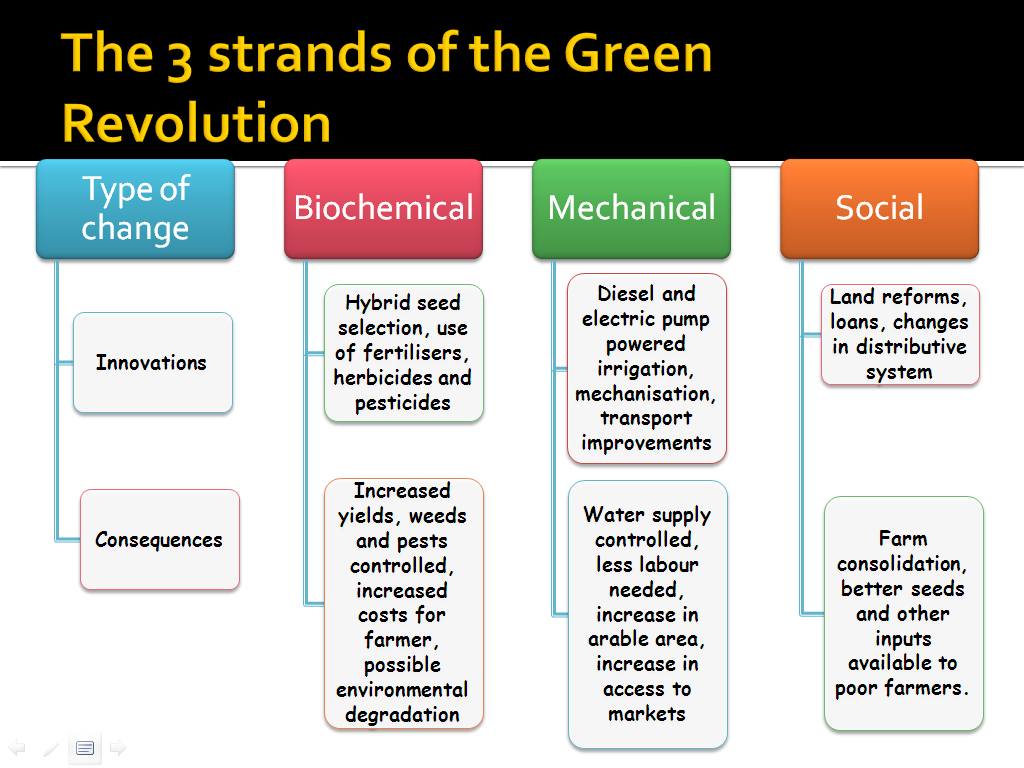
    • Green Revolution refers to the multiple growths in crop production in 3rd world countries based on the use of modern inputs, technologies, HYVs, farm mechanization, and irrigation facilities.

    Green Revolution in India

    • In India, the Green Revolution was mainly led by M.S. Swaminathan.
    • In 1961, M.S. Swaminathan invited Norman who suggested a revolution like what has happened in Mexico, Japan, etc in Indian agriculture. 
    • Green Revolution was introduced with the Intensive Agriculture District Program (IADP) on an experimental basis in 7 districtin India.
    • In 1965-66 the HYV program was started which is the starting point of the Green Revolution in India.
    • The Green Revolution, spreading over the period from 1967-68 to 1977-78, changed India’s status from a food-deficient country to one of the world’s leading agricultural nations.
    • The Green Revolution resulted in a great increase in production of food grains (especially wheat and rice) due to the introduction into developing countries of new, high-yielding variety seeds, beginning in the mid-20th century.
    Green Revolution in India

    History of Green Revolution in India

    • The history of Green Revolution is drawn back to the 1940s when the USA established a scientific operation to help the development of agricultural technology in Mexico. HYVs were at the focus of the novel technology.
    • Dr. Norman Borlaug, the Norway-born, U.S-based agricultural scientist was the innovator of ‘miracle seeds’ (HVY) of dwarf varieties of wheat.
    • In 1943, India suffered from the world’s worst recorded food crisis; the Bengal Famine, which led to the death of approximately 4 million people in eastern India due to hunger.
    • Even after independence in 1947, until 1967 the government largely concentrated on expanding the farming areas. But the population was growing at a much faster rate than food production.
    • This called for an immediate and drastic action to increase yield. The action came in the form of the Green Revolution.
    • The Green Revolution in India begun in the late 1960s. Green Revolution was functional in the period from 1967 to 1978 basically in parts of Punjab and Haryana.
    • At this stage, the Green Revolution was concern only with Wheat & Rice. Dr. M S Swaminathan from India led the Green Revolution as the Project.
    • In contrast, the agricultural growth in the 1980s (the second wave of the Green Revolution) involved almost all the crops including rice and covered the whole country.

    What are the Objectives of Green Revolution?

    1. Short Term: The revolution was launched to address India’s hunger crisis during the second Five Year Plan.
    2. Long Term: The long term objectives included overall agriculture modernization based on rural development, industrial development; infrastructure, raw material etc.
    3. Employment: To provide employment to both agricultural and industrial workers.
    4. Scientific Studies: Producing stronger plants which could withstand extreme climates and diseases.
    5. Globalization of the Agricultural World: By spreading technology to non-industrialized nations and setting up many corporations in major agricultural areas.

    Basic Features of the Green Revolution

    • High Yielding Varieties (HYVs): These are the genetically modified seed which can yield 2 to 3 times more than normal crop.
      • They are dwarf variety with dense canopy and needs grater amount of water, use of chemical fertilizer, protection from pest and weeds as it very tender and fragile.
      • It also requires on farm activities like soil preparation. It has short generation period and leads to greater production in short period of time.
    • Irrigation facilities: The net irrigated area in 1960 was only 30 million hectare and it was a daunting task to extend irrigation to rest of India.
    • Credit Requirements: Green Revolution required a good network of rural credit and micro financing for supporting the needs of farmers.
    • Commercialization of agriculture: Introduction of Minimum Support Prices for crops gave farmers extra reason to grow more crops.
    • Farm Mechanization: It was required for increasing the crop production.
    • Command Area Development Program (CADP): CADP was introduced in 1974. It consisted of two methods:
      • On farm development activities: It includes construction of agricultural channels, ploughing, leveling, budding etc.
      • Off farm development activities: It includes construction of roads, rural connectivity, marketing, transportation communication etc.
    • Use of chemical fertilizer: Indian soil is deficient in Nitrogen so NPK fertilizers were used with standard ratio of 4:2:1 but the actual ratio used was 3:8:1.
    • Use of insecticide, Pesticide, weedicide
    • Rural electrification: It was the precondition for increasing farm mechanization practices.
    • Land holding and land reforms: Land holding refers to consolidation of land and land reforms involves various steps such as abolition of intermediaries, abolition of Zamindari, tenancy reforms etc.
    • Important Crops in the Revolution:
      • Main crops were Wheat, Rice, Jowar, Bajra and Maize.
      • Non-food grains were excluded from the ambit of the new strategy.
      • Wheat remained the mainstay of the Green Revolution for years.

    Phases of Green Revolution in India

    (1) First Phase of Green Revolution (1965-66 to 1980)

    • India was in ardent need of immediate food supply and self sufficiency in food grain production. Wheat revolution was successful in various 3rd world countries like Mexico, Egypt, etc.
    • The first phase of green revolution was not only crop specific but also region specific because- 
      1. The agriculture infrastructure was well developed in Punjab while Haryana and Western Uttar Pradesh took advantage of its vicinity where irrigation facility could be easily extended.
      2. This region was free from natural hazards.
    • This phase stared with IADP and IAAP program on experimental basis but main initiative was the HYV program during the Annual Plan of 1965-66.
    • In 1974 with Command Area Development Program, Green Revolution was reemphasized.
    • The food production in 1950-51 was merely 25 MT and it was 33 MT in 1965-66. In 1980 it jumped to 100 MT which was three times increase in a span of 10 years.
    • It was more centralized towards wheat production which was increased by 2.5 times in 5 years. This was termed as Green Revolution.
    • This provided India with self sufficiency in food grain production and the incidences of malnutrition, famine, poverty, starvation were mitigated. India was successful in coming out of the Begging Bowl image.
    Phase to Dominated by extensive agriculture. Reforms in the form of land grant and land reforms. Phase to Productivity enhancement measures through green revolution technologies. Phase till now. Attempted liberalization of agriculture.

    (2) Second Phase of Green Revolution (1980-1991)

    • During the 6th and 7th plan, wet agriculture (mainly rice) was targeted.
    • During the first phase, rice production was increase merely 1.5 times. The regions having rainfall more than 100 cm like West Bengal, Bihar, Eastern Uttar Pradesh, Assam, Coastal plains were targeted.
    • It met with partial success and Krishna-Godavari delta and Cauvery basin yielded the coveted results. West Bengal and Bihar also showed increased productivity.
    • The full potential of productivity in rice was however not realized due to institutional factors like land reforms, tenancy etc.
    • The traditional outlook of farmers was also a major limiting factor in the success of Second phase of Green revolution.

    (3) Third Phase of Green Revolution (1991-2003)

    • During the 8th and 9th plan, dry land agriculture was targeted and HYV was introduced in cotton, oilseeds, pulses, millets etc. This met with partial success.
    • Integrated Watershed Management Programme was initiated to improve the conditions in sub- humid and semi-arid regions of India.
    • However, it was not very successful except in the Narmada – Tapi doab and the Tungbhadra basin and also the Bhima – Krishna basin.
    • After the end of 9th plan, there was a paradigm shift in approach of the govt policies. 
    • The ecological repercussion in the green revolution areas led to relatively new concept of balanced Agriculture growth based on agricultural ecology, conversation method and sustainable development (10th plan).
    • The entire agricultural sector was targeted and it is known as the Rainbow Revolution.
    • The process of Rainbow Revolution had affiliated in 1980’s with Yellow revolution (oilseeds), Blue Revolution, White Revolution (milk earlier in 1970’s), Brown Revolution (fertilizers) and Silver revolution (poultry).
    • In the 11th plan, the idea has been further elevated to sustainable agriculture with balanced growth referred to as inclusive growth.
    Allocation of the harvested area under cereal production

    Impact of Green Revolution in India

    • Tremendous Increase in Crop Produce: It resulted in a grain output of 131 million tonnes in the year 1978-79 and established India as one of the world’s biggest agricultural producers.
    • Reduced Import of Food-Grains: India became self-sufficient in food-grains and had sufficient stock in the central pool, even, at times, India was in a position to export food-grains.
      • The per capita net availability of food-grains has also increased.
    • Benefits to the Farmers: The introduction of the Green Revolution helped the farmers in raising their level of income.
      • Farmers ploughed back their surplus income for improving agricultural productivity.
      • The big farmers were particularly benefited by this revolution by investing large amounts of money in various inputs like HYV seeds, fertilizers, machines, etc. It also promoted capitalist farming.
      • Green Revolution gave rise to capitalistic farming practices in India.
      • Surplus was generated in agriculture which led to its commercialization.
    • Industrial Growth: The Revolution brought about large scale farm mechanization which created demand for different types of machines like tractors, harvesters, threshers, combines, diesel engines, electric motors, pumping sets, etc.
      • Besides, demand for chemical fertilizers, pesticides, insecticides, weedicides, etc. also increased considerably.
      • Several agricultural products were also used as raw materials in various industries known as agro based industries.
      • Development of agro-processing industries, food-processing industries led to industrialization of tier – II/III towns. It led to higher rate of urbanization.
    • Rural Employment: There was an appreciable increase in the demand for labour force due to multiple cropping and use of fertilizers.
      • The Green Revolution created plenty of jobs not only for agricultural workers but also industrial workers by creating related facilities such as factories and hydroelectric power stations.
      • Green Revolution led to the removal of hunger and famine.
      • Green Revolution led to the development of rural infrastructure which was a pre condition to Green Revolution.

    Negative Effects of Green Revolution in India

    • Focus on limited food-grains: Although all food-grains including wheat, rice, jowar, bajra and maize have gained from the revolution, other crops such as coarse cereals, pulses and oilseeds were left out of the ambit of the revolution.
      • Major commercial crops like cotton, jute, tea and sugarcane were also left almost untouched by the Green Revolution.
    • Limited Coverage of HYVP: High Yielding Variety Programme (HYVP) was restricted to only five crops: Wheat, Rice, Jowar, Bajra and Maize.
    • Economic Effects
      • Inter – personal disparity emerged which led to differences between people due to difference in earning at different places.
      • Inter – regional disparity emerged due to difference in crop production e.g. West UP vs. East UP.
      • Inter – state disparity emerged, for e.g. in 1960 Punjab and Bihar, both states contributed same in terms of crop production but due to Green Revolution there became a huge gap in crop production between the two states by 1990.
      • Due to increase in informal credit services labors and cultivators got into the vicious cycle of debt – trap.
    • Excessive Usage of Chemicals: The Green Revolution resulted in a large-scale use of pesticides and synthetic nitrogen fertilisers for improved irrigation projects and crop varieties.
      • However, little or no efforts were made to educate farmers about the high risk associated with the intensive use of pesticides.
      • This causes more harm than good to crops and also becomes a cause for environment and soil pollution.
    • Increased Water Consumption: The crops introduced during the green revolution were water-intensive crops.
    • Impacts on Soil and Crop Production: Repeated crop cycle in order to ensure increased crop production depleted the soil’s nutrients.
      • To meet the needs of new kinds of seeds, farmers increased fertilizer usage.
      • The pH level of the soil increased due to the usage of these alkaline chemicals.
      • Toxic chemicals in the soil destroyed beneficial pathogens, which further led to the decline in the yield.
    • Social Effects
      • Increased rural landlessness, smaller marginal farmers were rendered landless and became agricultural labourers which led to rural handicapness and health hazards.
      • Greater unemployment due to mechanisation.
      • Patriarchy was strengthened, female discrimination, female foeticide, dowry increased.
    • Health Hazards: The large-scale use of chemical fertilizers and pesticides such as Phosphamidon, Methomyl, Phorate, Triazophos and Monocrotophos resulted in resulted in a number of critical health illnesses including cancer, renal failure, stillborn babies and birth defects.

    Conclusion

    • Green Revolution in India was directed towards food sufficiency for the country. The goal has been achieved. Thus it requires sustainable agricultural pattern.
    • Also, much wider area could be brought under the Green Revolution and instead of Green Revolution it can be transformed into evergreen Revolution.
    • It represented the successful adaptation and transfer of the same scientific revolution in agriculture that the industrial countries had already appropriated for themselves.
    • However, lesser heed was paid to factors other than ensuring food security such as environment, the poor farmers and their education about the know-how of such chemicals.
    • As a way forward, the policymakers must target the poor more precisely to ensure that they receive greater direct benefits from new technologies and those technologies will also need to be more environmentally sustainable.

    Try this question for mains:

    Q.  In spite of having several achievements, the green revolution has several defects. Examine

    FAQs

    Who started the Green Revolution in India?
    The Green Revolution in India was primarily initiated by Dr. M.S. Swaminathan and supported by the Indian government, which adopted various agricultural policies and investments.

    How is the Green Revolution relevant for UPSC?
    The Green Revolution is an essential subject in the UPSC syllabus, covering aspects like its history, impact, and policies related to agricultural development in India. Understanding this movement is crucial for aspiring civil servants.

    What was the impact of the Green Revolution in India?
    The Green Revolution significantly increased food production, reduced famine risk, and improved farmers’ incomes. However, it also led to environmental concerns, such as soil degradation and increased pesticide use.


    UPSC 2022 countdown has begun! Get your personal guidance plan now! (Click here)

  • Challenges facing cooperative sector in India

    Context

    The article delved into the past of the cooperative movement and give some suggestions to resolve the issues facing cooperatives in India.

    Background of cooperatives

    • Friedrich Raiffeisen, who along with compatriot Schulze-Delitzsch in Germany, and Luzzatti of Italy, pioneered cooperatives in Europe.
    • Cooperatives in India: The Governor of the Madras Presidency, Lord Wenlock, was the first to seriously attempt replicating European cooperatives in India.
    • Principles: Raiffeisen based them on the principles of self-help, self-governance, and self-responsibility.
    • Nicholson wrote that the ‘future of rural credit lies with those who being of the people, live among the people, and yet by their intelligence, prescience and energy, are above the people’.
    •  Plunkett, in his foreword to Eleanor Hough’s The Cooperative Movement in India (1932), commented that what India had was not a movement, but a policy.
    • It was ‘created by ‘resolutions of the Central Government’ unlike Europe.
    • Increasing government control: John Matthai wrote in 1925 that the challenge was to loosen government grip on cooperation over the years.
    • But, government control has only increased, violating a core cooperative principle of political neutrality.
    • This reflects a collective failure of the political class.

    Challenges facing cooperatives

    • After Independence, cooperative institutions became an instrument of planning and state action.
    • Not surprisingly, successful Indian cooperatives such as the Gujarat Cooperative Milk Marketing Federation Ltd (GCMMF)/Amul, Indian Farmers Fertiliser Cooperative Limited (IFFCO) and Krishak Bharati Cooperative Limited (KRIBHCO), are outside government control.
    • Globally, seven of the top 10 cooperatives by asset size are from the financial sector.
    • The Indian financial sector is nowhere in the picture going by asset size.
    •  Cooperatives have also become avenues for regulatory arbitrage, circumventing lending and anti-money laundering regulations.
    •  The committees which examined cooperative banking suffered from the top-down quality that Plunkett and others frowned upon.
    • Recent initiatives such as an umbrella organisation for urban cooperatives and a new Ministry of Cooperation at the Centre threaten to further this approach in the absence of safeguards.

    Suggestions

    • First, the powers of the RCS need to be scaled back.
    •  In almost all States, the RCS has become an instrument of inspection and domination, one which imposes uniform by-laws, and amends them when individual societies do not fall in line.
    •  There is a need to transfer work from the RCS to cooperative federations — as in Singapore.
    • Second, the rural-urban dichotomy in the regulatory treatment of cooperatives is specious and outdated.
    • Such differences are immaterial when regulation is to be based on the cooperative nature of organisations.
    • Third, the regulation and the supervision of cooperative banks should move to a new body from the Reserve Bank of India (RBI) for urban banks and the National Bank for Agriculture and Rural Development (NABARD) for rural banks.
    • Fourth, lessons from the Netherlands, where cooperative banks owe their success to a segmented market, are pertinent.
    • In India, adopting a multi-agency approach, especially after bank nationalisation, has affected the efficiency of both commercial and cooperative banks.
    • Commercial bank-cooperative sector linkages at various levels could alternatively provide better synergies.

    Conclusion

    The cooperative sector in India faces challenges on various fronts. There is a need for implementing the changes suggested above to play an important role expected from it in the economy.

    UPSC 2022 countdown has begun! Get your personal guidance plan now! (Click here)

  • Centre and states must work together to tackle the pollution in the NCR

    Context

    Supreme Court (SC) judges have pulled up the Delhi and central governments for not doing enough to correct the dire air quality situation. They also remarked on what message we are sending to the world.

    The pollution problem raises doubt about the quality of urbanisation in India

    •  If one looks at the capitals of G20 countries, Delhi’s air quality index (AQI) during November 1-15, is by far the worst at 312, as per World Air Quality Index Project.
    •  India’s distinction goes beyond Delhi.
    • As per the World Air Quality Report of 2020, prepared by IQAir (a Swiss organisation), of the 30 most polluted cities in the world, 22 are in India.
    • The problem is much deeper, raising doubts about the quality of our urbanisation.

    Contributing sources and their share

    • Contributing sources: As per the report of the Ministry of Environment, Forest, and Climate Change submitted to the UN Framework Convention on Climate Change following sources contribute in the given proportion:
    • Energy generation (largely coal-based thermal power) is the biggest culprit with a share of 44 per cent in greenhouse gas emissions,
    • Energy generation is followed by manufacturing and construction-18 per cent.
    • Agriculture-14 per cent.
    • Transport-13 per cent industrial processes and product use- 8 per cent and waste burning- 3 per cent.

    Suggestions to tackle Delhi’s pollution

    • As per the System of Air Quality Forecasting and Research (SAFAR), the reasons for poor AQI differ day to day.
    • On a particular day, say November 7, stubble burning contributed 48 per cent of Delhi’s air pollution, which fell to just 2 per cent on November 18.
    • Reduce rice cultivation: The Centre needs to sit down with neighbouring states and come up with a plan to reduce the rice area in this belt, which is already depleting the water table, creating methane and nitrous oxide, to incentivise farmers to switch to other crops through better returns than in rice cultivation.
    • Adopt EVs: To tackle vehicular pollution, we need a massive drive towards electric vehicles (EVs), and later towards green hydrogen when it becomes competitive with fossil fuels.
    • Charging stations: Scaling up EVs quickly demands creating charging stations on a war footing.
    • Develop carbon sink: Delhi also needs a good carbon sink.
    • Rejuvenating the Ridge area with dense forests and developing thick forests on both sides of the Yamuna may help.

    Enhancing farmers income through solar farming

    •  The Prime Minister has done a commendable job in Glasgow to commit that 50 per cent of India’s energy will be from renewable sources by 2030.
    • To replace coal in energy generation, solar and wind is the way to go at the all-India level.
    • The current model in solar energy is heavily tilted towards companies.
    • They are setting up large solar farms on degraded or less fertile lands.
    • We can supplement that model by developing solar farms on farmers’ fields.
    • This would require solar panels to be fixed at a 10 feet height with due spacing to let enough sunlight come to the plants for photosynthesis.
    • These “solar trees” can then become the “third crop” for the farmers, earning them regular income throughout the year, provided the law allows them to sell this power to the national grid.
    • The Delhi government’s pilot in Ujwa KVK land on these lines showed that farmers can earn up to Rs 1 lakh per acre per year from this “solar farming”.
    • This is on top of the two crops they can keep growing under those solar trees.
    • This will double farmers’ income within a year.

    Conclusion

    As deteriorating air quality grips the whole country, we need to work on multiple levels with coordination to tackle the problem.

    UPSC 2022 countdown has begun! Get your personal guidance plan now! (Click here)
  • Realising the potential of India-Russia ties

    Context

    The Russian president is on visit to India. Visits by Russian presidents to India always invoke a sense of nostalgia. The Moscow-Delhi relationship dates back to the Cold War era and it has been strong ever since.

    Factors limiting the possibilities for bilateral partnership

    • The conflict between Russia and the West: One factor is the continuing conflict between the Kremlin and the West.
    • Absence of trade between India and Russia: The other is the absence of a thriving commercial relationship between India and Russia.
    • India-US relations: India’s relations with Washington has never been as intense as it is today.
    • Russia-China relations: Moscow’s embrace of Beijing is tighter than ever.
    • The US-China rivalry: That the US and China are now at each other’s throats makes the great power dynamic a lot more complicated for India and Russia.

    Importance of trade ties

    • Need for robust business ties: That Delhi and Moscow have problems with the best friend of the other would have been more manageable if business ties between India and Russia were solid.
    • Where India and Russia have greater freedom is in the economic domain, but their failure to boost the commercial relationship has been stark.
    • India-Russia annual trade in goods is stuck at about $10 billion.
    • Slow progress on enhancing trade and investment ties: During the last 20 summits with Putin, the two sides have repeatedly affirmed the importance of enhancing trade and investment ties; but progress has been hard to come by.
    • How to fix the problem? The problem clearly can’t be fixed at the level of governments.
    • The Russian business elites gravitate to Europe and China. The Indian corporations are focused on America and China.

    Russia-US ties and its implications for India

    • Implications for India? The structural constraints posed by the great power dynamic and vastly different appreciation of the regional security environment could be reduced if matters improve between Washington and Moscow.
    • In Washington, the Biden administration recognises the importance of ending this permanent crisis in US-Russian relations.
    • Winning a strategic competition with China: The Biden administration, which is focused on winning the intensifying strategic competition with China, values a stable relationship with Russia.
    •  Nothing pleases Moscow more than the image of being Washington’s equal on the global stage.
    • Relief for India: A less conflictual relationship between Washington and Moscow will be a huge relief for India; but Delhi can’t nudge them closer to each other.

    Why the partnership with India matters to Russia

    • Dangers of excessive reliance on China: Persistent conflict with the US, Europe, and Japan have moved Moscow ever closer to Beijing.
    • But Moscow knows the dangers of relying solely on a neighbour which has risen to greatness — the Chinese economy at nearly $15 trillion today is nearly 10 times larger than that of Russia.
    • Sustaining the traditional partnership with India: While resetting Russia’s relations with the West is hard, sustaining the traditional partnership with Delhi is of some political value to Moscow.
    • Longstanding defence ties: Russia is pleased that the S-400 missile sale has gone through despite strong US opposition.
    • For it signals Delhi’s commitment not to let Washington roll back India’s longstanding defence ties with Russia.
    • Russia knows India’s strategic cooperation with the US has acquired an unstoppable momentum; and Delhi knows it has no veto over the Sino-Russian strategic partnership.
    • Moscow and Delhi are learning to live with this uncomfortable unreality and stabilising their political ties within that context.

    Consider the question “While both India and Russia have drifted apart from the depth of past partnerships, there is a need for stabilising their political ties within the changed context.Comment.”

    Context

    Delhi and Moscow have no reason to be satisfied with the poor state of their commercial ties. The success of Monday’s summit lies not in squeezing more out of bilateral defence ties, but in laying a clear path for expansive economic cooperation, and generating a better understanding of each other’s imperatives on Afghanistan and the Indo-Pacific.

    UPSC 2022 countdown has begun! Get your personal guidance plan now! (Click here)

  • Meeting Link Inside, Register & Join||What are the 5 Ways to Remain Consistent in your UPSC Preparation?|| Brainstorm with IPS Officer Shubham Nagargoje|| Free Q&A Webinar, Open for All, Limited Slots

    Meeting Link Inside, Register & Join||What are the 5 Ways to Remain Consistent in your UPSC Preparation?|| Brainstorm with IPS Officer Shubham Nagargoje|| Free Q&A Webinar, Open for All, Limited Slots

    Team is inviting you to a scheduled Zoom meeting.

    Ask me Anything Session with Shubham Nagargoje (IPS, AIR 453) CSE 2020
    Date & Time: Dec 6, 2021 @07:00 PM (start logging in by 06:45 PM) India

    Join Zoom Meeting
    https://zoom.us/j/99069125449pwd=MExEMm1Fb1lXRk91V2cyT3RTYXVXUT09

    Meeting ID: 990 6912 5449
    Passcode: 331985

    Success isn’t always because of greatness. It’s about consistency. Consistent hard work leads to success. Greatness will come.” – Dwayne Johnson.

    IPS Officer Shubham Nagargoje lived by this saying during his entire UPSC and RBI Grade B preparation of three years. Hence, failing to clear the UPSC Prelims twice didn’t deter him. He finally got appointment letters both as an RBI Grade B officer and an IPS officer. His joy knew no bounds and the very first thing he did upon hearing the news was hug his roommate and cry tears of joy. Shubham’s inclination in civil service motivated him to reject the former for the latter.

    Free Open for All, Q&A Webinar with Shubham Nagargoje IPS

    As UPSC-CSE aspirants, most of us would have faced the issue of consistency — we achieve our targets for the first month, but soon afterward our preparation (best known to us) fizzles out. Before we know, we would have gone months together without studying due to which we would give the upcoming UPSC exams a miss. This invariably delays the prospects of selection by a year or more.

    But what exactly is consistency? It appears to be a very common word just like ‘sorry’ and ‘thank you’ that everyone throws around. How does it feel to follow consistent life like other UPSC toppers? Consistency in UPSC parlance involves two aspects — being regular and being steadfast. It’s the willpower to read the current affairs in the morning, read the prelims portions in the afternoon, study for your Optional subject in the evening and round it off with a Mains subject at night. It’s the ability to not skip prelims and mains test series on the weekends. And it’s about making time to revise your notes once a week. Even if you miss one of these aspects, you are not true to your preparation.

    Does this sound difficult? Then attend the Ask Me Anything Session with Shubham Nagargoje to understand the five ways you can keep yourself consistent aka motivated for the upcoming UPSC CSE 2021 Mains and UPSC CSE 2022 Prelims exam.

    It’s absolutely free for anyone to attend but due to a fixed duration of 1 hour, we are only having limited slots. So kindly register for the webinar by filling this form right now.

    Key Takeaways of the Free Q&A Webinar with Shubham Nagargoje IPS

    1. Consistency according to Shubham. What did it mean to him?

    2. Day 01 v/s Day 365. How regular studies made him more intellectual, mentally strong and increased his confidence in mastering the topics?

    3. Mistakes aspirants make in the name of consistency. For example, why studying one book for the entire day is a bad idea?

    4. The right approach to Dynamic Prelims. What are the changes Shubham made in his 3rd attempt which helped him clear Prelims?

    5. Acing group studies for UPSC. How did Shubham successfully prepare with his four friends because of which all of them cleared Prelims and Mains?

    6. The time-management technique which helped Shubham stay focused. What were the distractions in Shubham’s preparation and how did he conquer them?

    7. What to write in DAF and what not to. How did Shubham research on his DAF because of which he was able to give a convincing interview?

    8. Navigating through study breaks. How long should a study break be and how to get back to study mode?

    9. Ideal hobbies for UPSC Aspirants. What are the hobbies you should cultivate now that can be a refreshing break for you?

    10. Other Government Exams. What are the other government exams you can study along with UPSC which has a similar syllabus but lesser competition?

    Webinar Details

    If you want to improve your preparation for UPSC, then do attend this webinar by IPS officer Shubham. Registration is free but limited due to the number of questions we can accommodate in the one-hour session. So fill the form below and confirm your attendance ASAP!

    Date: 6 December 2021 (Monday)

    Time: 7 P.M

  • Registration Closing in 1 Hour ||Free Q&A Webinar with Shubham Nagargoje IPS, Open for All, Limited Slots|| What are the 5 Ways to Remain Consistent in your UPSC Preparation?

    Registration Closing in 1 Hour ||Free Q&A Webinar with Shubham Nagargoje IPS, Open for All, Limited Slots|| What are the 5 Ways to Remain Consistent in your UPSC Preparation?

    Success isn’t always because of greatness. It’s about consistency. Consistent hard work leads to success. Greatness will come.” – Dwayne Johnson.

    IPS Officer Shubham Nagargoje lived by this saying during his entire UPSC and RBI Grade B preparation of three years. Hence, failing to clear the UPSC Prelims twice didn’t deter him. He finally got appointment letters both as an RBI Grade B officer and an IPS officer. His joy knew no bounds and the very first thing he did upon hearing the news was hug his roommate and cry tears of joy. Shubham’s inclination in civil service motivated him to reject the former for the latter.

    Free Open for All, Q&A Webinar with Shubham Nagargoje IPS

    As UPSC-CSE aspirants, most of us would have faced the issue of consistency — we achieve our targets for the first month, but soon afterward our preparation (best known to us) fizzles out. Before we know, we would have gone months together without studying due to which we would give the upcoming UPSC exams a miss. This invariably delays the prospects of selection by a year or more.

    But what exactly is consistency? It appears to be a very common word just like ‘sorry’ and ‘thank you’ that everyone throws around. How does it feel to follow consistent life like other UPSC toppers? Consistency in UPSC parlance involves two aspects — being regular and being steadfast. It’s the willpower to read the current affairs in the morning, read the prelims portions in the afternoon, study for your Optional subject in the evening and round it off with a Mains subject at night. It’s the ability to not skip prelims and mains test series on the weekends. And it’s about making time to revise your notes once a week. Even if you miss one of these aspects, you are not true to your preparation.

    Does this sound difficult? Then attend the Ask Me Anything Session with Shubham Nagargoje to understand the five ways you can keep yourself consistent aka motivated for the upcoming UPSC CSE 2021 Mains and UPSC CSE 2022 Prelims exam.

    It’s absolutely free for anyone to attend but due to a fixed duration of 1 hour, we are only having limited slots. So kindly register for the webinar by filling this form right now.

    Key Takeaways of the Free Q&A Webinar with Shubham Nagargoje IPS

    1. Consistency according to Shubham. What did it mean to him?

    2. Day 01 v/s Day 365. How regular studies made him more intellectual, mentally strong and increased his confidence in mastering the topics?

    3. Mistakes aspirants make in the name of consistency. For example, why studying one book for the entire day is a bad idea?

    4. The right approach to Dynamic Prelims. What are the changes Shubham made in his 3rd attempt which helped him clear Prelims?

    5. Acing group studies for UPSC. How did Shubham successfully prepare with his four friends because of which all of them cleared Prelims and Mains?

    6. The time-management technique which helped Shubham stay focused. What were the distractions in Shubham’s preparation and how did he conquer them?

    7. What to write in DAF and what not to. How did Shubham research on his DAF because of which he was able to give a convincing interview?

    8. Navigating through study breaks. How long should a study break be and how to get back to study mode?

    9. Ideal hobbies for UPSC Aspirants. What are the hobbies you should cultivate now that can be a refreshing break for you?

    10. Other Government Exams. What are the other government exams you can study along with UPSC which has a similar syllabus but lesser competition?

    Webinar Details

    If you want to improve your preparation for UPSC, then do attend this webinar by IPS officer Shubham. Registration is free but limited due to the number of questions we can accommodate in the one-hour session. So fill the form below and confirm your attendance ASAP!

    Date: 6 December 2021 (Monday)

    Time: 7 P.M

  • Arms Race towards Hypersonic Weapons

    China recently tested a nuclear-capable hypersonic missile while Russia announced that it had successfully test-launched a Tsirkon hypersonic cruise missile in early October.

    What are Hypersonic Weapons?

    • The speed of sound is Mach 1, and speeds upto Mach 5 are supersonic and speeds above Mach 5 are hypersonic.
    • They are manoeuvrable weapons that can fly at speeds in excess of Mach 5, five times the speed of sound.
    • A number of other countries – including Australia, India, France, Germany, and Japan—are developing hypersonic weapons technology.

    Features of HSWs

    • Trajectory: Ballistic Missiles are long-range missile that leaves the earth’s atmosphere before re-entry, pursuing a parabolic trajectory towards its target
    • Maneuverability: HSW travel within the atmosphere and can manoeuvre midway which combined with their high speeds make their detection and interception extremely difficult.
    • Stealth: Radars and air defences cannot intercept them till they are very close. They can penetrate most missile defences and further compress the timelines for response by a nation under attack.

    Types of Hypersonic Weapons

    There are two classes of hypersonic weapons:

    1. Hypersonic glide vehicles (HGV): They are launched from a rocket before gliding to a target.
    2. Hypersonic cruise missiles (HCM): They are powered by high-speed, air-breathing engines, or scramjets, after acquiring their target.

    Where does the US stand?

    • The US has active hypersonic development programs.
    • It is said to be lagging behind China and Russia because most US hypersonic weapons are not being designed for use with a nuclear warhead.
    • It is in process of developing prototypes to assist in the evaluation of potential weapon system concepts and mission sets.

    Hypersonic program in India

    • HSTDV program: India is developing an indigenous, dual-capable hypersonic cruise missile as part of its Hypersonic Technology Demonstrator Vehicle (HSTDV) program.
    • Capacity: India operates approximately 12 hypersonic wind tunnels and is capable of testing speeds of up to Mach 13.
    • In-operation: The DRDO has successfully tested a Mach 6 scramjet in June 2019 and September 2020 using the demonstrated scramjet engine technology.

    DRDO has validated many associated crucial technologies such as:

    1. Aerodynamic configuration for hypersonic maneuvers
    2. Use of scramjet propulsion for ignition and sustained combustion at the hypersonic flow
    3. Thermo-structural characterization of high-temperature materials
    4. Separation mechanism at hypersonic velocities has been validated

    Conclusion

    • There are rising tensions between the US, China and Russia worsening the geopolitical situation worldwide.
    • The focus for hypersonic weapons is only set to accelerate more countries to invest significant resources in their design and development.

    Back2Basics:


    UPSC 2022 countdown has begun! Get your personal guidance plan now! (Click here)

  • When can an individual get Statutory Bail?

    The National Investigation Agency (NIA) has approached the Supreme Court against a Bombay High Court order granting bail to an advocate and activist.

    What is the case?

    • In its bail order, the court has asked the NIA Court to decide the conditions for her release.
    • The activist was given ‘default bail’.
    • The case highlights the nuances involved in a court determining the circumstances in which statutory bail is granted or denied, even though it is generally considered “an indefeasible right”.

    What is default bail?

    • This is enshrined in Section 167(2) of the Code of Criminal Procedure.
    • Also known as statutory bail, this is a Right to Bail that accrues when the police fail to complete investigation within a specified period in respect of a person in judicial custody.
    • When it is not possible for the police to complete an investigation in 24 hours, the police produce the suspect in court and seek orders for either police or judicial custody.

    When is the Bail granted?

    • For most offences, the police have 60 days to complete the investigation and file a final report before the court.
    • However, where the offence attracts death sentence or life imprisonment, or a jail term of not less than 10 years, the period available is 90 days.
    • In other words, a magistrate cannot authorise a person’s judicial remand beyond the 60-or 90-day limit.
    • At the end of this period, if the investigation is not complete, the court shall release the person “if he is prepared to and does furnish bail”.

    How does the provision vary for special laws?

    The extension of time is not automatic but requires a judicial order.

    • Ordinary law (IPC/CrPC): The 60- or 90-day limit is only for ordinary penal law.
    • Narcotic Drugs and Psychotropic Substances Act: In NDPS Act, the period is 180 days. However, in cases involving substances in commercial quantity, the period may be extended up to one year.
    • Unlawful Activities (Prevention) Act: In UAPA, the default limit is 90 days only. The court may grant an extension of another 90 days, if it is satisfied that the progress made in the investigation and giving reasons to keep the accused in further custody.

    What are the laid-down principles on this aspect?

    • A matter of Right: Default or statutory bail is an indefeasible right’, regardless of the nature of the crime liberty under Article 21 of the Constitution.
    • Stipulated period calculation: The stipulated period within which the charge sheet has to be filed begins from the day the accused is remanded for the first time. It includes days undergone in both police and judicial custody, but not days spent in house-arrest.
    • Voluntary: There is no automatic bail.

    Try this similar PYQ from CSP 2021:

    Q. With reference to India, consider the following statements:

    1. When a prisoner makes a sufficient case, parole cannot be out denied to such prisoner because it becomes a matter of his/her right.
    2. State Governments have their own Prisoners Release on Parole Rules.

    Which of the statements given above is/are correct?

    (a) 1 only

    (b) 2 only

    (c) Both 1 and 2

    (d) Neither 1 nor 2


    Post your answers here.


    UPSC 2022 countdown has begun! Get your personal guidance plan now! (Click here)

  • How is Gold Hallmarking being implemented?

    The Government has made it mandatory for the introduction of a Hallmark Unique Identification (HUID) number in every piece of jewellery.

    What is HUID?

    • HUID is a six-digit alphanumeric code, or one that consists of numbers and letters. It is given to every piece of jewellery at the time of hallmarking and is unique for each piece.
    • It is being implemented by the Bureau of Indian Standards (BIS) in a phased manner.
    • Hallmarking & HUID are mandatory for 14-, 18- and 22-carat gold jewellery and artefacts.
    • Before buying any piece of gold jewellery, the buyer should check all these three symbols.

    Implementation of HUID

    • Symbols: The hallmark consists of three symbols which give some information about the jewellery piece. The first symbol is the BIS logo; the second indicates purity and fineness; and the third symbol is the HUID.
    • A&H centre: Jewellery is stamped with the unique number manually at the Assaying & Hallmarking centre.

    Why is it being introduced?

    • Authentication: HUID gives a distinct identity to each piece of jewellery enabling traceability.
    • Credibility: It is critical to the credibility of hallmarking and to help address complaints against adulteration.
    • Registration: In HUID-based hallmarking, registration of jewellers is an automatic process with no human interference.
    • Prevents malpractice: It also helps check malpractice by members of the trade.
    • Data privacy: It is a secure system and poses no risk to data privacy and security.
    • Financial tracking: HUID provides traceability and financial tracking of purchases.

    Issues with HUID

    • Time-consuming: It is cumbersome to number each piece of jewellery
    • Intricate jewellery: HUID cannot be engraved in tiny pieces.
    • Unnecessary expense: Also it will increase cost for consumers.
    • Infrastructural issues: there needs to be ample AH Centres.

    What does this mean for the consumer?

    • Consumer protection: Given that gold plays a big role in the lives of Indians, mandating gold hallmarking is aimed at protecting consumer interests.
    • Assurance of quality: It provides ‘third-party assurance’ to consumers on the purity of gold jewellery.

    Conclusion

    • HUID concept is innovative, out-of-the-box thinking and more than makes up for stepping in late with mandatory hallmarking.
    • It is the sort of global leadership India has and needs to show in gold-related reforms.


    UPSC 2022 countdown has begun! Get your personal guidance plan now! (Click here)

  • Dhawan-1: India’s first privately developed Cryogenic Rocket

    Skyroot Aerospace successfully tested Dhawan-1 last month. It became the country’s first privately developed fully cryogenic rocket engine.

    Dhawan-1

    • The indigenous engine was developed using 3D printing with a superalloy.
    • It runs on two high-performance rocket propellants — liquid natural gas (LNG) and liquid oxygen (LoX).
    • This was after successfully designing and developing the solid propulsion rocket engine, the first private firm in the country to do so.

    Other projects by Skyroot

    • Skyroot is working simultaneously on different stages of both solid propulsion and liquid propulsion engines.
    • It is named after eminent scientists, like Kalam (Abdul Kalam) series for the former and Dhawan (Satish Dhawan).
    • The launch vehicles are named after Vikram Sarabhai.


    UPSC 2022 countdown has begun! Get your personal guidance plan now! (Click here)

More posts