💥Mains Ready By December. Smash Mains & Smash PYQ Admissions Open

Search results for: “”

  • Governor’s discretion: Constitutional Norm vs Cultural Symbolism ?

    Governor’s discretion: Constitutional Norm vs Cultural Symbolism ?

    N4S

    This article explores a timely clash between cultural symbolism and constitutional authority, using the Kerala Raj Bhavan controversy as a lens. UPSC typically asks such questions by merging static constitutional provisions with dynamic political events, like in the 2022 question on the Governor’s ordinance powers. However, aspirants often falter by focusing solely on textbook articles (like Articles 154 and 163) without understanding real-world application or judicial interpretation.Under heads like Governor’s Constitutional Role vs Elected Government and Constitutional Norms vs Cultural Nationalism, it breaks down the legal, political, and symbolic dimensions of the issue. It also brings in comparative flashpoints like Ayodhya, hijab bans, and Vande Mataram debates – offering aspirants a broader framework to answer questions on secularism, executive restraint, and state symbolism.

    PYQ ANCHORING:

    GS 2 :  Discuss the essential conditions for exercise of the legislative powers by the Governor. Discuss the legality of re-promulgation of ordinances by the Governor without placing them before the Legislature. [2022]

    MICROTHEMES:  Executive Vs Legislature

    A controversy erupted in Kerala after the Governor placed a portrait of Bharat Mata in an official room of the Raj Bhavan. The elected state government objected, arguing that this unilateral act violated constitutional norms and the principle of state neutrality. The issue reflects broader tensions between constitutional propriety and cultural nationalism. Thus, the issue represents a clash between procedural legitimacy and symbolic assertion. This raises a deeper question: Can nationalism expressed through cultural symbols coexist with a secular constitutional democracy that mandates institutional neutrality?

    About the Bharat Mata Image

    1. Literary Origins: The idea of Bharat Mata first appeared in Anandamath (1882) by Bankim Chandra Chattopadhyay as Banga Mata (Mother Bengal). The novel introduced the hymn “Vande Mataram”, later adopted as a national song.
    2. Artistic Representation: In 1905, Abanindranath Tagore painted Bharat Mata as a saffron-clad, four-armed woman, resembling a Hindu goddess. This image was popularised by Sister Nivedita during the Swadeshi movement.
    3. Political Evolution: Bharat Mata became a powerful emotional and unifying symbol during the Indian freedom struggle. The slogan “Bharat Mata ki Jai” gained mass appeal and was used in nationalist mobilisations.
    4. No Legal Recognition: Despite its influence, Bharat Mata has no constitutional or legal status as a national symbol.
    5. Post-Independence Role: Bharat Mata continues as a cultural and symbolic figure, occasionally invoked in political rhetoric. Its presence in official or state spaces often sparks debate and controversy.

    Governor’s Constitutional Role vs Elected Government

    1. Constitutional Head: The Governor is the nominal head of the state and is bound to act on the aid and advice of the Council of Ministers (Article 163).
      • Explanation: Cannot independently decide on administrative matters, such as installing symbols in Raj Bhavan.
    2. No Personal Discretion: Dr. B.R. Ambedkar clarified in the Constituent Assembly that the Governor has no independent or personal powers.
      • Explanation: Governor is a constitutional figure, not meant to take individual decisions outside ministerial advice.
    3. Supreme Court Rulings: In Nabam Rebia v. Deputy Speaker (2016), the Supreme Court reaffirmed that Governors cannot use personal discretion in routine affairs.
      • Explanation: Discretion is allowed only in exceptional constitutional situations, not daily governance.
    4. Protocol Violation: Installing non-official symbols like Bharat Mata without government approval breaches constitutional norms.
      • Explanation: The Kerala government criticised such actions as violating democratic procedures and state protocol.

    Constitutional Norms vs Cultural Nationalism

    The issue of placing a Bharat Mata image in official spaces like the Raj Bhavan has sparked a larger debate between constitutional norms and cultural nationalism.

    1. Constitutional Norms: Rule-Based, Secular, Institutional

    • Governor’s Role is Constitutional, Not Cultural: The Governor is bound by the Constitution to act on the advice of the elected government (Article 163) and cannot use the office to promote personal or ideological symbols.
    • No Official Status for Bharat Mata: Unlike the national flag or emblem, Bharat Mata is not a state-recognised symbol, and placing her image in a constitutional office violates institutional neutrality.
    • Secular Framework: The Indian Constitution upholds  secular ethos. Since Bharat Mata is often depicted in a form resembling Hindu iconography, its official display can be seen as privileging one cultural-religious tradition over others.
    • Democratic Protocols: Any use of public institutions or symbols must reflect collective state decisions, not unilateral actions by unelected constitutional authorities.

    2. Cultural Nationalism: Identity, Emotion, Symbolism

    • Bharat Mata as a Unifying Symbol: For many, Bharat Mata represents national pride, cultural heritage, and emotional unity, especially rooted in India’s freedom struggle and civilizational ethos.
    • Assertion of Cultural Identity: Proponents argue that placing the image affirms India’s civilizational continuity and reflects the will of the majority or dominant culture.
    • Symbol Beyond Religion: Some argue that Bharat Mata transcends religion and is a symbol of patriotism, not necessarily tied to Hinduism, and thus deserves a place in public institutions.

    Key Flashpoints in India

    IssueConstitutional NormsCultural NationalismOutcome
    Ayodhya Temple Verdict (2019)Rule of law, secularism, property rightsAssertion of Hindu identity and civilisational heritageSC awarded land to temple trust, citing both legal and faith-based reasoning
    Vande Mataram MandatesArticles 19 & 25 protect freedom of expression and religionSinging it linked to patriotism and national prideSC clarified that singing is not compulsory
    Beef Bans & Cow VigilantismRight to food and livelihood under Articles 21 & 25Gau raksha rooted in Hindu beliefs and cultural reverenceLaws strengthened in many states; SC intervened in cases of mob violence
    Hijab Ban in Karnataka (2022)Religious freedom under Article 25Uniform dress code seen as promoting national unity and secularismKarnataka HC upheld ban; SC gave split verdict
    Yoga & Sanskrit in SchoolsSecularism in education; state should not promote religionSeen as revival of ancient Indian (Hindu) cultureMainstreamed in curricula; critics argue it sidelines minority traditions
    Citizenship Amendment Act (2019)Article 14 guarantees equality regardless of religionCAA aligns with view of India as a homeland for persecuted non-Muslim minoritiesLaw passed; judicial review pending; sparked major protests and constitutional concerns

    View of Judiciary

    Over the years, the Indian judiciary has played a crucial role in navigating the tensions between constitutional norms and cultural nationalism. It has acted as a constitutional guardian when symbolic assertions have come head-on with the secular-democratic fabric. 

    1. Affirming Secularism as a Basic Feature

    • Case: S.R. Bommai v. Union of India (1994)
    • Observation: The Supreme Court ruled that secularism is part of the basic structure of the Constitution.
    • Relevance: This judgment established that state institutions must remain neutral in matters of religion, setting limits on the role of cultural nationalism in governance.

    2. Restricting Forced Cultural Symbols

    • Case: Bijoe Emmanuel v. State of Kerala (1986)
    • Observation: SC held that students belonging to the Jehovah’s Witnesses faith cannot be forced to sing the national anthem if it goes against their beliefs.
    • Relevance: Protects individual freedom of conscience over state-imposed patriotic symbols, reaffirming constitutional rights over cultural uniformity.

    3. Vande Mataram Not Compulsory

    • Case: SC Order (2017)
    • Observation: Clarified that singing Vande Mataram is not mandatory in schools or public spaces.
    • Relevance: Pushback against efforts to equate cultural-nationalist symbols with patriotism, protecting freedom of expression and belief.

    4. Ayodhya Verdict: Balancing Faith and Rule of Law

    • Case: M. Siddiq v. Mahant Suresh Das (2019 – Ayodhya Dispute)
    • Observation: Court acknowledged the faith of Hindus in Ram Janmabhoomi, while also affirming the illegality of mosque demolition and providing alternative land to Muslims.
    • Relevance: Seen as an effort to balance constitutional neutrality with deep-seated cultural sentiment.

    5. Freedom of Religion in Attire

    • Case: Fathima Tasneem v. State of Kerala (2018) & Karnataka Hijab Case (2022)
    • Observation: Courts gave mixed rulings—Kerala HC upheld school uniforms; Karnataka HC said hijab is not essential religious practice.
    • Relevance: Courts have struggled to maintain a clear line between individual religious freedom and uniform cultural practices.

    6. Limiting Governor’s Discretion

    • Case: Nabam Rebia v. Deputy Speaker (2016)
    • Observation: SC ruled that the Governor cannot act without the aid and advice of the council of ministers except in specific cases.
    • Relevance: Prevents constitutional offices from becoming platforms for personal or ideological expression, relevant in Bharat Mata image controversies.

    7. Upholding Right to Food and Privacy

    • Case: Puttaswamy v. Union of India (2017 – Right to Privacy) & Mob Lynching Cases
    • Observation: Right to food, privacy, and personal choices are fundamental rights under Article 21.
    • Relevance: Serves as a constitutional check against majoritarian moral policing, like beef bans and vigilante actions.

    Way Forward

    1. Prioritise Constitutional Duty: Public officials must uphold constitutional principles over personal or ideological preferences in official matters.
    2. Maintain Institutional Neutrality: Personal beliefs must not shape public conduct; official spaces should remain neutral and inclusive.
    3. Codify Symbol Use in Government Offices: Create a formal list of approved national symbols (flag, emblem, anthem) for use in official spaces.
    4. Strengthen Constitutional Literacy: Train public officials on the scope and limits of their constitutional role, especially in symbolic matters.

    #BACK2BASICS : CONSTITUTIONAL POSITION OF THE GOVERNOR

    Constitutional Position of the Governor

    1. Nominal Head of State
      • India follows a parliamentary system at both Union and State levels.
      • The Governor is the nominal executive, functioning with the aid and advice of the Council of Ministers led by the Chief Minister.
    2. Key Constitutional Articles
      • Article 154: Executive power of the state vests in the Governor.
      • Article 163: The Governor acts on the aid and advice of the Council of Ministers, except where discretion is permitted.
      • Article 164: Council of Ministers is collectively responsible to the Legislative Assembly (core of parliamentary accountability).
    3. Governor vs President: Key Differences
      • The Governor has discretionary powers in certain matters; the President does not (except in limited cases).
      • After the 42nd Amendment (1976), the President must act on ministerial advice—no such compulsion exists for the Governor.

    Types of Discretion

    A. Constitutional Discretion (Explicitly Mentioned in the Constitution)

    1. Reserving a bill for the President’s consideration (Art. 200)
    2. Recommending President’s Rule in the state (Art. 356)
    3. Acting as administrator of a Union Territory with additional charge
    4. Deciding royalty payments to Tribal District Councils in Northeast
    5. Seeking information from the Chief Minister (Art. 167)

    B. Situational Discretion (Implied/Derived from Political Circumstances)

    1. Appointing a Chief Minister in case of a hung assembly or CM’s death
    2. Dismissing the Council of Ministers if they lose the Assembly’s confidence
    3. Dissolving the Legislative Assembly when government loses majority

    Special Responsibilities (Discretion Based on Presidential Directions)

    The Governor acts in discretion in certain states as per special directives from the President, even while consulting the state government:

    StateSpecial Responsibility
    MaharashtraDev boards for Vidarbha & Marathwada
    GujaratDev boards for Saurashtra & Kutch
    NagalandLaw & order during internal disturbances
    AssamAdministration of tribal areas
    ManipurAdministration of hill areas
    SikkimPeace and socio-economic development
    Arunachal PradeshLaw & order maintenance
    KarnatakaDev board for Hyderabad-Karnataka region

    Key Supreme Court Cases on Governor’s Discretionary Powers

    1. Shamsher Singh v. State of Punjab (1974)
      • Key Holding: The Governor is a constitutional head and must act on the aid and advice of the Council of Ministers in all matters except where the Constitution explicitly provides discretion.
      • Significance: Laid down the foundational principle limiting discretionary powers.
    2. Rameshwar Prasad v. Union of India (2006) (Bihar Assembly Dissolution Case)
      • Key Holding: The Governor’s report recommending dissolution of the assembly without allowing government formation was held unconstitutional.
      • Significance: Governors must act with objectivity and constitutional responsibility, not on political whim.
    3. Nabam Rebia v. Deputy Speaker (2016)
      • Key Holding: The Governor cannot summon or dissolve the assembly without the advice of the Council of Ministers.
      • Significance: Strongly curtailed discretionary misuse and clarified that even legislative sessions must be decided in consultation with the elected government.
    4. S.R. Bommai v. Union of India (1994)
      • Key Holding: The floor of the House is the only valid forum to test majority; Governors cannot assume loss of confidence arbitrarily.
      • Significance: Prevents Governors from unilaterally dismissing state governments.
    5. Arunachal Pradesh Assembly Case (2016)
      • Follow-up to Nabam Rebia: The Supreme Court quashed the President’s Rule and Governor’s actions as unconstitutional.
      • Significance: Reinforced that Governors cannot act independently except in constitutionally defined situations.
    6. Kehar Singh v. Union of India (1989)
      • While not directly about Governors, it clarified executive power and discretion, which also applies to the Governor’s role under Article 161 (pardoning powers).
    7. Prafulla Kumar Mahanta Case (Assam, 2001) (Gauhati HC upheld by SC)
      • Issue: Governor invited a party with less seats to form government.
      • SC View: Governors have limited discretion in hung assemblies, but it must be exercised with fairness and neutrality.

    SMASH MAINS MOCK DROP

    “In a constitutional democracy, the exercise of gubernatorial powers must be guided by neutrality, not symbolism.” In light of recent controversies surrounding cultural assertions by Governors, critically examine the constitutional limitations on the discretionary powers of the Governor. How do such actions impact federal principles and secularism in India?
  • NGO ‘Educate Girls’ wins Ramon Magsaysay Award 2025

    Why in the News?

    The Ramon Magsaysay Award 2025 has been awarded to Educate Girls, an Indian NGO working to promote girls’ education in rural and disadvantaged regions.

    Other winners include:

    • Shaahina Ali (Maldives): A noted environmental activist.
    • Fr. Flaviano Antonio L. Villanueva (Philippines): A human rights defender, critic of Duterte’s drug war.

    About Educate Girls:

    • Founded as: Foundation to Educate Girls Globally; CEO: Gayatri Nair Lobo.
    • Mission: Address gender inequality in education and uplift rural communities through girls’ schooling.
    • Impact:
      • Operates in India’s most rural and remote regions.
      • Employs community workers (preraks, team balikas) to mobilise enrollment and retention.
      • Creates ripple effects: education empowers girls → uplifts families → strengthens communities.
    • Significance: It is the first Indian organisation to win the award since its inception in 1958.

    About Ramon Magsaysay Award:

    • “Nobel Prize of Asia”: Awarded annually since 1958.
    • Purpose: Celebrate “greatness of spirit and transformative leadership” in Asia.
    • Recognition: Individuals/organisations showing integrity in governance, service, and idealism in democracy.
    • Origin:
      • Established April 1957 by Rockefeller Brothers Fund trustees with support of the Philippines govt.
      • Named in honour of Ramon Magsaysay, former Philippine President (1953–57), noted for administrative and military leadership.
    • Original Categories (1958–2008): Govt Service, Public Service, Community Leadership, Journalism & Arts, Peace & International Understanding, and later Emergent Leadership (2001).
    • Since 2009: Fixed categories dropped (except Emergent Leadership), award now honours diverse forms of excellence.
    • Notable Indian Recipients:
      • Vinoba Bhave (1958): Bhoodan movement.
      • Mother Teresa (1962): humanitarian service.
      • Satyajit Ray (1967): cinema.
      • M.S. Subbulakshmi (1974): music.
      • Arvind Kejriwal (2006): anti-corruption work.
      • Ravish Kumar (2019): journalism.
      • Sonam Wangchuk (2018): educational innovation.
      • Educate Girls (2025): first Indian organisation to be honoured.
    [UPSC 2004] Sandeep Pandey, the winner of Ramon Magsaysay Award, is mainly an activist in:

    Options: (a) a campaigner for urban sanitation (b) an anti-child labour activist (c) Environmental protection (d) Education and livelihood projects for Dalits*


  • Collapse of Atlantic Meridional Overturning Circulation (AMOC)

    Why in the News?

    A new study warned that the collapse of the Atlantic Meridional Overturning Circulation (AMOC) is no longer a low-likelihood scenario.

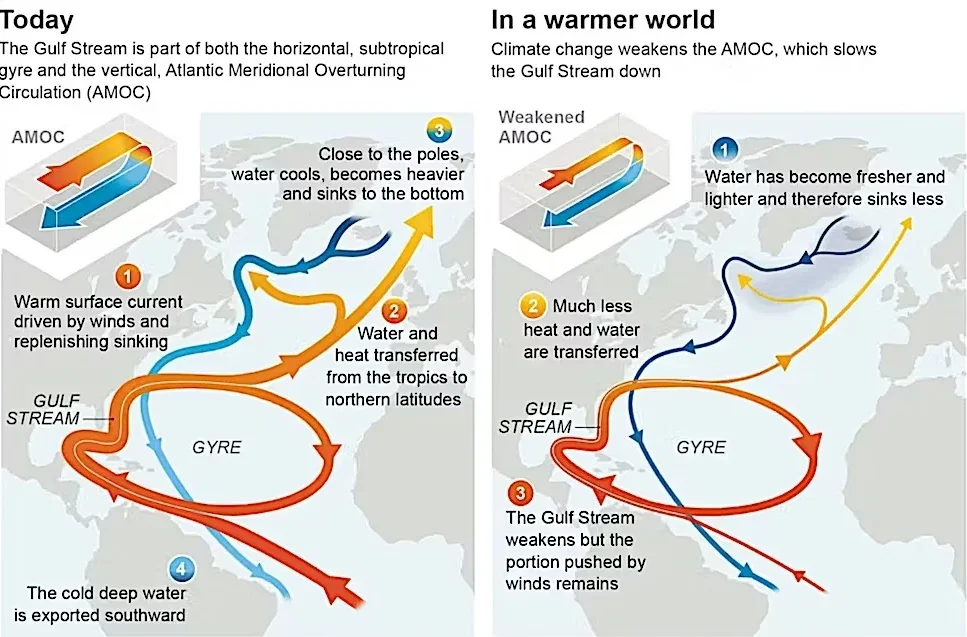
    What is AMOC?

    • Overview: It is a large system of ocean currents, part of the thermohaline circulation (THC) or global ocean conveyor belt.
    • Function: Moves warm tropical surface waters northward.
    • Deep Currents: In the North Atlantic, cooled water sinks and flows back south as deep currents.
    • Global Link: Connected to the Antarctic Circumpolar Current, making it part of a worldwide circulation system.
    • Key Role: Distributes heat and nutrients across the world’s oceans.

    Collapse of Atlantic Meridional Overturning Circulation (AMOC)

    Why is AMOC slowing down?

    • Melting Ice Sheets: Greenland and Arctic ice melt releases freshwater, lowering seawater density, preventing sinking, and weakening circulation.
    • Indian Ocean Warming (2019 Study): Extra rainfall in the Indian Ocean reduces rainfall in the Atlantic.
    • Temporary Boost: Atlantic water becomes saltier, sinks faster, giving AMOC short-term strengthening.
    • Future Outlook: Effect fades once Pacific and other oceans catch up in warming.
    • Climate Models: Predict a 34–45% weakening of AMOC by 2100 under continued global warming.

    What happens if AMOC collapses?

    • Severe Cooling: Europe and the North Atlantic would face strong cooling.
    • Rainfall Reduction: Decline in rainfall over Europe.
    • ENSO Impact: Altered El Niño–Southern Oscillation patterns.
    • Sea Ice Expansion: Increase in Greenland–Iceland–Norwegian seas.
    • Rain-belt Shift: Southward movement over the tropical Atlantic.
    • Long-term Impact: Global climate instability with regional extremes.
    [UPSC 2012] Consider the following factors:

    1. Rotation of the Earth 2. Air pressure and wind 3. Density of ocean water 4. Revolution of the Earth

    Which of the above factors influence the ocean currents?

    Options: (a) 1 and 2 Only (b) 1, 2 and 3* (c) 1 and 4 (d) 2, 3 and 4


  • [pib] Adi Vaani App: India’s First Tribal AI Translator

    Why in the News?

    The Ministry of Tribal Affairs has launched the Beta Version of “Adi Vaani”, India’s first AI-based translator for tribal languages.

    About Adi Vaani:

    • What is it: India’s first AI-powered translator for tribal languages.
    • Launch: Released in Beta Version (2025) by the Ministry of Tribal Affairs.
    • Inception: Developed under Janjatiya Gaurav Varsh to empower tribal communities and safeguard endangered tribal languages.
    • Created by: A team led by IIT Delhi with BITS Pilani, IIIT Hyderabad, IIIT Nava Raipur, and Tribal Research Institutes.
    • Impact: Strengthens digital literacy, ensures inclusive governance, preserves cultural identity, and positions India as a global leader in AI for endangered languages.

    Key Features:

    • Translation Modes: Text-to-Text, Text-to-Speech, Speech-to-Text, and Speech-to-Speech.
    • Languages (Beta): Santali, Bhili, Mundari, and Gondi. Kui and Garo to be added next.
    • AI Models: Based on NLLB (No Language Left Behind) and IndicTrans2, adapted for low-resource languages.
    • Community-Driven: Data collected, validated, and iteratively developed by local experts and Tribal Research Institutes.
    • Toolkit Additions: OCR for digitizing manuscripts, bilingual dictionaries, and curated repositories.
    [UPSC 2020] With the present state of development, Artificial Intelligence can effectively do which of the following?

    1. Bring down electricity consumption in industrial units 2. Create meaningful short stories and songs

    3. Disease diagnosis 4. Text-to-Speech Conversion

    5. Wireless transmission of electrical energy

    Options: (a) 1, 2, 3 and 5 only (b) 1, 3 and 4 only* (c) 2, 4 and 5 only (d) 1, 2, 3, 4 and 5


  • Species: Indian Rosewood (Dalbergia latifolia)

    Why in the News?

    The Indian Rosewood (Dalbergia latifolia) species is under threat as Tamil Nadu allowed the lapse of the Rosewood Conservation Act (1995–2025).

    Species: Indian Rosewood (Dalbergia latifolia)
    Indian Rosewood (Dalbergia latifolia)

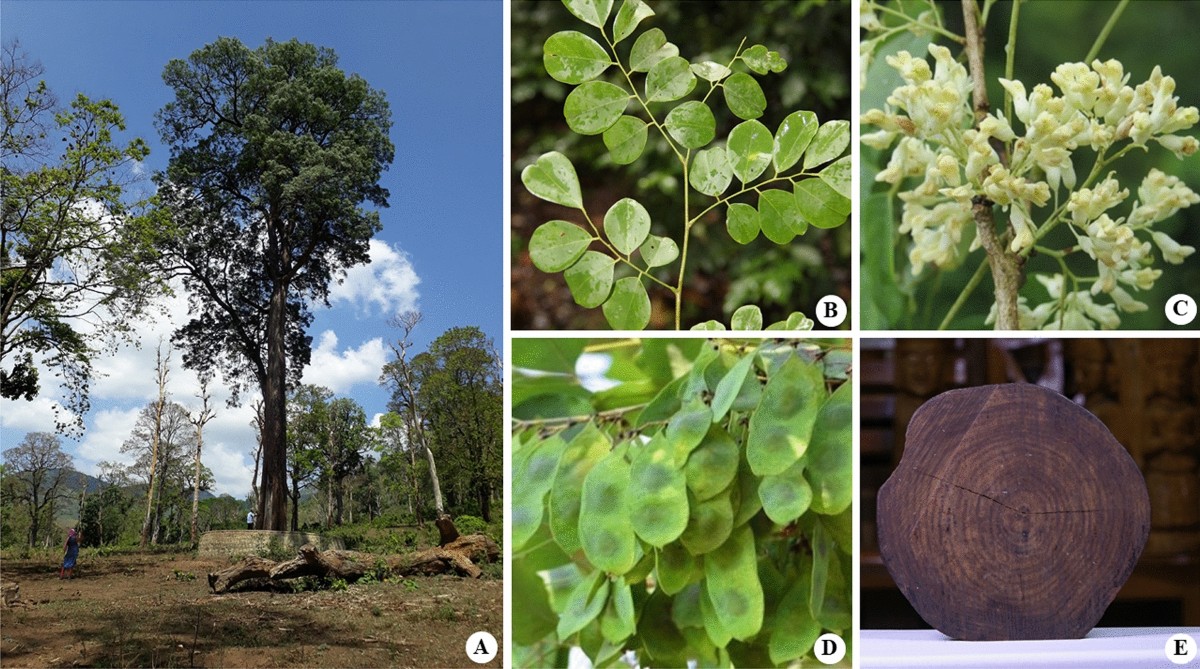
    About Indian Rosewood (Dalbergia latifolia):

    • Type: Tall deciduous or semi-evergreen tree reaching up to 40 metres.
    • Native Range: Nilgiris, Anamalai, and Parambikulam ranges of Tamil Nadu; also found in parts of Southeast Asia.
    • Adaptation: Thrives in tropical monsoon climates; considered drought hardy.
    • Wood Characteristics: Heartwood ranges from golden brown to purplish-brown with darker streaks, releasing a rose-like scent when worked.
    • Durability: Fine-grained, resistant to rot and insects; known as the “ivory of the forests.”
    • Uses: Premium furniture, cabinetry, decorative veneers, and musical instruments.
    • Conservation Status:
      • Classified as Vulnerable by IUCN since 2018.
      • Included under Appendix II, regulating international trade through permits.

    Legal Protection:

    • Indian Framework: Covered under the Indian Forest Act, 1927, regulating felling, harvest, and transport of timber.
    • Tamil Nadu Law (1995):
      • Prohibited cutting without government permission; extended in 2010 for 15 years.
      • Act lapsed in February 2025, exposing privately owned rosewood trees, especially in Nilgiri tea plantations, to felling.
    [UPSC 2007] Dalbergia species is associated with which one of the following?

    Options: (a) Cashew nut (b) Coffee (c) Tea (d) Rosewood*


  • Why are Killer Whales offering fresh prey to humans?

    Why in the News?

    A new study in the Journal of Comparative Psychology documents rare instances of Killer Whales (Orcinus orca) sharing freshly killed prey with humans.

    Why are Killer Whales offering fresh prey to humans?

    About Killer Whales (Orcinus orca):

    • Overview: Largest member of the dolphin family (Delphinidae), often called “wolves of the sea”.
    • Apex predators: At the top of the marine food chain.
    • Physical traits:
      • Black dorsal side, white underside, distinctive eye patch, saddle patch behind dorsal fin.
      • Can grow up to 9 m, weigh over 5,000 kg, and swim up to 54 km/hr.
    • Social structure: Live in pods led by a matriarch; highly coordinated hunters using complex tactics.
    • Distribution: Found in all oceans worldwide, from polar to tropical seas, in both open and coastal waters.
    • IUCN – Data Deficient: But many regional populations face threats from climate change, prey decline, and pollution.

    Why do they offer their fresh prey to humans?

    • Study Findings (2004–2024):
      • Killer whales were observed offering whole prey to humans (fish, birds, mammals, etc.) in multiple oceans.
      • In most cases, they waited for a human response before reclaiming or abandoning prey.
    • Possible Reasons:
      • Exploration/Curiosity: Reflects their advanced cognition and social curiosity; a way to learn about humans.
      • Prosocial Behaviour: They are among the few species that share food within and outside their groups.
      • Play Theory Rejected: Behaviour not limited to juveniles; adults also involved, often with whole prey.
      • Scientific Thinking Analogy: Behaviour resembles “asking questions” and testing human reactions — a form of exploratory intelligence.
      • Machiavellian Behaviour: Could sometimes be manipulative, as killer whales are known to steal fish and disrupt vessels.
    [UPSC 2023] Which one of the following makes a tool with a stick to scrape insects from a hole in a tree or a log of wood?

    Options: (a) Fishing cat (b) Orangutan * (c) Otter (d) Sloth bear


  • Fireflies emerge as Ecological Indicators

    Why in the News?

    A recent study in Tamil Nadu documented multiple firefly species and highlighted their role as ecological indicators of habitat health.

    About Fireflies and their behaviour traits:

    • Identity: Bioluminescent beetles (not true flies) of the family Lampyridae.
    • Life Cycle: Larvae live in soil/leaf litter feeding on snails and worms; adults emerge after rains and live briefly to reproduce.
    • Indian Species: Abscondita chinensis, Luciola ovalis, Luciola nicolleri, Asymmetricata humeralis, Pyrocoelia analis.
    • Distribution: Found in tropical and temperate regions; most visible on humid monsoon nights.
    • Bioluminescence: Glow produced in abdominal light organ using luciferin, luciferase, oxygen, and ATP.
    • Light Nature: Cold and efficient, colours vary between green and yellow depending on species.
    • Courtship Function: Flashing used as mating signal; males emit species-specific codes, females respond if correct.

    Ecological Role and Conservation Significance:

    • Sensitivity: Strongly affected by pesticides, habitat loss, artificial lights, and polluted water.
    • Habitat Health Indicator: Large synchronised gatherings reflect intact ecosystems; sparse numbers signal disturbance.
    • Light Pollution Impact: Artificial lighting disrupts flashing, forcing males to waste energy and reducing mating success.
    • Local Evidences: Communities like the Malasar and Irula report declines linked to pesticides and polluted streams.
    • Indicator Role: Act as proxy species for nocturnal biodiversity, signalling risks to moths, bats, and amphibians.
    [UPSC 2024] Which one of the following shows a unique relationship with an insect that has coevolved with it and that is the only insect that can pollinate this tree?

    Options: (a) Fig* (b) Mahua (c) Sandalwood (d) Silk cotton


  • [30th August 2025] The Hindu Op-ed: In an unstable world, energy sovereignty is the new oil

    PYQ Relevance

    [UPSC 2017] The question of India’s Energy Security constitutes the most important part of India’s economic progress. Analyze India’s energy policy cooperation with West Asian countries.

    Linkage: India’s past dependence on West Asia for over 60% of crude made energy security central to its economic stability, but the share has now reduced to under 45% through diversification. The article highlights how geopolitical flashpoints and chokepoints like Hormuz expose the risks of over-reliance on West Asia. Thus, India’s emerging doctrine of energy sovereignty through five domestic pillars complements but does not replace the strategic need for balanced cooperation with West Asian suppliers.

    Mentor’s comment

    Energy defines the destiny of nations. While oil shaped the geopolitics of the 20th century, uninterrupted, affordable, and indigenous energy will decide the balance of power in the 21st. For India, a country importing over 85% of its crude and more than 50% of its natural gasenergy dependence is not just an economic statistic but a national security liability. In an era of wars, fragile supply chains, and volatile prices, the debate is no longer about transition versus fossil fuel dependence. It is about energy sovereignty as the foundation of survival and strategic autonomy.

    Introduction

    India’s dependence on imported energy is a national vulnerability, with crude oil and natural gas alone forming nearly one-fourth of merchandise imports. While discounted Russian oil has provided temporary relief, heavy reliance on any single source magnifies strategic risks. In a fragile global environment, energy sovereignty is no longer an economic choice but a survival imperative.

    Energy Sovereignty as India’s New National Imperative

    • Import Dependence: Over 85% crude oil and 50% natural gas imports expose India’s economy to global shocks.
    • Economic Burden: Energy imports worth $170 billion (25% of total imports) destabilise the rupee and worsen the trade deficit.
    • Geopolitical Vulnerability: Russian oil now forms 35–40% of India’s imports, compared to just 2% pre-2022. Overdependence on one partner creates strategic risks.
    • Global Flashpoints: Near-conflict between Israel and Iran in June 2025 threatened 20 million barrels/day of global oil flows enough to push Brent crude above $103/barrel within days.
    • Fragile Transition: Despite global rhetoric, fossil fuels still supply 80% of primary energy; premature phase-outs, like Spain-Portugal’s 2025 blackout, prove the risks of over-reliance on intermittent renewables.

    Global Energy Shocks and the Lessons for India

    • 1973 Oil Embargo: Quadrupling of oil prices exposed Western overdependence on OPEC, prompting strategic reserves and diversified sourcing.
    • 2011 Fukushima Disaster: A nuclear meltdown stalled nuclear expansion, but the rise of coal/gas revived emissions. Nuclear energy is now regaining ground as a zero-carbon baseload.
    • 2021 Texas Freeze: Pipeline freezes and turbine failures highlighted the danger of cost-driven systems lacking resilience and weather-proofing.
    • 2022 Russia-Ukraine War: Europe’s 40% gas dependence on Russia ended abruptly, forcing record LNG prices and coal revival.
    • 2025 Iberian Blackout: Grid collapse in Spain-Portugal proved the risk of over-reliance on renewables without dispatchable backup.

    The Five Pillars of India’s Energy Sovereignty

    1. Coal Gasification for Indigenous Energy:
      • India has 150 billion tonnes of coal reserves, long sidelined due to high ash content.
      • Technologies like carbon capture and gasification can convert coal into syngas, methanol, hydrogen, and fertilizers.
      • Unlocking this potential ensures domestic supply security while reducing import dependence.
    2. Biofuels: Rural Empowerment Meets National Security:
      • Ethanol blending programme transferred over ₹92,000 crore to farmers, reduced crude imports, and saved foreign exchange.
      • With the E20 blending target, rural incomes will expand further.
      • SATAT scheme supports compressed biogas (CBG) plants, producing clean fuel and bio-manure with 20–25% organic carbon.
      • Vital for restoring soils in North India where organic carbon has dropped to 0.5% (vs healthy 2.5%).
    3. Nuclear Power for Dispatchable Zero-Carbon Future:
      • India’s nuclear capacity remains stagnant at 8.8 GW.
      • Thorium roadmap, uranium partnerships, and Small Modular Reactors (SMRs) are essential to create a baseload backbone for a renewable-heavy grid.
    4. Green Hydrogen as Strategic Technology:
      • Target: 5 million metric tonnes annually by 2030.
      • Requires domestic electrolyser manufacturing, catalysts, and storage systems.
      • The goal is not just production, but sovereign hydrogen value chains.
    5. Pumped Hydro as Grid Inertia Backbone:
      • Complements solar/wind by offering storage and grid balancing.
      • India’s topography provides vast potential for durable, scalable pumped hydro projects.

    India’s Shift Towards a Diversified Energy Strategy

    1. Reduced West Asia dependence: Crude sourcing from West Asia fell from 60% to under 45%, as per S&P Global.
    2. Diversification of partners: Russia has emerged as a key supplier, but long-term strategy aims at broad-based imports plus indigenous production.
    3. Energy Realism: India recognises transition as a pathway, not a switch. Security and resilience are prerequisites to climate ambition.

    Conclusion

    The 20th century was dominated by oil politics; the 21st will be shaped by energy sovereignty. India’s vulnerability due to high imports, volatile supply chains, and geopolitical risks makes domestic capacity building non-negotiable. Coal gasification, biofuels, nuclear, green hydrogen, and pumped hydro form the sovereign spine of a resilient energy future. The Israel-Iran ceasefire is a reminder: India must act during stability, not after a crisis. Energy sovereignty is no longer a policy choice, it is the foundation of survival, resilience, and strategic autonomy.

  • Detoxifying India’s entrance examination system

    Introduction

    Entrance examinations in India were envisioned as a filter for talent, ensuring merit-based access to elite institutions. However, over time, they have morphed into an industry-driven rat race. From ₹7 lakh coaching fees to student suicides, the costs are both economic and human. With growing disparities in access, an illusory notion of meritocracy, and mounting psychological toll, rethinking admissions is not a choice but a necessity.

    The Coaching Crisis and Its Toll

    1. Massive Aspirant Pool: Over 15 lakh students appear for JEE alone, making coaching almost unavoidable.
    2. High Costs: Coaching fees of ₹6–7 lakh for two years price out poor students.
    3. Early Sacrifices: Students as young as 14 years study Irodov & Krotov (beyond B.Tech level), sacrificing holistic growth.
    4. Mental Health Crisis: Rising stress, depression, alienation; some governments now regulate coaching centres.
    5. Core Issue: The examination system itself is flawed, creating overqualified candidates and distorted merit.

    Why Meritocracy is an Illusion

    1. Tiny Differences, Big Stakes: Distinguishing between 91% vs 97% in Class 12, or 99.9 percentile in JEE is unreasonable.
    2. Adequate Benchmark Exists: A 70–80% score in Physics, Chemistry, Mathematics is sufficient for B.Tech readiness.
    3. False Hierarchies: Overemphasis on marginal score differences creates elitism and exclusion.
    4. Privilege Bias: Wealthier families access top coaching, creating an illusory meritocracy.
    5. Philosophical Insight: Harvard’s Michael Sandel critiques meritocratic obsession, proposing lotteries for elite admissions.

    Global Inspirations for Reform

    1. Dutch Lottery System:
      • Introduced in 1972, reinstated in 2023 for medical school.
      • Weighted lottery: minimum eligibility required, higher grades = higher chances.
      • Promotes diversity, fairness, and reduced pressure.
    2. China’s “Double Reduction Policy” (2021):
      • Banned for-profit coaching overnight.
      • Reduced financial burden and youth stress.
      • Addressed unchecked growth of the coaching industry.

    Proposed Solutions for India

    1. Lottery-based Allocation:
      • Threshold of 80% in PCM for eligibility.
      • Weighted lottery with categories (90%+, 80–90%): A weighted lottery with categories (90%+, 80–90%) means all eligible students enter a lottery, but those with higher marks get proportionally better chances of selection.
      • Reservations integrated (gender, rural, region).
    2. Rural Empowerment: 50% IIT seats for rural govt school students to promote social mobility.
    3. Coaching Reform: Ban/nationalise coaching, provide free online lectures & study material.
    4. Diversity & Integration: Student exchange between IITs to break hierarchies.
    5. Faculty transfers to standardise academic quality.

    Conclusion

    India’s choice is stark: continue a toxic rat race that scars its brightest minds, or embrace a fair, equitable system that nurtures youth. Scrapping or reforming entrance exams through lotteries, trust in Class 12 boards, rural reservations, and coaching reforms can detoxify the system. The aim must not only be producing engineers and doctors but ensuring the emotional, social, and moral growth of India’s future citizens.

    Value Addition

    Committee Recommendations & Policy Inputs

    • Radhakrishnan Commission (1948–49) – Stressed on reducing rote-based entrance exams and aligning admissions with broader educational goals.
    • Kothari Commission (1964–66) – Recommended a common school system to minimise disparities in access, echoing today’s concerns about coaching and inequality.
    • National Knowledge Commission (2005) – Suggested multiple modes of testing and reducing dependence on a single high-stakes exam.
    • Yashpal Committee (2009) – Criticised the “overburden of entrance exams” and highlighted the need for a more holistic, less mechanical admission process.
    • NEP 2020 – Calls for a holistic and flexible education system, moving away from rote-based, high-pressure exams towards fairer assessment models.

    PYQ Relevance

    [UPSC 2024] What are the aims and objectives of the recently passed and enforced, The Public Examination (Prevention of Unfair Means) Act, 2024? Whether University/State Education Board examinations, too, are covered under the Act?

    Linkage: The Public Examination (Prevention of Unfair Means) Act, 2024 seeks to curb frauds like paper leaks and impersonation to restore exam credibility. The article extends this concern by highlighting systemic unfairness — coaching dependence, stress, and privilege-driven access. Together, they underline that ensuring fairness in exams requires not just legal safeguards but also structural reforms in India’s entrance system.

  • ClassGPT: How AI is reshaping campuses

    Introduction

    Artificial Intelligence (AI), particularly generative models like ChatGPT and Gemini, has become both a boon and a challenge in higher education. Students increasingly rely on AI for assignments, summaries, coding, and even emails, while faculty members grapple with maintaining originality, academic honesty, and critical thinking. With AI growing faster than existing regulatory or pedagogical frameworks, Indian institutions are experimenting with varied approaches, ranging from outright bans to integration into curricula. The choices made today will determine not just the future of learning but also India’s knowledge economy and workforce readiness.

    The Changing Landscape of Education with AI

    How widespread is AI usage among students and teachers

    1. IIT Delhi Survey (2024): Four out of five students admitted to using AI, often several times a week. One in ten subscribed to premium versions.
    2. Faculty usage: 77% of surveyed teachers used AI for summarising papers, creating slides, or drafting communication.
    3. Student motivations: Simplification of concepts, summarisation of material, mind maps, and scenario simulations.
    4. Concerns: Errors in math, flawed debugging, weak context handling.

    The integrity dilemma in classrooms

    1. Blurred lines: Students question whether using AI counts as “cheating” or “time-saving.”
    2. Academic honesty: IIT Delhi’s committee recommended rewriting plagiarism policies to require disclosure of AI use.
    3. Critical thinking loss: Faculty fear students may accept AI answers as “Truth” without questioning them.

    Institutional responses in India

    • Policy innovations:
      1. IIT Delhi – integration of AI/ML in curricula, AI workshops, campus-wide licenses.
      2. IIIT Delhi – shifted evaluation to 90% exams, 10% assignments.
      3. IIM Ranchi – evaluation rubric for responsible AI integration.
      4. Shiv Nadar University – five-level “Gen AI Assessment Scale” from prohibition to responsible autonomy.
      5. Ashoka University – AI literacy courses, foundation modules, ethics of AI curriculum.
      6. Strict resistance: Some universities (Delhi University’s Dept. of Education) enforce “No AI” policies, insisting on handwritten assignments.
    • Pedagogical experiments with AI
      1. Classroom integration: AI tools are increasingly used to automate routine tasks like code generation, freeing classroom time for higher-order problem-solving.
      2. Assessment innovation: Institutions are shifting towards interactive methods such as AI-assisted viva voce, project-based evaluation, and scenario testing to ensure genuine understanding.
      3. Ethics in curriculum: Courses on “Ethics of AI” and AI literacy modules are being introduced to sensitise students towards responsible and transparent usage.
      4. Balanced usage: AI is deployed after core concepts are taught, ensuring students retain critical thinking and do not outsource judgment entirely.

    Global responses and comparative perspectives

    1. USA: Princeton provides ChatGPT licenses; Oxford mandates disclosure but allows professors to decide; assignments redesigned to integrate AI.
    2. Australia: TEQSA guidelines legitimise AI but require mandatory disclosure; oral exams and viva voce are making a comeback.
    3. UK: Universities pilot TeacherMatic to ensure sector-wide learning models.

    Conclusion

    Generative AI has irreversibly entered the Indian classroom. The challenge is not whether to allow or ban it but how to regulate, integrate, and ethically harness it. From IITs’ committees to global universities’ adaptive models, the world is learning that AI can either weaken critical thinking or be a catalyst for higher-order learning. For India, the stakes are especially high: with its demographic dividend and growing tech economy, how students learn today will define the nation’s competitiveness tomorrow.

    Value Addition

    Real-Time Usage of AI in Education

    1. Adaptive Learning Platforms : AI customises lesson plans, adjusting pace and difficulty based on student performance, ensuring personalised learning outcomes.
    2. Automated Assessment and Feedback : AI evaluates tests, essays, coding tasks, and provides instant feedback, saving teacher time and helping students improve faster.
    3. Language Translation and Accessibility : Real-time translation, speech-to-text, and text-to-speech tools remove linguistic barriers, supporting multilingual and differently-abled learners.
    4. AI-Powered Virtual Tutors : Chatbots and digital assistants are available 24×7 to clarify doubts, simulate problem-solving, and provide personalised tutoring.
    5. Plagiarism and Academic Integrity Checks : AI tools detect plagiarism and even AI-generated content, ensuring transparency and originality in student submissions.
    6. Immersive Learning with AI + AR/VR : Virtual labs and simulations powered by AI allow safe, hands-on learning in science, medicine, and engineering.
    7. Administrative Automation : AI automates attendance, timetabling, grading records, and performance monitoring, reducing non-teaching workload for faculty.
    8. Industry 4.0 Skill Development : AI-based coding assistants, real-time debugging, and project simulators prepare students for jobs in data science, robotics, and emerging tech.

    PYQ Relevance

    [UPSC 2023]  Introduce the concept of Artificial Intelligence (AI). How does AI help clinical diagnosis? Do you perceive any threat to privacy of the individual in the use of AI in the healthcare?

    Linkage: AI’s growing role in education parallels its use in healthcare, where it aids efficiency but raises ethical and privacy concerns. Just as AI in clinical diagnosis demands accuracy, transparency, and accountability, AI in classrooms requires disclosure, integrity, and critical oversight. Both contexts highlight the larger governance challenge of balancing innovation with responsibility.