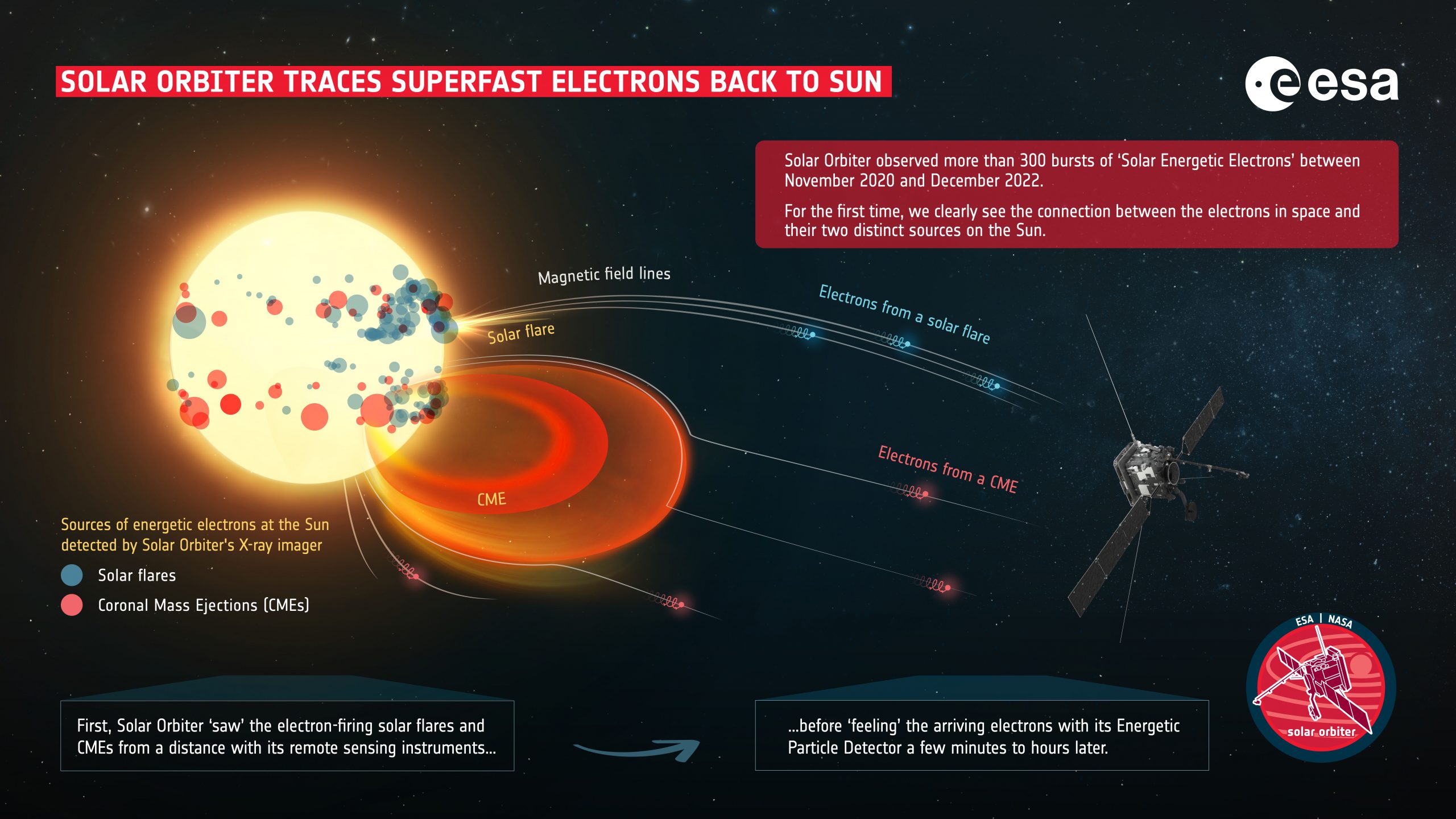
The NASA-ESA Solar Orbiter Mission has recently traced the origin of Solar Energetic Electrons (SEE), advancing knowledge of solar activity and space weather.
AboutNASA–ESA Solar Orbiter Mission:
Launch & Cost: Launched in Feb 2020 on an Atlas V from Cape Canaveral; joint ESA–NASA mission worth $1.5 billion.
Duration: Primary mission till 2026, extendable to 2030.
Orbit: Highly eccentric, approaching 0.28 AU (inside Mercury’s orbit); gradually tilts to image Sun’s poles.
Payload: 10 instruments — both in-situ (solar wind, magnetic fields, particles) and remote sensing (imaging, spectroscopy).
Firsts & Objectives: First to image solar poles; aims to study solar wind origin, solar cycle dynamics, causes of flares/CMEs, and their impact on heliosphere & space weather.
What are Solar Energetic Electrons (SEE)?
What are they: Streams of high-energy electrons released into space, travelling across the heliosphere.
Sources: Emerge from solar flares (sudden surface bursts) and coronal mass ejections (CMEs) (plasma + magnetic eruptions).
Patterns: Release not always immediate; often delayed by hours due to turbulence/scattering in interplanetary medium.
Solar Orbiter Observations: Detected 300+ bursts (2020–22), clearly linking SEE to solar flares/CMEs for the first time.
The Dongar cultivation, a hill-slope mixed cropping system of the Kondh tribals in Odisha’s Rayagada is now under decline due to eucalyptus monoculture.
What is Dongar Cultivation?
Overview: A traditional shifting/mixed cropping system practised on hill slopes (uplands) by the Kondh tribal community in Odisha.
Crops grown: Millets (finger millet, foxtail millet), pulses, oilseeds, and even uncultivated foods like wild tubers.
Benefits offered: Provides nutritional diversity, supports birds and biodiversity, and maintains soil fertility without chemical inputs.
Cultural practice: Linked to seed conservation, labour exchange, and community-based farming traditions, reflecting a holistic tribal food system.
Significance: Its poly-cropping nature makes it more resilient to rainfall variability and climate shocks, unlike monocultures.
Intensive valley wetland system; combines paddy farming with fish rearing; highly sustainable and productive.
[UPSC 2018] With reference to the circumstances in Indian agriculture, the concept of “Conservation Agriculture” assumes significance. Which of the following fall under the Conservation Agriculture?
1. Avoiding the monoculture practices
2. Adopting minimum tillage
3. Avoiding the cultivation of plantation crops
4. Using crop residues to cover soil surface
5. Adopting spatial and temporal rop sequencing/crop rotations.
Select the correct answer using the code given below:
Options: (a) 1, 3 and 4 (b) 2, 3, 4 and 5 (c) 2, 4 and 5 (d) 1, 2, 3 and 5*
Matanomadh in Kutch, Gujarat, with jarosite deposits like those on Mars, is being considered by ISRO as a test site for future Mars missions.
What is Jarosite?
Composition: A yellow, iron-rich sulphate mineral containing iron, sulphur, oxygen, and potassium.
Formation: Develops when volcanic ash or sulphur-bearing minerals chemically react with water, making it a marker of past water–rock interaction.
Discovery in India: Reported in 2016 at Matanomadh, Kutch (Gujarat) by ISRO’s Space Applications Centre; also found at Varkala cliffs, Kerala. Kutch is more suitable for planetary research.
Martian Link: Detected in 2004 by NASA’s Opportunity Rover. This referred as terrestrial clone of Martian surface.
Global Occurrence: Found in Mexico, Spain, Canada, Japan, and the USA (Utah, California), all serving as Mars analogue sites.
Matanomadh’s Significance for Mars Study:
Mars Analogue Value: Geological dating shows deposits about 55 million years old (Paleocene period), resembling early Martian conditions.
Test Bed for ISRO: Provides ground for testing rover mobility, drilling systems, geochemical studies, and remote sensing for Mangalyaan-2 and future missions.
Astrobiology Potential: Since jarosite can trap organic molecules, it helps in shaping strategies to search for signs of past life on Mars.
Complement to Ladakh: While Ladakh sites simulate Martian climate, Matanomadh represents Martian geology and mineralogy, creating a comprehensive Mars-analogue ecosystem in India.
Conservation Importance: Facing threats from waterlogging and coal mining; scientists urge its declaration as a Planetary Geo-heritage Site.
Strategic Edge: Strengthens India’s role in planetary exploration, astrobiology research, and international collaborations.
[UPSC 2016] Consider the following statements:
1. The Mangalyaan launched by ISRO
2. is also called the Mars Orbiter Mission
3. made India the second country to have a spacecraft orbit the Mars after USA
4. made India the only country to be successful in making its spacecraft orbit the Mars in its very first attempt
Which of the statements given above is/are correct?
(a) 1 only (b) 2 and 3 only (c) 1 and 3 only * (d) 1, 2 and 3
A powerful earthquake in Afghanistan killed at least 800 people and injured thousands, highlighting the country’s extreme vulnerability to seismic hazards.
Why is Afghanistan so prone to Earthquakes?
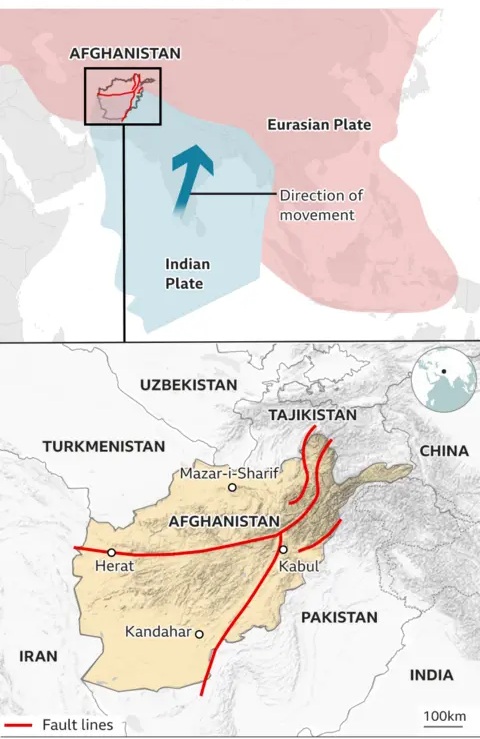
Geological Setting: Afghanistan lies in the Hindu Kush mountains, part of the Alpide Belt, the world’s second most seismically active belt after the Circum-Pacific.
Tectonic Origin: The Alpide Belt was formed by the closure of the Tethys Ocean, following the collision of the African, Arabian, and Indian Plates with the Eurasian Plate.
Ongoing Collision: The Indian Plate’s continued movement into the Eurasian Plate builds mountain ranges (Himalayas, Hindu Kush) and drives strong seismic activity.
Seismic Characteristics: Afghanistan experiences both shallow-focus earthquakes (0–70 km depth) causing major destruction and rare deep-focus quakes (up to 200 km) unique to the Hindu Kush.
Fault Structures: Major faults occur where the Indian and Eurasian Plates meet, making Afghanistan heavily fractured and highly vulnerable to tremors.
Where do Afghanistan’s Earthquakes occur?
Hindu Kush Region (Northern Afghanistan): Produces both shallow and deep-focus quakes due to the Indian Plate’s lithosphere sinking into the mantle, making it one of the world’s most unique seismic zones.
Sulaiman Range (SE Afghanistan & Western Pakistan): Known for shallow, thrust fault quakes, often destructive at the surface.
Main Pamir Thrust Zone: Another hotspot for shallow, surface-level earthquakes that cause high damage.
Overall Vulnerability: These regions together make Afghanistan one of the most earthquake-prone countries, with repeated deadly events since the 1990s.
[UPSC 2023] Consider the following statements:
1. In a seismograph, P waves are recorded earlier than S waves.
2. In P waves, the individual particles vibrate to and fro in the direction of waves propogation whereas in S waves, the particles vibrate up and down at right angles to the direction of wave propagation.
Which of the statements given above is/are correct?
Options: (a) 1 only (b) 2 only (c) Both 1 and 2 * (d) Neither 1 nor 2
The Supreme Court has referred to a larger Bench the question of whether Minority Educational Institutions (MEIs) are completely exempt from the purview of the Right to Education (RTE) Act, 2009.
About Minority Educational Institutions (MEIs):
Constitutional Basis:
Article 30(1) grants religious and linguistic minorities the right to establish and administer educational institutions of their choice.
Article 29 protects their cultural and educational rights.
Legal Framework:
Defined under the National Commission for Minority Educational Institutions (NCMEI) Act, 2004.
The NCMEI adjudicates disputes, grants recognition, and safeguards the autonomy of such institutions.
Recognized Minority Communities: Muslims, Christians, Sikhs, Buddhists, Jains, and Zoroastrians (Parsis) are notified as minorities by the Government of India.
Judicial Principles:
In T.M.A. Pai Foundation vs. State of Karnataka (2002), SC held that minority status is determined state-wise, not nationally.
Minority institutions can reserve seats for their community and enjoy greater control over administration and recruitment.
Purpose and Role:
Preserve the cultural, linguistic, and religious heritage of minority groups.
Provide quality education with constitutional protection from excessive state interference.
What is the Right to Education (RTE) Act, 2009?
Genesis: Stemming from Unnikrishnan vs. State of Andhra Pradesh (1993), where SC declared education as a Fundamental Right under Article 21.
Later given constitutional backing through the 86th Amendment Act (2002), which inserted Article 21A – free and compulsory education for children aged 6–14 years.
Enactment: To operationalize Article 21A, Parliament passed the Right of Children to Free and Compulsory Education Act, 2009.
Key Provisions:
Free and compulsory education for all children aged 6–14 in a neighbourhood school.
25% reservation in private schools for children from disadvantaged groups and weaker sections.
No detention, expulsion, or board exams up to Class VIII (amended in 2019 to allow states discretion).
Teacher norms: TET (Teachers Eligibility Test) qualification mandatory; ban on private tuitions by teachers.
School Management Committees (SMCs): Parents, local authority reps, and teachers oversee school functioning.
Curriculum & Standards: Developed by an academic authority (often NCERT/SCERT).
Amendments:
2012: Included children with disabilities; exempted minority/religious institutions.
2019: Abolished uniform “no-detention policy,” left to states’ choice.
[UPSC 2018] Consider the following statements:
1. As per the Right to Education (RTE) Act, to be eligible for appointment as a teacher in a State, a person would be required to possess the minimum qualification laid down by the concerned State Council of Teacher Education.
2. As per the RTE Act, for teaching primary classes, a candidate is required to pass a Teacher Eligibility Test conducted in accordance with the National Council of Teacher Education guidelines.
3. In India, more than 90% of teacher education institutions are directly under the State Governments
Which of the statements given above is/are correct?
Options: (a) 1 and 2 (b) 2 only* (c) 1 and 3 (d) 3 only
The Supreme Court intervened after Tamil Nadu faced ₹3,000+ crore reimbursements to private schools for economically disadvantaged students’ admissions, as the Centre declined to share costs under Samagra Shiksha.
About Samagra Shiksha Abhiyan:
Launch & Integration: Started in 2018 (by then Ministry of HRD), integrating Sarva Shiksha Abhiyan (SSA), Rashtriya Madhyamik Shiksha Abhiyan (RMSA), and Teacher Education (TE) into one holistic programme.
Benchmark Feature: Treats schooling as a continuous system from pre-primary to Class XII (ages 4–18), removing silos.
Funding Pattern: A Centrally Sponsored Scheme (CSS) with Centre–State sharing (60:40, 90:10 for NE/hilly states), implemented via a single State Implementation Society (SIS).
Policy Alignment: Aligned with NEP 2020 and UN SDG-4 (quality education).
Coverage: 1.16 million schools, 156+ million students, 5.7 million teachers across government & aided institutions.
Upgraded Phase: Samagra Shiksha 2.0 (2021–26) with focus on digital education, vocational training, FLN, and inclusion.
Key Features of the Scheme:
Unified Structure: One umbrella for pre-primary to Class XII, ensuring coherent planning.
Teachers & Technology:
Continuous teacher training via SCERTs, DIETs, NISHTHA, SWAYAM.
Digital initiatives: DIKSHA, Operation Digital Board, ICT labs, smart classrooms, AI-based learning tools.
Vocational & Skill Education: Subjects like coding, robotics, financial literacy, AI with 1000+ training centres (from Class VI).
Direct Benefit Transfers (DBT): Uniforms, textbooks, transport allowance directly credited via IT platforms.
Holistic Development: Integration of sports, physical education, self-defence, soft skills under Khelo India.
Funding Scale: Allocation crossed ₹41,000 crore (2025); nationwide coverage till March 2026 under Samagra Shiksha 2.0.
[UPSC 2017] What is the aim of the programme ‘Unnat Bharat Abhiyan’?
Options: (a) Achieving 100% literacy by promoting collaboration between voluntary organizations and government’s education system and local communities.
(b) Connecting institutions of higher education with local communities to address development challenges through appropriate technologies. *
(c) Strengthening India’s scientific research institutions in order to make India a scientific and technological Power.
(d) Developing human capital by allocating special funds for health-care and education of rural and urban poor, and organizing skill development programmes and vocational training for them.
Mothers are surviving births, yet hidden illnesses still stalk India’s women. UPSC usually turns such “population and health” themes into big GS 1 questions that ask “why” and “how,” much like the 2014 sex‑ratio poser that mixed prosperity with social bias; examiners expect you to go beyond numbers and trace deep causes and policy gaps. Many aspirants slip because they quote the falling MMR but ignore the silent crisis of anaemia or the uneven state data under “The Maternal Health Paradox: Falling MMR vs Rising Hidden Burdens” (Kerala MMR 19 vs Assam 195, anaemia 57%). They also forget to link welfare design flaws shown in “Disconnect Between Policy Success and Ground Realities” (institutional births 88.6% yet only 60% full ANC) and thus miss the continuity‑of‑care angle UPSC loves. This article rescues them by stitching both sides together: it pairs success metrics with unseen gaps, offers ready references like PMSMA coverage figures, and serves real solutions in “Way Forward” that move from delivery counts to healthy‑mother outcomes. Its standout gem is the “Back2Basics: Assessment of Maternal Health Governance” table, which condenses every key scheme—JSY cash support, LaQshya audits, Anaemia Mukt Bharat—into exam‑ready one‑liners you can drop as evidence. Read it once, and you have concept, critique, case studies, and policy toolkit all in one place.
PYQ ANCHORING
GS 1: Why do some of the most prosperous regions of India have an adverse sex ratio for women? Give your arguments. [2014]
MICROTHEME: Population and associated issues
India’s maternal health story today is one of striking contrast. On one hand, the country has made significant progress—its Maternal Mortality Ratio (MMR) dropped from 97 (2018–20) to 93 (2019–21), marking a steady improvement and moving closer to global targets. Yet, beneath this success lies a persistent crisis: over 57% of women of reproductive age suffer from undiagnosed anaemia (NFHS-5), a silent epidemic threatening both mothers and newborns.
This paradox—a falling MMR but a rising burden of hidden illness—raises urgent questions: Is India’s maternal health progress truly inclusive and sustainable? Can policy success coexist with widespread nutritional and diagnostic gaps?
The Maternal Health Paradox: Falling MMR vs Rising Hidden Burdens
Reason
Explanation
Substantiation
Success of Institutional Deliveries
Increased access to hospitals and trained personnel has reduced deaths during childbirth.
Institutional deliveries rose to 88.6% (NFHS-5), contributing to MMR decline.
Persisting Undernutrition & Anaemia
Nutritional deficiencies are chronic and underdiagnosed, especially in rural and poor women.
57% of women suffer from undiagnosed anaemia (NFHS-5); over 30% are underweight during pregnancy.
Health System Focused on Delivery, Not Continuum of Care
Focus remains on childbirth; less attention is paid to pre- and postnatal nutrition, diagnostics, and mental health.
Many women don’t receive full 4 antenatal checkups or follow-ups after delivery.
Uneven State Performance
National MMR averages hide wide interstate disparities. States like Kerala and Tamil Nadu show high performance, while others lag.
MMR: Kerala (19), Assam (195) – Sample Registration System, 2021.
Fragmented Data and Underdetection
Many cases of maternal morbidity (e.g., anaemia, hypertension, infections) remain unreported or poorly diagnosed.
Lack of routine haemoglobin testing in rural PHCs; poor data on postpartum complications.
Program Implementation Gaps
Schemes like PMSMA, Janani Suraksha Yojana often face manpower, funding, and awareness issues at the last mile.
Less than 30% of pregnant women covered under PMSMA (as per MoHFW 2022) in some districts.
This paradox shows that while India has moved the needle on survival, it is still struggling to ensure health, nutrition, and dignity for all mothers.
Here’s the content structured neatly into a table format with broader themes, causes, and examples — perfect for UPSC-style answers:
Disconnect Between Policy Success and Ground Realities in India’s Welfare Schemes
Broad Issue
Specific Causes
Example / Evidence
1. Design–Delivery Gap
a. Output-focused approach over outcome-based evaluation.
Institutional births at 88.6% (NFHS-5), yet 57% of women remain anaemic.
b. One-time delivery models with poor continuity of care.
Only ~60% of pregnant women receive full ANC (NFHS-5).
c. Uniform scheme design, poor contextualisation for diverse regions.
MGNREGA assets fail in flood-prone or tribal areas due to inappropriate planning.
2. Targeting and Access Issues
a. Outdated or flawed databases cause exclusion and inclusion errors.
SECC 2011 errors impact PDS and PM-KISAN targeting; genuine poor left out.
b. Digital divide restricts access to benefits.
Aadhaar-linked DBT failures in Jharkhand and Rajasthan disrupt MNREGA and pensions.
c. Socio-cultural barriers inhibit scheme utilisation.
Low hospital births among women in conservative rural belts despite full subsidies under JSY.
3. Governance & Coordination Gaps
a. Lack of convergence among departments handling linked services.
POSHAN Abhiyaan implementation suffers from poor coordination between WCD, Health, and Rural Development.
b. Weak monitoring, auditing, and grievance redressal mechanisms.
c. Populist policies prioritised over structural reforms.
Continuation of free ration (PMGKAY) while funding for anganwadis or school meals remains limited.
Local-level best practices
Several Indian states and districts have bridged the gap between access and quality in maternal health.
Tamil Nadu, with an MMR of just 54, has built a robust system through 99% institutional deliveries, the 108 ambulance network, HMIS-based risk tracking, and nutrition kits under the Dr. Muthulakshmi Reddy scheme. Its RCH programme ensures seamless care across ANC, delivery, and postnatal phases.
In Odisha’s tribal Malkangiri district, maternal mortality has halved. ASHAs are trained to test haemoglobin, track high-risk pregnancies digitally, and provide counselling. Localised incentives and cultural adaptation—ASHAs speaking tribal languages and accompanying women—have driven uptake.
Kerala’s Kudumbashree model leverages women’s self-help groups to deliver ANC, mental health counselling, and 100% immunisation. Community-led monitoring in tribal areas via mobile vans has made care both inclusive and accountable.
Chhattisgarh’s Janani Shishu Suraksha Yatra (JSSY) and Mitanin model raised institutional deliveries from 40% to 80%. Mitanins provide doorstep ANC, track danger signs, ensure nutrition, and refer mental health cases.
These models show that when delivery systems are community-driven, context-specific, and continuous—not just coverage-focused—India can overcome both mortality and morbidity challenges in maternal health.
Way Forward
Shift the metric: from “delivery counts” to “healthy mothers.” Track haemoglobin, BMI and mental-health scores alongside institutional-delivery data.
Localise nutrition action. Mandatory point-of-care anaemia testing at every ANC visit; millet-based THR (take-home rations); women-led farmer-producer co-operatives for iron-rich crops.
Close the quality loop in facilities. Kayakalp-style audits for labour rooms and post-natal wards; e-partographs and mandatory second-opinions for C-sections.
Universalise mental-health screening. Integrate PHQ-9 or EPDS tools into PMSMA; train ASHAs to identify red flags.
Data convergence & accountability. Link Poshan Tracker, HMIS and civil-registration data to a single dashboard; empower panchayat-level social audits.
#BACK2BASICS: ASSESSMENT OF MATERNAL HEALTH GOVERNANCE
What’s Driving India’s Decline in Maternal Mortality?
Driver
Key Action & Outcome
Incentivized Institutional Deliveries
Janani Suraksha Yojana (JSY) offers cash support for safe births — over 1 crore women benefited annually, with spending touching ₹1,814 crore in FY 2023–24.
Zero-Cost Maternal Care
Janani Shishu Suraksha Karyakram (JSSK) covers delivery, transport, diagnostics, and drugs — 1.36 crore women accessed services (Apr–Dec 2024).
High-Risk Pregnancy Tracking
PMSMA & e-PMSMA enable monthly ANC and digital tracking — 78.27 lakh high-risk cases identified till Dec 2024.
Improved Clinical Quality
LaQshya & SUMAN ensure respectful, high-standard care — 1,110 labour rooms, 808 maternity OTs certified; 47,700+ facilities covered under SUMAN.
Emergency & Critical Care Access
Over 400 Obstetric ICUs/HDUs and 650 MCH Wings with 42,000+ beds set up nationwide.
Trained Human Resources
Nationwide training of doctors and nurses — 2,518 EmOC doctors, 2,683 LSAS-trained, and 3.3 lakh SBAs deployed.
Real-Time Surveillance
MPCDSR & RCH Portal institutionalize digital maternal death reviews, replacing manual reporting for quicker response.
Key Maternal Health Programmes Under the National Health Mission (NHM)
Programme / Policy
Objective & Key Features
National Health Policy 2017
Targeted MMR <100 by 2020 — achieved with MMR now at 93 (SRS 2019–21).
SDG Target 3.1
Reduce MMR to ≤70 by 2030 — India on track.
JSY (2005)
Cash incentive for institutional deliveries — targeting SC/ST/BPL women.
PMMVY 2.0 (2022)
₹5,000 maternity benefit for first child; extra for second girl child — promoting positive gender norms.
JSSK (2011)
Free delivery (including C-section), transport, diagnostics, medicines, and diet in public hospitals.
SUMAN (2019)
Assures free, dignified, quality maternity care with zero denial.
PMSMA (2016)
Free ANC on 9th of each month; e-PMSMA tracks high-risk pregnancies — 5.9 crore+ women examined by March 2025.
LaQshya (2017)
Quality assurance in delivery rooms and OTs to reduce maternal and neonatal complications.
Anaemia Mukt Bharat (AMB)
Holistic anaemia reduction via testing, treatment, food fortification, and mass communication.
Infrastructure & Systems Strengthening
Initiative
Impact
Comprehensive Abortion Care (CAC)
Training + safe abortion access integrated into RMNCAH+N services.
Delivery Points & FRUs
Upgraded with equipment, drugs, trained staff, and referral linkages.
MCH Wings
Specialized maternal-child units built in high-caseload facilities.
Obstetric ICUs/HDUs
Critical care infrastructure scaled in tertiary centers for obstetric emergencies.
SMASH MAINS MOCK DROP
Despite significant improvements in institutional deliveries and a declining Maternal Mortality Ratio (MMR), India’s maternal health outcomes remain uneven and exclusionary. Critically examine the disconnect between policy achievements and ground-level realities in maternal health, with a focus on nutritional and diagnostic gaps.
[UPSC 2019] Do you agree with the view that steady GDP growth and low inflation have left the Indian economy in good shape? Give reasons in support of your arguments.
Linkage: India’s steady GDP growth of 7.8%, coupled with broad-based sectoral performance, reflects macroeconomic stability, while effective fiscal and monetary discipline underpins low inflation. The sovereign rating upgrade after 18 years validates external confidence in India’s fundamentals. These trends, along with inclusive poverty reduction, highlight that the economy is indeed in good shape.
Mentor’s Comment
India’s economy is once again at the centre of global attention. From being dismissed as a “dead economy” by sceptics, the latest economic data, sovereign rating upgrade, and energy security achievements have painted a powerful picture of resilience and renewal. This article unpacks the recent developments in India’s economic and energy story, their significance, and what they mean for aspirants of Viksit Bharat.
Why is this issue in the news?
India’s Q1 FY 2025-26 GDP figures revealed 7.8% real growth, the fastest among major economies, coupled with a historic sovereign rating upgrade by S&P Global after 18 years. Simultaneously, India has consolidated its position as the world’s third-largest energy consumer and is spearheading a green transition. These milestones are striking because they overturn the “dead economy” narrative, highlight India’s growing share in global growth, and showcase a balance between growth, reform, and welfare, all while maintaining democratic values in contrast to authoritarian models of fast-paced growth.
Introduction
Indian civilisation has always embraced the philosophy that turbulence precedes triumph, like the Samudra Manthan, where chaos yielded nectar. Similarly, India’s economic journey has turned crises into opportunities, from the liberalisation of 1991 to the digital surge during COVID-19. Today, India stands at another inflection point. Despite global headwinds and doubts, the country is demonstrating robust growth, deepening reforms, and a secure energy base, shaping the narrative of resilience and inclusive progress.
Broad-based economic growth
GDP expansion: Real GDP grew 7.8% in Q1 FY 2025-26, while GVA rose 7.6%, supported by manufacturing (7.7%), construction (7.6%), and services (9.3%).
Global standing: India is the world’s fourth-largest economy and the fastest-growing major one, projected to overtake Germany by decade’s end.
Global contribution: Independent estimates suggest India contributes 15% of incremental world growth, with ambitions to raise it to 20%.
Why the sovereign rating upgrade matters
S&P recognition: First upgrade in 18 years, citing robust growth, fiscal consolidation, and monetary credibility.
Lower borrowing costs: Improves India’s access to cheaper capital and widens the investor base.
Narrative shift: Counters the label of a “dead economy,” giving credibility to India’s reforms.
Growth with inclusion
Poverty reduction: 24.82 crore Indians moved out of multidimensional poverty between 2013-14 and 2022-23.
Last-mile delivery: Success through bank accounts, clean cooking fuel, health cover, tap water, and direct benefit transfers (DBT).
Democratic model: Built on consensus, competitive federalism, and digital rails, contrasting authoritarian growth models.
Energy security as a growth driver
Global role: India is the third-largest energy consumer, fourth-largest refiner, and fourth-largest LNG importer.
Capacity expansion: Refining capacity of 5.2 mb/d with plans to cross 400 MTPA by 2030.
Exploration reforms: Sedimentary basin coverage expanded to 16% in 2025 (from 8% in 2021), with 1 million sq kmtarget by 2030.
Gas reforms: New pricing linked to Indian crude basket; 20% premium for deepwater wells boosting investment.
India’s energy transition
Ethanol blending: Surged from 1.5% (2014) to 20% today, saving ₹1.25 lakh crore forex and paying ₹1 lakh crore to farmers.
Green fuels: 300 compressed biogas plants under SATAT, targeting 5% blending by 2028.
Hydrogen push: Oil PSUs driving the green hydrogen mission.
Responding to global criticism on Russian oil
Compliance: India operates fully within G-7/EU price cap systems; every transaction uses legal, audited channels.
Global stabiliser: Purchases prevented oil shocks and stabilised prices, aligning with Vasudhaiva Kutumbakam.
Export reality: India has been a top petroleum exporter for decades, not a “laundromat” for Russia.
India’s digital-industrial revolution
Semiconductors: Four new projects cleared under the India Semiconductor Mission; strengthened by Japan collaborations.
Digital economy: India leads in real-time payments; UPI enhances small-business productivity and exports of solutions.
Synergy: Gati Shakti logistics & digital rails reduce costs, formalise the economy, and spur consumption.
Conclusion
India’s recent performance is more than statistics, it is the reaffirmation of resilience, reform, and inclusion. The world’s doubters labelled it a “dead economy,” yet growth, energy security, digital leadership, and poverty reduction tell a different story. As reforms deepen, India is on track not just to become the world’s third-largest economy soon but also to build a model of democratic, inclusive, and sustainable growth. For India, Viksit Bharat is not aspiration, it is delivery in motion.
India’s federal design is unique, balancing a strong Union with an inclusive representation of States. The abrogation of Article 370 and the downgrading of Jammu and Kashmir into a Union Territory in 2019 raised critical constitutional and political debates. The Supreme Court’s December 2023 ruling upheld the abrogation but directed restoration of statehood. While elections were held in October 2024, the absence of progress on restoring statehood highlights a sharp tension between constitutional intent and political practice. The issue has become a litmus test of Indian federalism, bringing into focus the balance between unity, diversity, and democratic representation.
The Demand for Restoration of Statehood to Jammu and Kashmir
Supreme Court Intervention: Recently, the Court sought a detailed response from the Centre on the timeline for restoring statehood to J&K.
Sharp Contrast: While elections were held in 2024, statehood has not been restored, despite the Court’s explicit direction.
Federal Implications: Critics argue that prolonged delay undermines federalism, part of the Constitution’s basic structure, and weakens democratic rights of J&K’s citizens.
Striking Point: For the first time, a full-fledged State was downgraded into a Union Territory, setting a precedent that challenges constitutional norms.
Constitutional Processes for the Creation of States
Admission: Admission of new States requires an organised political unit; e.g., J&K’s Instrument of Accession (1947).
Establishment: Territory can be acquired under international law, as in the case of Goa and Sikkim.
Formation: Article 3 empowers Parliament to reorganise existing States by altering boundaries, names, or creating new ones.
India’s Federal Design and Its Unique Character
Union of States: Article 1 describes India as a Union of States, signifying indivisibility while denying the right of secession.
Composite Culture: The dual identity of India and Bharat reflects political unity and cultural plurality.
Unitary Tilt: The word Union ensures a strong Centre, but representation of States through the Rajya Sabha balances federalism.
Basic Structure Doctrine: Federalism is recognised as part of the Basic Structure, making it inviolable.
Constitutional Imperatives for Restoring Statehood
Violation of Federal Features: The Union can reorganise States but cannot permanently strip a State into a Union Territory.
Supreme Court’s Directive: In December 2023, the Court mandated restoration of statehood along with Assembly elections.
Representation at the Centre: Permanent representation of States in the Rajya Sabha is essential to sustain India’s federalism.
Erosion of Trust: Prolonged delay risks alienating citizens and eroding India’s image as a welfare-oriented union.
The Road Ahead for Jammu and Kashmir
Elections Held: A 90-member Assembly election was conducted in October 2024.
Centre’s Silence: No concrete roadmap has been shared for restoring statehood, despite judicial directions.
Critics’ Argument: Restoring statehood would empower the elected government, reducing the powers of the Lieutenant Governor, which the Union may be reluctant to cede.
Constitutional Morality: Failure to restore statehood risks weakening the principle of cooperative federalism.
Conclusion
The demand for restoration of J&K’s statehood is not a mere political debate but a constitutional necessity. India’s federal design hinges upon the delicate balance between a strong Union and empowered States. If the Union delays restoration indefinitely, it risks setting a precedent that erodes the sanctity of federalism and weakens democratic representation. Upholding statehood is thus not only about J&K but about preserving the essence of India’s constitutional federation.
PYQ Relevance
[UPSC 2014] Though the federal principle is dominant in our Constitution and that principle is one of its basic features, but it is equally true that federalism under the Indian Constitution leans in favour of a strong Centre, a feature that militates against the concept of strong federalism. Discuss.
Linkage: The recent controversy over the restoration of statehood to Jammu & Kashmir directly exemplifies the asymmetry in India’s federal design. While federalism is a part of the Basic Structure, the downgrading of a full-fledged State into a Union Territory shows the unitary tilt of the Constitution. The Supreme Court’s directive to restore statehood reflects the tension between a strong Centre ensuring unity and the need to preserve the spirit of cooperative federalism, echoing the very debate raised in the 2014 question.
Sea-level rise is one of the most significant consequences of global warming, threatening ecosystems, economies, and human settlements. In the Indian Ocean, recent findings based on coral microatolls suggest that sea levels began rising rapidly as early as the 1950s, decades before satellite and tide-gauge data had indicated. This challenges existing assumptions in climate change studies and raises critical questions about preparedness for vulnerable island states like Maldives, Lakshadweep, and the Chagos archipelago.
Coral Microatolls as Natural Recorders of Sea-Level History
Unique natural recorders: Coral microatolls are disk-shaped colonies that stop growing upwards once constrained by the lowest tide, making their surface a natural reflection of long-term sea-level change.
Longevity and accuracy: They can survive for decades or centuries, providing high-resolution, continuous data.
Study site: Research conducted on Mahutigalaa reef, Huvadhoo Atoll (Maldives), measured a Porites microatoll covering 1930–2019.
Acceleration and Scale of Sea-Level Rise in the Indian Ocean
Accelerated rise: Data showed a 0.3 metre increase over 90 years.
Rates of rise:
1930–1959: 1–1.84 mm/year
1960–1992: 2.76–4.12 mm/year
1990–2019: 3.91–4.87 mm/year
Striking revelation: Sea-level rise began in the late 1950s, not around 1990 as earlier assumed.
Cumulative impact: Maldives, Lakshadweep, and Chagos have witnessed 30–40 cm rise in half a century, worsening flooding and erosion risks.
Climate Variability and Environmental Signals Captured in Corals
Climate variability: Slow or interrupted coral growth coincided with El Niño and negative Indian Ocean Dipole (IOD) events.
Astronomical influence: The 18.6-year lunar nodal cycle was reflected in the growth bands, showing tidal and sea-level oscillations.
Tectonic stability: Critical factor ensuring that coral growth data reflects sea-level change rather than land movement.
Regional Significance of Findings for the Indian Ocean Basin
Above-average warming: The Indian Ocean is heating faster than the global average, amplifying sea-level fluctuations.
Strategic gaps: Despite its ecological and geopolitical importance, the central Indian Ocean is one of the least-monitored basins.
Regional variations: Coastal areas saw recent acceleration, but the central basin experienced earlier, stronger rise, influenced by shifts in Southern Hemisphere westerlies, ocean heat uptake, and the Intertropical Convergence Zone.
Vulnerabilities and Adaptation Imperatives for Island Nations
Existential threat: Infrastructure and communities are concentrated just above sea level in Maldives and Lakshadweep.
Adaptation strategies: Understanding historic timing and magnitude of sea-level rise is vital for coastal planning, disaster preparedness, and climate resilience.
Scientific value: Microatolls cannot replace tide gauges or satellites but offer a vital complementary tool to refine projections in data-sparse regions.
Conclusion
The discovery that sea-level rise in the Maldives and Lakshadweep began decades earlier than thought is a wake-up call for policymakers and communities. Coral microatolls, silent sentinels of the ocean, have revealed the urgency of accelerating adaptation and resilience measures. As the Indian Ocean warms faster than global averages, the survival of low-lying nations will depend on proactive international cooperation and evidence-based planning.
Value Addition
Global Reports and Scientific Frameworks
IPCC AR6 (2021–22): Predicts global mean sea level rise of 0.28–1.01 m by 2100, depending on emission scenarios.
World Meteorological Organization (WMO): State of the Global Climate 2023: Confirms Indian Ocean warming faster than the global average, intensifying regional sea-level anomalies.
UNFCCC & Paris Agreement: Commitments to limit warming below 2°C directly shape adaptation strategies for vulnerable island nations.
Case Studies for Enrichment
Maldives: Declared intent to become a carbon-neutral nation by 2030; adaptation measures include artificial islands and elevated infrastructure.
Kiribati (Pacific Island): Purchased land in Fiji to relocate populations – showcases climate migration.
Lakshadweep Islands: Reports of shoreline erosion, freshwater lens salinity, and threat to tourism livelihoods.
Scientific Concepts for Enrichment
Thermal Expansion: Ocean water expands as it warms, contributing ~50% to global sea-level rise.
Lunar Nodal Cycle (18.6 years): Natural oscillation in tides influencing local sea-level variability, as confirmed in microatoll data.
PYQ Relevance
[UPSC 2023] The Intergovernmental Panel on Climate Change (IPCC) has predicted a global sea level rise of about one metre by AD 2100. What would be its impact in India and the other countries in the Indian Ocean region?
Linkage: The article’s findings on coral microatolls show that sea-level rise in the Maldives, Lakshadweep, and Chagos began as early as the 1950s, much earlier than assumed. This reinforces IPCC projections of accelerated rise, highlighting existential risks for low-lying islands. For India and the wider Indian Ocean region, the impacts include intensified coastal erosion, loss of habitats, and the need for urgent adaptation strategies.