The government is considering measures to ensure uniform application of the ‘creamy layer’ condition in OBC reservations across central and state government jobs, public sector enterprises, universities, and autonomous bodies.
About the Concept of Creamy Layer:
Origin: Emerged from Indra Sawhney vs Union of India (1992); excluded affluent Other Backward Class (OBC) groups from reservations.
1993 DoPT Rules: Defined creamy layer – children of Group A/Class I officers, early-promoted officials, Group B parents, senior armed forces, high constitutional functionaries, professionals, traders, and large landowners.
Income Criteria:
Ceiling: ₹1 lakh in 1993, revised to ₹8 lakh in 2017.
Exclusions: Salary and agricultural income not counted.
2004 Clarification & Implementation Issues:
Clarification: DoPT directed separate assessment of salary and other income (except agriculture).
Rule: If either exceeded limit (₹2.5 lakh then) for 3 consecutive years → creamy layer.
Problem: Poor enforcement (2004–14) due to political sensitivities; stricter checks after 2014.
Impact: Between CSE 2015–23, over 100 OBC caste certificates rejected under new interpretations.
Equivalence Efforts:
Consultations: Involved Social Justice, Education, Law, Labour Ministries, DoPT, NITI Aayog, NCBC.
Goal: Standardise creamy layer rules across universities, Public Sector Undertakings (PSUs), and autonomous bodies.
Proposal: Retrospective relief suggested by Home Minister Amit Shah and NCBC.
Key Proposals Under Consideration:
University Teachers: Salaries start at Group A-equivalent → children to be creamy layer.
Autonomous Bodies: Posts aligned with central pay scales.
Non-Teaching Staff: Categorisation based on equivalence with government jobs.
PSU Executives: Already included since 2017; those ≤₹8 lakh excluded.
Aided Institutions: Staff categorised based on parity with govt. employees.
Likely Beneficiaries:
Lower Govt. Staff: Children of employees earning just above ₹8 lakh gain most.
Correction of Anomalies: Ensures parity between teachers and aided staff.
State PSU Issues: Fixes cases like fuel pump attendants in PSUs being declared creamy layer.
Private Sector: No change; creamy layer based only on income/wealth criteria.
[UPSC 2023] Consider the following organizations/bodies in India:
1. The National Commission for Backward Classes
2. The National Human Rights Commission
3. The National Law Commission
4. The National Consumer Disputes Redressal Commission
How many of the above are constitutional bodies?
Options: (a) Only one *(b) Only two (c) Only three (d) All four
The Opposition (INDI Alliance bloc) is considering moving a motion of removal of the Chief Election Commissioner (CEC) in Parliament.
About Election Commission of India (ECI):
Establishment: Permanent constitutional body set up on 25 January 1950 (National Voters Day).
Constitutional Basis: Articles 324–329, Part XV of the Constitution.
Mandate: Conducts elections to Lok Sabha, Rajya Sabha, State Legislative Assemblies, and the offices of President and Vice President.
Structure: Since 1993, functions as a three-member body with Chief Election Commissioner (CEC) and two Election Commissioners.
Status of CEC: Same salary, status, and perks as a judge of the Supreme Court of India.
Appointment to ECI:
Law: Chief Election Commissioner and Other Election Commissioners (Appointment, Conditions of Service and Term of Office) Act, 2023 (replaced 1991 Act).
Appointing Authority: President of India.
Selection Committee: Prime Minister (Chairperson), Leader of Opposition in Lok Sabha, and a Union Cabinet Minister nominated by the Prime Minister.
Eligibility: Must have served as a Secretary-level officer in Government of India with proven integrity and election management experience.
Tenure: 6 years or until 65 years of age, whichever is earlier.
Removal:
CEC: Removed like a Supreme Court judge (Article 324(5)) on grounds of proved misbehaviour or incapacity. Requires a motion passed by two-thirds majority in both Houses of Parliament and Presidential order.
Other Election Commissioners: Removed only on recommendation of the Chief Election Commissioner.
[UPSC 2012] Consider the following statements with reference to India:
1. The Chief Election Commissioner and other Election Commissioners enjoy equal powers but receive unequal salaries
2. The Chief Election Commissioner is entitled to the same salary as in provided to a judge of the Supreme Court
3. The Chief Election Commissioner shall not be removed from his office except in like manner and on like grounds as a judge of the Supreme Court
4. The term of office of the Election Commissioner is five years from the date he assumes his office or till the day he attains the age of 62 years, whichever is earlier
Which of these statements are correct?
Options: (a) 1 and 2 (b) 2 and 3* (c) 1 and 4 (d) 2 and 4
The Union Minister of State for the Ministry of Consumer Affairs, Food and Public Distribution has provided crucial information regarding the Anna-Chakra Tool to the Parliament.
About Anna-Chakra:
Purpose: Digital tool to optimise supply chain of the Public Distribution System (PDS).
Developed by: World Food Programme (WFP) and Foundation for Innovation and Technology Transfer (IIT-Delhi).
Implementation: Adopted in 30 States/UTs, except Manipur.
Coverage: Supports 4.37 lakh Fair Price Shops and 6,700 warehouses.
Savings: Reduces logistics/fuel costs, saving about ₹250 crore annually.
History: Originated in inter-war years; expanded after 1960s food shortages.
Reforms: Revamped PDS (1992) extended coverage to rural and poverty-prone areas.
Structure:
Centre (FCI) – procurement, storage, transportation, bulk allocation.
States – distribute food grains to families via Fair Price Shops.
Coverage: Serves ~800 million people through 5 lakh+ Fair Price Shops.
Items Distributed: Wheat, rice, sugar, kerosene; some states add pulses and oils.
Significance: Shields poor households from food price shocks and economic distress.
[UPSC 2008] Consider the following statements:
1. Regarding the procurement of food grains, Government of India follows a procurement target rather than an open-ended procurement policy.
2. Government of India announces minimum support prices only for cereals.
3. For distribution under Targeted Public Distribution System (TPDS), wheat and rice are issued by the Government of India at uniform Central issue prices to the States/Union Territories.
Which of the statements given above is/are correct?”
Options: (a) 1 and 2 (b) 2 only (c) 1 and 3* (d) 3 only
SEBI has released a consultation paper proposing changes in Minimum Public Shareholding (MPS) and Minimum Public Offer (MPO) norms for listed companies.
What is Minimum Public Offer (MPO)?
Meaning: When a company launches an Initial Public Offer (IPO), it must sell a minimum number of shares to the public.
Analogy: Like a new shop ensuring enough goods are displayed for customers — otherwise trading is thin and controlled by a few.
What is Minimum Public Shareholding (MPS)?
Concept: A company is like a cake. Promoters (founders/owners) usually keep most of it, but SEBI mandates at least 25% must be shared/sold with the public.
Purpose:
Broader ownership and participation.
Fairer prices by reducing manipulation.
Greater accountability of companies.
What SEBI is proposing?
Flexibility: Large companies find it difficult to release big chunks of shares at once; rules will be eased.
Extended Timelines:
Companies valued at ₹50,000–1,00,000 crore now get up to 10 years (instead of 5) to meet 25% MPS.
They must reach 15% in 5 years first, then 25% in 10 years.
Reduced Burden: For very large companies, the initial Minimum Public Offer (MPO) will be lowered.
Significance of the Move:
Market Stability: Selling too many shares too quickly is like flooding the market — prices may fall even if the company is strong.
Benefits:
More big companies will list in India.
Investors can enter gradually without sudden shocks.
Encourages fund-raising while maintaining fair trading.
[UPSC 2024] Consider the following statements:
I. India accounts for a very large portion of all equity option contracts traded globally, thus exhibiting a great boom.
II. India’s stock market has grown rapidly in the recent past, even overtaking Hong Kong’s at some point in time.
III. There is no regulatory body either to warn small investors about the risks of options trading or to act on unregistered financial advisors in this regard.
Which of the statements given above are correct?”
Options: (a) I and II only * (b) II and III only (c) I and III only (d) I, II and III
The Union Home Minister is set to introduce three bills in the Lok Sabha to provide legal framework for removal of the Prime Minister, Union Ministers, Chief Ministers and Ministers in States and UTs who are “arrested and detained in custody on account of serious criminal charges.”
Jammu and Kashmir Reorganisation (Amendment) Bill, 2025 – Provides clarity on removal of CM and Ministers in J&K.
Government of Union Territories (Amendment) Bill, 2025 – Defines similar provisions for Puducherry and other UTs.
About the 130th Constitutional Amendment Bill, 2025:
Scope: Applies to Prime Minister, Chief Ministers, and Ministers at Union, State, and Union Territory levels.
Grounds for Removal: Arrest and detention for 30 consecutive days for an offense punishable by five years or more.
Reappointment: Possible after release from custody.
Objective: Prevent prolonged tenure of arrested leaders in office (e.g., recent case involving Delhi CM Arvind Kejriwal).
Amendments proposed to the following Articles:
Current Provision
Limitation
Changes Proposed
Article 75 (Union – PM & Union Ministers)
PM appointed by President; Ministers appointed on PM’s advice. They hold office during the pleasure of the President. Removal is political (loss of confidence, resignation, dismissal).
No explicit mechanism to remove PM/Ministers if detained/arrested for long periods.
New provision: If PM or any Union Minister is detained in custody for 30 consecutive days for a serious offense (≥5 years punishment), they must resign by 31st day or automatically cease to hold office. They may be reappointed after release.
Article 164 (States – CM & State Ministers)
CM appointed by Governor; Ministers appointed on CM’s advice. They hold office during the pleasure of the Governor. Council of Ministers collectively responsible to State Assembly.
No clear rule for automatic removal if CM/Ministers remain in custody.
Similar to Union level: If CM or Minister is detained in custody for 30 consecutive days under serious charges (≥5 years punishment), they automatically lose office. Reappointment allowed after release.
Article 239AA (Union Territory of Delhi – CM & Ministers)
Special status for Delhi (NCT). CM and Council of Ministers aid & advise LG. They hold office as per political responsibility to the Assembly.
No explicit provision for automatic removal on detention.
A new Section 5A to be inserted: CM/Ministers of NCT of Delhi cease office if detained for 30 days under serious charges (≥5 years). Reappointment possible after release.
Rationale and Significance:
At present, the Constitution has no provision for automatic removal of ministers in custody.
Bill ensures that office bearers uphold public trust and do not undermine governance during detention.
The statement of objects emphasized that elected representatives must rise above political interests and maintain conduct beyond suspicion.
Promotes integrity of democracy by aligning ministerial positions with constitutional morality and accountability.
[UPSC 2020] Consider the following statements:
1. According to the Constitution of India, a person who is eligible to vote can be made a minister in a State for six months even if he/she is not a member of the Legislature of that State.
2. According to the Representation of People Act, 1951, a person convicted of a criminal offence and sentenced to imprisonment for five years is permanently disqualified from contesting an election even after his release from prison.
Options: (a) 1 only (b) 2 only (c) Both 1 and 2 (d) Neither 1 nor 2*
[UPSC 2017] Hunger and Poverty are the biggest challenges for good governance in India still today. Evaluate how far successive governments have progressed in dealing with these humongous problems. Suggest measures for improvement.
Linkage: India’s recent success in reducing undernourishment by 30 million people and transforming its PDS shows definite progress in tackling hunger and poverty, aligning with welfare-driven governance. Yet, challenges of affordability, malnutrition, and nutrition security highlight that while gains are visible, deeper reforms in agrifood systems and social protection are still required.
Mentor’s Comment
The world is finally seeing a decline in hunger after years of setbacks. At the centre of this shift is India, whose food security programmes have reduced undernourishment at an unprecedented scale. For UPSC aspirants, this story reflects governance, technology, and welfare delivery working together.
Introduction
The State of Food Security and Nutrition in the World 2025 report shows undernourishment fell to 673 million people globally in 2024, down from 688 million in 2023. India has been decisive in this progress, reducing hunger for nearly 30 million people in just two years. The Public Distribution System (PDS) alone supports over 800 million beneficiaries with digital efficiency unmatched in scale. This progress stands in sharp contrast with the bleak COVID-era surge in hunger and makes India a global anchor in the journey towards SDG 2 – Zero Hunger.
India’s Pathway to Ending Hunger:
Transformation of the Public Distribution System (PDS)
Digital shift: Aadhaar-based targeting, real-time tracking, and biometric authentication improved delivery.
Portability: One Nation One Ration Card enabled migrants and vulnerable households to access entitlements anywhere.
Rapid Scale of support: Over 800 million people received subsidised food grains during the pandemic.
Shifting of Focus from Calories to Nutrition
High Cost of Healthy Diets: Over 60% of Indians cannot afford nutrient-rich foods due to inflation, poor cold chains, and weak market linkages.
Nutrition-Centric Schemes: PM POSHAN (2021) and ICDS are addressing dietary diversity and nutrition sensitivity.
Dual Challenge: Even as hunger declines, malnutrition, obesity and micronutrient deficiencies are rising.
Need for Agrifood System Structural Reforms
Boosting Production of Nutrient-Rich Foods: Pulses, fruits, vegetables, and animal products must be scaled for affordability.
Reducing Post-Harvest Losses: About 13% of food is lost between farm and market due to weak cold storage and logistics.
Supporting Women-Led Enterprises and Farmer Producer Organization: Promoting climate-resilient crops enhances both nutrition and livelihoods.
Digital governance drives agrifood transformation
AgriStack & e-NAM: Enhance planning, digital logistics, and market access for farmers.
Geospatial Tools: Enable better agricultural mapping and nutrition-sensitive targeting.
Data-Driven Agriculture: Improves service delivery and strengthens supply-demand alignment.
Why is India’s success globally significant?
Leadership in Global South: India’s digital and governance innovations can be replicated in developing nations.
Global SDGs: With only five years left for 2030 SDGs, India’s example shows that hunger reduction is possible with political will and smart investments.
Symbol of Hope: FAO calls India’s progress not just a national achievement but a contribution to global food security.
Conclusion
India’s recent performance marks a historic pivot in the fight against hunger. The country has shown that scale, digital governance, and targeted welfare can turn crisis into opportunity. Yet, the journey forward must emphasise nutrition, resilience, and inclusivitynot just calories. If sustained, India will not only feed itself but also light the path for global hunger eradication.
Value Addition
Reports & Indices
State of Food Security and Nutrition in the World 2025 (SOFI Report) – Global undernourishment fell from 688 million (2023) to 673 million (2024); India reduced undernourishment from 14.3% to 12% (30 million fewer hungry people).
FAO Food Loss Report – Around 13% of food is lost between farm and market in India, affecting affordability.
India’s Constitution has a tool to avoid fights between its main institutions: Article 143. This article explains how the President can ask the Supreme Court for advice before disputes grow. In UPSC, the question is not “What is Article 143?” but “How does it help checks and balances?” (2023 GS 2). Many aspirants just list cases without showing its purpose. This article keeps the focus on how 143 acts as a safety valve between the executive, legislature, and judiciary. It covers five important opinions (Berubari, Third Judges, etc.) and links them to current issues like the 2025 case of Governors delaying state bills. These examples show how 143 can reduce tension between Centre and States and keep governance running smoothly
PYQ ANCHORING
GS 2: “Constitutionally guaranteed judicial independence is a prerequisite of democ racy”. Comment. [2023]
MICROTHEME- Separation of Powers
The Indian Constitution is more than just a legal text, it’s a dynamic blueprint for governance that grows through court rulings and legislative responses. One standout feature of this framework is Article 143, which allows the President to ask the Supreme Court for its opinion on important legal or constitutional questions. As noted in Law Commission Report No. 272, this reflects the judiciary’s role as a co-equal branch of government. Justice Fali S. Nariman rightly called such provisions a mark of “mature constitutional statesmanship.”
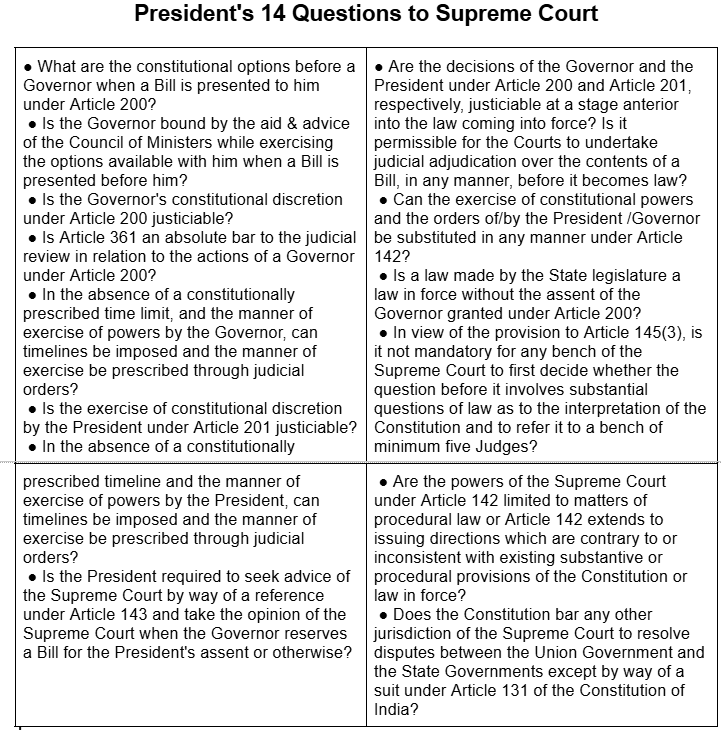
About the issue In May 2025, President Droupadi Murmu used Article 143 to ask the Supreme Court for advice about Articles 200 and 201, which deal with how Governors and the President give approval to state laws. This came after the Supreme Court set deadlines for acting on State Bills, sparking an important debate about the balance of power between the Centre and the states. Since 1950, there have only been 15 such Presidential references, showing that this is a rare and special tool in the Constitution. It helps clear up tricky constitutional questions without leading to bitter legal battles.
Role of Article 143 in Indian System of Checks and Balances
Article 143 of the Indian Constitution empowers the President to seek the Supreme Court’s opinion on significant legal or constitutional matters. This advisory role doesn’t settle disputes like a court judgment but helps clarify complex issues before they become bigger problems. By doing so, Article 143 acts as a tool to maintain a healthy balance between the different branches of government and supports smooth governance.
Point
Explanation
Example
1. Advisory Role Prevents Conflicts
Allows the President to seek Supreme Court’s opinion on complex legal or constitutional questions, helping avoid disputes between branches.
Sikkim Merger Case (1975): Clarified legality of merging Sikkim with India.
2. Supports Separation of Powers
Helps maintain balance by ensuring the executive consults judiciary on important matters, preventing unilateral decisions.
Keshavananda Bharati (1973): Helped define limits on constitutional amendments.
3. Encourages Dialogue Between Branches
Promotes cooperation rather than confrontation among legislature, executive, and judiciary.
Advisory opinions on questions referred by the President on federal disputes.
4. Provides Authoritative Legal Guidance
Offers the government expert legal advice to act within constitutional limits, even though opinions are not binding.
Opinion on appointment of judges or state emergencies.
5. Prevents Constitutional Crises
Early judicial input reduces chances of constitutional conflicts escalating into crises.
Reference on Presidential powers during Emergency (1975).
6. Limits and Challenges Exist
Advisory opinions are non-binding; the President may choose not to seek advice, limiting the tool’s effectiveness.
Occasional reluctance of executive to refer controversial issues.
Five Landmark Advisory Opinions Under Article 143 That Shaped India’s Legal and Political Landscape
Article 143 allows the President to ask the Supreme Court for its advice on important legal or constitutional questions. Though these opinions are advisory, they have often clarified complex issues and influenced Indian governance deeply. Below are five key cases where Article 143 advisory opinions played a pivotal role.
Case
Significance of Advisory Opinion
Impact on Indian Polity or Governance
1. Kerala Education Bill, 1957, In re (1959)
Examined if the Kerala government’s Education Bill violated fundamental rights or religious freedoms under the Constitution.
Balanced state legislative power with minority rights, influencing education policy and minority protections.
2. Berubari Union Case, In re (1960)
Advised on whether a portion of Indian territory could be ceded to Pakistan under a treaty, and the procedure required.
Affirmed Parliament’s power to amend the Constitution for ceding territory, clarifying India’s sovereignty and treaty powers.
3. Sea Customs Act, S. 20(2), In re (1964)
Clarified interpretation of customs law related to import duties and exemptions under constitutional law.
Helped unify tax law application and ensured clarity in customs regulations.
4. Powers, Privileges and Immunities of State Legislatures, In re (1965)
Defined the extent of legislative privileges and immunities granted to state legislatures and their members.
Strengthened legislative autonomy while balancing judicial oversight.
5. Presidential Poll, In re (1974)
Addressed questions regarding the conduct and validity of the Presidential election process under the Constitution.
Reinforced the legitimacy and transparency of Presidential elections.
Comparison of Constitutions
India is among the few democracies where the executive can formally consult the judiciary. In contrast, other countries follow diverse models:
Canada: The Supreme Court of Canada has an advisory jurisdiction under the Supreme Court Act (s. 53), and opinions are regularly sought on constitutional and legal questions. For instance, the 2014 reference on Senate reform and the 1998 Quebec secession reference have had long-lasting legal and political consequences.
United States: The U.S. Constitution maintains a strict separation of powers. Article III does not allow the Supreme Court to issue advisory opinions.
United Kingdom: Although it does not have a written constitution, the UK’s judicial system allows opinions from the Law Lords (now the Supreme Court) via declaratory judgments in matters of significant legal uncertainty.
Australia: The High Court cannot provide advisory opinions due to constitutional constraints (Section 76).
France: The Conseil Constitutionnel reviews laws pre-promulgation, effectively offering binding advisory review on constitutional compliance.
Thus, India’s mechanism is more aligned with Canada’s model, blending judicial authority with executive consultative processes. India’s model is more flexible than the U.S., yet more limited in scope and enforceability compared to France and Canada.
Way Forward
Set Clear Rules for Advisory References: The Supreme Court should codify guidelines on what kinds of questions are allowed, how soon they must be answered, and in what form. Canada’s model ensures precise questions, public hearings, and fixed timelines.
Keep it Focused on Legal and Constitutional Issues: The reference power should only be used for constitutional interpretation, not political or vague issues (e.g., Ram Janmabhoomi case, 1993, which blurred legal lines and judicial neutrality).
Make the Process More Transparent and Inclusive Allow public experts, think tanks, and civil society to submit inputs, like in the Right to Privacy and Section 377 hearings, where diverse voices strengthened the judgment.
Clarify Whether Opinions are Binding or Not A constitutional amendment or Supreme Court ruling should define the legal status of advisory opinions (e.g., Berubari Case, 1960, saw the govt selectively use the Court’s opinion).
Build Accountability through Reporting The SC should publish data on Article 143 cases how many came in, how many were answered, and whether the government acted on them, within its Annual Report.
Consult States on Federal Matters If a reference affects State powers, a formal consultation mechanism should be built in. This aligns with the Punchhi Commission (2010) and would improve Centre-State trust.
#BACK2BASICS: Presidential Reference under Article 143
Article 143 lets the President ask the Supreme Court for advice on important legal or factual questions that affect the public. This idea comes from a similar power given to the British Governor-General back in 1935.
Under this article, the President can seek the Court’s opinion on any big public issue (Article 143(1)) or on cases already before other courts, especially involving treaties (Article 143(2)). Such questions are heard by a bench of at least five Supreme Court judges.
While the Court’s advice isn’t binding, it carries great weight and helps settle major constitutional questions peacefully. As Justice V.R. Krishna Iyer said, these references create a “solemn judicial discussion on national issues.”
Some famous examples where Article 143 opinions shaped India include:
Delhi Laws Act (1951): Set limits on delegated law-making powers.
Kerala Education Bill (1958): Balanced Fundamental Rights and policy goals.
Berubari Case (1960): Said giving away Indian territory needs a constitutional amendment.
Presidential Poll Case (1974): Upheld election validity even with electoral vacancies.
Third Judges Case (1998): Strengthened the system of appointing judges through the collegium.
Keshav Singh Case (1965): Balanced court review with legislative privileges.
Significance of Article 143
Clarifies Constitutional Doubts: Helps resolve legal ambiguities (e.g., 2025 reference on Articles 200 & 201 clarifies timelines for gubernatorial assent).
Protects Federal Balance: Offers a peaceful way to handle Centre-State tensions (e.g., Cauvery Water Dispute, 1992).
Ensures Executive Accountability: Keeps actions within constitutional limits (e.g., Kerala Education Bill, 1958 clarified Rights vs. Directive Principles).
Enables Judicial Innovation: Allows creative interpretation (e.g., Third Judges Case, 1998 led to Collegium system).
Reduces Future Litigation: Prevents disputes from escalating to court (e.g., 70,000+ pending SC cases in 2023).
Challenges with Article 143
Vague or Political References: Questions may be too broad or sensitive (e.g., Ram Janmabhoomi, 1993; Court declined to opine).
Not Legally Binding: Opinions can be ignored (e.g., Berubari Case, 1960—initially overlooked by govt).
Possible Political Misuse: Used to delay tough decisions (e.g., during politically sensitive times).
Lack of Public Input: No space for civil society participation.
Adds to SC Workload: Non-binding references divert attention (e.g., 80,000+ pending cases in 2024).
Can Strain Federal Relations: Opposition states may view it as Centre overreach (e.g., 2025 reference on Governors’ powers).
SMASH MAINS MOCK DROP
“Article 143 reflects the Indian Constitution’s commitment to mature constitutional statesmanship.”Discuss the significance of the Supreme Court’s advisory jurisdiction under Article 143 in maintaining constitutional balance, with suitable examples.
Plastic pollution represents one of the gravest environmental crises of our times. Despite decades of regulation and bans, plastics remain ubiquitous, cheap, and nearly indestructible. Talks in Geneva involving 180 countries failed to secure an internationally binding legal agreement to limit plastic pollution, reflecting deep divisions over whether the treaty should target waste alone or include production.
Global Plastic Treaty Deadlock: Why It Matters
Global deadlock: 180 countries failed to agree on a binding treaty on plastic pollution in Geneva, despite a UNEP-backed resolution already in place.
First-time sharp focus on health: Unlike earlier discussions centred only on waste management, the health impact of plastics is now central.
Scale of problem: Plastics contain more than 16,000 chemicals, with little knowledge on 10,000+ of them. A Nature study showed 4,000 chemicals of concern are present across major plastic types.
Striking evidence: Microplastics detected in blood, breast milk, placenta, bone marrow, bringing urgency to the debate.
The Persistence and Ubiquity of Plastics
Symbol of consumption economy: Cheap and versatile, plastics reflect today’s global consumption.
Persistence and flexibility: Synthetic, fossil-fuel-derived polymers are non-biodegradable and endure for decades.
Waste mismanagement: Cheap production, ubiquity, and limited recycling capacity turn plastics into the prime source of litter.
Plastics and Human Health: Emerging Evidence
Chemicals of concern: Plastics use ethylene, propylene, styrene derivatives, along with bisphenols, phthalates, PCBs, PBDEs, and PFAS.
Products of exposure: Found in food containers, bottles, teething toys, polyester, IV bags, cosmetics, paints, electronics, adhesives.
Health links: Studies link plastic chemicals to thyroid dysfunction, hypertension, kidney/testicular cancer, gestational diabetes.
Evidence base: Around 1,100 studies, involving 1.1 million individuals, compiled by Boston College & Minderoo Foundation dashboard.
Nature of studies: Mostly associative; longitudinal studies (gold standard) are still underway.
The Microplastic Menace
Definition: Plastics smaller than 5 mm, found in additives or broken-down products.
Recent discoveries: Detected in human blood, breast milk, placenta, bone marrow.
Health uncertainty: Exact impacts still under study, but linked to multiple disorders.
Policy Responses: Global and Indian Perspectives
Global scene: Negotiations divided on waste vs production; developing countries demand funding support.
India’s stance:
Ban on single-use plastics in ~20 States
Administrative push for Extended Producer Responsibility (EPR)
Views plastics as a waste management issue, not a health issue.
Prefers health dimension to be dealt with at WHO, not in the plastics treaty.
Conclusion
The Geneva deadlock reflects not just a failure of diplomacy but the widening gap between scientific evidence and policy action. Plastics are no longer an invisible convenience; they are a pervasive health hazard. While India treats plastics as a waste issue, ignoring health risks leaves a blind spot in policy. A robust, binding treaty addressing both production and health impact is indispensable if the world is to prevent plastics from becoming the new tobacco of the 21st century.
PYQ Relavance
[UPSC 2023] What is oil pollution? What are its impacts on the marine ecosystem? In what way is oil pollution particularly harmful for a country like India?
Linkage: Since UPSC has already asked about oil pollution (2023), it shows the exam’s focus on pollution and ecosystem impacts. Plastic pollution, like oil, originates from fossil fuels and has severe effects on marine life and human health. Hence, a direct question on plastic pollution and its health–environment nexus is highly probable.
Practice Mains Question
Plastics are no longer merely a waste management problem but a serious health hazard. Critically examine the health risks associated with plastic use and evaluate India’s stance in global plastic treaty negotiations.
Mapping Microthemes
GS-1: Impact of industrialisation and consumerism on environment.
GS-2: International negotiations, India’s foreign policy stance in environmental treaties.