The Union Culture Ministry has successfully retrieved the sacred ‘Piprahwa’ Buddhist relics, which were set to be auctioned in Hong Kong.
About the Piprahwa Relics:
Discovery: Unearthed in 1898 by William Claxton Peppe, a British engineer, at Piprahwa (Siddharthnagar, Uttar Pradesh), near the Nepal border.
Historical Significance: Identified as ancient Kapilavastu, capital of the Shakya republic, where Prince Siddhartha (Buddha) lived before renunciation.
Findings at the Site: A buried stupa yielded a large stone coffer containing:
Bone fragments believed to be Buddha’s relics
Caskets made of soapstone and crystal
A sandstone coffer
Over 1,800 ornaments: pearls, rubies, sapphires, gold sheets
Legal Custody:
The British Crown claimed the relics under the Indian Treasure Trove Act, 1878.
Most artifacts were transferred to the Indian Museum, Kolkata.
Stupas with Buddha’s Relics:
After the Buddha’s death (Mahaparinirvana), his cremated relics were divided among 8 kingdoms and a Brahmin named Drona, who coordinated their distribution.
Each recipient built a Stupa to enshrine their share of the relics, creating important pilgrimage sites and early centers of Buddhist worship.
The 9 stupas were located in Rajagriha, Vaishali, Kapilavastu, Allakappa, Ramagrama, Vethadipa, Pava, Kushinagar, and Pippalivana.
Emperor Ashoka (3rd century BCE) redistributed the relics from these stupas into thousands of new stupas across his empire.
The stupa at Ramagrama is unique because it is believed to remain untouched and still holds the original relics.
A typical early Buddhist stupa included a hemispherical mound (anda), a square railing (harmika), a central pillar (yashti) with umbrellas (chatra), and a path for circumambulation (pradakshinapatha).
[UPSC 2023] With reference to ancient India, consider the following statements:
1. The concept of Stupa is Buddhist in origin.
2. Stupa was generally a repository of relics.
3. Stupa was a votive and commemorative structure in Buddhist tradition. How many of the statements given above are correct?
Options: (a) Only one (b) Only two* (c) All three (d) None
[UPSC 2024] The world is facing an acute shortage of clean and safe freshwater. What are the alternative technologies which can solve this crisis? Briefly discuss any three such technologies citing their key merits and demerits.
Linkage: This question directly related to “alternative technologies” to address a critical global environmental and resource crisis (freshwater scarcity). This aligns with the broader theme that the world needs better and diverse green technologies to tackle urgent environmental problems and ensure resource self-sufficiency, as emphasized in the context of energy innovation.
Mentor’s Comment: As the push for sustainable energy intensifies, concerns are rising over the efficiency limits of widely used silicon photovoltaics. With the growing need for green hydrogen and land constraints, experts are questioning whether next-gen solar technologies offer better solutions. India must invest in efficient, diverse, and scalable innovations to meet climate goals and ensure energy self-sufficiency.
Today’s editorial analyses the concerns that are rising over the efficiency limits of widely used silicon photovoltaics. This topic is important for GS Paper III (Environment) in the UPSC mains exam.
_
Let’s learn!
Why in the News?
Recently, as the global need for clean energy has increased and countries aim to fulfill their climate promises, silicon solar panels have become the most popular choice, changing the look of places from city rooftops to large solar farms in villages.
What limits silicon photovoltaics in meeting India’s climate goals?
Low Energy Efficiency: Silicon solar panels have an in-field efficiency of only 15–18%, meaning a significant portion of solar energy is not converted into electricity. Eg: In Rajasthan, more panels are required to meet energy demand, increasing cost and land use due to low conversion efficiency.
High Land Requirement: Due to their low efficiency, silicon panels need a larger surface area to generate the same output compared to newer technologies. Eg: The Rewa Solar Park in Madhya Pradesh covers over 1,500 hectares, reducing land availability for agriculture and conservation.
Slow Climate Impact: Despite growing solar capacity, CO₂ levels have risen from 350 ppm in 1990 to ~425 ppm in 2025, indicating renewables are not scaling fast enough. Eg: Even after installing 4.45 TWh of renewable energy by 2024, India remains behind on its climate targets.
Environmental Footprint of Manufacturing: The production of silicon panels involves high energy use and toxic chemicals, partially offsetting their green benefits. Eg: Most panels are imported from China, where coal-powered factories dominate, adding to indirect emissions.
Incompatibility with Advanced Applications: Silicon PVs are less suitable for high-efficiency applications like green hydrogen production, which needs more consistent, high-output energy. Eg: In pilot projects in Gujarat, using silicon panels reduces the overall efficiency of green hydrogen production due to energy losses.
Why rethink electrolysis-based green hydrogen?
High Energy Consumption: Electrolysis requires more energy to produce green hydrogen than the energy hydrogen provides when used, making the process energy-inefficient. Eg: In India’s pilot projects in Ladakh, the high electricity input from solar panels results in low net energy gain, raising concerns about economic viability.
Storage and Transportation Challenges: Hydrogen has very low density, making it difficult and expensive to store and transport, often requiring high-pressure tanks or cryogenic conditions. Eg: In hydrogen mobility projects, such as those in Delhi, leakage and compression issues have hampered safe and cost-effective deployment.
Compounding Energy Losses in Conversion: Using green hydrogen to produce green ammonia or methanol, and then extracting hydrogen back, leads to multiple stages of energy loss. Eg: In proposed export hubs like Vizag, converting hydrogen to ammonia for shipping and then reconverting it abroad reduces overall energy efficiency.
How do land and efficiency issues impact India’s solar push?
Low Efficiency Increases Land Requirement: Silicon solar panels with 15–18% efficiency require larger surface areas to generate the same energy as advanced solar technologies. Eg: In Rajasthan’s Bhadla Solar Park, vast desert land is used to compensate for low panel efficiency, which limits deployment in land-constrained states.
Urbanisation Limits Land Availability: Rapid urban expansion and the need to conserve green zones reduce the availability of suitable land for large-scale solar projects. Eg: In Mumbai’s metropolitan region, limited open space has pushed the focus toward rooftop solar, which has its own technical and regulatory hurdles.
Hinders Achievement of Renewable Energy Targets: The inefficient land-to-energy ratio slows down the pace of solar capacity expansion, affecting progress toward India’s net-zero commitments. Eg: In Tamil Nadu, where land is both fertile and scarce, competing demands between agriculture and solar installations have delayed key solar proposals.
What role can artificial photosynthesis play in renewable energy?
Direct Conversion of Sunlight into Fuel: Artificial photosynthesis (APS) mimics natural photosynthesis to convert sunlight, water, and CO₂directly into fuels like green methanol or hydrogen, offering a clean, efficient alternative to traditional energy-intensive processes.
Bypasses Inefficiencies in Current Technologies: APS has the potential to eliminate multiple energy-loss steps such as electrolysis, storage, and reconversion, thereby enhancing the overall energy efficiency of renewable fuel production systems.
Why invest in next-gen renewable tech like RFNBO? (Way forward)
Enhances Energy Independence: Renewable Fuels of Non-Biological Origin (RFNBO) can reduce India’s heavy reliance on imported fossil fuels (currently ~85%), promoting energy self-sufficiency in a geopolitically volatile world.
Supports Diverse and Efficient Decarbonisation: RFNBO technologies enable the production of cleaner fuels like green hydrogen, ammonia, and methanol using renewable electricity, offering higher efficiency and adaptability for industrial and transport sectors.
Future-Proofing India’s Energy Strategy: Investing in RFNBO ensures India is aligned with global clean energy innovations, allowing it to meet net-zero targets and remain competitive in emerging green fuel markets.
The 25% tariff plus penalty imposed by U.S. President Donald Trump on Indian imports has brought renewed attention to the strain in India-U.S. trade relations.
Why did the U.S. impose a 25% tariff on Indian imports?
High Tariff and Non-Tariff Barriers by India: The U.S. accused India of maintaining high import duties and regulatory restrictions that limited American market access. Eg: Trump repeatedly criticized India’s high tariffs on U.S. goods like motorcycles and dairy products.
Geopolitical Frustration Over India-Russia Ties: India’s continued energy and defense cooperation with Russia, despite U.S. pressure, triggered punitive action. Eg: Trump expressed displeasure at India’s oil imports from Russia, linking them to trade penalties.
Failure to Reach a Mini-Trade Deal: Repeated delays and stalemates in talks over a limited trade agreement led to frustration in the U.S.
What stalled the India-U.S. mini-trade deal?
India’s Reluctance to Lower Tariffs: India resisted U.S. demands to reduce import duties, especially in agriculture and dairy, to protect domestic interests. Eg: India declined to open its dairy sector to U.S. exporters, citing religious and cultural concerns over feed practices involving animal blood, which conflict with Indian dietary norms.
Unclear Negotiation Timelines: The deal lacked a defined timeline, and momentum stalled due to shifting priorities on both sides. Eg: U.S. Trade Representative Jamieson Greer stated the deal needed “some more negotiations,” while India stopped referencing the mini-deal, signaling disengagement.
How do India’s farm and dairy policies hinder trade talks?
Protection of Domestic Farmers: India maintains high tariffs and import restrictions to shield small and marginal farmers from foreign competition. Eg: India imposes import duties of up to 100% on dairy products, making it difficult for U.S. exporters to access the Indian market.
Cultural and Religious Sensitivities: Indian regulations emphasise vegetarian feed practices, which clash with Western livestock farming methods. Eg: India rejected U.S. dairy imports because American cows are often fed blood meal, violating Hindu dietary norms.
Subsidy and MSP System: India’s Minimum Support Price (MSP) and subsidy policies create a non-level playing field, raising concerns about fairness among trade partners. Eg: The U.S. has objected to India’s public stockholding of food grains, which they claim distorts global agricultural trade.
How do India-Russia ties affect India-U.S. trade relations?
Strategic Autonomy in Foreign Policy: India maintains a non-aligned stance, continuing strong ties with Russia, especially in defence and energy sectors, despite Western pressure. Eg: India’s purchase of the S-400 missile system from Russia triggered U.S. concerns under the CAATSA sanctions regime.
Energy Trade with Russia: India increased crude oil imports from Russia due to discounted prices amid the Ukraine conflict, which contradicts U.S.-led sanctions. Eg: In 2023, Russia became one of India’s top oil suppliers, raising questions in Washington about India’s commitment to Western-led efforts.
How can India balance sovereignty with export interests? (Way forward)
Assert Strategic Autonomy while Building Economic Alliances: India must uphold its sovereign right to choose partners (e.g., Russia) while diversifying export markets and enhancing trade ties with nations like the U.S., EU, ASEAN, to reduce dependency and mitigate tariff risks.
Pursue Issue-Based Bilateral Negotiations: India can engage in sector-specific negotiations that safeguard sensitive areas (like agriculture) while offering market access in others (like pharmaceuticals or services), thereby balancing domestic priorities with global trade expectations.
Mains PYQ:
[UPSC 2018] How would the recent phenomena of protectionism and currency manipulations in world trade affect macroeconomic stability of India?
Linkage: The article is directly related to impact of “protectionism” on India’s macroeconomic stability. The “25% tariff ‘plus penalty’ on imports of Indian goods” by the U.S. is a clear example of protectionist measures in world trade. The article explicitly states that these tariffs place India at a “relative disadvantage”, directly relating to the “soured relations” and potential impact on India’s economic stability.
Recently, Prime Minister Narendra Modi’s two-day state visit to the Maldives (July 2025) marked a significant reset in bilateral ties after months of strain following the election of President Mohamed Muizzu, who had earlier run on an ‘India Out’ platform.
What caused the India-Maldives ties reset under Muizzu?
Troop Withdrawal & Civilian Substitution: President Muizzu demanded the removal of Indian military personnel, citing sovereignty. India responded by replacing them with civilian technical staff.
High-Level Diplomatic Engagements: Muizzu visited New Delhi in October 2024, signaling openness to dialogue.Indian PM reciprocated with a state visit to Male in July 2025, the first by a foreign Head of State under Muizzu.
Economic Support & Debt Relief: India extended budgetary support and credit lines, easing Maldives’ financial burden. Eg: A ₹4,850 crore Line of Credit and 40% debt repayment reduction in 2025.
Softening of Rhetoric & Public Signals: President Muizzu acknowledged historical ties, calling the Indian Ocean a testament to shared heritage. This marked a shift from his earlier India-Out campaign tone.
Launch of Institutional Mechanisms: Announcement of India-Maldives Parliamentary Friendship Group and FTA discussions in 2025.
How has India ensured the Maldives’ security?
Military Intervention in Crisis: In 1988, India launched Operation Cactus to foil a coup attempt, securing the capital and leadership.
Bilateral Defence Cooperation: The DOSTI maritime exercise, started in 1991, strengthens Coast Guard coordination.
Strategic Presence and Infrastructure Support: India maintained a defensive presence (now civilian) and supported surveillance capabilities like helped set up coastal radar systems.
Humanitarian and Disaster Relief Operations: India has provided quick assistance during natural disasters, showcasing readiness and goodwill. India provided critical aid to Maldives after the 2004 Indian Ocean tsunami.
Regional Security Engagements: Maldives is a key member of the Colombo Security Conclave, focusing on counter-terrorism and maritime security.
Why is the Maldives vital for India amid China’s presence?
Strategic Location in the Indian Ocean: The Maldives lies along key international shipping lanes, making it critical for India’s maritime security and energy supply routes. Eg: Over 80% of India’s energy imports pass close to the Maldives archipelago, near the Eight Degree Channel.
Countering China’s Expanding Influence: China’s increasing investments and debt diplomacy in Maldives threaten to shift the regional balance. Eg: The Sinamale Bridge, built with Chinese funding, raised concerns over strategic dependence.
Ensuring Regional Stability and Security Cooperation: Maldives’ support is essential for coordinated patrols, anti-terrorism, and anti-piracy efforts.
Way forward:
Strengthen People-to-People Ties and Institutional Dialogue: Promote educational, cultural, and tourism exchanges while deepening parliamentary and civil service cooperationto build long-term goodwill and trust.
Enhance Transparent and Sustainable Development Partnerships: Focus on jointly planned, community-driven projects with clear benefits to Maldivian citizens, countering external influence through mutual respect and shared values.
Mains PYQ:
[UPSC 2024] Discuss the geopolitical and geostrategic importance of Maldives for India with a focus on global trade and energy flows. Further also discuss how this relationship affects India’s maritime security and regional stability amidst international competition?
Linkage: The article talk about the Maldives’ geographical location in the northern Indian Ocean and its historical and ongoing ties with India. It also highlights India’s concerns about “growing Chinese influence in the region”, which directly relates to “international competition” and its impact on “regional stability.” The question also touches upon “global trade and energy flows” and “maritime security,” which are intrinsic to the strategic importance of an island nation like Maldives.
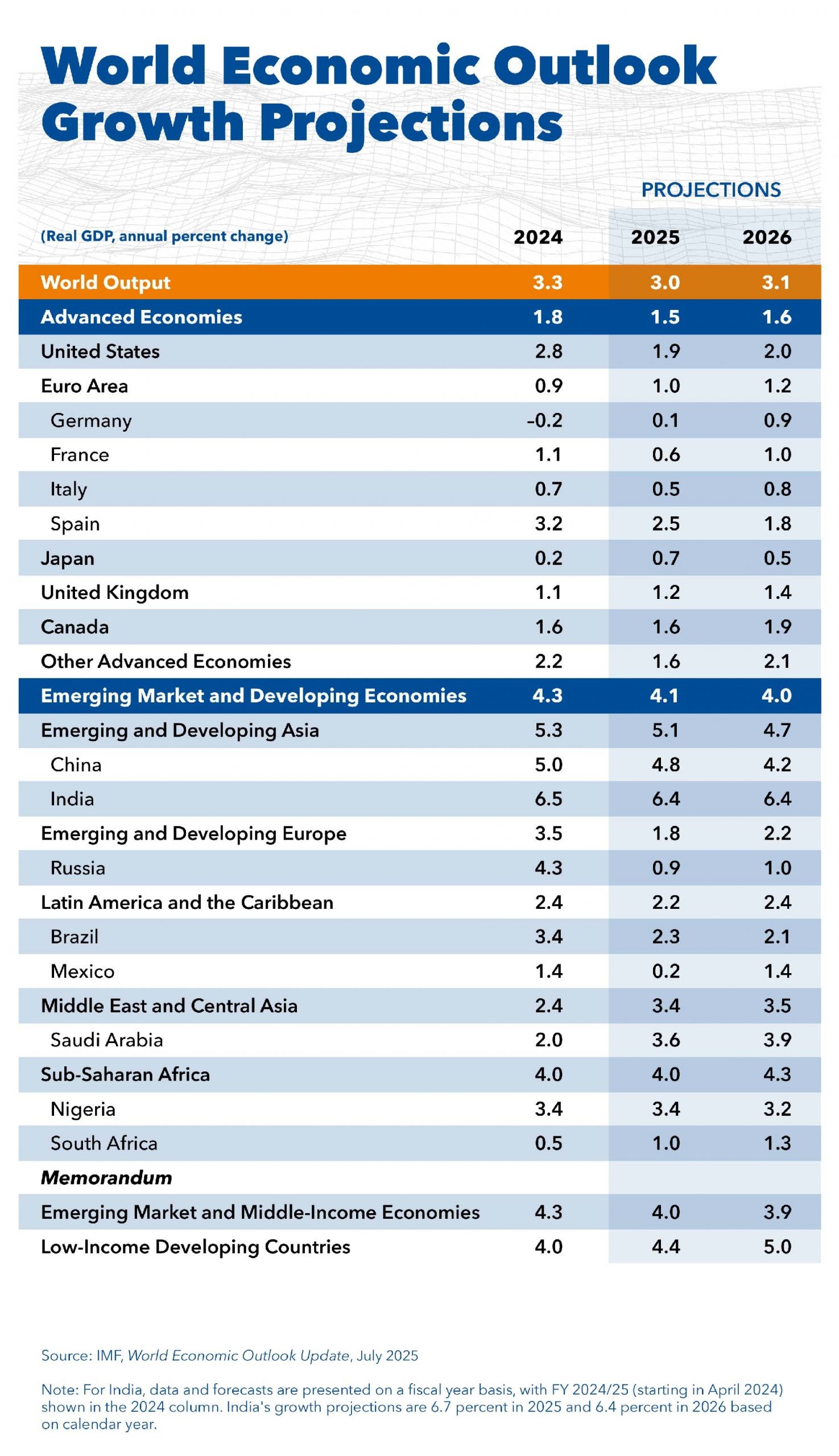
July 2025 Update Title:“Global Economy: Tenuous Resilience amid Persistent Uncertainty”
Key Highlights – July 2025 Update:
Global Growth Projections:
2025: 3.0% (↑ from 2.8% in April)
2026: 3.1% (↑ from 3.0%)
Despite multiple shocks—COVID-19, the Ukraine war, tariff increases—global growth continues. However, resilience remains fragile due to:
US–China tariff tensions and rising protectionism
Conflicts in Ukraine and the Middle East
High public debt in advanced economies is raising interest rates
Country Forecasts for 2025: United States: 1.9%, China: 4.8% (↑ from 4.0%), Euro Area: 1.0%, Germany: 0.1%, United Kingdom: 1.2%, Japan: 0.7%, Russia: 0.9%, Pakistan: 2.7%.
India – The Bright Spot:
Growth Rate: 2023: 9.2%; 2024: 6.5%; 2025: 6.4% (strongest among major economies).
Drivers of Growth:
Robust domestic demand
Strong services and manufacturing output
Effective inflation and monetary policy management
Strategic Position:
Set to overtake several advanced economies in GDP size
Viewed globally as a “bright spot” amid persistent uncertainties
[UPSC 2014] Which of the following organisations brings out the publication known as ‘World Economic Outlook?
Options: (a) The International Monetary Fund * (b)The United Nations Development Programme (c) The World Economic Forum (d) The World Bank
According to the Reserve Bank of India (RBI), digital payments registered a 12.6% year-on-year rise as of March 31, 2024, as measured by the RBI’s Digital Payments Index (DPI).
About RBI’s Digital Payments Index (DPI):
Launched by: Reserve Bank of India (RBI) in January 2021
Purpose: Measures the extent of digital payment adoption across India
Base Period: March 2018 (Index value = 100)
Release Frequency:Semi-annually (with a 4-month lag)
Objective: Track usage, infrastructure, and growth in digital payments
Key Parameters (with Weightage): These evaluate infrastructure readiness, transaction volume, user adoption, and innovation.
Payment Enablers – 25%
Payment Infrastructure – Demand Side – 10%
Payment Infrastructure – Supply Side – 15%
Payment Performance – 45%
Consumer Centricity – 5%
Growth Highlight:
Growth Trends in RBI-DPI: DPI grew nearly 5 times from 100 in March 2018 to 493.22 in March 2025, reflecting India’s rapid digital payment adoption.
Nearly 5× increase from the base value in 7 years
Driven by rapid expansion of Unified Payments Interface (UPI), mobile wallets, and QR code infrastructure
[UPSC 2024] Consider the following countries:
I. United Arab Emirates II. France III. Germany IV. Singapore V. Bangladesh
How many countries amongst the above are there other than India where international merchant payments are accepted under UPI?”
Options: (a) Only two (b) Only three* (c) Only four (d) All the five
The National Cooperation Policy (NCP) 2025 recently unveiled by Union Home and Cooperation Minister Amit Shah has drawn criticisms from SKM (Samyukt Kisan Morcha).
Also in news:
The Union Cabinet has also approved a ₹2,000 crore Central Sector Scheme to aid National Cooperative Development Corporation (NCDC) from 2025–26 to 2028–29.
NCDC was established in 1963 as a statutory Corporation under Ministry of Agriculture & Farmers Welfare (now functions under the Ministry of Cooperation since 2021).
About Cooperatives in India:
What is it: A cooperative is a voluntary, autonomous association of individuals who unite to meet common economic, social, or cultural needs through a jointly-owned and democratically-controlled enterprise.
Key Principles:
One member, one vote: Equal say in governance, regardless of financial contribution.
Based on collective benefit, democratic control, and mutual aid.
Historical Evolution:
1904 & 1912: Cooperative Acts laid the foundation for the cooperative movement in India.
Post-independence: Emphasis on rural credit, dairy, and agriculture cooperatives (e.g., Amul).
Key Institutions: NABARD (National Bank for Agriculture and Rural Development), NCDC (National Cooperative Development Corporation).
Constitutional & Legal Backing:
97th Constitutional Amendment (2011):
Article 19(1)(c): Right to form cooperative societies.
N4S: UPSC often picks such topics not just for data recall but to test empathy, societal understanding, and connection between systems — as seen in the 2023 GS1 question on suicides among young women. Where aspirants usually falter is in treating these as ‘soft’ topics, often lacking structure or specific multi-level analysis. This article changes that. It dives deep into real causes like academic pressure, social media, and stigma (see: “Immediate Triggers”, “Stigmatization”), and ties them with structural flaws like poor mental health infrastructure and societal taboos (“At Institutional Level”, “At Societal Level”). The piece doesn’t stop at problems. It shows state-level best practices (like Kerala’s 2013 policy or Tamil Nadu’s “Mano Amma”), making your answers richer and anchored in reality. One very special feature is how this article connects mental health to constitutional rights and social justice — like linking suicide decriminalization with the Mental Healthcare Act, 2017 and discrimination with SC/ST atrocities. It also humanizes the issue by opening with lived tragedies, making it hard to read without feeling the weight of the problem. This emotional-societal-policy thread is what UPSC expects, and this article delivers.
This article explores India’s growing mental health crisis, especially among the youth, by connecting personal, social, and systemic factors. UPSC often frames such issues to test empathy, governance insight, and constitutional understanding, as seen in the 2023 GS1 question on suicides among young women.
Aspirants often treat these topics as emotional rather than structural. This article goes deeper. It examines immediate triggers like academic stress and social media, and links them with larger issues such as poor mental health infrastructure and social stigma. It highlights policy efforts like Kerala’s 2013 framework and Tamil Nadu’s Mano Amma initiative. A key strength is how it ties mental health to constitutional rights, decriminalisation under the Mental Healthcare Act, and social justice. This layered approach helps aspirants write more grounded and impactful answers.
PYQ ANCHORING
GS 1: Explain why suicide among young women is increasing in Indian Society. [2023]
MICROTHEME: Women and Associated concerns
Two bright students. Two lives lost. And one powerful reminder from the Supreme Court — even the prestige of IIT-Delhi can’t be a shield against justice. The 2023 suicides of two students from SC/ST communities have cracked open a painful truth: our top institutions are silently breeding mental health crises.
Behind the glowing resumes and cutthroat competition, many students are battling pressure, isolation, and stigma — alone and unheard.
So, the questions to ponder over are: What’s really happening inside our most celebrated classrooms? Are we ignoring the emotional toll in the race for excellence? And how long will brilliance be measured by burnout?
FACTORS CONTRIBUTING TO MENTAL HEALTH PROBLEMS AMONG STUDENTS//MAINS
Category
Details
Examples / Research
Immediate Triggers / Precipitating Factors
Sudden adverse life events such as exam failure, financial loss, grief, or public humiliation. These can precipitate mental breakdowns or suicidal ideation.
Suicides in IITs and Kota due to failure or pressure; reports of self-harm after results announcements.
Influence of Social Media
Excessive or passive use of social media is linked to poor sleep quality, cyberbullying, low self-esteem, and FOMO (fear of missing out), increasing anxiety and depression.
A 2018 British study (University of Glasgow) found a link between disrupted sleep from social media and depression.
Social Isolation & Loneliness
Loneliness may stem from dysfunctional family relationships, lack of peer support, bullying, and confusion around gender identity or puberty-related changes.
Adolescents facing gender dysphoria or from broken families often report higher rates of anxiety and depression.
Academic Pressure & Parental Expectations
Constant pressure to perform, intense competition, and the fear of letting down parents who have made financial sacrifices can result in burnout, anxiety, and depression.
High suicide rates reported in Kota coaching centers due to overwhelming academic expectations.
Predisposing Biological Factors
Genetic predispositions (e.g., family history of depression or suicide), neurochemical imbalances, and chronic illnesses can heighten vulnerability.
Studies show impulsivity and mental disorders are higher in students with family history of mental illness.
Personality & Disability Factors
Traits like perfectionism, impulsivity, and poor coping mechanisms; physical disabilities may lead to social exclusion or frustration.
Students with learning disabilities are more prone to depression due to lack of understanding and peer rejection.
Stigmatization
Fear of judgment or being labeled prevents students from seeking timely help. This allows issues to worsen before intervention.
Studies find stigma is a major reason students avoid counseling even when services are available.
ROLE OF SOCIAL PREJUDICES AND TABOO IN MENTAL HEALTH
At individual level- The stress to cope up with the present day materialism, consumerism has resulted in higher levels of depression and associated issues like high blood pressure, heart issues etc. According to a Lancet study, between 1990 to 2017, one in seven people from India have suffered from mental illness ranging from depression, anxiety to severe conditions such as schizophrenia.
At family level- Change in the family structure, rise of nuclear families and individualism has impacted traditional family support resulting in isolation and a lack of emotional support during difficult times..
At societal levels-
Conforming to the social norms(‘Log kya kahenge’ approach)associated with mental illness prevents people from seeking help.
Society in general has stereotyped views about mental illness and how it affects people. Many people believe that people with mental ill health are violent and dangerous, when in fact they are more at risk of being attacked or harming themselves than harming other people.
Further, Social discrimination as seen in recent events like mob lynching, beating of Dalit youth for keeping moustache impact the mental health of marginalised sections of society due to rise in fear and anxiety.
At institutional level-
Violations of human rights have been reported in mental asylums and also at homes and places of traditional healing. In India, mental hospitals still practice certain obscure practices that violate human rights. Further poor infrastructure such as closed structures, a lack of maintenance, unclean toilets and sleeping areas etc clearly violate the basic human right to a life with dignity and add to the stigma. For example, Erwadi Tragedy: In 2001, 28 patients who were chained at a home for mentally-ill people died after a fire that engulfed the home in Erwadi village in the Ramanathapuram district (Tamil Nadu).
The situation is exacerbated by the media. Media reports often link mental illness with violence, or portray people with mental health problems as dangerous, criminal, evil, or very disabled and unable to live normal, fulfilled lives.
On vulnerable sections:
Impact on Women- Gender inequality and patriarchy coupled with Illiteracy, poverty and lack of awareness restricts the access to mental healthcare and leads to deterioration of mental health of women.
Impact on elderly- Lack of family support , changing patterns of relationships i.e movement from joint to nuclear families and social stigma associated with mental health leads to depression, stress and leads to rise in suicides among elderly.
Impact on children- Increased competition, peer pressure and exposure to indecent content on social media has increased the stress and depression levels among children.
COMMITTEES THAT SHAPED INDIA’S MENTAL HEALTH FRAMEWORK//PRELIMS
While mental health in India remained under the radar for decades, a series of expert committees quietly laid the groundwork for reform. From decriminalizing suicide to building community-based care, these government-appointed panels have shaped policy, law, and public health strategies over time.
Year
Committee / Report
Purpose / Focus
Key Recommendations
2009–2013
Mental Health Care Bill Drafting Committee
Drafting of the Mental Healthcare Act, 2017
Right to mental healthcare, Advance Directives, decriminalization of suicide, creation of Mental Health Review Boards
2011
Keshav Desiraju Committee
Reforming the National Mental Health Programme (NMHP)
Strengthen DMHP, community-based care, train general healthcare providers, integrate mental health into primary care
2014
National Mental Health Policy Group
Formulating the National Mental Health Policy
Rights-based approach, inclusive care for vulnerable populations, decentralization, inter-sectoral collaboration
2021–22
NITI Aayog Health Reforms Committee
Broader health sector reform with mental health focus
Increase funding, digitize mental health services, recognize mental health under NCDs, national mental health data surveys
2022
Parliamentary Standing Committee on Health & Welfare
Review of mental health care systems and implementation of MHCA
Mental health literacy in schools, integration with Ayushman Bharat, more professionals, inclusion in national health indicators
State-Level Best Practices in Mental Health Care
State
Initiative
Key Features / Impact
Kerala
Mental Health Policy (2013)
First state to launch a dedicated mental health policy Emphasizes community-based care and integration with primary health services
Tamil Nadu
“Mano Amma” Scheme
Provides free psychiatric treatment Includes free medicines, counseling, and awareness through public hospitals
Maharashtra
“Mansapurti Yojana”
Organizes mental health camps in rural areas Focuses on outreach, early detection, and referrals via local health workers
WAY FORWARD: MORE SUNLIGHT. MORE CANDOR. NO SHAME.
1. Individual Level
Speak Up: Share personal stories to normalize mental health conversations.
Connect: Build peer-support networks for listening and healing.
2. Society Level
Break the Taboo: Run awareness campaigns across media.
Family First: Encourage open dialogue in homes and communities.
3. Vulnerable Sections
Empower the Marginalized: Enforce SC/ST (PoA) Act, ensure financial and legal support for women and minorities.
4. Students
Start Early: Add mental health to school curricula.
Counsel Proactively: Regular sessions in schools, colleges, and workplaces.
5. Infrastructure
Upgrade & Expand: Strengthen psychiatric departments under NMHP.
Close the Gap: Train more psychiatrists—India needs 10x the current number.
6. Legal Implementation
Enforce the Law: Roll out Mental Health Care Act effectively—focus on rights, access, and autonomy.
7. Community-Led Solutions
Scale Models Like Atmiyata: Train local volunteers for frontline mental care.
#BACK2BASICS:Legislative Framework of Mental Health in India
India’s approach to mental health has evolved significantly—from custodial care under colonial laws to a rights-based framework focused on dignity, autonomy, and inclusion.
1. The Indian Lunacy Act, 1912
Colonial-era law based on the British Lunacy Act of 1890.
Focused on custodial care and institutionalization of the mentally ill.
Prioritized public safety over individual rights.
Eventually repealed due to being outdated and stigmatizing.
2. Mental Health Act, 1987
Replaced the 1912 Act.
Aimed to regulate admission and treatment of mentally ill persons in psychiatric hospitals.
Key Features:
Introduced the term “mental illness” instead of “lunacy.”
Provided for the setting up of Mental Health Authorities at central and state levels.
Focus remained on institutional care, with limited emphasis on rights or community-based treatment.
Criticized for lacking alignment with international human rights standards (like the UNCRPD).
3. Mental Healthcare Act, 2017 (In force since May 29, 2018)
Landmark rights-based legislation aligned with the UN Convention on the Rights of Persons with Disabilities (UNCRPD).
Repealed the 1987 Act.
Key Provisions:
Right to Access Mental Healthcare: Every person has the right to affordable, quality mental health services.
Decriminalization of Suicide: Suicide attempts are presumed to be due to severe stress; individuals are to be provided care, not punishment (Section 115).
Advance Directives: Individuals can decide how they want to be treated in the event of mental illness.
Nominated Representative: A person of choice can be appointed to take decisions during a mental health crisis.
Mental Health Review Boards: Established to protect rights and review decisions related to admissions and treatment.
Free Services for the Poor: Mental health services are to be provided free of cost for persons below the poverty line, even in private establishments (if funded by the government).
Integration with General Healthcare: Mandates mental health services at all levels — from primary to tertiary care.
4. Related Legislation Supporting Mental Health Rights
Rights of Persons with Disabilities (RPWD) Act, 2016: Recognizes mental illness as a specified disability and ensures equality and non-discrimination in education, employment, and public life.
Protection of Children from Sexual Offences (POCSO) Act, 2012: Mandates psychological support for child survivors.
SC/ST (Prevention of Atrocities) Act, 1989: Offers protective provisions for marginalized communities facing mental trauma due to caste-based violence.
India’s mental health legislative framework has shifted from institutional control to individual empowerment and dignity. The Mental Healthcare Act, 2017 is a progressive leap forward, but its effective implementation remains the real challenge.
MOCK DROP
Despite increasing awareness, suicide continues to be a leading cause of death in India, especially among the youth. Examine the role of mental health infrastructure, societal attitudes, and policy implementation in addressing this crisis. Suggest a multi-pronged strategy to reduce suicide rates in the country.