💥UPSC 2026, 2027, 2028 UAP Mentorship (March Batch) + Access XFactor Notes & Microthemes PDF

Search results for: “”

  • [Sansad TV] Perspective: Anti-Copying Law

    [Sansad TV] Perspective: Anti-Copying Law

    Context

    • Academic cheating has become a major problem in many countries, including India.
    • To address this issue, the State of Uttarakhand in northern India has recently enacted new anti-copying laws to curb cheating in exams.
    • We will take a closer look at India’s strictest Anti-Copying Law which has come into force in Uttarakhand.

    Uttarakhand Competitive Examination (Measures for Prevention of Unfair Means in Recruitment) Ordinance

    • The new anti-cheating law in Uttarakhand is legislation that aims to reduce cheating during exams and promote fairness in the educational system.
    • This comes after the UKPSC paper leak which led to cancellation of exams for around 1.4 lakh government job aspirants and to understand the implications of this law.

    Key provisions

    • 10 year ban: Under `Anti-copying law’, candidates involved in cheating will be punished and a `ban of 10 years` will be imposed on them.
    • Fine and imprisonment: There is a provision to impose a fine of 10 crore along with life imprisonment or 10 years in jail for the copycat mafia. 
    • Property confiscation: Apart from this, there is also a provision to attach the property of the copying mafia.

    Need for the law

    copy
    • Integrity of the educational system: It undermines the integrity of the education system and the value of educational qualifications, and it also detracts from students’ learning experiences.
    • Prevent opportunism: The laws aim to ensure that students can obtain their qualifications through honest and fair means and to promote a culture of academic integrity.
    • Create level playing field: The objective of the law is to create a level playing field for all students and ensure that educational achievements are based on merit and hard work rather than cheating.

    Issues with academic cheating/copying

    • Induces culture of Dishonesty: Cheating encourages a culture of dishonesty and opportunism, leading to a lack of respect for the academic process and for the institution as a whole.
    • Compromises merit: The new laws were introduced in response to concerns about the high levels of academic dishonesty in the State and the negative impact it has on the education system and society as a whole.
    • Promotes imposters: Cheating and copying can lead to a lack of understanding of the subject, which can lead to poor performance at work.
    • Curse for the talent: Cheating undermines the educational system. It devalues the hard work of those who have studied and learned the material legitimately.
    • Unfair advantage: Exam cheating gives students an unfair advantage over those who choose to work hard and study for their exams. This puts those who don’t cheat at a disadvantage and can lead to feelings of resentment and frustration.
    • False sense of accomplishment: Cheating and copying can lead to a false sense of accomplishment, as students may not learn the material fully and may perform poorly on exams or assignments.
    • Discourages hardwork: Cheating can lead to a lack of motivation, as students may not feel the need to work hard and learn when they know they can simply copy or cheat.
    • Lack of personal growth: Cheating on an exam does not help students learn or grow, as it does not provide any real understanding of the material. It also does not help students develop the skills and knowledge needed to succeed in their academic and professional careers.
    • May lead to dropouts: Cheating erodes the trust between faculty and students, as faculty may become suspicious and less willing to invest in their students.

    Benefits provided by the Law

    The new anti-cheating law in Uttarakhand is a step in the right direction, for it provides several benefits:

    • Fairness and integrity: The law aims to reduce instances of cheating and promote fairness in the educational system. By imposing severe punishments on those who cheat, it creates a level playing field for all students and ensures that educational achievements are based on merit and hard work.
    • Credibility of the educational system: The new law helps to maintain the credibility of the educational system and ensures that educational degrees and certificates are recognised as legitimate and reflective of actual knowledge and skills.
    • Discouragement of cheating: By imposing severe punishments on those who cheat, the law is intended to discourage cheating and promote a culture of honesty and hard work. This can lead to an overall improvement in the quality of education in the state.
    • Increased value of educational achievements: With fewer instances of cheating, the value of educational achievements are expected to increase. This can improve the job prospects of students and increase the overall competitiveness of the state’s workforce.
    • Improving academics quality: Many schools and colleges are now taking steps to improve the quality of education and reduce students’ stress levels in best possible manner.
    • Broader message: In addition to addressing the issue of academic cheating, the new anti-copying laws in Uttarakhand are also having a wider impact on the education system in the entire nation. The new laws are also helping to promote a more ethical and responsible attitude among students, both in Uttarakhand and in other parts of India

    Criticisms of the legislation

    • Coercive punishments: Some students and parents have criticised the laws, arguing that they are too harsh and that they unfairly penalise students. We as a nation pardon death penalty but attenuate such petty mistakes.
    • Doesn’t address root cause of cheating: They also argue that the laws do not address the root causes of cheating, such as the lack of quality education and the high level of stress and competition faced by students.
    • Performance pressure on marginalized students: The new law could lead to some unintended consequences, such as increased pressure on students to perform well and avoid cheating, which could negatively impact their mental health and well-being.

    Way forward

    • Taking all stakeholders to table: In the long term, the success of the laws will depend on the ability of educators, students, and parents to work together to create a supportive and ethical learning environment that values knowledge, hard work, and integrity.
    • Provide quality education: This requires a commitment to providing quality education, reducing the stress level faced by students, and promoting a positive and ethical attitude among students and other members of the education community.
    • Address mental health of students: It is important to ensure that the law is implemented in a way that strikes a balance between promoting fairness and protecting the well-being of students. Ex. Pariksha pe Charcha by PM.

    Crack Prelims 2023! Talk to our Rankers

    (Click) FREE 1-to-1 on-call Mentorship by IAS-IPS officers | Discuss doubts, strategy, sources, and more

  • India’s Agricultural Farm Exports data expected to reach a new high

    export

    India’s agricultural exports are poised to scale a new peak in the financial year ending March 31, 2023. But so are imports, bringing down the overall farm trade surplus.

    Agriculture trade in a nutshell

    • India’s agricultural exports are expected to reach a new high in FY 2022-23.
    • The value of farm exports from April-December 2022 was 7.9% higher than the same period of the previous year, totalling $39 billion.
    • Imports of agricultural produce have also grown 15.4% from $24.1 billion in April-December 2021 to $27.8 billion in April-December 2022, resulting in a shrinking of the overall farm trade surplus.
    • As a result, there has been a further shrinking of the surplus on the farm trade account.

    Note: This newscard provides useful insights regarding agricultural exports-import balance. Aspirants are not advised to memorize the numbers but imbibe the trend.

    Drivers of Exports

    The two big contributors to India’s agri-export growth have been rice and sugar.

    (1) Rice

    • India in 2021-22 shipped out an all-time-high 21.21 million tonnes (mt) of rice valued at $9.66 billion.
    • That included 17.26 mt of non-basmati (worth $6.12 billion) and 3.95 mt ($3.54 billion) of basmati rice.
    • In the current fiscal, the growth has been primarily led by basmati rice.
    • Its exports have gone up by 40.3% in value (from $2.38 billion in April-December 2021 to $3.34 billion in April-December 2022).
    • The corresponding increases have been less for non-basmati exports: 3.3% in value ($4.51 billion to $4.66 billion) and 4.6% in quantity (12.60 mt to 13.17 mt).

    (2) Sugars

    • Sugar exports hit a record value of $4.60 billion in 2021-22, as against $2.79 billion, $1.97 billion, $1.36 billion, and $810.90 million in the preceding four fiscals.
    • This fiscal has seen a further surge of 43.6%, from $2.78 billion in April-December 2021 to $3.99 billion in April-December 2022.
    • India exports of rice and sugar are well on course to touch, if not top, $11 billion and $6 billion respectively in 2022-23.

    Key imports

    More than a general export slowdown, it’s the growth in imports that should be cause for concern.  This has come mainly from three commodities-

    (1) Edible oils

    • The first is vegetable oils, whose imports shot up from $11.09 bn in 2020-21 to $18.99 bn in 2021-22.
    • Imports now account for over 60% of the country’s estimated 22.5-23 mt annual oil consumption.

    (2) Cotton

    • India has turned from a net exporter to a net importer of cotton.
    • India’s cotton exports reached an all-time-high of $4.33 bn back in 2011-12.
    • It remained at reasonably high levels until 2013-14 ($3.64 bn), before plunging to $1.62 bn by 2016-17 and $1.06 bn in 2019-20.
    • There was a recovery thereafter to $1.90 bn in 2020-21 and $2.82 bn in 2021-22.
    • But during this fiscal, imports have also soared from $414.59 million to $1.32 billion for the same period.

    Policy implications

    export

    • It can be seen how closely India’s farm performance is linked to international commodity prices.
    • The UN Food and Agriculture Organization’s (FAO) Food Price Index — having a base value of 100 for the 2014-16 period — averaged 122.5 points in 2012-13 and 119.1 points in 2013-14.
    • Those were the years when India’s agri-exports were at $42-43 billion. As the index crashed to 90-95 points in 2015-16 and 2016-17, so did exports to $33-34 billion.
    • The exports recovery in 2020-21 and 2021-22 happened along with — rather, on the back of — rising global prices and the FAO index averaging 102.5 points and 133 points in the two years.

    Inferences from this trend

    Ans. India’s farm exports will slow down in the months ahead.

    • Moreover, this could be accompanied by increased imports, as was the case from 2014-15 to 2017-18.
    • In the event, the focus of policymakers too, may have to shift from being pro-consumer (to the extent of banning/ restricting exports) to pro-producer (providing tariff protection against unbridled imports).

    Way forward

    • The government needs to do something about cotton and edible oils.
    • India’s cotton production has declined from the high of 398 lakh bales in 2013-14 to a 12-year low of 307.05 lakh bales in 2021-22.
    • Clearly, the effects of not allowing new genetic modification (GM) technologies after the first-generation Bt cotton are showing, and impacting exports as well.
    • A proactive approach is required in edible oils as well, where planting of GM hybrid mustard has been permitted with great reluctance — and which is now a matter before the Supreme Court.


    Crack Prelims 2023! Talk to our Rankers

    (Click) FREE 1-to-1 on-call Mentorship by IAS-IPS officers | Discuss doubts, strategy, sources, and more

  • What is Bhashini Initiative?

    bhashini

    Bhashini, a small team at the Ministry of Electronics and IT (MeitY), is currently building a WhatsApp-based chatbot that relies on information generated by ChatGPT to return appropriate responses to queries.

    What is Bhashini Initiative?

    • ‘Bhashini,’ one of these initiatives, is a local language translation mission that aims to break the barrier between various Indian tongues by using available technology.
    • This government platform aims to make Artificial Intelligence (AI) and Natural Language Processing (NLP) resources available in the public domain to be used by – Indian MSMEs, startups and individual innovators.
    • This will help developers to offer all Indians easy access to the internet and digital services in their native languages.

    How does it work?

    • The project is available on this website: https://www.bhashini.gov.in/en/.
    • It is aimed to build and develop an ecosystem where various stakeholders can unite to maintain an ‘ever-evolving repository of data, training and benchmark datasets, open models, tools and technologies.’
    • This online platform also has a separate ‘Bhashadaan section which allows individuals to contribute to multiple crowdsourcing initiatives and it is also accessible via respective Android and iOS apps.
    • The contribution can be done in four ways — Suno India, Likho India, Bolo India and Dekho India – where users have to type what they hear or have to validate texts transcribed by others.

    Importance of Bhashini

    • Bhashini hopes of breaking the massive Indian language barrier and wants developers to offer Indians digital services in their local languages.
    • The project not only has a massive size and magnitude but also has several benefits.
    • India has a chance to create a roadmap to allow internet access for local languages.
    • Moreover, this is important considering the increased availability of smartphones and cheaper data rates are allowing the internet to penetrate the remote and rural areas of the country.

    Key initiatives in this regard

    • The National Language Translation Mission (NLTM) was announced in the 2021-22 budget by finance minister Nirmala Sitharaman.
    • The reason behind introducing this mission was a survey that concluded that 53% of Indians who don’t access the internet have said that they would start using the web if it had content available in their native languages.
    • This is where Bhashini comes in with the sole purpose of developing a national digital public platform for languages to provide universal access to content.
    • This is expected to improve the delivery of digital content in all Indian languages.
    • Finally, it will help in creating a knowledge-based society where information is freely and readily available which will make the ecosystem and citizens “Atmanirbhar.”


    Crack Prelims 2023! Talk to our Rankers

    (Click) FREE 1-to-1 on-call Mentorship by IAS-IPS officers | Discuss doubts, strategy, sources, and more

  • Eastern Rajasthan Canal Project (ERCP)

    canal

    Rajasthan has brought up the issue of the Eastern Rajasthan Canal Project or ERCP before the Prime Minister.

    Why in news?

    • The Chief Minister has said that it is not possible for the state government to bear the estimated project cost of around Rs 40,000 crore by itself.
    • The state wants the Centre to declare this as a national project so that the cost-sharing ratio between the Centre and the state becomes 90:10.

    Eastern Rajasthan Canal Project (ERCP)

    • ERCP was incepted with the aim of providing water to the drought-prone areas of the state.
    • It aims to harvest surplus water available during the rainy season in rivers in southern Rajasthan, such as the Chambal and its tributaries Kunnu, Parvati, and Kalisindh.
    • The project consists of the construction of two canals:
    1. Chambal Canal (which originates from the Chambal River)
    2. East Rajasthan Canal (which originates from the Mahi River)
    • The ERCP is expected to irrigate about 3.4 million hectares of agricultural land in Rajasthan and Madhya Pradesh states.
    • It is estimated to cost about Rs 51,000 crore and was expected to be completed by 2021.
    • The project was expected to benefit about 2.6 million farmers in Rajasthan and an additional 2.4 million in Madhya Pradesh.

    When was the ERCP conceived?

    • In the state Budget for 2017-18, then Rajasthan government had said that the ERCP will help fulfil the long-term irrigation and drinking water needs of 13 districts: Jhalawar, Baran, Kota, Bundi, Sawai Madhopur, Ajmer, Tonk, Jaipur, Karauli, Alwar, Bharatpur, Dausa, and Dholpur.
    • The project was approved by the Central Water Commission in 2017.
    • The state government had sent a proposal to the central government to declare ERCP as a project having national importance.


    Crack Prelims 2023! Talk to our Rankers

    (Click) FREE 1-to-1 on-call Mentorship by IAS-IPS officers | Discuss doubts, strategy, sources, and more

    https://indianexpress.com/article/explained/ercp-rajasthan-rivers-project-ashok-gehlot-narendra-modi-8440734/

  • Who was Maharishi Dayanand Saraswati?

    dayanand

    PM inaugurated celebrations commemorating Maharishi Dayanand Saraswati’s 200th birth anniversary.

    Dayanand Saraswati (1824-1883)

    • Dayanand Saraswati (born Mool Shankar Tiwari) was a religious leader and founder of the Arya Samaj, a reform movement in the nineteenth century.
    • He was a profound scholar of the Vedic lore and Sanskrit language.
    • Dayanand was a great scholar, and was well-versed in the Vedas and the Upanishads.
    • He was also proficient in Sanskrit grammar, philosophy, religion, politics and other sciences.

    Notable works

    (1) Literary works

    • He wrote several books, including the Satyarth Prakash, which became the moral and spiritual foundation of the Arya Samaj.
    • This book was translated into many languages, including Hindi, English and Urdu.

    (2) Freedom movement

    • He was the first to give the call for Swaraj as “Indian for India” – in 1876, a call later taken up by Lokmanya Tilak.
    • Subsequently, the philosopher and President of India, S. Radhakrishnan, called him one of the “makers of Modern India”, as did Sri Aurobindo.

    (3) Religious reform

    • Denouncing the idolatry and ritualistic worship prevalent in Hinduism at the time, he worked towards reviving Vedic ideologies.
    • He believed that the Vedas should be interpreted in the light of reason and not of blind faith.
    • He also campaigned against animal sacrifice and the worship of idols.

    (4) Social reform

    • Dayanand was a staunch advocate of women’s rights.
    • He believed in the equality of all human beings and advocated the abolition of the caste system.

    (5) Education

    • Dayanand was an ardent believer in the power of knowledge and education.
    • He established the Gurukul system of education, which provided free education to all, irrespective of caste or gender.
    • Based on his teachings, in 1885 the first DAV School was established at Lahore which was subsequently upgraded to become the first DAV College.
    • In 1886 the DAV College Trust and Management Society was established and registered.


    Try this PYQ:

    Which among the following event happened earliest?

    (a) Swami Dayanand established Arya Samaj

    (b) Dinabandhu Mitra wrote Neeldarpan

    (c) Bankim Chandra Chattopadhyay wrote Anandmath

    (d) Satyendranath Tagore became the first India to succeed in the Indian Civil Services Examination.


    Post your answers here.


    Crack Prelims 2023! Talk to our Rankers

    (Click) FREE 1-to-1 on-call Mentorship by IAS-IPS officers | Discuss doubts, strategy, sources, and more

  • Scientists discover new ‘Quasicrystals’

    quasicrystals

    Scientists have discovered a new type of quasicrystal, one with 12-fold symmetry, in the Sand Hills of north central Nebraska, USA.

    What is a Quasicrystal?

    • Quasicrystal is essentially a crystal-like substance.
    • However, unlike a crystal, in which atoms are arranged in a repeating pattern, a quasicrystal consists of atoms that are arranged in a pattern that doesn’t repeat itself regularly.
    • For the longest time, physicists believed every crystalline arrangement of atoms must have a pattern that repeats itself perfectly over and over again.
    • However, this changed in 1982, when material scientist Dan Shechtman discovered crystal structures that are mathematically regular, but that do not repeat themselves.

    How are they formed?

    • Electrical discharge triggered quasicrystal formation in the recent finding.
    • It’s also the first time that researchers have found a quasicrystal somewhere other than meteorites or the debris from nuclear blasts.

    Applications of quasicrystals

    • There is no major commercial applications yet exploit properties of the quasicrystalline state directly.
    • Quasicrystals form in compounds noted for their high strength and light weight, suggesting potential applications in aerospace and other industries.
    • They can be used in surgical instruments, LED lights and non-stick frying pans.


    Crack Prelims 2023! Talk to our Rankers

    (Click) FREE 1-to-1 on-call Mentorship by IAS-IPS officers | Discuss doubts, strategy, sources, and more

  • In news: Agasthyarkoodam Observatory

    agasthyarkoodam

    Agasthyarkoodam was once home to a forgotten and long-lost 19th-century observatory established by Scottish meteorologist John Allan Broun.

    Agasthyarkoodam Observatory

    • The Agasthyarkoodam Observatory is an astronomical research observatory located in the state of Kerala.
    • The observatory is situated at an altitude of 1600 meters above sea level and is owned and operated by the Indian Institute of Astrophysics (IIA).
    • The observatory is equipped with a 1-meter optical telescope and various other instruments for studying the night sky.
    • The observatory is used for research and educational purposes and is open to the public for viewing night-sky objects.

    Why in news?

    • Agasthyarkoodam in the Western Ghats once housed a magnetic observatory that was established by Scottish meteorologist John Allan Broun.
    • Broun used it to record magnetic and meteorological observations in tandem with the Thiruvananthapuram astronomical observatory.
    • Broun’s astronomical research in India began after he was invited by the ruler of the erstwhile Travancore Uthram Tirunal Marthanda Varma to helm the Thiruvananthapuram observatory following the death of its first director John Caldecott in 1849.
    • The observatory started recording observations in July 1855.
    • However, it was closed in 1881 by the then Madras Governor Sir William Denison.

    What are magnetic observatories?

    • Magnetic observatories continuously measure and record Earth’s magnetic field at a number of locations.
    • In an observatory of this sort, magnetized needles with reflecting mirrors are suspended by quartz fibres.
    • Light beams reflected from the mirrors are imaged on a photographic negative mounted on a rotating drum.
    • Variations in the field cause corresponding deflections on the negative.
    • Their magnetograms are photographed on microfilm and submitted to world data centres, where they are available for scientific or practical use.


    Crack Prelims 2023! Talk to our Rankers

    (Click) FREE 1-to-1 on-call Mentorship by IAS-IPS officers | Discuss doubts, strategy, sources, and more

  • What is Solar Prominence?

    solar

    Recently, the sun puzzled many scientists with a large prominence near its north pole.

    What is Solar Prominence?

    • A solar prominence (also known as a filament when viewed against the solar disk) is a large, bright feature extending outward from the Sun’s surface.
    • Prominences are anchored to the Sun’s surface in the photosphere, and extend outwards into the Sun’s hot outer atmosphere, called the corona.
    • A prominence forms over timescales of about a day, and stable prominences may persist in the corona for several months, looping hundreds of thousands of miles into space.

    How are they formed?

    • Scientists are still researching how and why prominences are formed.
    • The red-glowing looped material is plasma, a hot gas comprised of electrically charged hydrogen and helium.
    • The prominence plasma flows along a tangled and twisted structure of magnetic fields generated by the sun’s internal dynamo.
    • An erupting prominence occurs when such a structure becomes unstable and bursts outward, releasing the plasma.


    Crack Prelims 2023! Talk to our Rankers

    (Click) FREE 1-to-1 on-call Mentorship by IAS-IPS officers | Discuss doubts, strategy, sources, and more

  • Marine pollution: An Alarming Situation

    Marine

    Context

    • A significant portion of single-use plastic gets piled up on coastlines and contributes to the growing burden of marine litter, endangering aquatic biodiversity. In India, anthropogenic activities add approximately eight million tonnes of plastic waste to the marine environment.

    Crack Prelims 2023! Talk to our Rankers

    Plastic pollution menace

    • The demand for plastic products has grown drastically in the last few decades: The possible reasons for this dramatic surge can be attributed to its durability, flexibility, lightness and affordability.
    • Plastic production and generation: Globally, the annual production of plastic reached 460 million tonnes in 2019 and 353 million tonnes of plastic waste were also generated in the same year.
    • Approximately 50% is dumped in landfills: Approximately 50 per cent of plastic waste generated in the same year was dumped in landfills, according to the Organization for Economic Corporation and Development.
    • First use plastic: In 2021-22, India’s plastic demand was 20.89 million tonnes. About 40 per cent of this gets added to plastic waste after the first use, a Delhi-based non-profit Centre for Science and Environment had found.

    Key sources of Marine pollution

    • Land based sources: Land-based sources such as dumpsites located near the coastlines or banks of a river, flood waters, industrial outfalls, discharge from storm water drains, untreated municipal sewerage, beach litter, tourism, fishing, ship breaking yards, defence-related facilities, automobiles, industrial wastes, natural events, etc are the main factors contributing to the menace of marine litter.
    • Sea based sources: In addition to this, sea-based sources such as waste from ships, fishing vessels and other public transport and research facilities; offshore mining and extraction; legal and illegal waste dumping; ghost nets, natural events, etc add to it.

    Marine

    Alarming situation

    • There may be more plastic than fish in oceans by 2050: Tributaries of major Indian rivers also carry around 15-20 per cent of plastic waste into the marine environment. If this trend continues, there may be more plastic than fish in oceans by 2050, warned many recent researchers on this front.
    • Microplastics in food chain: Marine debris can transcend international borders and disperse to faraway locations from its place of origin. Since marine species consume microplastics, they can eventually sweep into our food chain.
    • Bioaccumulation of chemicals endangers Human health: Additionally, leached chemicals may also bioaccumulate in these species and endanger human health.

    Marine

    Government efforts so far

    • Banned single use plastic: From July 1, 2022, the Union government banned the manufacturing, selling, use and storage of 19 identified single-use plastic items. Still, the ban is not effective as prohibited items have been found in use in almost every Indian city.
    • Swachh Bharat Mission (SBM): The central and state governments have already allocated a SBM and disbursed more than Rs 3,000 crore on public awareness campaigns and coastal area cleaning drives.
    • Coastal cleaning programme: The National Centre for Coastal Research, a body under the Ministry of Earth Sciences, led a coastal cleaning programme covering 7,500 kilometres.

    Did you know?

    • Swachh Sagar, Surakshit Sagar, a 75-day citizen-led campaign for improving ocean health through collective action, was launched on July 5, 2022.
    • It has three strategic underlying goals that target transformation and environmental protection through behaviour change.
    • The three underlying goals of the campaign are, consume responsibly, segregate waste at home and dispose of it responsibly.

    Way forward

    • Enlisting multi-layered plastic packaging in banned list: The government needs to enlist multi-layered plastic packaging items in the list of banned items; only 19 plastic items have been considered as of now.
    • Effective enforcement: Effective enforcement and penalty against defaulters is required as the government has already spent a lot on public awareness campaigns in the last six year.
    • Strict monitoring of CRZ: There should be strict implementation and monitoring of Coastal Regulation Zone and Special Area Planning guidelines in order to curb haphazard constructions along the coastlines. A National Marine Litter Policy needs to be formulated as early as possible.

    Marine

    Conclusion

    • A long-term vision plan should be developed for promoting partnerships among coastal towns, cities and urban administration for the reduction of marine litter and the creation of sustainable waste management ecosystems. Marine litter is complicated and a multi-layered problem has to be arrested at the earliest to safeguard the health of humans as well as the environment.

    Mains question

    Q. Marine litter is complicated and a multi-layered problem has to be arrested at the earliest to safeguard the health of humans as well as the environment. Discuss.

    (Click) FREE 1-to-1 on-call Mentorship by IAS-IPS officers | Discuss doubts, strategy, sources, and more

  • (Watch Live: Zoom Link inside) How to start UPSC 2024 preparation like a Topper? Understanding the expectations of UPSC at every stage by Gautam sir, Dy Controller of Accounts, IAS allied

    (Watch Live: Zoom Link inside) How to start UPSC 2024 preparation like a Topper? Understanding the expectations of UPSC at every stage by Gautam sir, Dy Controller of Accounts, IAS allied

    Join Zoom Meeting

    https://us06web.zoom.us/j/83267454882?pwd=SnE0MGgxTXFJcmNCTVhqcFZHWlFXQT09

    Meeting ID: 832 6745 4882
    Passcode: 347487


    UPSC Workshop for 2nd Day: Decoding How to start UPSC 2024 preparation like a Topper? | Register 1-1 Live Session With 2 UPSC Rankers to get a free PDF of the most value-added notes


    UPSC has a very rational approach w.r.t. the IAS-IPS exam. In every stage of the exam- Prelims, Mains, and Interview it has certain expectations from the candidate, you in this case. Whether you are worthy or not is then judged by the exam set by UPSC.

    The issue that most of the aspirants face is the lack of clarity about what the UPSC really expects from them. They tend to go haywire in their preparation, not knowing how to prioritize and what to study, which often leads to confusion, frustration and in some cases, repeated failures.

    The solution to this problem lies in understanding the expectations of the UPSC at each stage of the exam. Knowing what the UPSC wants from the aspirants will help in shaping up their preparation, making it more effective and result-oriented.

    By having a clear understanding of the UPSC’s expectations, aspirants can align their preparation accordingly, prioritize their study material, and set realistic targets. This will not only help in saving time and effort but also increase the chances of success. In addition, it will bring consistency to their preparation and make it more productive.

    13th Feb 2023 (Monday), 5:00 pm

    Mode: Online (Zoom link will be emailed to you)

    What you should expect after Day 2

    • How 99% of aspirants crowd follow the traditional way to start UPSC preparation blindly. And so the ultimate success rate is 0.0053%. But, how do toppers avoid this, start UPSC preparation &  acquire a day ‘0’ advantage?
    • Having a Clear Understanding of the UPSC’s expectations, syllabus and pattern.
    • Different approaches you should be having for different stages of UPSC CSE and integrating those approaches.
    • Following 80/20 principle for UPSC prep
    • Make a Study Plan and Stick to It 
    • Learn How to Manage Time, Resources and prioritize tasks
    • Break Down the Syllabus into Revision-Manageable Parts
    • How to read newspapers and magazines regularly
    • Make Notes & Use Flashcards
    • Analyze Your Weakness and Strengths
    • Understand the Pattern and Marking Scheme

    Do’s and Dont’s; and breaking the myths around UPSC. Eg. Aspirants from rural or non-engineering backgrounds are at a disadvantage

    Contact here: +91 7303316700


    Get recorded session of Day 1: How to crack UPSC with 5hr/day prep? Time management for Working UPSC 2023 & 2024 aspirants

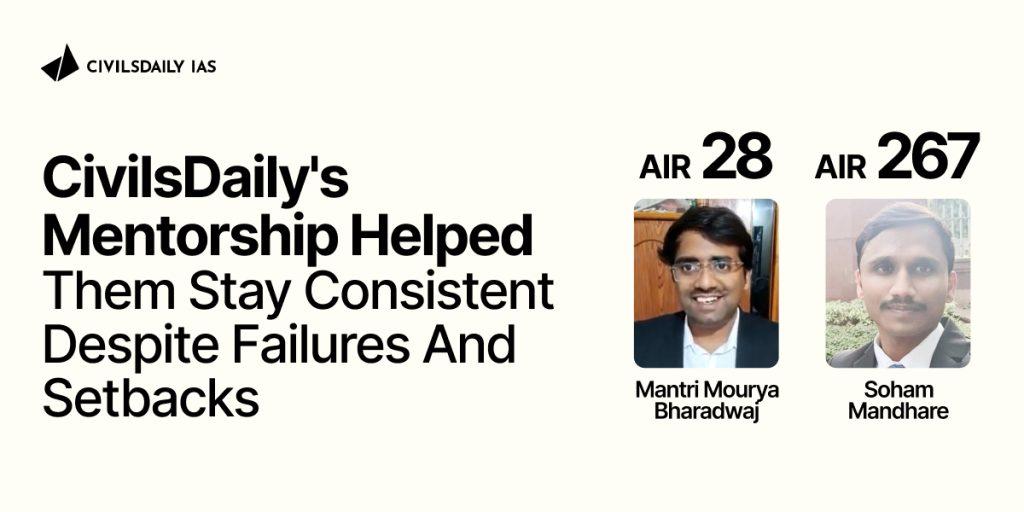
    👨‍🎓By Soham sir, AIR 267, Super Mentor- Civilsdaily

    11th Feb 2023 (Saturday), 7:30 pm

    Soham Mandhare, IRS and a Super Mentor at CivilsDaily will be LIVE for a 1-1 LIVE webinar to discuss practical and proven Time-Management strategies to bring productivity and efficiency to your UPSC preparation, with just 5 hours of study time.

    What you should expect on Day 1?

    • How to manage time for UPSC Preparation if you’re a working Professional? How to utilize the time, left in your hand, in the best possible way?
    • UPSC preparation timetable and schedule with just 5 hrs of daily study time?
    • How to identify those people or things that deplete your energy and waste your time?
    • How to break down the syllabus into small chunks, and develop an effective & workable study strategy for UPSC preparation.
    • How to complete the syllabus, in a short time! 
    • How to prioritize conventional topics/subjects?
    • How to divide your time and keep a balance between Prelims and mains preparation?
    • Selective reading or studying: How to deal with the ocean of current affairs and a mountain of GS?
    • How to tackle Optional subject preparation, Making Notes, and improving answer writing habits in a short time
    • Many more untold tips and techniques that only a topper can elaborate

    Time: 7:30 pm onwards

    Mode: This Workshop will be held online mode. We will share a Zoom link in your email. Please register.

    Contact here: +91 7303316700


    CivilsDaily’s FREE Webinar package

    Post-webinar we will share important PDFs, timetable framework, and notes.

    Other than this a strategy package will be emailed to you.


    What The Hindu opined about Civilsdaily Mentorship

    best coaching for upsc in delhi

More posts