


đŸ’„Join UPSC 2027,2028 Mentorship (July Batch) + XFactor Notes & Microthemes PDF

Archives: Stories

  • Black Money – Domestic and International Efforts

    Are there any provisions in UN which can help us chase black money?

     United Nations Convention Against Corruption

    Yes, there are a few. And they might help us get black money back in India. Let’s look at the history of such negotiations to learn more about them and hone your understanding for Probable questions for IAS Mains.

    1. Tough negotiations on this subject in Vienna, Austria, in 2003 was a vital part of the United Nations Convention Against Corruption (UNCAC).
    2. The first breakthrough came when the group established asset recovery as a “fundamental principle” of the convention.
    3. Then it was only a matter of laying a framework, in both civil and criminal law, for tracing, freezing, forfeiting and returning funds obtained through corrupt activities.
    4. What did the convention accomplish? Legal obstacles should be tackled with international cooperation rather than by domestic laws.
    5. Some of the relevant provisions of the convention are crucial to the question of recovery of assets.
    6. It provides that each state party shall take such measures as may be necessary to permit its competent authorities to give effect to an order of confiscation issued by a court of another state party.They are also required to share information with the competent authorities of another state, when necessary, to investigate, claim and recover proceeds of offences.

    The UN, through its Office on Drugs and Crime, which leads the fight against illicit drugs and international crime, has been given the responsibility to implement the convention, particularly its assets recovery provisions.


    Refining India’s approach

    1. In the case of India, difficulties may have arisen not in establishing that the sums amassed abroad belong to India, but in proving that the assets were illegally obtained.
    2. There is a need of domestic management and disposal of seized and confiscated assets and the management of the return and disposal of assets recovered in the context of international corruption cases.
  • Digital India Initiatives

    Budget to boost Digital India vision

    The Union Budget 2016-17 has given a big boost to the Digital India vision of the Hon’ble Prime Minister. Let’s understand it in brief.
    Narendra-Modi-Digital-India


    Announcements for Digital India

    • Budget announcements will give a big boost to Digital India initiatives, Digital literacy, greater application of Cloud and above all big push to the Electronics Manufacturing
    • Focus on the larger involvement of post office platform for financial inclusion, including delivery of services

    Let’s now take an overview of some profound changes of last 20 years –

    • IT / ITeS exports have crossed USD 100 billion
    • India’s share in global IT services outsourcing presently 56%, is growing every year
    • Total employment in IT / ITeS sector is 37 lakhs in this financial year, out of which the net addition is 2 lakhs
    • Electronics Manufacturing has seen remarkable improvement, due to the initiatives of government in this sector

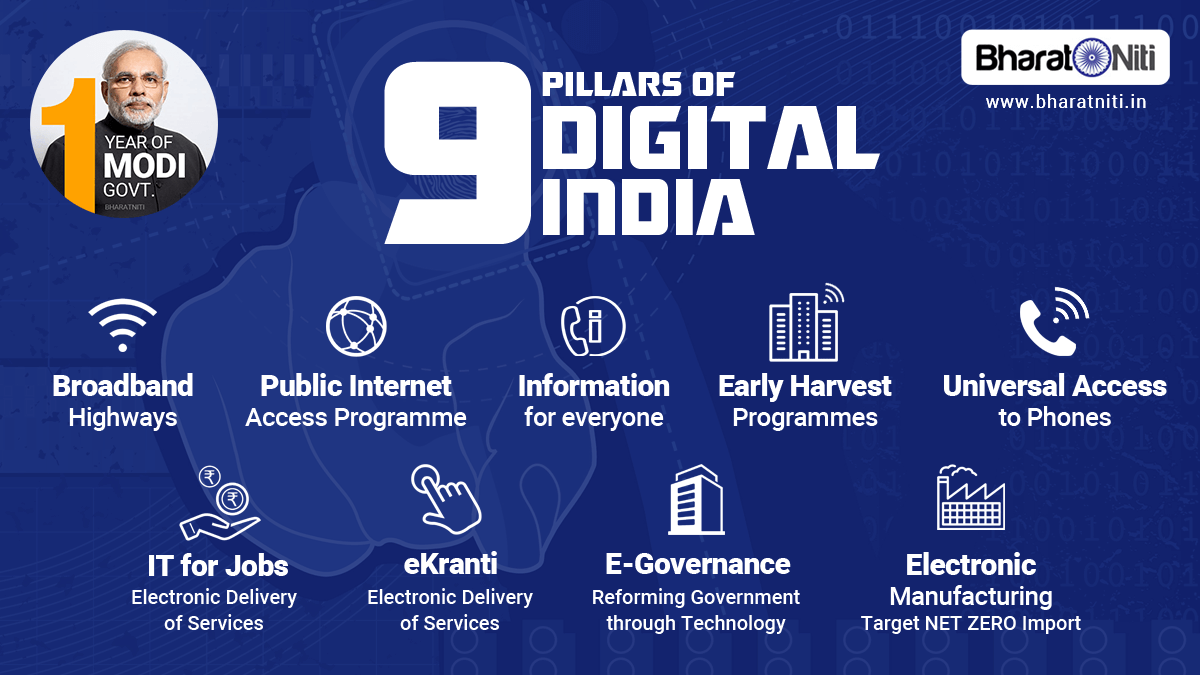
    Digital India 9 pillars

    New Incentives announced in the Budget 2016-17

    Electronics Manufacturing

    • Electronic manufacturing in India has got boost by further rationalization of duty structure
    • Tax benefits for IT units in SEZs has been extended from 2017 till 2020.
    • This will enable technology units to set up and commence operations in SEZs and also significant move for skill development to services companies as well
    • This will permit 30 % of additional wages paid to new workmen, deductible for 3 years. This will give a big boost to the BPO operations and generate new jobs (essential for India to reap it’s demographic dividend)

    Encouragement to Digital Literacy & Digital Lockers

    • Digital depository of school leaving certificates, college degrees and mark-sheets will be created
    • This would enhance the footprint of cloud technology in the Country
    • The IT department has already laid down the framework for cloud technology and will assist in the expansion <Cloud Technology is the delivery of on-demand computing resources— everything from applications to data centers over the Internet on a pay-for-use basis>
    • Extraordinary expansion to Digital Literacy in the country; imparting digital literacy to 6 crore households in next 3 years
    • As of now, against the target of 52.5 lakhs, more than40 lakhs have been trained

    Use of Aadhaar platform for delivery of services

    • A legislation will be brought to give a statutory backing to Aadhaar, for delivery of services /subsidies / benefits, corning out of Consolidated Fund of India
    • This will prevent leakages by identifying the beneficiaries correctly and would encourage good governance
    • Greater stress on the use of digital platform across various departments
    • This will further encourage consolidation of seminal programmed of Digital India

    Reforms in Postal department

    • Effort is being made to leverage the vast network of India Post for implementing the mandate of financial inclusion
    • Today, India Post has not only installed more than 576 ATMs but has overtaken the SBI to become India’s largest Core Banking Network having 18,231 branches
    • By March, 2016 all the 25,000 Departmental Post Offices would offer Anywhere Banking facilities using Core Banking Solutions
    • Further, India Post has achieved new heights in tapping the potential of e-commerce
    • Its parcel revenues have witnessed a growth of 110% and it has collected more than Rs.1200 Crores from Cash on Delivery mode of payment for e-Commerce services

    Read more-

    1. Digital India Initiative : What is Buzzing  
    2. Seven Mission for Transformation of Railways

    Published with inputs from Arun Source - Ministry of Communications & IT | Pic - 9 Pillars of Digital India
  • Cashless Society – Digital Payments, Demonetization, etc.

    In this article we will explain what Cashless economy is, what are the major advantages of cashless economy and what challenges India will face in moving towards a cashless economy.

    • What is a cashless economy?
    • Benefits of Cashless economy
    • Challenges in making India a cashless economy
    • Steps taken by RBI and Government to discourage use of cash
    • What else needs to be done?

    Introduction

    India continues to be driven by the use of cash; less than 5% of all payments happen electronically however the finance minister, in 2016 budget speech, talked about the idea of making India a cashless society, with the aim of curbing the flow of black money.

    Even the RBI has also recently unveiled unveiled a document — “Payments and Settlement Systems in India: Vision 2018” — setting out a plan to encourage electronic payments and to enable India to move towards a cashless society or economy in the medium and long term.

    What is a cashless economy and where does India stand?

    • A cashless economy is one in which all the transactions are done using cards or digital means. The circulation of physical currency is minimal.
    • India uses too much cash for transactions. The ratio of cash to gross domestic product is one of the highest in the world—12.42% in 2014, compared with 9.47% in China or 4% in Brazil.
    • Less than 5% of all payments happen electronically
    • The number of currency notes in circulation is also far higher than in other large economies. India had 76.47 billion currency notes in circulation in 2012-13 compared with 34.5 billion in the US.
    • Some studies show that cash dominates even in malls, which are visited by people who are likely to have credit cards, so it is no surprise that cash dominates in other markets as well.

    source

    Benefits of Cashless economy

    • Reduced instances of tax avoidance because it is financial institutions based economy where transaction trails are left.
    • It will curb generation of black money
    • Will reduce real estate prices because of curbs on black money as most of black money is invested in Real estate prices which inflates the prices of Real estate markets
    • In Financial year 2015, RBI spent Rs 27 billion on just the activity of currency issuance and management. This could be avoided if we become cashless society.
    • It will pave way for universal availability of banking services to all as no physical infrastructure is needed other than digital.
    • There will be greater efficiency in welfare programmes as money is wired directly into the accounts of recipients. Thus once money is transferred directly into a beneficiary’s bank account, the entire process becomes transparent. Payments can be easily traced and collected, and corruption will automatically drop, so people will no longer have to pay to collect what is rightfully theirs.
    • There will be efficiency gains as transaction costs across the economy should also come down.
    • 1 in 7 notes is supposed to be fake, which has a huge negative impact on economy, by going cashless, that can be avoided.
    • Hygiene – Soiled, tobacco stained notes full of germs are a norm in India. There are many such incidents in our life where we knowingly or unknowingly give and take germs in the form of rupee notes. This could be avoided if we move towards Cashless economy.
    • In a cashless economy there will be no problem of soiled notes or counterfeit currency
    • Reduced costs of operating ATMs.
    • Speed and satisfaction of operations for customers, no delays and queues, no interactions with bank staff required.
    • A Moody’s report pegged the impact of electronic transactions to 0.8% increase in GDP for emerging markets and 0.3% increase for developed markets because of increased velocity of money

    An increased use of credit cards instead of cash would primarily enable a more detailed record of all the transactions which take place in the society, allowing more transparency in business operations and money transfers.

    This will eventually have the following chain effect:

    1. Improvement in credit access and financial inclusion, which will benefit the growth of SMEs in the medium/long run.
    2. Reduce tax avoidance and money laundering thanks to the higher traceability of all the transactions.
    3. The increased use of credit cards will definitely reduce the amount of cash that people will carry and as a consequence, reduce the risk and the cost associated with that.

    Challenges in making India a cashless economy

    • Availability of internet connection and financial literacy.
    • Though bank accounts have been opened through Jan Dhan Yojana, most of them are lying un operational. Unless people start operating bank accounts cashless economy is not possible.
    • There is also vested interest in not moving towards cashless economy.
    • India is dominated by small retailers. They don’t have enough resources to invest in electronic payment infrastructure.
    • The perception of consumers also sometimes acts a barrier. The benefit of cashless transactions is not evident to even those who have credit cards. Cash, on the other hand, is perceived to be the fastest way of transacting for 82% of credit card users. It is universally believed that having cash helps you negotiate better.
    • Most card and cash users fear that they will be charged more if they use cards. Further, non-users of credit cards are not aware of the benefits of credit cards.
    • Indian banks are making it difficult for digital wallets issued by private sector companies to be used on the respective bank websites. It could be restrictions on using bank accounts to refill digital wallets or a lack of access to payment gateways. Regulators will have to take a tough stand against such rent-seeking behaviour by the banks.

    Steps taken by RBI and Government to discourage use of cash

    • Licensing of Payment banks
    • Government is also promoting mobile wallets.Mobile wallet allows users to instantly send money, pay bills, recharge mobiles, book movie tickets, send physical and e-gifts both online and offline. Recently, the RBI had issued certain guidelines that allow the users to increase their limit to Rs 1,00,000 based on a certain KYC verification
    • Promotion of e-commerce by liberalizing the FDI norms for this sector.
    • Government has also launched UPI which will make Electronic transaction much simpler and faster.
    • Government has also withdrawn surcharge, service charge on cards and digital payments

    What else needs to be done?

    • Open Bank accounts and ensure they are operationalized.
    • Abolishment of government fees on credit card transactions; reduction of interchange fee on card transactions; increase in taxes on ATM withdrawals.
    • Tax rebates for consumers and for merchants who adopt electronic payments.
    • Making Electronic payment infrastructure completely safe and secure so that incidents of Cyber crimes could be minimized and people develop faith in electronic payment system.
    • Create a culture of saving and faith in financial system among the rural poor.
    • The Reserve Bank of India too will have to come to terms with a few issues, from figuring out what digital payments across borders means for its capital controls to how the new modes of payment affect key monetary variables such as the velocity of money.
    • RBI will also have to shed some of its conservatism, part of which is because it has often seen itself as the protector of banking interests rather than overall financial development.
    • The regulators also need to keep a sharp eye on any potential restrictive practices that banks may indulge in to maintain their current dominance over the lucrative payments business.

    Though it will take time for moving towards a complete cashless economy, efforts should be made to convert urban areas as cashless areas. As 70% of India’s GDP comes from urban areas if government can convert that into cashless it will be a huge gain. Therefore different trajectories need to be planned for migration to cashless for those having bank account and for those not having.


    References:

  • Food Safety Standards – FSSAI, food fortification, etc.

    Food Safety Regulations in India and the Way Forward

    From junk food bans to street food regulations, FSSAI has been in news all the year round and most notoriously for the Maggie ban! UPSC does not necessarily goes for the most hot topic in news which is the Maggie ban in this context but this whole episode opens up a hitherto unknown organisation to us – The FSSAI.

    And what must a worthy IAS aspirant do? Study the ins and outs of this organisation – food safety regulations – its latest victories and controversies! And that’s not it, one more reason which makes this topic important is the declaration of the World Health Day’s 2015 theme – Food Safety.
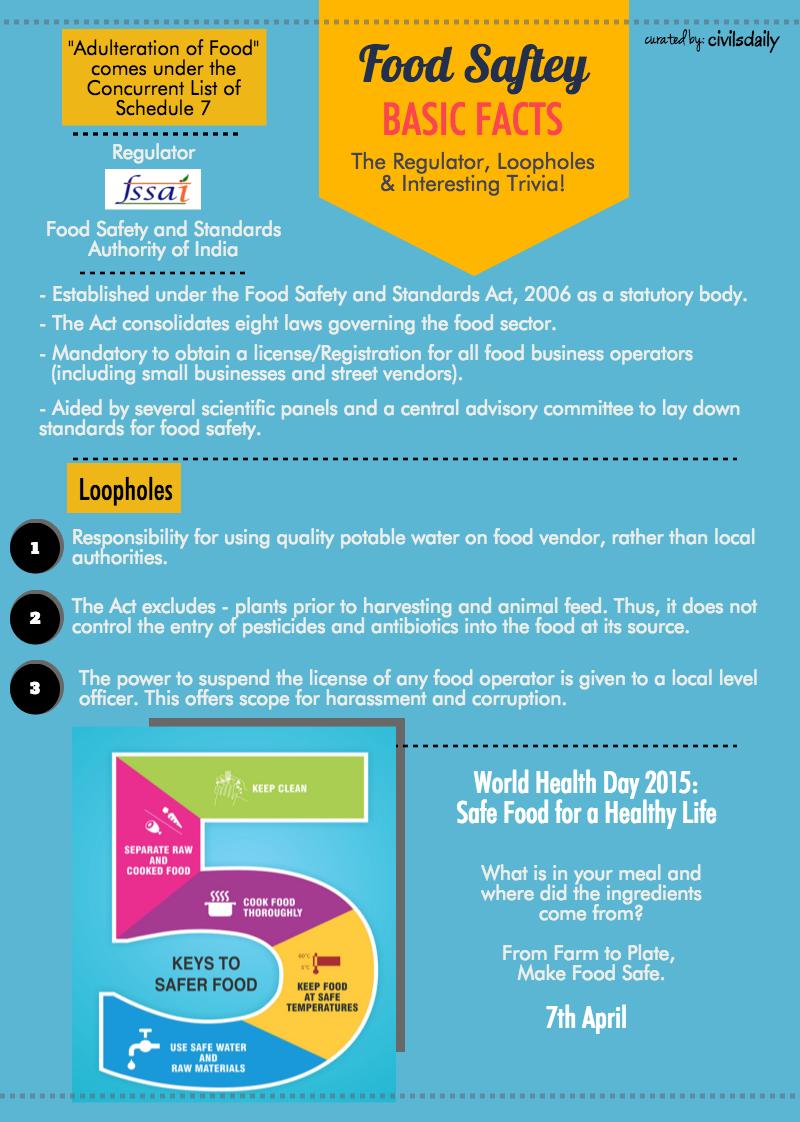
    So, what all have been the cases of FSSAI activism this year? For starters, these guys banned junk food in Delhi school canteens!

    1. Acting on a public interest writ petition, the Delhi HC had earlier directed FSSAI to regulate sale of foods high in salt, fats and sugar in and around 50 metres of schools.
    2. Court also directed CBSE to consider including the adherence to these guidelines while giving affiliation to the schools.
    3. The draft guidelines suggested creation of a canteen policy and education program to inform students and parents of link between ‘High in fats, salt & sugar’ (HFSS) foods and non-communicable diseases like obesity, hypertension, diabetes etc.

    But what was the need to do this? Glad you wondered!

    A study published in the noted medical journal Lancet says India is just behind US and China in this global hazard list of top 10 countries with highest number of obese people.

    Fair enough, what about the street food that we devour?

    This is where CSE came in and presented a case for regulation on the street food. They want the agencies to:

    1. Strengthen the implementation and enforcement of the Food Safety and Standards Act (FSS) .
    2. Improve food testing laboratory infrastructure and skills.
    3. The Food Safety and Standards Authority of India (FSSAI) should set maximum residual limits for antibiotic residues in chicken etc.
    4. Set a national level disease surveillance and public alert system.


    All this is well and fine but you probably still want to know what happened with the Maggi case? More particularly, what was the issue with MSG (Ajinomoto)!

    Here’s all that we could find on the MSG/ Ajinimoto issue. UPSC Might not ask a direct question but can probably check you on a quick objective (IAS 2016) or you can use this as a quick criticism point on FSSAI’s propensity to escalate issues!

    Some major criticisms that came in the way of FSSAI:

    1. It is time we wake up and work on a science-based approach and move forward rapidly.
    2. If we have periodical evaluation in aviation for pilots, why not for analysts who test our food?
    3. Ideally, scientists should be involved in monitoring at every stage, including sampling protocols, setting standards, and testing and simulation.
    4. The state labs are short of analytical personnel and ill-equipped to perform to capacity as compared to private labs which are approved by FSSAI.


    Published with inputs from Sumer.