💥Mains Ready By December. Smash Mains & Smash PYQ Admissions Open

Subject: Domestic Bodies/Agencies

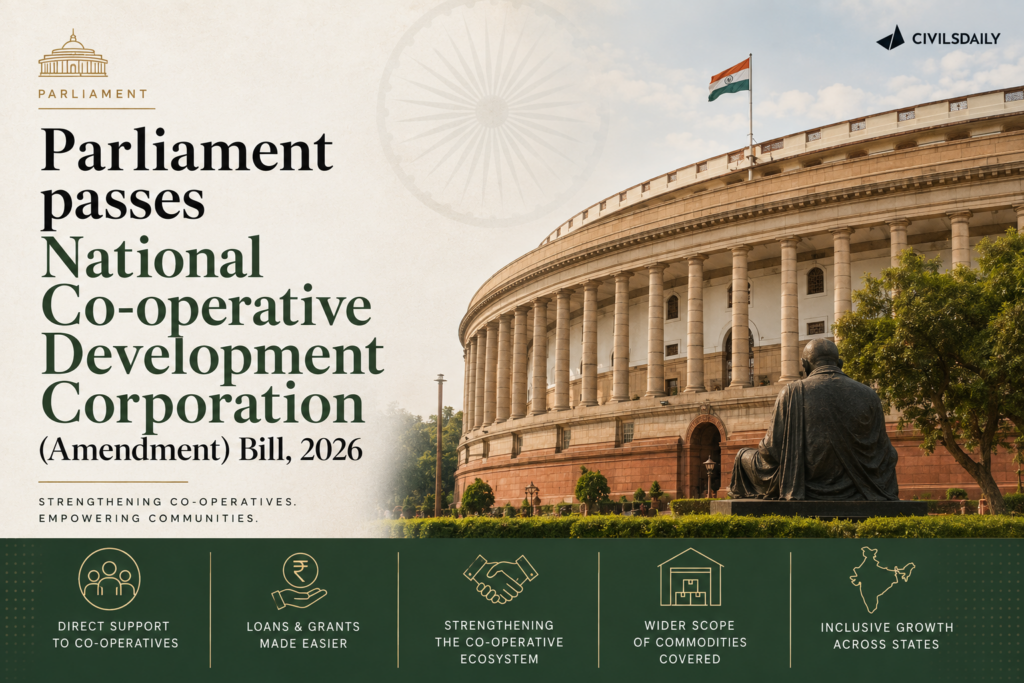
  • Parliament passes National Co-operative Development Corporation (Amendment) Bill, 2026

    Why in the News?

    Parliament passed the National Cooperative Development Corporation (Amendment) Bill, 2026, enabling the NCDC to provide loans and grants directly to cooperative societies.

    What is NCDC?

    • NCDC (National Cooperative Development Corporation) is a statutory corporation established under the National Cooperative Development Corporation Act, 1962.
    • Functions under the Ministry of Cooperation.
    • Promotes and finances cooperatives involved in production, processing, marketing, storage and trade of agricultural and allied produce.

    What does the Amendment Change?

    • Direct lending: NCDC can directly provide loans and grants to cooperative societies.
    • Wider coverage: Definition of foodstuffs expanded to include processed food and other food items notified by the Centre.
    • No additional budgetary outlay: The Bill does not provide for additional government financial assistance.

    Why is it Needed?

    • Faster flow of credit by removing intermediary delays.
    • Supports over 8 lakh cooperatives with more than 30 crore members.
    • Extends cooperative financing into value added food chains.

    Why are States Concerned?

    • Cooperation is largely a State subject.
    • Direct central lending may bypass State governments and registrars.
    • Raises concerns about cooperative federalism and centralisation.

    Key Challenges

    • Financial weakness and poor governance of PACS (Primary Agricultural Credit Societies).
    • Dual regulatory control.
    • Regional concentration of cooperatives.
    • Delayed elections and audits.
    • Limited professional management.
    • Centre State friction.

    Constitutional Framework

    • Entry 32, State List: Incorporation and regulation of cooperative societies within a State.
    • Article 43B: Promotes voluntary formation and autonomous functioning of cooperatives.
    • Part IXB, Articles 243ZH to 243ZT: Constitutional provisions on cooperatives.
    • Multi State Cooperative Societies Act, 2002: Governs cooperatives operating across multiple States.
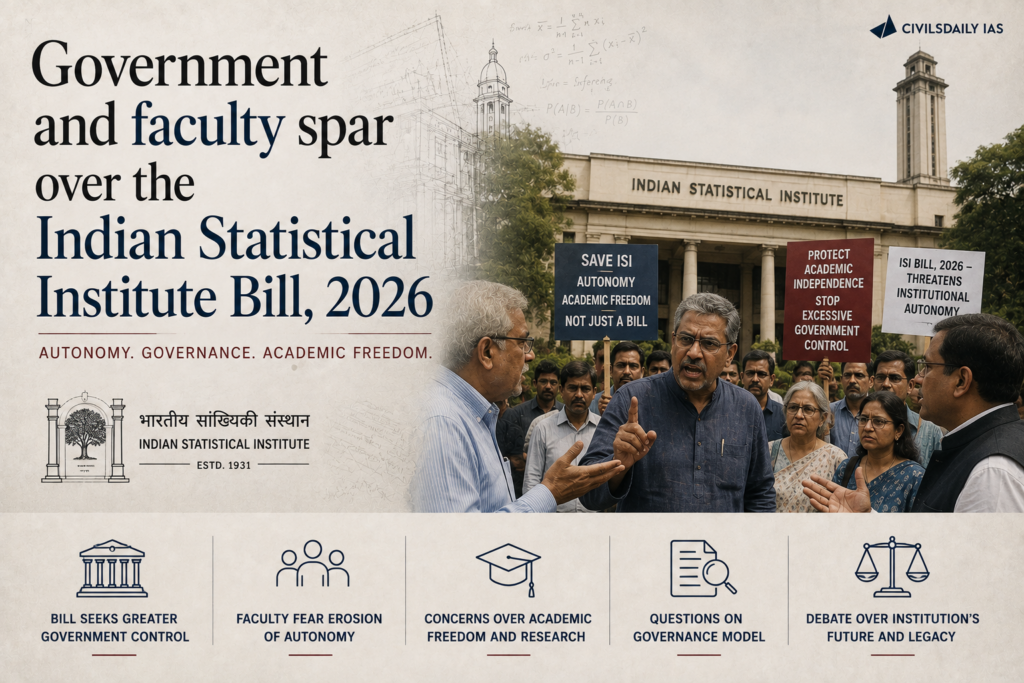
  • Government and faculty spar over the Indian Statistical Institute Bill, 2026

    Why in the News

    The Indian Statistical Institute (ISI) Bill, 2026 seeks to restructure the governance of the Indian Statistical Institute by converting it from a registered society into a government controlled statutory body corporate. The proposal has sparked concerns over institutional autonomy.

    What is the Indian Statistical Institute (ISI)?

    • Founded: Established in 1931 by Prasanta Chandra (P.C.) Mahalanobis.
    • Premier institution: A leading centre for statistics, mathematics, data science, computer science, quantitative economics and related research.
    • Institution of National Importance: Declared under the Indian Statistical Institute Act, 1959.
    • Administrative Ministry: Ministry of Statistics and Programme Implementation (MoSPI).
    • Current governance: Functions as a registered society managed by a representative Governing Council.

    What does the Bill propose?

    • Repeals the 1959 Act: Introduces the Indian Statistical Institute Bill, 2026.
    • Body corporate: Converts ISI from a society into a statutory body corporate with perpetual succession.
    • New governance structure: Replaces the Governing Council with an 11 member Board of Governors.
    • Greater government role: The Board will have a majority of government nominated members, increasing the Centre’s role in administration.

    Why are faculty members concerned?

    • Reduced academic autonomy: Faculty argue that greater government control may affect academic freedom and institutional independence.
    • Lack of consultation: They claim the Bill was drafted without adequate consultation with ISI’s academic community.
    • Demand for scrutiny: Opposition members have sought referral of the Bill to the Standing Committee on Finance for detailed examination.

    Prelims Pointers

    • Indian Statistical Institute (ISI) was founded in 1931 by P.C. Mahalanobis.
    • P.C. Mahalanobis developed the Mahalanobis Distance and played a key role in India’s statistical system and economic planning.
    • ISI is an Institution of National Importance under the Ministry of Statistics and Programme Implementation (MoSPI).
    • The Indian Statistical Institute Bill, 2026 proposes replacing the Governing Council with an 11 member Board of Governors.

    [2023] Consider the following organizations/bodies in India:
    1. The National Commission for Backward Classes
    2. The National Human Commission Rights
    3. The National Law Commission
    4. The National Consumer Disputes Redressal Commission
    How many of the above are constitutional bodies?

    [A] Only one

    [B] Only two

    [C] Only three

    [D] All four

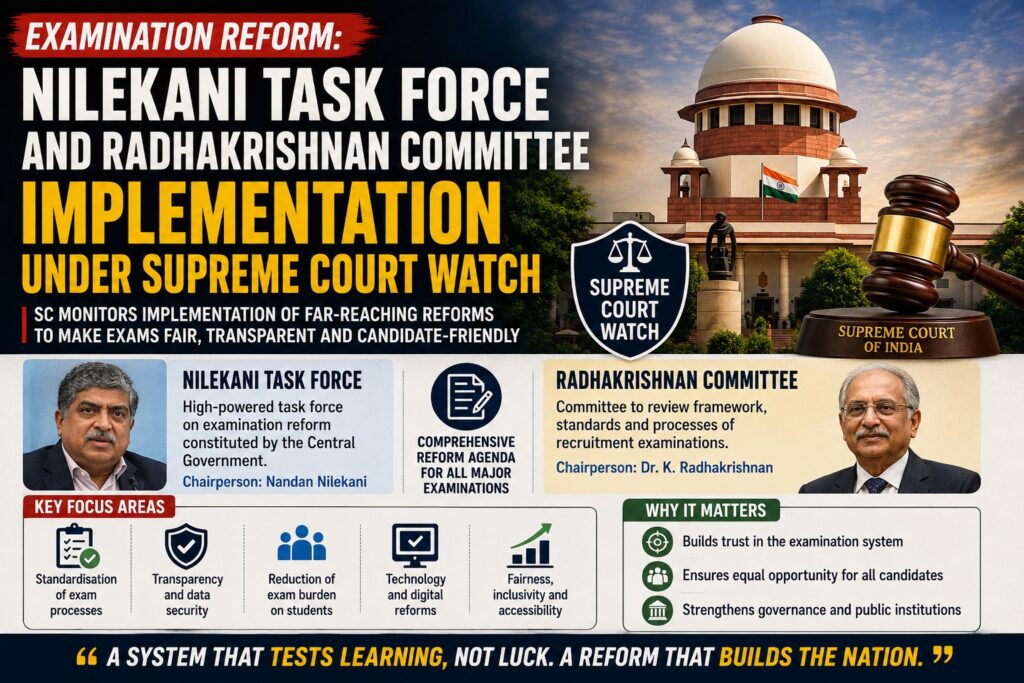
  • Examination reform: Nilekani task force and Radhakrishnan committee implementation under Supreme Court watch

    The Supreme Court will consult the Nandan Nilekani-led task force at its next hearing on 3 August 2026 regarding the proposed transition of NEET-UG from a pen-and-paper examination to Computer-Based Testing (CBT). The Court is also examining the government’s progress in implementing the K. Radhakrishnan Committee’s recommendations on examination reforms.

    Key Highlights

    • Implementation review: The Centre has submitted an affidavit on the implementation status of the 101 recommendations of the K. Radhakrishnan Committee.
    • Committee recommendations:
      • 60 short-term and 35 medium/long-term reforms.
      • Restructuring of the National Testing Agency (NTA).
      • Introduction of Computer-assisted Secure Pen-and-Paper Testing (CPPT).
      • Adoption of DIGI-EXAM for secure candidate authentication.
    • Infrastructure plan: Establishment of 1,000 Secure Testing Centres across the country.
    • Related development: Concerns over examination integrity have also emerged in the Jharkhand Combined Civil Services Examination, highlighting the need for broader examination reforms.

    About the National Testing Agency (NTA)

    • Established in 2017 as an autonomous organisation under the Ministry of Education.
    • Conducts major national entrance examinations such as NEET-UG, JEE Main, CUET and UGC-NET.
    • Objective is to ensure fair, transparent, efficient and technology-driven examinations.

    What is Computer-Based Testing (CBT)?

    • Candidates answer questions on a computer terminal instead of paper.
    • Responses are digitally recorded and securely transmitted.
    • Reduces risks associated with paper leaks, manual handling and evaluation delays.

    What is Computer-assisted Secure Pen-and-Paper Testing (CPPT)?

    • Question papers are generated digitally and printed securely at authorised centres shortly before the examination.
    • Minimises transportation and storage of printed question papers.
    • Reduces the possibility of paper leaks while retaining a pen-and-paper examination format.
  • The jurisdiction of the Central Bureau of Investigation (CBI) regarding lodging an FIR and conducting probe within a particular State is being questioned by various States. However, the power of the States to withhold consent to the CBI is not absolute. Explain with special reference to the federal character of India.

    The Central Bureau of Investigation (CBI), established under the Delhi Special Police Establishment (DSPE) Act, 1946, is India’s premier investigating agency. It has become the issue of confrontational federalism in recent years.

    Legal Framework of CBI’s Jurisdiction

    Section 6 of DSPE Act – CBI requires State consent to investigate cases within that State

    General Consent – blanket permission for all cases (most States provide this).

    Case-specific Consent – given on a case-to-case basis if general consent is withdrawn.

    States’ Power to Withhold Consent

    Police and Public order is a State List subject, Entry 2, List II.

    Several States (e.g., West Bengal, Kerala, Chhattisgarh, Punjab) have withdrawn general consent citing political misuse.

    However, States’ Power is Not Absolute

    Court’s Power –

    The Supreme Court and High Courts can direct the CBI to investigate without State consent under Articles 32 and 226. (State of West Bengal v. Committee for Protection of Democratic Rights (2010))

    Union Territories – CBI can operate without State consent in UTs.

    Inter-State and National Interest Cases – Involving corruption, national security, or cross-border crimes, Union may justify CBI probe to preserve national integrity.

    The Supreme Court ruled that the CBI can probe Central officials under Central laws without State consent.

    Impact on Federal Character of India

    Positive Aspects

    Judicial oversight – SC/HC powers to direct CBI investigations prevent misuse of State autonomy.

    Enables impartial probes in crimes affecting multiple States.

    National interest protection – accountability in cases threatening unity, security, or economy.

    Negative Aspects

    CBI entry without consent undermines State authority.

    Politicisation fears – Opposition-ruled States view CBI as a tool of the Centre

    SC criticized the CBI as a “caged parrot speaking in its master’s voice.” (Centre for Public Interest Litigation (CPIL) Case)

    Weakens cooperative federalism – Tensions between WB Govt and Centre

    Reinforces the unitary bias of the Constitution, reducing States to subordinate entities in criminal investigation matters.

    Way Forward

    Strengthen Autonomy – Implement Vineet Narain (1997) directives (“CVC-supervised model”).

    Statutory Backing – Replace DSPE Act, 1946 with a clear modern CBI law.

    Consultative Federalism – Respect States’ consent; use Inter-State Council for dialogue.

    Joint Collaboration – Form Centre-State task forces for investigation

    The need of the hour is strengthening institutional independence of CBI , and fostering cooperative federalism.

  • Consider the following statements

    Consider the following statements:
    1. MMTC Limited is India’s largest international trading organization.
    2. Neelachal Ispat Nigam Limited has been set up by MMTC jointly with the Government of Orissa.
    Which of the statements given above is/are correct?

  • Consider the following statements

    Consider the following statements:
    1. Petroleum and Natural Gas Regulatory Board (PNGRB) is the first regulatory body set up by the Government of India.
    2. One of the tasks of PNGRB is to, ensure competitive markets for gas.
    3. Appeals against the decisions of PNGRB go before the Appellate Tribunals for Electricity.
    Which of the statements given above are correct?
    Select the correct answer using the code given below.

  • Consider the following statements

    Consider the following statements :
    1. The India Sanitation Coalition is a platform to promote sustainable sanitation and is funded by the Government of India and the World Health Organization.
    2. The National Institute of Urban Affairs is an apex body of the Ministry of Housing and Urban Affairs in Government of India and provides innovative solutions to address the challenges of Urban India.
    Which of the statements given above is/are correct ?

  • With which one of the following is BRIT (Government Of India) engaged

    With which one of the following is BRIT (Government Of India) engaged?

  • Department of Border Management is a Department of which one of the following Union Ministries

    Department of Border Management is a Department of which one of the following Union Ministries?

  • With reference to the Consumer Disputes Redressal at district level in India, which one of the following statements is not correct

    With reference to the Consumer Disputes Redressal at district level in India, which one of the following statements is not correct ?