The global stock and bond markets, especially Japan’s, are experiencing turmoil due to the unwinding of the immensely popular yen carry trade.
What is Yen carry trade?
The yen carry trade is a popular currency trading strategy that involves borrowing Japanese yen at low interest rates and using the funds to invest in higher-yielding assets denominated in other currencies, with the goal of profiting from the interest rate differential.
Why is it unwinding right now?
Strengthening Yen: The Japanese yen has appreciated significantly, rising over 3% against the dollar after the Bank of Japan (BoJ) raised interest rates to 0.25% and announced a reduction in bond purchases. This strengthening of the yen diminishes the profitability of the carry trade, which relies on a weaker yen to remain viable.
Interest Rate Changes: Expectations of imminent interest rate cuts by the U.S. Federal Reserve have contributed to the dollar’s weakness, further impacting the carry trade. As the interest rate differential narrows, the incentive to maintain yen carry positions decreases.
How does it work?
Mechanism: The yen carry trade involves borrowing yen at low interest rates and converting it into higher-yielding currencies. Investors use the borrowed yen to purchase assets in currencies that offer better returns, such as U.S. dollars or Australian dollars.
Investors typically aim for annualized returns of around 5% to 6% on dollar-yen carry trades, which is the difference between U.S. and Japanese interest rates. The strategy can be lucrative as long as the yen does not appreciate significantly against the currencies in which the investments are made.
How did it begin?
The yen carry trade can be traced back to 1999 when Japan lowered its policy rates to zero following an asset price bubble burst. This led Japanese investors to seek better returns in international markets, effectively turning Japan into the world’s largest creditor nation.
The contemporary form of the carry trade gained prominence in 2013 under Prime Minister Shinzo Abe’s quantitative easing policies, coinciding with rising U.S. rates and a depreciating yen. This trend intensified in 2022 and 2023 as the Federal Reserve raised rates rapidly while the Bank of Japan maintained negative short-term rates.
How large Is It?
The estimated size is about $350 billion in short-term external loans by Japanese banks attributed to yen-funded carry trades. However, this figure may not fully capture the extent of the trades, as it could include commercial transactions or loans to foreign businesses.
The actual size of yen carry trades could be larger due to the leverage used by hedge funds and computer-driven funds.
Is it coming to an end?
The Bank of Japan has recently started raising rates, which has led to a stronger yen. As a result, the yield gap between Japanese and other currencies has narrowed, diminishing the profitability of carry trades.
The appreciation of the yen (by about 13% in a month) has prompted leveraged investors to unwind their positions, leading to a sell-off in global stock and bond markets. This unwinding is driven by the need to repay yen loans as the currency strengthens, causing further declines in asset prices internationally.
Conclusion: The yen carry trade is unwinding due to the strengthening yen and narrowing interest rate differentials. As the yen appreciates, profitability decreases, prompting investors to exit positions, leading to global market sell-offs. This trend signifies a shift in monetary policies and changing economic conditions affecting currency trading strategies.
Q1 China is using its economic relations and positive trade surplus as tools to develop potential military power status in Asia’, In the light of this statement, discuss its impact on India as her neighbour. (UPSC IAS/2021)
Q2 With respect to the South China sea, maritime territorial disputes and rising tension affaire the need for safeguarding maritime security to ensure freedom of navigation and ever flight throughout the region. In this context, discuss the bilateral issues between India and China. (UPSC IAS/2014)
Prelims:
Q ‘Belt and Road Initiative’ is sometimes mentioned in the news in the context of the affairs of (2016) (a) African Union (b) Brazil (c) European (d) Union China
Note4Students:
Prelims: Bordering countries with China;
Mains: Dependency on Chinese technician;
Mentor comments: Chinese technicians are vital for the Indian economy as they help bridge significant skill gaps in various industries, including manufacturing and technology. Their expertise is crucial for effectively operating Chinese machinery, which many Indian businesses have acquired but cannot utilize efficiently without skilled personnel. This dependency is highlighted by the urgent need for faster visa approvals for Chinese experts, as delays have led to substantial production losses, estimated at $15 billion over recent years. Integrating their knowledge is essential for enhancing productivity and achieving India’s manufacturing ambitions.
Let’s learn!
__
Why in the News?
Indian authorities plan to increase visas for Chinese technicians, acknowledging a significant skill gap between them and Indian workers, which is crucial for enhancing productivity in various industries.
Dependency on Chinese Technicians
Skill Gaps: Indian businesses are facing a substantial skill deficit compared to their Chinese counterparts, which hampers productivity and the effective use of advanced machinery.
Declining Visa Issuance: The number of visas issued to Chinese nationals has drastically decreased from approximately 200,000 in 2019 to just 2,000 in 2024, largely due to geopolitical tensions following border clashes in 2020.
This reduction has created a bottleneck in the manufacturing sector, leading to estimated production losses of around $15 billion over the past four years.
Government Response: In light of these challenges, Indian authorities are working to expedite the visa process for Chinese technicians, aiming to reduce processing times from several months to about 30 days.
Importance of Foreign Knowledge Integration:
Role of Foreign Knowledge in Development: Foreign knowledge is crucial for economic development but is most effective when combined with a well-educated domestic workforce. This integration enhances the ability to utilize foreign expertise effectively.
Korea’s Successful Model: In the 1980s, South Korea leveraged foreign technology by purchasing machines to dismantle and reverse engineer them.
This was possible due to a strong educational foundation that had been established over three decades, allowing minimal reliance on foreign assistance.
China’s Strategic Approach: China began its rapid economic growth in the early 1980s, despite having a weaker educational base than Korea. However, the quality of primary education during the Communist era prepared China for development.
Deng Xiaoping’s initiatives, including sending policymakers on international study tours and attracting foreign investors, facilitated the absorption of global knowledge.
India’s Educational Challenges: India has focused on building school infrastructure and increasing enrollment, but the quality of education remains low.
Only about 15% of Indian students possess the basic skills necessary for participation in the global economy, compared to 85% of Chinese students.
Global Competitiveness: China’s performance in international assessments, such as the Programme for International Student Assessment (PISA), has consistently improved, with Chinese students outperforming their peers globally.
In contrast, India’s participation in PISA ended after a poor showing in 2009, highlighting a significant gap in educational outcomes.
Red Queen Race:
Fundamental lesson from the Red Queen: The phrase “You must run twice as fast as you can to stay in the same place” illustrates the necessity for continuous improvement and adaptation in the face of competition, especially in the context of global technological advancements.
China’s educational advancements: Chinese universities are now among the world’s best, particularly in fields like computer science and mathematics, reflecting a strong emphasis on integrating foreign knowledge with domestic education.
Scientific progress: Chinese scientists are making significant strides in applied sciences relevant to industrial progress, positioning China as a leader in electric vehicles, solar technology, and artificial intelligence.
Western response to competition: Instead of addressing deficiencies in their education systems, Western leaders are resorting to protectionist measures against Chinese imports, which may not effectively resolve underlying issues in their own educational frameworks.
India’s educational challenges: Indian elites appear to overlook the lessons from China, with economists suggesting a shift towards technology-enhanced service exports while ignoring the need for a robust base of high-quality education to support such initiatives.
Way forward:
Streamline Visa Approval Processes: India should expedite the visa application process for Chinese technicians by implementing a fast-track system that reduces approval times to less than a month.
Enhance Domestic Education and Training: To complement foreign expertise, India must invest in improving its educational system, focusing on vocational training and technical skills.
The Reserve Bank of India (RBI) has broadened the regulations governing remittances to International Financial Services Centres (IFSCs) under the Liberalised Remittance Scheme (LRS). The RBI’s circular authorizes “authorised persons” to facilitate remittances for all permissible purposes under LRS to IFSCs.
About Liberalised Remittance Scheme (LRS)
LRS is governed by the Foreign Exchange Management Act (FEMA) 1999, regulated by the Reserve Bank of India (RBI).
The scheme was introduced by the RBI in 2004 to facilitate outward remittances from India.
LRS allows resident individuals, including minors, to remit a specified amount of money abroad each financial year (April – March).
Currently, individuals are allowed to remit up to USD 250,000 per financial year under LRS.
Funds remitted under LRS can be used for permissible current or capital account transactions, or a combination of both.
Permissible Uses:
Expenses related to travel (private or for business).
Medical treatment abroad.
Payment of fees for education abroad.
Gifts and donations.
Maintenance of close relatives.
Investment in shares, debt instruments, and immovable properties overseas.
Accounts: Individuals can open and maintain foreign currency accounts with banks outside India for transactions permitted under LRS.
Exclusions: LRS is NOT available to corporations, partnership firms, Hindu Undivided Families (HUFs), trusts, etc.
Prohibited Transactions:
Remittances for activities prohibited under Schedule-I of FEMA, such as purchase of lottery tickets, sweepstakes, proscribed magazines, etc.
Trading in foreign exchange abroad.
Remittances to countries identified as non-cooperative by the FATF.
Remittances to individuals/entities identified as posing a terrorism risk by the RBI.
Significance of the move
The RBI’s decision reinforces GIFT IFSC’s position as a prominent international financial services hub.
By broadening the scope of LRS, GIFT IFSC aims to attract more diverse investments and transactions, contributing to the growth of India’s financial sector.
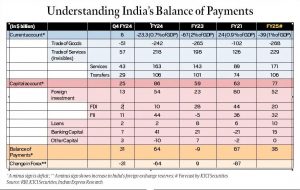
India’s current account showed a surplus in Q4 of 2023-24. However, current account surpluses are not always beneficial, and deficits are not inherently detrimental.
Latest Data from the Reserve Bank of India (RBI)
Current Account Surplus: India registered a current account surplus during the fourth quarter (Jan-Mar) of the 2023-24 financial year, marking the first surplus in 11 quarters.
Quarterly vs. Annual Data: Despite the Q4 surplus, the current account balance for the entire FY2023-24 remained in deficit, indicating underlying economic trends and demands.
What is Balance of Payments (BoP)?
The BoP is a ledger of a country’s transactions with the rest of the world, recording all monetary transactions between residents of a country and the rest of the world.
It shows the amount of money flowing into and out of the country, indicating the relative demand for the rupee compared to foreign currencies (usually in dollar terms).
Constituents of the BoP
The BoP has two main accounts: the Current Account and the Capital Account.
Current Account: It covers the trade in goods (exports and imports), trade in services (transportation, tourism, licensing, etc.), Income (wages, interest, dividends, etc.), and current transfers (remittances, foreign aid, etc.).
Trade of Goods (Merchandise Account): Records export and import of physical goods. A trade deficit occurs when imports exceed exports.
Invisibles of Trade: Includes services (banking, insurance, IT, tourism), transfers (remittances), and income (earnings from investments). These are transactions not visible like physical goods.
Net Balance: The sum of the merchandise trade and invisible trade determines the current account balance. Q4 showed a surplus in the current account due to a surplus in invisible despite a trade deficit.
Capital Account: It covers debt forgiveness, migrants’ transfers of financial assets, taxes on gifts and inheritances, and ownership transfers of fixed assets.
Investments: Captures transactions related to investments such as Foreign Direct Investment (FDI) and Foreign Institutional Investments (FII).
Net Balance: Q4 showed a net surplus of $25 billion in the capital account.
Impact on the Indian Economy:
Exchange Rate Stability: The current account surplus in Q4 helped stabilize the exchange rate of the rupee. By absorbing excess dollars, the Reserve Bank of India (RBI) prevented excessive appreciation of the rupee, which helps maintain the competitiveness of Indian exports.
Improved Sovereign Ratings: A current account surplus can positively impact India’s sovereign credit ratings, as it indicates stronger external financial health and reduces reliance on foreign borrowing.
Foreign Exchange Reserves: The surplus contributed to an increase in India’s foreign exchange reserves, enhancing the country’s ability to manage external shocks and providing a buffer against global economic uncertainties.
Investment Climate: A surplus in the capital account, driven by Foreign Direct Investment (FDI) and Foreign Institutional Investments (FII), indicates investor confidence in the Indian economy, potentially leading to more robust economic growth and development.
Economic Health Indicators: Despite the Q4 surplus, the annual current account deficit suggests robust domestic demand and investment needs. This aligns with a growing economy that requires imports of capital goods to enhance production capacity and future export potential.
Way forward:
Enhance Export Competitiveness: India should focus on boosting its export sector by diversifying export products and markets, improving product quality, and providing incentives for export-oriented industries.
Promote Sustainable Foreign Investment: Encouraging sustainable and long-term foreign investments, particularly in sectors like manufacturing, technology, and renewable energy, can strengthen the capital account.
Mains PYQ:
Q Craze for gold in Indian has led to surge in import of gold in recent years and put pressure on balance of payments and external value of rupee. In view of this, examine the merits of Gold Monetization scheme. (UPSC IAS/2015)
JP Morgan is including Indian Government Bonds in its emerging markets bond indices starting June 28. This move is expected to attract significant foreign investment, boosting India’s bond market and economic stability.
What would be India’s weight in the index?
India is poised to achieve a maximum weighting of 10% in the GBI-EM Global Diversified Index. This increased allocation is anticipated to attract greater investment from global investors into Indian debt, with analysts projecting monthly inflows of $2-3 billion.
Benefits of Higher Inflows from the Inclusion of Indian Government Bonds in JP Morgan’s Emerging Markets Bond Indices
Increase in Foreign Exchange Reserves: The inflows from foreign investments will directly boost India’s foreign exchange reserves, providing a stronger buffer against external economic shocks.
Strengthening the Rupee: The surge in foreign investment will enhance demand for the rupee, leading to its appreciation and contributing to a more stable and robust currency.
Enhanced External Financial Management: With increased foreign exchange reserves, India will have greater flexibility and resilience in managing its external financial obligations and mitigating balance of payment issues.
Reduction in Borrowing Costs: Higher reserves and a stronger rupee can lead to improved credit ratings and reduced risk premiums, lowering borrowing costs for the government and corporates.
Promotion of Economic Confidence: The inflows signify international investor confidence in India’s economic prospects, boosting overall economic sentiment and encouraging further investments.
What about the impact on inflation as RBI mops up the dollars and releases an equivalent amount in rupees?
Liquidity Injection: When the RBI mops up dollars from the market, it releases an equivalent amount of rupees into the financial system. This injection of liquidity can potentially increase the supply of money circulating in the economy.
Demand-Pull Inflation: Increased liquidity can stimulate demand for goods and services, potentially leading to demand-pull inflation if the production capacity of the economy does not keep pace with the increased demand.
Asset Price Inflation: The influx of liquidity can also inflate asset prices such as real estate and stocks, impacting affordability and potentially creating asset price inflation.
Exchange Rate Stability: On the flip side, mopping up dollars can help stabilize the exchange rate by reducing downward pressure on the rupee due to excessive inflows.
RBI’s Policy Response: The RBI has various monetary policy tools, such as open market operations, repo rates, and reserve requirements, to manage liquidity and inflationary pressures arising from such inflows. It may use these tools to absorb excess liquidity and stabilize inflation.
Way forward:
Prudent Monetary Policy Management: The RBI should continue to employ effective monetary policy measures, such as open market operations and repo rate adjustments, to carefully manage liquidity and inflationary pressures stemming from increased foreign inflows.
Enhanced Economic Diversification: India should use the influx of foreign investment to diversify its economy further, focusing on infrastructure development, technological advancements, and sustainable growth initiatives to bolster long-term economic resilience and stability.
Reserve Bank of India (RBI) has proposed to rationalise regulations governing export and import transactions. The aim is to promote ease of doing business and empower banks to provide more efficient service to their foreign exchange customers.
RBI Proposal and Directions
The RBI issued ‘Regulation of Foreign Trade under Foreign Exchange Management Act (FEMA), 1999 – Draft Regulations and Directions.’
Key propositions include:
Repatriation Timeline: The full export value of goods and services must be realised and repatriated to India within 9 months from the date of shipment for goods and the date of invoice for services.
Caution Listing: Exporters who fail to realise the full value within the specified time may be caution-listed by the authorised dealer.
Caution-Listed Exporters: Caution-listed exporters can undertake exports only against receipt of advance payment in full or an irrecoverable letter of credit, to the satisfaction of the authorised dealer.
Advance Remittance Restrictions: No advance remittance for the import of gold and silver is permitted unless specifically approved by the RBI.
Expected Benefits
Ease of Doing Business: The proposed regulations are intended to promote ease of doing business, especially for small exporters and importers.
Empowerment of Banks: The regulations aim to empower authorised dealer banks to provide quicker and more efficient service to their foreign exchange customers.
About Foreign Exchange Management Act (FEMA), 1999
The FEMA, 1999, regulates foreign exchange and trade in India.
FEMA replaced the older Foreign Exchange Regulation Act (FERA), 1973.
How does FEMA regulate EXIM Transaction?
Regulation under FEMA
Resident Indian Criteria
Defined in Section 2(v) of FEMA;
A person residing in India for more than182 days during the course of the preceding financial year.
Current Account Transactions
Permitted freely for EXIM activities, including trade payments and remittances.
Capital Account Transactions
Regulated by RBI, includes FDI in export-oriented units and overseas investments by Indian entities.
Documentation and Declarations
Exporters and importers must furnish declarations to RBI to ensure compliance and monitor foreign exchange.
Export Declarations
Declare the value of goods/services exported, expected earnings, and timeframe for realization.
Import Declarations
Provide details of goods/services imported, and foreign exchange spent, and ensure payments through authorized channels.
Authorized Dealers
Only RBI-approved dealers (banks/financial institutions) can handle foreign exchange transactions for EXIM.
Import Payment Regulations
Payments must be made through authorized channels within prescribed time limits, complying with DGFT terms.
Foreign Currency Accounts
Entities can maintain foreign currency accounts for efficient handling of foreign exchange for EXIM activities.
Significance of FEMA in Regulating EXIM Transactions
Facilitates Trade: By providing a clear regulatory framework, FEMA facilitates smoother and more efficient EXIM transactions, contributing to the growth of international trade.
Economic Stability: Ensures that foreign exchange earnings and expenditures are monitored and regulated, maintaining economic stability and preventing illegal outflows.
Investor Confidence: A transparent and regulated foreign exchange environment boosts investor confidence, attracting more foreign investment.
Liberalization: Replaces the stringent controls of FERA with a more liberal approach, encouraging businesses to engage in global trade.
PYQ:
[2013] Which of the following constitutes Capital Account?
1. Foreign Loans
2. Foreign Direct Investment
3. Private Remittances
4. Portfolio Investment
Select the correct answer using the codes given below.
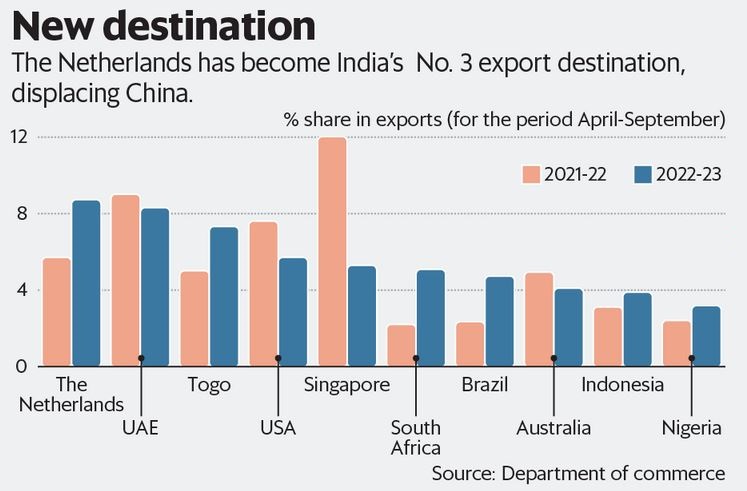
During fiscal year 2023-24, the Netherlands emerged as India’s third-largest export market, with a trade surplus expanding to $17.4 billion.
India’s Trade with the Netherlands
Key Export Commodities: Notable export items to the Netherlands include petroleum products ($14.29 billion), electrical goods, chemicals, and pharmaceuticals, showcasing robust growth in these sectors.
Continual Expansion: India’s exports to the Netherlands have steadily risen by approximately 3.5% to reach $22.36 billion in 2023-24, illustrating sustained growth momentum.
Mutual Investment: The Netherlands is a significant investor in India, with foreign direct investment (FDI) amounting to about $5 billion during the last fiscal.
Corporate Presence: Over 200 Dutch companies, including industry giants like Philips, Akzo Nobel, and KLM, operate in India, while Indian firms like TCS, HCL, and Sun Pharmaceuticals have a substantial presence in the Netherlands.
Shift in Trade Dynamics
Outpacing Major Destinations: The Netherlands has surpassed traditional trade partners such as the U.K., Hong Kong, Bangladesh, and Germany in terms of India’s export focus.
Long-term Growth: Export figures have shown consistent growth since 2000-01 when India’s exports to the Netherlands were a mere $880 million.
Significance: Gateway to Europe
Strategic Positioning: The Netherlands’ efficient ports and extensive connectivity with the EU via roads, railways, and waterways have positioned it as a vital gateway to the European market.
Strong Ties: Diplomatic relations between India and the Netherlands, established in 1947, have evolved into robust political, economic, and commercial partnerships.
India’s Trade Dynamics
Export Figures:
Forecasted to reach approximately US$776.68 billion in FY 2023–24.
Slightly surpassed the US$776.40 billion recorded in the previous fiscal year.
Concluded with the highest monthly merchandise exports of US$41.68 billion in March 2024.
Import Figures:
Total goods imports decreased by 5.66 percent to US$675.44 billion.
Global Merchandise Export Ranking:
India advanced from 19th to 17th place.
Marginal increase in share from 1.70 percent in 2014 to 1.82 percent in 2023.
Exported to 115 countries out of a total of 238 destinations during FY 2023-24.
Key Export Markets:
Include the US, UAE, Netherlands, China, UK, Saudi Arabia, Singapore, Bangladesh, Germany, and Italy.
Represent 46.5 percent of India’s export portfolio.
Diversification Strategy:
Focus on expanding beyond traditional sectors like iron ore and agricultural commodities.
Target sectors include electronics, pharmaceuticals, engineering products, and food items.
Plan to introduce goods such as alcoholic beverages, prepared meals, confectioneries, jackfruit, and bananas.
Emphasis on market research and analysis for product customization.
Trade Partners:
China emerged as India’s largest trading partner, surpassing the US.
Bilateral trade with China totalled US$118.4 billion in FY 2023-24.
Bilateral trade with the US amounted to US$118.3 billion in the same period.
India’s exports to China increased by 8.7 percent in FY24, driven by various sectors.
Imports from China rose moderately, totalling US$101.7 billion.
(Source of Data:Ministry of Commerce and Industry, Department of Commerce)
PYQ:
[2013] The balance of payments of a country is a systematic record of:
(a) All import and export transactions of a country during a given period of time, normally a year.
(b) Goods exported from a country during a year.
(c) Economic transaction between the governments of one country to another.
(d) Capital movements from one country to another.
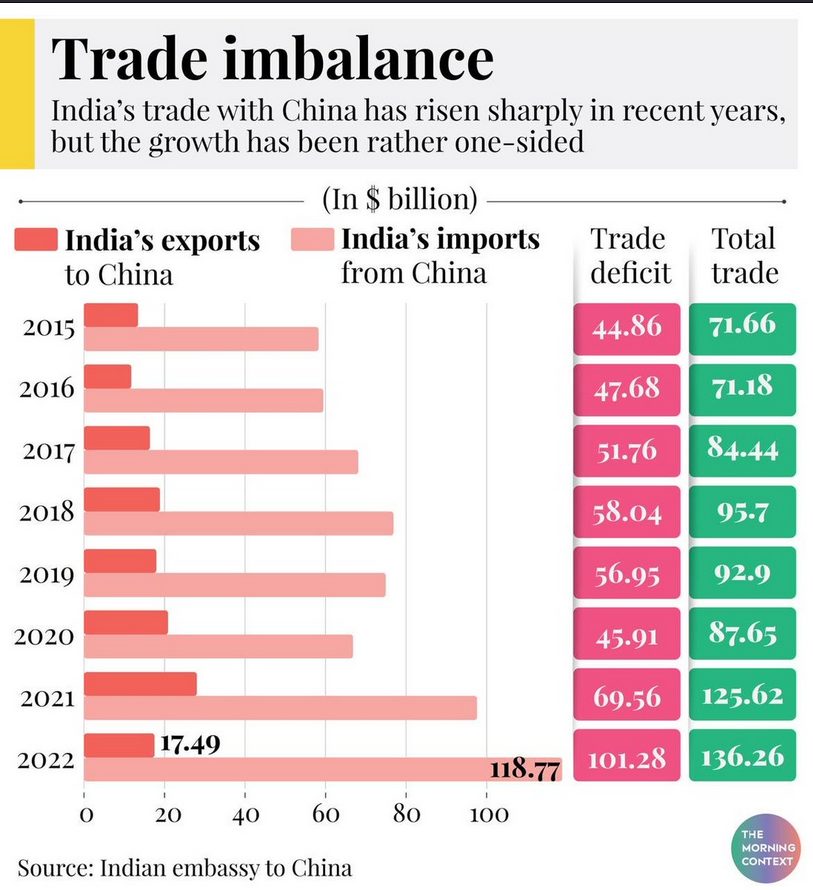
India’s imports from China crossed $101 billion in 2023-24 from about $70 billion in 2018-19, and the country’s share of India’sindustrial goods imports has risen from 21% to 30% over 15 years, according to a report by the Global Trade Research Initiative (GTRI).
The data shows, it’s resulting in a cumulative trade deficit exceeding $387 Billion in the last 5 years, which is an alarming situation for the Indian government.
What is meant by Trade Deficit?
A trade deficit refers to a situation where the country’s imports exceed the receipts from its exports. A trade deficit arises in the course of international trade when the payments for imports exceed the receipts from export trade.
A trade deficit is also referred to as a negative balance of trade.
The concerns arising due to this deficit include pressure on external payments and on the currency value of a country. Countries often alter import and export policies, curbing imports or increasing import duties on certain goods due to this.
They also encourage exports and consumption of indigenous goods.
India’sIndustrial Imports from China:
Electronics and Telecom Sector: During April-January 2023-24, India’s import value for electronics, telecom, and electrical products was $67.8 billion, with China contributing $26.1 billion. (38.4% of the total imports)
Machinery Sector: China contributed 39.6% of India’s imports in this category. This highlights China’s essential role as a supplier of machinery to India.
Chemical and Pharmaceutical Sector: India’s chemical and pharmaceutical imports were $54.1 billion, with $15.8 billion coming from China (29.2% of the total).
MSMEs sector: Products like mobiles and data processing units, are imported by Indian MSMEs. These imports could potentially be produced domestically, highlighting gaps in India’s industrial capabilities.
Current Trade Observations concerning China and other countries:
Rising Trade Deficit with China: India’s exports to China have stagnated at around $16 billion annually (from 2019 to 2024), while imports from China surged from $70.3 billion in 2018-19 to over $101 billion in 2023-24.
Growth Rate of Imports: China’s share in India’s industrial product imports increased from 21% to 30% over the last 15 years. China’s exports to India grew 2.3 times faster than India’s total imports from all other countries.
Diverse Product Imports: Chinese firms are increasingly entering the Indian market, which is expected to accelerate the import of industrial products from China. India’s imports span high to low-technology items, like smartphones, electronics, electric vehicles, and solar energy.
Strategic Concerns: The growing trade deficit and dependence on China have profound strategic implications, affecting both economic and national security dimensions.
Way Forward:
Supply chain diversification: India must focus on diversifying its supply chains and reducing dependency on single-country imports, especially from geopolitical competitors like China.
Boosting R&D: Increase investment in research and development for electronics, semiconductors, and machinery to foster innovation and improve domestic production capabilities.
Incentivizing Production: Provide tax incentives, subsidies, and grants to local manufacturers of electronics, data processing units, and semiconductor devices to encourage production and reduce import dependency.
Mains PYQ:
Q China is using its economic relations and positive trade surplus as tools to develop potential military power status in Asia’, In the light of this statement, discuss its impact on India as her neighbor. (UPSC IAS/2017)
The Spices Board has proactively engaged with CODEX, the international food standards authority, to address the pressing issue of ethylene oxide (ETO) contamination in spices.
This initiative follows recent recalls of certain branded spices exported from India to Hong Kong and Singapore due to concerns regarding ETO contamination.
Concerns over spice quality have also been raised by countries like the US, New Zealand, and Australia, prompting ongoing evaluations of Indian Spice Imports.
Back2Basics: Spices Board of India
The merger of the erstwhile Cardamom Board and Spices Export Promotion Council on 26th February 1987, under the Spices Board Act 1986 led to the formation of the Spice Board of India.
The Board functions as an International link between the Indian exporters and the importers abroad with a Nodal Ministry of Commerce & Industry.
Headquartered in Kochi, it has regional laboratories in Mumbai, Chennai, Delhi, Tuticorin, Kandla and Guntur.
Main Functions:
It promotes organic production, processing, and certification of spices.
Responsible for the overall development of Cardamom.
Focuses on post-harvest improvement programs for improving the quality of the 52 scheduled spices for export.
These programs are included under the head ‘Export Oriented Production’.
About CODEX
The Codex Alimentarius Commission (CAC) is an inter-governmental food standards body established jointly by the Food and Agriculture Organization (FAO) and the World Health Organization (WHO) in May 1963.
Objective: Protecting consumer’s health and ensuring fair practices in food trade.
The Agreement on Application of Sanitary and Phytosanitary Measures (SPS) of the World Trade Organization (WTO) recognizes Codex standards, guidelines, and recommendations as reference standards.
Members:
Currently, the CAC has 189 Codex Members made up of 188 Member Countries and the EU.
India became a member in 1964.
CODEX Committee on Spices and Culinary Herbs
CODEX committee (CCSCH) was formed in 2013 with the support of more than a hundred countries with India as the host country and the Spices Board as the Secretariat for organizing the committee sessions.
Objectives:
To consult with other International Organisations for the standards development process in the spice market.
To develop and expand worldwide standards.
Since its inception, the CODEX Committee has been on a positive path in developing harmonized global standards for worldly herbs and spices.
India’s push for Permissible ETO Limits
Advocacy for Limits: India has advocated for the establishment of limits for ETO usage, recognizing the variance in regulations across different countries.
CODEX, thus far, has not prescribed any limit for ETO usage, and India has submitted a proposal for standardizing ETO testing protocols.
Focus on Safety: While acknowledging the carcinogenic nature of ETO when used excessively, efforts to prevent contamination have been intensified.
Notably, India’s sample failure rate in spices exports is less than 1% in major markets, underscoring the industry’s commitment to quality and safety standards.
Spice Market of India:
Production:
Major producing states: Madhya Pradesh, Rajasthan, Gujarat, Andhra Pradesh, Telangana, Karnataka, Maharashtra, Assam, Orissa, Uttar Pradesh, West Bengal, Tamil Nadu and Kerala.
The production of different spices has been growing rapidly over the last few years. During 2022-23, the export of spices from India stood at US$ 3.73 billion from US$ 3.46 billion in 2021-22.
India produces about 75 of the 109 varieties which are listed by the International Organization for Standardization (ISO).
Major Produced and Exported Spices by India: Pepper, cardamom, chili, ginger, turmeric, coriander, cumin, celery, fennel, fenugreek, garlic, nutmeg & mace, curry powder, spice oils, and oleoresins.
Out of these spices, chili, cumin, turmeric, ginger, and coriander make up about 76% of the total production.
Export: In 2023-24, India’s spice exports totaled $4.25 billion, accounting for a 12% share of the global spice exports. (till February 2024 data).
India exported spices and spice products to 159 destinations worldwide as of 2023-24. The top destinations among them were China, the USA, Bangladesh, the UAE, Thailand, Malaysia, Indonesia, the UK, and Sri Lanka. (which comprises more than 70% of the total exports).
PYQ:
[2019] Among the agricultural commodities imported by India, which one of the following accounts for the highest imports in terms of value in the last five years?
India needs a clear Free Trade Agreement policy, especially in dealing with International Trade and Foreign Investment Laws.
About Free Trade Agreement:
A Free Trade Agreement between two or more countries aims to reduce or eliminate barriers to trade, such as tariffs, quotas, and other restrictions, to facilitate the flow of goods and services across borders.
Its significance for India: It can increase market access for Indian goods and services, boost exports, attract foreign investment, stimulate economic growth, create employment opportunities, and enhance competitiveness through exposure to international markets and technologies.
Present status of India’s Involvement in FTA:
India is involved in various free trade arrangements, including the South Asian Free Trade Area (SAFTA), the Association of Southeast Asian Nations (ASEAN) Free Trade Area, the India-Japan Comprehensive Economic Partnership Agreement (CEPA), and negotiations with the European Union for a free trade agreement, among others.
Negotiations for India’s FTAs with countries like the United Kingdom and the European Union (EU) appear to have stalled amidst the current parliamentary elections in India.
Why does India need to rebuild its Free Trade Agreement policy?
For Comprehensive Economic Treaties: Combining trade and investment negotiations provides India with clear negotiating leverage to strike beneficial deals.
It allows India to leverage concessions in trade for advancements in investment, and vice versa. This approach enhances India’s bargaining power in FTA negotiations.
For Scope Expansion: India should expand the scope of investment issues by incorporating provisions for protecting foreign investors under international law, ensuring their confidence in investing in India.
It will help India to establish an efficacious dispute settlement mechanism under international law to resolve investment disputes effectively.
Providing enforceable legal protection to foreign investors is crucial for boosting their confidence, especially amidst declining foreign direct investment levels in India.
For addressing the drop in FDI Levels: The policy should address the decline in foreign direct investment levels in India by instilling confidence among foreign investors through robust legal protection and dispute resolution mechanisms.
Investment lessons from the India-EFTA Trade deal:
The India-EFTA FTA includes a comprehensive investment chapter, which is missing in recent Indian FTAs with countries like Australia, UAE, and Mauritius.
The agreement includes provisions wherein EFTA countries commit to making honest endeavors to increase FDI to India and facilitate job generation, codifying an obligation of conduct rather than an obligation of result.
Economic theory highlights the close linkage between trade and investment. While earlier Indian FTAs included both binding trade rules and investment protection, recent ones decoupled international trade law from international investment law.
The India-EFTA FTA, emphasizes combining trade and investment negotiations in one comprehensive economic treaty, that is ‘FTA 3.0 Approach’, which represents a departure from the decoupling approach seen in recent FTAs.
Way Forward:
Capacity Building: Enhance the capacity of Indian negotiators and policymakers to understand complex trade and investment issues, including legal frameworks, dispute resolution mechanisms, and international best practices.
Integrated Negotiation Approach: Adopt an integrated approach to FTA negotiations, wherein trade and investment aspects are negotiated together within a single agreement, ensuring coherence and synergy between the two.
Mains PYQ:
Q Quadrilateral Security Dialogue (Quad) is transforming itself into a trade bloc from a military alliance, in present times Discuss.
![[30th July 2024] The Hindu Op-ed: The problem with India’s blocking of the Chinese](https://www.civilsdaily.com/wp-content/uploads/2024/07/30-july1-1568x882.jpg)