💥Mains Ready By December. Smash Mains & Smash PYQ Admissions Open

Subject: External Sector

  • Red Sea Crisis: Impact on Global and Indian Trade

    red sea

    Introduction

    • Houthi Militia Attacks: Since November, attacks by the Houthi militia of Yemen have rendered the Red Sea, a crucial marine route via the Suez Canal, unsafe for cargo ships.
    • Alternative Route: This has led to a significant rerouting of cargo, with ships now taking the longer Cape of Good Hope route, affecting global trade and increasing costs.

    About the Red Sea

    Details
    Location Between Africa (Egypt, Sudan, Eritrea, Djibouti) and Asia (Saudi Arabia, Yemen).
    Connection Connects to the Indian Ocean via the Bab el Mandeb strait and the Gulf of Aden.
    Length Approximately 2,250 km long.
    Width Varies from 355 km at its widest point to 20 km at the Strait of Tiran.
    Maximum Depth About 7,254 feet (2,211 m) in the central median trench.
    Unique Features – One of the world’s saltiest bodies of water.

    – Notable for its rich ecosystem, including extensive coral reefs.

    Climate Generally hot and arid; surrounding desert and high evaporation rates contribute to its high salinity.
    Economic Importance Major shipping route; oil-rich region with significant petroleum deposits on the sea’s borders.

    Impact on Indian Trade

    red sea

    • Shift in Shipping Routes: Following the attacks, about 90% of India’s western hemisphere cargo is being rerouted through the Cape of Good Hope.
    • Contractual Implications: The impact varies based on the type of buyer-seller contract, with some consignments being held up due to increased freight costs.
    • Freight Cost Surge: Freight costs have risen significantly, by up to six-fold in some cases, affecting all consignments, especially low-value, high-volume cargo and perishables.

    Implications for India’s Imports

    • Increased Import Costs: The longer transit time and crisis could lead to costlier imports and necessitate better inventory management.
    • Effect on Fuel Prices: The crisis might impact plans to reduce fuel prices in India, given the country’s high dependence on crude oil and petroleum product imports.
    • Tanker Market Dynamics: Despite increased freight rates for affected routes, there hasn’t been a widespread rerouting of tankers.

    Global and Indian Response

    • UN and US Stance: The UN condemned the Houthi attacks, and the US is seeking more support for ‘Operation Prosperity Guardian’ to ensure safe sea lanes.
    • India’s Monitoring: The Indian government is closely observing the situation, with the Commerce Secretary discussing potential impacts with officials and trade bodies.

    Sector-Specific Impact

    • Commodities Most Affected: Sectors like chemicals, plastics, and petrochemicals are severely impacted due to their inability to absorb freight hikes.
    • Alternatives for High-Value Goods: For high-value, low-volume commodities, airlifting is an option, but most affected goods are large in volume.

    Conclusion

    • Continued Uncertainty: The situation in the Red Sea presents ongoing challenges for global and Indian trade, with no immediate resolution in sight.
    • Adaptation and Monitoring: Businesses and governments are adapting to these changes, with a focus on monitoring developments and mitigating impacts.
    • Long-Term Implications: The crisis underscores the vulnerability of global trade routes to geopolitical conflicts and the need for diversified shipping strategies.
  • The dispute on India’s debt burden

    IMF cautions India on govt debt vulnerabilities, Centre disagrees


    Central Idea:

    The article discusses concerns raised by the International Monetary Fund (IMF) regarding India’s long-term debt sustainability and the reclassification of its exchange rate regime. It emphasizes the need for prudent debt management, considering potential adverse circumstances, and explores challenges India faces in credit ratings and fiscal responsibility.


    Key Highlights:

    • IMF expresses concerns about India’s long-term debt sustainability, projecting government debt to be 100% of GDP by 2028 under adverse circumstances.
    • The reclassification of India’s exchange rate regime by the IMF raises questions about the country’s currency management.
    • Challenges in managing public debt, maintaining credit ratings, and potential fiscal slippage in the face of increased subsidies and expenditure.


    Key Challenges:

    • Long-term risks associated with India’s considerable investment needs for climate change mitigation and resilience to natural disasters, as highlighted by the IMF.
    • India faces challenges in enhancing credit ratings despite being the fastest-growing major economy, attributed to weak fiscal performance and burdensome debt stock.
    • The possibility of fiscal slippage in FY24 due to increased expenditure on employment guarantee schemes and subsidies, posing a challenge to fiscal correction.


    Key Terms:

    • Article IV consultation report
    • Debt sustainability
    • Exchange rate regime
    • Fiscal Responsibility and Budget Management Act (FRBMA)
    • Credit ratings


    Key Phrases:

    • “Long-term risks are high due to considerable investment needs for climate change mitigation and resilience.”
    • “Challenges in enhancing credit ratings despite being the fastest-growing major economy.”
    • “Fiscal slippage attributed to higher expenditure on employment guarantee schemes and subsidies.”


    Key Quotes:

    • “IMF’s worst-case scenario projections for India need to be viewed in the context of the persistent debt conundrum in developing nations.”
    • “India’s stronger fundamentals are undermined by the government’s weak fiscal performance and burdensome debt stock, according to rating agencies.”


    Key Statements:

    • “The Finance Ministry refutes IMF projections as a worst-case scenario and not fait accompli.”
    • “India’s public debt-to-GDP ratio has barely increased, but it remains higher than levels specified by the FRBMA.”


    Key Examples and References:

    • The IMF’s projections on India’s government debt and exchange rate regime from the annual Article IV consultation report.
    • India’s credit rating remaining unchanged at ‘BBB-‘ since 2006, indicating the lowest investment grade.
    • India Ratings and Research’s report on the possibility of fiscal slippage in FY24.


    Key Facts:

    • Global public debt reached a record USD 92 trillion in 2022, with developing countries, including India, contributing almost 30%.
    • Despite being the fastest-growing major economy, India’s sovereign investment ratings have remained unchanged since August 2006.
    • India’s public debt-to-GDP ratio is higher than levels specified by the Fiscal Responsibility and Budget Management Act.


    Critical Analysis:

    The article critically examines the IMF’s concerns and India’s challenges in debt management, credit ratings, and fiscal responsibility. It discusses the potential impact of increased subsidies on fiscal slippage and the need for short-term fiscal correction.


    Way Forward:

    • Prudent debt management to address long-term sustainability concerns raised by the IMF.
    • Enhance credit ratings by improving fiscal performance and addressing burdensome debt stock.
    • Navigate short-term challenges, such as fiscal slippage, by adhering to fiscal correction paths and avoiding worst-case scenarios.
  • Development led by corporates, not women

    G-20 Summit | New Delhi declaration accepts disproportionate impact of  climate change on women - The Hindu

    Central idea 

    The article critiques the G20 Summit’s Declaration on women’s empowerment, highlighting past implementation challenges and questioning the clarity of “women-led development.” It emphasizes the discrepancy between rhetoric and actions, especially regarding declining budget allocations for women’s development. The central theme revolves around the need for a reevaluation of women-led development strategies to address persistent inequalities effectively.

    Key Highlights:

    • The G20 Summit’s Declaration on the empowerment of women is acknowledged, but past working groups and sustainable development goals have seen limited implementation.
    • The term “women-led development” in the Declaration lacks clarity, and the article questions its parameters and implications for the existing development models.
    • The G20 Declaration reaffirms the role of private enterprise in driving economic growth, raising concerns about the compatibility of women-led development with the prevailing macroeconomic model.

    Key Challenges:

    • The article highlights the persistent discrimination against women and girls globally, emphasizing the need for more effective measures to achieve Sustainable Development Goals.
    • Women-led development schemes, as mentioned in government bulletins, are criticized for masking the reduction in government investment in projects benefiting women’s development.
    • The Gender Budget, intended to prioritize women’s development, has shown a decline in total expenditure, raising concerns about the commitment to women-led development.

    Key Terms/Phrases:

    • Women-led development
    • Sustainable Development Goals (SDGs)
    • Trickle-down theory
    • G20 Summit Declaration
    • Gender Budget
    • Private enterprise
    • Corporate-led development

    Key Quotes for value addition:

    • “At the midway point to 2030, the global progress on SDGs is off-track with only 12% of the targets on track.”
    • “We encourage women-led development and remain committed to enhancing women’s full, equal, effective, and meaningful participation…”

    Key Statements:

    • The article questions the lack of clarity in the term “women-led development” and its compatibility with existing development models.
    • Concerns are raised about the reduction in the Gender Budget and the inadequate allocation for wholly women-specific schemes.

    Key Examples and References:

    • The article cites the decline in women’s share in regular waged work in India according to the Periodic Labour Force Survey (PLFS).
    • Specific government schemes and budgetary allocations are referenced to illustrate the disparities in women-led development.

    Key Facts/Data:

    • The total Gender Budget for 2023-2024 was reduced from 5.2% of the total expenditure the previous year to 5%.
    • The share of women in regular waged work in India fell from 21.9% in 2018-2019 to 15.9% in 2022-2023.

    Critical Analysis:

    • The article critically examines the discrepancies between rhetoric and action in women-led development, highlighting concerns about declining budget allocations and the lack of clarity in the proposed development model.

    Way Forward:

    • The need for a reevaluation of women-led development strategies is emphasized, urging policymakers to prioritize economic independence for women and address the disparities in budgetary allocations.
  • India Tops Global Remittance Inflows in 2023: World Bank Report

    remittance

    Central Idea

    • In 2023, India witnessed the highest remittance inflows globally, amounting to USD 125 billion.
    • The surge was influenced by various factors, including India’s currency agreement with the UAE.

    World Bank’s Analysis on Remittance Growth

    • Report Findings: The World Bank’s report indicates a slowdown in remittance growth in India to 12.4% in 2023, down from 24.4% in 2022.
    • Increased Share in South Asia: India’s share in South Asian remittances is expected to rise to 66% in 2023 from 63% in 2022.

    Global Remittance Scenario

    • Other Leading Countries: Following India, the top remittance-receiving countries are Mexico (USD 67 billion), China (USD 50 billion), the Philippines (USD 40 billion), and Egypt (USD 24 billion).
    • Significance in GDP: In economies like Tajikistan, Tonga, Samoa, Lebanon, and Nicaragua, remittances form a substantial part of the GDP, highlighting their critical economic role.

    Contributing Factors for India

    • Key Drivers: Declining inflation and robust labor markets in high-income countries contributed to increased remittances.
    • Major Sources: Significant remittance flows came from the US, the UK, and Singapore, as well as from the GCC, particularly the UAE.
    • UAE’s Role: The UAE is the second-largest source of remittances to India, accounting for 18% of the total.

    India-UAE Currency Agreement Impact

    • February 2023 Agreement: The agreement to promote local currency use in cross-border transactions and interlink payment systems has boosted remittances.
    • Dirhams and Rupees Usage: The use of dirhams and rupees in transactions is expected to channel more remittances through formal channels.

    Global Remittance Trends

    • Growth in Low- and Middle-Income Countries: Remittances to these countries grew by an estimated 3.8% in 2023.
    • Future Concerns: There is a risk of real income decline for migrants in 2024 due to global inflation and low growth prospects.
  • US, EU slap Countervailing Duties on 4 Indian goods

    Central Idea

    • The US and the European Union have imposed countervailing duties (CVDs) on select Indian products such as paper file folders, common alloy aluminum sheet, and forged steel fluid end blocks.
    • These measures are in retaliation against India’s Remission of Duties and Taxes on Export Products (RoDTEP) scheme, initiated in January 2021.

    About Countervailing Duties (CVDs)

    Details
    Definition Tariffs imposed to neutralize the adverse effects of subsidies provided by a foreign government to their export industries.
    Purpose To protect domestic industries from unfair competition due to imports subsidized by the exporting country’s government.
    Investigation & Imposition Requires a domestic investigation to confirm the presence of subsidies and their impact on domestic industries.
    WTO Compliance Imposition of CVDs must comply with World Trade Organization rules.
    Types of Subsidies Includes direct transfers of funds, tax concessions, loan guarantees, and provision of goods/services at a discount.
    Calculation The duty amount is typically equivalent to the value of the foreign subsidy.
    Duration Not permanent; imposed for a specific period and subject to review and removal.
    Global Use Frequently used by countries like the United States, European Union, Canada, and India.
    Controversy and Disputes Can lead to trade disputes, viewed by some as protectionist or unjustified.
    Impact on Prices May result in higher prices for affected goods in the importing country due to increased import costs.

     India’s Response to the Duties

    • Government and Exporters’ Defense: The Indian government and affected exporters have actively defended against the subsidy allegations. Their defense covered various programs and schemes at both the Central and State levels in India.
    • Method of Defense: The defense was presented through written and oral responses during the investigations.

    Potential WTO Dispute

    • India’s Stance on Dispute Resolution: Minister of State for Commerce and Industry indicated India’s openness to bilateral resolution.
    • WTO Dispute Settlement Mechanism: Any party could approach the WTO Dispute Settlement mechanism if they believe a WTO member has adopted measures inconsistent with WTO agreements.

    Conclusion

    • Growing Trade Tensions: The imposition of CVDs by the US and EU signifies escalating trade tensions with India, particularly concerning the RoDTEP scheme.
    • Impact on Indian Exports: These duties could potentially impact Indian exporters, affecting trade dynamics between India and these global economic powers.
    • Prospect of WTO Involvement: The possibility of this dispute reaching the WTO highlights the complexities of international trade laws and the need for careful navigation of global trade policies.

    Back2Basics: RoDTEP Scheme

    Details
    Introduction Announced in 2020, replacing the Merchandise Exports from India Scheme (MEIS).
    Objective To refund taxes and duties on exported products not covered under any other scheme, enhancing export competitiveness.
    Scope and Coverage Covers various sectors, beneficial for a wide range of industries, including those not covered under MEIS.
    Rebate Rates Varies based on the taxes and duties incurred on the production and distribution of the exported product.
    Eligibility Exporters must comply with criteria including the condition that goods must be manufactured in India.
    Claim Process Rebate claimed as a transferable duty credit/electronic scrip, maintained in an electronic ledger.
    Implementation Implemented by the Directorate General of Foreign Trade (DGFT) and Customs Department.
    Impact Aims to make Indian exports more competitive globally by offsetting domestic taxes and levies.
    Compliance with WTO Designed to comply with India’s commitments under the WTO framework.
    Process Fully digital and transparent process for claiming rebates, reducing the compliance burden on exporters.
  • A $5 trillion economy, but for whom?

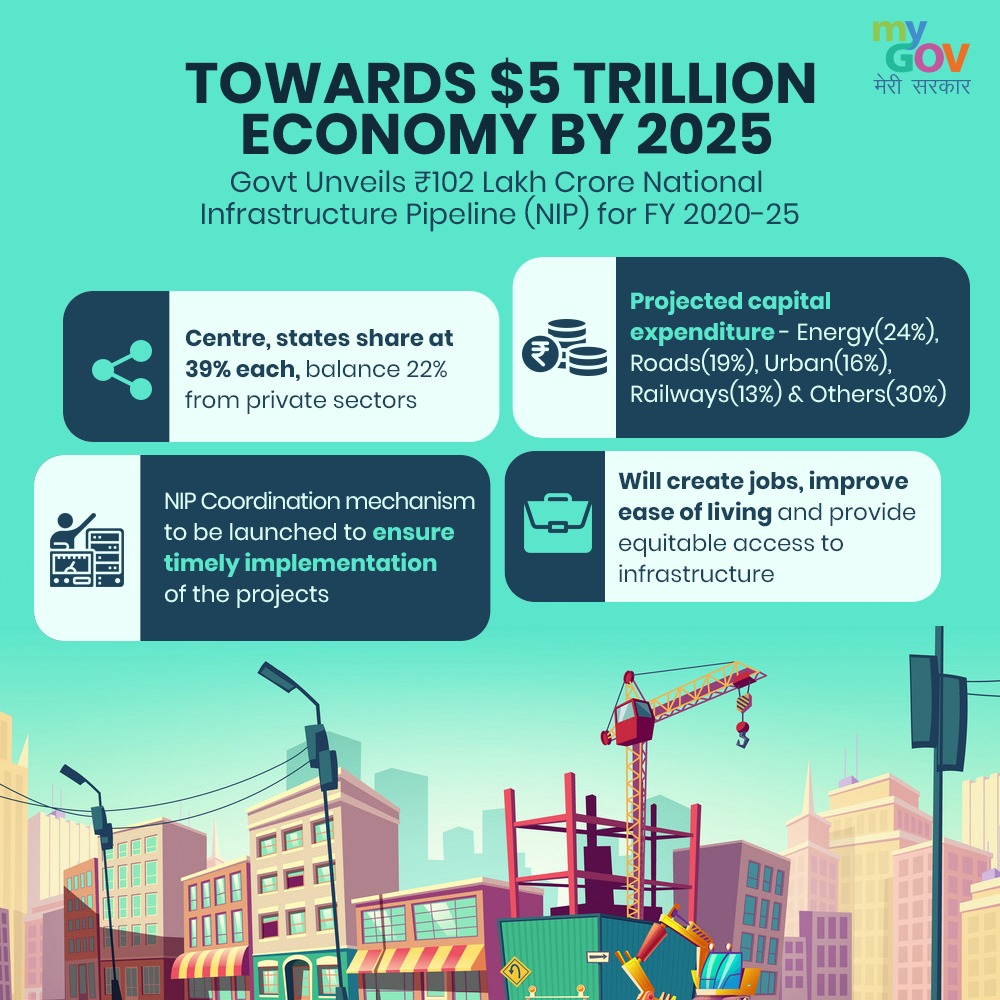
    Towards $5 Trillion Economy by 2025 – Transforming India

    Central idea

    The article critically examines India’s ambitious pursuit of a $5 trillion GDP by 2028, juxtaposing it with Japan’s economic trajectory. It highlights concerns about wealth disparity, inclusivity in high-tech sectors, and questions the impact on marginalized citizens.

    Key Highlights:

    • Extension of Welfare Scheme: Prime Minister Modi’s announcement to extend the Pradhan Mantri Garib Kalyan Ann Yojna by five years.
    • Concerns about Hunger: Raised concerns about persistent hunger despite the ambitious target of achieving a $5 trillion GDP by 2028.
    • Japan’s Economic Challenges: Comparison with Japan’s economic growth and the social challenges faced, including suicide rates and social withdrawal.
    • Reliance on GDP Growth: Emphasis on India’s economic growth relying on capital, productivity, and labor.
    • Wealth Disparity: Identification of significant wealth disparity, with 1% of the population owning a substantial portion of the nation’s wealth.
    • Government’s Economic Tools: Government’s identification of sectors and tools, such as the digital economy, fintech, and climate change initiatives.

    Key Challenges:

    • Impact on Marginalized Citizens: Expressing concerns about the potential adverse impact on marginalized citizens in the race towards a $5 trillion economy.
    • Wealth Inequality: Highlighting the wealth disparity issue, with 1% of the population owning a significant portion of the nation’s wealth.
    • Inclusivity in High-Tech Sectors: Concerns about the ability of a large segment of the population to participate in cutting-edge sectors such as AI, data science, and fintech.
    • Lack of Per Capita Income Estimates: Criticism regarding the absence of estimates on India’s per capita income at the $5 trillion GDP mark.

    Key Terms and Phrases:

    • Pradhan Mantri Garib Kalyan Ann Yojna: Specific welfare scheme providing free foodgrains.
    • Hikikomori: Term referring to severe social withdrawal in Japan.
    • Kodokushi: Japanese term for lonely deaths.
    • GST (Goods and Services Tax): Mention of the significant contribution from the bottom 50% of the population.
    • Inclusive Growth: Government’s emphasis on growth that includes all segments of society.
    • Insolvency and Bankruptcy Code: Part of the identified tools for achieving the $5 trillion goal.
    • Make in India: Mention of one of the identified sectors for economic growth.
    • Start-Up India: Highlighting a sector emphasized for achieving economic targets.
    • Production Linked Incentives: Part of the government’s strategy for economic growth.

    Key Examples and References:

    • Japan’s Societal Challenges: Referring to suicide rates, social withdrawal, and lonely deaths in Japan as examples.
    • Wealth Distribution Statistics: Citing wealth distribution statistics from Oxfam.
    • Minister Chaudhri’s Identification: Referring to the government’s identification of tools and sectors for achieving the $5 trillion goal.
    • Per Capita Income Comparison: Comparing per capita income between Japan, China, and India.

    Key Facts and Data:

    • Welfare Scheme Extension: Mentioning the extension of the Pradhan Mantri Garib Kalyan Ann Yojna.
    • Japan’s Economic History: Referring to Japan’s economic history and challenges post-2008.
    • Wealth Distribution Data: Citing wealth distribution data from Oxfam.
    • GST Contribution: Highlighting the significant contribution of different income groups to GST.

    Critical Analysis:

    • Societal and Economic Impact: Analyzing the potential impact of the $5 trillion goal on marginalized citizens and society.
    • Wealth Disparity and Inclusive Growth: Critical evaluation of wealth distribution and the need for inclusive economic policies.
    • Capability Mismatch: Examining the mismatch between targeted sectors/tools and the capabilities of a significant population segment.
    • Per Capita Income Concerns: Critically assessing the absence of estimates on per capita income and concerns about the inequality index.

    Way Forward:

    • Addressing Wealth Disparity: Emphasizing the need to address wealth disparity through inclusive economic policies.
    • Ensuring Inclusive Growth: Focusing on ensuring that economic growth benefits all segments of the population.
    • Skill Development and Education: Highlighting the importance of skill development and education to enable participation in emerging sectors.
    • Regular Assessment and Recalibration: Emphasizing the need for regular assessment and recalibration of economic goals to align with societal well-being.
  • State of the economy — temper the euphoria

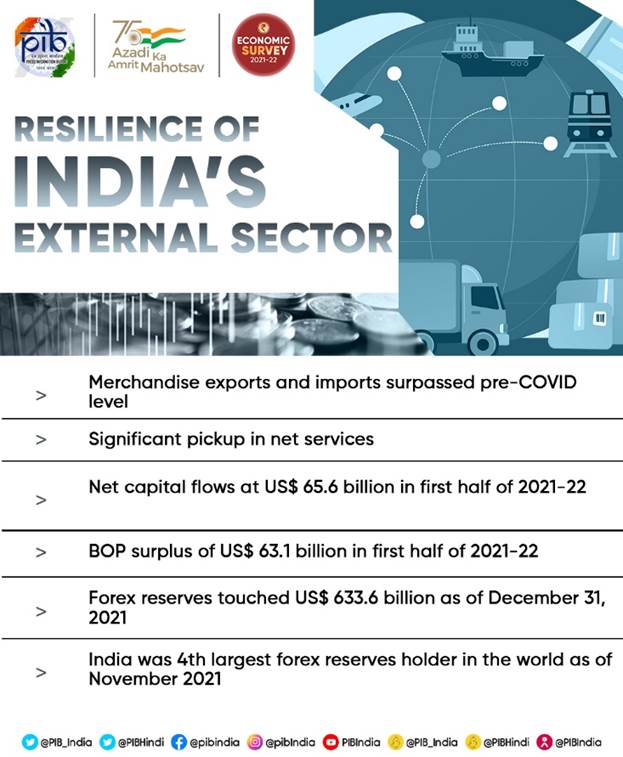
    INDIA'S EXTERNAL TRADE RECOVERS STRONGLY IN 2021-22

    Central idea

    The article highlights India’s economic challenges, including concerns about post-COVID recovery sustainability, vulnerabilities to geopolitical shifts, a growing dependency on Chinese imports, and a decline in industrial growth rates. The central idea revolves around acknowledging these challenges and the imperative for strategic interventions to ensure long-term economic resilience and growth

    Key Highlights

    • GDP Growth and Recovery: India’s GDP projected to grow by 6.3% in 2023-24, showcasing post-COVID recovery. Positive signs of resilience, but concerns persist about employment quality and inflation.
    • Geopolitical Shifts and Vulnerabilities: Globalization ended in 2022-23, exposing India to geopolitical vulnerabilities. Calls for a reevaluation of economic strategies to navigate changing global dynamics.
    • Trade Deficit with China: India grapples with a soaring trade deficit with China. Strategic threat due to dependency on Chinese imports; calls for diversification.
    • Industrial Woes and Growth Rates: Industrial growth rates, especially in capital goods, have regressed. Decline in key sectors signals a threat to overall economic stability.
    • Public Sector Investment: Public sector investment appears stagnant despite reported growth. Doubts about credibility underscore the need for transparent reporting.
    • Social Development Challenges: India’s Human Development Index (HDI) ranking has slipped. Recognition of challenges in social development, prompting a need for improved strategies.

    Challenges

    • Sustainability Concerns Post-COVID Recovery: Quality and sustainability of post-COVID recovery raise concerns, necessitating comprehensive strategies.
    • Vulnerabilities to Geopolitical Shifts: Geopolitical vulnerabilities impact India’s economic stability, demanding adaptation of economic policies.
    • Dependency on Chinese Imports: Rising trade deficit with China poses economic frailty, urging the urgent need to diversify imports.
    • Decline in Industrial Growth: Regression in industrial growth rates, especially in capital goods, requiring targeted interventions for revitalization.

    Key Phrases and Terms for making mains answer value added

    • Post-COVID Resilience: Short-term economic success after the COVID-19 pandemic.
    • Geopolitical Realignment: Recognition of shifts in global dynamics impacting India’s economic strategies.
    • Trade Deficit Dynamics: China’s influence on India’s economic vulnerabilities due to a soaring trade deficit.
    • Industrial Regression: Decline in growth rates, especially in capital goods, signaling industrial challenges.
    • Credibility of Public Sector Investment: Doubts raised about the accuracy of reported public sector investment growth..

    Analysis of the article in balanced way for mains score improvement

    • Short-Term Success vs. Long-Term Resilience: Balancing short-term GDP growth with the need for sustainable and inclusive recovery.
    • Adapting to Geopolitical Realities: Necessity to adapt economic policies to navigate geopolitical shifts and ensure stability.
    • Diversification for Economic Stability: Addressing the trade deficit challenge by diversifying imports and promoting self-reliance.
    • Revitalizing Key Sectors for Growth: Targeted interventions required to revitalize industrial growth, especially in crucial sectors.

    Key Data and Facts

    • Projected GDP Growth (2023-24):3%
    • Trade Deficit with China: Strategic Threat
    • Industrial Growth Decline: Capital Goods
    • HDI Ranking (2021): Decline

    The Way Forward

    • Sustainable and Inclusive Growth: Develop comprehensive strategies for sustained and inclusive growth post-COVID.
    • Adaptive Economic Policies: Adapt economic policies to navigate evolving global dynamics and ensure stability.
    • Diversification and Self-Reliance: Diversify imports and boost domestic production for economic self-reliance.
    • Targeted Interventions for Industrial Revitalization: Implement targeted interventions to revitalize key industrial sectors and stimulate overall economic growth.
  • The Nobel in economics as a need to course correct

    Claudia Goldin Wins Nobel Prize In Economics For Studying Women At Work

    Central idea

    Claudia Goldin’s Nobel Prize win highlights the belated acknowledgment of gender dynamics in labor markets, prompting a reevaluation of entrenched biases in economics. Feminist economists stress the imperative to dismantle androcentric biases, advocating for a more inclusive economic theory that reflects diverse experiences.

    Key Terms for quality answers:

    • Androcentric biases
    • Economic man
    • Gender inequalities
    • Unpaid work
    • Masculinity in economics
    • Empirical findings
    • Feminist economists
    • Social mechanisms

    Key Phrases for improving mains score:

    • Androcentric Biases: Are gender-based prejudices or preferences that favor male perspectives, often manifested in economic theories that reflect traditional gender roles and reinforce a male-centric viewpoint.
    • Economic Man: Is a theoretical construct representing a rational, self-interested individual in economic models. It simplifies human behavior for analytical purposes but is critiqued for its failure to capture the complexities of real-life decision-making.
    • Humanizing Economics: Involves infusing empathy, emotions, and a more realistic understanding of human behavior into economic analyses, recognizing that individuals are not solely motivated by rational self-interest.

    Key Highlights:

    • Claudia Goldin wins Nobel Prize in Economic Sciences for gender dynamics research in labor markets.
    • Recognition prompts reflection on the delayed acknowledgment of gender-focused economic research.
    • Economics traditionally male-dominated, leading to the marginalization of gender inequality issues.

    Challenges:

    • Under-representation of women in economics.
    • Androcentric biases in economic theories, perpetuating gender hierarchies.
    • Economic models ignoring gendered experiences and unpaid work, especially by women.
    • Limited understanding of non-market spaces like households, hindering accurate economic analysis.
    • Economic man assumptions perpetuate gender stereotypes and fail to question existing hierarchies.
    • Masculinity in economics detaches the discipline from gendered experiences, particularly of women.

    Analysis:

    • Feminist economists call for an economic theory free of androcentric biases to address gender inequalities.
    • Economic models fail to account for the contributions of women as unpaid workers, impacting the accuracy of empirical findings.
    • Biases in economic theory can affect statistical methods and interpretation of empirical results.
    • Economic rationality may overlook social mechanisms, leading to misinterpretation of empirical findings.

    Way Forward:

    • Educational Initiatives: Propose educational programs to sensitize economists to gender biases and promote inclusivity.
    • Policy Changes: Advocate for policy changes within academic institutions to encourage diverse perspectives in economic research.
    • Recognizing Diverse Contributions: Encourage acknowledgment of the work of economists from diverse backgrounds.
    • Inclusive Policies: Advocate for policies that actively promote diversity and inclusivity within economics departments.
    • Training Economists: Suggest incorporating training on mixed methods in economics education.
    • Interdisciplinary Collaboration: Promote collaboration with sociologists, anthropologists, and other disciplines to enrich economic research

    Conclusion:

    Claudia Goldin’s Nobel Prize win serves as a catalyst for a much-needed evolution in economic thinking. By addressing historical biases, overcoming gender-based challenges, and embracing a more inclusive and nuanced approach, the discipline can truly reflect the complexities of reality.

  • The U.S.’s signal of a huge digital shift

    Central idea

    The U.S. changed its digital trade stance, wanting more control over Big Tech and AI. China’s rise influenced this, creating a possible digital Cold War. Developing nations should make strong digital rules but avoid depending too much on the U.S. or China.

    Key Highlights:

    • The U.S. withdrawal from key digital trade positions at the WTO signifies a shift in global digital dynamics.
    • The move is prompted by the recognition of the need for domestic policy space to regulate Big Tech and AI, impacting data flows, source code, and computing facilities.
    • The China factor emerges as a significant reason behind the U.S. decision, as a digital Cold War scenario looms between the U.S. and China.

    Challenges:

    • The potential split of the global digital space into U.S. and China-led blocs poses challenges for countries caught in the crossfire.
    • Developing nations must navigate the risk of digital dependencies on either the U.S. or China, avoiding entanglement in a new form of digital Cold War.

    Key Phrases:

    • Digital colonisation and extractive nature.
    • Digital trade proposals as an agenda at plurilateral trade negotiations and the WTO.
    • The flat world concept and its evolution into a split digital world.

    Analysis:

    • The withdrawal is seen as a shift from the flat world narrative, with the U.S. adapting to a more complex digital landscape influenced by the rise of China.
    • The U.S. emphasis on preserving policy space for domestic regulation highlights the recognition of the importance of digital control in the era of Big Tech and AI.

    Key Data:

    • The U.S. withdrawal in late October from digital trade positions at the WTO.
    • China’s active participation in global digital trade negotiations and its potential to outsmart the U.S. digitally

    Key Terms to enrich your upsc mains answer:

    • Digital colonisation.
    • ICT4D (Information and Communication Technologies for Development).
    • Digital Cold War.
    • Digital industrial policies.
    • Global-scale interoperability.

    Way Forward:

    • Developing countries should leverage the global consensus on the need for strong digital regulations to shape new paradigms for national digital regulation.
    • Resistance against falling into a digital Cold War trap, emphasizing the creation of open global standards and digital public infrastructures for genuine global interoperability.
  • India’s Current Account Deficit (CAD) Widens: Implications and Outlook

    Central Idea

    • Data released by the Reserve Bank of India (RBI) reveals that India’s Current Account Deficit (CAD) expanded significantly to $9.2 billion, equivalent to 1.1% of GDP, during the April-June quarter.
    • This represents a substantial increase from the preceding three months when it stood at $1.3 billion, or 0.2% of GDP.
    • Contrasting with the year-earlier quarter of fiscal 2022-23, where the CAD was $17.9 billion (2.1% of GDP), the current scenario reflects evolving economic dynamics.

    What is Current Account Deficit (CAD)?

    • A current account is a key component of balance of payments, which is the account of transactions or exchanges made between entities in a country and the rest of the world.
    • This includes a nation’s net trade in products and services, its net earnings on cross border investments including interest and dividends, and its net transfer payments such as remittances and foreign aid.
    • A CAD arises when the value of goods and services imported exceeds the value of exports, while the trade balance refers to the net balance of export and import of goods or merchandise trade.

    Components of Current Account

    Current Account Deficit (CAD) =  Trade Deficit + Net Income + Net Transfers

    (1) Trade Deficit

    • Trade Deficit = Imports – Exports
    • A Country is said to have a trade deficit when it imports more goods and services than it exports.
    • Trade deficit is an economic measure of a negative balance of trade in which a country’s imports exceeds its exports.
    • A trade deficit represents an outflow of domestic currency to foreign markets.

    (2) Net Income

    • Net Income = Income Earned by MNCs from their investments in India.
    • When foreign investment income exceeds the savings of the country’s residents, then the country has net income deficit.
    • This foreign investment can help a country’s economy grow. But if foreign investors worry they won’t get a return in a reasonable amount of time, they will cut off funding.
    • Net income is measured by the following things:
    1. Payments made to foreigners in the form of dividends of domestic stocks.
    2. Interest payments on bonds.
    3. Wages paid to foreigners working in the country.

    (3) Net Transfers

    • In Net Transfers, foreign residents send back money to their home countries. It also includes government grants to foreigners.
    • It Includes Remittances, Gifts, Donation etc

    How does Current Account Transaction takes place?

    • While understanding the Current Account Deficit in detail, it is important to understand what the current account transactions are.
    • Current account transactions are transactions that require foreign currency.
    • Following transactions with from which component these transactions belong to :
    1. Component 1 : Payments connection with Foreign trade – Import & Export
    2. Component 2 : Interest on loans to other countries and Net income from investments in other countries
    3. Component 3 : Remittances for living expenses of parents, spouse and children residing abroad, and Expenses in connection with Foreign travel, Education and Medical care of parents, spouse and children

    What are the reasons for the current account deficit?

    deficit

    • Intensifying geopolitical tensions and supply chain disruptions leading to crude oil and commodity prices soaring globally have been exerting upward pressure on the import bill.
    • A rise in prices of coal, natural gas, fertilizers, and edible oils have added to the pressure on trade deficit.
    • However, with global demand picking up, merchandise exports have also been rising.

    How will a large CAD affect the economy?

    • A large CAD will result in the demand for foreign currency rising, thus leading to depreciation of the home currency.
    • Nations balance CAD by attracting capital inflows and running a surplus in capital accounts through increased foreign direct investments (FDI).
    • However, worsening CAD will put pressure on the inflow under the capital account.
    • Nevertheless, if an increase in the import bill is because of imports for technological upgradation it would help in long-term development.