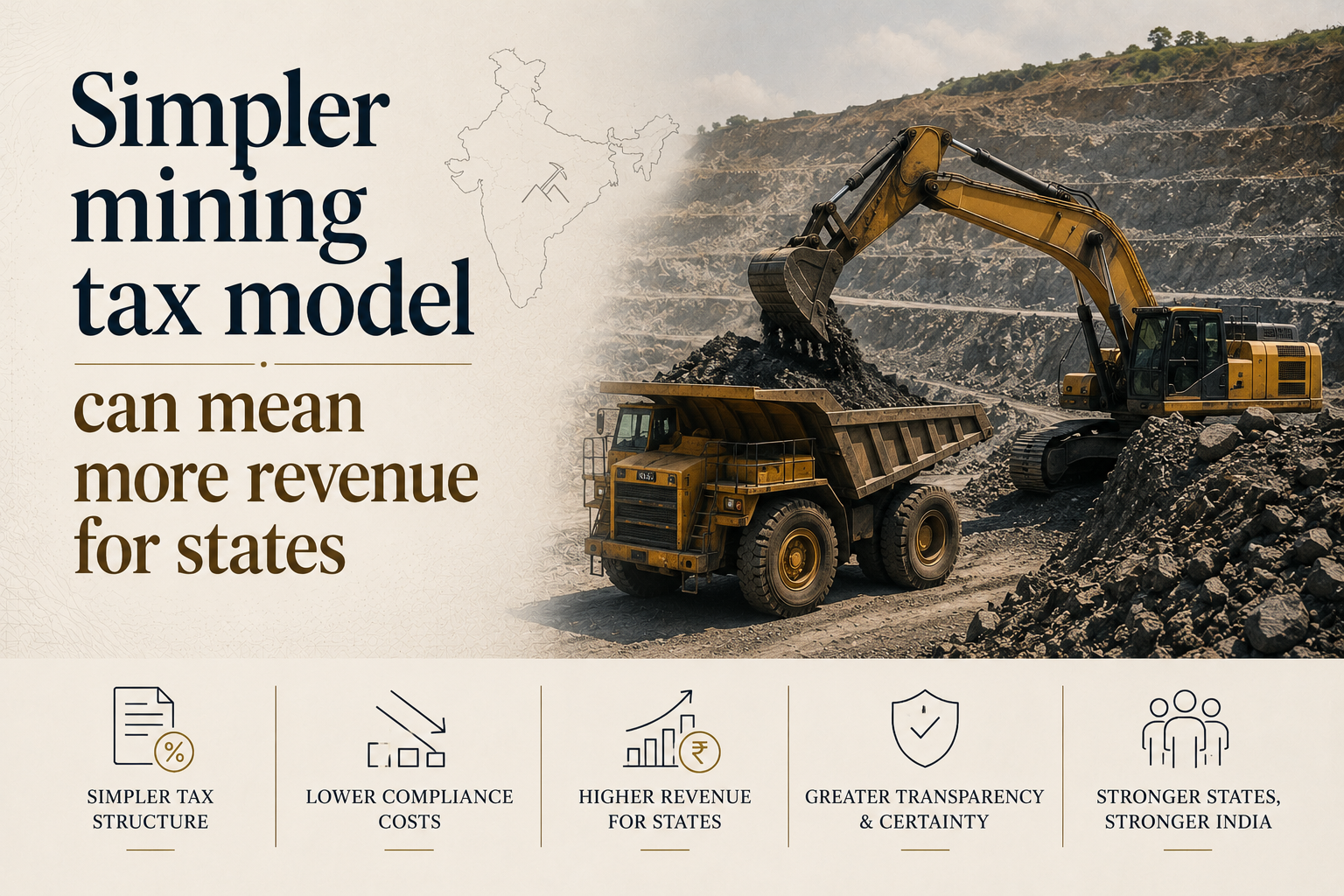
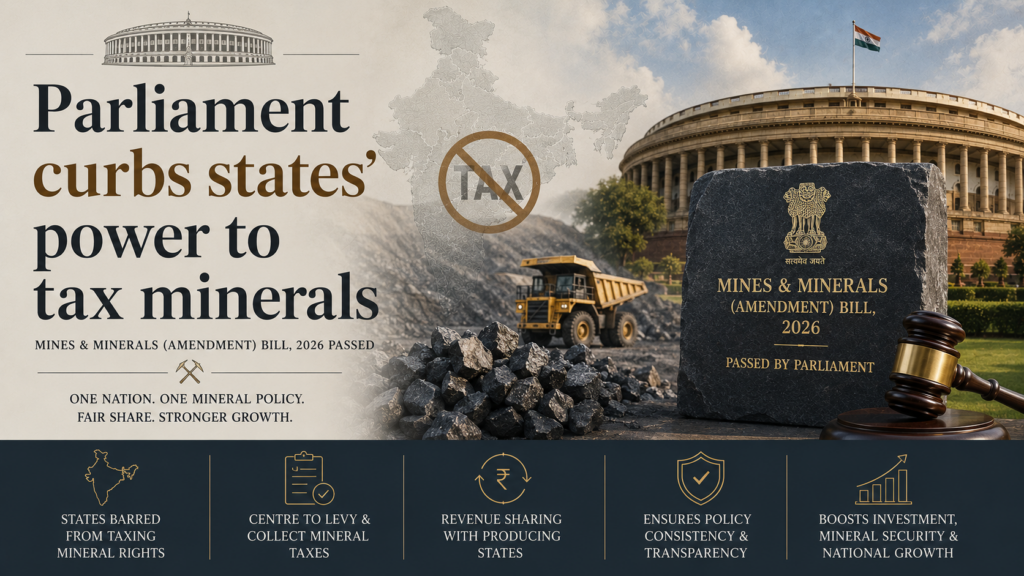
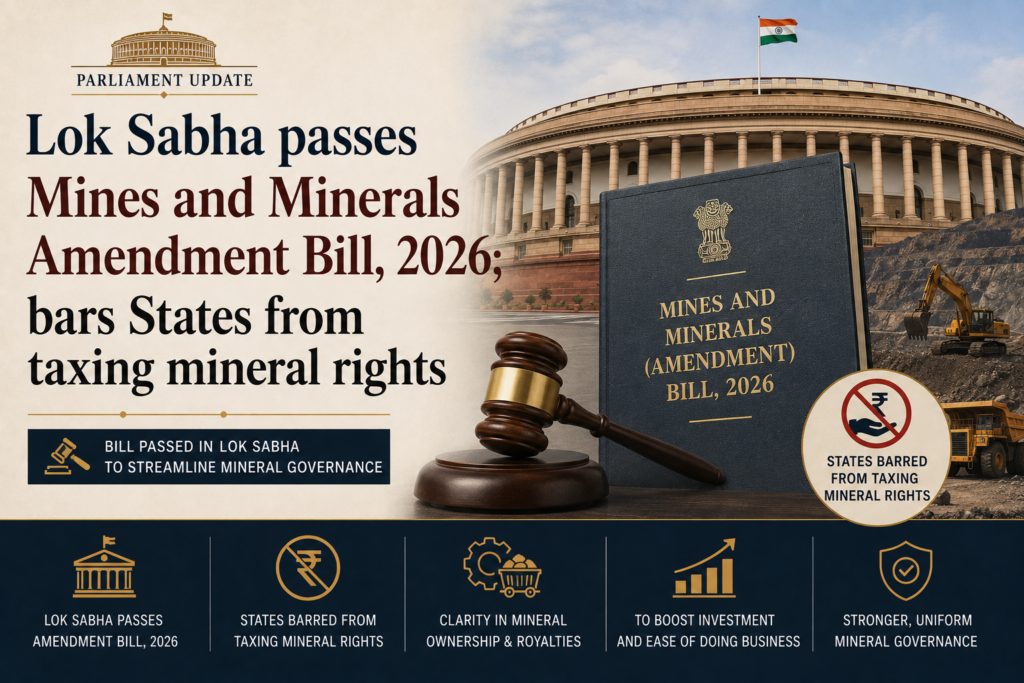
The chairperson of the Economic Advisory Council to the Prime Minister, argues that the recently passed Mines and Minerals (Development and Regulation) Amendment Act, 2026 replaces a fragmented mineral taxation system, up to 14 different taxes, charges, fees and levies across States, with a simpler, uniform and predictable framework, extending the certainty-over-discretion principle already applied to mineral block allocation in 2015 to mineral taxation itself.
What does the amended Act change, and what does it retain?
It targets fiscal fragmentation across States: The amendment addresses a landscape where mineral producers face up to 14 types of taxes, charges, fees and levies that differ by State, and aims to keep India’s mineral market integrated rather than fractured along State fiscal lines.
The revenue-sharing formula with States is retained, not altered: Since the e-auction regime began in 2015, States have received more than Rs 7 lakh crore, about 90% of total revenue from the coal and non-coal sectors combined, through royalty, auction premium, District Mineral Foundation (DMF) contributions and GST; the amendment continues this formula, with 90 paise of every rupee earned from mineral production retained by the State.
The reform is framed as continuing a 12-year trajectory: The op-ed traces the shift from a pre-2014 system of discretionary block allotment, marked by delay and opacity, to transparent competitive e-auctions, arguing that the new tax simplification extends the same certainty principle to fiscal treatment of mining.
Conclusion
The op-ed’s position is that a simpler, uniform mineral tax framework under the amended MMDR Act protects mineral-rich States’ own revenue pool while removing the fiscal fragmentation that has made India’s mineral market uncompetitive against import sources, an argument resting on the Act’s own revenue-sharing data rather than a general case for lower taxation.
Back2Basics
Mines and Minerals (Development and Regulation) Act, 1957: The principal central legislation governing regulation of mines and mineral development in India, under which State governments grant mineral concessions but the Centre sets the overarching regulatory and taxation framework.
District Mineral Foundation (DMF): A non-profit trust set up in mining-affected districts under the Act to work for the interest and benefit of persons and areas affected by mining-related operations, funded through a share of royalty payments.
“[2025, GS2, 15 marks] Examine the evolving pattern of Centre-State financial relations in the context of planned development in India. How far have the recent reforms impacted the fiscal federalism in India?”
The Ministry of External Affairs denied political clearance for a United States visit by the Chief Minister of Telangana, A. Revanth Reddy, a visit that had included planned meetings with the Mayor of New York and the Vice-President of the United States. Indian States require political clearance from the Union government before a Chief Minister undertakes an official foreign visit, a longstanding practice meant to keep foreign policy under central control. Denying clearance for meetings with a State chief executive and senior foreign leaders sets up a tension between the Centre’s constitutional primacy over foreign affairs and the norm of allowing Opposition-ruled States a role in India’s outward-facing federalism.
Why does a Chief Minister need Union clearance to travel abroad?
Foreign affairs sit exclusively with the Union: Entry 10 of the Union List places foreign affairs, including all matters bringing the Union government into relation with any foreign country, exclusively within the Centre’s legislative and executive competence.
Political clearance is an executive practice, not a statutory requirement: The requirement that a Chief Minister obtain the Ministry of External Affairs’ political clearance before an official foreign visit rests on executive instructions rather than a specific Act, developed to keep sub-national actors from appearing to conduct independent foreign policy.
Distinct from clearance for private or non-official travel: Clearance requirements attach to visits with an official or government-to-government character, such as meetings with a foreign government’s officials, rather than to purely personal travel.
Why is denying clearance in this instance being criticised?
Meetings involved routine sub-national and diplomatic engagement: A meeting between an Indian Chief Minister and the Mayor of New York, or a courtesy meeting with the Vice-President of the United States, falls within the kind of city-to-state and state-to-country economic diplomacy the Centre has itself encouraged States to pursue for investment.
Selective application undermines federal trust: Denial of clearance to an Opposition-ruled State’s Chief Minister, where clearance is routinely granted for similar visits by Chief Ministers of Union government-aligned States, reads as a partisan use of a foreign-policy gatekeeping power.
Costs India’s global federal image: India projects itself internationally as a cooperative federal system encouraging States to compete for investment; blocking a State’s own outreach to a potential investment and diaspora hub like New York works against that projection.
Undermines Centre-Opposition dialogue norms: Routine denial of clearance to Opposition Chief Ministers, without a stated security or diplomatic justification, erodes the norm that foreign-policy gatekeeping is applied on non-partisan grounds.
Conclusion
The Ministry of External Affairs’ denial of political clearance for the Chief Minister of Telangana’s US visit is criticised here as an overreach of a gatekeeping power meant to coordinate foreign policy, not to selectively restrict an Opposition-ruled State’s economic and diplomatic outreach. The episode is likely to recur with other Opposition-ruled States unless the Centre states clear, non-partisan criteria for granting or denying political clearance.
Back2Basics: Political clearance for foreign travel by State functionaries
An executive requirement, not a statutory one, under which a Chief Minister or other State functionary must obtain the Ministry of External Affairs’ approval before undertaking an official foreign visit.
Rests on the Union’s exclusive constitutional competence over foreign affairs under Entry 10 of the Union List in the Seventh Schedule.
Applies to visits with an official or government character; distinguished from private travel, which does not require the same clearance.
Has periodically become a point of Centre-State friction when applied to Opposition-ruled States’ Chief Ministers.
Matching Previous Year Question
“[2021] Which one of the following in Indian polity is an essential feature that indicates that it is federal in character? (a) The independence of the judiciary is safeguarded. (b) The Union Legislature has elected representatives from constituent units. (c) The Union Cabinet can have elected representatives from regional parties. (d) The Fundamental Rights are enforceable by Courts of Law. ANSWER: (a)”
The Telangana Chief Minister’s visit to the United States has been cancelled after the Ministry of External Affairs denied “clearance from political angle”. The refusal invokes a standing requirement. Every public servant, including the elected head of a State government, must obtain political clearance from the Union government before travelling abroad. That requirement was last formalised in a Cabinet Secretariat circular of 6 May 2015. That circular made prior political clearance and clearance under the Foreign Contribution (Regulation) Act, 2010 mandatory for such travel. The contest is over an executive discretion that decides whether a State’s chief executive may travel abroad at all.
What is political clearance?
A Union permission for foreign travel by officials: Political clearance is an approval granted by the Ministry of External Affairs before any public servant undertakes a foreign trip.
Its coverage is not limited to senior functionaries: It is required not only for public servants at the top of the administration but for any government servant travelling abroad.
Its stated purpose is foreign policy screening: The system exists to ensure that official foreign visits do not carry diplomatic or foreign policy implications that the government has not assessed.
It is a precondition, not a formality: No other clearance in the chain is processed until political clearance has been obtained.
On what basis is clearance granted or refused?
The nature of the event: What the visit is for, and whether the occasion is one at which an Indian official presence carries diplomatic weight.
The level of participation from other countries: Who else is attending and at what rank, which determines the protocol implications of an Indian participant.
The kind of invitation extended: Who issued the invitation and through which channel, which is where a direct approach by a foreign mission to a State government becomes an issue.
India’s relations with the host country: The current state of the bilateral relationship, which can make an otherwise routine visit sensitive.
The volume is substantial: The Ministry receives hundreds of requests for political clearance every month from ministries, secretaries, bureaucrats and other officials.
The process has been online since 2016: Applications can be made on the Ministry’s portal at epolclearance.gov.in, and clearance is issued after coordination among various divisions of the Ministry.
What clearances must a Chief Minister obtain?
Two authorities must be informed: Chief Ministers, along with State and Union Territory ministers, must inform both the Cabinet Secretariat and the Ministry of External Affairs about any foreign visit.
Private travel is not exempt: The requirement applies whether the visit is official or private.
Two clearances are mandatory: The Cabinet Secretariat circular of 6 May 2015 states that prior political clearance and clearance under the Foreign Contribution (Regulation) Act, 2010 are mandatory.
A third clearance comes from the finance side: Chief Ministers, State ministers and other State officials also need clearance from the Department of Economic Affairs, with a copy of the application sent to the Secretary of that Department.
The sequence is fixed: The Department of Economic Affairs and the administrative ministry concerned will entertain an application only if the Ministry of External Affairs political clearance is attached to it.
How do the rules differ for Union ministers and Members of Parliament?
Union ministers face a second gate: After obtaining political clearance from the Ministry of External Affairs, a Union minister needs additional clearance from the Prime Minister, whether the trip is official or personal.
Members of the Lok Sabha go to the Speaker: Clearance for a Lok Sabha member is granted by the Speaker of the House.
Members of the Rajya Sabha go to the Chairperson: Clearance for a Rajya Sabha member is granted by the Chairperson of that House.
The pattern is significant: Union ministers and Members of Parliament are cleared within their own institution. A State Chief Minister is cleared by an authority outside the State’s own structure.
What does the record of past denials show?
Refusal is not a new development: Political clearance being denied to a Chief Minister has happened repeatedly across governments of different parties.
A Delhi Chief Minister was refused twice: In 2022 the then Delhi Chief Minister had to cancel a Singapore visit after not receiving clearance, and in October 2019 the Centre had not approved his attendance at another conference abroad.
Refusals also occurred under the previous Union government: During the earlier United Progressive Alliance government, the Ministry denied political clearance for trips by the then Chief Minister of Assam, who belonged to the Congress, to the United States and Israel.
Party affiliation did not decide the outcome: The same government also denied clearance to the then Chief Minister of Jharkhand, who belonged to the Bharatiya Janata Party, for a visit to Thailand.
What grounds has the Ministry cited for refusing a Chief Minister’s travel?
Channel of invitation as a ground: For a proposed New York visit on 2 April 2012 for a “high level meeting”, the Ministry recorded that direct correspondence by a diplomatic mission with a State government was inappropriate. The objection was to the route of the invitation, not to the substance of the meeting.
Protocol capacity as a ground: For a proposed visit to Israel for an event on water and environment technology, the Ministry recorded that the agencies concerned would be hard put to provide special consideration for a Chief Minister, both from the substantive and the protocol angles.
Neither ground turns on foreign policy risk: Both refusals rest on how a State government engages a foreign mission and on the resources a mission can spare, rather than on any assessed diplomatic consequence of the visit.
The reasons are not published as a rule: These grounds surfaced through disclosed file notings, not through any obligation to communicate reasons to the applicant.
Is political clearance a foreign policy filter or a check on State autonomy?
Foreign affairs is genuinely a Union subject: Entries 10 to 14 of the Union List place foreign affairs, diplomatic representation and treaty implementation exclusively with the Union, so a clearance requirement has a constitutional foundation.
The State interest is economic, not diplomatic: States compete for investment through overseas roadshows and investor summits, so a travel refusal directly affects a State’s own economic strategy rather than the country’s foreign policy.
The record cuts both ways: The pattern of past refusals weakens the charge that the instrument is purely partisan, and it equally shows that the discretion runs without a settled standard whoever is in office.
Challenges to the political clearance system
Discretion without published criteria invites the charge of bias: A refusal that cannot be tested against a written standard will always be read politically, whatever the actual reason. Eg. Past refusals to Chief Ministers were each read at the time as partisan acts. Fix. Notify a written clearance policy listing the grounds of refusal and require that the applicable ground be communicated in every rejection.
No timeline means a delay works as a refusal: Where no decision deadline exists, a pending file achieves the same result as a denial once the event date passes. Eg. Conference and summit invitations carry fixed dates that a delayed clearance renders moot. Fix. Fix a statutory outer limit of fifteen working days, after which clearance is deemed granted.
Multiple clearances multiply points of failure: A Chief Minister needs the Ministry of External Affairs, the Cabinet Secretariat and the Department of Economic Affairs to act in sequence, and each can stall. Eg. The finance side will not even open a file until the political clearance is attached to it. Fix. Route the entire chain through the single existing online portal with a common tracking number and visible stage wise status.
No forum reviews a refusal: There is no appellate authority, so the only remedy is writ litigation, which is slower than any travel schedule. Eg. Cancelled visits are typically abandoned rather than litigated. Fix. Designate an appellate authority in the Cabinet Secretariat with a seven day disposal requirement.
States have no institutional channel for external economic engagement: Investment promotion by States is treated case by case through the clearance route rather than through a standing mechanism. Eg. States conduct overseas investor roadshows without any permanent Union State coordination forum for external economic engagement. Fix. Constitute a standing States division consultation under the Ministry of External Affairs to pre clear recurring categories of economic travel.
The instrument has no statutory basis: The entire regime rests on executive circulars, so its scope can be widened or narrowed without legislative scrutiny. Eg. The governing instrument for Chief Ministers is a Cabinet Secretariat circular of 2015. Fix. Place the clearance framework in subordinate legislation laid before Parliament, so changes to its scope are on the record.
Conclusion
The refusal is not an unprecedented act, and the constitutional basis for a Union filter on official foreign travel is not seriously in doubt, since foreign affairs sits squarely on the Union List. What the episode exposes is that the filter operates through executive circulars alone, which is what allows every refusal to be read as a political act. Until the grounds of refusal are codified and a review route exists, an instrument designed to protect foreign policy coherence will keep producing federal friction it was never meant to create.
What is the current status of Centre State relations in India?
The division of powers is constitutionally fixed: Legislative competence is distributed through the Seventh Schedule across the Union List, the State List and the Concurrent List, with residuary powers vesting in Parliament.
The scheme is federal with strong unitary features: Parliament may alter State boundaries without State consent, may legislate on a State List subject in the national interest, and central law prevails over State law on the Concurrent List.
The fiscal position of States has weakened: The States’ effective share of the Centre’s gross tax revenue fell from about 35 per cent in the 2015 to 2020 period to roughly 31 per cent in 2020 to 2024, even as the recommended devolution share stands at 41 per cent.
The standing dialogue forum is largely dormant: The Inter State Council under Article 263 meets infrequently, and its recommendations carry no binding force.
Constitutional provisions related to Centre State relations
Articles 245 and 246 with the Seventh Schedule: Distribute legislative power between Parliament and the State Legislatures across three enumerated lists.
Union List entries 10 to 14: Place foreign affairs, diplomatic and consular representation, United Nations organisations, participation in international conferences, and entering into and implementing treaties exclusively with the Union.
Article 248: Vests residuary legislative power, over subjects in none of the three lists, in Parliament.
Article 254: Provides that a central law prevails over an inconsistent State law on a Concurrent List subject.
Article 256: Requires every State to exercise its executive power so as to ensure compliance with laws made by Parliament, and empowers the Union to give directions to that end.
Article 257: Empowers the Union to direct a State so that the State’s executive power does not impede the exercise of Union executive power.
Article 263: Empowers the President to establish an Inter State Council to inquire into and advise on disputes and on subjects of common interest between States and the Union.
Article 282: Allows the Union to make grants for any public purpose, which is the route for discretionary transfers outside the Finance Commission award.
Major debates surrounding Indian federalism
How federal the Constitution actually is: One reading treats India as a unitary state with subsidiary federal features, and the competing reading treats the Centre and the States as co equal within their respective fields, bound by a duty of cooperation.
The office of the Governor: Delays in granting assent to State legislation and the use of discretionary powers have made the Governor the most contested institutional link in the federal chain.
Population based devolution and the North South gap: Southern States argue that devolution formulas anchored in population penalise States that achieved demographic stabilisation, and the delimitation exercise sharpens the same dispute.
Fiscal autonomy after the Goods and Services Tax: States have lost the power to vary rates on most goods, which removes the principal instrument they held for responding to a local revenue shock.
Conditional transfers and scheme design: Centrally Sponsored Schemes require States to find matching funds for programmes designed centrally, which converts State budgets into co financing instruments for Union priorities.
What it regulates: It governs the acceptance and utilisation of foreign contribution and foreign hospitality by individuals, associations and companies in India.
Who administers it: The Foreigners Division of the Ministry of Home Affairs, which grants registration and prior permission and can suspend or cancel a registration.
Why it applies to official travel: Acceptance of foreign hospitality, which includes travel, boarding or lodging costs borne by a foreign source, requires prior permission for public servants and legislators.
Who is barred outright: Election candidates, judges, government servants, members of legislatures, journalists and office bearers of political parties are prohibited from accepting foreign contribution.
Matching Previous Year Question
“[2024, GS2, 15 marks] What changes has the Union Government recently introduced in the domain of Centre-State relations? Suggest measures to be adopted to build the trust between the Centre and the States and for strengthening federalism.”
Punjab brought a stringent sacrilege law into force in April 2026 by amending an existing State statute on the ceremonial custody of the Guru Granth Sahib, avoiding the Presidential assent that had defeated three earlier attempts. The route exposes a conflict between a State's determination to legislate on religious sentiment and the constitutional limits set by secularism, equality, proportionality and the division of legislative competence. A challenge to the Act is pending before the Punjab and Haryana High Court.
What does Punjab's 2026 sacrilege law do?
What it penalises: It punishes sacrilege committed against the Guru Granth Sahib, and covers no other religious scripture.
The sentence it carries: Its most serious provisions carry a mandatory minimum sentence extending to life imprisonment, leaving no room for a judge to calibrate punishment to the facts of a case.
The statute it amends: It amends a pre existing State law concerned specifically with the ceremonial custody of the Guru Granth Sahib, rather than the central penal code.
How it was brought into force: Because the State argued the amendment falls within its own legislative competence, it claimed no Presidential assent was needed, and the Governor's signature brought it into force in April 2026.
What is the current status of sacrilege law in India?
The central provision: Insulting religion or religious beliefs with deliberate and malicious intent is an offence under Section 299 of the Bharatiya Nyaya Sanhita, 2023, the successor to Section 295A of the Indian Penal Code, 1860.
The settled constitutional position: Section 295A was upheld in Ramji Lal Modi, and the Supreme Court has not revisited that ruling in almost sixty years.
The intent requirement on paper: Conviction requires proof of deliberate and malicious intent, a threshold the court reads into the provision.
Where the practical harm falls: Indian criminal procedure allows a First Information Report to be lodged and an accused arrested well before any court examines whether that intent was present, so the chilling effect operates at the point of complaint, not at the point of conviction.
No standalone national sacrilege statute: There is no separate central law on sacrilege beyond the religious offence provisions of the Bharatiya Nyaya Sanhita, 2023, which is why Punjab has repeatedly attempted a State law.
Constitutional Provisions Related to Sacrilege, Speech and Secularism
Article 14: Guarantees equality before the law, and permits classification only where an intelligible differentia bears a rational nexus to the law's stated purpose.
Article 19(1)(a): Guarantees freedom of speech and expression to all citizens.
Article 19(2): Permits reasonable restrictions on that freedom in the interests of public order, decency or morality, among other grounds.
Article 21: Guarantees life and personal liberty, which the Supreme Court has read as requiring a just, fair and reasonable procedure.
Article 25: Guarantees freedom of conscience and the free profession, practice and propagation of religion, subject to public order, morality and health, and permits the State to legislate for social welfare and reform even where this cuts against religious custom.
Entry 1, Concurrent List, Seventh Schedule: Places criminal law within the legislative competence of both Parliament and the State legislatures.
Article 254: Provides that a State law repugnant to a central enactment on the same Concurrent List subject is void to that extent.
Article 254(2): Saves such a State law only where it has been reserved for and has received the assent of the President.
How did Punjab arrive at this law across a decade?
2016, the first attempt: The then Akali Dal and Bharatiya Janata Party government passed a bill imposing life imprisonment for sacrilege committed specifically against the Guru Granth Sahib. The Centre returned it, objecting that a law protecting only one religion's scripture could not sit easily with India's secular Constitution.
2018, the second attempt: The succeeding Congress government extended the same life sentence to the Guru Granth Sahib, the Bhagavad Gita, the Quran and the Bible, through a new Section 295AA of the penal code. That Bill was also returned without Presidential assent.
July 2025, the third attempt: The Aam Aadmi Party government introduced the Punjab Prevention of Offences Against Holy Scripture(s) Bill, again covering all four texts, with sentences ranging from ten years to life. It was sent to a select committee and has since been effectively shelved.
April 2026, the successful route: The State abandoned the amendment of the central penal code and instead amended an existing State statute on the ceremonial custody of the Guru Granth Sahib, bringing the law into force on the Governor's signature alone.
The pattern the sequence shows: A State legislature has persistently tried, by one route or another, to entrench a sacrilege code of ever increasing severity, undeterred by repeated constitutional rebuffs.
Why does a religion specific penal law run into the equality guarantee?
The classification test it must pass: A provision drawing a line between one community's sacred text and every other's needs an intelligible differentia bearing a rational nexus to its stated purpose, the test the Supreme Court set out in State of West Bengal versus Anwar Ali Sarkar.
Why the classification fails on its own terms: The Act's stated purpose is communal harmony, framed in terms of all communities, and singling out one faith's scripture does not serve a purpose framed in terms of all of them.
The objection is not new: By protecting only the Guru Granth Sahib, the 2026 Act revives precisely the objection that sank the 2016 attempt.
The pending litigation: In May 2026, the Anglican Church of India, through its Amritsar bishop, petitioned the Punjab and Haryana High Court arguing that the Act creates a religion specific penal regime violating equality before law, and sought both the quashing of the Act and a stay on its implementation.
The standing wrinkle: The Bench reportedly questioned how a church whose own scripture the Act does not touch could claim to be aggrieved by it, a question that demonstrates the very defect alleged, since a law can discriminate in structure while leaving those it excludes without the conventional standing to challenge it. The petition remains pending.
Why does the mandatory life sentence raise a proportionality problem?
What the Act does: Its most serious provisions carry a mandatory minimum sentence extending to life imprisonment, removing all sentencing discretion from the trial judge.
The controlling precedent: In Mithu versus State of Punjab, the Supreme Court struck down a different mandatory sentencing provision precisely because it stripped courts of discretion.
The standard applied: Mithu applied the requirement of a just, fair and reasonable procedure that Maneka Gandhi versus Union of India had read into Article 21.
The parallel is close: The earlier case also arose out of Punjab, which makes the comparison with the 2026 Act direct rather than analogical.
Why proportionality matters here: Sacrilege covers conduct ranging from a deliberate desecration to an inadvertent act, and a single fixed maximum sentence prevents a court from distinguishing between them.
Does the State have the legislative competence to enact this law?
Where the subject sits: Criminal law sits on the Concurrent List, so both Parliament and the State legislature may legislate on it.
The repugnancy rule: Article 254 makes a State law repugnant to a central enactment on the same subject void to that extent, and the Bharatiya Nyaya Sanhita, 2023 carries its own provisions on sacrilege and on outraging religious feeling.
The only saving route: Article 254(2) saves such a State law only where it has received Presidential assent, which is the requirement that defeated the 2016 and 2018 Bills.
How Punjab avoided it: The State amended a pre existing, ostensibly ceremonial statute rather than the Bharatiya Nyaya Sanhita directly, and argued that no assent was therefore needed.
The challenge to that route: A petition before the Punjab and Haryana High Court argues that a life sentence is a matter of criminal law and cannot dodge central scrutiny merely by changing which statute book it sits in.
Why does the free speech objection survive despite Ramji Lal Modi?
The vagueness of the operative terms: Section 295A and its successor in the Bharatiya Nyaya Sanhita, 2023 rest on terms such as outrage, insult and religious feelings, policed after the fact by whichever officer receives the complaint.
The precedent that should apply: In Shreya Singhal versus Union of India in 2015, the court struck down Section 66A of the Information Technology Act, 2000 in its entirety, holding that criminalising online messages using undefined terms such as offensive and menacing left the provision impermissibly vague, invited arbitrary enforcement and chilled protected speech in violation of Article 19(1)(a).
The terms are no more precise: The words on which the religious offence provisions rest are as undefined as the words the court found fatal in Shreya Singhal.
What the court has not done: It has never brought the Shreya Singhal reasoning to bear on Section 295A, whose constitutionality it settled in Ramji Lal Modi almost sixty years earlier and has not revisited since.
The reason for the gap: The inconsistency reads as reluctance rather than principle, since it is easier to strike down a recent statute governing an unfamiliar medium than to unsettle an eighty year old precedent with a long and emotionally fraught history behind it.
What the vagueness enables: A cartoon, a novel, a documentary or a stray remark on social media can all be made to fit the language of insult without any accompanying threat of actual disorder.
Major debates surrounding sacrilege law
Secularism as an unamendable limit: Secularism was declared part of the Constitution's unamendable basic structure in S.R. Bommai versus Union of India, precisely so that the State could neither favour a religion nor punish disrespect towards one, and a sacrilege law does the second.
Religious freedom against religious reform: Article 25 protects the practice of religion and at the same time preserves the space for social reformers, sceptics and atheists to challenge religious practice, since the right is subject to public order, morality and health and the State may legislate for reform.
Public order as a threshold or a label: One position requires an actual threat of disorder before speech may be punished, the other treats the giving of offence as itself a disturbance of public order.
Ramji Lal Modi against Shreya Singhal: Two lines of authority now sit in tension, one upholding a vague religious offence provision and the other striking down a vague online speech provision on the same reasoning.
Federal competence against local sentiment: A State legislature responding to local religious sentiment collides with a national criminal code and the Article 254 assent requirement designed to keep criminal law uniform.
Deterrence against chilling effect: Severe sentences are defended as deterrence against desecration, and are opposed on the ground that the harm is inflicted at the stage of arrest, long before any court weighs intent.
Challenges to enforcing a sacrilege law
Undefined operative terms: Insult and outrage are not statutorily defined, so the same conduct produces prosecution in one district and none in another. e.g. Section 66A of the Information Technology Act, 2000 was struck down in Shreya Singhal in 2015 for exactly this defect.
Arrest precedes adjudication of intent: A First Information Report can be registered and an accused arrested before any court tests the deliberate and malicious intent the offence requires. e.g. the 2026 Punjab Act's life sentence attaches to a charge that a magistrate never has to evaluate before custody begins.
Selective protection invites litigation: Protecting one scripture and not others invites an equality challenge that can stall the law for years. e.g. the Anglican Church of India's May 2026 petition before the Punjab and Haryana High Court, still pending.
No sentencing discretion: A mandatory minimum forces the same punishment on a deliberate desecration and an inadvertent act. e.g. Mithu versus State of Punjab struck down a mandatory sentencing provision for removing exactly this discretion.
Repugnancy risk to the whole statute: A State criminal law that overlaps a central enactment is void to the extent of repugnancy unless it carries Presidential assent, so the entire Act can fall on a procedural ground. e.g. the 2016 and 2018 Punjab Bills were both returned without assent.
Incentive for mob complaint: A severe penalty attached to a subjective standard makes the police complaint itself a weapon against critics, writers and artists. e.g. the returned 2018 Bill would have extended a life sentence to insult of four separate scriptures, multiplying the categories of complainant.
Standing gap for excluded groups: A community whose scripture the law does not cover may be told it is not aggrieved, so the discrimination cannot be tested. e.g. the Punjab and Haryana High Court's question to the Amritsar bishop in the pending petition.
Conclusion
Punjab's 2026 Act carries three distinct constitutional infirmities at once: an equality defect under the Anwar Ali Sarkar test, a proportionality defect under Mithu, and a legislative competence defect under Article 254. Each of these is separate from the broader secularism objection that a State may neither favour a religion nor punish disrespect towards one. The petitions challenging the Act remain pending before the Punjab and Haryana High Court, and the next milestone is that court's decision on the quashing and stay applications.
What is Secularism as a Constitutional Doctrine?
About: Indian secularism requires the State to maintain equal distance from all religions, neither establishing nor favouring one, while retaining the power to regulate the secular aspects of religious practice.
Rationale: It exists to secure equal citizenship in a society of multiple faiths, so that a citizen's legal standing does not vary with religious affiliation.
Its constitutional status: It was declared part of the Constitution's unamendable basic structure in S.R. Bommai versus Union of India, and was written into the Preamble by the Forty second Amendment in 1976.
Its distinguishing feature: Unlike a strict wall of separation, the Indian model allows positive State intervention in religion for social welfare and reform, which Article 25(2) expressly authorises.
Where it is enforced: Articles 25 to 28 supply the operative provisions, and Article 15 and Article 16 bar religious discrimination by the State.
Key Concerns Regarding Constitutional Secularism
State regulation shading into State preference: The power to reform religious practice can be exercised unevenly across communities, converting regulation into favour.
Religious offence provisions in a secular code: Criminal provisions protecting religious feelings require the State to adjudicate what counts as an insult to faith, a task secularism was meant to keep it out of.
Uneven codification of personal law: Some communities' family law is codified and reviewable while others' is not, producing different legal protection for identically placed citizens.
The essential religious practices test: Courts must decide what is essential to a religion before they may regulate it, drawing judges into theological determination.
Local majoritarian legislation: State legislatures respond to locally dominant religious sentiment, so a nationally uniform standard fragments at the State level.
Enforcement discretion at the police station: Where the offence turns on a subjective standard, the identity of the complainant rather than the conduct determines whether the law is invoked.
Laws and Rules Governing Speech Restrictions in India
Constitutional anchors for hate speech regulation: Article 14 on equality, Article 15 on non discrimination, Article 21 on dignity, Article 51A on the fundamental duty of harmony, and the Preambular value of fraternity.
Bharatiya Nyaya Sanhita, 2023: Section 196 on promoting enmity between groups, Section 197 on imputations prejudicial to national integration, Section 299 on outraging religious feelings, and Section 356 on defamation.
Section 152, effective from 1 July 2024, replaced Section 124A of the Indian Penal Code, 1860 and criminalises acts exciting secession, armed rebellion, subversive activities, separatist feelings or endangering sovereignty, unity and integrity, with punishment extending to life imprisonment.
Representation of the People Act, 1951: Section 123(4) prohibits false statements about candidates during elections, and the Act carries the electoral speech restrictions.
Information Technology Act, 2000 and the Information Technology (Intermediary Guidelines and Digital Media Ethics Code) Rules, 2021: Govern online content, intermediary due diligence and takedown obligations.
Cable Television Networks (Regulation) Act, 1995: Prohibits misleading and prohibited broadcast content under its Programme Code.
Cinematograph Act, 1952: Governs film certification and censorship.
Indecent Representation of Women (Prohibition) Act, 1986: Restricts indecent depiction of women in publications and advertisements.
Kedar Nath Singh versus State of Bihar (1962): Sedition requires both a tendency to create disorder and incitement to violence, and vigorous criticism of government measures is protected.
Shreya Singhal versus Union of India (2015): Distinguishes discussion, advocacy and incitement, protects discussion and advocacy even where unpopular, and holds that vague terms such as annoyance or inconvenience cannot be the basis for restricting speech.
Amish Devgan versus Union of India (2020): Applies a three part contextual test of content, intent of the speaker and harm caused or likely to be caused, with public figures held to a higher standard.
Ashwini Kumar Upadhyay versus Union of India (29 April 2026): The Supreme Court dismissed a batch of petitions seeking new hate speech laws, holding that creating criminal offences belongs exclusively to the legislature and that the existing framework is adequate, the real problem being an enforcement deficit.
Back2Basics: S.R. Bommai versus Union of India
What it is: A Supreme Court ruling of 1994 delivered by a nine judge bench, arising out of the dismissal of State governments and the imposition of President's Rule under Article 356.
Its holding on federalism: It made the exercise of Article 356 justiciable, requiring the proclamation to rest on relevant material and permitting courts to restore a dismissed government.
Its holding on secularism: It declared secularism a part of the Constitution's basic structure, and therefore beyond the amending power under Article 368.
The consequence for State action: A State government acting against secularism can itself be a ground for action under Article 356.
Why it governs this item: It is the authority for the proposition that the State may neither favour a religion nor punish disrespect towards one, which is the core objection to a scripture specific penal law.
Its broader effect: It sharply reduced the routine use of President's Rule, which had been invoked over a hundred times before the ruling.
Way Forward
Legislate through the correct route: A State that wishes to create a criminal offence on a Concurrent List subject should reserve the Bill for Presidential assent under Article 254(2) rather than route it through a ceremonial statute.
Protect all scriptures equally or none: A provision framed around communal harmony must apply uniformly across faiths to satisfy the intelligible differentia and rational nexus test.
Restore sentencing discretion: Replacing the mandatory minimum with a graded range lets courts distinguish deliberate desecration from an inadvertent act, meeting the Mithu standard.
Define the operative terms: Statutory definitions of insult and religious feelings, and an express requirement of proximate incitement, would reduce the vagueness Shreya Singhal identified as fatal.
Insert a pre registration safeguard: Requiring a preliminary inquiry or prior sanction before a First Information Report is registered addresses the chilling effect that operates at the point of complaint.
Refer Ramji Lal Modi for reconsideration: A larger bench revisiting the 1957 ruling in the light of Shreya Singhal would settle the doctrinal inconsistency that now runs through religious offence law.
Matching Previous Year Question
“[2025, GS2, 15 marks] Examine the evolving pattern of Centre-State financial relations in the context of planned development in India. How far have the recent reforms impacted the fiscal federalism in India?”
Parliament passed the Mines and Minerals (Development and Regulation) Amendment Bill, 2026 last week, barring States from imposing specified levies on mineral rights and on mineral bearing land. The bar removes the very taxing power the Supreme Court had affirmed for States on 25 July 2024. Mineral bearing States say the change strips out a revenue stream they control fully, while the Centre says uncapped State levies raise the cost of minerals for the whole economy.
What is the Mines and Minerals (Development and Regulation) Amendment Bill, 2026?
About: It amends the Mines and Minerals (Development and Regulation) Act, 1957, the parent law governing grant of mineral concessions and regulation of mines.
Core bar: It restricts States from imposing specified levies on mineral rights and on mineral bearing land.
Extinguishment of past dues: It wipes out unpaid or unrecovered dues arising from such levies imposed before the amendment comes into force.
Scale of the dues: Estimates place outstanding dues of this kind across the mining sector at about Rs 2 lakh crore.
Ceiling design: Mines Ministry officials state that about 14 levies in the mineral sector will survive, subject to a combined percentage ceiling.
Stated purpose: The Centre frames the measure as fiscal certainty for mining companies over their total statutory burden.
What is royalty on minerals?
About: Royalty is the payment a lease holder makes to the State government for every unit of mineral extracted under a mining lease.
Who fixes it: Rates are specified in the Schedules to the Mines and Minerals (Development and Regulation) Act, 1957 and revised by the Union government, not by the State that receives the money.
What is the District Mineral Foundation?
About: A non profit trust set up in every mining affected district, funded by a statutory contribution from lease holders, created by the 2015 amendment.
Use of funds: Money is spent on people and areas affected by mining under the Pradhan Mantri Khanij Kshetra Kalyan Yojana.
What is the National Mineral Exploration Trust?
About: A trust created by the 2015 amendment and funded by a contribution equal to 2 per cent of royalty paid by lease holders.
Use of funds: It finances regional and detailed mineral exploration through accredited agencies.
What is the current status of State powers to tax mineral rights in India?
Judicial position: A nine judge Constitution Bench held on 25 July 2024 that States hold legislative competence to tax mineral rights and mineral bearing land.
Precedent overruled: That ruling overruled India Cement Ltd v State of Tamil Nadu (1989), which had treated royalty as a tax and placed the subject beyond State competence.
Statutory position now: The 2026 amendment bars the specified levies, so a power the Court restored stands narrowed by ordinary legislation.
Levies that survive: About 14 levies continue, including environmental and pollution cesses, subject to a combined ceiling still to be fixed.
Centrally fixed payments: Royalty, District Mineral Foundation contributions and National Mineral Exploration Trust contributions remain set under central law.
Effect on accrued claims: Levies imposed before commencement lose their recoverability, so demands already raised become unenforceable.
Constitutional Provisions Related to taxation of mineral rights
Article 246: Distributes legislative power between Parliament and State legislatures through the three lists of the Seventh Schedule.
Entry 54, Union List: Regulation of mines and mineral development to the extent Parliament declares expedient in the public interest.
Entry 23, State List: Regulation of mines and mineral development, expressly subject to Entry 54 of the Union List.
Entry 49, State List: Taxes on lands and buildings, the entry States have relied on for a mineral bearing land cess.
Entry 50, State List: Taxes on mineral rights, subject to any limitations imposed by Parliament by law relating to mineral development.
Article 265: Bars the levy or collection of any tax except by authority of law.
Article 300A: Bars deprivation of property save by authority of law, the provision invoked when accrued statutory dues are extinguished.
Article 39(b): Directs the State to ensure that ownership and control of material resources are distributed to subserve the common good.
Why does the 25 July 2024 ruling sit at the centre of the dispute?
What was decided: The Court upheld the power of States to tax mineral rights and mineral bearing land as a distinct field from royalty.
What was overruled: The 1989 India Cement position, that royalty is itself a tax, had blocked States from taxing the same subject for 35 years.
What States did next: Several mineral bearing States began framing fresh cesses on mineral bearing land after the judgment.
What the Centre saw: Mines Ministry officials describe the resulting levies as excessive cesses stacked on top of existing statutory payments.
How Parliament responded: The amendment uses the limitation power built into Entry 50 to restrict what the Court had permitted.
Why do mineral bearing States say the Bill damages their finances?
Dependence on mining: Mining revenue accounted for about 84.9 per cent of Jharkhand’s own non tax revenue in the 2024 to 2025 financial year.
Forgone cess: The Mineral Bearing Land Cess was expected to yield about Rs 11,000 crore a year for Jharkhand alone.
Dues written off: Outstanding dues across the mining sector estimated at about Rs 2 lakh crore cease to be recoverable.
Fiscal capacity argument: The Jharkhand Chief Minister wrote to the Prime Minister that mineral revenues are a critical component of the State’s fiscal capacity and not marginal receipts.
Federal objection: The Kerala Chief Minister has raised concerns over the implications of the amendment for India’s federal structure.
Political response: Jharkhand has threatened protests against the amendments.
What is the Centre’s case for restricting State levies?
Cost of key minerals: Unchecked State levies raise mineral prices and feed into inflation and infrastructure costs.
Predictability for industry: A single combined ceiling gives mining companies certainty over their total fiscal burden across States.
Cumulative burden: Companies already pay royalty, District Mineral Foundation and National Mineral Exploration Trust contributions and environmental and pollution cesses.
The largest single addition: Industry assessment identifies the mineral bearing land tax as the biggest additional burden of the recent levies.
A ceiling, not abolition: About 14 levies survive, with the combined percentage to be fixed after consulting all States.
Limited realised loss: Industry view holds that most of these levies were legally contested for decades, so little was actually collected.
Does fiscal certainty for industry justify overriding a power the Court has just affirmed?
Two legitimate claims: Investment certainty in a capital heavy sector sits against the fiscal autonomy of the States that hold the minerals.
A judicial gain reversed: States won the power in 2024 and lost its practical use in 2026 without any change in the constitutional text.
The retrospective element: Extinguishing accrued dues removes revenue already claimed, which goes further than limiting future levies.
Sequence of consultation: The ceiling is to be fixed after the bar is enacted, so States negotiate the number after losing their leverage.
Who gains and who pays: The saving accrues to mining companies and mineral consuming States, the loss falls on a small group of mineral bearing States.
Cost borne locally: Land loss, displacement and pollution stay with the producing State even after its claim on the rent is narrowed.
Major debates surrounding taxation of mineral rights
Royalty as tax or as consideration: India Cement treated royalty as a tax, the 2024 ruling treated it as contractual consideration, and that classification decides State competence.
Reach of the Entry 50 limitation: How far Parliament may hollow out a State taxing entry through a limitation clause remains legally contested.
Recovery of past dues: The 2024 ruling allowed staggered recovery of past demands, the amendment extinguishes them outright.
Producer against consumer States: Mineral bearing States argue they carry the ecological and social cost while value addition and tax revenue accrue elsewhere.
Cooperative against unilateral federalism: The Centre frames the change as integration of a national market, States frame it as unilateral action on their own revenue base.
Deepening vertical fiscal imbalance: Non tax mineral revenue is one of the few sources States control fully, so its removal raises dependence on central transfers.
Challenges to the Mines and Minerals Amendment Bill
Litigation risk: States can challenge the bar and the extinguishment of accrued dues as a colourable exercise of legislative power. e.g. Jharkhand and Kerala both registered formal objections within days of the Bill’s passage in August 2026.
Concentrated revenue shock: A small set of States carries almost the entire loss. e.g. Odisha and Jharkhand together account for the bulk of India’s iron ore and coal output.
Undecided ceiling: The combined percentage is unfixed at the point of enactment, leaving States unable to plan budgets. e.g. the Mines Ministry states only that the figure will follow consultation with all States.
Weak district level spending: Money already collected for mining affected areas is poorly used. e.g. audits have repeatedly flagged large unspent District Mineral Foundation balances in mining districts.
Unpriced ecological damage: Removing land based levies weakens the price signal for land degradation. e.g. the Shah Commission findings preceded the suspension of iron ore mining in Goa in 2012.
Certainty alone does not unlock supply: Fiscal predictability does not resolve clearance and land bottlenecks. e.g. several auctioned coal blocks remain unoperationalised for want of forest clearance.
Weak consultation machinery: Resource disputes between the Union and States lack a standing forum for settlement. e.g. the Inter State Council has met only rarely since its creation in 1990.
Conclusion
The dispute is about who captures the rent from a fixed natural resource, not about the rate of any single cess. Parliament has passed the Mines and Minerals (Development and Regulation) Amendment Bill, 2026, and the measure now moves to Presidential assent and commencement. The next concrete step named by the Mines Ministry is fixing the combined percentage ceiling on the roughly 14 surviving levies after consulting all States. Until that ceiling is notified, mineral bearing States carry a quantified loss against an unquantified entitlement.
“[2025, GS2, 15 marks] Examine the evolving pattern of Centre-State financial relations in the context of planned development in India. How far have the recent reforms impacted the fiscal federalism in India?”
Parliament passed the Mines and Minerals (Development and Regulation) Amendment Bill, 2026 on 13 August 2026, restricting the power of States to levy taxes on mineral rights and mineral bearing lands. The measure reverses in statute the fiscal gain that a nine judge Bench of the Supreme Court gave mineral rich States in 2024, and it has united ruling and opposition parties in Kerala, Odisha and Jharkhand against it.
What is the Mines and Minerals (Development and Regulation) Act, 1957?
About: The Mines and Minerals (Development and Regulation) Act, 1957 is the central law regulating the grant of mineral concessions and the development of mines in India.
The declaration it carries: Section 2 declares it expedient in the public interest that the Union take control of the regulation of mines and mineral development, which activates Entry 54 of the Union List.
Royalty setting: Section 9 empowers the Central Government to fix and revise royalty rates, and revision is permitted not more than once every three years.
Concession route: Since the 2015 amendment, mineral concessions are granted by States through competitive auction rather than by discretionary allotment.
Local sharing: Section 9B requires a District Mineral Foundation in every district affected by mining, funded by a contribution linked to royalty.
What is a royalty on minerals?
Definition: Royalty is the payment a lessee makes to the owner of the mineral for the privilege of extracting and removing it, calculated on the quantity or value produced.
Legal character: The Supreme Court has held royalty to be a contractual consideration flowing from the mining lease, not a tax levied by the state.
What is a cess?
Definition: A cess is a levy imposed for a specified purpose, with its proceeds earmarked for that purpose rather than merged into general revenue.
Why it matters here: Mineral bearing States had imposed cesses on royalty and on mineral bearing land, and it is this class of levy that the amendment restricts.
What is the District Mineral Foundation (DMF)?
Definition: The District Mineral Foundation is a non profit trust established in every mining affected district to work for the benefit of persons and areas affected by mining.
Funding: Lessees contribute a share of royalty to the Foundation, and the money is spent through the Pradhan Mantri Khanij Kshetra Kalyan Yojana on health, education, drinking water and livelihood in mining affected areas.
What is the current status of State taxing power over mineral rights in India?
Constitutional entry:Entry 50 of the State List gives States the power to tax mineral rights, expressly subject to any limitations imposed by Parliament by law relating to mineral development.
Judicial position since 2024: A nine judge Bench held that royalty is not a tax and that States retain legislative competence to tax mineral rights and mineral bearing land.
Retrospective effect: The Court permitted recovery of dues from 1 April 2005, to be paid in staggered instalments over twelve years beginning 1 April 2026, without interest or penalty for the earlier period.
State levies in force: Mineral rich States including Odisha, Jharkhand and West Bengal had enacted or revived levies on mineral rights in reliance on that ruling.
The new limitation: The 2026 amendment now exercises the limitation power in Entry 50 to restrict those levies and vests sole authority to frame rules in the Centre.
Central levies unaffected: Royalty under Section 9, the District Mineral Foundation contribution and the National Mineral Exploration Trust contribution of 2 per cent of royalty continue to be fixed centrally.
Constitutional Provisions Related to Mineral Rights and State Taxation
Article 246: Distributes legislative power between Parliament and State legislatures through the three lists of the Seventh Schedule.
Entry 54, Union List: Gives Parliament power over the regulation of mines and mineral development to the extent that such control is declared by law to be expedient in the public interest.
Entry 23, State List: Gives States power over the regulation of mines and mineral development, expressly subject to Entry 54 of the Union List.
Entry 18, State List: Places land, including rights in land and land tenures, within the exclusive competence of the States.
Entry 49, State List: Gives States the power to tax lands and buildings, which covers mineral bearing land as a class of land.
Entry 50, State List: Gives States the power to tax mineral rights, subject to limitations imposed by Parliament by law relating to mineral development.
Article 265: Provides that no tax shall be levied or collected except by authority of law.
Article 254: Governs repugnancy between a central and a State law on a concurrent subject, and gives the central law primacy.
What does the 2026 amendment actually change?
Restriction on State taxes: The Bill restricts the power of States to levy taxes on mineral rights and on mineral bearing lands.
Restriction on cesses: The restriction extends to cesses and other levies imposed on the same subject matter.
Rule making centralised: An amendment grants sole authority over the framing of rules to the Centre.
The Centre’s stated purpose: The government has argued that the amendment will promote mineral production, ensure mineral security and create a more uniform regulatory framework.
Passage: The Bill was cleared by the Rajya Sabha and passed by Parliament on 13 August 2026 amid Opposition protests.
How did the 2024 nine judge ruling set up this legislative response?
The question referred: Whether royalty under the 1957 Act is a tax, and whether States retain independent power to tax mineral rights and mineral bearing land.
The holding: By a majority of eight to one the Court held that royalty is not a tax, and that State competence under Entry 50 survives.
The precedent overruled: The 1990 ruling that had treated royalty as a tax, and had thereby denied States a separate taxing field, was overturned.
The fiscal consequence: Mineral rich States became entitled to arrears accumulated since 2005, an amount running into more than a lakh crore rupees across States.
The opening the Court left: The judgment expressly preserved Parliament’s power under Entry 50 to impose limitations on State taxation of mineral rights, and the 2026 amendment uses exactly that power.
Why do mineral rich States say the Bill strips their revenue base?
Encroachment on land: The Kerala Chief Minister described the legislation as a serious encroachment on the State’s constitutional powers over land and a grave threat to India’s federal structure, and said the State would mount political and, if necessary, legal opposition.
Land is a State subject: The Leader of the Opposition in Kerala argued that land falls under Entry 18 of the State List and that taxation of land is also a State subject, so the restriction enters the States’ constitutional domain.
Disproportionate impact: Odisha’s former Chief Minister wrote that the provisions would disproportionately impact mineral rich States and cause massive revenue losses that would stifle the State’s developmental agenda.
What the revenue funds: He stated that mining revenue finances healthcare, education, welfare schemes and infrastructure development across the State, and demanded a special Assembly session and a unanimous resolution.
Fiscal autonomy claim: He described fiscal autonomy as a constitutional principle built into the federal system, and said stripping States of the power to tax their own mineral bearing lands strikes at cooperative federalism.
Protest in Jharkhand: The Jharkhand Chief Minister called it a black Bill and warned of protests in every district, block, panchayat and town of the State.
The privatisation charge: The Kerala Opposition alleged that the larger objective was to weaken the public sector and create opportunities for corporates to earn windfall profits.
How was the Bill carried through Parliament?
Passage amid protest: The Bill was passed while the Opposition was protesting, and the concerns raised about federalism were not addressed on the floor.
Rights of affected people: The legislation overlooks the rights of those living on resource rich land, who are the first to bear the cost of expanded extraction.
A pattern, not an exception: The amendment follows an established pattern of hurried lawmaking and continuing expansion of central powers at the cost of States and local communities.
Session context: The monsoon session that began on 20 July 2026 passed several Bills with inadequate deliberation.
What deliberation would have required: An all party meeting, circulation of the draft and consultation with State Chief Ministers were available and were not used.
Can a Bill be constitutionally valid and still weaken federalism?
The text supports the Centre: Entry 50 has always made State taxation of mineral rights subject to limitations imposed by Parliament, so the amendment uses a power the Constitution itself confers.
The Court anticipated it: The 2024 judgment recognised that parliamentary limitation was available, so the amendment is a legislative answer within the space the ruling left open.
The effect side: A limitation that removes the entire field converts a qualified State power into no power at all, which is a different thing from regulating its exercise.
Who bears the loss: The States that lose most are the poorest resource States, whose own tax base is narrow and whose transfers do not compensate for mineral revenue.
The federal principle at stake: Fiscal autonomy is not merely a revenue question, because a State that cannot tax its own resource base cannot plan expenditure independently of central transfers.
The objection is not uniformly principled: The Kerala Opposition itself pointed out that the State government’s Revised Budget and White Paper on State finances proposed full privatisation of beach sand mining, which is the same direction it attacks in the Centre.
Major Debates Surrounding Mineral Taxation and Federalism
Royalty as tax or consideration: The 1990 ruling treated royalty as a tax, the 2004 five judge ruling read that as a drafting error, and the 2024 nine judge ruling settled it as a contractual consideration.
How far a limitation may go: Whether Parliament’s power to impose limitations under Entry 50 extends to extinguishing the State’s taxing field altogether remains contested.
Retrospective recovery burden: The staggered recovery of arrears from 2005 falls heavily on public sector miners and steel producers, and industry has argued it will be passed into input costs.
Uniformity against autonomy: The Centre’s case for a single national regulatory framework for mineral security runs directly against the States’ claim to price their own resource endowment.
Resource curse: Mineral rich States record among the highest poverty rates despite the highest extraction, which raises whether royalty and District Mineral Foundation flows compensate the host population at all.
Community consent: The rights of Scheduled Area residents under the Fifth Schedule and the 1996 Panchayats Extension to Scheduled Areas Act sit uneasily with a centralised concession regime, as the Samatha and Niyamgiri rulings demonstrated.
District Mineral Foundation utilisation: Large unspent balances and expenditure outside mining affected areas have raised the question whether local sharing works in practice.
Challenges to the Mineral Taxation Framework after the Amendment
Revenue substitution gap: No mechanism replaces the levies the States lose, e.g. Odisha’s mining revenue funds a large share of its own tax receipts and no equivalent central transfer has been announced.
Litigation risk: The amendment invites a fresh constitutional challenge, e.g. the Kerala Chief Minister has already said the State will consider legal opposition to the Act.
Investment uncertainty: Repeated changes to the fiscal regime deter long lead mining investment, e.g. bidders in mineral auctions price in future levy changes through lower premium bids.
Local community exclusion: Centralised rule making distances the decision from those displaced, e.g. Niyamgiri in Odisha showed that consent of gram sabhas can defeat a project cleared at higher levels.
Auction premium distortion: High auction premiums already compress operating margins, e.g. several iron ore blocks won at premiums above 100 per cent of sale value have remained unoperated.
Enforcement of illegal mining controls: Restricting State fiscal powers does not address extraction outside the legal framework, e.g. illegal sand and iron ore mining continues to be reported across multiple States despite the auction regime.
Environmental cost transfer: The framework does not price ecological damage into the concession, e.g. mining in the Aravallis and in central Indian forest belts has continued alongside contested clearances.
Conclusion
Entry 50 always made State taxation of mineral rights subject to limitation by Parliament, so the amendment uses a power the Constitution grants. Its effect is to reverse in statute the fiscal gain that a nine judge Bench gave mineral rich States in 2024. What remains unresolved is whether a formally valid limitation that removes an entire revenue base is compatible with fiscal federalism, and that question is now headed back to the courts.
What is Fiscal Federalism?
About: Fiscal federalism is the division of taxation powers, expenditure responsibilities and transfer mechanisms between the Union and the States in a federal system.
Rationale: Revenue raising capacity is concentrated at the centre while service delivery responsibility sits with the States, so a transfer system is required to close the gap.
Vertical fiscal imbalance: The mismatch between the Union’s revenue powers and the States’ expenditure responsibilities, corrected through tax devolution.
Horizontal fiscal imbalance: The mismatch between States of differing income and need, corrected through the Finance Commission’s inter se distribution formula.
Third tier imbalance: The mismatch at the level of panchayats and municipalities, whose own revenue is minimal and whose transfers depend on State Finance Commissions.
Key Concerns Regarding Fiscal Federalism
Shrinking divisible pool: Cesses and surcharges are not shared with States, so a growing share of central revenue sits outside the devolution formula.
Loss of taxation autonomy under GST: States surrendered most of their independent indirect taxing power, leaving mineral rights and land among the few residual fields.
Conditional transfers: Centrally sponsored schemes come with matching share and design conditions that constrain State expenditure choices.
Weak third tier finance: Local bodies remain dependent on State transfers because property tax and user charge collection is under exploited.
Borrowing limits: State borrowing under Article 293 requires central consent where the State is indebted to the Union, which constrains counter cyclical spending.
Constitutional Framework Governing Mineral Rights and State Taxation
Article 246: Distributes legislative competence between the Union and the States through the Seventh Schedule.
Seventh Schedule: Contains the Union List, the State List and the Concurrent List that operationalise Article 246.
Entry 54, Union List: Regulation of mines and mineral development to the extent declared by Parliament by law to be expedient in the public interest.
Entry 23, State List: Regulation of mines and mineral development, subject to Entry 54 of the Union List.
Entry 18, State List: Land, rights in land, land tenures and the relation of landlord and tenant.
Entry 49, State List: Taxes on lands and buildings.
Entry 50, State List: Taxes on mineral rights, subject to any limitations imposed by Parliament by law relating to mineral development.
Article 265: No tax shall be levied or collected except by authority of law.
The Mineral Area Development Authority line of cases: India Cement in 1990 treated royalty as a tax, Kesoram Industries in 2004 read that as a drafting error, and Mineral Area Development Authority in 2024 held by eight to one that royalty is not a tax and that Entry 50 competence survives.
Laws and Rules Governing Mining in India
Mines and Minerals (Development and Regulation) Act, 1957: The parent statute for mineral concessions; its Section 2 declaration is what brings mineral regulation under Union control.
MMDR Amendment Act, 2015: Introduced auction as the only route for granting mineral concessions and created the District Mineral Foundation and the National Mineral Exploration Trust.
MMDR Amendment Act, 2021: Removed the distinction between captive and merchant mines and allowed transfer of statutory clearances with the lease.
MMDR Amendment Act, 2023: Created the exploration licence and moved twelve critical and deep seated minerals, including lithium and beryllium, to central auction under a new Part D.
Mines Act, 1952: Governs worker safety, working hours and welfare in mines, enforced through the Directorate General of Mines Safety.
Offshore Areas Mineral (Development and Regulation) Act, 2002: Governs mineral rights in territorial waters and the exclusive economic zone, amended in 2023 to introduce auctions.
Mineral Conservation and Development Rules, 2017: Prescribe scientific mining, mine closure and conservation obligations for lessees.
Forest (Conservation) Act, 1980 and Forest Rights Act, 2006: Govern diversion of forest land and require settlement of individual and community forest rights before diversion.
Panchayats (Extension to Scheduled Areas) Act, 1996 (PESA): Requires consultation with the gram sabha before granting a mineral concession in a Scheduled Area.
Back2Basics: Mineral Area Development Authority v. Steel Authority of India (2024)
Bench strength: It was decided by a nine judge Constitution Bench of the Supreme Court, the largest bench to sit on the question.
Majority: The ruling was by a majority of eight to one.
Core holding: Royalty payable under Section 9 of the 1957 Act is a contractual consideration and not a tax.
Competence upheld: States retain legislative competence under Entry 50 of the State List to tax mineral rights, and under Entry 49 to tax mineral bearing land.
Precedent overruled: It overruled India Cement Limited v. State of Tamil Nadu (1990), which had treated royalty as a tax.
Limitation preserved: The Court recorded that Parliament may impose limitations on the Entry 50 power through a law relating to mineral development.
Prospectivity ruling: In a separate order the Court allowed recovery of dues from 1 April 2005 in instalments over twelve years starting 1 April 2026, and waived interest and penalty for the period before the judgment.
Government Initiatives for the Mineral Sector
National Mineral Policy, 2019: Sets the policy framework for sustainable mining, exploration expansion and a right of first refusal in auctions for existing lessees.
National Critical Mineral Mission: Launched to secure supply of critical minerals, targeting 1,200 domestic exploration projects by 2030 to 2031, production of 15 critical minerals and acquisition of 50 overseas assets.
Khanij Bidesh India Limited (KABIL): A joint venture of three public sector undertakings to acquire mineral assets abroad, including lithium acreage in Argentina.
Pradhan Mantri Khanij Kshetra Kalyan Yojana: Spends District Mineral Foundation funds on drinking water, health, education, sanitation and livelihoods in mining affected areas.
National Mineral Exploration Trust: Funded by a levy of 2 per cent of royalty, it finances regional and detailed exploration by notified agencies.
Mining Tenement System and Star Rating of Mines: Digitise concession records and grade operating mines on sustainable development performance.
Key Facts about India’s Mineral Sector
Production base: India produces 95 minerals, comprising fuel, metallic, non metallic, atomic and minor mineral categories.
Global standing: India is the world’s second largest producer of coal and among the largest producers of iron ore and crude steel.
Leading States: Odisha, Chhattisgarh, Jharkhand, Karnataka and Rajasthan account for the bulk of the value of mineral production.
Critical minerals list: India notified a list of 30 critical minerals in 2023, of which twelve were moved to central auction under the 2023 amendment.
Foundation contribution: Lessees contribute 10 per cent of royalty to the District Mineral Foundation for auctioned leases and 30 per cent for older leases.
Sector share: Mining and quarrying contribute roughly 2 to 3 per cent of gross value added, well below the share in comparable resource economies.
Challenges in India’s Mining Sector
Exploration deficit: Only a small fraction of the obvious geological potential area has been explored in detail, e.g. India still imports the bulk of its lithium, cobalt and rare earth requirement despite favourable geology.
Land and forest clearance delays: Concession holders wait years for statutory clearances, e.g. blocks auctioned in central India have remained unoperated pending forest diversion approval.
Displacement and rehabilitation: Mining displaces tribal populations without durable resettlement, e.g. the Niyamgiri hills case turned on the Dongria Kondh community’s rights over the proposed bauxite site.
Illegal mining: Extraction outside the legal framework persists in high value and low value minerals alike, e.g. river sand mining continues to be reported across States despite auction and monitoring rules.
Environmental damage: Overburden, dust and water table impact are inadequately priced, e.g. coal mining in the Singrauli belt has produced sustained air and water contamination.
Occupational safety: Accident rates in mines remain high, e.g. rat hole coal mining in Meghalaya has caused repeated fatal flooding incidents despite prohibition.
Value addition gap: India exports ore and imports processed metal, e.g. iron ore fines have historically been exported while high grade steel inputs are imported.
Way Forward
Compensate the fiscal loss: Route a defined share of central mineral levies back to producing States to replace the revenue the amendment removes.
Legislate the limitation narrowly: Define the scope of the Entry 50 limitation in the statute so that the residual State field is stated rather than left to litigation.
Institutionalise consultation: Refer contested federal legislation to a Joint Parliamentary Committee and consult State Chief Ministers before introduction.
Strengthen local sharing: Audit District Mineral Foundation spending and restrict it to a defined radius around mining affected habitations.
Expand exploration: Use the exploration licence route to bring private and junior exploration capital into deep seated and critical mineral search.
Build processing capacity: Support domestic refining and separation of critical minerals so that concession reform translates into value addition rather than ore export.
Matching Previous Year Question
“[2025, GS2, 15 marks] Examine the evolving pattern of Centre-State financial relations in the context of planned development in India. How far have the recent reforms impacted the fiscal federalism in India?”
Parliament passed the Mines and Minerals (Development and Regulation) Amendment Bill, 2026. It bars states from imposing specified levies on mineral rights except on terms set by the Centre, reopening a fiscal federalism dispute.
What does the Mines and Minerals (Development and Regulation) Amendment Bill, 2026 do?
Levy restriction: States cannot impose specified taxes on mineral rights or mineral-bearing land except as the Centre prescribes.
Dues extinguished: Pre-amendment dues estimated near 2 lakh crore rupees stand extinguished.
Scope: The Bill applies to major minerals such as iron ore, coal, bauxite, manganese, and copper.
Why is this a fiscal federalism flashpoint?
2024 ruling reversed in effect: The Supreme Court in 2024 upheld states’ power to tax mineral rights, which the Bill now constrains.
Revenue dependence: Mining was 84.9% of Jharkhand’s non-tax revenue in 2024-25.
Mineral-rich states hit: States holding large mineral reserves lose an expected revenue stream.
What is the Centre’s justification?
Uniform rates: The government argues uniform mineral rates prevent a patchwork of state levies.
No revenue loss claim: The Centre states that states retain powers over minor minerals.
Investment climate: Predictable levies are framed as protecting mining-sector investment.
What are the major debates surrounding it?
Tax versus royalty: The dispute turns on whether a levy on minerals is a tax or a royalty, which the 2024 ruling addressed.
Tribal concerns: Mineral belts overlap with Scheduled Areas, raising questions of local benefit-sharing.
Divisible resource control: Centralising mineral levies shifts fiscal power toward the Union.
Conclusion
The amendment centralises control over mineral taxation soon after the Supreme Court affirmed states’ taxing power. The immediate stage is enactment, with a likely constitutional challenge the next development.
Back2Basics
Constitutional Framework Governing mineral taxation
Entry 50, State List: Taxes on mineral rights, subject to Parliament’s limitations relating to mineral development.
Entry 54, Union List: Regulation of mines and mineral development declared expedient in public interest.
Article 246: Distributes legislative power between Union and states via the Seventh Schedule.
What did the Supreme Court hold in 2024?
The Mineral Area Development Authority v. SAIL judgment is the constitutional backdrop to the 2026 amendment. The 9-judge Constitution Bench, by 8:1 majority, held that royalty is not a tax and that States have legislative competence to tax mineral rights under Entry 50, State List. It also recognised the States’ power to tax mineral-bearing land under Entry 49, State List.
Royalty ≠ Tax: Royalty paid under the MMDR Act is consideration for the right to extract minerals and is distinct from a tax.
State Taxing Power: States can impose taxes on mineral rights under Entry 50, List II, subject to limitations imposed by Parliament.
Mineral-Bearing Land: States can also levy taxes on land under Entry 49, List II.
MMDR Limitation: The Court held that the MMDR Act, as it then stood, did not impose a limitation on the States’ taxing power.
Why is the 2026 Amendment significant?
The 2026 amendment seeks to alter this position prospectively by restricting State taxation of mineral rights and mineral-bearing lands, except in accordance with conditions or restrictions prescribed by the Centre
PYQ Relevance
[UPSC 2025] Examine the evolving pattern of Centre-State financial relations in the context of planned development in India. How far have the recent reforms impacted the fiscal federalism in India?
Linkage: The 2025 PYQ examines the evolution of Centre–State financial relations and their impact on fiscal federalism. The Bill raises fresh concerns over the Union’s role in restricting States’ mineral revenue powers and fiscal autonomy.
The Lok Sabha passed the Mines and Minerals (Development and Regulation) Amendment Bill, 2026 without debate, barring State governments from imposing additional taxes, cesses or levies on mineral rights and giving the Centre greater control over regulating mineral-laden lands. The move exposes a fiscal federalism clash, since it curtails a State taxation power the Supreme Court had upheld in 2024 and shifts fiscal authority over a Concurrent-domain resource toward the Union.
What does the Mines and Minerals (Development and Regulation) Amendment Bill, 2026 do?
Bars State levies: It prevents State governments from imposing additional taxes, cesses or levies on mineral rights.
Central control: It gives the Centre greater control over regulating mineral-laden lands.
Stated rationale: The Coal and Mines Minister argued that divergent fiscal levies by States had created uncertainty in the mineral sector.
Feared effects cited: The government said such divergence could raise costs, encourage imports and undermine domestic supply chains.
What is the Mines and Minerals (Development and Regulation) Act, 1957?
Purpose: The MMDR Act, 1957 is the principal law regulating the mining sector, governing the grant of mineral concessions, leases and the development and regulation of mines.
Federal scheme: It empowers the Centre to frame rules for major minerals, while States frame rules for minor minerals and grant concessions for minerals in their territory.
Current Status of State taxation power over minerals in India
State entitlement: States levy royalty on extracted minerals and, since a 2024 Supreme Court ruling, hold constitutional competence to tax mineral rights and mineral-bearing lands.
The 2024 judgment: A nine-judge Bench held that royalty is not a tax and that States have legislative power to tax mineral rights, a power the present Bill now seeks to restrict.
Revenue stakes: Mineral-rich States such as Jharkhand, Odisha and Chhattisgarh rely on mining royalties and cesses as a significant own-revenue source.
Constitutional Provisions related to mineral regulation and fiscal federalism
Entry 54, Union List: Regulation of mines and mineral development to the extent Parliament declares expedient in the public interest.
Entry 23, State List: Regulation of mines and mineral development subject to the Union List entry.
Entry 50, State List: Taxes on mineral rights subject to any limitations imposed by Parliament relating to mineral development.
Entry 49, State List: Taxes on lands and buildings, the basis on which States tax mineral-bearing land.
Article 246 and Seventh Schedule: Distribute legislative competence between the Union and the States across the three Lists.
Article 265: No tax shall be levied or collected except by authority of law.
Why does the Centre want to bar State levies?
Uniformity: A single fiscal regime is intended to remove the uncertainty created by State-by-State levies.
Cost competitiveness: The government links divergent levies to higher input costs for downstream industry and greater import dependence.
Supply chain security: Uniform charges are framed as protection for domestic mineral supply chains, including critical minerals.
Why do States and the Opposition see this as an assault on federalism?
Overriding the Court: The Bill legislatively narrows a taxation power the Supreme Court affirmed for States in 2024.
Erosion of own-revenue: Barring cesses and levies removes a fiscal lever that mineral-rich States use to fund local development.
Centralising trend: Critics place it within a wider pattern of the Union tightening control over resources located in State territories.
Process objection: The Bill was passed without debate amid protests, which the Opposition cited as a denial of scrutiny on a federalism-sensitive measure.
Major debates surrounding mineral taxation federalism
Royalty versus tax: Whether royalty is a tax and where the line lies between Union regulation of mineral development and State taxation of mineral rights.
Parliamentary limitation: How far Parliament’s power under Entry 50 to limit State mineral taxation can extend before it hollows out the State entry.
Distributive justice: Whether mineral-bearing States should retain fiscal upside from resources extracted within their borders.
Investment climate: Whether uniform central levies genuinely lower costs or merely redistribute fiscal space from States to industry.
Challenges to a centralised mineral fiscal regime
Vertical fiscal imbalance: Reduced own-revenue deepens State dependence on central transfers.
Litigation risk: A statutory override of a constitutional ruling invites fresh challenges before the Supreme Court.
Regional equity: Resource-rich but income-poor States lose a development financing tool.
Cooperative federalism strain: Bypassing State consent on a shared-domain subject weakens negotiated federalism.
Compliance uncertainty: Transition from varied State levies to a single regime creates short-term ambiguity for operators.
Conclusion
The Lok Sabha has cleared a Bill that removes the States’ power to levy additional taxes on mineral rights and centralises regulatory control over mineral lands. The current status is passage in the Lower House amid Opposition protest; the next milestone is its consideration in the Rajya Sabha and likely constitutional scrutiny given its tension with the 2024 Supreme Court ruling on State taxation of minerals.
What is Fiscal Federalism? (Foundational Context)
About: Fiscal federalism is the division of taxation powers, expenditure responsibilities and transfers between the Union and the States.
Rationale: It exists to match revenue-raising capacity with spending needs across tiers of government.
Named typology: It addresses vertical imbalance between the Union and States, horizontal imbalance across States, and weak third-tier finances at the local level.
Key Concerns Regarding Fiscal Federalism
Shrinking divisible pool: Rising cesses and surcharges reduce the shareable tax pool with States.
Eroded State autonomy: GST and central levies have narrowed independent State taxation.
Resource control: Central assertion over minerals and land in State territories limits State fiscal levers.
Weak local finances: Third-tier bodies remain underfunded and dependent.
Constitutional Framework Governing Mineral Regulation
Entry 54 (List I): Union regulation of mines and mineral development in the public interest.
Entry 23 (List II): State regulation of mines subject to the Union entry.
Entry 50 (List II): State taxes on mineral rights subject to parliamentary limitation.
Article 246: Allocation of legislative competence across the three Lists.
Article 265: Taxation only by authority of law.
Way Forward
Consultative design: Frame mineral fiscal policy through the GST Council model of negotiated federalism.
Revenue neutrality: Compensate mineral-rich States for lost cesses through predictable transfers.
Legal clarity: Reconcile the amendment with the 2024 ruling to avoid protracted litigation.
District mineral funds: Strengthen use of mining revenues for affected local communities.
“[2025] Consider the following statements:
Statement I: In India, State Governments have no power for making rules for grant of concessions in respect of extraction of minor minerals even though such minerals are located in their territories.
Statement II: In India, the Central Government has the power to notify minor minerals under the relevant law.
Which one of the following is correct in respect of the above statements?
(a) Both Statement I and Statement II are correct and Statement II explains Statement I
(b) Both Statement I and Statement II are correct but Statement II does not explain Statement I
(c) Statement I is correct but Statement II is incorrect
(d) Statement I is incorrect but Statement II is correct
PYQ Relevance[UPSC 2020] National Education Policy 2020 is in conformity with the Sustainable Development Goal-4 (2030). It intends to restructure and reorient education system in India. Critically examine the statement. Linkage: While the PYQ focuses on evaluating NEP 2020’s educational reforms, the article examines how the implementation of those reforms has generated new Centre-State tensions and debates over federalism, autonomy, and governance in higher education.
Mentor’s Comment
The implementation of the National Education Policy 2020, growing central control through regulatory and funding mechanisms, and disputes over language policy and Vice-Chancellor appointments have intensified Centre-State tensions in higher education. The debate highlights concerns that, despite education being in the Concurrent List, governance is becoming increasingly centralised. This raises questions about State autonomy and Indian federalism.
How Has Higher Education Become a Site of Federal Contestation?
Federal Interface: Higher education has evolved beyond a sectoral policy issue and now reflects broader Centre-State power relations.
Governance Disputes: Regulatory authority, curriculum design, language policy, public funding, and digital governance have become contested domains.
Political Divergence: Different States have responded differently to central reforms, reflecting diverse political and developmental priorities.
Constitutional Significance: Debates increasingly concern the distribution of authority within the Indian Union rather than merely educational administration.
How Is the Centre Expanding Its Influence in Higher Education Governance?
Concurrent List Position: Education falls under the Concurrent List, enabling both Union and State governments to legislate.
Institutional Leverage: The Union exercises influence through the Ministry of Education, UGC, accreditation agencies, and national regulatory frameworks.
Regulatory Expansion: National standards increasingly shape university functioning across States.
Policy Coordination: Central institutions possess significant capacity to standardise governance structures nationwide.
Constitutional Basis
Provision
Significance
Entry 66, Union List
Coordination and determination of standards in higher education
Global Integration: Facilitates international academic partnerships.
How Are Funding Mechanisms Strengthening Central Influence?
Conditional Funding: Access to central financial support increasingly depends on compliance with nationally designed reforms.
Institutions of Eminence (IoE): Links excellence funding with centrally determined criteria.
Research Incentives: Competitive funding structures influence institutional priorities.
Anusandhan National Research Foundation (ANRF): Expands central role in research governance and resource allocation.
Policy Alignment: Financial incentives encourage States and institutions to adopt national reform agendas.
Fiscal Federalism and Higher Education
Vertical Fiscal Imbalance: States bear substantial implementation responsibilities while major funding flows remain centrally influenced.
Conditional Grants: Strengthen policy convergence across States.
Performance-Based Funding: Links resources with nationally determined outcomes.
Why Are National Regulatory Reforms Creating Concerns Among States?
Regulatory Restructuring: Proposed reforms seek to replace existing higher education regulatory bodies with new frameworks.
Authority Concerns: States fear gradual erosion of their influence over university governance.
Centralised Oversight: National regulators may exercise greater supervisory powers.
Governance Uniformity: Increased standardisation may reduce flexibility for regional requirements.
Example Mentioned
Viksit Bharat Shiksha Adhishthan Bill, 2025: Proposed restructuring of higher education regulatory architecture has generated apprehensions regarding State autonomy.
How Is Digital Governance Contributing to Centralisation?
Academic Bank of Credits (ABC): Creates nationally integrated academic records.
Standardisation: Enables uniform academic tracking and credit recognition.
Monitoring Capacity: Enhances the Centre’s ability to oversee institutional performance.
Data Governance: Strengthens central regulatory visibility across States.
What Are the Major Centre-State Conflicts in Higher Education?
Tamil Nadu: Opposes the NEP 2020’s three-language formula and has resisted UGC directives related to third-language implementation.
Kerala: Has raised concerns over university governance, particularly the appointment of Vice-Chancellors and the powers exercised by the Governor.
Karnataka: Has witnessed disputes over institutional autonomy, especially regarding university administration and appointments. West
Bengal: Has experienced recurring conflicts between the Governor and the State Government over control and administration of higher education institutions.
Broader Pattern
Vice-Chancellor Appointments: Emerging as a recurring federal conflict.
Governor’s Role: Increasingly linked to debates over educational autonomy.
Regional Identity: Language and curriculum issues reinforce federal tensions.
Are States Merely Resisting or Strategically Adapting?
Selective Adoption: States increasingly adopt reforms aligned with local priorities while resisting others.
Negotiated Federalism: Centre-State relations are becoming more adaptive rather than purely confrontational.
Policy Customisation: States modify implementation pathways according to regional political contexts.
Pragmatic Governance: Reflects a balance between compliance and autonomy.
Negotiated Federalism: A form of federalism in which States neither fully accept nor fully reject central policies but strategically adapt them to local circumstances.
How Is Internationalisation Reshaping Centre-State Dynamics?
Regional Education Hubs: States seek to attract international institutions and students.
Global Partnerships: State governments facilitate collaborations with overseas universities.
Economic Development Tool: Higher education is increasingly viewed as a driver of investment and knowledge-led growth.
Implementation Dependence: Despite central regulations, operational success depends heavily on State-level clearances, infrastructure, and facilitation.
What Does This Debate Reveal About the Future of Indian Federalism?
Beyond Constitutional Text: Federal outcomes increasingly depend on political negotiation.
Dynamic Federalism: Governance outcomes emerge through continuous negotiation rather than fixed constitutional arrangements.
Conclusion
Higher education has emerged as a key arena for negotiating Indian federalism, where issues of regulation, funding, language, and institutional governance increasingly shape Centre–State relations. The future of the sector will depend on balancing national standards with State autonomy through cooperative and negotiated federalism, ensuring both educational excellence and constitutional federal balance.
PYQ Relevance[UPSC 2024] What changes has the Union Government recently introduced in the domain of Centre-State relations? Suggest measures to be adopted to build the trust between the Centre and the States and for strengthening federalism.Linkage: This PYQ is highly relevant as the Ladakh debate concerns federal balance, democratic representation, and Centre-region relations in a Union Territory framework. The article directly examines tensions between administrative centralisation and political autonomy, making it useful for answers on cooperative and asymmetrical federalism.
Mentor’s Comment
Ladakh’s demand for constitutional representation has intensified after the Union Ministry of Home Affairs reportedly argued that additional districts and administrative decentralisation may be more suitable for Ladakh than a legislature or Sixth Schedule protections. The issue is significant because Ladakh occupies a strategically sensitive frontier bordering China and Pakistan. At the same time, it remains without legislative representation after the abrogation of Article 370 and reorganisation of Jammu & Kashmir in 2019.
Why Is Ladakh’s Demand for Representation a Major Constitutional Question?
Post-2019 Governance Shift: Ladakh became a Union Territory without a legislative assembly after the reorganisation of Jammu & Kashmir in 2019, creating a governance vacuum in political representation.
Constitutional Demand: Local groups have demanded Sixth Schedule protections, statehood, or legislative mechanisms to safeguard land, employment, culture, and local autonomy.
Democratic Deficit: Governance remains concentrated in bureaucratic institutions despite growing aspirations for elected representation.
Strategic Significance: Ladakh shares sensitive borders with China and Pakistan, making political legitimacy and local trust crucial for national security.
Sharp Institutional Contrast: While the Centre advocates administrative decentralisation through districts, local stakeholders seek constitutional and political decentralisation.
Can Administrative Decentralisation Substitute Democratic Representation?
Administrative Accessibility: Creation of five new districts, Nubra, Changthang, Sham, Zanskar and Drass, improves access to local administration in geographically difficult terrain.
Harsh Terrain Constraints: Ladakh spans nearly 59,000 sq km, with mountain barriers, harsh winters, and sparsely distributed settlements requiring local accessibility.
Functional Limitation of Districts: District administrations implement policies but cannot legislate on land rights, employment priorities, education, renewable energy governance, or cultural protection.
Political Accountability Gap: A district magistrate remains accountable upward to administrative superiors, whereas legislatures ensure accountability downward to citizens.
Democratic Agency: Administrative convenience cannot replace political voice in a representative democracy.
Why Is the “Population and Viability” Argument Against Representation in Ladakh Being Questioned?
The debate centres on whether low population, financial dependence, and difficult geography should limit Ladakh’s political representation. A key argument against a legislature is that Ladakh’s sparse population and dependence on the Centre make elected governance impractical. However, this view is contested because India has historically prioritised political inclusion and strategic integration over population size or economic viability, especially in sensitive border regions where representation strengthens trust and stability.
Democratic Equality Principle: India has not historically linked representation exclusively to population size or economic profitability. Several small or fiscally dependent regions have received legislative institutions to strengthen democratic participation.
Northeast Precedent:Nagaland (1963), Mizoram (1987), and Arunachal Pradesh (1987) received statehood despite sparse populations, difficult terrain, and heavy dependence on central transfers, reinforcing political integration in strategic frontier regions.
Strategic Imperative:Frontier populations contribute to national security through territorial presence, local intelligence, and social resilience. Political inclusion strengthens trust in border areas adjoining adversarial neighbours.
Fiscal Federalism Logic:Redistributive federalism under institutions such as the Finance Commission exists precisely because regions possess unequal economic capacities. Fiscal dependence has not been a constitutional ground for limiting political representation.
Governance versus Representation Distinction:Administrative decentralisation through districts may improve service delivery, but districts cannot legislate on land rights, employment safeguards, resource governance, or cultural protections, which require representative institutions.
Normative Constitutional Concern: The larger question is whether strategically vital citizens who bear frontier hardships should remain politically underrepresented despite their central role in safeguarding territorial integrity.
How Does the Northeast Challenge Arguments Against Ladakh’s Representation?
Arunachal Pradesh Example: Despite sparse population and strategic sensitivity near China, Arunachal Pradesh received statehood in 1987, reinforcing political integration.
Mizoram Example: Mizoram became a state in 1987 despite a relatively small population, demonstrating that representation was prioritised over demographic size.
Nagaland Example: Nagaland received statehood in 1963, despite limited population and fiscal dependence.
Security Through Inclusion: India historically integrated border regions through political accommodation rather than purely military or bureaucratic administration.
Belonging-Based Integration: Political participation strengthened trust and national integration in sensitive frontier regions.
Is Fiscal Dependence a Valid Reason to Deny Political Representation?
Redistributive Federalism: India’s fiscal system operates through redistribution via the Finance Commission, recognising unequal developmental capacities.
Example: Northeastern and Himalayan states receive higher per capita transfers due to difficult terrain and limited revenue bases.
Intergovernmental Transfers: Several states depend heavily on central transfers for governance and welfare expenditure.
Regional Disparity Reality: Mountainous terrain, sparse population, and strategic limitations naturally constrain revenue generation in border regions.
Developmental Equity: Fiscal dependence has never been an accepted constitutional basis for limiting democratic rights.
Example: Mizoram and Nagaland received statehood despite limited economic self-sufficiency.
Comparative Illustration: Even large states receive significant fiscal devolution despite differing revenue capacities.
Example: States such as Uttar Pradesh and Bihar receive large transfers due to population and developmental criteria, though for different reasons.
Why Is Land Governance Emerging as the Core of Ladakh’s Anxiety?
Large-Scale Renewable Projects: Proposed renewable energy expansion in the Pang region of Changthang reportedly seeks access to nearly 13 GW of solar and renewable capacity.
Land Transformation Concerns: Approximately 50,000 hectares of land may be impacted, raising questions over ecological sustainability and local consent.
Economic Stakes: Investments nearing ₹50,000 crore and potential annual income of approximately ₹7,000 crore make land governance politically significant.
Representation Deficit: The article argues that decisions on land, royalties, sustainability, and livelihoods require locally accountable institutions.
How Is Ladakh’s Demand About Belonging Rather Than Separatism?
Constitutional Inclusion: The article frames Ladakh’s demand as a desire to belong more fully within India’s constitutional framework.
Political Trust: Greater representation strengthens legitimacy in border areas where citizens bear high strategic burdens.
Frontier Citizenship: Border communities often experience developmental and climatic hardships while contributing significantly to territorial security.
Democratic Principle: India’s strength lies in deepening participation rather than expanding administrative centralisation.
Conclusion
Ladakh’s demand highlights the broader challenge of balancing strategic administration with democratic representation in frontier regions. Administrative decentralisation may improve governance access, but it cannot substitute political voice, accountability, and local participation in decisions concerning land, resources, and identity. India’s experience in border regions suggests that durable integration is strengthened not merely through security and administration, but through constitutional inclusion and representative institutions.