💥Join UPSC 2027,2028 Mentorship (August Batch) + XFactor Notes & Microthemes PDF

Subject: Federal System

  • Why India needs to empower local bodies

    Why in the News?

    India’s rapid urbanisation has renewed focus on the weak condition of Urban Local Bodies (ULBs). Despite constitutional status under the 74th Constitutional Amendment, 1992, municipalities remain heavily dependent on states for funds, staff and decision-making. This exposes a major gap in India’s federal structure.

    What is the Constitutional position of Urban Local Bodies?

    India constitutionally recognised urban local governance through the 74th Constitutional Amendment Act, 1992, which came into force in 1993 to institutionalise democratic decentralisation in urban areas.

    Key Constitutional Dimensions 

    1. Part IX-A (Articles 243P-243ZG): Establishes the constitutional framework for municipalities and urban governance.
    2. Three-Tier Urban Structure: Provides for Municipal Corporations (large urban areas), Municipal Councils (smaller urban areas), and Nagar Panchayats (transitional urban areas).
    3. Twelfth Schedule: Assigns 18 functional responsibilities, including urban planning, roads, sanitation, slum improvement, public health, water supply, and land-use regulation.
    4. State Finance Commission (SFC): Ensures periodic recommendations for fiscal devolution to local bodies.
    5. State Election Commission (SEC): Ensures regular local elections and democratic continuity.
    6. Constitutional Objective: Seeks to establish democratic decentralisation through devolution of Funds, Functions and Functionaries (3Fs).
    Three Fs of Democratic
    DecentralisationFunds: Ensures fiscal autonomy through own-source revenues and predictable transfers.
    Functions: Ensures effective transfer of constitutionally mandated responsibilities.
    Functionaries: Ensures administrative autonomy through independent personnel control.

    Why has the 74th Amendment failed to empower ULBs?

    Constitutional recognition has not translated into real empowerment, leaving local bodies dependent rather than autonomous.

    1. Functional Incompleteness: Lack of Devolved Powers
      1. Incomplete Devolution: Restricts effective transfer of Funds, Functions and Functionaries (3Fs) despite constitutional backing under Part IX-A.
      2. Minimal Functional Transfer: States have only devolved an average of 9 out of the 18 functions, with crucial services like water supply, urban planning, and slum improvement often withheld. A 2022 Comptroller and Auditor General (CAG) report covering 18 states revealed that in many areas, ULBs have full control over only 4 functions, a limited role in 7 functions, and almost no role in others.
      3. Proliferation of Parastatals: State governments frequently empower special-purpose agencies (parastatals) rather than elected municipalities. Authorities like water boards, development authorities, and housing boards manage critical urban services, marginalizing the elected city council.
      4. The Special Purpose Vehicles (SPV) Problem: Modern urban missions (e.g., Smart Cities Mission) often use SPVs controlled by bureaucrats rather than elected representatives, bypassing elected municipal councils.
    2. Fiscal Dependency: Lack of Financial Autonomy
      1. Weak Own-Source Revenue (OSR): Municipalities generate only a small portion of their income. A 2022-23 RBI report indicated that local bodies are overly dependent on grants, with very low generation of tax revenue. 
      2. Failure of State Finance Commissions (SFCs): The 74th Amendment mandates setting up SFCs to recommend financial devolution. However, states often delay forming SFCs, and when formed, their recommendations are frequently ignored.
    3. Administrative Control: Lack of Control Over Staff
      1. Dependence on State Cadre: Most municipal staff are deputed from the state government, meaning they are accountable to state bureaucracy rather than elected municipal officials.
      2. Lack of Own Personnel: Local bodies do not have their own specialized cadre of staff, affecting their capacity to plan and implement projects effectively.
      3. Political Centralisation: Allows states to retain substantial control over urban administration, weakening democratic decentralisation.
    4. Weakened Accountability and Political Structure
      1. Lack of Empowered Mayors: In many states, the Mayor’s position is not directly elected or lacks executive power, rendering the office a tokenistic figurehead.
      2. Neglect of Ward Committees: While the 74th Amendment mandates ward committees to encourage public participation, they exist only in a few states, weakening local democracy.
      3. Frequent Supersession: State governments often dissolve or supersede elected municipal councils prematurely, bypassing the 74th amendment’s intention of 5-year fixed terms.
    5. Constitutional-Practical Gap: Creates a disconnect between constitutional intent and actual governance outcomes.

    Why does political centralization persist within the urban governance architecture?

    1. The Low-Equilibrium Trap: It allows state political leaders to withhold administrative powers from local bodies under the pretext of limited local capacity. This creates a cycle that justifies keeping control centralized.
    2. Sidelined Mayoral Positions: Limits the role of the Mayor to a largely ceremonial figure with short tenures and little executive authority. This is unlike the powerful mayoral models seen in global metropolises.
    3. Suppressed Local Leadership: Discourages the emergence of strong local leadership, as state governments view empowered municipal leaders as potential political competitors.
    4. Examples of Weak Executive Terms: Restricts political continuity across major urban areas, as seen in cities like Mumbai or Bengaluru. Here the mayoral term is often limited to a single year or lacks direct executive power over the municipal budget.

    How does India compare globally in empowering local governments?

    1. Public Workforce Concentration: The Capacity Deficit
      1. India: Local government employment accounts for slightly above 10% of India’s total public workforce.
      2. Global Contrast: In sharp contrast, nearly two-thirds (60-65%) of all government employees in China and the United States function at the local level.
    2. Service Delivery Deficit: Restricts local governance capacity in urban planning, public utilities and municipal administration.
      1. The Indian Reality: Functions like urban planning, public utilities (water, sanitation), and municipal administration are fragmented. 
      2. The Global Contrast: Global cities operate as autonomous service powerhouses. For example, the Mayor of London or the New York City government directly controls public transit, public housing, policing, and zoning laws.
    3. Economic Governance Gap: Weakens India’s ability to develop city-led growth ecosystems compared to China.
      1. The Indian Reality: Indian cities are treated as centers of consumption rather than engines of production. Municipalities have virtually no power to independently attract foreign direct investment (FDI), offer localized tax incentives, or create bespoke economic zones. They rely heavily on top-down state and central government schemes.
      2. The Global Contrast: China’s economic miracle was largely built on city-led growth ecosystems. Chinese municipal leaders are given vast economic autonomy to negotiate directly with global corporations, build infrastructure, and compete aggressively with neighboring cities for investments.
    4. Fiscal Decentralisation: The Funding Disparity
      1. The Indian Reality: Local government revenue in India accounts for less than 1% of the national GDP.
      2. The Global Contrast: Local government revenues routinely exceed 6% to 10% of GDP in many developed and emerging economies

    Why are Urban Local Bodies fiscally weak in India?

    1. Stagnant Own Revenues: Limits ULB tax generation to only 0.3% of GDP, remaining largely stagnant over decades.
      1. Lack of Buoyant Taxes: The abolition of Octroi (a local entry tax) and the subsequent rollout of the Goods and Services Tax (GST) subsumed several local taxes. This stripped ULBs of their most dynamic, inflation-linked local revenue sources.
      2. Outdated Valuation and Leakages: Municipalities rely on outdated property assessment systems, suffer from low collection efficiencies, and lack comprehensive digital property registries (GIS mapping), causing massive revenue leakages.
    2. Asymmetric Fiscal Growth: Allows Centre and States to significantly increase independent revenues while municipal finances remain weak.
    3. High Fiscal Dependence: Forces ULBs to depend on grants and transfers for basic operations.
    4. Low Spending Capacity: Restricts third-tier spending to less than 1% of GDP, whereas Centre and States spend nearly 15-20 times more.
    5. Conditional Funding: Ties urban reform initiatives to centrally sponsored schemes rather than stable municipal revenues.
    6. Example: Schemes such as Jawaharlal Nehru National Urban Renewal Mission (JNNURM) and AMRUT linked funding to reforms but did not fundamentally resolve fiscal dependence.

    Why did India fail to monetise urban land unlike China?

    1. The Missed Opportunity of Land Value Capture: Urbanization naturally causes land and property values to skyrocket relative to GDP. China successfully harnessed this trend, while India could not effectively capture rising urban land values during rapid urbanisation.
      1. The Chinese Miracle: China used rapid economic growth to fiscalise rising land values. Instead of selling land off, it systematically leased land. This scaled its revenue from land taxes and sales from less than 1% of GDP to over 10% of GDP during peak years.
    The Rise: China’s revenue from land taxes and sales hovered near 1-2% of GDP in the early 2000s, began climbing rapidly after 2009, and spiked sharply throughout the 2010s.
    The Peak: It reached its absolute highest point, exceeding 10% of GDP, in the year 2020, right before starting a downward trajectory in 2021.
    1. The Indian Stagnation: In contrast, India’s revenues from land taxes remained roughly stagnant at about 1% of GDP over the same 1999 to 2021, completely failing to benefit from the real estate boom.
    1. Restrictive Legal Frameworks and Ideological Baggage: The inability to fiscalise land owes much to “socialist-era idealist ideology intersecting with vested interests.”
      1. The ULCRA Bottleneck: The Urban Land Ceiling and Regulation Act (ULCRA) of 1976 fragmented urban land markets. Designed to prevent land hoarding, it backfired by trapping massive amounts of land in legal disputes.
      2. Artifical Scarcity: It splintered urban land into small parcels with ill-defined titles. This created an artificial scarcity of land, skyrocketing prices for citizens, and yielded a trivial amount of revenue for the state.
    2. Underutilised Public Land and State Monopoly: The Indian state sits on vast wealth that it refuses to or cannot mobilize.
      1. The Monopoly Contrast: Unlike India, China maintained a complete monopoly on land, allowing it to act as the city’s primary bank.
      2. Frozen State Assets: In India, massive public sector entities, such as public enterprises, ports, the defence department, state-managed temples, and railways, hold vast amounts of vacant or encroached-upon land. These valuable urban parcels have never been monetised to fund municipal infrastructure.
    3. Weak Property Tax Systems: Restricts municipal revenue mobilisation through poor valuation and collection mechanisms.
    4. Real Estate Distortions: Encourages informality and contributes to the growth of black money in real estate markets.
    5. Striking Data: Chinese local land revenue per urban resident was nearly 15 times higher than India in 1999, rising to almost 225 times higher by 2020.

    How has excessive state control weakened urban democracy?

    1. Appointment Control: Allows state governments to appoint municipal commissioners and senior administrators.
    2. Personnel Dependence: Keeps municipal staff accountable primarily to states rather than elected city governments.
    3. Weak Democratic Accountability: Reduces responsiveness to local citizen concerns.
    4. Administrative Over-Centralisation: Limits municipal flexibility in planning and public service delivery.
    5. Reduced Local Innovation: Prevents cities from designing context-specific development models.

    What is the ‘low-equilibrium political trap’ affecting Indian cities?

    “Low-equilibrium political trap” is a self-reinforcing vicious cycle where the upper tiers of government deliberately keep Urban Local Bodies (ULBs) weak, and then use that weakness as a justification to deny them autonomy. Instead of evolving into self-governing institutions, Indian cities are structurally pinned down into a state of permanent underdevelopment.

    1. Deliberate Under-Empowerment: Keeps local governments weak in taxation, staffing and administration.
    2. Dependency Cycle: Uses weak performance as justification for withholding further powers.
    3. Political Incentive Problem: Discourages municipalities from levying realistic property taxes and user charges.
    4. Institutional Stagnation: Produces a self-reinforcing cycle of weak finances and poor governance.
    5. Outcome: Cities remain administratively dependent instead of functioning as autonomous governance institutions.

    Can empowered cities strengthen India’s economic growth and federalism?

    1. Competitive Sub-Federalism: Encourages cities to compete for investment, talent and industrial growth.
    2. Urban Growth Engines: Positions cities as centres of innovation, employment and productivity.
    3. Rise of Tier-II Cities: Highlights potential in Bhubaneswar, Coimbatore, Indore, Kochi, Mohali and Surat as emerging economic hubs.
    4. Urbanisation Pressures: Makes city governance increasingly important amid congestion and pollution in megacities like Delhi and Bengaluru.
    5. Demographic Shift: Increases political importance of urban voters, especially with future delimitation.

    Way Forward: How Can India Strengthen Urban Local Governance?

    1. Genuine Devolution of 3Fs: Ensure effective transfer of Funds, Functions and Functionaries to Urban Local Bodies in line with the spirit of the 74th Constitutional Amendment.
    2. Strengthening Municipal Finances: Expand property tax reforms, user charges and land value capture mechanisms to reduce dependence on state grants.
    3. Administrative Autonomy: Grant municipalities greater control over appointments, staffing and personnel management to improve accountability.
    4. Land Monetisation Reforms: Unlock underutilised public land and adopt scientific urban land valuation to generate sustainable municipal revenues.
    5. Competitive Sub-Federalism: Empower Tier-II and Tier-III cities to emerge as growth centres through decentralised planning and investment.

    Conclusion

    India’s federalism cannot remain confined to Centre–State relations when cities are becoming the primary drivers of economic growth. Constitutional recognition without real devolution has left Urban Local Bodies dependent and weak. Strengthening municipal autonomy, finances and administrative capacity is essential for building liveable cities and making democratic decentralisation meaningful.

    PYQ Relevance

    [UPSC 2023] “The states in India seem reluctant to empower urban local bodies both functionally as well as financially.” Comment.

    Linkage: The PYQ directly tests issues of devolution, municipal autonomy and fiscal decentralisation, which form the article’s core theme. The article explains this reluctance through weak fiscal autonomy, state control over staff, incomplete transfer of functions and poor municipal revenues despite the 74th Amendment.
  • In federalism challenges, consensus is the solution

    Why in the News?

    India’s federalism debate has regained urgency because the post-2026 delimitation exercise could significantly reshape parliamentary representation due to changing demographic patterns. The discussion has gained further traction through a book, A Sixth of Humanity, which identifies a growing democratic deficit in representation, rising fiscal resentments, and weakening democratic sensitivity as emerging fault lines in Indian federalism.

    How Is India Witnessing a Rising Democratic Deficit in Representation?

    1. Equal Citizenship: Democracy requires that citizens possess broadly equal political weight, making periodic adjustment of parliamentary representation inevitable.
    2. Constitutional Freeze: Constitutional amendments in 1976 and 2002 froze delimitation until the first Census after 2026 to avoid penalising states that achieved population control.
    3. Demographic Divergence: Southern states and West Bengal have reached or fallen below replacement fertility levels, while parts of the Hindi heartland continue to record relatively higher population growth.
    4. Population Redistribution: Population share has increasingly shifted toward northern states, raising pressure for seat redistribution in Parliament.
    5. Striking Data: Based on recent population estimates:
      1. Southern States: Andhra Pradesh, Karnataka, Kerala, Tamil Nadu, Telangana, may collectively lose approximately 23 Lok Sabha seats.
      2. Northern States: Bihar, Madhya Pradesh, Rajasthan, Uttar Pradesh, may collectively gain around 31 seats.
    6. Governance Disincentive: States that successfully implemented family planning increasingly perceive delimitation as penalising demographic success.
    7. Democratic Deficit: Federal tensions are no longer restricted to administrative authority; they increasingly concern the distribution of political voice itself.

    How Are Rising Fiscal Transfers Intensifying Federal Strains?

    1. Rising Fiscal Transfers: Finance Commission transfers have increased significantly over time. Redistribution has become a major federal issue.
    2. Widening Fiscal Gap: The gap between contributing and beneficiary states has widened sharply, especially after the 1990s.
      1. Hindi Heartland Gains: By 2023, Hindi heartland states received nearly 90% more transfers relative to economic contribution.
      2. Southern States’ Loss: Southern states received nearly 44% less relative to contribution, despite stronger economic and demographic performance.
      3. Western States’ Loss: Western states received around 58% less relative to contribution, increasing perceptions of fiscal imbalance.
    3. Beyond North-South Divide: The divide is not purely regional.
      1. Major contributors: Gujarat, Maharashtra, Haryana, besides southern states.
      2. Major beneficiaries: Odisha and West Bengal, alongside Hindi belt states.
    4. Redistributive Tension: Better-performing states increasingly view transfers as penalising economic and demographic success.
    5. Federal Concern: Redistribution is necessary for national cohesion. However, prolonged asymmetry risks creating regional resentment and combative federal politics.

    Why Is Cooperative Federalism Gradually Turning Combative?

    Cooperative Federalism ensures consultation, negotiation, and consensus-building between the Centre and States in policymaking. States function as partners rather than subordinates.

    Combative Federalism reflects increasing political confrontation, distrust, and unilateral decision-making, where Centre-State relations become adversarial.

    1. Consultative Deficit: Several major policy decisions are increasingly perceived to involve limited state consultation, weakening institutional trust.
    2. Policy Examples:
      1. Demonetisation (2016): Implemented with minimal prior state consultation.
      2. CAA, 2019: Triggered opposition from several states.
      3. Farm Laws: Generated strong resistance, especially from Punjab and other agrarian states.
      4. Criminal Law Reforms: Replacement of IPC, CrPC, and Evidence Act raised concerns over inadequate deliberation.
      5. Electoral Changes: Perceived centralisation in electoral processes created federal sensitivities.
      6. Women’s Reservation Act: Linking implementation to future delimitation revived regional anxieties.
    3. Power Asymmetry: India’s federal system gives the Union greater institutional power, increasing the need for restraint and accommodation.
    4. Changing Federal Culture: Earlier federal bargaining and compromise are increasingly perceived as giving way to majoritarian policymaking.
    5. Visible Consequence: Federal dissatisfaction has surfaced in Kashmir, Ladakh, Manipur, southern states, and among religious minorities, reflecting declining political trust.
    6. Resultant Shift: Weak consultation risks transforming cooperative federalism into combative federalism, where negotiation is replaced by confrontation.
    7. Visible Grievances: Federal dissatisfaction has surfaced in Kashmir, Ladakh, Manipur, southern states, and among religious minorities, reflecting weakening trust in institutions.

    What are the Deeper Causes Behind Federal Strains?

    Divergent Economic and Demographic Performance

    1. Economic Divergence: Since the 1980s, southern and western states, along with Haryana and West Bengal, have recorded faster growth in per capita GDP.
    2. Developmental Gap: Better-performing states increasingly generate greater economic output while simultaneously experiencing slower population growth.
    3. Migration Dynamics: Faster-growing regions attract labour migration, increasing demands on infrastructure and public expenditure
    4. Federal Contradiction: States generating greater economic value increasingly demand greater fiscal retention and political influence, whereas poorer states remain dependent on redistribution.
    5. High-Stakes Politics: Federal debates now concern both power and resources simultaneously, making compromise more difficult.

    Erosion of Democratic Sensitivity 

    1. Democratic Sensitivity: Federal systems require consultation, accommodation, compromise, and respect for dissent, especially within diverse societies.
    2. Historical Practice: Earlier federalism functioned through negotiation and bargaining, even amid political disagreements.
    3. GST Council Example (2018): The then Union Finance Minister reportedly avoided pushing through a vote on gambling taxation due to lack of consensus, preserving cooperative legitimacy.
    4. Current Challenge: Increasing unilateralism weakens the trust that sustains federal systems beyond constitutional text.
    5. Political Risk: Weakening democratic sensitivity may convert manageable disagreements into structural federal crises.

    What is Consensus-based federalism?

    Consensus-Based Federalism refers to a model of federalism where the Centre and States resolve disputes through consultation, negotiation, compromise, and mutual accommodation rather than unilateral decision-making. It prioritises trust-building and shared decision-making in managing political, fiscal, and administrative differences.

    Examples of Consensus-Based Federalism

    1. GST Council: Ensures Centre-State bargaining through consensus-based tax decisions. In 2018, the Union government reportedly avoided forcing a vote on gambling taxation due to lack of consensus.
    2. Linguistic Reorganisation (1956): Prevented regional alienation through negotiated accommodation of linguistic identities instead of coercive centralisation.
    3. 14th Finance Commission: Increased states’ share in the divisible tax pool from 32% to 42%, strengthening fiscal autonomy and cooperative federalism.
    4. COVID-19 Coordination: Facilitated Centre-State cooperation on vaccination, containment measures, and disaster response despite political differences.
    5. Creation of Telangana (2014): Reflected constitutional accommodation of regional aspirations through democratic negotiation.
    6. Inter-State Water Sharing Arrangements: Agreements on Krishna and Ravi-Beas rivers demonstrate negotiated, though contested, federal settlements.
    7. Key Outcome: Consensus-based federalism reduces regional alienation, strengthens legitimacy, and prevents cooperative federalism from turning combative.

    Can Consensus-Based Federalism Provide a Sustainable Solution?

    1. Institutional Consultation: Strengthens cooperative mechanisms such as the Inter-State Council (Article 263) and structured Centre-State dialogue.
    2. Delimitation Safeguards: Balances demographic justice with protection against penalising population-control success.
    3. Fiscal Reform: Ensures transparent and legitimate redistribution through balanced Finance Commission criteria.
    4. Consensus-based Policymaking: Reduces adversarial politics by prioritising negotiation over unilateral assertion.
    5. Democratic Self-restraint: Requires stronger constitutional actors to exercise restraint for preserving federal legitimacy.

    Conclusion

    India’s federal challenge today is not solely about constitutional distribution of powers but about preserving trust between unequals. Demographic shifts, fiscal redistribution disputes, and political centralisation have exposed tensions within the federal compact. Sustainable solutions require consultation, accommodation, compromise, and democratic self-restraint, ensuring that federalism remains an instrument of national integration rather than regional alienation.

    Value Addition

    Constitutional Provisions Related to Federalism

    1. Article 1: India as a “Union of States”.
    2. Seventh Schedule: Union, State and Concurrent Lists.
    3. Article 246: Legislative competence.
    4. Article 263: Inter-State Council.
    5. Article 280: Finance Commission.
    6. Article 275: Grants-in-aid.
    7. Article 356: President’s Rule.
    8. 73rd & 74th Amendments: Decentralisation.

    Key Commissions/Reports

    1. Sarkaria Commission (1983): Recommended cooperative rather than coercive federalism.
    2. Punchhi Commission (2007): Recommended greater consultation and state autonomy.
    3. 15th Finance Commission: Added demographic performance as a criterion.

    Key Supreme Court Judgments

    1. S.R. Bommai v. Union of India: Strengthened federalism and limited misuse of Article 356.

    Government of NCT of Delhi v. Union of India: Reinforced cooperative federalism and constitutional morality.

    PYQ Relevance

    [UPSC 2024] What changes has the Union Government recently introduced in the domain of Centre-State relations? Suggest measures to be adopted to build the trust between the Centre and the States and for strengthening federalism.Linkage: This PYQ is directly aligned with the article’s core argument on eroding cooperative federalism, consultation deficit, and trust deficit between Centre and States.The article provides contemporary examples to enrich answers on strengthening federalism.

  • Tamil Nadu Assembly Floor Test 2026

    Why in the News

    Vijay won the confidence motion in the Tamil Nadu Legislative Assembly with 144 votes, ensuring the survival of the TVK-led coalition government.

    Key Highlights of the Floor Test

    • Confidence Motion Passed
      • The motion moved by Chief Minister Vijay received: 144 votes in favour
    • Supporting Parties
      • Indian National Congress
      • Communist Party of India
      • Communist Party of India (Marxist)
      • Viduthalai Chiruthaigal Katchi
      • Indian Union Muslim League
      • 25 rebel AIADMK MLAs
      • One AMMK MLA

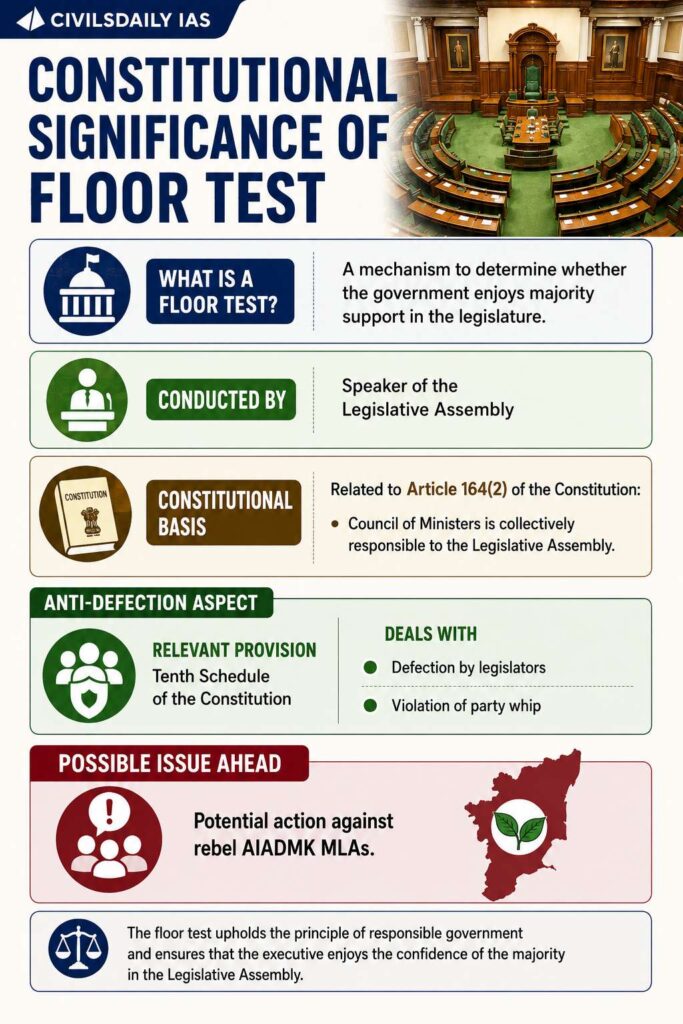
    Constitutional Significance of Floor Test

    • What is a Floor Test?: A mechanism to determine whether the government enjoys majority support in the legislature.
    • Conducted By: Speaker of the Legislative Assembly
    • Constitutional Basis: Related to Article 164(2) of the Constitution:
    • Council of Ministers is collectively responsible to the Legislative Assembly.

    Anti-Defection Aspect

    • Relevant Provision: Tenth Schedule of the Constitution
    • Deals With
      • Defection by legislators
      • Violation of party whip
    • Possible Issue Ahead
    • Potential action against rebel AIADMK MLAs.

    Note: In India, the office of the “whip” is not explicitly mentioned in the Constitution, the Rules of the House, or any parliamentary statute; rather, it is based on convention. However, the authority to issue whips and the consequences for defying them are legally upheld by the Tenth Schedule (Anti-Defection Law).

    [2020] A Parliamentary System of Government is one in which 
    a) All political parties in the Parliament are represented in the Government 
    b) the Government is responsible to the Parliament and can be removed by it 
    c) the Government is elected by the people and can be removed by them 
    d) the Government is chosen by the Parliament but cannot be removed by it before completion of a fixed term
  • “When does a CM cease to hold office? “

    Why in the News?

    The debate on the tenure and removal of a Chief Minister has re-entered public discourse after West Bengal Chief Minister Mamata Banerjee questioned the fairness of electoral processes following the BJP’s victory in the state. The controversy has revived critical constitutional questions: Can a Governor remove a Chief Minister? What does “pleasure of the Governor” actually mean? Is resignation mandatory after electoral defeat? The issue is significant because it directly concerns the balance between constitutional morality, democratic legitimacy, gubernatorial discretion, judicial review, and federalism.

    What Does “Pleasure of the Governor” Actually Mean Under Article 164?

    1. Article 164: Provides that the Chief Minister is appointed by the Governor and holds office during the Governor’s pleasure.
    2. Parliamentary System: Limits gubernatorial discretion because the Council of Ministers remains collectively responsible to the Legislative Assembly.
    3. Constitutional Convention: Ensures that the Governor acts on the aid and advice of the Council of Ministers in ordinary circumstances.
    4. Dr. B.R. Ambedkar’s Clarification: Stated in the Constituent Assembly that “pleasure” cannot be interpreted arbitrarily and survives only as long as the ministry enjoys Assembly confidence.
    5. Constitutional Morality: Prevents misuse of gubernatorial authority for partisan political intervention.
    6. Shamsher Singh v. State of Punjab (1974): Established that the Governor is only a constitutional head and ordinarily acts on ministerial advice.
    7. Nabam Rebia v. Deputy Speaker (2016): Restricted discretionary powers of Governors in legislative matters.

    Can a Governor Remove a Chief Minister Arbitrarily?

    1. Legislative Majority: Determines the continuance of the Chief Minister, not the subjective satisfaction of the Governor.
    2. Judicial Interpretation: Restricts arbitrary dismissal powers and strengthens parliamentary accountability.
    3. Floor Test Principle: Requires objective verification of majority support on the Assembly floor.
    4. S.R. Bommai Case (1994): Established that the majority must be tested in the House and not determined by the Governor’s personal assessment.
    5. Constitutional Safeguard: Prevents politically motivated dismissal of elected governments.
    6. Exceptional Situations: Permit Governor intervention only when no party demonstrates majority support or constitutional machinery collapses.

    Why Is the Floor Test Considered the Ultimate Constitutional Test?

    1. Democratic Legitimacy: Ensures that elected representatives determine the survival of the government.
    2. Collective Responsibility: Requires the Council of Ministers to retain Assembly confidence under Article 164(2).
    3. Judicial Preference: Recognizes floor tests as the most transparent mechanism for resolving majority disputes.
    4. Political Stability: Prevents horse-trading and speculative claims regarding majority support.
    5. Recent Examples: Floor tests were ordered in states such as Maharashtra, Karnataka, Madhya Pradesh, and Uttarakhand during political crises.
    6. Failure to Prove Majority: Compels resignation of the Chief Minister or dismissal of the ministry.

    Does a Chief Minister Automatically Cease to Hold Office After Electoral Defeat?

    A Chief Minister does not automatically cease to hold office the instant electoral results are declared. While the loss of majority makes resignation the standard constitutional convention, the incumbent typically transitions into a caretaker capacity until new arrangements are made, ensuring administrative continuity.

    1. Article 172: The Legislative Assembly normally continues for five years from the date of its first sitting, after which it stands dissolved by efflux of time.
    2. Majority Principle: A Chief Minister can continue only so long as they enjoy the confidence of the Legislative Assembly under Article 164(2).
    3. No Immediate Termination: The Chief Minister does not automatically cease to hold office on the day election results are declared or when the Assembly’s tenure expires.
    4. Caretaker Convention: The outgoing ministry continues in a caretaker capacity to ensure continuity of governance until a new government is formed.
    5. Loss of Mandate: Electoral defeat or loss of majority creates a constitutional expectation of resignation, though office does not terminate instantly.
    6. Governor’s Constitutional Role: If doubt exists regarding majority support, the Governor may require the Chief Minister to prove majority through a floor test.
    7. Dismissal of Ministry: The Governor may dismiss the Council of Ministers only when the Chief Minister refuses to resign despite clearly losing majority support and failing a floor test.

    Can Election Results and Electoral Processes Be Challenged in Court?

    Election results and electoral processes in India can be challenged in court, but strictly through a specific legal mechanism called an Election Petition.

    1. Representation of the People Act, 1951, Election Petition Mechanism: Under Article 329(b) of the Constitution and the Representation of the People Act (RPA), 1951, an election can only be questioned by an election petition.
      1. Who can file: Any candidate who contested the election or any elector (voter) from that specific constituency.
      2. Where to file: The petition must be filed in the High Court of the state where the constituency is located. For Presidential or Vice-Presidential elections, petitions are filed directly in the Supreme Court.
      3. Timeline: The petition must be submitted within a strict window of 45 days from the date of the result declaration.
    Article 329(b) of the Indian Constitution:It bars courts from interfering with electoral matters. It states that no election to Parliament or State Legislature can be challenged except through an election petition presented to the authorized body. It restricts judicial intervention during the election process, ensuring disputes are handled post-election.
    1. Grounds for Challenging Results: An election can be declared void by the High Court under Section 100 of the RPA, 1951, on several grounds, including:
      1. Corrupt Practices: Evidence of bribery, undue influence, or appealing to voters on the basis of religion, race, caste, or language.
      2. Nomination Issues: Improper acceptance or rejection of any nomination papers.
      3. Disqualification: The elected candidate was not qualified or was disqualified to take the seat on the date of the election.
      4. Procedural Non-compliance: Any non-compliance with the provisions of the Constitution or the RPA that materially affects the result
    2. Role of Judicial Review and Writ Jurisdiction: While Article 329(b) bars interference during the election process, courts maintain limited oversight through other avenues:
      1. Writ Petitions (Article 226/32): Courts may intervene via writ jurisdiction for broader integrity issues, such as arbitrary deletion of names from electoral rolls or administrative actions that disturb a “level playing field,” provided they do not stop the election process itself.
      2. Appeals: A High Court decision on an election petition can be appealed to the Supreme Court within 30 days

    What Happens if No Party Can Form a Stable Government?

    When no single party or pre-poll alliance secures a clear majority in a state election, the situation is known as a Hung Assembly. In such a scenario, the constitutional process follows several steps to explore options for government formation before resorting to fresh elections.

    1. The Governor’s Discretionary Role: The Governor acts as the “executive head” and must find a leader who can command the confidence of the Legislative Assembly. According to guidelines from Indian constitutional practice and the Sarkaria Commission, the Governor typically follows this order of preference:
      1. Pre-poll Alliance: The combination of parties that contested the election together.
      2. Single Largest Party: The party with the most seats, even if it lacks a majority on its own.
      3. Post-poll Coalition: A new alliance formed by parties after results are declared to reach the required numbers.
    2. Proving a Majority (Floor Test): The invited leader is appointed as Chief Minister and is usually given a specific timeframe (often around 10 days) to prove their majority through a Floor Test. If they fail to win this vote of confidence, the Governor may invite the next most viable claimant.
    3. President’s Rule (Article 356): If the Governor is satisfied that no party or coalition can form a stable government, they report a “failure of constitutional machinery” to the President. Under Article 356 of the Constitution, the President’s Rule is imposed:
      1. The State Government is suspended, and the Governor administers the state on behalf of the President.
      2. The Legislative Assembly is either suspended (kept in “animated suspension”) or dissolved.
    4. Fresh Elections: If the political deadlock cannot be resolved during the period of President’s Rule, the Governor, under Article 174(2)(b), dissolves the Assembly and calls for fresh elections. This allows the electorate to provide a new mandate.

    Conclusion

    The continuance of a Chief Minister depends fundamentally on majority support in the Legislative Assembly and not on the personal discretion of the Governor. Judicial interpretation, constitutional conventions, and parliamentary norms collectively ensure that democratic legitimacy prevails over arbitrary authority. The debate surrounding gubernatorial powers highlights the continuing need for constitutional morality, political neutrality, and institutional accountability within India’s federal parliamentary system.

    PYQ Relevance

    [UPSC 2022] Discuss the procedures to decide the disputes arising out of the election of a Member of the Parliament or State Legislature under The Representation of the People Act, 1951. What are the grounds on which the election of any returned candidate may be declared void? What remedy is available to the aggrieved party against the decision? Refer to the case laws.

    Linkage: The PYQ is directly linked to election petitions, Article 329(b), jurisdiction of High Courts, and judicial review of electoral disputes under the Representation of the People Act, 1951. It helps in understanding constitutional limits on court intervention during elections, electoral integrity, and landmark election case laws.

  • Resumption of Centre-Ladakh Talks (May 2026)

    Why in the News?

    Following a prolonged stalemate and violent unrest in 2025, the Ministry of Home Affairs (MHA) is set to resume formal talks with Ladakh’s civil society groups on May 22, 2026. This coincides with Union Home Minister Amit Shah’s visit to the region for the Buddha Purnima holy relics exposition.

    Core Demands of Ladakh (UPSC Focus)

    The dialogue involves two major socio-political groupings: the Leh Apex Body (LAB) and the Kargil Democratic Alliance (KDA). Their “Four-Point Agenda” includes:

    1. Statehood for Ladakh: Transition from a Union Territory (UT) to a full-fledged State.
    2. Sixth Schedule Inclusion: Granting constitutional safeguards under Article 244 to protect land, employment, and cultural identity.
    3. Exclusive Public Service Commission (PSC): A dedicated recruitment body for Ladakh to ensure local preference in government jobs.
    4. Enhanced Parliamentary Representation: Increasing the number of Lok Sabha seats from one to two (one each for Leh and Kargil).

    Significance of the Sixth Schedule

    The Sixth Schedule provides for the administration of tribal areas through Autonomous District Councils (ADCs).

    • Powers: ADCs have legislative, judicial, and administrative autonomy to make laws on land, forests, water, and social customs.
    • Current Status: Currently applies to tribal areas in four Northeastern states: Assam, Meghalaya, Tripura, and Mizoram (AMTM).
    • Ladakh’s Argument: Over 90% of Ladakh’s population is tribal, making it a fit candidate for these safeguards to prevent demographic changes and environmental degradation.
    [2015] The provisions in the Fifth Schedule and Sixth Schedule in the Constitution of India are made in order to: 
    (a) protect the interests of Scheduled Tribes 
    (b) determine the boundaries between States 
    (c) determine the powers, authority and responsibilities of Panchayats 
    (d) protect the interests of all border States
  • [25th April 2026] The Hindu OpED: The crisis of urban electoral disenfranchisement

    PYQ Relevance[UPSC 2024] Examine the need for electoral reforms as suggested by various committees with particular reference to ‘one nation-one election’ principleLinkage: This question directly links to electoral roll integrity, voter inclusion, and institutional reforms, which are central to the issue of urban disenfranchisement. The article provides contemporary evidence (mass deletions, SIR flaws) that strengthens answers on why electoral reforms are urgently needed in India’s democracy

    Mentor’s Comment

    There is a deepening crisis of urban electoral disenfranchisement in India. This has been triggered by the recent Special Intensive Revision (SIR) of electoral rolls, where mass deletions of voters, especially urban poor, migrants, and informal workers, have come to light. This is significant because it marks a shift from inclusion (universal adult franchise) to exclusion through bureaucratic processes, The scale is alarming, Patna saw 16.5 lakh deletions, Ghaziabad ~36.67%, Lucknow ~30.88%, and Mumbai ~14 lakh deletions with 50% from informal housing, indicating a systemic pattern rather than isolated errors.

    Why is universal adult franchise weakening in urban India?

    1. Systematic disenfranchisement: Urban voters increasingly excluded through SIR processes; reflects erosion of the constitutional promise of “one person, one vote.”
    2. Urban marginalisation: Poor, migrants, minorities face structural exclusion; example, large-scale deletions in cities like Patna, Lucknow, Ghaziabad.
    3. Demographic mismatch: Rapid urban population growth not matched by electoral inclusion; table shows low voter ratios despite rising population.

    How does the SIR process contribute to exclusion?

    1. Bureaucratic enumeration: Relies on documentation and verification; excludes those lacking stable residence proof.
    2. Limited outreach: Focuses on verification over registration; discourages new voter inclusion.
    3. Data evidence: Patna (16.5 lakh deletions), Ghaziabad (36.67%), Mumbai (14 lakh deletions) indicate systemic filtering.

    Why are migrants and the urban poor disproportionately affected?

    1. High mobility: Migrants frequently change residences; fail documentation requirements.
    2. Informal settlements: ~40% of urban population lives in slums; lack formal address proof.
    3. Dual burden: Unable to register + higher probability of deletion; example, Kolkata (25.62% deletions in unorganised workers).

    Does electoral secrecy face new challenges in urban settings?

    1. Booth-level disclosure risk: Small booth sizes enable inference of voting patterns.
    2. Technological vulnerability: Electronic voting systems may reveal demographic voting trends.
    3. Urban concentration: Tight clusters make secrecy harder compared to dispersed rural booths.

    Is there evidence of selective filtration in electoral rolls?

    1. Selective exclusion: Groups perceived as politically inconvenient may be filtered out.
    2. Documentation bias: Rigid criteria disproportionately impact working-class populations.
    3. Case evidence: Lucknow (30.88%), Ghaziabad (36.67%) deletions linked to migrant workforce mobility.

    How does urbanisation intensify electoral challenges?

    1. Migration-driven growth: Continuous inflow disrupts stable voter registration systems.
    2. Administrative lag: Electoral systems based on static populations fail dynamic urban contexts.
    3. Comparative gap: Rural areas show relatively stable rolls vs volatile urban deletions.

    Conclusion

    Urban electoral disenfranchisement represents a structural contradiction between constitutional ideals and administrative practices. If left unaddressed, it risks weakening democratic legitimacy, particularly in rapidly urbanising India. Electoral reforms must shift from documentation-centric exclusion to inclusion-oriented governance, ensuring that mobility does not become a ground for loss of citizenship rights.

  • Delimitation: At heart of row, value of a vote, fiscal imbalance

    Why in the News?

    India is approaching the first delimitation exercise after 2026, ending a freeze in place since the 1970s, making it a politically explosive issue. The debate has intensified because projections show northern states gaining up to +42 seats while southern states lose a similar number, raising fears of vote inequality and regional political imbalance. The core concern is that population-based representation may penalize states that successfully controlled population growth, fundamentally challenging the constitutional principle of “one person, one vote, one value.”

    What is delimitation?

    1. Delimitation is the process of updating Lok Sabha and state assembly constituencies and reallocating seat numbers based on population shifts to ensure fair representation, often termed “one vote one value”. 
    2. The Delimitation Commission is a powerful statutory body whose decisions are final and cannot be challenged in court. 84th Amendment Act, 2001 froze seat allocations based on the 1971 census until 2026 to promote family planning
    3. Article 82 of the Constitution mandates this exercise, with the next one due after the first census following 2026.

    Why was delimitation frozen and what was its rationale?

    Delimitation was frozen to prevent penalizing states that successfully implemented family planning, ensuring they did not lose political representation compared to faster-growing states. The 42nd Amendment (1976) locked seat allocations based on the 1971 Census until 2001, later extended by the 84th Amendment (2002) until 2026 to ensure political and administrative stability.

    1. Population Control Incentive: Ensured that states implementing family planning were not penalized; example: southern states reduced fertility significantly.
    2. 1976 Constitutional Amendment: Fixed seat allocation based on the 1971 Census for 25 years.
      1. Passed during the Emergency, the 42nd Amendment halted the reapportionment of seats to keep the political landscape stable and focus on population management policies rather than immediate, unequal representation changes.
    3. Extension till 2026: Freeze extended to avoid penalizing demographic transitions.
    4. Administrative Stability: Frequent restructuring of constituencies every ten years was seen as disruptive, and freezing the numbers brought continuity to the parliamentary and assembly structures.

    What are the projected changes in seat distribution post-2026?

    1. Northern Gains: Uttar Pradesh (+12), Bihar (+10), Rajasthan (+7) due to higher population growth.
    2. Southern Losses: Tamil Nadu (-10), Kerala (-7), Andhra Pradesh (-5).
    3. Total Shift: Approximately +42 seats to high-growth states; -42 to low-growth states.
    4. Representation Imbalance: Bihar MP represents ~3.1 million vs Kerala MP ~1.75 million.

    How does delimitation affect the principle of ‘one person, one vote’?

    1. Unequal Vote Value (Larger vs. Smaller Constituencies) Larger constituencies dilute voter influence in populous states.
      1. The Issue: When constituencies are not redrawn frequently, population shifts (e.g., migration to cities) mean that some constituencies become far more populous than others. A voter in a densely populated constituency has less “vote weight” than one in a thinly populated area.
      2. Urbanization Penalty: Rapidly growing urban areas (e.g., Pune, Surat) often become underrepresented because their expansion outpaces the creation of new seats, causing urban disenfranchisement. 
    2. Constitutional Concern: Violates principle of equal representation.
      1. The Constraint: The Indian Constitution mandates that the ratio of population to seats should be similar across all states, as far as practicable (Articles 81 & 170).
      2. The Problem: A pure population-based delimitation risks abandoning the federal principle of equitable state representation. If seats are redistributed purely by population, states that controlled their population (e.g., Southern states) would lose influence, while those with higher growth gain seats, leading to a “tyranny of numbers“.
      3. Silent Gerrymandering“: Critics argue that changing the total seat share of states (rather than just drawing internal boundaries) acts as a form of “silent gerrymandering” that favors the ruling party’s strongholds rather than just reflecting demographic changes
    3. Malapportionment: Disparity in Seat Share: Disparity between population share and seat share.
      1. Passive Malapportionment: When delimitation is frozen or delayed (as it was in India from 1976 to 2008), malapportionment increases. This means seat shares no longer match population shares.
      2. Federal Imbalance: A purely population-based exercise can lead to high-population states gaining a disproportionate share of total seats. This reduces the federal voice of smaller or more developed states in the Lok Sabha.
    4. Democratic Distortion: Vote weight differs significantly across regions.
      1. Diminished Representation: When delimitation is not done, an increasing population is represented by a single representative, making the MP less accessible and effective. (e.g., average population per MP rose from 7.32 lakh in 1951 to over 27 lakh by 2024).
      2. Communal and Political Manipulation: Delimitation can be used for political gain, where boundaries are deliberately redrawn to isolate or concentrate opposition votes, distorting the democratic outcome.

    Why is fiscal federalism central to the debate?

    Fiscal federalism is central to the Indian delimitation debate because the reallocation of Parliamentary seats based on current population data will directly alter the political power required to control the national purse strings, causing a perceived “double penalty” on wealthier southern states.

    1. Revenue Contribution Gap: Wealthier Southern States: Wealthier southern states generate more taxes.
      1. Economic Engines: States like Tamil Nadu, Kerala, Karnataka, Andhra Pradesh, and Telangana have significantly lower fertility rates and higher per capita incomes. They contribute a substantial share (approximately 35% of national GDP with only 18% of the population) to the national tax pool.
      2. The Fear: These states fear that their economic productivity will be undermined if they lose their voice in Parliament, reducing their ability to protect their tax revenues from being heavily diverted to other regions. 
    2. Redistribution Mechanism: Demographic Disadvantage: Central transfers based on population disadvantage these states.
      1. Finance Commission Formula: The Finance Commission (FC) transfers tax revenues to states based on a formula that weighs population (need) and income distance (relative poverty).
      2. The Disadvantage: If delimitation results in higher population weights in Parliament, the “need-based” redistribution formula will likely heavily favour high-population northern states, reducing the share of southern states.
      3. Cess and Surcharge: States already complain that the Centre uses non-sharable cesses and surcharges to hold more funds. A new, northern-dominated Parliament might increase this centralization, reducing the share of taxes for the South. 
    3. Double Penalty (Seats and Funds): Lose both financial share and political power.
      1. Loss of Financial Share: A reduced number of MPs in the Lok Sabha means less bargaining power in the GST Council and Finance Commission negotiations.
      2. The Penalty: The southern states fear they will lose both political representation (power to influence laws) and economic share (funds), creating a “second-class citizenship” scenario. 
    4. Horizontal Imbalance: Poorer States Gain Power and Funds: Poorer states gain both seats and fiscal transfers.
      1. Transfer Shift: The core of fiscal federalism is that wealthier states subsidize poorer ones. Delimitation accelerates this by shifting both seat share (political power) and financial allocation (fiscal transfer) towards states that failed to implement effective family planning, thereby reversing the incentives of “good governance”.

    What are the structural causes behind regional disparities?

    1. Uneven Economic Growth: Rich states grow faster than poorer states.
    2. Fertility Divergence: Lower fertility in developed states leads to slower population growth.
    3. Human Capital Differences: Education and health outcomes vary significantly.
    4. Policy Success Paradox: Successful states face reduced representation.

    What are the political and governance implications?

    1. Shift in Power Centre: Greater influence of northern states in Parliament.
    2. Policy Priorities Shift: National policies may reflect interests of high-population states.
    3. Federal Tensions: Increased friction between Union and southern states.
    4. Coalition Politics Impact: Changes electoral arithmetic and alliances.

    What reforms are being suggested?

    1. Revisiting Fiscal Federalism: Align financial transfers with efficiency and contribution.
    2. Weighted Representation Models: Balance population with development indicators.
    3. Rajya Sabha Strengthening: Ensure states retain influence irrespective of population.
    4. Constitutional Reforms: Reinterpret equality beyond strict population basis.

    Conclusion

    Delimitation after 2026 presents a constitutional dilemma between democratic equality and federal fairness. A purely population-based approach risks rewarding demographic expansion while penalizing governance success. Reforming fiscal and political frameworks is essential to maintain balanced federalism and democratic legitimacy.

    PYQ Relevance

    [UPSC 2024] What changes has the Union Government recently introduced in the domain of Centre-State relations? Suggest measures to be adopted to build trust between Centre and States and strengthen federalism.

    Linkage: The PYQ is directly linked to delimitation debate impacting federal balance and political representation of states. It tests understanding of cooperative federalism, fiscal federalism, and regional equity concerns emerging from population-based seat redistribution.

  • Ghose Commission & Telangana HC Verdict  

    Why in the News? 

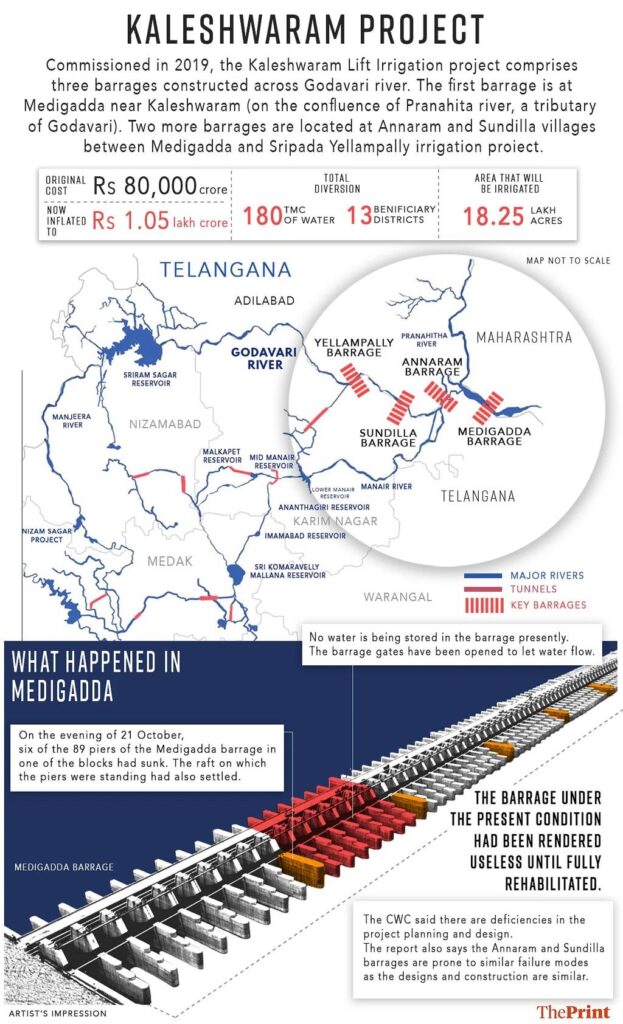
    • The Telangana High Court ruled that the Ghose Commission report on the Kaleshwaram project will be “inoperative”, and no action can be taken against former CM K. Chandrashekar Rao and others.

    Background

    • The Telangana government constituted a Commission of Inquiry in 2024:
      • Headed by Justice P. C. Ghose
    • Purpose: Probe alleged irregularities in: Kaleshwaram Lift Irrigation Scheme

    About Kaleshwaram Project (KLIS)

    • One of the largest lift irrigation projects in India
    • Built on: Godavari River
    • Key barrages:
      • Medigadda
      • Annaram
      • Sundilla
    [2022] Consider the following pairs:
    Reservoirs: States 
    1. Ghataprabha: Telangana 
    2. Ghandhi Sagar: Madhya Pradesh 
    3. Indira Sagar: Andhra Pradesh 
    4. Maithon: Chhattisgarh 
    How many pairs given above ate not correctly matched? 
    [A] Only one pair [B] Only two pair [C] Only three pair [D] All four pair
  • Delimitation Using Old Census Data — Supreme Court View 

    Why in the News?

    • The Supreme Court of India cautioned that conducting delimitation before Census post-2026 could disturb the constitutional electoral framework.

    Core Issue

    • Whether delimitation can be done using old Census data (pre-2026)
    • Petition demanded parity with Jammu & Kashmir delimitation (2022)

    Supreme Court’s Key Observations

    1. Constitutional Timeline Must Be Followed

    • Delimitation cannot be done until:
      • First Census after 2026 is published
      • Based on: Article 82 (Lok Sabha) and Article 170 (State Assemblies)

    2. Risk to Electoral Framework

    • Using old data may:
      • Destabilize uniform electoral system
      • Disturb fair representation
      • Blur line between: Constitutional mandate and Political discretion

    3. Equality Principle (Article 14)

    • Selective delimitation (only some States) would: Violate Article 14
    • All States must be treated equally

    Court’s Decision

    • Rejected plea for delimitation in: Andhra Pradesh and Telangana
    • Reason: Violates constitutional embargo
    • In India, there is a constitutional embargo on delimitation:
    • Under:
      • Article 82
      • Article 170
    • It states that: No readjustment of seats can be done until:
      • First Census after 2026 is published
    • This is the constitutional embargo referred to by the Supreme Court.

    Judicial Review of Delimitation

    • General Rule: Courts have limited power to review delimitation
    • Exception: Court can intervene if:
      • Arbitrary
      • Unreasonable
      • Violates constitutional values
    • Reinforced in: Kishorchandra Chhanganlal Rathod case

    Important Case Reference

    • Indira Nehru Gandhi vs Raj Narain
      • Parliament responsible for: Free & fair elections and Delimitation laws

    Current Relevance

    • Important due to: Proposed Constitution (131st Amendment) Bill, 2026
      • Debate on: Using 2011 Census for delimitation
    [2023] With reference to the Delimitation Commission, consider the following statements: 
    1 The orders of the Delimitation Commission cannot be challenged in a Court of Law. 
    2 When the orders of the Delimitation Commission are laid before the Lok Sabha or State 
    3 Legislative Assembly, they cannot effect any modifications in the orders. 
    Which of the statements given above is/are correct? 
    (a) 1 only (b) 2 only (c) Both 1 and 2 (d) Neither 1 nor 2
  • [10th April 2026] The Hindu OpED: Have elections in India become plutocratic?

    PYQ Relevance[UPSC 2024] Examine the need for electoral reforms as suggested by various committees with particular reference to ‘one nation-one election’ principle.Linkage: The PYQ directly connects to systemic flaws in electoral processes, including rising costs and inefficiencies. It links with the need for financial transparency and reducing excessive campaign expenditure.

    Mentor’s Comment

    Plutocracy refers to a system where political power is effectively controlled by the wealthy, either directly or through influence over decision-making. Plutocratic Elections describes a situation where money, rather than merit, ideology, or public support, becomes the decisive factor in electoral outcomes. India’s electoral system operates under strict legal expenditure limits imposed by the Election Commission, yet actual campaign spending often exceeds these limits by several multiples. This divergence reflects systemic opacity in political financing, weak enforcement mechanisms, and evolving campaign practices. This further raises concerns about the credibility and fairness of elections in the world’s largest democracy.

    Why do official election expenditure limits fail to reflect ground realities?

    1. Legal Ceiling Constraint: Imposes strict caps on candidate spending but excludes party and third-party expenditures, creating systemic loopholes. The Legal Ceilings on Election Expenditure are as follows:
      1. Statutory Basis: Governed under the Representation of the People Act, 1951 (Sections 77 & 78) and prescribed by the Election Commission of India (ECI).
      2. Lok Sabha Elections: ₹95 lakh (larger states) / ₹75 lakh (smaller states & UTs) per candidate. State Assembly Elections: ₹40 lakh (larger states) / ₹28 lakh (smaller states) per candidate.
      3. Scope Limitation: Applies only to individual candidates, not to political parties.
      4. Exclusions (Core Loophole): Party expenditure, star campaigners’ costs, media campaigns, and third-party spending are excluded from candidate limits (as per RPA provisions).
      5. Monitoring Mechanism: Candidates must maintain a day-to-day expenditure register and submit accounts within 30 days of result declaration; non-compliance leads to disqualification under Section 10A
    2. Underreporting Incentives: Encourages candidates to show minimal official expenditure to avoid disqualification risks.
    3. Cash-Based Campaigning: Enables unaccounted spending through informal cash transactions, especially in voter mobilization.
    4. Weak Audit Mechanisms: Limits post-election verification due to lack of forensic auditing and real-time scrutiny.
    5. Third-Party Spending: Allows supporters, contractors, and local networks to incur expenses outside official candidate accounts.

    How does opaque political funding distort democratic competition?

    1. Unequal Playing Field: Advantages resource-rich candidates, marginalizing smaller parties and independents.
    2. Policy Capture Risk: Strengthens influence of corporate donors over policy priorities and governance decisions.
    3. Vote Buying Potential: Facilitates inducements such as cash distribution, gifts, and welfare targeting during elections.
    4. Reduced Electoral Credibility: Weakens public trust in fairness and legitimacy of election outcomes.
    5. Barrier to Entry: Discourages capable but financially weaker candidates from contesting elections.

    What are the institutional limitations of election monitoring mechanisms? (Corrected & Aligned)

    1. Limited Statutory Powers: Constrains the Election Commission of India to act primarily within RPA provisions, restricting independent investigation into unaccounted or third-party expenditures.
    2. Candidate-Centric Legal Framework: Limits regulation to individual candidates, while political parties remain outside expenditure ceilings, weakening institutional oversight.
    3. Fragmented Institutional Architecture: Disperses responsibilities across ECI, Income Tax Department, Enforcement Directorate, leading to weak coordination and accountability gaps.
    4. Reactive Monitoring Design: Structures oversight around post-facto scrutiny of submitted accounts, rather than proactive, continuous financial surveillance.
    5. Inadequate Transparency Mandate: Lacks compulsory real-time disclosure mechanisms for political funding, reducing institutional capacity to detect violations.
    6. Weak Deterrence Framework: Provides limited and delayed penalties (e.g., disqualification), which fail to create strong institutional deterrence against overspending

    How has the scale of election spending evolved in India?

    1. Rising Campaign Costs: Reflects increasing expenditure on media, advertising, and voter outreach strategies.
    2. 2014 Elections Benchmark: Estimated spending crossed ₹30,000 crore collectively by parties and candidates.
    3. 2019 Elections Expansion: Considered among the most expensive globally, with estimates exceeding ₹60,000 crore.
    4. Digital Campaign Surge: Increased reliance on social media, data analytics, and targeted political advertising.
    5. Logistical Intensification: Higher spending on rallies, transportation, booth management, and grassroots mobilization.

    What reforms are necessary to enhance transparency and accountability?

    1. Comprehensive Disclosure Norms: Mandates reporting of all candidate, party, and third-party expenditures.
    2. State Funding of Elections: Reduces dependence on private and corporate financing sources.
    3. Real-Time Expenditure Tracking: Introduces digital platforms for monitoring campaign spending continuously.
    4. Stronger Audit Framework: Establishes independent bodies for forensic auditing of political finances.
    5. Legal Reforms: Expands scope of Representation of the People Act to cover entire ecosystem of election funding. 

    Conclusion

    The divergence between declared and actual election expenditure reflects a structural flaw in India’s democratic framework. Addressing this requires systemic reforms in political finance, enhanced institutional capacity, and greater transparency, ensuring that elections remain free, fair, and credible.